Have you ever paused while writing because you couldn’t decide between striping vs. stripping? You’re not alone. These two words look almost identical, but that extra letter “p” changes their spelling and meaning.
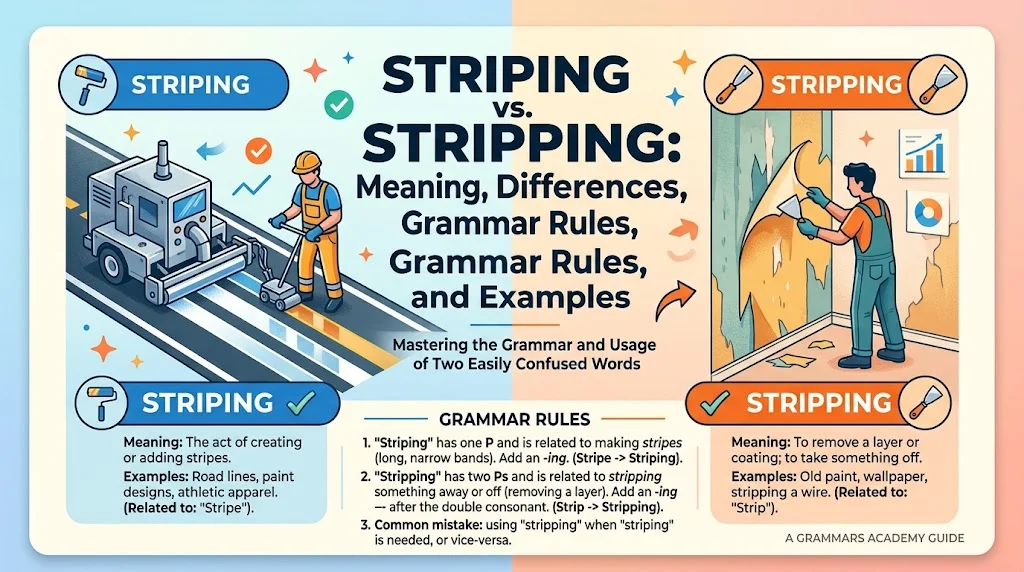
The difference becomes easier to understand when you look at the root words. Striping comes from stripe and usually means adding lines, bands, or patterns to a surface. Stripping comes from strip and generally means removing something, such as paint, insulation, clothing, or a protective layer.
Although both words follow standard English grammar rules, writers often mix them up in workplace documents, construction instructions, and everyday messages. A single letter can change the meaning of a sentence completely.
This guide explains the difference between striping and stripping, including their definitions, spelling rules, grammatical uses, and practical examples. You’ll also learn how professionals use these words in road maintenance, manufacturing, construction, and design.
By the end, you’ll know which spelling fits your sentence and how to avoid this common mistake.
Striping vs. Stripping: Quick Answer
The main difference between striping and stripping is what happens to the object or surface.
- Striping means adding stripes, lines, or patterned markings to something.
- Stripping means removing something from an object or surface.
- Striping comes from the noun and verb stripe.
- Stripping comes from the verb strip.
- Stripe becomes striping by dropping the final e and adding -ing.
- Strip becomes stripping by doubling the final p before adding -ing.
Here are two simple examples:
- The crew is striping the parking lot to mark individual spaces.
- The crew is stripping the old paint from the parking lot’s metal gate.
In the first sentence, workers add visible lines. In the second, they remove an existing coating.
| Feature | Striping | Stripping |
| Root word | Stripe | Strip |
| Basic meaning | Adding stripes or markings | Removing something |
| Spelling rule | Drop the final e and add -ing | Double the final p and add -ing |
| Common example | Striping a parking lot | Stripping paint from a door |
| Typical purpose | Marking or decorating | Cleaning, removing, or exposing |
| Example phrase | Road striping | Paint stripping |
Easy rule to remember: If you’re adding stripes, use striping. If you’re removing something, use stripping.
What Does Striping Mean?
Word form: stripe + ing → striping
Definition of Striping
Striping means applying stripes, lines, bands, or similar markings to a surface. These markings may serve a practical purpose, improve appearance, or help people identify different areas.
For example, road crews use striping to create lane boundaries, pedestrian crossings, and directional markings. Parking lot contractors paint lines to separate parking spaces and guide drivers.
Designers also use striping to add visual patterns to clothing, furniture, walls, and other products.
The exact meaning depends on the context, but the central idea remains the same: striping usually involves creating or applying stripes rather than removing material.
Consider these examples:
- The maintenance team finished striping the school parking lot.
- The designer added blue-and-white striping to the uniform.
- Road striping helps drivers recognize lane boundaries.
- The manufacturer uses decorative striping on the product’s outer surface.
In each sentence, striping refers to lines or bands that appear on an object or surface.
Common Uses of Striping in Everyday English
The word striping appears in several fields. Although the details differ, each use involves stripes or line-like markings.
Common applications include:
- Road maintenance: Applying lane lines, centerlines, and pedestrian-crossing markings.
- Parking lots: Marking parking spaces, accessible spaces, traffic arrows, and loading zones.
- Fashion: Adding striped patterns to shirts, dresses, jackets, and uniforms.
- Automotive design: Applying decorative stripes to vehicle bodies.
- Manufacturing: Adding identifying bands or visual markings to products.
- Sports facilities: Marking playing areas, courts, and other designated zones.
Striping doesn’t always involve paint. Depending on the material and application, workers may use tape, reflective materials, printed patterns, or other marking methods.
For instance, a clothing manufacturer can create striping by weaving different-colored threads into fabric. A road contractor, on the other hand, might use specialized marking paint or thermoplastic material.
The technique changes, but the meaning stays connected to stripes.
Striping in Road Markings and Parking Lots
Road and parking lot striping is one of the most familiar uses of the word.
5
On roads, striping helps organize traffic by showing drivers where lanes begin and end. Markings can also indicate turn lanes, stop lines, crosswalks, and restrictions on vehicle movement.
In parking lots, striping defines individual spaces and helps organize traffic flow. Clear markings can make a lot easier to navigate and help drivers identify designated parking areas.
For example:
- The contractor completed the parking lot striping before the store opened.
- Faded road striping can make lane boundaries harder to see.
- The city scheduled highway striping after resurfacing the road.
Notice the difference between striping and painting. Painting is a broader term for applying paint, while striping specifically involves creating stripes or lines.
Road striping can also involve more than appearance. The markings may communicate traffic rules, guide road users, and support safer movement when properly designed and maintained.
Striping in Fashion, Design, and Manufacturing
Striping also describes patterns that appear on clothing, vehicles, furniture, and manufactured goods.
A shirt with alternating horizontal bands has striped fabric. A racing car with contrasting lines along its body may feature decorative striping. A product might use colored bands to distinguish different versions or indicate specific features.
Here are some examples:
- The tailor added gold striping to the jacket sleeves.
- The designer chose diagonal striping for the fabric.
- The motorcycle features red striping along its fuel tank.
- The factory inspected the decorative striping on every finished unit.
In manufacturing, the word can describe either a decorative feature or a functional marking. The context tells you which meaning applies.
For example, a manufacturer might add colored stripes to distinguish cables or identify components. In that case, striping serves a practical identification purpose rather than simply improving appearance.
Examples of Striping in Sentences
The following sentences show how to use striping naturally.
- The road crew began striping the highway after the repairs.
- Fresh striping made the parking spaces easier to identify.
- The designer chose black-and-white striping for the new collection.
- The mechanic applied decorative striping to the motorcycle.
- The school repainted the court markings during the summer break.
- The factory checks the striping on each product before shipment.
- The faded striping on the road needed to be refreshed.
- The company specializes in commercial parking lot striping.
Writing tip: When your sentence describes applying or displaying stripes, striping is usually the correct choice.
What Does Stripping Mean?
Word form: strip + ing → stripping
Definition of Stripping
Stripping means removing something from an object, person, or surface. The removed material might be paint, insulation, a protective coating, a covering, or another layer.
The word can describe physical actions as well as certain technical processes. For example, a worker might strip paint from a wooden door, an electrician might strip insulation from a wire, or a technician might strip unwanted components from a material.
Unlike striping, which commonly involves adding visible lines, stripping focuses on taking something away.
Consider these examples:
- The carpenter is stripping the old paint from the cabinet.
- The electrician is stripping the insulation from the wire.
- The restoration team is stripping wallpaper from the walls.
- The technician is stripping unwanted material from the component.
Each sentence describes removal rather than the application of stripes.
The term can also appear in specialized contexts. In manufacturing, for instance, stripping may involve separating a finished product from a mold. In data processing, it can mean removing unwanted characters from text.
The shared idea is that something is taken off, separated, or removed.
Common Uses of Stripping in Everyday English
Stripping appears in several industries and ordinary situations.
- Home improvement: Removing paint, wallpaper, varnish, or old finishes.
- Electrical work: Removing insulation from the end of a wire before connecting it.
- Construction: Removing flooring, coatings, or temporary forms.
- Manufacturing: Separating a product from a mold or removing unwanted material.
- Cleaning and restoration: Taking off old finishes before applying new treatments.
- Text processing: Removing unwanted spaces, symbols, or characters from a string.
- Automotive repair: Removing paint or coatings from vehicle parts.
The intended meaning depends on what is being removed and how the process works.
For example, stripping a wire generally means removing some of its insulation. It doesn’t mean taking all the insulation off the entire wire. Often, an electrician removes insulation only from the end to prepare the conductor for a connection.
Likewise, stripping a wooden surface usually means removing an existing finish to prepare the material for refinishing.
Stripping Paint, Wires, and Other Materials
4
Two particularly common uses of stripping involve paint removal and electrical work.
Paint stripping removes paint or another finish from a surface. Depending on the material and project, a person may use a scraper, sanding equipment, heat, or an appropriate chemical paint remover.
The goal is to remove an existing coating, not to add decorative lines.
Examples:
- The restoration specialist is stripping the paint from the antique door.
- We hired a professional to handle the old paint removal.
- The crew finished stripping the damaged coating from the metal railing.
Wire stripping has a different purpose. An electrician removes a small section of insulation to expose the conductive metal underneath.
Examples:
- The electrician is stripping the wire before making the connection.
- Use the correct tool for stripping the insulation.
- The technician carefully stripped the cable ends during installation.
These examples show why context matters. The materials and methods differ, but the word still refers to removal.
Stripping in Construction and Manufacturing
In construction, stripping can refer to several different operations. Workers might remove a coating from concrete, take up old flooring, or remove temporary formwork after concrete has gained sufficient strength.
The precise meaning depends on the construction process.
For example, stripping formwork means removing the temporary molds or supports used to shape concrete. The timing depends on factors such as concrete strength, structural requirements, and project specifications.
In manufacturing, stripping can describe removing a molded product from its mold or taking unwanted layers off a component. Some processes also involve removing insulation, surface treatments, or excess material.
Examples include:
- The contractor began stripping the old flooring before installing the replacement.
- The crew removed the formwork after the concrete reached the required strength.
- The technician is stripping the coating from the metal component.
- The operator completed the mold-stripping process according to the production procedure.
Important distinction: Stripping doesn’t always mean scraping something away. It can involve pulling, separating, dissolving, or otherwise removing a material or component.
Examples of Stripping in Sentences
Here are additional examples showing how stripping works in everyday and professional writing.
- The painter spent the afternoon stripping the old finish from the table.
- The electrician is stripping the insulation from the cable.
- The renovation team started stripping wallpaper from the bedroom.
- The factory uses a specialized process for stripping unwanted coatings.
- The contractor completed the floor-stripping work before installation.
- The software removes extra spaces by stripping whitespace from the text.
- The restoration company is stripping several layers of paint from the door.
- The technician inspected the wire after stripping its insulation.
When the main action involves removal, stripping is generally the word you need.
Read More: As Well or Aswell – Which One Is Correct?
Striping vs. Stripping: Key Differences
Although the words look similar, their meanings and spelling rules are different. Understanding their root words makes the distinction easier to remember.
Meaning and Definition
Striping relates to stripes, lines, or bands. Stripping relates to removing something.
Compare these sentences:
- The workers are striping the parking lot. They are adding painted lines.
- The workers are stripping the parking lot surface. They are removing an existing coating or layer.
The second sentence requires context because a parking lot surface can undergo several kinds of removal work. However, the meaning of stripping remains removal.
Spelling and Pronunciation
The difference between the words is visible in their spelling:
- Striping: S-T-R-I-P-I-N-G
- Stripping: S-T-R-I-P-P-I-N-G
Both words contain the same basic sounds in many common American English pronunciations, but the spelling reflects different root words and spelling rules.
The single “p” in striping belongs to the root stripe. The double “p” in stripping comes from the root strip.
Root Words: Stripe vs. Strip
The simplest way to understand the difference is to remove the -ing ending mentally.
Stripe → Striping
A stripe is a long, narrow band or line. As a verb, stripe means to mark or decorate something with stripes.
Example: The artist will stripe the helmet with silver paint.
Strip → Stripping
The verb strip means to remove something, take something off, or clear away a layer.
Example: The artist will strip the old paint from the helmet.
These verbs describe different actions, so their -ing forms also have different meanings.
When to Use Striping
Use striping when you mean adding stripes, creating bands, or applying line-based markings.
Common phrases include:
- Road striping
- Parking lot striping
- Decorative striping
- Vehicle striping
- Uniform striping
- Court striping
Example: The school hired a contractor for basketball court striping.
Here, the contractor will apply the lines that define the playing area.
When to Use Stripping
Use stripping when you mean removing a layer, covering, coating, or other material.
Common phrases include:
- Paint stripping
- Wire stripping
- Wallpaper stripping
- Floor stripping
- Coating stripping
- Formwork stripping
Example: The renovation crew began stripping the old paint before refinishing the doors.
Here, the crew removes an existing finish rather than adding stripes.
Striping vs. Stripping: Side-by-Side Comparison
The table below summarizes the key differences.
| Feature | Striping | Stripping |
| Root word | Stripe | Strip |
| Meaning | Adding stripes or markings | Removing something |
| Main action | Applying or creating lines | Taking away or separating |
| Spelling change | Drop final e | Double final p |
| Roadwork example | Painting lane markings | Removing an old surface coating |
| Home improvement | Adding decorative wall stripes | Removing old wallpaper |
| Electrical work | Applying identifying stripes to a cable | Removing wire insulation |
| Design | Adding bands to clothing | Removing an unwanted finish |
| Example sentence | The crew is striping the road. | The crew is stripping the paint. |
How Context Helps You Choose
Sometimes, the word alone doesn’t tell you everything. The surrounding words help clarify the intended action.
Consider the phrase wire striping. It may refer to applying colored stripes to a wire for identification.
By contrast, wire stripping usually refers to removing insulation from a wire.
Both expressions can appear in electrical work, but they describe different operations.
The same distinction applies to paint:
- Paint striping can describe applying striped paint patterns.
- Paint stripping describes removing paint.
When you’re unsure, ask yourself one simple question: Is something being marked with stripes, or is something being removed?
That question resolves most everyday cases.
Why Do People Confuse Striping and Stripping?

The confusion usually comes from the words’ similar appearance. Both begin with strip- and end with -ing. Only one letter separates their spellings, yet their meanings differ.
The One-Letter Spelling Difference
Look at these two words:
- Striping
- Stripping
The extra “p” in stripping often causes mistakes when people write quickly. Writers may remember the sound of the word but forget which root word it comes from.
This mistake can happen in emails, work orders, product descriptions, invoices, and maintenance instructions.
For example:
Incorrect: The contractor finished stripping the parking spaces.
Correct: The contractor finished striping the parking spaces.
The corrected sentence makes sense when the contractor has painted the parking-space lines. If the contractor removed existing markings or a coating, however, stripping could be appropriate.
The surrounding context matters as much as the spelling.
How the Final E Changes When Adding -ing
English spelling rules explain why stripe becomes striping.
When a verb ends in a silent e, writers generally drop that letter before adding -ing.
Examples include:
| Root verb | Correct -ing form |
| Stripe | Striping |
| Make | Making |
| Write | Writing |
| Drive | Driving |
| Bake | Baking |
The final e disappears, but the remaining letters preserve the connection to the original word.
Therefore, stripe + ing becomes striping, not stripeing.
Why Doubling the Final Consonant Matters
The verb strip follows a different spelling pattern.
For many short verbs ending in a single consonant preceded by a single vowel, English doubles the final consonant before adding -ing. This commonly applies when the final syllable carries the stress, as in run → running.
Examples include:
| Root verb | Correct -ing form |
| Strip | Stripping |
| Run | Running |
| Sit | Sitting |
| Plan | Planning |
| Stop | Stopping |
Because strip follows this pattern, the correct form is stripping, with two “p” letters.
Writing striping when you mean removing something changes the word rather than simply introducing a minor spelling variation.
How Context Determines the Correct Word
Context can reveal the intended meaning even when a sentence contains few details.
Compare these examples:
- The company is striping the warehouse floor. The workers are adding lines or markings.
- The company is stripping the warehouse floor. The workers are removing a layer or finish.
The first sentence describes marking a surface. The second describes removing material.
When the sentence is ambiguous, add a detail that explains the action.
For example, instead of writing “The crew is working on the floor,” write “The crew is striping the floor to mark storage zones.”
Specific wording improves clarity and reduces misunderstandings.
Grammar Rules for Striping and Stripping
Both words are grammatically correct. The difference comes from their root verbs and the actions they describe.
How to Form Striping from Stripe
The verb stripe means to mark something with stripes. To form its present participle or gerund, remove the final e and add -ing.
The spelling process is straightforward:
Stripe → Strip → Striping
The intermediate form isn’t a separate spelling step in ordinary writing. It simply helps illustrate that the final e disappears.
Use striping in sentences such as:
- The contractor is striping the parking lot.
- Striping the road requires suitable equipment and materials.
- The crew has been striping the new traffic lanes.
The correct spelling always retains a single “p.”
How to Form Stripping from Strip
The verb strip means to remove something. To form stripping, double the final consonant and add -ing.
Strip → Stripping
Examples:
- The worker is stripping the paint from the railing.
- Stripping the cable exposes its conductor.
- They have been stripping the old wallpaper from the walls.
The double “p” is part of the standard spelling.
Striping and Stripping as Present Participles
A present participle is the -ing form of a verb used in continuous verb constructions or other grammatical roles.
For example:
- The team is striping the road.
- The team is stripping the old coating.
In these sentences, the present participles follow the auxiliary verb is to form the present continuous tense.
You can also use them with other forms of be:
- The workers were striping the parking lot yesterday.
- The workers were stripping the damaged finish yesterday.
- The crew will be striping the road tomorrow.
- The crew will be stripping the old coating tomorrow.
The tense changes, but the spelling of each -ing form stays the same.
Striping and Stripping as Gerunds
A gerund is an -ing verb form that functions as a noun.
Both words can serve this purpose.
Examples:
- Striping improves the visibility of parking spaces.
- Stripping the old paint takes several hours.
- The company specializes in striping commercial parking lots.
- Proper stripping prevents unwanted insulation from remaining on the wire.
In the first example, striping names an activity. In the second, stripping names the process of removing paint.
The grammar is similar even though the meanings differ.
Using Both Words in Different Verb Tenses
The words can appear in several tenses and sentence structures.
| Grammar form | Striping | Stripping |
| Present simple | The crew stripes the road. | The worker strips the paint. |
| Present continuous | The crew is striping the road. | The worker is stripping the paint. |
| Past simple | The crew striped the road. | The worker stripped the paint. |
| Present perfect | The crew has striped the road. | The worker has stripped the paint. |
| Future | The crew will stripe the road. | The worker will strip the paint. |
| Gerund | Striping requires planning. | Stripping requires preparation. |
Notice the past-tense spellings: striped and stripped.
The verb stripe drops its final e before adding -ing, but it keeps the e when forming the regular past tense. The verb strip doubles the final p in stripping and stripped.
These patterns follow different spelling rules, so learning the root word is especially helpful.
Striping vs. Stripping in Real-World Contexts
The difference becomes clearer when you examine situations where both words could appear in the same industry.
Road Striping vs. Surface Stripping
Road striping involves applying markings to pavement. These markings may identify lanes, turning areas, pedestrian crossings, and other traffic features.
Surface stripping, by contrast, involves removing an existing layer from a road or another paved surface. Depending on the project, that layer might be old paint, a coating, or another material.
For example:
- The highway department scheduled striping after resurfacing the road.
- The maintenance crew began stripping the damaged coating from the metal barrier.
One operation adds markings. The other removes material.
Parking Lot Striping vs. Paint Stripping
Parking lot striping creates visible boundaries for parking spaces and traffic movement. Contractors may use different paints or marking materials depending on the surface and project requirements.
Paint stripping removes unwanted paint from a surface. The work may involve a gate, a metal fixture, a wooden door, or another painted object.
Consider this realistic example:
A property manager hires a contractor to renovate an aging parking area. The contractor removes deteriorated material where necessary, prepares the pavement, and applies fresh parking lines.
The removal process may involve stripping, while applying the new lines involves striping.
The words describe different stages of work, not interchangeable names for the same task.
Wire Striping vs. Wire Stripping
In electrical settings, the distinction can be particularly important.
Wire striping may refer to colored stripes used to identify a wire or distinguish it from others. The exact identification system depends on the application and applicable standards.
Wire stripping means removing insulation from a section of wire, usually to prepare it for a connection.
For example:
- The manufacturer uses colored striping to distinguish certain wires.
- The electrician is stripping the insulation before connecting the conductor.
Confusing these terms could make a work instruction unclear. Technical documents should identify the exact operation and material involved.
Electrical work should also follow applicable safety procedures and specifications. Correct terminology supports clear instructions, but it doesn’t replace safe working practices.
Decorative Striping vs. Removing a Finish
Designers may add decorative stripes to vehicles, furniture, clothing, or walls. These stripes can create contrast, emphasize a shape, or establish a visual pattern.
Stripping a finish serves another purpose. It removes an existing surface treatment, often to prepare the object for restoration or refinishing.
For instance:
- The designer added silver striping to the motorcycle.
- The restoration specialist is stripping the motorcycle’s old paint.
Both operations involve the same object, but they produce different results.
Striping and Stripping in Industrial Work
Industrial settings use both words in different processes.
Striping may involve adding identification marks, colored bands, or decorative lines to products. Stripping may involve removing coatings, separating materials, or taking a finished item out of a mold.
Consider a factory producing metal components. One department might strip an unwanted surface coating before further processing. Another might apply colored stripes to finished components for identification.
These operations can appear in the same production workflow, yet each requires different tools, procedures, and quality checks.
When writing technical instructions, specify the material, action, and intended result. Instead of saying “Prepare the component,” write “Strip the old coating from the component” or “Apply blue striping to the finished component.”
Specific verbs make instructions easier to follow.
Common Mistakes When Using Striping and Stripping
Even experienced writers can confuse these words, especially when typing quickly or preparing technical documents. Fortunately, a few simple checks can prevent most errors.
Writing Stripping When You Mean Adding Stripes
This mistake happens when someone uses stripping to describe painting lines or applying decorative bands.
Incorrect: The company provides professional parking lot stripping services.
Correct: The company provides professional parking lot striping services.
The corrected version describes a company that paints parking spaces and other pavement markings.
However, the original wording could be appropriate if the company actually removes paint or another material from a parking lot. Always consider the service being offered.
Writing Striping When You Mean Removing Material
The opposite mistake occurs when someone uses striping to describe removing paint, insulation, or another layer.
Incorrect: The technician is striping the old paint from the door.
Correct: The technician is stripping the old paint from the door.
The second sentence clearly describes removing the existing finish.
Remember that stripe relates to bands or lines, while strip relates to removal.
Incorrect and Correct Sentence Examples
| Incorrect or intended meaning | Correct wording | Explanation |
| The crew is stripping the parking spaces with white paint. | The crew is striping the parking spaces with white paint. | The crew is adding lines. |
| The painter is striping the old varnish from the table. | The painter is stripping the old varnish from the table. | The painter is removing a finish. |
| The electrician is striping the wire insulation. | The electrician is stripping the wire insulation. | The electrician is removing insulation. |
| The designer added decorative stripping to the car. | The designer added decorative striping to the car. | The designer is adding decorative lines. |
| The contractor finished the road stripping with yellow paint. | The contractor finished the road striping with yellow paint. | The contractor is applying road markings. |
These corrections assume the intended actions described in the explanations. In other contexts, the original word might be correct.
How to Avoid Spelling Errors in Professional Writing
Use these practical habits when writing emails, reports, estimates, and work instructions:
- Identify the action first. Decide whether the work involves adding stripes or removing something.
- Check the root word. Ask whether the intended verb is stripe or strip.
- Review technical phrases. Pay special attention to terms such as parking lot striping and wire stripping.
- Use spell-check carefully. Both words are valid English words, so spell-check software may not catch an incorrect choice.
- Read the sentence in context. Make sure the verb describes the actual work being performed.
A quick review can prevent a small spelling mistake from creating a confusing service description or work order.
Easy Ways to Remember Striping vs. Stripping
You don’t need to memorize complicated grammar terminology to distinguish these words. A few simple memory tricks will do the job.
Remember the Word Stripe Inside Striping
The word striping contains the root stripe. Think of a striped shirt, a road marking, or a parking space.
If the task involves creating lines or bands, choose striping.
For example:
- The crew is striping the road.
- The designer is adding striping to the jacket.
- The contractor completed the parking lot striping.
Each example involves stripes or markings.
Remember the Word Strip Inside Stripping
The word stripping comes from strip, which can mean removing something.
Imagine stripping old wallpaper from a wall or stripping insulation from a wire.
If the task involves removal, choose stripping.
Examples:
- The worker is stripping the paint.
- The electrician is stripping the wire.
- The renovation team is stripping the old flooring.
The double “p” reminds you of the spelling, while the root word reminds you of the meaning.
Use the Adding vs. Removing Memory Trick
Here’s the quickest way to remember the difference:
STRIPING = ADDING
Add stripes, lines, or decorative bands to a surface.
Example: The crew is striping the parking lot.
STRIPPING = REMOVING
Remove paint, insulation, a finish, or another material.
Example: The crew is stripping paint from the gate.
This trick works well because it connects spelling with meaning rather than asking you to memorize two isolated words.
Check the Root Word Before You Write
If you’re still unsure, remove the -ing ending mentally.
- Striping → Stripe
- Stripping → Strip
Then ask whether the root verb matches the action.
For example, if the sentence describes adding colored bands to a vehicle, stripe fits. If it describes removing an old finish, strip fits.
This method works for ordinary writing and specialized vocabulary alike.
How to Choose Between Striping and Stripping

Follow these steps whenever you’re uncertain about the correct spelling.
Identify the Action
Start by deciding what the person or machine is doing.
Are they painting lines, applying a pattern, or marking a surface? If so, striping may be correct.
Are they removing paint, insulation, a coating, or another layer? If so, stripping is likely the intended word.
Determine Whether Something Is Being Added or Removed
Think about the result of the action.
- If new stripes appear, use striping.
- If an existing layer disappears, use stripping.
This distinction resolves most cases quickly.
Check the Root Word
Determine whether the sentence needs stripe or strip.
For instance, a contractor might stripe a road but strip paint from a railing. The root word reveals the intended meaning.
Apply the Correct -ing Spelling Rule
Once you’ve identified the root, use the appropriate spelling pattern.
- Stripe + -ing = striping
- Strip + -ing = stripping
The first drops the final e. The second doubles the final consonant.
Review the Sentence for Meaning
Finally, read the complete sentence and check whether it describes the intended operation.
Compare:
- The contractor is striping the pavement with fresh lane markings.
- The contractor is stripping the pavement’s old coating.
Both sentences can be correct because they describe different actions.
A correct spelling must fit the meaning, not merely look familiar.
Striping vs. Stripping: Practice Quiz
Test your understanding with these short questions. Choose the word that best fits each sentence before checking the answer key.
Question 1: Road Markings or Material Removal?
The road crew is ______ the highway with fresh white lane lines.
- A. Stripping
- B. Striping
Question 2: Choose the Correct Spelling
The painter is ______ the old varnish from the wooden door.
- A. Striping
- B. Stripping
Question 3: Complete the Sentence
The electrician is ______ the insulation from the wire.
- A. Striping
- B. Stripping
Question 4: Identify the Root Word
Which root word forms striping?
- A. Strip
- B. Stripe
Question 5: Apply the Grammar Rule
Which spelling correctly describes adding decorative bands to a motorcycle?
- A. Motorbike stripping
- B. Motorbike striping
Answer Key With Explanations
| Question | Correct answer | Explanation |
| 1 | B. Striping | The crew is adding lane lines. |
| 2 | B. Stripping | The painter is removing varnish. |
| 3 | B. Stripping | The electrician is removing insulation. |
| 4 | B. Stripe | Stripe becomes striping when the final e is dropped. |
| 5 | B. Motorbike striping | Decorative bands are stripes, so striping fits. |
If you answered all five correctly, you’ve grasped the main distinction. If you missed any, review the root words and the adding-versus-removing trick.
Frequently Asked Questions About Striping vs. Stripping
Is Striping a Real Word?
Yes, striping is a standard English word. It is the -ing form of stripe, which means to mark or decorate something with stripes.
The word commonly appears in road maintenance, parking lot marking, clothing design, and manufacturing.
Example: The contractor finished striping the parking lot before the building opened.
What Is the Difference Between Striping and Stripping?
Striping means adding stripes or markings, while stripping means removing something.
For example, striping a parking lot involves painting lines to mark spaces. Stripping paint from a door means removing the existing finish.
The extra “p” in stripping reflects the spelling rule for the root verb strip.
Is It Parking Lot Striping or Parking Lot Stripping?
Both phrases are possible, but they describe different services.
Parking lot striping means applying or refreshing lines that mark parking spaces, traffic lanes, and other designated areas.
Parking lot stripping could describe removing a coating or another layer from a parking lot surface. Its precise meaning depends on the work being performed.
If you’re referring to painting parking spaces, parking lot striping is the correct expression.
What Does Stripping Mean in Construction?
In construction, stripping generally refers to removing a material, layer, or temporary component.
Examples include stripping paint from a railing, stripping old flooring, removing a surface coating, or stripping formwork from concrete.
The exact process depends on the material and construction stage. For example, removing concrete formwork requires attention to the concrete’s strength and project specifications.
Why Does Stripping Have Two P’s?
The verb strip doubles its final consonant before adding -ing. This produces stripping.
Similar examples include run → running, sit → sitting, and stop → stopping.
By contrast, stripe ends in a silent e. English spelling rules generally drop that letter before adding -ing, producing striping.
Is Striping Correct When Talking About Road Lines?
Yes. Road striping is the standard term for applying road markings such as lane lines, centerlines, and other painted or applied markings.
For example: The road crew completed the highway striping overnight.
If workers are removing an existing coating rather than applying markings, stripping may be appropriate for that particular operation.
Can Striping and Stripping Be Used Interchangeably?
No. Although the words look similar, their meanings differ.
Use striping for adding stripes, bands, or line-based markings. Use stripping for removing something, such as paint, insulation, or a coating.
Replacing one with the other can change the meaning of a sentence and make instructions unclear.
What Is the Difference Between Stripe, Strip, Striping, and Stripping?
These four words are related in appearance but differ in meaning and grammatical form.
| Word | Meaning | Example |
| Stripe | A band or line; also a verb meaning to mark with stripes | The shirt has a blue stripe. |
| Strip | To remove something; also a narrow piece or band in certain contexts | Workers strip the old paint. |
| Striping | Adding or applying stripes; the -ing form of stripe | The crew is striping the road. |
| Stripping | Removing something; the -ing form of strip | The crew is stripping the paint. |
The easiest approach is to identify the action first. Once you know whether the sentence describes marking or removal, the correct word becomes much easier to choose.
Conclusion: Striping vs. Stripping
Understanding striping vs. stripping comes down to two root words and two different actions.
Striping comes from stripe and usually means adding lines, bands, or decorative patterns to a surface. You’ll see it in phrases such as road striping, parking lot striping, and decorative striping.
Stripping comes from strip and means removing something. Common examples include paint stripping, wire stripping, and stripping old wallpaper.
The spelling rules are straightforward once you recognize the original verbs. Drop the final e from stripe to form striping. Double the final p in strip to form stripping.
Here’s the simplest reminder to keep in mind: striping adds stripes; stripping removes something.
Whenever you hesitate, check the action described in your sentence. That small step will help you choose the right spelling in everyday conversations, professional documents, and technical writing.