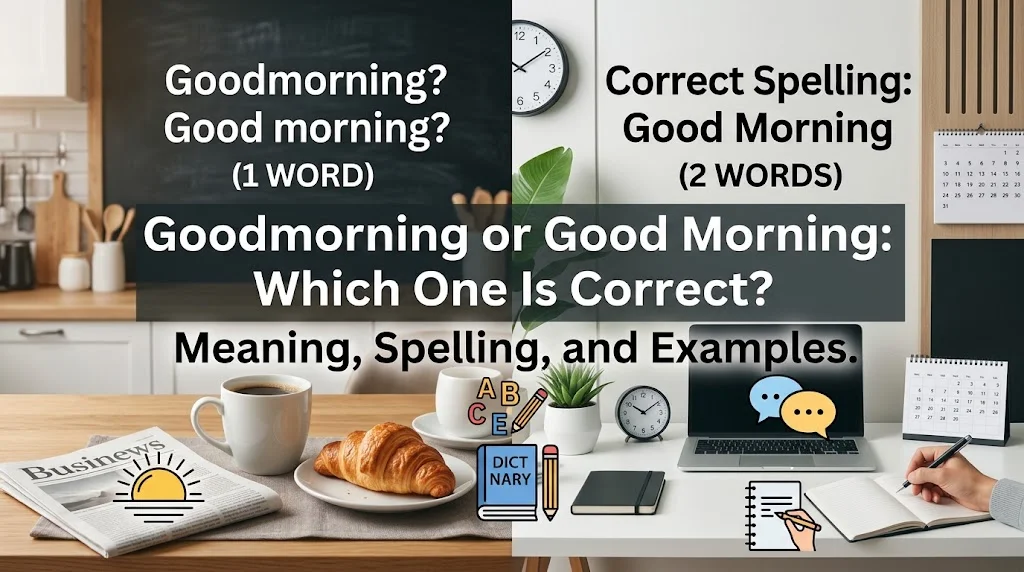
Have you ever wondered whether to write Goodmorning or Good Morning in a text message, email, or social media post? You’re not alone. Many English learners and native speakers get confused by common English greetings and their correct spelling. Although both forms may look understandable, only one follows standard English spelling.
The correct form is good morning, written as two separate words. You can use this morning greeting when meeting someone early in the day, starting a conversation, or opening a professional email. On the other hand, goodmorning is considered a spelling mistake in ordinary English writing.
Understanding the difference between these expressions helps you improve your English grammar, spelling accuracy, and written communication. It also makes your messages look more polished and professional. For example, you should write “Good morning, Sarah!” rather than “Goodmorning, Sarah!”
In this guide, you’ll learn the correct spelling of good morning, its meaning, capitalization rules, and punctuation guidelines. You’ll also discover how to use this greeting in formal emails, casual conversations, and everyday writing. By the end, you’ll know exactly when and how to use good morning correctly without second-guessing yourself.
Goodmorning or Good Morning: The Correct Spelling
The correct spelling is good morning, with a space between the two words. Standard English uses this two-word expression as a greeting or a way to wish someone a pleasant start to the day.
“Goodmorning” combines the words without a space. Although readers can usually understand its meaning, standard written English does not recognize it as the conventional spelling of the greeting.
Consider these examples:
- Correct: Good morning, everyone!
- Correct: I wished my neighbor a good morning.
- Incorrect: Goodmorning, everyone!
- Incorrect: I wished my neighbor a goodmorning.
The rule is straightforward: whenever you use this expression in ordinary English writing, keep good and morning separate.
Why “Good Morning” Is Correct
The expression consists of two words that retain their individual identities.
- Good is an adjective that describes something positively.
- Morning is a noun that refers to the early part of the day.
Together, they form an established greeting used to welcome someone or express a friendly wish.
For example:
Good morning, David! Did you sleep well?
Here, the speaker greets David at the beginning of the day. The two-word spelling follows standard English usage.
You can also use the expression within a longer sentence:
We had a good morning at the park before the weather changed.
In this sentence, “good morning” describes a pleasant morning rather than directly greeting someone. The spelling remains the same.
Is “Goodmorning” Ever Acceptable in Standard English?
In ordinary writing, goodmorning is not the standard spelling. You should avoid it in school assignments, business emails, articles, reports, and other situations where conventional spelling matters.
However, you might encounter the joined form in usernames, social media handles, creative projects, or business names. A person may deliberately choose it for branding or stylistic reasons.
That special use doesn’t change the standard spelling rule.
For example:
| Context | Recommended form | Reason |
| Professional email | Good morning, Lisa. | Follows standard spelling and punctuation |
| School assignment | Good morning | Uses conventional English |
| Text message | Good morning! | Clear and correct |
| Social media caption | Good morning, sunshine! | Friendly and correctly spelled |
| Creative username | Goodmorning123 | May be a deliberate name |
| Formal article | Good morning | Appropriate standard spelling |
Remember: A creative name can use unusual spelling, but ordinary prose should use “good morning.”
Good Morning vs. Goodmorning: Key Differences
The main difference is spelling rather than meaning. Most readers will understand both forms, but only one follows standard English conventions.
| Feature | Good morning | Goodmorning |
| Standard spelling | Correct | Nonstandard |
| Number of words | Two | One |
| Meaning | A morning greeting or wish | Usually intended to mean the same thing |
| Professional writing | Recommended | Avoid |
| Academic writing | Recommended | Avoid |
| Casual texting | Correct | Commonly a typo or informal variation |
| Grammar-checking tools | Usually accepted | May be flagged |
When writing for an audience, choose the conventional form. It looks polished and avoids distracting readers with an unnecessary spelling mistake.
Correct and Incorrect Examples in Everyday Writing
Seeing the spelling in context makes the rule easier to remember.
| Incorrect sentence | Correct sentence |
| Goodmorning, Mom! | Good morning, Mom! |
| Goodmorning everyone. | Good morning, everyone. |
| I sent her a goodmorning message. | I sent her a good morning message. |
| Goodmorning, Mr. Wilson. | Good morning, Mr. Wilson. |
| Hope you have a goodmorning. | Hope you have a good morning. |
Notice that the correction doesn’t require changing the meaning. You simply separate the two words and adjust the punctuation when necessary.
What Does “Good Morning” Mean?
Good morning is a common English expression used to greet people during the morning. It can communicate politeness, friendliness, warmth, or professional courtesy, depending on the situation.
People use it when they arrive at work, meet neighbors, greet family members, enter a classroom, or begin a conversation.
The phrase can also express a wish for someone’s day to begin well.
For instance:
- “Good morning, everyone!” welcomes a group.
- “Good morning, Professor Adams” respectfully greets a teacher.
- “Have a good morning” expresses a positive wish.
- “We had a good morning fishing” describes an enjoyable experience.
Although these examples share the same words, their purposes differ slightly.
Definition and Meaning of Good Morning
The expression has two main uses.
As a greeting: You say it when meeting or addressing someone in the morning.
Good morning, Alex. How are you today?
As a description or wish: You use it to describe a pleasant morning or refer to the quality of someone’s morning.
I hope you have a good morning at work.
The surrounding sentence tells you which meaning applies. In both cases, the words remain separate.
When People Use This Greeting
People use “good morning” in many everyday situations.
- At home: “Good morning, everyone. Breakfast is ready.”
- At school: “Good morning, Mrs. Carter.”
- At work: “Good morning, team. Let’s begin.”
- In an email: “Good morning, Michael,”
- On a phone call: “Good morning. I’m calling about tomorrow’s appointment.”
- In a text message: “Good morning! Hope your day goes well.”
The expression works in formal and informal settings. Your tone, punctuation, and choice of words help determine how formal it sounds.
Is “Good Morning” a Phrase or a Compound Word?
“Good morning” is a two-word greeting phrase, not a standard one-word compound.
A compound word combines two or more words into a single lexical unit. English contains several examples, including “sunrise,” “bedroom,” and “notebook.”
However, English doesn’t combine every pair of words that frequently appear together. Some expressions retain spaces even when people use them regularly.
For example:
- Good morning
- Good afternoon
- Good evening
- Thank you
- Ice cream
These expressions have established spellings that you should learn individually.
The fact that “good morning” functions as a familiar expression doesn’t mean you can remove the space.
Why Is “Good Morning” Written as Two Words?
English spelling follows established conventions rather than one universal rule for combining words. Some word pairs become single words over time, while others remain separate.
“Good morning” belongs to the second group in standard contemporary English.
Understanding its grammatical structure can help explain why the expression makes sense as two words. However, the most important point is that conventional spelling determines the accepted written form.
The Grammatical Role of “Good”
The word good is an adjective. Adjectives describe or modify nouns by providing information about qualities, conditions, or characteristics.
For example:
- A good book
- A good friend
- A good day
- A good morning
In each example, “good” describes the noun that follows it.
When someone says “Have a good morning,” the adjective describes the kind of morning the speaker hopes the other person will experience.
This grammatical pattern is common throughout English. You wouldn’t normally combine “good” and “book” into “goodbook” simply because the adjective and noun appear together.
The same principle helps you remember the spelling of “good morning.”
How “Morning” Completes the Expression
The word morning is a noun that refers to the early portion of the day. In everyday conversation, it generally describes the period between waking hours and noon, although exact boundaries vary by context.
When paired with “good,” it creates a familiar expression associated with the beginning of the day.
Compare these sentences:
- “Good morning, Emily!” — a greeting.
- “It was a good morning for a walk.” — a description.
- “We spent a good morning together.” — a description of an enjoyable period.
The grammatical role changes slightly according to the sentence, but the spelling doesn’t.
Why the Two Words Remain Separate
The expression has an established two-word spelling in standard English dictionaries and usage references. Writers should follow that convention rather than inventing a joined form.
English includes many familiar expressions that remain separate even when speakers treat them as a single idea.
For example, people write “good afternoon,” not “goodafternoon,” and “good evening,” not “goodevening.”
The same spelling pattern applies to “good morning.”
A useful rule: If an expression is conventionally written as two words, familiarity alone doesn’t justify combining them.
Read More: Lable or Label: Which Spelling Is Correct?
Why “Goodnight” and “Good Morning” Follow Different Spelling Patterns
This comparison can confuse learners because goodnight is sometimes written as one word, while “good morning” remains two.
The distinction comes from established usage and grammatical function.
“Good night” is commonly written as two words when used as a farewell:
Good night, everyone. I’ll see you tomorrow.
“Goodnight” also appears as a single word in established uses, especially as a noun or adjective in expressions such as “a goodnight kiss.” Dictionaries may record additional uses depending on the word and context.
By contrast, “good morning” remains the conventional spelling of the greeting.
| Expression | Typical use | Example |
| Good morning | Morning greeting | Good morning, Sarah. |
| Good afternoon | Afternoon greeting | Good afternoon, everyone. |
| Good evening | Evening greeting | Good evening, Dr. Lee. |
| Good night | Farewell before sleep or at night | Good night, Mom. |
| Goodnight | Compound use in certain contexts | He gave her a goodnight kiss. |
The lesson isn’t that all greetings must follow the same spelling pattern. Learn the conventional form of each expression individually.
Good Morning or Goodmorning in Different Situations
The spelling remains the same across most contexts, but your greeting can change depending on your audience.
A message to a close friend might sound cheerful and relaxed. A greeting to a manager or customer may need a more professional tone.
Fortunately, you don’t need a different spelling for each situation.
Using Good Morning in Formal Writing
In formal writing, use “good morning” with standard capitalization and punctuation.
You might use the expression in:
- Business emails
- Letters
- Workplace announcements
- Academic presentations
- Customer service messages
- Formal meeting introductions
For example:
Good morning, Dr. Williams. Thank you for meeting with us today.
This greeting sounds respectful without becoming unnecessarily stiff.
In a formal email, you can follow the greeting with a comma and begin the message on the next line. Some organizations use different formatting styles, so consistency with workplace conventions also matters.
Using Good Morning in Text Messages and Chats
Text messages allow more flexibility in tone, but the standard spelling still applies.
Here are a few natural examples:
- “Good morning! Did you get home safely?”
- “Good morning 😊 Hope you have a great day.”
- “Good morning, are we still meeting at 10?”
- “Morning! I’ll call you in a bit.”
The final example uses “Morning!” as a shortened greeting. It is common in casual conversation and doesn’t require the word “good.”
You can use emojis, exclamation points, and informal wording when they fit your relationship with the recipient. However, there is little reason to remove the space between “good” and “morning.”
Using Good Morning on Social Media
Social media posts often use greetings to start the day on a positive note.
Examples include:
- “Good morning, friends! Wishing you a peaceful day.”
- “Good morning, sunshine. Make today count!”
- “A fresh start begins with a good morning and a grateful heart.”
- “Good morning from our little corner of the world.”
Hashtags and usernames sometimes omit spaces because of platform conventions. For example, a hashtag might appear as #GoodMorning.
That format doesn’t mean the phrase should become one word in ordinary sentences. Hashtags often remove spaces so that a phrase can function as a single clickable label.
Writing Good Morning in Cards and Personal Notes
Greeting cards and personal notes often use warm, expressive language.
For example:
Good morning, Grandma! I hope your day is filled with laughter and lovely surprises.
Or:
Good morning, my friend. Just a little reminder that someone is thinking of you today.
The expression can sound affectionate, cheerful, or thoughtful depending on the words around it.
Even in a handwritten note, the standard spelling remains “good morning.”
Is “Goodmorning” Acceptable in Creative Writing or Brand Names?
Creative writing sometimes bends spelling conventions to achieve a particular effect. An author might invent “Goodmorning” as a fictional character’s username, a brand name, or the title of a creative project.
Such choices are stylistic rather than standard grammatical forms.
For example, a fictional app might be named Goodmorning Club. If that is the official name, you can preserve its branding in references to the app.
However, when writing a normal sentence, use the standard expression:
I said good morning to the receptionist.
Don’t assume that a spelling used in a brand name automatically becomes acceptable in general writing.
How to Capitalize “Good Morning” Correctly
Capitalization depends on where the expression appears in a sentence. The words don’t need capital letters simply because they form a greeting.
The basic rule is simple: capitalize the first word when it begins a sentence or greeting. Capitalize “Morning” only when a separate rule requires it.
Good Morning at the Beginning of a Sentence
When the expression begins a sentence, capitalize “Good.” Keep “morning” lowercase.
Correct:
- Good morning, everyone.
- Good morning! How did you sleep?
- Good morning, Mr. Davis.
Incorrect in ordinary sentence case:
- good morning, everyone.
- Good Morning, everyone.
The second example isn’t necessarily wrong in every context. Title case and certain design styles capitalize more words. However, ordinary sentence case uses “Good morning.”
Good Morning in the Middle of a Sentence
When the expression appears in the middle of a sentence, both words generally remain lowercase.
Examples:
- I said good morning to my neighbor.
- She wished everyone a good morning before the meeting.
- We enjoyed a good morning outdoors.
The phrase doesn’t receive capital letters simply because it is a greeting.
Good Morning in Email Greetings
Email greetings often begin with capitalized words because they appear at the start of a message.
For example:
Good morning, Jessica,
I wanted to confirm our appointment for Thursday at 11 a.m.
In this format, “Good” is capitalized because it begins the greeting. “Morning” remains lowercase.
Some writers prefer a comma after the recipient’s name, while others follow the greeting with a comma and begin the body on a new line. Follow your organization’s preferred style when one exists.
Good Morning in Titles and Headings
Headings can use different capitalization styles.
In sentence case:
– Good morning or good morning: Which one is correct?
In title case:
– Good Morning or Goodmorning: Which One Is Correct?
Both styles may be appropriate for headings, depending on the publication’s style guide.
The key difference is that title case capitalizes major words according to a chosen style. It doesn’t change the correct spelling of the phrase.
Should You Write “Good Morning Everyone” or “Good Morning, Everyone”?
When directly addressing a group, the standard punctuation is:
Good morning, everyone!
The comma separates the greeting from the person or group being addressed. In grammar, “everyone” functions as a term of direct address in this sentence.
More examples:
- Good morning, team.
- Good morning, class!
- Good morning, everyone.
- Good morning, ladies and gentlemen.
The same rule applies when addressing a person by name:
Good morning, Michael.
Remember that the comma serves a grammatical purpose. It isn’t merely a decorative pause.
How to Punctuate “Good Morning” Correctly
Correct spelling is only one part of a polished greeting. Punctuation helps readers understand whom you’re addressing and how your message should sound.
When to Add a Comma After Good Morning
Use a comma when a greeting directly addresses someone and continues into the sentence.
Examples:
- Good morning, Sarah.
- Good morning, everyone!
- Good morning, Professor.
- Good morning, team. Let’s get started.
However, the comma isn’t automatically required after the phrase in every sentence.
For example:
I usually say good morning when I arrive at work.
Here, “good morning” appears within the sentence as the object of “say.” You don’t need a comma after it.
Using Good Morning With Someone’s Name
When you greet a person by name, separate the greeting from the name with a comma.
Correct examples:
- Good morning, James.
- Good morning, Mrs. Parker.
- Good morning, Dr. Ahmed!
- Good morning, my friend.
Avoid writing “Good morning James” in carefully edited prose when the name is being used as direct address. The missing comma is a punctuation error.
Ending a Greeting With a Comma, Period, or Exclamation Point
The ending punctuation depends on the message’s format and tone.
| Punctuation | Example | Typical effect |
| Period | Good morning, David. | Neutral and professional |
| Exclamation point | Good morning, David! | Warm or enthusiastic |
| Comma | Good morning, David, | Often used when the email body follows on another line |
| Question mark | Good morning? | May suggest surprise or uncertainty rather than a routine greeting |
A period is usually sufficient for a professional message. An exclamation point can add warmth, especially in friendly conversations.
You don’t need several exclamation points to make a greeting sound cheerful.
Common Punctuation Mistakes to Avoid
Watch for these errors:
- Missing comma: “Good morning everyone!”
- Unnecessary comma: “I said good, morning to him.”
- Missing punctuation: “Good morning Sarah”
- Excessive punctuation: “Good morning, Sarah!!!”
Correct versions:
- “Good morning, everyone!”
- “I said good morning to him.”
- “Good morning, Sarah.”
- “Good morning, Sarah!”
Small changes make writing easier to read and more professional.
How to Use “Good Morning” in Professional Emails
A greeting sets the tone for a professional email. It helps establish courtesy before you move into the purpose of your message.
“Good morning” works well when you contact a colleague, supervisor, customer, professor, or business partner during the morning. Still, the most suitable greeting depends on your relationship and the context.
Examples of Formal Email Greetings
Here are several practical examples.
Example 1: Email to a manager
Good morning, Ms. Thompson,
I wanted to ask whether we could schedule a brief meeting to discuss the project timeline.
Thank you for your time.
Example 2: Email to a customer
Good morning, Mr. Harris,
Thank you for contacting our support team. I’m writing to provide an update on your order.
Please let me know if you have any questions.
Example 3: Email to a teacher
Good morning, Professor Miller,
I’m writing to ask for clarification about the assignment due next Monday.
Thank you for your guidance.
Each example uses the same correct spelling. The tone changes through the wording that follows.
Good Morning vs. Hello vs. Hi
These greetings serve similar purposes, but they don’t always fit the same situations.
| Greeting | Tone | Best use |
| Good morning | Polite and time-specific | Morning emails, meetings, and conversations |
| Hello | Neutral and versatile | Professional and casual communication |
| Hi | Friendly and informal | Colleagues, familiar contacts, and everyday messages |
| Dear | Formal and traditional | Formal letters and certain professional emails |
| Morning | Relaxed and conversational | Familiar colleagues, friends, and casual settings |
None of these greetings is automatically correct for every situation.
For example, “Hi, Sam” might suit a coworker you speak with daily. “Good morning, Dr. Patel” may be more appropriate when opening a formal conversation.
Should You Write “Good Morning” or “Good Morning, John”?
Both can be correct, depending on the situation.
Use “Good morning” when greeting a group or opening a message without naming a specific person.
Use “Good morning, John” when directly addressing John.
Examples:
- General: Good morning.
- Personal: Good morning, John.
- Group: Good morning, everyone.
- Team email: Good morning, team.
Adding a name can make your greeting feel more personal. However, you don’t need to include one in every message.
Email Greeting Etiquette Across Different Time Zones
Time zones matter when you communicate with people in different locations.
Imagine you start work at 9 a.m. in New York while your colleague begins the day at 7 a.m. in Los Angeles. A morning greeting may fit both situations. However, a message sent later in your day might arrive during your colleague’s evening.
When timing is uncertain, “Hello” is a useful alternative because it doesn’t depend on the time of day.
You can also avoid the issue by scheduling your email for the recipient’s working hours when appropriate.
The goal is to communicate naturally without making assumptions about the other person’s local time.
Common Mistakes to Avoid in Workplace Communication
Professional emails benefit from simple, consistent writing.
Avoid these common mistakes:
- Writing “Goodmorning” as one word.
- Forgetting the comma before a directly addressed name.
- Using an overly casual greeting for an unfamiliar recipient.
- Sending time-specific greetings without considering the recipient’s location.
- Adding several exclamation points to a routine business email.
A well-written greeting doesn’t need to be elaborate. Clear spelling, appropriate punctuation, and a respectful tone are usually enough.
Good Morning vs. Other Common Greetings
English has several greetings for different times of day. Learning their conventional spellings helps you avoid mixing them up.
Good Morning vs. Good Afternoon
“Good morning” is generally used earlier in the day. “Good afternoon” is commonly used after noon and before evening.
Examples:
- Good morning, everyone. The meeting starts at 10 a.m.
- Good afternoon, everyone. Thank you for joining us at 2 p.m.
The exact transition isn’t fixed in every culture or workplace. Noon is a useful general dividing point, but people may adjust their greetings according to local habits.
Both expressions use two words.
Good Morning vs. Good Evening
“Good evening” is used when greeting someone later in the day, usually around the beginning of the evening.
For example:
Good evening, everyone. Welcome to the event.
Unlike “goodnight,” which commonly serves as a farewell, “good evening” often introduces a conversation or welcomes people to a gathering.
The spelling is straightforward: write “good evening” as two words.
Good Morning vs. Goodnight
These expressions have different purposes.
Good morning usually welcomes someone or starts a conversation earlier in the day.
Good night commonly serves as a farewell, especially when someone is leaving or going to sleep.
Examples:
- Good morning, Dad. Did you sleep well?
- Good night, Dad. I’ll see you tomorrow.
In some contexts, “goodnight” also appears as one word, as in “a goodnight kiss.” That established usage doesn’t make “goodmorning” standard.
Good Morning vs. Morning
“Morning” can work as a shortened greeting in casual conversation.
For example:
Morning, Alex! Ready for the meeting?
This sounds relaxed and natural among friends or familiar coworkers.
“Good morning” is more complete and often feels slightly more polite or formal. Still, both expressions are appropriate in many everyday situations.
Choose the version that fits your audience.
Good Morning vs. Have a Good Morning
These expressions are similar but serve different purposes.
- Good morning: Usually greets someone.
- Have a good morning: Wishes someone a pleasant morning.
For example:
Good morning, Olivia!
This opens a conversation.
Have a good morning, Olivia!
This expresses a positive wish for the hours ahead, perhaps as someone leaves.
Both forms are correct, and both keep “good” and “morning” separate.
Common Mistakes When Writing “Good Morning”
Even familiar expressions can cause errors when people type quickly or overlook punctuation.
The following mistakes are easy to fix once you know what to look for.
Combining the Words Into “Goodmorning”
This is the central mistake in the goodmorning or good morning spelling question.
Incorrect:
Goodmorning, everyone. I hope you’re doing well.
Correct:
Good morning, everyone. I hope you’re doing well.
The correction requires only one space, but that small change brings the sentence in line with standard English spelling.
Capitalizing Every Letter Without a Reason
In ordinary sentence case, “Good Morning” isn’t the standard capitalization when the phrase appears in the middle of a sentence.
Incorrect:
I said Good Morning to my neighbor.
Correct:
I said good morning to my neighbor.
However, capitalization may differ in titles, headings, posters, or designs that use title case.
Always consider the context before deciding which letters to capitalize.
Forgetting Commas When Addressing Someone
A direct greeting should normally separate the greeting from the person’s name.
Incorrect:
Good morning Rachel.
Correct:
Good morning, Rachel.
The same principle applies to groups:
Incorrect:
Good morning everyone.
Correct:
Good morning, everyone.
This rule makes the sentence easier to read and follows standard punctuation conventions.
Confusing a Greeting With a Sentence
Not every use of “good morning” functions as a direct greeting.
Compare these examples:
- Greeting: Good morning, Daniel.
- Description: It was a good morning for gardening.
- Wish: I hope you have a good morning.
- Reported speech: She said good morning before sitting down.
Recognizing the phrase’s function helps you choose the correct punctuation and capitalization.
Using the Same Greeting in Every Professional Situation
“Good morning” works well in many settings, but it isn’t always the most practical choice.
If you’re unsure when the recipient will read your message, “Hello” may be more suitable. If you’re addressing a familiar coworker, “Hi” may feel natural.
Choose greetings according to your audience, relationship, and communication style. Correct spelling is important, but so is using language that fits the situation.
When Should You Say “Good Morning”?
There is no single worldwide rule defining the exact minute when morning begins or ends for greetings.
In everyday English, people generally use “good morning” from the early part of the day until around noon. However, social expectations, work schedules, and cultural habits can affect how people use it.
What Time Does Good Morning Start?
People often begin saying “good morning” when they wake up or start interacting with others early in the day.
For example, someone might greet a family member at 6:30 a.m., a coworker at 8:45 a.m., or a shopkeeper at 10 a.m.
All three examples are natural.
The greeting doesn’t require a precise starting time. Its use depends on the situation and the speaker’s local conventions.
When Does Good Morning End?
Noon is a useful general guideline, although everyday usage can vary.
Many people switch to “good afternoon” around 12 p.m. Others may continue saying “good morning” slightly later, particularly if they’re beginning a conversation with someone who has just arrived.
For instance, greeting a colleague who arrives at 12:05 p.m. with “good morning” might sound unusual to some people but understandable to others.
When in doubt, “Hello” is a neutral option at any time.
Does the Meaning Change Depending on Culture or Context?
Yes. Greetings can reflect cultural expectations, workplace habits, and personal preferences.
Some workplaces use time-specific greetings throughout the day. Others favor “Hi” or “Hello” regardless of the hour.
People working overnight shifts may also use “good morning” at times that differ from a typical daytime schedule.
The important distinction is between social convention and spelling. Although the appropriate time for the greeting can vary, the conventional written form remains good morning.
Can You Say Good Morning in the Afternoon as a Joke?
Yes. You can use the expression humorously outside its usual time range.
For example, a friend who wakes up at 2 p.m. might walk into the kitchen and announce:
Good morning, everyone!
The joke works because the greeting contrasts with the actual time.
This playful use doesn’t change the ordinary meaning or spelling. It simply uses the expression in an unexpected way.
Easy Ways to Remember the Correct Spelling
You don’t need to memorize a complicated grammar rule to spell “good morning” correctly. A few practical reminders can help you use it consistently.
The Two-Word Spelling Rule
Remember this simple principle:
Write “good morning” as two words in standard English.
The same pattern applies to other familiar greetings:
- Good morning
- Good afternoon
- Good evening
Learning these expressions together can make their spelling easier to recall.
A Simple Memory Trick
Think about the expression as a description:
- A good day
- A good evening
- A good morning
You naturally leave a space between “good” and the noun in these examples. The greeting follows the same conventional spelling.
You can also remember this short phrase:
“A good morning starts with a space.”
It’s a simple reminder, especially when you’re typing quickly.
Examples That Help You Remember
Read these sentences and notice the spacing:
- Good morning, Mom.
- I hope you have a good morning.
- We enjoyed a good morning walk.
- Good morning, everyone!
- She sent a good morning message.
The expression stays separate regardless of whether it begins a sentence, appears in the middle, or describes a message.
Repeated exposure to correct examples makes the spelling feel more natural over time.
How to Check Your Writing Before Sending It
A quick proofreading routine can prevent common errors.
Before sending a message, ask yourself:
- Have I written “good morning” as two words?
- Have I capitalized the first word where necessary?
- Have I added a comma before a person’s name?
- Does the greeting suit the recipient and situation?
- Have I checked the rest of the sentence for spelling and punctuation errors?
Grammar-checking tools can catch many mistakes, but they shouldn’t replace your judgment. Some tools may overlook errors when a misspelled word appears in an unusual context.
A final read-through is still worthwhile.
Goodmorning or Good Morning: Examples in Real Sentences
Examples show how the phrase works across different sentence structures and communication settings.
Correct Examples for Everyday Conversations
Here are several natural ways to use the expression:
- Good morning, Mom! What’s for breakfast?
- Good morning, everyone. Let’s get started.
- I said good morning to my neighbor on the way out.
- We had a good morning at the beach.
- Have a good morning at school.
- Good morning! Did you sleep well?
- She sent me a good morning message before work.
Each example uses the standard two-word spelling.
Correct Examples for Work and School
The expression also fits professional and academic settings.
At work:
Good morning, team. Today’s meeting will begin at 9:30 a.m.
At school:
Good morning, Mrs. Johnson. I have a question about the homework.
In a business email:
Good morning, Mr. Brown,
I’m following up on the proposal we discussed yesterday.
During a presentation:
Good morning, everyone. Thank you for being here today.
These examples demonstrate how you can adapt the wording without changing the spelling.
Incorrect Examples and Their Corrections
| Incorrect | Correct |
| Goodmorning, John! | Good morning, John! |
| good morning, everyone! | Good morning, everyone! |
| Good morning everyone. | Good morning, everyone. |
| I hope you have a goodmorning. | I hope you have a good morning. |
| She said Good Morning to me. | She said good morning to me. |
| Goodmorning! How are you? | Good morning! How are you? |
Some mistakes involve spelling, while others involve capitalization or punctuation. Identifying the specific error helps you correct it accurately.
Before-and-After Sentence Examples
Consider this short workplace example.
Before:
Goodmorning everyone I hope you had a nice weekend lets start the meeting.
After:
Good morning, everyone! I hope you had a nice weekend. Let’s start the meeting.
The revised version improves the spelling, adds the comma needed for direct address, separates the sentences, and uses the apostrophe in “let’s.”
Here’s another example.
Before:
I sent my teacher a goodmorning email.
After:
I sent my teacher a good morning email.
Only one space changes in this example. Nevertheless, that small correction makes the sentence conform to standard spelling.
Practice Quiz: Goodmorning or Good Morning
Test your knowledge with these five questions. Choose the option that follows standard English spelling, capitalization, or punctuation.
Choose the Correct Spelling
Which sentence uses the correct spelling?
A. Goodmorning, Lisa!
B. Good morning, Lisa!
C. Good Morning, Lisa!
Answer: B. “Good morning” is conventionally written as two words. The capitalization in option C may appear in some title-style designs, but sentence case normally keeps “morning” lowercase.
Identify the Capitalization Error
Which sentence follows standard sentence capitalization?
A. I said Good Morning to my friend.
B. I said good morning to my friend.
C. I said good Morning to my friend.
Answer: B. Because the phrase appears in the middle of the sentence, both words normally remain lowercase.
Correct the Punctuation
Which greeting is punctuated correctly?
A. Good morning everyone!
B. Good morning, everyone!
C. Good, morning everyone!
Answer: B. The comma separates the greeting from “everyone,” which is the term of direct address.
Complete the Email Greeting
Choose the most appropriate option for a polite email to a manager.
A. goodmorning, Mr. Davis,
B. Good morning Mr. Davis
C. Good morning, Mr. Davis,
Answer: C. It uses the standard spelling, capitalizes the opening word, and separates the greeting from the manager’s name. The final comma can introduce the email body on the next line.
Check Your Answers With Explanations
If you answered all five questions correctly, you’ve understood the key spelling and usage rules.
If you missed one, review these points:
- Write “good morning” as two words.
- Capitalize “Good” at the beginning of a sentence or greeting.
- Keep “morning” lowercase in ordinary sentence case.
- Use a comma when directly addressing a person or group.
- Choose punctuation that suits the sentence and communication format.
The rules are simple once you see them in context.
Frequently Asked Questions
Is “Goodmorning” One Word or Two?
The standard spelling is two words: “good morning.” The joined form, “goodmorning,” is nonstandard in ordinary English writing. Use the two-word version in emails, school assignments, articles, and everyday messages.
Is “Goodmorning” Grammatically Correct?
No. “Goodmorning” is not the conventional spelling of the greeting in standard English. Although readers can usually understand it, you should write “good morning” to follow accepted spelling conventions.
Why Do People Write “Goodmorning”?
People may combine the words because they type quickly, imitate informal online writing, or assume familiar expressions should become single words. Others may simply overlook the space. These habits explain the mistake but don’t make the joined spelling standard.
Should “Good Morning” Be Capitalized?
At the beginning of a sentence or greeting, write “Good morning.” Keep “morning” lowercase in ordinary sentence case. In headings and titles, you may capitalize both words if your chosen title style calls for it.
For example:
- Greeting: Good morning, Sarah.
- Middle of a sentence: I said good morning to Sarah.
- Title: Good Morning: A Guide to Correct Spelling.
Is It Correct to Write “Good Morning, Everyone”?
Yes. “Good morning, everyone!” is correct. The comma separates the greeting from “everyone,” which directly identifies the people being addressed.
You can use the same punctuation with other names and groups, such as “Good morning, team” or “Good morning, everyone.”
Should I Put a Comma After “Good Morning”?
It depends on the sentence.
Use a comma when you directly address someone:
Good morning, James.
You don’t need a comma when the expression appears naturally within a sentence:
I wished James a good morning.
The punctuation depends on the grammatical structure rather than the phrase alone.
Is “Good Morning” Appropriate for Professional Emails?
Yes. “Good morning” is a polite, widely used greeting for professional emails sent during the morning. You can address the recipient by name for a more personal opening.
For example:
Good morning, Ms. Carter,
I’m writing to confirm our meeting scheduled for Thursday.
If you don’t know when the recipient will read the message, “Hello” is a useful alternative.
What Is the Difference Between “Good Morning” and “Goodnight”?
“Good morning” generally greets someone early in the day. “Good night” usually serves as a farewell when someone leaves or prepares to sleep.
Examples:
- Good morning, Dad. Have a great day.
- Good night, Dad. Sleep well.
The farewell “good night” is commonly written as two words. “Goodnight” also appears as one word in established uses such as “a goodnight kiss.”
What Time Should You Stop Saying “Good Morning”?
People commonly switch to “good afternoon” around noon. However, there is no universal rule that everyone follows to the minute. Local customs, workplace habits, and the circumstances of a conversation can affect the choice.
If you’re unsure, “Hello” works throughout the day.
Do Dictionaries List “Good Morning” as Two Words?
Yes. Standard English dictionaries and usage references treat “good morning” as a two-word expression. You can verify conventional spelling and usage through established dictionary resources such as:
Search for “good morning” in these references to check the expression and related usage information. Dictionary entries can also help distinguish a greeting from other uses of the individual words.
Conclusion: Always Write “Good Morning” as Two Words
When deciding between goodmorning or good morning, the answer is simple: “Good morning” is the correct standard spelling. Keep the two words separate in everyday conversations, professional emails, academic assignments, and other forms of ordinary writing.
Remember a few related rules, too. Capitalize “Good” when the expression begins a sentence or greeting. Keep “morning” lowercase in normal sentence case. Add a comma when directly addressing someone, as in “Good morning, Sarah!”
Although you may encounter “goodmorning” in usernames, creative names, or informal online posts, those special uses don’t change the standard spelling.
With these simple guidelines, you can greet colleagues, friends, teachers, and family members confidently. When in doubt, choose the familiar two-word form: Good morning