Choosing between People Do or People Does can seem like a tiny grammar detail, yet it causes plenty of confusion in everyday English. The correct form is “people do” because people is normally a plural noun. Once you understand subject-verb agreement, the rule becomes much easier to apply.
The basic pattern is simple: a person does, while people do. The same distinction appears in questions, negative sentences, and everyday expressions. For example, do people is correct when asking a question, while people don’t is the correct negative form. Understanding the difference between do and does, singular and plural nouns, and person and people can help you avoid common grammar mistakes.
This guide explains people do grammar, people does grammar, and the rules behind do people or does people in clear, practical language. You’ll also see real sentence examples, common errors, and useful comparisons with words such as everyone, someone, and a person.
Whether you’re writing an email, academic assignment, article, or everyday message, knowing when to use do or does will make your English more accurate and natural.
People Do or People Does: Which Is Correct?
“People Do” Is Correct
When people means more than one person, use do.
Consider these examples:
- People do strange things sometimes.
- People do what they think is best.
- People do their work in different ways.
- People do care about how they’re treated.
- People do make mistakes.
In each sentence, people refers to multiple individuals. The verb therefore agrees with a plural subject.
This rule applies whether do functions as the main verb or as an auxiliary verb.
For instance:
People do their homework.
Here, do is the main verb.
In this sentence:
People do understand the problem.
Do works as an auxiliary verb that adds emphasis to understand.
Both constructions are grammatically valid.
Why “People Does” Is Usually Incorrect
“People does” is incorrect in ordinary standard English when people is the subject.
The form does belongs with a singular third-person subject:
- He does.
- She does.
- It does.
- A person does.
- Everyone does.
The plural counterparts use do:
- They do.
- People do.
- We do.
- You do.
So this sentence is incorrect:
❌ People does different things.
The correct version is:
✅ People do different things.
The problem isn’t the meaning. The problem is subject-verb agreement.
The Quick Rule to Remember
If you need a fast answer, remember this pair:
Person → does
People → do
You can also use the pronoun substitution trick:
People = they
If you’d say:
They do…
then you should normally say:
People do…
For example:
- They do their best.
- People do their best.
The same pattern works with questions and negatives:
- Do they agree?
- Do people agree?
- They don’t agree.
- People don’t agree.
This simple comparison handles most people do or people does questions in seconds.
Why People Takes “Do” Instead of “Does”
People Is a Plural Noun
In its ordinary everyday meaning, people is the plural of person.
One individual is a person.
Two or more individuals are people.
That difference affects the verb:
| Subject | Verb | Example |
| A person | does | A person does the job. |
| One person | does | One person does the work. |
| People | do | People do the work. |
| Many people | do | Many people do the work. |
| They | do | They do the work. |
| Everyone | does | Everyone does the work. |
English uses different present-tense forms of do depending on the subject.
The important point is that the noun’s grammatical number controls the verb.
Do and Does Are Forms of the Same Verb
Do and does aren’t separate verbs with unrelated meanings. They are forms of the same verb.
The present-tense pattern looks like this:
| Subject | Correct Form |
| I | do |
| You | do |
| We | do |
| They | do |
| He | does |
| She | does |
| It | does |
People belongs with they, not he, she, or it.
That’s why we write:
People do…
rather than:
People does…
The same pattern appears with other verbs:
- People work.
- People have opinions.
- People are different.
- People do different things.
The plural pattern isn’t unique to do.
Why the “S” in Does Can Be Misleading
One reason learners make this mistake is the spelling.
The word does contains an -s, which can make it look like a plural form. In English grammar, however, the opposite is true here.
Compare:
- He does
- She does
- It does
The -s marks the third-person singular present form.
By contrast:
- They do
- People do
- We do
So don’t decide whether to use do or does by looking at the spelling of the noun.
Instead, ask:
Is the subject singular or plural?
That question leads you to the right form.
Subject-Verb Agreement With People
Subject-verb agreement means that the verb form should match the subject in grammatical number and person.
With people, the rule is normally simple because people is plural.
Singular Subjects Use Does
A singular third-person subject generally takes does in the present tense.
Examples include:
- A person does the work.
- One employee does the task.
- My brother does his homework.
- She does everything carefully.
- Everyone does something differently.
Notice the difference between one person and people:
One person does the job.
Several people do the job.
The number of individuals changes the verb.
Plural Subjects Use Do
Plural subjects use do.
Examples:
- People do the work.
- Employees do their jobs.
- Students do their assignments.
- They do what they can.
- The workers do their best.
This isn’t a special rule for the word people. It’s part of the broader English subject-verb agreement system.
Use “They” as a Quick Test
The they test provides an easy shortcut.
Replace people with they.
If the sentence works with they do, use people do.
For example:
Do people understand?
Replace people:
Do they understand?
The structure remains natural.
Another example:
People don’t always agree.
Replace people:
They don’t always agree.
Again, the agreement remains the same.
This test is especially helpful when you’re writing quickly and don’t want to stop and analyze grammatical terminology.
Read More: Masonary vs Masonry: Which Spelling Is Correct and Why It Matters
How to Use “People Do” Correctly
The phrase people do appears in several sentence structures. Understanding each one helps you avoid mistakes beyond the basic rule.
People Do in Affirmative Sentences
You can use do as the main verb in a positive statement.
Examples:
- People do their jobs differently.
- People do what they believe is right.
- People do many things for different reasons.
- People do their best under pressure.
Here, do carries the main meaning of performing or carrying out an action.
People Do as an Auxiliary Verb
Do can also act as an auxiliary verb.
This happens when another verb carries the main meaning:
People do understand the problem.
Here, understand is the main verb. Do adds emphasis.
Compare:
People understand the problem.
with:
People do understand the problem.
The second sentence stresses the fact that people really understand it.
You’ll often see this structure when someone wants to correct an assumption:
Some people think nobody cares. However, people do care.
The auxiliary do gives the statement extra force.
People Do Not and People Don’t
For negative statements, use do not or the contraction don’t.
Correct:
- People do not always agree.
- People don’t always agree.
- People do not know everything.
- People don’t behave predictably.
Incorrect:
- ❌ People doesn’t always agree.
- ❌ People doesn’t know everything.
Why?
Because people is plural.
The correct pair is:
People do / people don’t
The singular pair is:
A person does / a person doesn’t
Do People in Questions
Questions with people use do:
- Do people like this?
- Do people understand?
- Do people remember?
- Do people need more information?
The incorrect structure is:
❌ Does people like this?
The correct form is:
✅ Do people like this?
The auxiliary do comes before the subject in this question structure.
Why Do People…?
The construction “why do people” is extremely common.
Examples include:
- Why do people make mistakes?
- Why do people change their minds?
- Why do people believe this?
- Why do people behave differently?
- Why do people ask this question?
The structure is:
Why + do + plural subject + base verb
So:
Why do people make mistakes?
Not:
❌ Why does people makes mistakes?
There are actually two agreement errors in the incorrect version.
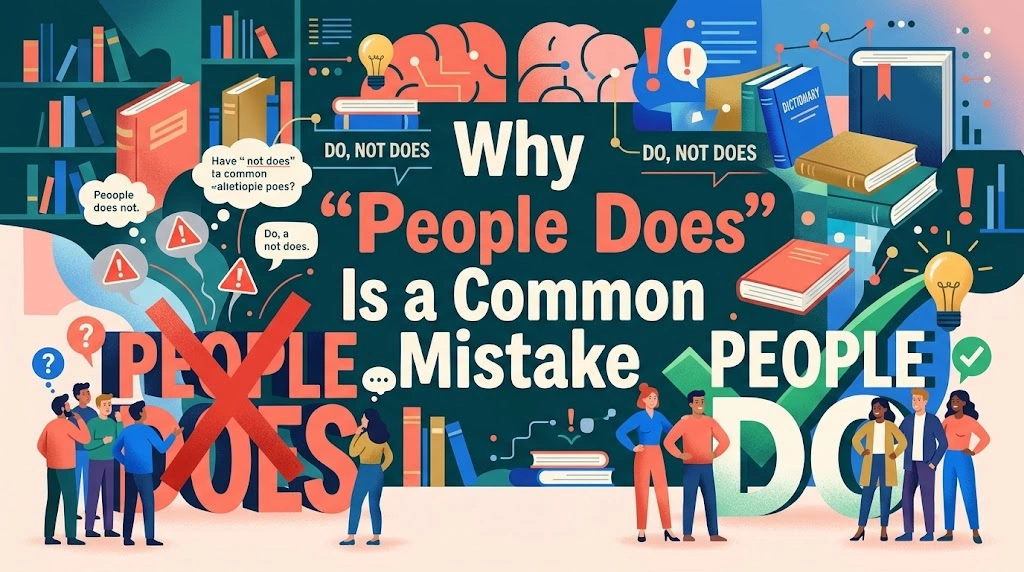
Why “People Does” Is a Common Mistake
Confusing People With a Singular Subject
Writers sometimes think of people as one general category and therefore use a singular verb.
English doesn’t normally work that way.
When people refers to multiple individuals, it remains grammatically plural:
People are different.
People have different opinions.
People do different things.
Its general meaning doesn’t turn it into a singular noun.
Confusing People With Everyone
This is one of the most important distinctions.
Both people and everyone can refer to multiple individuals in real life. Grammatically, however, they behave differently.
Compare:
People do what they want.
Everyone does what they want.
Why?
People is plural.
Everyone is grammatically singular.
The ending -one in words such as everyone, someone, and anyone doesn’t mean that only one individual exists in the real-world situation. It reflects how these indefinite pronouns function grammatically.
Compare:
| Subject | Correct Verb |
| People | do |
| They | do |
| Everyone | does |
| Someone | does |
| Anyone | does |
| A person | does |
This distinction solves many people do or people does questions.
Confusing People With a Singular Collective Noun
Another source of confusion occurs when people appears inside a longer noun phrase.
Consider:
The people do the work.
Here, the subject is people, so do agrees with it.
Now compare:
The group of people does the work.
Here, the grammatical head of the subject is group, which is singular.
The phrase of people provides additional information. It doesn’t change the number of group.
This distinction matters:
The people do…
The group of people does…
The nearby word people doesn’t automatically determine the verb.
People Do vs. Person Does
The easiest way to understand the rule is to put the two nouns side by side.
Person Takes Does
Person is singular.
Examples:
- A person does the work.
- One person does everything.
- That person does a good job.
- Each person does something different.
The same principle applies to phrases such as:
Every person does…
Each person does…
Both every and each create singular agreement here.
People Takes Do
People is normally plural.
Examples:
- People do the work.
- Many people do this.
- Those people do things differently.
- People do what they believe is necessary.
The contrast is easy to remember:
One person does.
Many people do.
Side-by-Side Comparison
| Singular | Plural |
| A person does | People do |
| One person does | Many people do |
| This person does | These people do |
| That person does | Those people do |
| Every person does | All people do |
This comparison also demonstrates why the phrase “people does” doesn’t normally work.
People Do or People Does in Questions, Negatives, and Different Verb Patterns
“Do People…?”
Use do when asking a question about people.
Examples:
- Do people like the product?
- Do people understand the instructions?
- Do people remember important details?
- Do people care about the difference?
The structure is:
Do + people + base verb
“Why Do People…?”
This follows the same pattern:
Why + do + people + base verb
Examples:
- Why do people make mistakes?
- Why do people avoid difficult conversations?
- Why do people forget important information?
- Why do people react differently?
The verb after do remains in its base form.
That’s an important detail.
Correct:
Why do people make mistakes?
Incorrect:
❌ Why do people makes mistakes?
The auxiliary do already carries the present-tense agreement.
“People Don’t…”
Use don’t with people.
Examples:
- People don’t always agree.
- People don’t know everything.
- People don’t behave exactly alike.
- People don’t necessarily remember every detail.
The expanded form is do not.
Therefore:
People do not…
becomes:
People don’t…
“People Do + Base Verb”
When do works as an auxiliary, the following verb normally stays in its base form.
Correct:
- People do make mistakes.
- People do understand the issue.
- People do need clear information.
- People do care about the result.
Incorrect:
- ❌ People do makes mistakes.
- ❌ People do understands the issue.
- ❌ People do needs clear information.
- ❌ People do cares about the result.
Think of do as carrying the grammatical load. The next verb doesn’t need to carry it again.
People Do or People Does: Common Mistakes
Several mistakes appear repeatedly in questions about this construction.
“People Does”
Incorrect:
❌ People does different things.
Correct:
✅ People do different things.
“People Doesn’t”
Incorrect:
❌ People doesn’t always agree.
Correct:
✅ People don’t always agree.
Compare it with the singular:
A person doesn’t always agree.
“Does People…?”
Incorrect:
❌ Does people understand?
Correct:
✅ Do people understand?
The subject is plural, so the auxiliary must be do.
“People Do Makes…”
Incorrect:
❌ People do makes mistakes.
Correct:
✅ People do make mistakes.
After auxiliary do, use the base form make, not makes.
Choosing the Verb by the Last Word
Don’t let a nearby noun trick you.
Consider:
The people in my neighborhood do many things together.
The subject is people.
Now consider:
The group of people does many things together.
The subject is group.
This distinction becomes especially important in longer sentences. Find the main subject first. Then choose the verb.
The Important Difference Between People and Everyone
The people vs. everyone distinction deserves special attention because it causes many errors.
People Is Normally Plural
Use plural agreement with people:
- People do.
- People are.
- People have.
- People want.
- People know.
For example:
People have different opinions.
Not:
❌ People has different opinions.
Everyone Is Grammatically Singular
Use singular agreement with everyone:
- Everyone does.
- Everyone is.
- Everyone has.
- Everyone wants.
- Everyone knows.
For example:
Everyone has an opinion.
Not:
❌ Everyone have an opinion.
This is why replacing people with everyone isn’t a reliable way to preserve the verb.
Why Everyone Can Still Mean Many People
Here’s the subtle part: grammatical number and real-world quantity aren’t always identical.
Everyone can refer to a room full of people. Grammatically, however, it behaves as a singular indefinite pronoun.
So:
Everyone does their part.
but:
People do their part.
That contrast is completely normal in standard English.
People, Person, Persons, and Peoples Explained
These four words look similar, but their uses aren’t identical.
Person
Person refers to one individual.
Examples:
- One person does the job.
- That person does excellent work.
- Every person has a different experience.
People
People is the normal plural of person in everyday English.
Examples:
- Many people work here.
- People have different opinions.
- People do things for many reasons.
If you’re talking about ordinary groups of individuals, people is usually the natural choice.
Persons
Persons is a legitimate plural form of person, but everyday English usually prefers people.
Persons can appear in formal, legal, administrative, or specialized language.
For example:
The elevator has a maximum capacity of eight persons.
In ordinary conversation, however, most speakers would naturally say:
The elevator can hold eight people.
Because persons has more specialized uses, it shouldn’t be treated as simply a more sophisticated replacement for people.
Peoples
Peoples has a different meaning.
It can refer to distinct populations or communities considered as separate cultural, ethnic, national, or social groups.
For example:
The histories of the world’s peoples are remarkably diverse.
Here, peoples means distinct groups rather than individual human beings in general.
This is a semantic distinction, not merely a spelling variation.
When “A People” Can Be Singular

The word people has another established meaning that can create confusion.
In expressions such as “a people,” it can refer to a distinct nation, ethnic community, or cultural group.
For example:
The Sámi are an Indigenous people of northern Europe.
Here, people refers to a distinct community rather than simply several individual persons.
You may also encounter expressions such as:
a people with a shared history
The meaning depends on context.
Why This Doesn’t Make “People Does” Correct
This specialized meaning doesn’t mean you can freely treat ordinary people as a singular noun.
Compare:
People do many different things.
with:
The group does many different things.
The second sentence uses the singular noun group as its subject.
The phrase “a people” is a specialized noun construction and doesn’t establish people does as a normal alternative to people do.
A Simple Method for Choosing Do or Does
When you’re unsure, use this quick process.
Find the Subject
Ask:
Who or what is doing the action?
Example:
The people in the office do their work.
The subject is people.
Determine Whether the Subject Is Singular or Plural
Ask whether you’re referring to one individual or more than one.
- One person → singular
- Several people → plural
Choose the Correct Form
Use:
- Singular third person → does
- Plural → do
Examples:
A person does…
People do…
Everyone does…
They do…
Watch for Distracting Words
Long noun phrases can hide the actual subject.
Compare:
The people in the office do their work.
and:
The manager of the people does the planning.
The phrase of the people doesn’t control the verb. Manager does.
Check the Verb After Auxiliary Do
If do acts as an auxiliary, use the base form of the next verb.
Correct:
People do work hard.
Correct:
Do people work hard?
Incorrect:
❌ People do works hard.
The same principle applies to does:
Does a person work hard?
Not:
❌ Does a person works hard?
People Do or People Does: Examples in Real Contexts
Everyday Conversation
Natural conversation frequently uses these forms:
People do what they think is right.
Why do people worry so much?
People don’t always say what they mean.
Do people really believe that?
These sentences are ordinary, natural English.
Workplace Writing
The same grammar applies in professional communication:
People do their best when expectations are clear.
Do people understand the new policy?
People don’t respond well to confusing instructions.
There’s no reason to avoid people do in formal writing. It’s standard grammar.
Academic Writing
Academic prose can also use the construction naturally:
People do not always respond to information in the same way.
Researchers examine why people make certain decisions.
The important issue isn’t whether the phrase sounds formal. It’s whether the sentence uses the correct grammatical structure.
Before-and-After Corrections
| Incorrect | Correct |
| People does this every day. | People do this every day. |
| People doesn’t always agree. | People don’t always agree. |
| Does people understand? | Do people understand? |
| Why does people make mistakes? | Why do people make mistakes? |
| People do makes mistakes. | People do make mistakes. |
| A person do the work. | A person does the work. |
These examples cover the most common forms of the error.
People Do or People Does: Quick Reference Table
| Sentence Pattern | Correct Example |
| People + do | People do different things. |
| People + don’t | People don’t always agree. |
| Do + people | Do people understand? |
| Why + do + people | Why do people make mistakes? |
| Person + does | A person does the work. |
| Person + doesn’t | A person doesn’t always know. |
| Does + person | Does that person know? |
| Everyone + does | Everyone does their part. |
| Group + does | The group of people does the work. |
Keep this table handy if the distinction tends to trip you up.
Practice: Can You Choose Do or Does?
Choose Do or Does
Fill in each blank.
- People ___ different things.
- A person ___ not always know the answer.
- Why ___ people make mistakes?
- Everyone ___ something differently.
- ___ people understand the rule?
- People ___ not always agree.
- The group of people ___ its work carefully.
Answers:
- People do different things.
- A person does not always know the answer.
- Why do people make mistakes?
- Everyone does something differently.
- Do people understand the rule?
- People do not always agree.
- The group of people does its work carefully.
Correct the Mistake
Incorrect: People does their work.
Correct: People do their work.
Incorrect: Why does people make mistakes?
Correct: Why do people make mistakes?
Incorrect: People doesn’t always agree.
Correct: People don’t always agree.
Incorrect: People do makes mistakes.
Correct: People do make mistakes.
People, Everyone, or Person?
Try these:
___ does the job alone.
Possible answers include a person or everyone, depending on the intended meaning.
Now:
___ do the job together.
The natural answer is people.
The key isn’t simply memorizing do and does. You need to identify what the subject actually means.
Frequently Asked Questions About People Do or People Does
Is “People Do” or “People Does” Correct?
People do is correct in standard English when people refers to more than one person. For example, “People do make mistakes” is grammatically correct.
Why Do We Say “People Do” and Not “People Does”?
People normally functions as a plural noun. Plural subjects take do, while singular third-person subjects take does.
Is “People Doesn’t” Correct?
No. Use people don’t or people do not.
Correct: People don’t always agree.
Incorrect: People doesn’t always agree.
Do People or Does People?
The correct question form is “Do people…?”
For example: “Do people understand this rule?”
Why Do People Say “People Does”?
This usually results from confusion about subject-verb agreement. Writers may also confuse people with singular words such as everyone, which takes does.
Does a Person or Do a Person?
Use “does a person” because person is singular.
For example: “Does a person need more information?”
Is “People Do” Correct in Formal Writing?
Yes. People do is standard English and is completely appropriate for formal, academic, professional, and everyday writing.
Final Answer: People Do or People Does?
The answer is clear:
People do is correct.
When people refers to multiple individuals, it takes plural agreement.
Remember the basic contrast:
A person does.
People do.
The same pattern applies to related constructions:
- People do their work.
- People don’t always agree.
- Do people understand?
- Why do people make mistakes?
Be careful with nearby words and similar-looking subjects. Everyone is grammatically singular, so it takes does. A phrase such as “the group of people” also takes does because group is the subject.
If you remember only one shortcut, use this:
People = they = do.
Person = he/she = does.
Once that pattern becomes familiar, the people do or people does question becomes much easier to answer correctly.