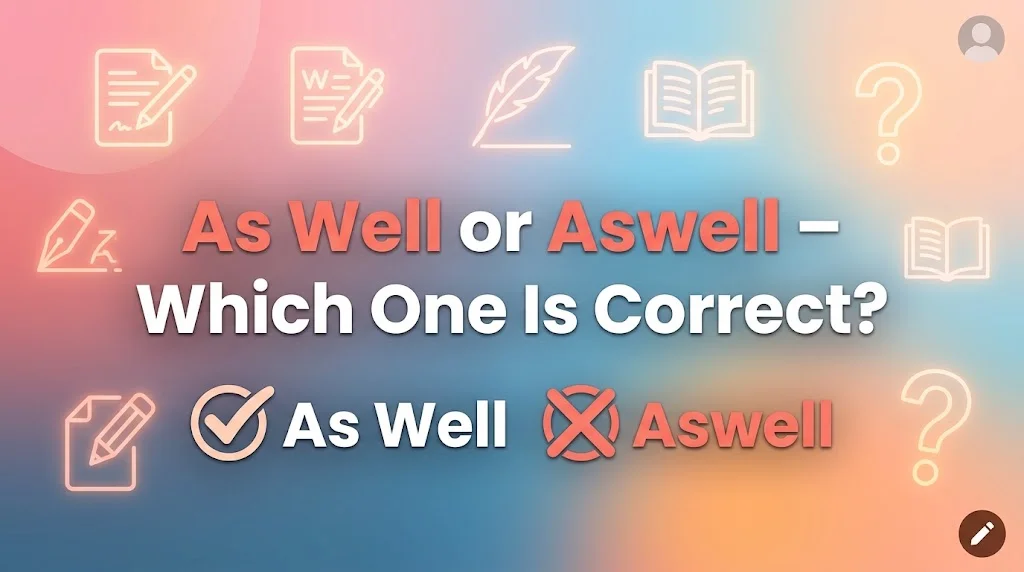
Choosing between As Well or Aswell can be confusing, especially when both forms look almost identical. If you’ve ever wondered whether as well should be written as one word or two, the answer is simple: as well is the correct form in standard English. Aswell is a common spelling mistake that appears in informal writing, quick messages, and other places where people type without proofreading.
The phrase as well usually means also, too, or in addition. You can use it when adding another person, action, object, or idea to a sentence. For example, “I’d like some coffee as well” means “I’d like some coffee too.”
Understanding the difference between as well and aswell becomes especially useful when writing professional emails, academic assignments, essays, articles, and other forms of formal writing. It’s also helpful to know how as well, also, and too differ in sentence placement and tone.
In this guide, you’ll learn the correct spelling, meaning of as well, grammar rules, sentence examples, common mistakes, and the difference between as well and as well as. Once you understand the basic rule, this is one spelling choice you won’t have to second-guess again.
What Does “As Well” Mean?
As well is an English adverbial expression that commonly means “also,” “too,” or “in addition.” It adds another person, thing, action, or idea to something already mentioned.
Consider this example:
I’m going to the meeting as well.
The speaker isn’t saying that something is happening “well” in a particular way. Instead, as well adds the speaker to a group of people who are going to the meeting.
In other words:
I’m going to the meeting too.
The two sentences have essentially the same meaning.
Definition and Meaning of “As Well”
The expression as well generally means that something is true in addition to something else.
For example:
- Sarah speaks Spanish as well.
- We bought the tickets as well.
- He wants to come as well.
- They serve breakfast as well.
- I enjoyed the movie as well.
In each sentence, as well adds information.
The expression can refer to a person, object, action, quality, or situation that joins something already established.
“As Well” as a Synonym for “Also” and “Too”
One of the easiest ways to understand as well is to compare it with also and too.
| Expression | Basic meaning | Example |
| as well | also; too | I want dessert as well. |
| also | in addition | I also want dessert. |
| too | also; in addition | I want dessert too. |
These expressions can often communicate the same basic idea.
However, their normal positions differ.
As well and too frequently appear toward the end of a sentence:
I ordered a salad as well.
I ordered a salad too.
Also commonly appears before the main verb:
I also ordered a salad.
This difference becomes important when you’re trying to make your sentence sound natural.
How Context Changes the Meaning
Although as well often means “also” or “too,” context determines exactly what it adds.
Compare these sentences:
Maria is attending the conference as well.
Here, as well probably means Maria is attending in addition to someone else.
Now consider:
The restaurant serves lunch as well.
Here, as well adds lunch to another service already mentioned.
For example:
The restaurant serves breakfast. It serves lunch as well.
The expression connects the second idea to the first without repeating unnecessary information.
Examples of “As Well” in Everyday English
Here are some natural examples:
- I’d like a glass of water as well.
- James is coming with us as well.
- She plays the piano as well.
- We need to buy milk as well.
- They watched the second movie as well.
- Can you send me the report as well?
- I enjoyed the book as well.
- He wants to join the team as well.
Notice a pattern: as well is frequently placed near the end of the sentence.
That position makes it especially common in conversation and everyday writing.
Is “Aswell” a Real Word?
Aswell is not the standard spelling of the expression meaning “also” or “too.”
When you mean “also” or “too,” write:
as well
Not:
aswell
This distinction matters in school assignments, professional documents, articles, emails, and other forms of standard English writing.
Is “Aswell” Listed as a Standard English Word?
For the ordinary meaning of “also” or “too,” the accepted form is as well, written as two words.
English contains many compound words that are written together. That can make aswell look plausible at first glance. However, the fact that English sometimes combines words doesn’t mean every frequently used phrase eventually becomes one word.
For example:
- already is one word.
- always is one word.
- altogether is one word.
- as well remains two words.
So don’t apply a general “common phrases become one word” rule here.
Why People Write “Aswell”
People usually write aswell because the phrase sounds connected when spoken.
In normal conversation, you don’t pause noticeably between as and well:
I want one as well.
The two words flow together naturally. When people type quickly, that sound can lead to the mistaken spelling aswell.
Other possible causes include:
- Fast typing
- Autocorrect or typing habits
- Confusion with compound words
- Lack of familiarity with the phrase
- Treating the expression as a single unit
The mistake is understandable, but it doesn’t make aswell standard English.
Quick Answer: “As Well” Is Correct
If you’re asking “as well or aswell?”, the answer is straightforward:
As well is correct.
Aswell is incorrect when you mean “also” or “too.”
Remember that the correct expression contains two words.
As Well vs. Aswell: The Main Difference
The difference between as well and aswell isn’t a difference in meaning. It’s a difference between the standard spelling and a common spelling error.
| Form | Correct? | Typical meaning |
| as well | Yes | also; too; in addition |
| aswell | No | Nonstandard spelling of “as well” |
For example:
Correct: I want to go as well.
Incorrect: I want to go aswell.
The second sentence should contain a space between as and well.
“As Well” Is Written as Two Words
The expression consists of two separate words:
as + well = as well
The words work together as an expression, but they don’t combine into aswell.
This is similar to many other English expressions that contain separate words:
- of course
- at least
- in fact
- as soon as
- a lot
- as well
You wouldn’t normally combine these into single words just because they frequently occur together.
“Aswell” Is a Spelling Error in Standard English
If you’re proofreading an article, essay, resume, business email, or academic assignment, replace aswell with as well.
For example:
❌ The manager attended the meeting aswell.
✅ The manager attended the meeting as well.
Another example:
❌ Please bring your notebook aswell.
✅ Please bring your notebook as well.
The correction is tiny, but accurate spelling makes professional writing easier to read.
Side-by-Side Sentence Comparison
| Incorrect | Correct |
| She wants to come aswell. | She wants to come as well. |
| I need a pen aswell. | I need a pen as well. |
| He speaks French aswell. | He speaks French as well. |
| We ordered dessert aswell. | We ordered dessert as well. |
| They joined the discussion aswell. | They joined the discussion as well. |
The meaning doesn’t change after the correction. Only the spelling does.
How to Use “As Well” Correctly
Using as well isn’t difficult once you recognize its basic function.
Most of the time, it adds another item or person to an existing statement.
Using “As Well” at the End of a Sentence
This is one of the most common patterns.
I want to visit New York as well.
Emma bought a ticket as well.
We need more chairs as well.
The expression naturally fits at the end because it adds something to information already presented.
For example:
Tom is coming to dinner. Sarah is coming as well.
The second sentence means Sarah is coming too.
Using “As Well” After a Verb or Phrase
Although sentence-final placement is especially common, as well can occur in other positions depending on the sentence.
For example:
She as well as her brother attended the event.
However, this construction involves as well as, which has its own grammatical structure.
With the standalone expression, natural placement often depends on what you’re adding:
We as well need to consider the cost.
This is grammatically possible in some contexts, but it can sound less natural than:
We need to consider the cost as well.
Good writing isn’t only about grammatical possibility. Natural placement matters, too.
Read More: You Too or You To: What’s the Correct Grammar in 2026?
Using “As Well” to Add Another Person or Thing
You can use as well to add another person:
David is joining us as well.
You can add another object:
Please bring your laptop as well.
You can add another action:
She sings as well.
You can add another piece of information:
The course includes practical exercises as well.
The basic idea stays consistent: something else is included.
Using “As Well” in Questions and Negative Sentences
Questions can also use as well:
Are you coming as well?
Did you invite Sarah as well?
Can I have one as well?
The expression can also appear in negative contexts, although the exact sentence structure may change depending on the intended meaning.
For example:
I don’t want to miss the second session either.
In negative sentences, either often sounds more natural than as well when you’re expressing agreement with a negative statement.
Compare:
I don’t like the movie either.
This is more natural than forcing as well into the same position.
Using “As Well” in Formal and Academic Writing
As well is perfectly acceptable in formal writing.
For example:
The study examines cost and environmental impact as well.
However, academic writers often choose also or another precise transition when sentence structure makes it clearer.
For example:
The study also examines environmental impact.
Neither choice is automatically more correct. The best option depends on sentence rhythm, emphasis, and surrounding context.
When “As Well” Sounds Unnatural or Repetitive
Even a correct expression can become distracting when overused.
Consider:
The report discusses costs as well. It examines taxes as well. It covers labor as well. It considers regulations as well.
Every sentence is grammatically understandable. Yet the repeated ending creates a monotonous rhythm.
A smoother version might be:
The report discusses costs, taxes, labor, and regulations.
Or:
The report discusses costs. It also examines taxes, labor, and regulations.
Correct grammar isn’t the same thing as strong style.
Where Should “As Well” Go in a Sentence?
Placement is one of the more useful details to understand.
“As Well” at the End of a Sentence
This is the most familiar placement when as well means “too.”
I want to go as well.
She ordered coffee as well.
We saw the new exhibit as well.
This structure works naturally in everyday English.
“As Well” After the Main Verb
In some sentences, as well can appear close to the action or item being added.
Still, final placement is often smoother:
I enjoyed the concert as well.
rather than forcing a less natural position:
I as well enjoyed the concert.
The second version may occur in particular styles or contexts, but it isn’t the ordinary conversational pattern.
“As Well” With Infinitives
You may encounter as well alongside infinitive constructions:
It’s important to check the figures as well.
We need to consider the timing as well.
The expression doesn’t change the infinitive. It simply adds another consideration.
“As Well As” at the Beginning or Middle of a Sentence
Don’t confuse as well with as well as.
For example:
As well as English, she studies Spanish.
Here, as well as means something closer to “in addition to.”
Another example:
He plays football as well as basketball.
This structure connects two items.
By contrast:
He plays football as well.
Here, as well means “too.”
That small extra word—as—changes the grammatical structure.
Punctuation With “As Well”
When as well appears at the end of an ordinary sentence, you don’t normally need a special comma before it.
I bought a new notebook as well.
Not:
I bought a new notebook, as well.
A comma can appear in particular stylistic constructions, but it isn’t required simply because as well occurs at the end.
“As Well” vs. “As Well As”
These expressions look similar, but they aren’t interchangeable in every sentence.
What “As Well As” Means
As well as commonly means “in addition to.”
For example:
She speaks Spanish as well as English.
The phrase connects Spanish and English.
Another example:
The package includes a charger as well as a protective case.
The charger and case are both included.
How “As Well” and “As Well As” Differ
Compare:
I bought a charger as well.
This means:
I bought a charger too.
Now compare:
I bought a charger as well as a protective case.
This means the charger and protective case were both bought.
| Expression | Function | Example |
| as well | adds information | I bought one as well. |
| as well as | connects two elements | I bought a case as well as a charger. |
That extra as isn’t decorative. It changes the structure.
Correct Sentence Patterns
As well:
James attended the meeting as well.
As well as:
James attended the meeting as well as the workshop.
The first sentence adds James to another group. The second connects the meeting with another event.
Common Mistakes With “As Well As”
A frequent mistake involves treating as well as exactly like and in every grammatical situation.
For example:
She, as well as her colleagues, is attending.
The subject is she, while as well as her colleagues adds extra information. The verb therefore agrees with the main subject.
This is an area where sentence structure matters more than simply replacing and with as well as.
As Well vs. Also vs. Too
As well, also, and too frequently communicate the same basic idea. Their positions and stylistic effects differ.
What “As Well,” “Also,” and “Too” Have in Common
All three can add information.
I want tea as well.
I also want tea.
I want tea too.
The core meaning is similar.
When to Use “As Well”
Use as well when you want a natural way to add information, especially at the end of a sentence.
Please send the photos as well.
It works particularly well in conversational and general-purpose writing.
When “Also” Fits Better
Also commonly appears before the main verb:
I also need the receipt.
It can sound slightly more neutral or structured in many written contexts.
When “Too” Sounds More Natural
Too is extremely common in everyday conversation.
I want to come too.
It is short, familiar, and natural.
Comparison Table With Examples
| Expression | Common position | Example |
| as well | Usually near the end | I want to join as well. |
| also | Often before the main verb | I also want to join. |
| too | Usually near the end | I want to join too. |
Can You Use Them Interchangeably?
Often, yes—but not always without changing the sentence structure.
She also likes jazz.
She likes jazz as well.
She likes jazz too.
These sentences express essentially the same idea.
However, simply swapping one expression into the exact same position can make a sentence sound awkward.
For natural writing, consider both meaning and placement.
Common Mistakes With “As Well”
Writing “Aswell” as One Word
This is the most obvious error.
❌ I want to go aswell.
✅ I want to go as well.
Always leave a space between as and well when you’re using this expression to mean “also” or “too.”
Placing “As Well” in the Wrong Part of a Sentence
Correct grammar doesn’t guarantee natural word order.
Natural: I enjoyed the presentation as well.
Less natural: I as well enjoyed the presentation.
In ordinary English, the first version is much more natural.
Confusing “As Well” With “As Well As”
These expressions serve different purposes.
She wants to attend as well.
Here, she wants to attend too.
She wants to attend as well as the workshop.
Here, as well as connects two elements.
Using “As Well” Multiple Times in One Sentence
Repetition can make prose sound mechanical:
He bought a ticket as well as a program as well as a drink as well.
When several additions are involved, restructure the sentence.
For example:
He bought a ticket, a program, and a drink as well.
Or:
He bought a ticket and also picked up a program and a drink.
Treating “As Well” and “Well” as the Same Expression
The word well has several meanings.
It can describe health:
I feel well today.
It can describe how an action happens:
She sings well.
It can appear in the expression as well:
She sings as well.
The last example means she also sings. Context determines the function.
As Well in American and British English
Is “As Well” Correct in American English?
Yes. As well is standard in American English.
You can use it in:
- Conversation
- Emails
- Articles
- Business writing
- Academic writing
- Reports
- General correspondence
For example:
Please review the second document as well.
This sentence is completely natural in American English.
Is “As Well” Correct in British English?
Yes. British English also uses as well as a standard expression meaning “also” or “too.”
For example:
I’d like to come as well.
The spelling remains as well.
Differences in Usage and Style
There is no American-versus-British spelling difference comparable to words such as color/colour or center/centre.
Both varieties write the expression as:
as well
The difference usually comes from individual style and sentence preference rather than spelling.
Does the Spelling Change Between Varieties?
No.
| Variety | Correct form |
| American English | as well |
| British English | as well |
| Canadian English | as well |
| Australian English | as well |
The phrase remains two words across these standard varieties.
Formal vs. Informal Use of “As Well”
Using “As Well” in Professional Writing
There’s nothing inherently informal about as well.
For example:
Please send the updated invoice as well.
That sentence works perfectly well in a professional email.
Using “As Well” in Academic Writing
Academic writers can also use as well.
For example:
The researchers examined the economic effects as well.
However, academic writing often benefits from precise transitions and varied sentence structures. If also creates a cleaner sentence, use also.
Using “As Well” in Emails and Messages
In everyday communication, as well is extremely useful.
Thanks for sending the document. Could you send the spreadsheet as well?
It’s concise and polite without sounding overly formal.
When “Also” or “Too” May Be More Natural
Sometimes another option simply sounds better.
Compare:
I would also like to discuss the deadline.
I would like to discuss the deadline as well.
Both work.
In a casual conversation, you might naturally say:
I’d like to discuss the deadline too.
Good writers don’t choose words solely because they’re technically correct. They consider tone, rhythm, emphasis, and audience.
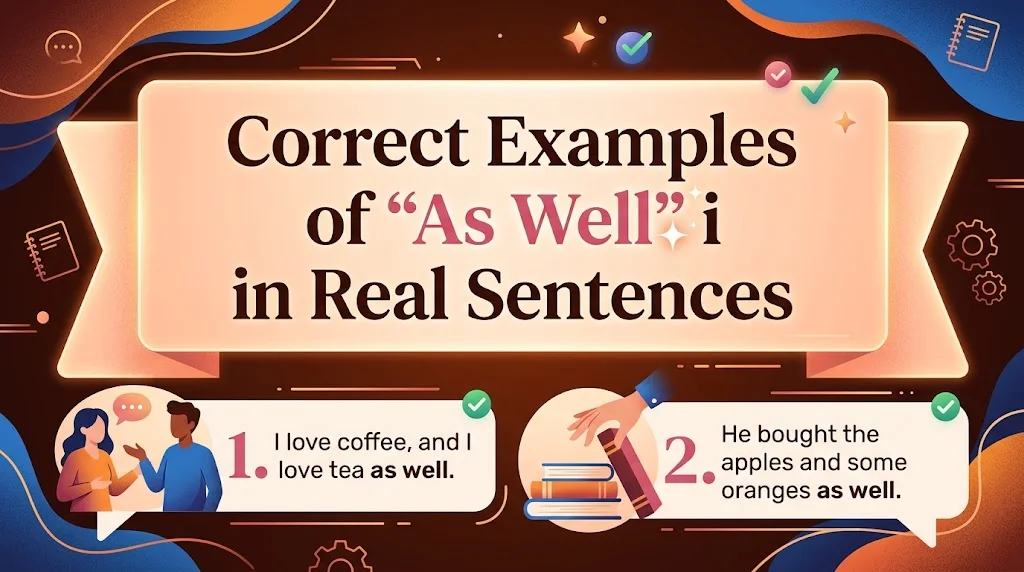
Correct Examples of “As Well” in Real Sentences
Examples With People
- Mia is attending the conference as well.
- My brother wants to come as well.
- The manager joined the discussion as well.
- Several students submitted their projects as well.
Examples With Actions
- I want to learn French as well.
- She enjoys cooking as well.
- They decided to stay overnight as well.
- We visited the museum as well.
Examples With Objects and Ideas
- Please bring your identification as well.
- The package includes batteries as well.
- The report discusses costs as well.
- We should consider the deadline as well.
Examples in Professional Writing
Please review the attached contract as well.
The revised report includes the financial data as well.
We should discuss the delivery schedule as well.
Examples in Everyday Conversation
Are you coming as well?
I want pizza as well.
Did you watch the final episode as well?
She lives nearby as well.
Examples of “As Well as” for Comparison
He studies biology as well as chemistry.
The hotel provides breakfast as well as dinner.
She bought shoes as well as a jacket.
These examples show why as well and as well as shouldn’t be treated as identical expressions.
Incorrect Examples and How to Fix Them
“Aswell” → “As Well”
❌ We need more time aswell.
✅ We need more time as well.
Incorrect Placement → Natural Placement
❌ I as well enjoyed the concert.
✅ I enjoyed the concert as well.
The corrected sentence follows the more natural sentence-final pattern.
“As Well” vs. “As Well As”
❌ She speaks English as well Spanish.
✅ She speaks English as well as Spanish.
Here, as well as is necessary because the expression connects English and Spanish.
Before-and-After Sentence Corrections
| Incorrect | Correct |
| I need one aswell. | I need one as well. |
| They came aswell. | They came as well. |
| She aswell wants to leave. | She wants to leave as well. |
| He speaks French as well German. | He speaks French as well as German. |
| We also need the receipt as well. | We also need the receipt. |
The final example illustrates another useful point: also and as well can sometimes become unnecessarily repetitive when used together.
Easy Ways to Remember “As Well”
The Two-Word Rule
The simplest memory trick is:
As well = two words.
Don’t let the phrase’s pronunciation fool you. When written, as and well remain separate.
The “Also” and “Too” Substitution Test
If as well means also or too, keep it as two words.
For example:
I want to come as well.
Replace it:
I want to come too.
The meaning remains essentially the same.
That makes the correct spelling easier to remember.
A Simple Memory Trick
Think of as well as a small team of two words.
AS + WELL = AS WELL
They work together, but they don’t merge.
Quick Reference Table
| Question | Answer |
| Is as well correct? | Yes |
| Is aswell correct for “also”? | No |
| How many words are in as well? | Two |
| Can it mean “too”? | Yes |
| Can it be used formally? | Yes |
| Is it used in American English? | Yes |
| Is it used in British English? | Yes |
| Is as well as the same expression? | No |
Mini Quiz: As Well or Aswell?
Test yourself before checking the answers.
Choose the Correct Spelling
Which sentence is correct?
A. I want to join aswell.
B. I want to join as well.
Answer: B
The expression meaning “too” is spelled as well.
Find the Incorrect Usage
Which sentence contains an error?
A. She wants to come as well.
B. He bought a ticket aswell.
C. We ordered lunch as well.
Answer: B
It should read:
He bought a ticket as well.
Complete the Sentence
I would like some water ______.
A. aswell
B. as well
C. as well as
Answer: B
The sentence means the speaker wants water too.
Choose Between “As Well,” “Also,” and “Too”
Which sentence is natural?
I ______ need a copy of the receipt.
A. as well
B. also
C. too
Answer: B
Also commonly appears before the main verb:
I also need a copy of the receipt.
Identify “As Well as”
Which sentence correctly uses as well as?
A. I want to attend as well.
B. I want to attend as well as the workshop.
Answer: B
Here, as well as connects two elements.
True or False
“Aswell” is the standard spelling in British English.
Answer: False.
British English uses as well, just like American English.
Answer Key With Explanations
The key distinction is simple:
- as well = correct two-word expression
- aswell = incorrect spelling for this meaning
- as well as = a related but different construction
- also = another common way to express addition
- too = another common synonym for “as well”
Frequently Asked Questions
Is “Aswell” Ever Correct?
For the standard English expression meaning “also” or “too,” aswell is not the correct spelling.
Use:
as well
rather than:
aswell
If you see aswell in ordinary writing, it is generally a spelling error.
Should “As Well” Always Be Written as Two Words?
Yes, when you’re using the standard expression meaning “also,” “too,” or “in addition,” write it as two words:
as well
For example:
I want to attend as well.
What Does “As Well” Mean?
As well commonly means “also,” “too,” or “in addition.”
For example:
She wants to participate as well.
This means:
She wants to participate too.
Can “As Well” Be Used in Formal Writing?
Yes. As well is standard English and works in formal, professional, academic, and everyday writing.
For example:
The report examines environmental effects as well.
Depending on the sentence, also may provide a smoother style, but as well itself isn’t too informal for professional writing.
What Is Another Word for “As Well”?
Common alternatives include:
- also
- too
- in addition
- additionally
The best choice depends on sentence structure and tone.
For example:
I want to come as well.
I also want to come.
I want to come too.
All three communicate a similar idea.
Is “As Well” the Same as “Too”?
In many sentences, yes.
I want one as well.
I want one too.
Both mean the speaker wants one in addition to something already mentioned.
However, too and as well don’t always behave identically in every grammatical context.
Is “As Well” the Same as “Also”?
They often have the same basic meaning, but their usual positions differ.
I also like coffee.
I like coffee as well.
Both can mean that the speaker likes coffee in addition to something else.
What Is the Difference Between “As Well” and “As Well As”?
As well commonly means “also” or “too.”
I want to go as well.
As well as commonly connects two people, things, or actions.
I want to visit London as well as Paris.
The two expressions shouldn’t be treated as interchangeable.
Why Do People Write “Aswell”?
The mistake probably comes from the fact that as well sounds like one connected phrase when spoken. Fast typing, unfamiliarity, and confusion with compound words can also contribute.
However, standard spelling keeps the words separate.
Is “As Well” Correct in American English?
Yes. As well is standard American English.
It can appear in casual conversation, professional correspondence, academic writing, articles, reports, and many other contexts.
Is “As Well” Correct in British English?
Yes. British English also uses as well as a standard two-word expression.
There is no standard British spelling aswell for this meaning.
Conclusion: As Well or Aswell?
When you’re deciding between as well or aswell, the answer is clear: as well is the correct standard form.
The expression is written as two separate words and commonly means “also,” “too,” or “in addition.”
For example:
I want to come as well.
The incorrect version would be:
I want to come aswell.
The distinction may look small, but accurate spelling helps your writing look polished and professional. It also prevents confusion when you’re writing emails, school assignments, articles, reports, or other important documents.
Remember three simple points:
- As well is correct.
- Aswell is not the standard spelling for “also” or “too.”
- As well as is a related expression with a different grammatical function.
When in doubt, try replacing as well with also or too. If the meaning still works, you probably have the right expression. Most importantly, keep that space between as and well.