Have you ever paused while writing and wondered whether “other than” or “other then” is the correct phrase? You’re not alone. These two expressions look almost identical, and a single letter can change the meaning of a sentence.
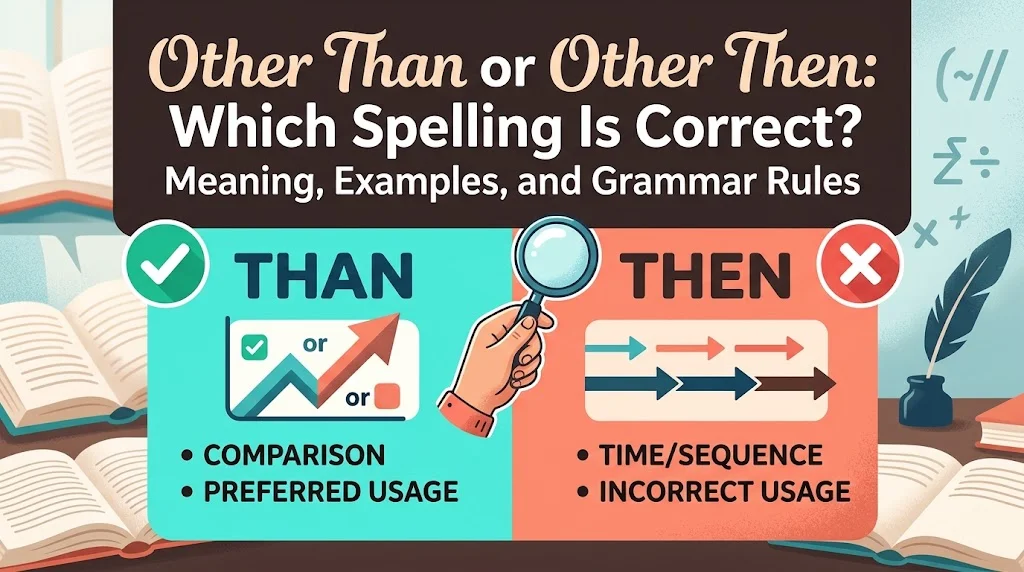
Here’s the simple answer: “Other than” is the standard phrase when you mean “except,” “besides,” or “apart from.” The word then usually refers to time, order, or a result. It doesn’t replace than in this expression.
For example, you might write, “Other than Sarah, everyone attended the meeting.” However, writing “Other then Sarah” would be incorrect if you intended to exclude Sarah from the group.
Although the difference seems small, choosing the right word makes your writing clearer. It also helps readers understand your message without stopping to figure out what you mean.
In this guide, you’ll learn the meaning of other than, the difference between than and then, common spelling mistakes, and practical ways to remember the correct usage. You’ll also find examples, comparison tables, and a short quiz to test your understanding.
Let’s start with the basic rule.
Other Than or Other Then: Which One Is Correct?
“Other than” is correct when you mean “except,” “besides,” or “apart from.” “Other then” is generally a mistake when someone intends to express those meanings.
The confusion happens because than and then have similar spellings and sounds. However, they serve different grammatical purposes.
Consider these examples:
- Correct: Other than coffee, I don’t drink anything in the morning.
- Incorrect: Other then coffee, I don’t drink anything in the morning.
- Correct: Nobody knew the answer other than Emma.
- Incorrect: Nobody knew the answer other then Emma.
In both correct examples, other than identifies an exception. The incorrect versions use then, which doesn’t express the intended relationship.
Here’s another way to understand the distinction:
| Expression | Meaning | Example |
| Other than | Except or apart from | Other than Monday, I’m available all week. |
| Than | Used for comparisons | This route is shorter than the other one. |
| Then | Refers to time or sequence | We finished lunch and then went shopping. |
| If…then | Introduces a result or consequence | If you finish early, then you can leave. |
The easiest rule to remember is this: Use than for comparisons and in the established phrase other than. Use then for time, sequence, and related results.
What Does “Other Than” Mean?
The phrase other than can express an exception, introduce an additional option, or distinguish one thing from another. Its exact meaning depends on the sentence.
For instance, “Other than my brother, everyone likes spicy food” identifies an exception. Meanwhile, “I have no plans other than visiting my grandparents” identifies the only plan being considered.
The phrase is common in everyday conversation, academic writing, professional emails, and formal documents.
Let’s explore its main uses.
Other Than Meaning “Except”
One of the most common meanings of other than is “except” or “excluding.” You use it when you want to identify someone or something that doesn’t belong to a particular group.
For example:
- Other than James, everyone arrived on time.
- I eat everything other than mushrooms.
- No one other than the manager can approve this request.
- The store is open every day other than Sunday.
- Other than a small scratch, the car looks perfect.
In each sentence, the phrase separates one person or thing from the rest.
Take the sentence, “Everyone passed the exam other than Mark.” It means Mark did not pass, while the other people did.
You can often replace other than with except for without changing the main meaning.
Example:
- Original: Other than two spelling errors, your essay is excellent.
- Alternative: Except for two spelling errors, your essay is excellent.
Both sentences identify the same exception.
However, always consider the full sentence before substituting a phrase. Similar expressions don’t fit every grammatical structure equally well.
Other Than Meaning “Besides” or “In Addition To”
Sometimes, other than introduces something additional rather than simply excluding it. In these cases, it can mean besides or apart from.
Consider these examples:
- Other than English, Maria speaks Spanish and French.
- What do you enjoy doing other than reading?
- Other than his regular job, Daniel runs a small online business.
- Is there anything other than water available?
- Other than the books we ordered, the package contained a notebook.
The intended meaning depends on the context.
For example, “What do you enjoy doing other than reading?” asks about activities besides reading. It doesn’t suggest that reading is forbidden or excluded from someone’s interests.
Similarly, “Other than English, she speaks French” identifies an additional language she speaks.
One useful tip is to ask yourself whether the sentence refers to an exception or an additional possibility. That question often makes the meaning clear.
Other Than for Showing Differences
The phrase can also identify something outside a particular category or distinguish one option from another.
For example:
- I wanted something other than a traditional birthday party.
- She chose a career other than medicine.
- We need a solution other than increasing prices.
- He asked for something other than the usual coffee.
- They considered options other than moving abroad.
In these examples, other than introduces an alternative.
Notice the difference between these two sentences:
- “I want something other than tea.” This expresses a desire for an alternative.
- “Coffee is stronger than tea.” This compares two drinks.
The first sentence uses other than to identify an alternative. The second uses than to compare the strength of two drinks.
Understanding that distinction helps you choose the right expression without memorizing dozens of separate rules.
Than vs. Then: Understanding the Difference
The main reason people write other then instead of other than is that they confuse two words with different jobs.
Although than and then look similar, they aren’t interchangeable. One commonly connects comparisons, while the other usually relates to time, sequence, or consequences.
What Does “Than” Mean?
Than is primarily used to introduce the second part of a comparison. It helps explain how one person, object, amount, or situation differs from another.
You’ll often see it after comparative words such as better, worse, taller, shorter, faster, slower, more, and less.
Here are some examples:
- My new phone is faster than my old one.
- This exercise is easier than the previous exercise.
- Sarah is taller than her brother.
- We received more applications than we expected.
- I’d rather walk than wait for the bus.
- The weather is warmer today than it was yesterday.
In each example, than connects two things being compared.
However, than doesn’t appear only in obvious comparisons. It’s also part of established expressions such as other than, rather than, and more than.
For example:
- Nobody called other than my sister.
- I’d prefer tea rather than coffee.
- The repair cost more than $200.
These expressions serve different purposes, but they all use than, not then.
Remember: When you compare two things or use a phrase that requires than, choose the spelling with an a.
What Does “Then” Mean?
Then usually refers to a time, an order of events, or a result. It can tell readers when something happened, what happened next, or what follows from a condition.
Here are its main uses.
To refer to a particular time
- I lived in Chicago back then.
- Things were different in those days, and I remember them well.
- She was younger then than she is now.
To describe a sequence of events
- We finished dinner and then watched television.
- First, read the instructions. Then, complete the form.
- He packed his bags and then called a taxi.
To introduce a result or consequence
- If you’re ready, then we can begin.
- If the store is closed, then we’ll return tomorrow.
- You missed the deadline, so you’ll need to submit a new application.
To describe what follows logically
- If all the seats are taken, then we’ll stand.
- If the information is correct, then the report is ready.
These examples show why then doesn’t fit the usual meaning of other than. The phrase isn’t describing when an event occurs or what happens next. Instead, it identifies an exception, an additional item, or an alternative.
The Main Difference Between Than and Then
The quickest way to distinguish the two words is to look at the relationship they express.
| Feature | Than | Then |
| Main function | Comparison | Time, order, or consequence |
| Common expressions | Better than, more than, other than | Back then, since then, and then |
| Example | This book is cheaper than that one. | I bought the book and then read it. |
| Memory clue | Compare two things | Think about what happens next |
Consider this pair:
- Correct: My new job is better than my old one.
- Correct: My new job started in June. I was unemployed then.
Both sentences are grammatical, but the words perform different functions.
In the first sentence, than introduces a comparison between two jobs. In the second, then refers to the time when the speaker was unemployed.
The same distinction explains why other than is correct when expressing an exception.
Read More: Take Effect or Take Affect? The Correct Phrase Explained
Why Is “Other Then” Usually Incorrect?
The expression other then is usually incorrect because writers use it where the established phrase other than is required.
The problem isn’t that then is misspelled. It’s a real English word. The problem is that it doesn’t express the intended meaning in that position.
For example:
- Incorrect: Other then my father, nobody knew about the surprise.
- Correct: Other than my father, nobody knew about the surprise.
The corrected sentence uses other than to identify the one person who knew about the surprise.
Common Incorrect Examples and Their Corrections
Here are common mistakes that show how to fix the phrase.
| Incorrect sentence | Correct sentence | Why? |
| Other then John, everyone agreed. | Other than John, everyone agreed. | The phrase identifies an exception. |
| I have no choice other then to wait. | I have no choice other than to wait. | The phrase introduces the only remaining option. |
| Nothing other then water was available. | Nothing other than water was available. | The phrase identifies what was available. |
| She enjoys nothing other then music. | She enjoys nothing other than music. | The phrase identifies the only thing being discussed. |
| We need another option other then leaving. | We need another option other than leaving. | The phrase introduces an alternative. |
The correction is straightforward in each case: replace then with than when the sentence requires the expression other than.
Can “Other Then” Ever Be Correct?
This question needs a little nuance.
“Other then” is not a standard fixed expression meaning “except,” “besides,” or “apart from.” However, the two words can appear next to each other in a sentence if each has a separate grammatical role and the intended meaning supports that construction.
For instance, consider this sentence:
“Use the other, then continue with the next step.”
Here, other describes an alternative item, and then indicates what to do next. The words aren’t functioning as the phrase other than.
Compare it with these examples:
- Correct: Choose the other option, then submit your answer.
- Correct: Nobody other than Alex submitted an answer.
- Incorrect for the intended meaning: Nobody other then Alex submitted an answer.
The first sentence uses other and then separately. The second uses the standard phrase other than. The third incorrectly substitutes then for than.
There’s also an important distinction between a word sequence and a fixed expression. English allows many combinations of words, but that doesn’t make every combination suitable for every meaning.
When you want to express an exception or an alternative, use other than.
Other Than or Other Then: Examples in Different Contexts
Learning the rule is helpful, but seeing it in realistic situations makes it easier to apply. The following examples show how the phrase works in everyday, academic, and professional writing.
Other Than in Everyday Conversation
People frequently use other than when discussing preferences, plans, food, hobbies, and personal choices.
Examples include:
- Other than pizza, what would you like for dinner?
- I don’t watch much television other than the evening news.
- Other than Saturday, I’m free all week.
- Is there anything other than coffee you’d like to drink?
- Nobody other than my best friend knows the secret.
- I enjoy outdoor activities other than hiking.
- Other than a little rain, the weather was perfect.
Notice how the meaning changes with the context. Some sentences ask about additional choices, while others exclude something from a group.
In conversation, people might not notice a than/then error immediately. In writing, however, the incorrect phrase can distract readers or make the sentence look poorly edited.
Other Than in Academic Writing
In essays, assignments, and research papers, other than helps writers define exceptions and clarify statements.
For example:
- No significant differences were observed other than those described in the results.
- Other than the sources listed in the references, no additional materials were used.
- The study found no explanation other than the one proposed by the researchers.
- Other than minor formatting issues, the report met the submission requirements.
Academic writing often requires precision. A small word substitution can make a sentence less clear, especially when readers are trying to understand a detailed argument.
When editing an assignment, check whether other than introduces an exception or limitation. If it does, the phrase should contain than.
Other Than in Professional Emails
Professional communication benefits from clear, direct wording. The phrase other than works naturally in workplace emails, project updates, reports, and business discussions.
Consider these examples:
- Other than the missing attachment, your email looks complete.
- We have no outstanding issues other than the final approval.
- Other than the delivery date, all project details remain unchanged.
- Please let me know if you need anything other than the updated report.
- The team has no concerns other than the proposed schedule.
These sentences communicate exceptions without sounding overly formal.
For professional writing, the best approach is to proofread both spelling and meaning. A spellchecker may recognize then as a correctly spelled word even when the sentence requires than.
Other Than in Formal and Informal English
Is other than suitable for formal writing? Yes. It works in both formal and informal contexts.
| Context | Example |
| Casual conversation | Other than pizza, what do you want? |
| School assignment | No errors were found other than two punctuation mistakes. |
| Business email | Other than the revised budget, everything remains unchanged. |
| Academic report | No variables were altered other than those specified in the methodology. |
| Personal message | I don’t need anything other than a little rest. |
You don’t need a more complicated expression to make your writing sound professional. In most situations, other than is clear, natural, and appropriate.
Other Than vs. Other Then: A Detailed Comparison
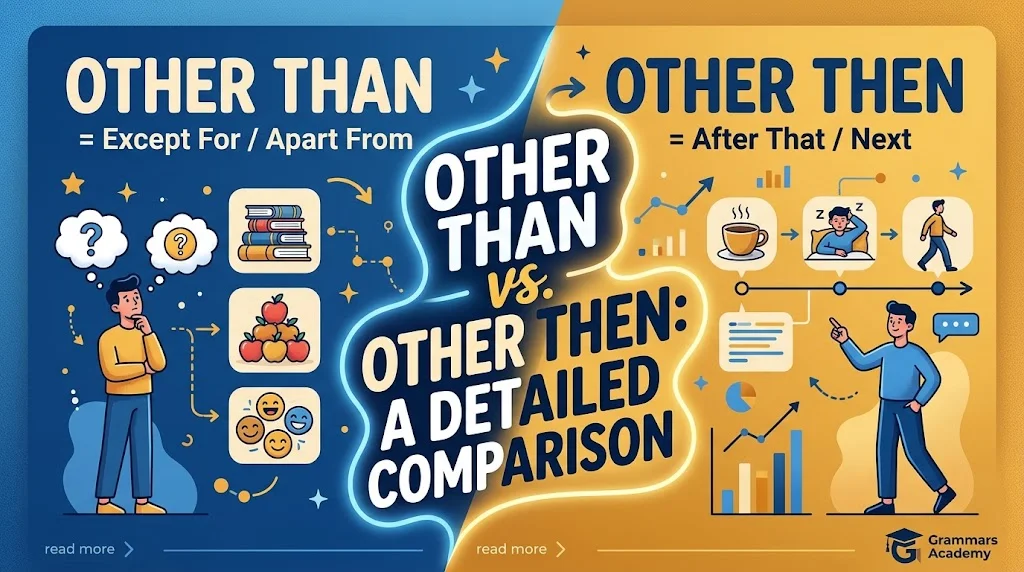
The difference becomes easier to remember when you compare complete sentences rather than isolated words.
Both than and then are valid English words. The key is choosing the one that matches the relationship you’re trying to express.
| Sentence | Correct or incorrect? | Explanation |
| Other than Lily, everyone came to the party. | Correct | Other than identifies an exception. |
| Other then Lily, everyone came to the party. | Incorrect | Then doesn’t express the intended exception. |
| My sister is older than me. | Correct | Than introduces a comparison. |
| We ate lunch and then went home. | Correct | Then shows the sequence of events. |
| I have no option other than waiting. | Correct | Other than introduces the remaining option. |
| I have no option other then waiting. | Incorrect | The phrase requires than. |
| Back then, we walked to school. | Correct | Then refers to a past time. |
| This route is shorter than the highway. | Correct | Than compares two routes. |
Why Context Matters More Than Spelling Alone
A sentence can contain a correctly spelled word and still be grammatically wrong. That’s precisely what happens when a writer uses then instead of than.
For example, a spellchecker may accept both words because each exists in English. It may not recognize the substitution without understanding the sentence’s intended meaning.
That’s why you should check the relationship between words rather than relying on spelling tools alone.
Ask yourself:
- Am I excluding something from a group?
- Am I introducing an alternative?
- Am I comparing two things?
- Am I describing when something happened or what happened next?
If you’re excluding something or introducing an alternative, other than will usually fit. If you’re describing time or sequence, then may be appropriate.
Easy Ways to Remember Than vs. Then
You don’t need to memorize complicated grammar terminology to use these words correctly. A few practical memory tricks can help you make the right choice while writing.
Use “Than” When Comparing
The word than frequently appears in comparisons.
Remember these familiar expressions:
- Better than
- Worse than
- More than
- Less than
- Taller than
- Faster than
- Rather than
- Other than
Try remembering the phrase “other than” as one complete expression rather than deciding between than and then every time you write it.
For example:
“I’d rather read a book other than watch television.”
The sentence uses than in rather than and other than. Both expressions require that spelling.
Use “Then” When Referring to Time
Think of then as a word that helps you follow a timeline.
For example:
- I woke up.
- I ate breakfast.
- Then I went to work.
The word then connects the events in order.
You can also associate it with expressions such as:
- Back then
- Until then
- Since then
- Every now and then
- First this, then that
When a sentence answers the question when? or what happened next?, then may be the word you need.
Replace “Other Than” With “Except For”
Here’s a practical test that works in many sentences.
If you can replace other than with except for without changing the intended meaning, you probably need than.
For example:
- Original: Other than James, everyone finished the assignment.
- Replacement: Except for James, everyone finished the assignment.
Both versions express the same exception.
Try the same test with an incorrect sentence:
- Incorrect: Other then James, everyone finished the assignment.
- Intended meaning: Except for James, everyone finished the assignment.
The replacement reveals the problem. The sentence needs other than.
This technique isn’t a universal grammar test for every possible sentence, but it’s useful for the common mistake discussed here.
Ask Whether the Sentence Refers to Time
If you’re still unsure, look at the word’s job.
Compare these sentences:
- Other than Monday, I’m available every day. The phrase identifies an exception.
- I was busy then. The word refers to a particular time.
- Other than the final chapter, I finished the book. The phrase identifies an exception.
- I finished the final chapter and then closed the book. The word indicates sequence.
The difference becomes clear when you focus on meaning instead of appearance.
Common Mistakes With Than and Then
Even confident writers make mistakes with words that look or sound similar. Understanding the most common patterns can help you catch them before they appear in a finished document.
Mistake: Writing “Other Then” Instead of “Other Than”
This is the central error.
Incorrect: “Other then my regular duties, I help train new employees.”
Correct: “Other than my regular duties, I help train new employees.”
The corrected sentence uses other than to introduce information beyond the regular duties. Depending on the intended meaning, besides might also work.
Mistake: Confusing “Better Than” With “Better Then”
Comparisons require than.
Incorrect: This laptop is better then my old computer.
Correct: This laptop is better than my old computer.
The sentence compares two laptops. It doesn’t describe a sequence of events.
However, then can appear in a separate part of a sentence:
“I used my old computer then, but my new laptop is better.”
Here, then refers to the time when the writer used the old computer.
Mistake: Confusing “More Than” With “More Then”
Use more than when expressing a comparison or quantity.
Incorrect: The package weighs more then five pounds.
Correct: The package weighs more than five pounds.
Another example:
- Incorrect: More then 100 people attended the event.
- Correct: More than 100 people attended the event.
The word than introduces the comparison between the actual amount and the stated number.
Mistake: Relying Only on Spellcheck
Spellcheckers can identify many spelling errors, but they don’t always catch words that are spelled correctly and used incorrectly.
For example, both than and then are valid words. A basic spelling checker may accept either one without recognizing that the sentence requires a particular choice.
To reduce these errors:
- Read the entire sentence instead of checking isolated words.
- Check whether the phrase expresses comparison, exception, or time.
- Use grammar-checking software as a supporting tool.
- Read important emails and assignments aloud before sending them.
- Review recurring mistakes so you can recognize them more quickly.
A few seconds of proofreading can prevent an easily avoidable error.
How to Avoid Than and Then Errors in Your Writing
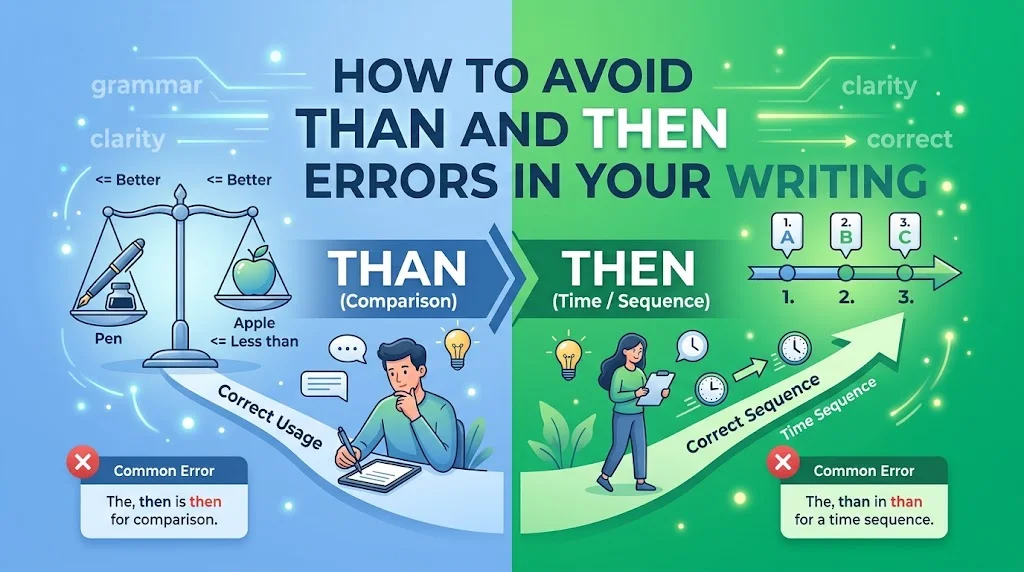
Correct grammar doesn’t require you to stop and analyze every sentence. The goal is to develop a habit of recognizing common patterns.
Proofread for Meaning, Not Just Spelling
When you review your writing, look beyond misspelled words. Ask whether each word expresses the relationship you intend.
For example:
“Other then the budget, we need approval from the director.”
The words are familiar, and the sentence may look reasonable at first glance. However, the phrase should be other than because it introduces an exception or additional consideration.
A useful proofreading routine is to check these three things:
- Meaning: Does the word communicate the intended idea?
- Grammar: Does the word fit the sentence?
- Clarity: Can readers understand the sentence on the first attempt?
This method works for many commonly confused words, not just than and then.
Read the Sentence Aloud
Reading aloud forces you to slow down and pay attention to the sentence’s structure.
Although than and then can sound similar in casual speech, reading the sentence aloud may reveal awkward wording or an unclear meaning.
For example:
“Other then the missing pages, the report is complete.”
When you read the sentence carefully, you can ask whether then makes sense. Replacing it with than produces the intended meaning.
Reading aloud won’t catch every error, but it can help you identify sentences that deserve another look.
Use Grammar Tools as a Second Check
Writing tools can help identify possible grammatical problems, punctuation mistakes, and awkward phrasing.
However, don’t accept every automated suggestion without reviewing it. Tools can misunderstand context or recommend changes that alter your intended meaning.
A reliable approach combines automated checking with your own judgment:
- Write the sentence naturally.
- Run a spelling and grammar check.
- Review suggested corrections.
- Confirm that the final wording expresses your intended meaning.
This process is especially helpful when writing professional emails, school assignments, website articles, and reports.
Learn Commonly Confused Words
The than/then distinction belongs to a larger group of common English mistakes.
Here are a few examples worth learning:
| Commonly confused words | Main difference | Example |
| Than / Then | Comparison versus time or sequence | Better than; see you then |
| Your / You’re | Possession versus you are | Your book; you’re ready |
| Their / There / They’re | Possession, place, and they are | Their house is over there. They’re home. |
| Its / It’s | Possession versus it is or it has | The dog wagged its tail. It’s friendly. |
| Affect / Effect | Usually a verb versus a noun | The weather can affect mood. The effect was noticeable. |
| To / Too / Two | Direction or infinitive, also or excessively, and the number | Go to school, too many, two books |
You don’t have to master every confusing word at once. Start with the mistakes you make most often and practice them in complete sentences.
Mini Quiz: Other Than or Other Then?
Now it’s time to test what you’ve learned. Choose the correct word or phrase for each sentence before checking the answers.
Test your grammar
0 of 8 answered
Choose one answer for each question. Then check your results and explanations.
1. Other ___ my brother, everyone enjoyed the movie.
than
then
2. We finished dinner and ___ went for a walk.
than
then
3. My new shoes are more comfortable ___ my old ones.
than
then
4. I have no choice other ___ to tell the truth.
than
then
5. I lived in that neighborhood back ___.
than
then
6. Other ___ a few minor errors, your essay is excellent.
than
then
7. Which sentence is correct?
This route is shorter then the other route.
This route is shorter than the other route.
8. Choose the correct sentence.
Other then Sarah, nobody attended.
Other than Sarah, nobody attended.
Check my answers
What the Quiz Teaches You
The questions cover the most important rules:
- Use other than to identify an exception or alternative.
- Use than in comparisons such as shorter than and more comfortable than.
- Use then to describe a time or the next event in a sequence.
- Read the entire sentence before choosing a word.
If you answered a question incorrectly, don’t worry. Focus on what the word does in the sentence rather than how it looks.
Frequently Asked Questions About Other Than or Other Then
Is “Other Than” or “Other Then” Correct?
Other than is the correct phrase when you mean except, besides, or apart from. For example, “Other than Monday, I’m available every day.”
Other then is incorrect when used as a substitute for this established expression.
What Does “Other Than” Mean?
Other than can mean except, besides, or apart from. It identifies an exception, introduces an additional possibility, or distinguishes something from another option.
For example, “Other than coffee, I drink tea every morning” identifies a drink besides coffee.
Is “Other Then” Ever Grammatically Correct?
Other then isn’t a standard expression equivalent to other than. However, the words other and then can appear near each other when they serve separate grammatical functions.
For example, “Choose the other option, then continue” uses other to identify an alternative and then to indicate the next action.
Why Do People Confuse Than and Then?
People often confuse these words because their spellings are similar and their pronunciation can be similar in everyday speech.
However, their meanings differ. Than commonly introduces comparisons and appears in expressions such as other than. Then generally refers to time, sequence, or consequences.
Learning a few common expressions can help you remember which word belongs in each sentence.
Is “Other Than” Formal English?
Yes. Other than is appropriate in both formal and informal English.
You can use it in academic papers, professional emails, business reports, personal messages, and everyday conversations.
For example, “Other than the final review, the project is complete” works well in a professional update.
Which Is Correct: “Better Than” or “Better Then”?
Better than is correct when comparing two things.
For example, “This solution is better than the previous one” compares two solutions.
You can use then in a different context, such as “Things were different then.” In that sentence, then refers to a particular time.
Can Grammar Checkers Detect Than and Then Errors?
Some grammar checkers can identify incorrect word choices by analyzing sentence context. However, they may miss mistakes when both words are spelled correctly.
For example, a basic spellchecker might accept “Other then my sister, everyone came” because then is a valid English word.
For reliable proofreading, combine grammar tools with a quick review of the sentence’s meaning.
What Are Some Synonyms for “Other Than”?
Common alternatives include:
- Except for: Other than John, everyone arrived. → Except for John, everyone arrived.
- Apart from: Apart from the cost, the plan looks good.
- Besides: Besides English, she speaks French.
- Excluding: Excluding weekends, the process takes five days.
These expressions overlap in meaning, but they’re not interchangeable in every sentence. Choose the one that fits your intended meaning and sentence structure.
Conclusion: Remember the Difference Between Other Than and Other Then
The difference between other than or other then is easier to understand once you focus on meaning rather than spelling.
Use other than when you mean except, besides, apart from, or when introducing an alternative. Use than in comparisons such as better than, faster than, and more than.
On the other hand, use then when referring to time, sequence, or a result. Expressions such as back then, since then, and and then show how the word works in everyday English.
Here’s the simplest reminder:
- Than: Comparisons and the phrase other than.
- Then: Time, sequence, and consequences.
When you’re unsure, try replacing other than with except for. If the sentence keeps its intended meaning, you’ve probably found the right expression.
With a little practice, you’ll recognize the difference naturally and avoid this common writing mistake in emails, essays, blog posts, and everyday conversations.