Choosing between Hola or Ola can feel surprisingly confusing, especially when you’re learning Spanish. Both words sound alike because the h in Spanish is silent, yet their meanings are completely different. Hola is a common Spanish greeting that means hello or hi, while ola is a Spanish noun meaning wave. There’s also a third form worth knowing: olá, the Portuguese word for hello.
Understanding this small spelling difference can make your Spanish writing much clearer. It also helps you avoid common language mistakes in texts, conversations, school assignments, travel messages, and everyday communication. Instead of guessing from pronunciation, focus on the word’s meaning and the language you’re using.
In this guide, you’ll learn how hola and ola work in real Spanish sentences, why they sound identical, when to use each spelling, and how Portuguese olá fits into the picture. You’ll also see practical examples, common mistakes, easy memory tricks, and quick comparisons. By the end, choosing the correct word should feel simple: hola for a Spanish greeting, ola for a Spanish wave, and olá for a Portuguese greeting. That distinction may seem tiny, but it reflects an important lesson about spelling, pronunciation, context, and meaning in related languages. It is worth mastering.
Hola vs. Ola: What’s the Difference?
The simplest distinction is this:
- Hola = “hello” or “hi” in Spanish.
- Ola = “wave” in Spanish.
- Olá = “hello” or “hi” in Portuguese.
The words may look almost identical, but their functions differ.
| Word | Language | Meaning | Example |
| hola | Spanish | Hello, hi | Hola, ¿cómo estás? |
| ola | Spanish | Wave | La ola es enorme. |
| olá | Portuguese | Hello, hi | Olá, tudo bem? |
There’s an important detail here. Spanish hola and Spanish ola are pronounced alike because Spanish h is silent.
That creates a homophone situation. Two words can have the same pronunciation while having different spellings and meanings.
So if someone says hola aloud, you can’t identify the spelling from the sound alone. Context helps you determine what the speaker means.
Hola Meaning in Spanish
Hola is the standard Spanish word for “hello” or “hi.”
You can use it when beginning a conversation, greeting someone you know, or addressing someone you’ve just met.
For example:
Hola, ¿cómo estás?
Hello, how are you?
You might also hear:
¡Hola, María!
Hi, María!
Or:
Hola, ¿qué tal?
Hi, how are you? / Hi, how’s it going?
Unlike some English greetings that can feel strongly formal or informal, hola works across many everyday situations. The level of formality often comes from the words you add after it and from the overall context.
Ola Meaning in Spanish
Spanish ola is a noun meaning wave.
It commonly describes a physical wave in water:
La ola golpeó la costa.
The wave hit the coast.
You can also use ola in weather-related expressions:
Una ola de calor llegó a la ciudad.
A heat wave arrived in the city.
The word can also appear in figurative expressions describing a large or sudden movement involving people, events, or trends.
So ola isn’t a misspelled version of hola. It is a legitimate Spanish word with its own meaning.
Olá Meaning in Portuguese
Portuguese uses olá as a greeting.
Olá! Como você está?
Hello! How are you?
Notice the accent:
olá
The accent falls on the final á.
This is different from Spanish:
hola
Spanish doesn’t use the accent mark in hola.
That distinction becomes especially important for people learning both Spanish and Portuguese. The languages share many similarities, but similar-looking words don’t necessarily follow identical spelling rules.
Hola Meaning in Spanish: How to Use It Correctly
Once you know that hola means “hello,” using it becomes straightforward.
Hola as a Greeting
You can use hola to open a conversation.
Examples include:
- Hola, Ana.
- Hola, ¿cómo estás?
- ¡Hola, amigos!
- Hola, buenos días.
- Hola, mucho gusto.
The greeting itself doesn’t tell the reader everything about the social relationship. The rest of the sentence and the situation provide that information.
For example:
Hola, señor García.
This sounds more respectful because of the title señor, not because hola itself suddenly became a highly formal word.
Hola in Questions and Conversations
Spanish speakers frequently place hola before another greeting or question.
For example:
Hola, ¿cómo te va?
Hola, ¿qué haces?
Hola, ¿todo bien?
These examples show why context matters. None of them has anything to do with an ocean wave.
Hola in Written Spanish
You can find hola in many forms of everyday communication:
- Text messages
- Online chats
- Social media
- Informal emails
- Personal letters
- Conversation
- Greeting cards
For instance:
Hola, Carlos. Te escribo para confirmar la reunión.
Here, hola simply opens the message.
Ola Meaning in Spanish: How to Use It Correctly
Spanish ola works differently because it functions as a noun.
Ola as an Ocean Wave
The most familiar meaning refers to a wave in water.
La ola era muy alta.
The wave was very high.
Los surfistas esperaban una buena ola.
The surfers were waiting for a good wave.
Una ola grande llegó a la playa.
A big wave reached the beach.
Because ola is a noun, it commonly appears with articles and adjectives:
- la ola — the wave
- una ola — a wave
- olas grandes — big waves
- olas pequeñas — small waves
- una ola enorme — an enormous wave
Ola in Figurative Spanish
Spanish also uses ola in figurative contexts.
For example:
Una ola de entusiasmo recorrió el país.
This describes a powerful spread of enthusiasm rather than literal water.
Similarly, ola de calor means “heat wave.”
Other expressions can describe a sudden or widespread movement using the idea of a wave.
Common Expressions With Ola
Here are useful combinations:
| Spanish | English |
| ola de calor | heat wave |
| ola de frío | cold wave |
| ola gigante | giant wave |
| ola enorme | huge wave |
| ola del mar | sea wave |
| olas grandes | big waves |
| olas pequeñas | small waves |
These examples make the distinction easy to see. If the sentence describes water, weather, or a figurative movement, ola may be the intended word.
Olá vs. Hola: Spanish and Portuguese
One of the biggest sources of confusion is the similarity between Spanish and Portuguese.
Both languages are Romance languages. They share vocabulary and grammatical features because they developed from varieties of Latin. Yet they remain separate languages with their own spelling and pronunciation systems.
Olá Means “Hello” in Portuguese
In Portuguese, olá means “hello” or “hi.”
For example:
Olá, Maria!
Olá, tudo bem?
The accent is part of the standard spelling.
Hola Is Spanish, Not the Portuguese Greeting
If you want to write “hello” in standard Spanish, use:
Hola
If you want to write “hello” in Portuguese, use:
Olá
Don’t simply add or remove the accent based on personal preference.
Ola and Olá Are Not the Same in Portuguese
The accent in Portuguese can distinguish words and indicate stress or pronunciation.
Therefore, someone learning Portuguese should pay attention to:
- olá — hello
- ola — a different written form that isn’t the standard Portuguese greeting
This is a good example of why accents shouldn’t be treated as decorative marks. In many languages, they carry meaningful information.
How Are Hola and Ola Pronounced?
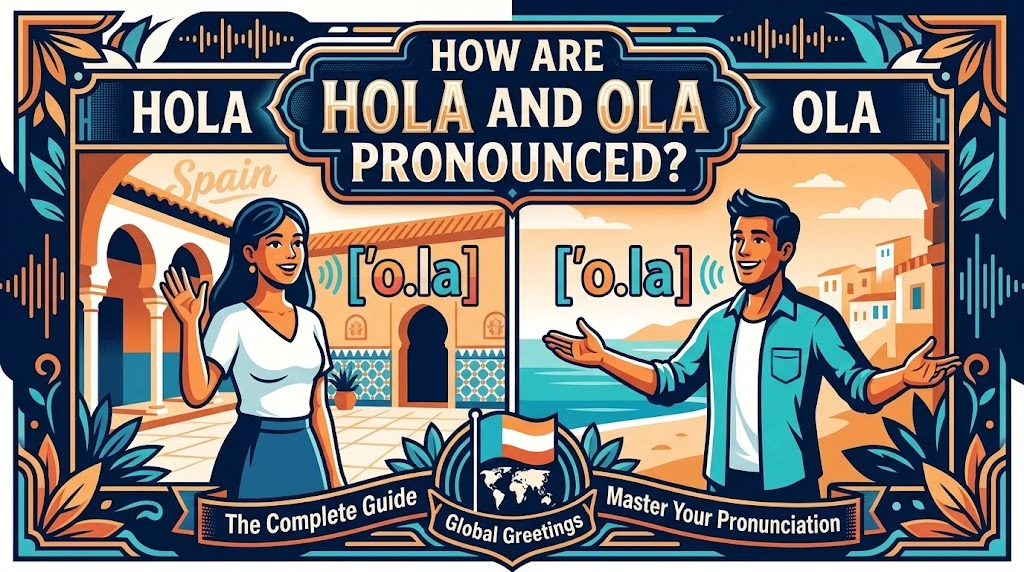
Pronunciation explains much of the confusion surrounding hola vs. ola.
Are Hola and Ola Pronounced the Same in Spanish?
Yes. In standard Spanish pronunciation, the h in hola is silent.
Therefore:
- hola
- ola
have the same pronunciation in Spanish.
The difference appears in spelling and meaning, not in the ordinary pronunciation.
This creates a useful language-learning lesson: sound and spelling don’t always have a one-to-one relationship.
Why the Silent H Matters
Spanish has many words containing an h that doesn’t receive a pronounced consonant sound.
For an English speaker, this can feel unusual because English often gives the letter h a clear sound.
Compare:
- English hello
- Spanish hola
The initial sounds aren’t the same.
That’s why the memory trick H = Hello can help English-speaking learners remember the spelling of Spanish hola.
Why Pronunciation Can Cause Spelling Mistakes
Imagine hearing someone say:
“Hola.”
If you’ve never seen the word written down, you might logically guess:
“Ola.”
The pronunciation doesn’t provide the missing h.
That’s why learners should connect the sound, spelling, and meaning together instead of relying on pronunciation alone.
Hola or Ola: Which One Should You Use?
The answer depends on what you want to say.
Use Hola for “Hello” in Spanish
Choose hola when you’re greeting someone in Spanish.
Correct:
Hola, ¿cómo estás?
Incorrect:
Ola, ¿cómo estás?
The second sentence uses the Spanish word for “wave,” so it doesn’t express the intended greeting.
Use Ola for “Wave” in Spanish
Choose ola when you mean a wave.
Correct:
La ola era enorme.
Here, ola refers to a physical wave.
Another example:
El surfista esperó una ola perfecta.
The word clearly refers to a wave suitable for surfing.
Use Olá for “Hello” in Portuguese
When writing Portuguese, use:
Olá
For example:
Olá, João!
The accent distinguishes the Portuguese greeting from the Spanish spelling.
A Three-Question Decision Rule
When you’re unsure, ask yourself:
Am I writing Spanish or Portuguese?
Then ask:
Am I greeting someone?
Finally:
Am I talking about a wave?
The answer leads you to the correct form:
Spanish + greeting → HOLA
Spanish + wave → OLA
Portuguese + greeting → OLÁ
Simple. No linguistic gymnastics required.
Read More: Wether vs. Weather vs. Whether: What’s the Difference?
Hola vs. Ola in Real Sentences
Seeing the words in context makes the distinction much easier.
Examples With Hola
Hola, ¿cómo estás?
Hello, how are you?
Hola, Carlos.
Hi, Carlos.
¡Hola a todos!
Hello, everyone!
Hola, mucho gusto.
Hello, nice to meet you.
Hola, ¿qué tal?
Hi, how’s it going?
In each sentence, hola functions as a greeting.
Examples With Ola
La ola era muy grande.
The wave was very large.
Una ola golpeó el barco.
A wave hit the boat.
Los niños jugaron entre las olas.
The children played among the waves.
El surfista esperó una ola perfecta.
The surfer waited for a perfect wave.
La ola de calor duró varios días.
The heat wave lasted several days.
Examples With Olá
Olá!
Hello!
Olá, tudo bem?
Hello, how are you?
Olá, João.
Hi, João.
The language context changes the meaning and spelling.
Why Do Hola and Ola Cause Confusion?
The confusion isn’t random. Several linguistic factors work together.
They Sound the Same in Spanish
The silent h creates identical pronunciation between hola and ola.
That means a learner can’t always determine the spelling simply by listening.
This is especially challenging for beginners who haven’t built a strong visual vocabulary yet.
Context Determines Meaning
Consider these two sentences:
Hola, ¿cómo estás?
La ola es grande.
The first sentence clearly involves a greeting.
The second describes a wave.
Context acts like a signpost. It tells you which spelling makes sense.
English Learners May Spell by Sound
English learners often try to map pronunciation directly to letters.
That’s useful in some situations. It doesn’t work perfectly in Spanish.
The missing h in hola is a good example. You hear the same opening sound as ola, but the written greeting requires h.
Spanish and Portuguese Add Another Layer
Someone who knows Portuguese may already recognize olá as “hello.”
That can create another spelling question:
- Spanish: hola
- Spanish: ola
- Portuguese: olá
The languages are related, but their spelling conventions aren’t interchangeable.
Hola vs. Ola: Quick Comparison Guide
Here’s the distinction at a glance.
| Feature | Hola | Ola | Olá |
| Language | Spanish | Spanish | Portuguese |
| Meaning | Hello/hi | Wave | Hello/hi |
| Word type | Greeting/interjection | Noun | Greeting/interjection |
| Spanish H | Silent | None | N/A |
| Accent | None | None | Acute accent |
| Used as a greeting | Yes | No | Yes |
| Means wave | No | Yes | No |
The Easy Memory Trick
Remember:
H = Hello → Hola
Then:
Ola = Ocean wave
And finally:
Olá = Portuguese hello
The memory trick isn’t a linguistic rule. It’s simply an easy way to attach each spelling to its meaning.
Quick Decision Checklist
Before writing the word, check:
- Spanish greeting? → hola
- Spanish wave? → ola
- Portuguese greeting? → olá
- Spanish “holá”? → Not the standard spelling
- Spanish “ola” as hello? → Incorrect
Common Mistakes With Hola and Ola
Mistake: Writing Ola as a Spanish Greeting
A common learner error is:
❌ Ola, ¿cómo estás?
The correct spelling is:
✅ Hola, ¿cómo estás?
Why? Because ola means “wave,” not “hello.”
Mistake: Adding an Accent to Spanish Hola
Another common error is:
❌ Holá
The standard Spanish greeting is:
✅ Hola
Don’t transfer the Portuguese accent to Spanish.
Mistake: Assuming Olá Is Always Wrong
This mistake goes in the opposite direction.
Olá is absolutely correct when you’re writing Portuguese and want to say “hello.”
The problem occurs when someone uses Portuguese spelling in a Spanish sentence.
Mistake: Assuming Ola Is Never Correct
Spanish ola is a perfectly valid word.
For example:
La ola llegó a la orilla.
Here, replacing ola with hola would change the meaning completely.
A Real-Life Example: The Beginner Who Wrote “Ola”
Imagine a Spanish learner sending a message to a Spanish-speaking friend.
They type:
Ola, ¿cómo estás?
The friend can probably understand the intended meaning from context. However, the spelling is incorrect for the greeting.
The learner heard hola, noticed that the h wasn’t pronounced, and wrote the word according to sound.
A better learning strategy is to memorize the greeting visually:
Hola = hello
Then separately learn:
Ola = wave
This approach works because it treats spelling as part of vocabulary rather than something you must always reconstruct from pronunciation.
What This Example Teaches
The mistake highlights three useful lessons:
- Silent letters can create spelling traps.
- Context can reveal intended meaning.
- Correct spelling still matters even when the reader understands you.
That last point becomes particularly important in school, professional communication, translation, and language exams.
Hola vs. Ola in Different Contexts
Everyday Conversation
If you’re greeting someone in Spanish:
Hola, ¿qué tal?
If you’re talking about the sea:
Las olas son fuertes hoy.
The surrounding vocabulary makes the intended meaning obvious.
Travel and Tourism
You might use hola when meeting someone:
Hola, buenos días.
You might use ola while discussing the beach:
Las olas son grandes.
The same pronunciation can appear in both situations, but the written words remain different.
Text Messages and Social Media
Spanish-language messages frequently begin with hola:
Hola, ¿estás libre esta tarde?
Writing ola could make the message look like a spelling mistake.
That’s especially noticeable when you’re trying to communicate clearly with native speakers.
School and Language Learning
Teachers may ask students to distinguish:
- hola
- ola
- olá
The exercise tests more than spelling. It checks whether the student understands language, context, and meaning.
Professional Communication
A Spanish email might begin with a greeting such as:
Hola, Ana:
The appropriate greeting depends on the relationship and communication style. The spelling of hola, however, doesn’t change.
Hola vs. Ola in Active Sentence Patterns
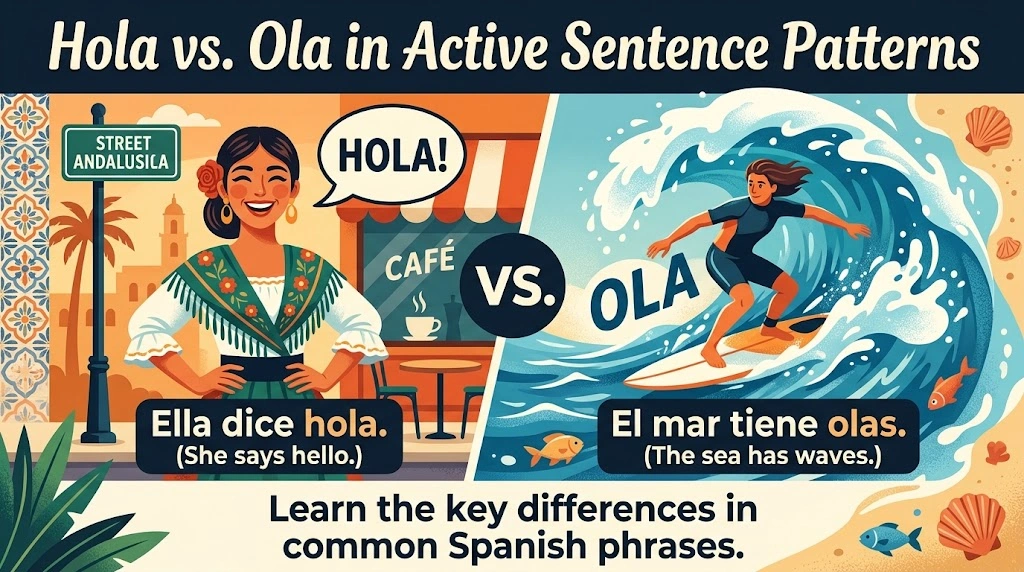
The two Spanish words behave differently grammatically.
Hola generally works as a greeting or interjection:
Hola, Pedro.
Ola functions as a noun:
La ola es alta.
That means you can normally expect articles, adjectives, or other noun-related words around ola.
Compare:
Hola, Pedro.
with:
La ola grande llegó a la costa.
The grammar itself provides another clue.
Grammatical Clues
If you see:
- la ola
- una ola
- olas grandes
- una ola de calor
you’re almost certainly looking at the noun ola.
If you see:
- Hola, Ana.
- Hola a todos.
- ¡Hola!
you’re looking at the greeting hola.
Hola vs. Ola: A Practical Decision Guide
Use this simple process whenever you hesitate.
What do you mean?
|
———————
| |
Greeting Wave
| |
Which language? Spanish
/ \
Spanish Portuguese
| |
HOLA OLÁ
This works because the meaning comes before the spelling.
Instead of asking, “Which spelling looks right?” ask:
“What am I trying to say?”
That small change makes the choice much easier.
Hola vs. Ola: Useful Facts to Remember
Here are the key facts worth keeping in your notes:
- Hola is the standard Spanish greeting meaning “hello” or “hi.”
- The h in hola is silent in Spanish.
- Ola is a Spanish noun meaning “wave.”
- Spanish hola and ola are pronounced alike in standard pronunciation.
- Olá is the Portuguese greeting meaning “hello.”
- Spanish hola does not use an accent.
- Portuguese olá uses an acute accent on the final á.
- Spelling determines meaning even when two words sound the same.
- Context helps distinguish hola from ola.
- Ola isn’t a misspelling when it means “wave.”
Hola vs. Ola Practice Quiz
Test yourself before moving on.
Choose the Correct Word
___, ¿cómo estás?
A. Ola
B. Hola
C. Olá
Answer: B. Hola
La ___ era enorme.
A. hola
B. ola
C. olá
Answer: B. ola
___, ¿cómo você está?
A. Hola
B. Ola
C. Olá
Answer: C. Olá
Fill in the Blank
___, María.
Answer: Hola
Las ___ golpeaban la costa.
Answer: olas
___, tudo bem?
Answer: Olá
Correct the Mistake
❌ Ola, ¿cómo estás?
Correct version:
✅ Hola, ¿cómo estás?
❌ Holá, amigo.
Correct Spanish version:
✅ Hola, amigo.
If the sentence is Portuguese, however, the correct greeting is:
✅ Olá, amigo.
Spanish or Portuguese?
Which language uses olá as a standard greeting?
Answer: Portuguese.
Which language uses hola as its standard greeting?
Answer: Spanish.
Which language uses ola for “wave”?
Answer: Spanish.
True or False
“Hola” and “ola” have the same meaning in Spanish.
False.
They sound alike but have different meanings.
“Ola” can be a correct Spanish word.
True.
It means “wave.”
“Holá” is the standard Spanish spelling for hello.
False.
The standard Spanish spelling is hola.
“Olá” is a Portuguese greeting.
True.
Frequently Asked Questions About Hola vs. Ola
Is “hola” or “ola” correct for hello?
Hola is correct for “hello” in Spanish. Ola means “wave” in Spanish.
If you’re writing Portuguese, olá means “hello.”
Is “ola” a Spanish word?
Yes. Ola is a Spanish word meaning wave.
For example:
La ola es enorme.
The wave is enormous.
Does hola mean hello in Spanish?
Yes. Hola is the standard Spanish greeting for “hello” or “hi.”
It’s one of the most common Spanish greetings.
Why does hola have an H if the H is silent?
Spanish h is silent in hola. The spelling comes from the established history and orthography of the Spanish word.
For learners, the easiest practical approach is to memorize hola as the written form of the greeting rather than trying to reconstruct it from pronunciation.
Are hola and ola pronounced the same in Spanish?
Yes. Because the h in hola is silent, the two words are pronounced alike in standard Spanish.
Their meanings remain different.
Does ola mean hello in Portuguese?
No. The standard Portuguese greeting is olá, with an acute accent on the final á.
Is “olá” Spanish or Portuguese?
Olá is Portuguese.
The standard Spanish greeting is hola.
Is “holá” correct?
Not as the standard Spanish spelling of “hello.”
Use:
Hola
In Portuguese, use:
Olá
What is the difference between hola and olá?
Hola means “hello” in Spanish.
Olá means “hello” in Portuguese.
The languages use different spelling conventions, including the Portuguese accent.
What does ola mean in Spanish?
Ola means wave.
It can refer to a physical wave in water or appear in figurative expressions such as ola de calor, meaning “heat wave.”
Can hola and ola be used interchangeably?
No.
Although they sound alike in Spanish, they have different meanings:
- hola = hello
- ola = wave
Using the wrong spelling can change the meaning or make your sentence incorrect.
How do you remember hola vs. ola?
Use two simple associations:
H = Hello → hola
Ola = ocean wave
For Portuguese, remember:
Olá = hello
The accent is part of the Portuguese spelling.
Final Takeaway: Hola or Ola?
The difference between hola vs. ola is simple once you connect each spelling with its meaning.
Hola means “hello” or “hi” in Spanish. Use it when you’re greeting someone.
Ola means “wave” in Spanish. Use it when you’re talking about waves, whether literal or figurative.
Olá means “hello” in Portuguese. The accent on á is an important part of the Portuguese spelling.
The biggest source of confusion is pronunciation. Spanish h is silent, so hola and ola sound the same. Yet they remain completely different written words.
Keep this three-word pattern in mind:
Hola = Spanish hello
Ola = Spanish wave
Olá = Portuguese hello
When in doubt, think about the meaning first. If you’re greeting someone in Spanish, write hola. If you’re describing a wave, write ola. If you’re greeting someone in Portuguese, write olá.
That small distinction will save you from one of the easiest Spanish spelling traps.
Related Spanish Language Guides
- Spanish greetings and common expressions
- Common Spanish spelling mistakes
- Spanish homophones and confusing words
- Spanish vs. Portuguese vocabulary
- Silent letters in Spanish
- Common Spanish words for English learners