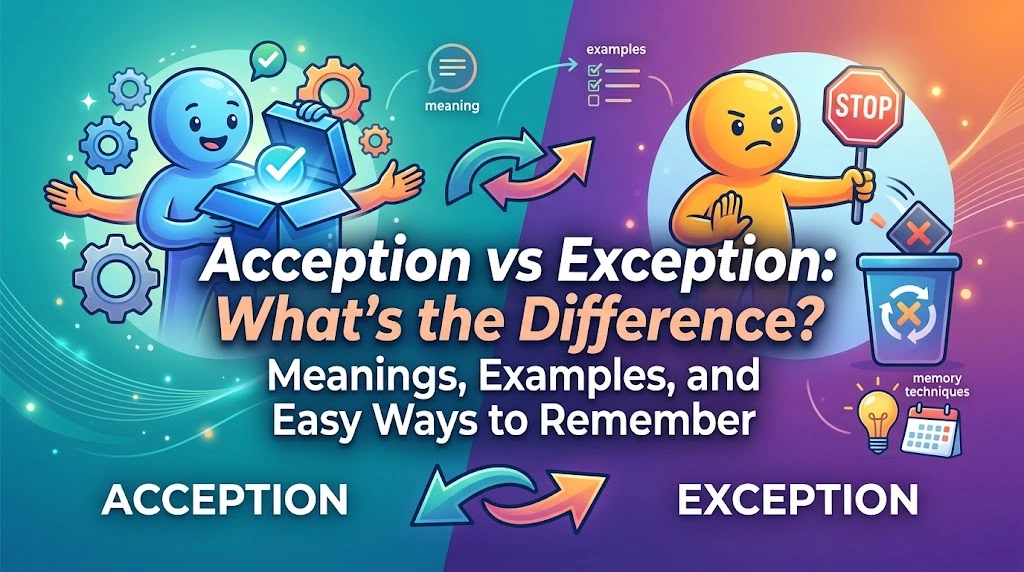
Confusing acception vs exception is easy because the two words look almost identical. Change just one letter and you suddenly have a completely different word. The good news is that the difference becomes simple once you focus on meaning, usage, and word families rather than spelling alone.
Exception is the word you normally need when you’re talking about something excluded from a rule, a situation that differs from the norm, or an objection. For example, you might say, “There is one exception to the rule.” The word connects naturally with except, which means to leave someone or something out.
Acception, however, is a real English word with a much narrower role. Dictionaries record it as a rare or historical term associated with acceptation. It isn’t the normal modern noun form of accept. When you mean the act of accepting something, acceptance is the standard choice.
Understanding acception vs exception also helps you avoid a related mistake involving accept vs except. Think of the words as separate branches: accept → acceptance, while except → exception. Once you learn that connection, choosing the correct word becomes far easier.
Whether you’re writing an email, assignment, article, or formal document, knowing these distinctions can make your English clearer, more precise, and more natural.
Acception vs Exception: The Quick Difference
The quickest way to separate these words is to look at what you’re trying to say.
| Word | Meaning | Modern usage | Example |
| Exception | Something excluded from a rule or something unusual | Common | “Everyone passed the test with one exception.” |
| Acceptance | The act of accepting something | Common | “She received acceptance from the university.” |
| Acception | A rare or historical noun related to acceptation | Rare | Mainly encountered in historical or specialized texts |
The distinction becomes much clearer when you connect each word to a familiar word family.
Except → exception
Accept → acceptance
That relationship gives you a reliable shortcut.
If you’re talking about leaving something out, breaking from a general rule, or identifying an unusual case, exception is almost certainly the word you want.
For example:
“Every employee must attend the meeting, with one exception.”
You wouldn’t normally write:
“Every employee must attend the meeting, with one acception.”
That sentence needs exception because someone is being excluded from the general rule.
Exception Means Something Excluded or Different
An exception is commonly something that doesn’t follow a general rule, expectation, condition, or pattern.
Consider this sentence:
“The store is open every day except Sunday.”
Here, Sunday is excluded.
You can turn that idea into a noun:
“Sunday is an exception to the store’s daily schedule.”
The word can also describe something unusual:
“The company normally promotes managers internally, but James was an exception.”
The central idea remains similar: something stands outside what normally happens.
Acception Is a Rare or Historical Word
Acception exists in English dictionaries, but its status differs dramatically from exception in everyday communication.
Merriam-Webster defines acception as a noun meaning acceptation, and records its history as reaching back to the 14th century. Merriam-Webster: Acception
That historical background matters.
A word can be legitimate without being useful in ordinary modern conversation. Acception is a good example. You may encounter it in older texts, linguistic discussions, or specialized writing. Most contemporary readers, however, won’t expect it in ordinary business, academic, or personal communication.
So the fact that a dictionary recognizes acception doesn’t mean you can substitute it freely for exception.
Acception vs Exception at a Glance
Here’s the practical distinction to keep handy:
| If you mean… | Use… |
| Something excluded from a rule | Exception |
| Something unusual or different | Exception |
| An objection to something | Exception |
| The act of accepting | Acceptance |
| A rare historical meaning related to acceptation | Acception |
The key isn’t the first three letters.
It’s the meaning of the sentence.
What Does Exception Mean?
Exception is a common modern English noun with several related meanings.
Merriam-Webster and Cambridge Dictionary both document its established uses, including an excluded case, something that differs from a general pattern, and an objection. (Merriam-Webster: Exception, Cambridge Dictionary: Exception)
The word appears constantly in everyday conversation and formal writing.
You might encounter it in workplace policies, school rules, legal documents, software documentation, news reports, and casual conversations.
Exception Meaning in Simple English
In simple terms, an exception is something that doesn’t fit the general rule.
Imagine a school rule saying:
“All students must wear the standard uniform.”
If one student receives permission to wear something different because of a special circumstance, that student represents an exception to the rule.
The word can also describe something unusually good or bad.
For example:
“The restaurant is usually busy, but Tuesday was an exception.”
The normal pattern is that the restaurant gets busy. Tuesday didn’t follow that pattern.
So you can think of exception as a linguistic signpost that says:
“This case doesn’t follow the usual pattern.”
The Main Meanings of Exception
Although the meanings overlap, several important uses deserve attention.
Something excluded from a rule or group
This is probably the most familiar meaning.
“Everyone received a certificate with the exception of Mark.”
Mark was excluded.
A case that differs from the usual pattern
An exception can also describe something unusual.
“Most winter days were cold, but that afternoon was an exception.”
The afternoon didn’t match the general pattern.
An objection or disagreement
The phrase take exception to has a different but related meaning.
“The manager took exception to the accusation.”
Here, the manager objected to or was offended by the accusation.
You’re not talking about a rule being broken. You’re talking about strong disagreement or objection.
A specialized legal meaning
In legal writing, exception can have more specific meanings involving objections, rulings, or matters excluded from a particular provision.
The legal use depends heavily on jurisdiction and context. Therefore, legal documents should be interpreted according to the relevant law rather than ordinary dictionary meaning.
A technical computing meaning
In programming, an exception is an event that interrupts the normal flow of program execution.
For example, a program might encounter an invalid input or attempt to access something that doesn’t exist.
That technical meaning is unrelated to the common spelling confusion with acception. It’s simply another established sense of the word.
Common Expressions With Exception
You’ll see exception in several fixed phrases.
| Expression | Meaning | Example |
| exception to the rule | A case that doesn’t follow a rule | “This situation is an exception to the rule.” |
| with the exception of | Excluding someone or something | “Everyone attended with the exception of Lisa.” |
| make an exception | Allow something normally not permitted | “I’ll make an exception this time.” |
| without exception | In every case | “The policy applies without exception.” |
| no exception | Also included or affected | “The new rule applies to everyone, with no exception.” |
| take exception to | Object to something | “She took exception to his comment.” |
These expressions are worth learning as complete phrases because they occur frequently in natural English.
What Does Acception Mean?
Here’s where the acception vs exception question gets interesting.
Acception is a real word. But that doesn’t make it a modern replacement for exception.
Merriam-Webster lists acception as a noun and gives acceptation as its meaning. Its recorded history goes back centuries. (Merriam-Webster: Acception)
Is Acception a Real Word?
Yes.
Calling acception “not a word” would be inaccurate.
The better explanation is that it is rare and largely historical or specialized, while exception remains a normal modern English word.
This distinction is important because dictionary status and everyday frequency aren’t the same thing.
Many English words survive in dictionaries despite becoming uncommon in ordinary speech. You may recognize them when reading older literature or historical linguistic material without ever needing them in a normal email.
That’s essentially the situation with acception.
What Does Acception Mean?
The word is associated with acceptation, which historically refers to the accepted or conventional meaning of a word, expression, or term.
In historical usage, writers could use terminology that looks unfamiliar to modern readers. The meanings and forms of English have changed considerably over the centuries.
That makes acception especially relevant when discussing:
- Historical English
- Older texts
- Historical dictionaries
- Linguistic terminology
- Historical meanings of words
- Specialized discussions of word interpretation
However, modern writers shouldn’t reach for acception simply because it resembles accept.
If you mean that someone agreed to, received, or approved something, acceptance is normally the appropriate noun.
Why You Rarely See Acception Today
Modern English strongly favors familiar forms such as acceptance.
For example:
“We received confirmation of her acceptance.”
That sounds completely natural.
By contrast:
“We received confirmation of her acception.”
Most modern readers would find that unusual or confusing.
The problem isn’t necessarily that the second sentence is grammatically impossible in every historical context. The problem is modern usage and intended meaning.
Clear writing should make the reader’s job easier.
If a common word communicates your meaning accurately, there’s little reason to replace it with an obscure alternative.
Acception vs Acceptance
This is one of the most important distinctions in the entire topic.
Acceptance is the normal modern noun related to accept.
For example:
“The university sent her an acceptance letter.”
Here, acceptance refers to being accepted.
Another example:
“His acceptance of the offer came quickly.”
Again, the noun describes the act or state of accepting.
Compare that with exception:
“There was an exception to the offer.”
Now the meaning has completely changed. You’re talking about something excluded from the offer.
Acception vs Exception: Detailed Comparison
The spelling similarity can make these words look like close relatives. Their practical functions, however, are very different.
Difference in Meaning
Exception commonly refers to:
- Something excluded
- A deviation from a rule
- An unusual case
- An objection
Acception refers to a rare or historical concept connected with acceptation.
Acceptance refers to the act or process of accepting.
Here’s a useful mental picture:
ACCEPT
│
└── ACCEPTANCE
→ accepting something
EXCEPT
│
└── EXCEPTION
→ something excluded or different
ACCEPTION
│
└── rare/historical usage
→ related to acceptation
This isn’t merely a spelling trick. It reflects how the words function.
Difference in Modern Usage
Modern English gives exception a very active role.
You encounter it in ordinary phrases such as:
“There are no exceptions.”
“She’s an exception to the rule.”
“I’ll make an exception.”
“He took exception to the criticism.”
Acception, by comparison, appears much less frequently.
That difference should influence your word choice.
If you’re writing a school assignment, professional email, website, report, or social post, exception or acceptance will usually be the word you need.
Difference in Word Families
Word families make this distinction easier.
| Verb | Noun | Related adjective |
| accept | acceptance | acceptable |
| except | exception | exceptional |
This is one of the most useful patterns to remember.
Notice the meaning shift:
Accept involves receiving, approving, or agreeing.
Except involves excluding or leaving something out.
That single vowel difference can change the entire sentence.
Why Exception Is Usually the Correct Word
When someone writes acception instead of exception, the intended meaning usually involves exclusion or deviation.
That’s your clue.
Think of the Word Except
The easiest memory connection is:
EXCEPT → EXCEPTION
The word except means that something or someone is excluded.
For example:
“Everyone came except John.”
John didn’t come.
Now turn that idea into a noun:
“John was the exception.”
The relationship becomes obvious.
Except excludes.
Exception identifies the excluded or unusual case.
Exception to a Rule
The phrase exception to the rule is especially common.
Suppose a company has a policy:
Employees must submit expenses within 30 days.
An employee receives special permission to submit an expense after 30 days.
You could say:
“The manager approved an exception to the rule.”
The employee’s situation doesn’t follow the standard requirement.
You wouldn’t use acception here because nothing about the sentence concerns acceptation.
When Exception Means an Objection
Don’t overlook another common construction:
take exception to
This means to object to something or react negatively to it.
For example:
“The customer took exception to the way the complaint was handled.”
The customer wasn’t excluded from a rule. Instead, the customer objected to something.
That’s why learning whole phrases can be more useful than memorizing isolated definitions.
Read More: Reinforce or Reenforce? The Correct Spelling Explained in Seconds
Acception vs Exception vs Acceptance
Adding acceptance to the comparison eliminates one of the biggest sources of confusion.
Exception
Use exception when something falls outside a rule, pattern, category, or expectation.
“The policy has one exception.”
Acceptance
Use acceptance when discussing accepting something.
“Her acceptance of the job offer surprised everyone.”
Acception
Use acception only when the specific historical or specialized meaning makes it appropriate.
“The historical text uses acception in its older sense.”
For most modern writing, the practical decision looks like this:
| Meaning you’re trying to express | Correct word |
| Outside a rule | Exception |
| An unusual case | Exception |
| An objection | Exception |
| Agreeing to or receiving something | Acceptance |
| Historical meaning related to acceptation | Acception |
The Fastest Way to Tell Them Apart
Ask yourself one question:
Am I talking about accepting something or excluding something?
If you’re talking about accepting something, choose acceptance.
If you’re talking about exclusion or something outside the norm, choose exception.
If you’re working with historical terminology involving acceptation, acception may be relevant.
How to Use Exception Correctly
Understanding the definition is only half the battle. You also need to recognize how native English speakers actually use the word.
Exception as a Special Case
An exception can identify something unusual.
“The weather was unusually warm for December, but yesterday was an exception.”
The sentence establishes a general expectation and then identifies one unusual case.
Another example:
“Most customers prefer online payment. Cash payments are now the exception.”
Here, exception means something uncommon rather than explicitly prohibited.
Exception to a Rule
This construction is extremely common.
“Children under five are an exception to the age requirement.”
“There is one exception to the attendance policy.”
“The rule applies to everyone except those with medical authorization.”
Notice how except and exception can work together while serving different grammatical roles.
Except functions as a preposition, conjunction, or other grammatical form depending on context.
Exception functions as a noun.
With the Exception Of
The phrase with the exception of means that someone or something is excluded.
“The entire department attended with the exception of two employees.”
You could often make the sentence shorter:
“The entire department attended except for two employees.”
Both constructions communicate the exclusion clearly.
Make an Exception
To make an exception means to allow something that normally wouldn’t be allowed.
“The deadline is Friday, but we’ll make an exception for students affected by the outage.”
This phrase often appears when someone has authority to bend a rule.
Take Exception To
To take exception to something means to object to it.
“The editor took exception to the inaccurate claim.”
This phrase sounds somewhat formal. In casual conversation, you might simply say:
“The editor objected to the claim.”
Both are valid. The second is more direct.
Common Mistakes With Acception and Exception
The confusion usually comes from spelling rather than meaning.
Using Acception When You Mean Exception
Incorrect for ordinary modern usage:
“There is an acception to this rule.”
Correct:
“There is an exception to this rule.”
The sentence concerns a rule and something outside that rule.
Using Acception as the Noun of Accept
Another common mistake is assuming:
accept → acception
Modern English normally uses:
accept → acceptance
For example:
“The company confirmed its acceptance of the proposal.”
That’s the natural modern construction.
Treating Acception and Exception as Interchangeable
They aren’t interchangeable simply because they look alike.
Consider:
“The scholarship has one exception.”
This means one case is excluded.
Now compare:
“The scholarship has one acceptance.”
That means something completely different.
And:
“The scholarship has one acception.”
That doesn’t naturally communicate either idea in ordinary modern English.
Choosing a Rare Word to Sound More Formal
A rare word isn’t automatically a better word.
In fact, unusual vocabulary can weaken professional writing when readers have to stop and decode it.
Good formal writing isn’t about making simple ideas sound complicated. It’s about expressing precise ideas clearly.
Acception vs Exception: Examples in Real Sentences
Context makes the difference much easier to recognize.
Everyday Conversation
“Everyone likes the new restaurant, with one exception.”
The meaning is clear: one person doesn’t fit the general pattern.
“I’ll make an exception and let you leave early.”
The speaker is allowing something unusual.
Workplace Writing
“The attendance policy applies to all employees without exception.”
The policy applies universally.
“Management approved an exception to the normal reimbursement deadline.”
A special case has been authorized.
Academic Writing
“The results generally supported the hypothesis, with one notable exception.”
One result differed from the overall pattern.
Academic writing frequently uses exception because researchers often discuss general trends and cases that don’t fit them.
Formal or Legal Contexts
“The provision applies to all qualifying applicants, subject to the stated exceptions.”
Here, exceptions identify circumstances where the general provision doesn’t apply.
Legal writing can assign technical meanings to familiar words. Therefore, context remains essential.
Historical or Linguistic Writing
A discussion of historical English may legitimately mention acception.
For example:
“The author uses acception in an older sense related to acceptation.”
This is very different from accidentally typing acception when you mean exception.
Practical Case Study: A Small Spelling Choice in Professional Communication
Consider a workplace policy that says:
“Employees must submit travel expenses within 14 days.”
An employee submits expenses after 14 days because a documented system outage prevented timely submission.
The manager writes:
“We have approved an exception to the 14-day deadline.”
That’s precise. The manager is saying the employee’s circumstances fall outside the normal rule.
Now imagine someone writes:
“We have approved an acception to the 14-day deadline.”
The reader may hesitate immediately.
Why?
Because acception doesn’t naturally signal “special permission outside a rule” in modern English.
Now change the meaning entirely.
Suppose the company offers an employee a position, and the employee agrees to it.
The appropriate sentence is:
“The company received the employee’s acceptance of the offer.”
The three words now have clearly different jobs:
| Situation | Best word |
| Special permission outside a deadline | Exception |
| Employee agrees to an offer | Acceptance |
| Historical discussion of acceptation | Acception |
The lesson is simple: choose the word according to the idea, not its appearance.
How to Choose the Right Word
When you’re unsure about acception vs exception, run through this short checklist.
Are You Talking About Something Outside a Rule?
Use exception.
“This is an exception to the policy.”
Are You Talking About Approving or Receiving Something?
Use acceptance.
“We received your acceptance.”
Are You Talking About Something Unusual?
Use exception.
“That result was an exception.”
Are You Discussing Historical Word Usage?
Acception may be appropriate if you’re specifically referring to its documented historical or specialized sense.
Do You Mean “Except”?
If you can naturally connect the sentence to except, choose exception.
For example:
“Everyone attended except Maria.”
→ “Maria was the exception.”
That’s a powerful test because the two words share a direct conceptual connection.
Correct and Incorrect Usage Examples
| Sentence | Verdict | Explanation |
| “There is an exception to the rule.” | ✅ Correct | Refers to something outside a rule. |
| “There is an acception to the rule.” | ❌ Usually incorrect | Exception is the normal modern word here. |
| “She accepted the proposal.” | ✅ Correct | Uses the verb accept. |
| “She sent her acceptance of the proposal.” | ✅ Correct | Acceptance is the normal noun. |
| “She sent her acception of the proposal.” | ❌ Usually incorrect | Acceptance is the modern noun intended here. |
| “He took exception to the criticism.” | ✅ Correct | Means he objected to the criticism. |
| “I’ll make an exception this time.” | ✅ Correct | Means a normal rule will be relaxed. |
| “The historical text contains the word acception.” | ✅ Correct | Refers specifically to the historical word. |
The word usually matters here. Saying that acception is always wrong would oversimplify its dictionary status and historical use.
Easy Memory Tricks for Acception vs Exception
You don’t need to memorize complicated definitions.
Remember: EXCEPTION = EXCEPT
This is the strongest shortcut.
EXCEPT means leaving something out.
EXCEPTION describes the thing left outside the normal rule or pattern.
Except → Exception
Remember: ACCEPT = ACCEPTANCE
When you’re talking about approval, agreement, or receiving something favorably:
Accept → Acceptance
For example:
“They accepted the offer.”
→ “They confirmed their acceptance.”
The Three-Word Formula
Use this:
Except = exclude
Exception = excluded case
Acceptance = accepting
And keep acception in its own category:
Acception = rare/historical usage
That’s enough to solve most real-world spelling decisions.
A Quick Quiz: Acception, Exception, or Acceptance?
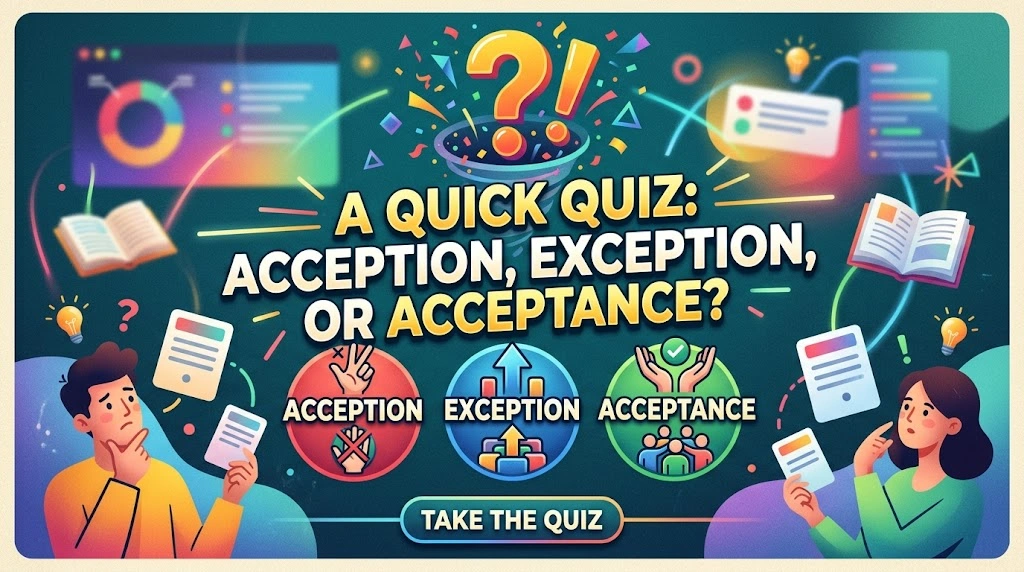
Try these before checking the answers.
Choose the Correct Word
The new policy applies to everyone without _____.
- Acception
- Exception
- Acceptance
Answer: Exception
The university sent her an official letter of _____.
- Acception
- Exception
- Acceptance
Answer: Acceptance
The manager approved an _____ to the normal deadline.
- Acception
- Exception
- Acceptance
Answer: Exception
He took _____ to the accusation.
- Acception
- Exception
- Acceptance
Answer: Exception
The historian was discussing the older use of the word _____.
- Acception
- Exception
- Acceptance
Answer: Acception
The final question is intentionally different. It tests whether you understand that acception isn’t simply a misspelling.
Why Context Matters More Than Spelling
English contains many words that look almost identical but behave differently.
Think about:
- affect / effect
- advice / advise
- accept / except
- principal / principle
- complement / compliment
Acception vs exception belongs to the same broader family of word-choice problems.
The solution isn’t to stare harder at the spelling.
Instead, identify the concept first.
Ask:
“What am I actually trying to say?”
If the answer is “something excluded,” you’re looking for exception.
If the answer is “the act of accepting,” you’re looking for acceptance.
If you’re discussing an older linguistic usage associated with acceptation, acception may be the appropriate historical term.
This meaning-first approach works far beyond these three words.
Exception in Modern Formal and Informal English
One reason exception is easy to recommend is its flexibility.
Everyday English
“There’s always an exception.”
“I’ll make an exception.”
These sound completely natural.
Business English
“The policy allows exceptions under specific circumstances.”
This construction works well in professional documents.
Academic English
“The findings revealed one significant exception.”
Academic writers use exception when describing results that don’t follow a broader trend.
Legal English
“The statute contains several exceptions.”
Legal usage can become more technical depending on the document and jurisdiction. Still, the word itself is firmly established.
Technical Writing
In software documentation, exception can refer to an error or unusual runtime event.
For example:
“The application throws an exception when the input is invalid.”
This is a technical sense rather than the everyday “rule exception” meaning.
Is Acception a Misspelling of Exception?
Not necessarily.
If someone writes acception when they mean “a special case outside a rule,” they’ve almost certainly chosen the wrong word.
But acception itself is not an invented spelling error. Dictionaries recognize it as a word with historical usage.
The better distinction is:
Acception is a real word that is rarely needed in ordinary modern English.
That statement is much more accurate than:
“Acception isn’t a word.”
Likewise, it’s inaccurate to tell readers that acception and exception are interchangeable.
They aren’t.
Can You Use Acception in Modern English?
Yes, but the circumstances are limited.
If you’re writing about historical language or quoting an older source, acception can be entirely appropriate.
For ordinary modern writing, however, a clearer alternative will usually exist.
Better Modern Alternatives
Depending on your intended meaning, consider:
- Acceptance — the act of accepting
- Interpretation — the way something is understood
- Meaning — what a word or statement signifies
- Understanding — an interpretation or accepted sense
- Exception — something excluded or unusual
Don’t replace acception automatically with exception. First identify what you mean.
That’s the crucial step.
Expert Tips for Avoiding Similar Word Confusion
Focus on Meaning Before Spelling
Before choosing a word, describe the idea in plain English.
If your plain-English explanation is:
“This doesn’t follow the rule.”
You probably need exception.
If it’s:
“They agreed to receive or approve this.”
You probably need acceptance.
Learn Word Families
Word families reveal relationships that spelling alone can hide.
Remember:
accept → acceptance
except → exception
This technique works with many confusing English words.
Read the Sentence Again
After choosing a word, read the entire sentence naturally.
Ask whether it says exactly what you intended.
If the sentence feels strangely formal or unfamiliar, check the dictionary rather than assuming the unusual word is more sophisticated.
Use Reliable Dictionaries
When a word seems suspicious, consult an established dictionary.
Useful references include:
- Merriam-Webster
- Cambridge Dictionary
- Oxford English Dictionary
- Merriam-Webster: Acception
- Merriam-Webster: Exception
A dictionary can tell you more than whether a word exists. Look at its definition, labels, examples, and usage information.
Words marked as archaic, obsolete, dialectal, or rare deserve particular care in modern writing.
Frequently Asked Questions
Is acception a real word?
Yes. Acception is a recognized English word. Merriam-Webster defines it in relation to acceptation and records historical usage dating back to the 14th century. (Merriam-Webster)
However, it is uncommon in contemporary everyday English.
Which is correct: acception or exception?
It depends on your meaning.
Use exception for something excluded from a rule, something unusual, or an objection.
Use acception only when its rare or historical meaning is specifically intended.
Is acception the noun form of accept?
No, not in normal modern English.
The standard noun is acceptance.
“They accepted the offer.”
“They confirmed their acceptance.”
What is the difference between acception and acceptance?
Acceptance is the common modern noun referring to the act or process of accepting.
Acception is a rare or historical noun associated with acceptation.
They shouldn’t be treated as interchangeable.
What does exception mean?
An exception is commonly something that doesn’t follow a general rule, something excluded from a group or condition, or something that differs from an expected pattern.
It can also mean an objection in expressions such as take exception to.
What is an example of exception?
“Everyone received a bonus with one exception.”
The sentence means everyone received one except a particular person or case.
What does “exception to the rule” mean?
An exception to the rule is a situation that doesn’t follow a general rule.
For example:
“Employees normally need approval, but this case is an exception to the rule.”
What does “make an exception” mean?
To make an exception means to allow something that normally wouldn’t be allowed.
“The deadline is firm, but we’ll make an exception this once.”
What does “take exception to” mean?
Take exception to means to object to something or react negatively to it.
“She took exception to his remarks.”
In simpler everyday English, you could say:
“She objected to his remarks.”
Can acception be used in modern English?
It can appear in modern writing when someone is discussing its historical or specialized meaning. However, it’s not a natural replacement for exception or acceptance in ordinary modern English.
Final Takeaway: Acception vs Exception
The difference between acception vs exception becomes simple once you stop treating them as spelling variations.
Exception is the word you normally need when something is excluded, unusual, or outside a general rule.
Acceptance is the ordinary modern noun for the act of accepting something.
Acception is a legitimate but rare or historical word associated with acceptation. It shouldn’t normally replace either exception or acceptance.
Keep these three relationships in mind:
| Word | Remember it as | Typical meaning |
| Exception | Except → exception | Something excluded or unusual |
| Acceptance | Accept → acceptance | The act of accepting |
| Acception | Rare/historical term | Related to acceptation |
When you’re stuck, don’t guess from the spelling. Start with the meaning.
If you’re leaving something out, think except → exception.
If you’re accepting something, think accept → acceptance.
And if you encounter acception, check the context carefully. It may be a genuine historical term rather than a typo—but in everyday modern writing, it’s rarely the word you need.



[…] Read More: Acception vs Exception: What’s the Difference? Meanings, Examples, and Easy Ways to Remember […]