Have you ever paused while writing because you couldn’t decide between drier and dryer? You’re not alone. These words look and sound remarkably similar, yet they usually serve different purposes in English. Understanding the distinction can help you avoid a small spelling mistake that changes the meaning of your sentence.
Drier is generally the comparative form of dry. It means more dry and describes something with less moisture than something else. For example, you might say that today’s air is drier than yesterday’s. In contrast, dryer usually refers to a machine or device that removes moisture, such as a clothes dryer or hair dryer.
The confusion becomes easier to solve once you focus on meaning instead of spelling. Think about whether you’re describing a condition, making a comparison, or naming a drying appliance. That simple approach works in everyday writing, professional communication, and academic contexts.
Whether you’re comparing dry weather, describing dry clothes, or talking about a hair dryer, knowing when to use each word makes your writing more precise and natural.
Drier or Dryer: The Quick Answer
Both drier and dryer are correct English words. The right choice depends on what you mean.
| Word | Main meaning | Typical use | Example |
| Drier | More dry | Comparative adjective | The weather is drier today. |
| Dryer | Something that dries | Noun, usually a machine | The clothes are in the dryer. |
Drier Means “More Dry”
Drier is normally the comparative form of dry.
When you compare two things and one contains less moisture than the other, you can use drier.
Examples:
- The desert is drier than the rainforest.
- My skin feels drier in winter.
- The soil is drier after several weeks without rain.
- Today’s weather is drier than yesterday’s.
- This towel is drier than that one.
In each sentence, drier means something like “more dry.”
Dryer Usually Means a Drying Machine
Dryer commonly functions as a noun. It names a machine or device that dries something.
Common examples include:
- clothes dryer
- hair dryer
- hand dryer
- food dryer
- grain dryer
- industrial dryer
For example:
I put the wet clothes in the dryer.
The word doesn’t describe the clothes as “more dry.” Instead, it identifies the appliance.
The One-Line Rule
Here’s the easiest rule to remember:
Drier = more dry. Dryer = a device that dries.
If you can replace the word with “more dry,” use drier.
If you’re naming a machine or device that performs the drying, dryer is usually the right choice.
What Does “Drier” Mean?
Drier is primarily the comparative form of dry.
The adjective dry describes something that contains little or no moisture. When you compare two things, you can use drier to say that one contains less moisture than the other.
Consider these examples:
- This towel is dry.
- This towel is drier than the other towel.
- This towel is the driest one here.
The pattern is:
dry → drier → driest
Drier as the Comparative Form of Dry
English commonly forms comparative adjectives by adding -er. However, spelling rules sometimes change the original word slightly.
For adjectives ending in y, the y commonly changes to i before -er.
For example:
- happy → happier
- easy → easier
- busy → busier
- heavy → heavier
- dry → drier
That’s why drier has an i, not a y before the ending.
The same pattern appears in the superlative:
dry → drier → driest
This is important because some writers mistakenly assume that dryer must be the comparative form simply because it contains -er.
It isn’t normally the comparative form.
Examples of Drier as an Adjective
You can use drier whenever you’re comparing levels of dryness.
Weather
The climate becomes drier as you travel farther inland.
Soil
The upper layer of soil is drier than the soil underneath.
Air
The air feels drier during the winter months.
Skin
Cold weather can leave your skin drier than usual.
Clothes
These clothes are drier than the ones hanging outside.
Food
The second batch of bread turned out drier than the first.
Notice the common thread. In every example, drier describes a greater degree of dryness.
Drier as a Noun
There’s an additional meaning worth knowing.
Drier can also function as a noun in specialized contexts. It can refer to a substance that promotes drying, especially in technical or industrial language.
For example, certain drying agents used in paints, inks, oils, and related materials can be called driers.
This noun use is much less common in everyday American English than dryer when referring to an appliance.
That distinction matters because it prevents an overly simple rule such as “drier is always an adjective.” It usually works as an adjective, but English has documented noun uses as well.
The context tells you which meaning applies.
What Does “Dryer” Mean?
Dryer is commonly a noun meaning a device, machine, or appliance that dries something.
The word appears in many everyday compound nouns.
Clothes Dryer
A clothes dryer is an appliance designed to remove moisture from clothing and other washable fabrics.
For example:
The clothes are still inside the dryer.
Don’t overload the dryer with heavy towels.
The dryer stopped working halfway through the cycle.
In these sentences, dryer doesn’t mean “more dry.” It identifies the appliance.
Hair Dryer
A hair dryer is a handheld electrical device that blows heated or unheated air over hair to help remove moisture or style it.
Examples include:
She used a hair dryer after washing her hair.
This hair dryer has several heat settings.
Keep the hair dryer away from water.
You’ll also encounter blow dryer in American English. Both terms refer to the same general type of device.
Other Types of Dryers
The word dryer isn’t limited to household appliances.
You can find dryers in many settings, including manufacturing, agriculture, food processing, and public facilities.
Examples include:
- Hand dryer — dries hands after washing.
- Food dryer — removes moisture from food.
- Grain dryer — reduces moisture in harvested grain.
- Industrial dryer — removes moisture from manufactured materials.
- Clothes dryer — dries clothing and fabrics.
- Hair dryer — dries hair.
- Spray dryer — converts certain liquid materials into dry powder.
- Vacuum dryer — dries materials under reduced pressure.
The underlying idea remains the same: a dryer is something designed to dry another thing.
Drier vs. Dryer: Grammar and Meaning Compared
The easiest way to understand drier vs. dryer is to look at their grammatical roles.
Drier Is Usually an Adjective
Drier normally describes a noun.
For example:
The desert has drier air.
Here, drier describes the air.
Another example:
This towel is drier than that one.
Again, the word describes the towel’s condition.
The sentence usually contains an implied or explicit comparison.
Dryer Is Usually a Noun
Dryer generally names an object or device.
For example:
The dryer is running.
We need a new dryer.
The clothes are inside the dryer.
In each case, dryer identifies something that performs the drying.
When Both Words Appear in the Same Sentence
Sometimes you need both words in one sentence.
Consider:
The air is drier, so the clothes dry faster in the dryer.
The first word describes the air.
The second word names an appliance.
Another example:
Her hair became drier after she used the hair dryer every day.
Here, drier describes the hair while dryer identifies the device.
That’s a useful way to see the difference in action.
Drier vs. Dryer Comparison Table
| Feature | Drier | Dryer |
| Basic meaning | More dry | Something that dries |
| Common part of speech | Adjective | Noun |
| Related word | Dry | Dry |
| Common spelling pattern | dry → drier | dry + er → dryer |
| Common example | drier weather | clothes dryer |
| Usually compares things? | Yes | No |
| Can refer to a machine? | Not usually in everyday usage | Yes |
| Common in everyday English? | Very common | Very common |
Drier or Dryer: American vs. British English
Regional English can make spelling questions even more confusing. However, the fundamental distinction between drier and dryer remains useful across major varieties of English.
Drier in American English
In American English, drier is the standard comparative form of dry.
Examples include:
- drier weather
- drier climate
- drier soil
- drier skin
- drier conditions
- drier clothes
You would normally write:
The climate is drier in the western part of the state.
Not:
The climate is dryer in the western part of the state.
Dryer in American English
American English commonly uses dryer for appliances and devices.
Examples include:
- clothes dryer
- hair dryer
- hand dryer
- industrial dryer
So this sentence is standard:
I put the towels in the dryer.
Drier and Dryer in British English
British English also uses drier as the comparative form of dry.
For drying appliances, British English commonly uses dryer as well, particularly in terms such as tumble dryer.
For example:
The clothes are still in the tumble dryer.
British and American English can differ in the names used for particular appliances, but that doesn’t eliminate the basic meaning distinction.
Is “Hair Drier” Ever Correct?
You may occasionally encounter hair drier, especially in older writing, regional usage, or less common spelling preferences.
However, hair dryer is the familiar modern spelling in American English and is widely recognized in general English.
This illustrates an important point: not every uncommon variant is automatically a spelling mistake.
When writing for a broad modern audience, hair dryer is the clearer and more familiar choice.
Drier vs. Dryer: Common Examples
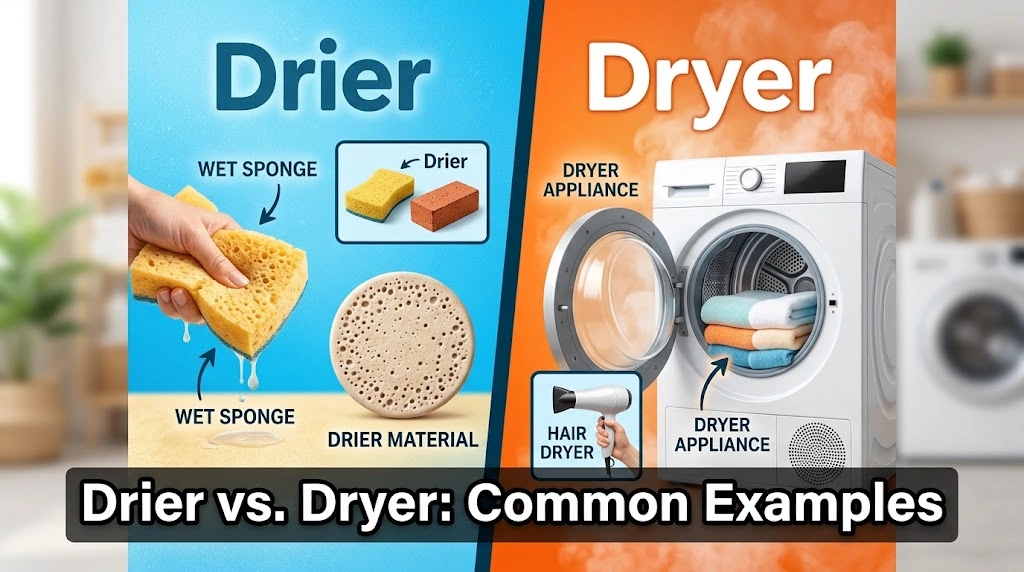
Seeing the words in realistic sentences makes the distinction much easier to remember.
Examples Using Drier Correctly
The climate is drier this year.
My hands become drier during cold weather.
The soil is drier near the surface.
This towel feels drier than the other one.
The western region has drier conditions.
The bread became drier after sitting uncovered.
The room feels drier with the heater running.
These leaves are drier than the freshly collected ones.
Each example uses drier to describe a greater degree of dryness.
Examples Using Dryer Correctly
The clothes are in the dryer.
I bought a new hair dryer.
The dryer uses less electricity than our old model.
The hotel has a hand dryer in the bathroom.
The farmer installed a grain dryer.
The food goes into a commercial dryer after preparation.
Here, dryer identifies a machine or device.
Examples Where Both Words Appear
The clothes are drier after ten minutes in the dryer.
My hair feels drier after using the hair dryer.
The air is drier, so the clothes may dry faster in the dryer.
The towels became drier after another cycle in the dryer.
These examples demonstrate the distinction perfectly.
Drier describes a condition. Dryer names a device.
Read More: Taught or Tought: Which Spelling Is Correct?
Drier or Dryer: A Real-Life Writing Example
Imagine you’re writing about doing laundry.
You want to say that one towel contains less moisture than another. You might write:
The blue towel is drier than the white towel.
That’s correct because you’re comparing the towels’ dryness.
Now imagine that you want to identify the machine:
I put both towels in the dryer.
That’s also correct, but the meaning has changed.
The word dryer refers to the machine.
Now combine both ideas:
After another cycle in the dryer, the blue towel was drier than the white towel.
This sentence gives you the entire distinction in one example.
The machine is the dryer.
The comparative condition is drier.
Common Mistakes With Drier and Dryer
The confusion usually comes from the similar spelling. Fortunately, the most common mistakes follow a few predictable patterns.
Mistake: Thinking Drier Is Always Wrong
Some writers assume dryer is the correct spelling whenever they see the word “dry.”
That’s incorrect.
For example:
The climate is drier in the mountains.
Here, drier is exactly right.
The sentence compares the level of dryness.
Mistake: Writing Dryer When You Mean More Dry
Consider:
The soil is dryer than yesterday.
Many readers will understand this sentence. However, when dryer is intended as the comparative adjective, drier is the standard spelling.
Better:
The soil is drier than yesterday.
The reason is grammatical: drier is the comparative form of dry.
Mistake: Assuming Dryer Is Incorrect
The opposite mistake happens too.
Some people see dryer and assume it should always be drier.
That’s wrong when you’re naming a drying appliance.
Correct:
The clothes are in the dryer.
Incorrect for the intended appliance meaning:
The clothes are in the drier.
The second sentence doesn’t use the usual modern term for the appliance.
Mistake: Ignoring Context
Context often solves the problem immediately.
Compare:
The room is drier.
and:
The dryer is in the laundry room.
The first sentence describes a condition.
The second sentence identifies an object.
When you’re uncertain, don’t look at the spelling alone. Look at what the word actually means in the sentence.
Mistake: Confusing Pronunciation With Spelling
Depending on accent and speaking speed, drier and dryer can sound extremely similar.
That similarity doesn’t make them interchangeable.
English has many words whose pronunciations overlap or nearly overlap while their meanings differ. In writing, the surrounding sentence provides the necessary clue.
How to Remember Drier vs. Dryer
You don’t need a complicated mnemonic.
Use the “More Dry” Test
Ask:
Does the sentence mean more dry?
If yes, drier is probably the word you need.
For example:
The desert is drier than the coast.
Replace the word:
The desert is more dry than the coast.
The meaning remains clear.
Therefore, drier works.
Use the “Machine” Test
Now ask:
Am I talking about something that dries another thing?
If you’re naming a machine or device, dryer is usually the correct choice.
For example:
Put the clothes in the dryer.
The machine performs the drying.
Remember the Spelling Pattern
Keep this sequence in mind:
dry → drier → driest
And remember:
dryer → drying device
That small distinction can prevent most spelling mistakes.
Drier or Dryer in Real Sentences
Weather and Climate
Weather descriptions frequently use drier.
This summer has been drier than last summer.
The northern region tends to have drier conditions.
The air becomes drier during the cold season.
These sentences compare environmental conditions.
Clothing and Laundry
Laundry creates one of the most useful contrasts.
The towels are drier now.
But:
The towels are in the dryer.
You can even combine them:
The towels became drier after another cycle in the dryer.
Hair and Personal Care
Hair-related sentences work the same way.
My hair feels drier after swimming.
But:
I used a hair dryer to dry my hair.
The first sentence describes the hair.
The second identifies the device.
Household Writing
You’ll often see both terms around the home:
- drier air
- drier towels
- drier clothes
- clothes dryer
- hair dryer
- hand dryer
Context makes the distinction straightforward.
Technical and Industrial Contexts
Technical writing frequently uses dryer as part of equipment names.
Examples include:
- rotary dryer
- vacuum dryer
- spray dryer
- drum dryer
- grain dryer
- industrial dryer
These terms describe equipment designed to remove moisture from a material.
Meanwhile, drier can still function as a comparative adjective in technical writing:
The material becomes drier as the process continues.
That sentence doesn’t name equipment. It describes a changing moisture condition.
Drier or Dryer: How to Choose the Correct Word
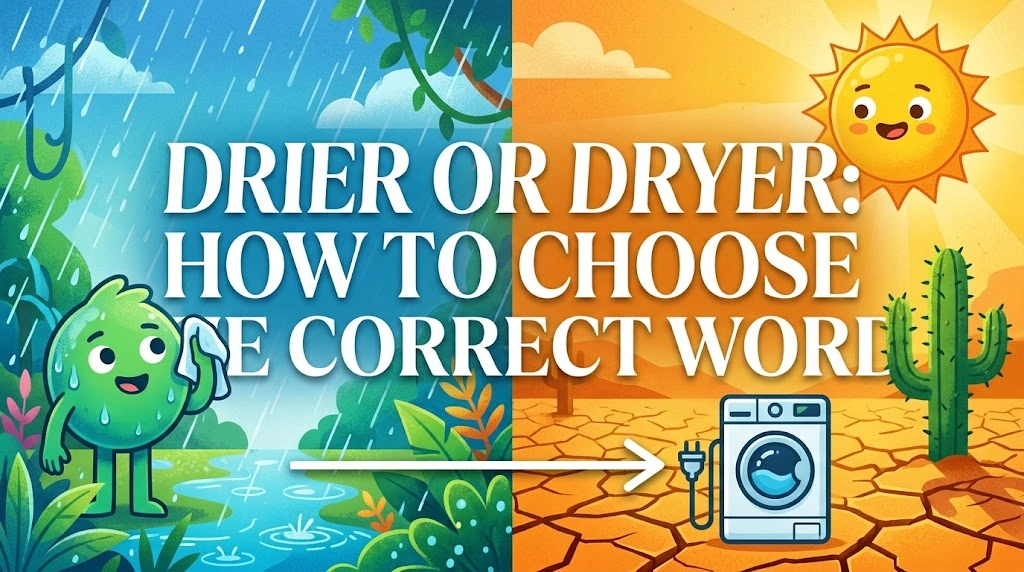
When you’re stuck between drier and dryer, follow these steps.
Check the Meaning
First, ask what you’re trying to say.
If you mean more dry, choose drier.
If you mean a device that dries something, choose dryer.
Check the Part of Speech
Look at how the word functions in your sentence.
If it describes a noun, drier may be the correct comparative adjective.
If it names an object, machine, or device, dryer is usually appropriate.
Read the Entire Sentence
Don’t choose the spelling in isolation.
For example:
The drier climate requires different farming methods.
Here, drier modifies climate.
Compare:
The dryer needs to be repaired.
Here, dryer is the subject and names a machine.
The surrounding words reveal the intended meaning.
Consider Regional Usage
If you’re writing for a particular country or audience, check local terminology.
For example, appliance names can vary between varieties of English. However, the basic comparative form drier remains useful when you mean “more dry.”
Drier or Dryer: Practice Quiz
Test your understanding with these examples.
Choose Drier or Dryer
The desert has a ______ climate than the coast.
Answer: drier
The sentence compares two climates.
Fill in the Blank
Please put the wet clothes in the ______.
Answer: dryer
The sentence refers to an appliance.
Which Word Means “More Dry”?
The answer is:
Drier
For example:
This towel is drier than that one.
Which Word Names a Machine?
The answer is:
Dryer
For example:
The dryer is running.
Can Both Words Be Correct?
Yes.
Consider:
The clothes are drier after using the dryer.
Both words are correct because they have different meanings.
True or False
“Drier” is always an incorrect spelling.
False.
It’s the standard comparative form of dry.
Hair Care Challenge
Choose the correct word:
I bought a new hair ______.
Answer: dryer
The sentence names a device.
Complete the Pattern
dry → ______ → driest
Answer:
drier
Correct the Sentence
The towels are in the drier.
If the intended meaning is the household appliance, the usual wording is:
The towels are in the dryer.
Think About the Meaning
The weather is ______ this year.
Answer:
drier
The sentence describes a greater degree of dryness.
Dictionary and Usage Evidence
Major dictionaries recognize both drier and dryer, although their principal everyday meanings differ.
Merriam-Webster’s entry for “dry” documents the adjective and its inflected forms, including comparative usage.
Cambridge Dictionary’s entry for “drier” identifies drier as the comparative form associated with dry.
Cambridge Dictionary’s entry for “dryer” covers the noun referring to a device used for drying.
The Oxford English Dictionary also documents the broader historical and lexical development of these forms, including specialized noun uses.
What Dictionary Evidence Shows
The important point isn’t simply that both words appear in dictionaries.
It’s how dictionaries define and categorize them.
Drier commonly represents the comparative adjective:
dry → drier
Dryer commonly represents a noun describing something that dries, especially an appliance or machine.
That dictionary distinction supports the practical rule used throughout this article.
Why Dictionary Evidence Matters
English spelling can be messy.
Words sometimes have multiple meanings, regional variants, historical forms, or specialized technical uses. A dictionary provides evidence beyond what a spelling checker can offer.
A spell checker might recognize both drier and dryer. It can’t always determine which meaning you intended.
That’s why context remains essential.
Drier vs. Dryer: Quick Reference Guide
Use this table when you need a fast answer.
| If you mean… | Use | Example |
| More dry | Drier | The air is drier today. |
| Less moisture than something else | Drier | This towel is drier. |
| A clothes appliance | Dryer | The clothes are in the dryer. |
| A hair-drying device | Dryer | I need a new hair dryer. |
| A bathroom hand-drying device | Dryer | The hand dryer isn’t working. |
| A machine used in agriculture | Dryer | The grain dryer removes moisture. |
| A greater degree of dryness | Drier | The soil is drier now. |
| Industrial drying equipment | Dryer | The factory uses an industrial dryer. |
Frequently Asked Questions
Is “drier” or “dryer” correct?
Both are correct, but they normally have different meanings. Drier is usually the comparative form of dry, meaning “more dry.” Dryer usually refers to a machine or device that dries something.
Is “drier” the comparative form of “dry”?
Yes. The standard comparative form is drier.
The pattern is:
dry → drier → driest
For example:
The climate is drier than it was last year.
Is “dryer” a real word?
Yes. Dryer is a standard English noun. It commonly refers to a machine or device that removes moisture.
Examples include:
- clothes dryer
- hair dryer
- hand dryer
- industrial dryer
Should I write “drier clothes” or “dryer clothes”?
Write drier clothes when you mean clothes that are more dry.
For example:
The towels are drier after another cycle.
Dryer clothes could theoretically be interpreted differently depending on context, but it isn’t normally the standard choice when you mean “more dry.”
Is “hair dryer” or “hair drier” correct?
Hair dryer is the familiar modern spelling, particularly in American English.
You may encounter hair drier as a variant, but hair dryer is the conventional term for the device.
Can “drier” be used as a noun?
Yes. Drier has documented specialized noun uses, particularly for substances or materials that promote drying.
However, this isn’t the everyday meaning most readers expect when discussing household appliances.
Is “dryer” always a machine?
No. Dryer can have broader uses related to something that dries. Still, in everyday modern English, the word most commonly refers to a drying machine or device.
Are “drier” and “dryer” pronounced the same?
They can sound very similar, and in some accents they may be difficult to distinguish by ear.
That’s one reason the spelling causes confusion.
The safest approach is to identify the meaning first rather than relying on pronunciation.
Does British English use “drier” and “dryer” differently?
Both forms occur in British English. Drier is used as the comparative form of dry, while dryer is commonly used for drying equipment.
British English also frequently uses terms such as tumble dryer for a clothes-drying appliance.
How can I quickly remember the difference between drier and dryer?
Use this simple rule:
Drier means “more dry.” Dryer means “a device that dries.”
If you’re comparing dryness, choose drier.
If you’re naming an appliance or drying device, choose dryer.
Final Takeaway: Drier or Dryer?
The difference between drier and dryer comes down to meaning and grammatical function.
Drier is normally the comparative form of dry. It means “more dry” and describes something with a greater degree of dryness.
The air is drier today.
Dryer is normally a noun that refers to something designed to remove moisture.
Put the clothes in the dryer.
The spelling becomes much easier when you stop treating these words as competing versions of the same word.
Think about what you mean first.
If you’re describing more dryness, use drier.
If you’re naming a drying device, use dryer.
One final example brings everything together:
The weather is drier, so the clothes dried quickly in the dryer.
That’s the distinction in a nutshell. Drier describes the degree of dryness, while dryer usually names the thing that does the drying.