Shown vs showed can look like a tiny grammar issue, yet choosing the wrong form can change the entire structure of a sentence. Both words come from the verb show, but they don’t serve the same grammatical role. Showed is normally the simple past tense, while shown is the standard past participle. Understanding that difference makes it much easier to write clear English sentences, especially in formal writing, academic writing, and professional communication.
The basic verb forms are show, showed, and shown. You typically use showed for a completed past action, such as “She showed me the report yesterday.” Meanwhile, shown usually follows has, have, or had, as in “She has shown me the report.” It also appears in passive voice, such as “The report was shown to the committee.”
This guide explains verb conjugation, past tense, past participle, simple past, present perfect, past perfect, passive construction, auxiliary verbs, helping verbs, sentence structure, and verb agreement. You’ll also see grammar rules, common mistakes, correct examples, incorrect examples, usage patterns, English usage, standard English, modern English, everyday English, spoken English, written English, grammar usage, verb tense, tense markers, perfect tense, past perfect tense, present perfect tense, passive voice, active voice, base verb, irregular verb, regular verb, verb phrase,
auxiliary verb, modal verb, did, has, have, had, was, were, been, showing, showed form, shown form, show verb, show past tense, show past participle, show conjugation, show grammar, show examples, shown examples, showed examples, correct verb form, verb choice, grammar choice, sentence examples, English grammar, grammar explanation, grammar guide, language rules, writing accuracy, grammar accuracy, common grammar errors, grammar mistakes, verb mistakes, past participle rules, simple past rules, perfect tense rules, passive voice rules, verb patterns,
English verb forms, past tense verbs, irregular verbs, English verb conjugation, correct English, standard grammar, sentence construction, grammar practice, grammar quiz, English learners, English writers, writing skills, clear writing, professional English, academic English, natural English, correct usage, word choice, grammar tips, verb usage, tense usage, English language, English sentence patterns, verb form comparison, shown or showed, and showed or shown.
Shown vs Showed: What’s the Difference?
The clearest distinction is grammatical.
Showed normally functions as the simple past form of show. Shown normally functions as the past participle.
Here’s the basic pattern:
| Verb form | Name | Example |
| show | Base form | I show the picture. |
| showed | Simple past | I showed the picture. |
| shown | Past participle | I have shown the picture. |
The difference becomes easier when you look at the verb forms in complete sentences.
Showed can stand as the main verb in a simple past sentence:
Maria showed me her new apartment yesterday.
Shown, however, normally needs an auxiliary verb in standard constructions:
Maria has shown me her new apartment.
Notice what happened. The sentence changed from simple past to present perfect.
Showed Is the Simple Past Form
When you describe an action that happened and finished in the past, showed is generally the form you need.
Consider these examples:
- I showed him the photograph yesterday.
- She showed us her new car last weekend.
- The teacher showed the students a documentary.
- They showed me where the office was.
- The company showed strong growth last year.
A specific past-time reference often makes the choice especially clear.
We showed the presentation to the client on Monday.
You wouldn’t normally write:
We shown the presentation to the client on Monday. ❌
The correct sentence is:
We showed the presentation to the client on Monday. ✅
Shown Is the Past Participle
Shown is normally the past participle of show. It commonly appears after has, have, or had.
For example:
- She has shown great improvement.
- They have shown excellent results.
- He had shown the document to his supervisor.
- The study has shown a clear relationship.
- The evidence had shown that the system was unreliable.
It also appears in passive constructions:
The results were shown to the committee.
Here, shown isn’t functioning as a simple past verb. It’s part of a passive construction.
The Quickest Rule to Remember
If you need one shortcut, remember this:
Showed = simple past
Shown = past participle
There are two especially useful checks.
Check one: Does the sentence contain has, have, or had?
If yes, shown is normally the correct form.
She has shown me the report.
Check two: Does the sentence contain did?
If yes, use the base form show, not showed or shown.
Did she show you the report?
This small rule solves a surprising number of shown vs showed problems.
When Should You Use “Showed”?
Use showed when show functions as the simple past verb.
The action took place in the past. The sentence doesn’t need a perfect auxiliary or another construction that requires a participle.
Showed for a Completed Past Action
Suppose you visited a friend yesterday and displayed some photographs.
You could say:
I showed my friend the photographs yesterday.
The action happened in the past and finished there.
More examples include:
- James showed me his new laptop.
- Sarah showed the children how to solve the problem.
- The guide showed us the quickest route.
- The doctor showed the patient the test results.
- The manager showed the team the new schedule.
The same principle applies in professional writing.
The researcher showed the participants the experimental results.
The word showed tells the reader that the action occurred in the past.
Showed With Specific Past-Time Expressions
Specific past-time expressions often work naturally with the simple past.
Common examples include:
- yesterday
- last night
- last week
- last month
- last year
- two days ago
- three hours ago
- in 2020
- when I was a child
- during the meeting
- earlier that morning
For example:
The teacher showed us the video yesterday.
The company showed its new product at the conference last year.
He showed me the message two hours ago.
A useful point here is that time expressions don’t mechanically force a verb form in every possible sentence. However, completed past-time references strongly favor the simple past when you’re describing a finished event.
Showed in Questions
This is where many learners make a mistake.
When you use did to form a past-tense question, the main verb returns to its base form.
So:
Did you show him the picture? ✅
Not:
Did you showed him the picture? ❌
Why?
Because did already carries the past tense.
Think of the structure as:
Did + subject + base verb
Examples:
- Did you show her the email?
- Did they show you the results?
- Did he show them the way?
- Did Sarah show you the photograph?
The same rule applies regardless of the subject.
Showed in Negative Sentences
Negative simple past sentences follow the same pattern.
Use:
did not + base verb
For example:
I didn’t show him the document.
Not:
I didn’t showed him the document. ❌
Other examples:
- She didn’t show me the message.
- We didn’t show them the results.
- He didn’t show any interest.
- They didn’t show us the correct procedure.
Again, did carries the past tense. The main verb stays in its base form.
When Should You Use “Shown”?
Use shown when the grammatical structure calls for the past participle.
The most common situations involve perfect tenses and passive voice.
Shown With Has, Have, or Had
The most familiar pattern is:
has/have/had + shown
Examples:
- She has shown considerable improvement.
- They have shown strong interest.
- He has shown me the document.
- The researchers have shown that the treatment works.
- The team had shown excellent discipline before the final match.
The auxiliary verb creates the perfect construction. Shown supplies the past participle.
Shown in the Present Perfect
The present perfect uses:
has/have + past participle
Because shown is the standard past participle, you get:
She has shown remarkable progress.
They have shown strong support for the proposal.
The present perfect often connects a past action or experience with the present.
Compare these two sentences:
She showed me the report yesterday.
She has shown me the report.
The first sentence points to a completed past event. The second uses the present perfect and doesn’t specify a finished past time in the same way.
This distinction matters in formal writing because changing the tense can change the time relationship.
Shown in the Past Perfect
The past perfect follows this structure:
had + past participle
Therefore:
He had shown the document before the meeting began.
Not:
He had showed the document before the meeting began. ❌
The past perfect is useful when you want to establish that one past event happened before another past event.
For example:
The manager had shown the report before the meeting started.
First, the manager showed the report. Later, the meeting started.
The word had establishes the earlier past relationship. Shown completes the verb phrase.
Shown in the Passive Voice
Shown also appears frequently in passive constructions.
Compare:
The teacher showed the students the results.
This is active voice. The teacher performs the action.
Now compare:
The results were shown to the students.
This is passive voice. The results receive the action.
The passive pattern uses a form of be + past participle.
Examples include:
- The film was shown at the festival.
- The evidence was shown to the jury.
- The results were shown on the screen.
- The data were shown in the final report.
- The documentary was shown on television.
This is one reason “was showed” usually sounds wrong in standard modern English.
The correct passive form is generally:
The video was shown to the class. ✅
Read More: Coach vs Couch: What’s the Difference? Meaning, Pronunciation, Examples, and Easy Tips
Can “Showed” Ever Be a Past Participle?
This question deserves a little more attention because English has a history of variation.
In modern standard English, shown is the normal past participle of show. That’s the form learners should generally use in perfect and passive constructions.
However, showed has appeared as a past participle in historical English and continues to occur in some regional or nonstandard varieties.
That means you’ll occasionally encounter forms such as:
has showed
in real-world writing or speech.
The existence of such usage doesn’t make it the preferred form for standard contemporary English.
For most formal, academic, professional, and educational writing, use:
has shown
rather than:
has showed
The same applies to:
had shown
rather than:
had showed
Language changes over time, and English contains many competing verb patterns. Still, modern standard usage has established showed as the simple past and shown as the usual past participle.
For learners, the safest pattern is:
show – showed – shown
Showed vs Shown: Side-by-Side Comparison
Seeing the forms together makes the distinction much easier.
| Situation | Correct Form | Example |
| Base form | show | I want to show you something. |
| Simple present | show/shows | She shows me the results. |
| Simple past | showed | She showed me the results. |
| Present perfect | shown | She has shown me the results. |
| Past perfect | shown | She had shown me the results. |
| Passive | shown | The results were shown to us. |
| After did | show | Did she show you the results? |
| After didn’t | show | She didn’t show us the results. |
The Three-Form Pattern
Memorizing the basic irregular verb pattern helps:
SHOW → SHOWED → SHOWN
Unlike regular verbs such as walk → walked → walked, show uses different forms for the past tense and past participle.
Compare:
I showed him the photograph.
with:
I have shown him the photograph.
The first uses the simple past.
The second uses the past participle.
Simple Past vs Past Participle
A past participle isn’t simply another name for the past tense.
That’s an important distinction.
The simple past can often function as the main verb by itself:
She showed me the report.
The past participle generally works with an auxiliary in these constructions:
She has shown me the report.
She had shown me the report.
The report was shown to the committee.
This distinction explains most shown vs showed questions.
Common Mistakes With Showed and Shown
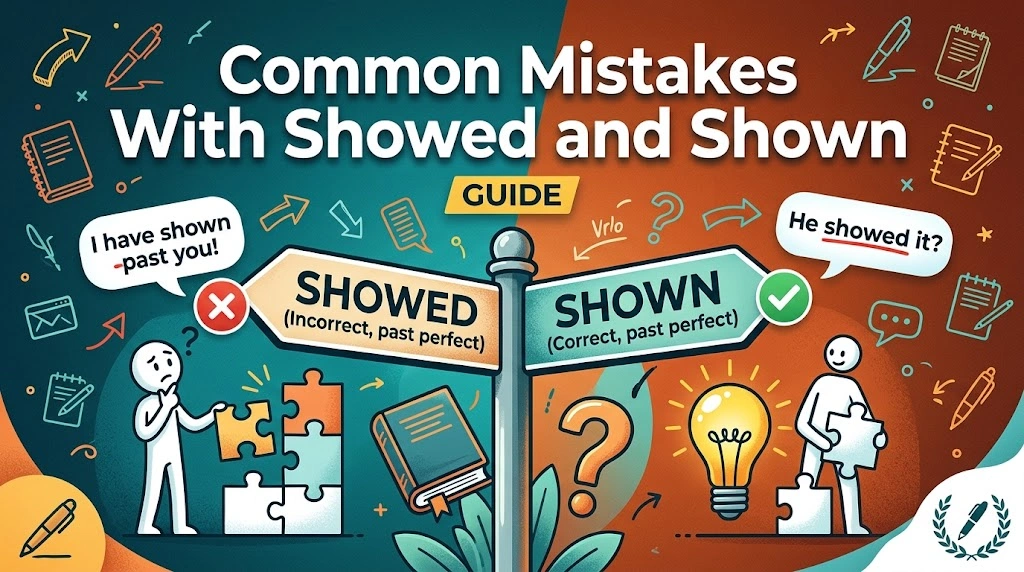
These mistakes usually happen when writers focus on the meaning rather than the grammatical structure.
“Has Showed” vs “Has Shown”
Incorrect in standard modern English:
She has showed excellent progress. ❌
Preferred:
She has shown excellent progress. ✅
The structure is has + past participle, so use shown.
“Had Showed” vs “Had Shown”
Incorrect in standard modern English:
He had showed the evidence before the hearing. ❌
Correct:
He had shown the evidence before the hearing. ✅
The structure is had + past participle.
“Was Showed” vs “Was Shown”
A common passive-voice error looks like this:
The movie was showed last night. ❌
The standard form is:
The movie was shown last night. ✅
Here, was combines with the past participle shown.
Don’t confuse this with:
The movie showed last night.
That sentence can have a different structure and meaning. For example, a movie or display may be described as showing something, but when you’re saying that someone presented or screened something, was shown is the standard passive construction.
“Did Showed” vs “Did Show”
Incorrect:
Did you showed him the picture? ❌
Correct:
Did you show him the picture? ✅
The past tense is already expressed by did.
The same principle applies to negatives:
I didn’t show her the email. ✅
Not:
I didn’t showed her the email. ❌
“I Shown Him” vs “I Showed Him”
If you’re talking about a completed past action, use showed:
I showed him the photograph. ✅
Not:
I shown him the photograph. ❌
However, shown becomes correct when an auxiliary requires the past participle:
I have shown him the photograph. ✅
That one extra word, have, changes the construction.
Showed vs Shown in Different Sentence Patterns
Context can make these forms much easier to understand.
Everyday Conversation
In ordinary conversation, you’ll frequently hear showed for a completed past action.
I showed Mike the new photos yesterday.
She showed me her vacation pictures.
He showed us where he parked the car.
When talking about experience or an action connected to the present, shown may appear:
I’ve shown you everything.
She’s shown me the message already.
School and Academic Writing
Academic writing frequently uses shown because researchers often discuss findings and evidence.
For example:
The experiment showed a significant difference between the two groups.
This sentence describes a completed research finding.
You could also write:
The experiment has shown a significant difference between the two groups.
Here, the present perfect connects the finding with the broader present discussion.
Both forms can be correct. The surrounding grammar and intended time relationship determine the choice.
Workplace and Professional Writing
Professional documents often contain both forms.
For example:
The presentation showed how the new system works.
But:
The presentation has shown how the new system can reduce processing time.
The first describes a particular completed presentation. The second emphasizes a result or conclusion that remains relevant.
News, Media, and Entertainment
The passive form shown appears often when discussing programs, films, exhibitions, and presentations.
Examples:
The documentary was shown at the local theater.
The interview was shown on national television.
The results were shown on the screen.
In active sentences, showed may be appropriate:
The network showed the documentary on Friday.
The difference comes from sentence structure, not from the subject matter.
Showed vs Shown in Active and Passive Sentences
Understanding voice can eliminate another common source of confusion.
Active Voice
In active voice, the subject performs the action.
The teacher showed the students a video.
The teacher performs the action of showing.
Another example:
The researcher showed the participants the results.
Again, the subject performs the action.
Passive Voice
In passive voice, the focus shifts to the person or thing receiving the action.
The video was shown to the students.
The results were shown to the participants.
The structure becomes:
Form of be + past participle
Because shown is the standard past participle, it fits the passive construction.
Here’s a useful comparison:
| Active | Passive |
| The teacher showed the video. | The video was shown by the teacher. |
| The researcher showed the results. | The results were shown to the participants. |
| The company showed the data. | The data were shown in the report. |
This doesn’t mean every sentence with was + shown needs to mention who performed the action. English often leaves the agent unstated when it isn’t important.
How to Choose Between Showed and Shown
When you’re unsure, don’t guess based on which word sounds more natural. Look at the grammar around the verb.
Check for a Perfect Auxiliary
Look for:
- has
- have
- had
If one appears before the verb, you normally need shown.
She has shown excellent judgment.
They have shown strong interest.
He had shown the report to his manager.
Check for a Passive Construction
Look for a form of be followed by a past participle.
The documentary was shown yesterday.
The results were shown to the audience.
The evidence has been shown to be unreliable.
In these constructions, shown is the standard choice.
Check for “Did”
If you see did, use show.
Did you show him the photograph?
Not:
Did you showed him the photograph?
The auxiliary did already marks the sentence as past tense.
Check Whether You Mean a Completed Past Action
If you’re simply describing something that happened in the past, showed is usually right.
She showed me the message yesterday.
They showed us the new building last week.
He showed the customer the available options.
A specific finished event generally points toward the simple past.
Showed vs Shown: Examples You Can Use
Here are practical examples covering the most important structures.
Simple Past Examples
- I showed him my new phone.
- She showed us the photographs.
- They showed the visitors around the building.
- The teacher showed a short video.
- The report showed a sharp increase in sales.
Present Perfect Examples
- I have shown him the results.
- She has shown great patience.
- They have shown strong improvement.
- The study has shown a clear trend.
- The company has shown steady growth.
Past Perfect Examples
- I had shown him the document earlier.
- She had shown the evidence before the meeting.
- They had shown strong interest before negotiations began.
Passive Examples
- The film was shown at the festival.
- The results were shown on the screen.
- The evidence was shown to the committee.
- The documentary was shown on television.
Questions
- Did you show her the message?
- Did he show you the results?
- Did they show the customer the new design?
Negative Sentences
- I didn’t show him the email.
- She didn’t show us the report.
- They didn’t show any interest in the proposal.
A Practical Case Study: Choosing the Right Form in Professional Writing
Imagine a marketing manager writing a report about a product launch.
The manager wants to describe something that happened during last week’s presentation:
The presentation showed customers how the new software works.
That’s simple past. The presentation happened at a particular time.
Now the manager wants to summarize the broader results:
The demonstration has shown that customers can learn the software quickly.
The present perfect works because the result remains relevant to the current discussion.
Next, the manager describes what happened to the presentation:
The demonstration was shown to more than 200 attendees.
That’s passive voice.
Finally, the manager asks a colleague about a past action:
Did you show the sales team the updated figures?
The base form show follows did.
One verb can therefore appear in several forms within the same report:
The presentation showed the product’s main features. It has shown that customers understand the new system quickly. The demonstration was shown to several groups. Did you show the updated figures to the sales team?
The surrounding structure determines the form.
How to Remember Shown vs Showed

You don’t need to memorize dozens of isolated sentences. A small pattern is much more useful.
If There Is No Auxiliary, Think “Showed”
For a straightforward completed past action:
She showed me the picture.
They showed us the results.
However, remember that did is an exception to this shortcut because it requires the base form:
Did she show you the picture?
If There Is a Perfect Auxiliary, Think “Shown”
When you see has, have, or had, think:
shown
Examples:
has shown
have shown
had shown
If There Is a Passive Construction, Think “Shown”
When show appears in a standard passive construction:
was shown
were shown
is shown
has been shown
will be shown
The past participle shown is the normal choice.
If There Is “Did,” Use “Show”
This is the easiest exception to memorize:
did + show
Never add another past-tense marker to the main verb in standard English.
Practice Quiz: Showed or Shown?
Test yourself before checking the answers.
Choose the Correct Form
The teacher ___ us the answer yesterday.
- A. showed
- B. shown
The researcher has ___ that the method works.
- A. showed
- B. shown
Did you ___ Sarah the report?
- A. showed
- B. show
The documentary was ___ at the conference.
- A. showed
- B. shown
They had ___ the evidence before the hearing.
- A. showed
- B. shown
Fill in the Blanks
Complete each sentence with show, showed, or shown.
- I have ___ him the new design.
- She ___ me the message last night.
- Did they ___ you the results?
- The movie was ___ at the local theater.
- He had ___ considerable improvement.
Correct the Mistake
Correct each sentence:
She has showed excellent progress.
Did you showed him the report?
The video was showed to the class.
I shown him the photograph yesterday.
They had showed the results earlier.
Answer Key and Explanations
1. showed
The teacher showed us the answer yesterday.
The sentence describes a completed past action.
2. shown
The researcher has shown that the method works.
Has requires the past participle.
3. show
Did you show Sarah the report?
Did already carries the past tense.
4. shown
The documentary was shown at the conference.
This is a passive construction.
5. shown
They had shown considerable improvement.
Had is followed by the past participle.
The correction examples follow the same rules:
- She has shown excellent progress.
- Did you show him the report?
- The video was shown to the class.
- I showed him the photograph yesterday.
- They had shown the results earlier.
Frequently Asked Questions About Showed and Shown
Is “Shown” the Past Tense of Show?
Not exactly. Showed is the standard simple past form of show. Shown is normally the past participle.
The basic pattern is:
show → showed → shown
For example:
I showed him the picture.
I have shown him the picture.
Is “Showed” or “Shown” Correct?
Both are correct, but they serve different grammatical functions.
Use showed for the simple past:
She showed me the report yesterday.
Use shown as the standard past participle:
She has shown me the report.
The surrounding words determine which form belongs in the sentence.
Is “Has Showed” Grammatically Correct?
In standard contemporary English, has shown is the preferred form.
She has shown remarkable improvement. ✅
The structure is has + past participle, and shown is the standard past participle of show.
You may encounter has showed in historical, regional, or nonstandard usage. Formal writing should generally use has shown.
Is “Had Showed” Correct?
In standard contemporary English, use had shown.
He had shown the report to his manager. ✅
The structure is:
had + past participle
Therefore, shown is the standard choice.
Is “Was Showed” Correct?
When you’re using passive voice, the standard form is was shown.
The film was shown yesterday. ✅
The passive structure uses a form of be + past participle.
Should I Say “I Showed Him” or “I Shown Him”?
Use I showed him for a simple past statement.
I showed him the photograph. ✅
You need an auxiliary before shown in a perfect construction:
I have shown him the photograph. ✅
So I shown him is not standard English.
Which Is Correct: “Did You Show” or “Did You Showed”?
The correct form is:
Did you show?
After did, use the base verb.
Therefore:
Did you show him the report? ✅
Not:
Did you showed him the report? ❌
Can “Showed” Be a Past Participle?
Showed has appeared as a past participle in historical English and occurs in some regional or nonstandard varieties.
However, shown is the standard past participle in contemporary standard English.
For formal writing, use:
has shown
have shown
had shown
was shown
What Are the Three Forms of Show?
The three commonly taught forms are:
show – showed – shown
Show is the base form. Showed is the simple past. Shown is the standard past participle.
Is “Shown” Used in Passive Voice?
Yes.
Examples include:
The film was shown at the theater.
The results were shown on the screen.
The evidence was shown to the committee.
Passive constructions use a form of be + past participle, which makes shown the standard form here.
Final Takeaway: Showed vs Shown
The difference between shown vs showed becomes much easier once you identify the grammatical structure.
Remember the core pattern:
Show → Showed → Shown
Use showed for the simple past:
She showed me the report yesterday.
Use shown as the standard past participle:
She has shown me the report.
She had shown me the report.
The report was shown to the committee.
And when did appears, go back to the base form:
Did she show you the report?
The most useful rules are therefore:
- Simple past → showed
- Has/have/had → shown
- Passive voice → shown
- Did/didn’t → show
- Base form → show
Once you stop treating showed and shown as interchangeable versions of the same word, the choice becomes much clearer. Look at the helper verb first. Then identify whether you’re describing a simple past action, a perfect construction, or a passive sentence.
That’s the key to getting shown vs showed right consistently.