Introduction
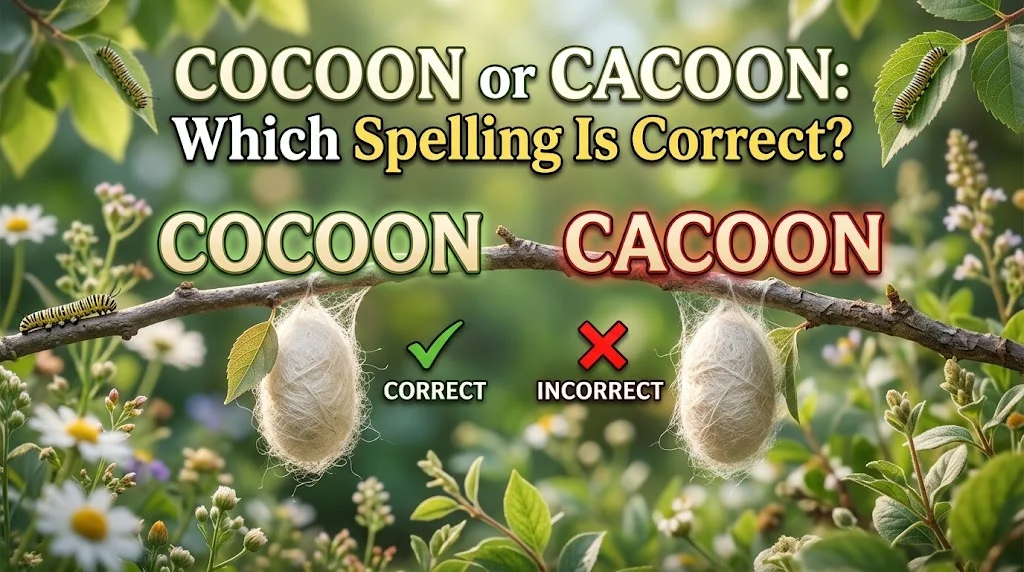
Have you ever paused while typing cocoon or cacoon and wondered which spelling belongs in your sentence? You’re not alone. These two words look remarkably similar, yet they carry different meanings. The confusion becomes especially common when discussing insects, moths, silkworms, butterflies, and metamorphosis. If you’re searching for the correct spelling of cocoon, the answer depends partly on context.
In everyday English, cocoon is the familiar term for a protective covering, insect covering, or silk case created by certain insects. It can also describe a protected environment, safe space, or sheltered condition in a figurative sense. Meanwhile, cacoon is not simply a spelling mistake. It is a rare botanical term associated with a bean, seed, and certain tropical plants.
Understanding this difference helps you avoid a common spelling error while also recognizing a legitimate but uncommon English word. Whether you’re writing a biology assignment, nature article, school essay, or everyday sentence, knowing the distinction makes your writing more precise. So, let’s explore cocoon vs cacoon, their meanings, usage, spelling differences, and examples in clear, simple English.
Cocoon or Cacoon: Quick Answer
The spelling you need depends on what you’re trying to say.
| Word | Correct Word? | Main Meaning | Common Usage |
| Cocoon | Yes | A protective covering made by certain insects; also a protected environment | Very common |
| Cacoon | Yes | A large bean or seed associated with certain tropical plants | Rare |
Cocoon Is the Correct Word for an Insect’s Protective Covering
If you’re describing the structure that surrounds a developing moth or another insect, use cocoon.
For example:
The moth remained inside its cocoon during its transformation.
The spelling contains two consecutive O’s:
C-O-C-O-O-N
That is the word most people have in mind when they ask about cocoon or cacoon.
Cacoon Is Also a Real Word With a Different Meaning
Here’s where things get interesting.
Cacoon isn’t simply a typo that someone invented by accident. It is a rare word used in botanical contexts. It can refer to the large bean or seed of a tropical climbing plant.
Because this meaning is uncommon in everyday English, many readers have never encountered cacoon before.
That unfamiliarity often creates the impression that it must be a misspelling of cocoon.
When Should You Use Cocoon Instead of Cacoon?
Use cocoon when you’re referring to:
- An insect’s protective covering
- A moth’s cocoon
- A silkworm’s cocoon
- A protective or enclosed environment
- A person becoming isolated from the outside world
- Something being surrounded or protected
Use cacoon only when the context specifically refers to its botanical meaning.
The context is the key.
What Does Cocoon Mean?
Cocoon is a noun and a verb. Its most familiar meaning relates to insect development, but English speakers also use it figuratively.
Understanding those different uses makes the spelling easier to remember.
Cocoon as a Noun
As a noun, a cocoon is a protective covering produced by certain insects during part of their development.
Moths are a familiar example. A developing insect may create a protective structure using materials such as silk. The exact process varies among species.
The cocoon provides a protected space while the insect undergoes significant biological changes.
For example:
The caterpillar disappeared into a cocoon before emerging as a moth.
Another example is:
We found an empty cocoon attached to the branch.
The word can therefore describe both the structure itself and the familiar object left behind after the adult insect emerges.
Cocoon as a Verb
Cocoon can also function as a verb.
When you use it as a verb, it means to surround, enclose, or protect something or someone.
For example:
The thick blankets cocooned the baby.
Here, nobody is suggesting that the baby literally became an insect. The word creates an image of being surrounded by something protective and comfortable.
Another example:
She cocooned herself in a warm blanket during the storm.
This figurative use has become natural in modern English.
Figurative Meaning of Cocoon
The word cocoon often suggests safety, privacy, comfort, or isolation.
For instance:
After a stressful week, he spent Saturday in a quiet cocoon of books and music.
The person isn’t physically inside an insect’s cocoon. Instead, the word describes a sheltered personal environment.
You might also see phrases such as:
- a cocoon of comfort
- a cocoon of safety
- a cocoon of warmth
- a private cocoon
- a protective cocoon
These expressions use the biological image metaphorically.
The underlying idea remains the same: something is surrounded and protected from the outside world.
Read More: In-Person vs In Person: What’s the Difference?
What Does Cacoon Mean?
Now let’s look at the less familiar spelling.
Cacoon Is a Separate Word
Cacoon is a legitimate but uncommon word. It doesn’t serve as a normal alternative spelling for cocoon.
That’s an important distinction.
If you write:
The moth built a cacoon.
you aren’t simply choosing an alternate spelling of cocoon. You’re using a different word whose meaning doesn’t fit the sentence.
The Botanical Meaning of Cacoon
The word cacoon can refer to a large bean or seed produced by certain tropical plants.
This meaning belongs mainly to botanical, historical, or specialized contexts. Consequently, most everyday readers are far more likely to encounter cocoon than cacoon.
The rarity of the word explains much of the confusion.
Imagine seeing the word cacoon in isolation. If you’ve spent years seeing cocoon in books and articles, your brain may automatically interpret the unfamiliar spelling as an error.
That reaction is understandable. However, context tells you which word is intended.
Cacoon and the Cacoon Plant
The term cacoon is associated with tropical climbing plants whose seeds or beans have been given this name.
Because these plants aren’t part of most people’s daily vocabulary, the word rarely appears in ordinary conversation.
You might encounter it in:
- Botanical writing
- Historical plant descriptions
- Plant databases
- Ethnobotanical discussions
- Older texts
- Specialized reference works
This is very different from cocoon, which appears regularly in children’s books, science lessons, nature articles, fiction, and everyday descriptions.
Why Cacoon Is Rare in Everyday English
Frequency plays a major role in spelling confusion.
Words that you encounter often become visually familiar. You don’t necessarily sound them out letter by letter. You recognize their shape almost instantly.
Cocoon has strong visual familiarity.
Cacoon doesn’t.
That’s why someone may immediately recognize cocoon while hesitating over cacoon, even though both words exist.
Cocoon vs Cacoon: Side-by-Side Comparison
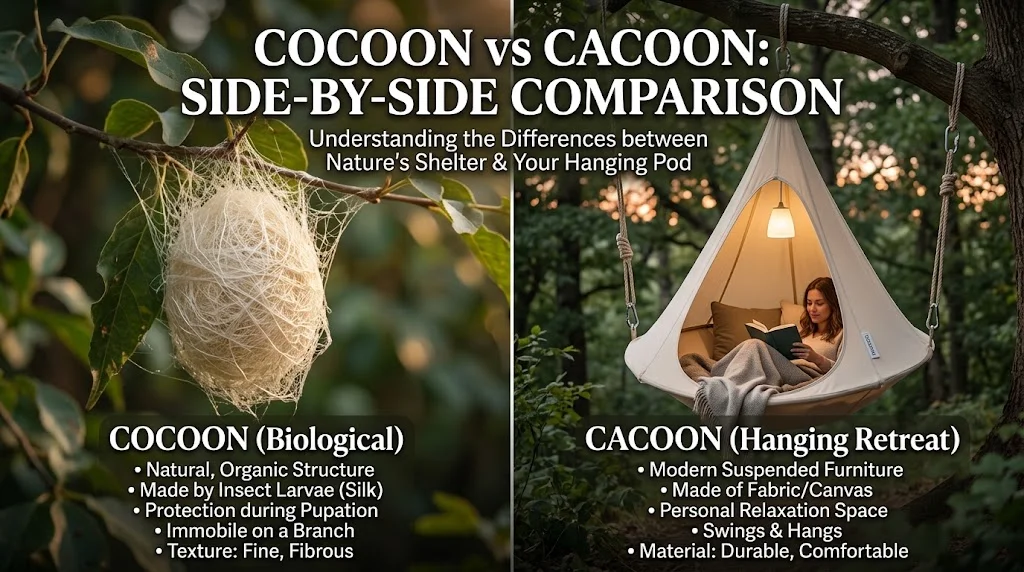
The easiest way to understand cocoon vs cacoon is to compare their meanings directly.
| Category | Cocoon | Cacoon |
| Spelling | C-O-C-O-O-N | C-A-C-O-O-N |
| Status | Standard English word | Real but uncommon English word |
| Primary meaning | Protective covering associated with certain insects | A large bean or seed of certain tropical plants |
| Common part of speech | Noun and verb | Noun |
| Biology usage | Common | Specialized botanical usage |
| Figurative usage | Yes | Generally no |
| Everyday frequency | High | Very low |
| Typical context | Insects, protection, isolation, transformation | Botany and plant-related references |
Spelling Difference
The most noticeable difference is the third letter.
Cocoon:
C O C O O N
Cacoon:
C A C O O N
Both words end with -coon, which contributes to their visual similarity.
The opening vowel separates them.
Meaning Difference
The meanings are completely different.
Cocoon relates primarily to an insect’s protective covering and, by extension, protection or isolation.
Cacoon has a botanical meaning involving a bean or seed.
Therefore, you shouldn’t replace one with the other merely because they look similar.
Pronunciation Difference
Pronunciation can vary depending on dialect and context. More importantly, neither word should be chosen based solely on how it sounds.
English spelling contains many examples where similar sounds correspond to different spellings.
That means the safest approach is to connect the spelling with the meaning and context, rather than relying only on pronunciation.
Usage Difference
You’ll see cocoon in ordinary English far more often.
For example:
The caterpillar formed a cocoon.
You’ll rarely encounter cacoon unless you’re reading about a particular plant or specialized botanical subject.
That difference in frequency matters when you’re choosing a word for general writing.
Why Do People Confuse Cocoon and Cacoon?
The confusion isn’t difficult to understand.
The Words Look Almost Identical
Compare:
cocoon
cacoon
Only one letter changes.
Both begin with c, contain another c, and finish with -oon.
When words have nearly identical visual patterns, it’s easy for your eyes to substitute one for another.
Their Pronunciations Are Similar
The words can also sound similar enough to create uncertainty.
When you hear a word instead of seeing it, you don’t get any visual clue about whether the middle vowel should be o or a.
This is one reason spelling questions often arise after hearing a word in conversation.
English Spelling Can’t Always Be Predicted From Sound
English has a complicated spelling system.
A word’s pronunciation doesn’t always tell you exactly which letters to write. That’s true across thousands of English words.
For example, English contains words such as:
- write
- right
- rite
- site
- sight
- cite
Sound alone doesn’t always settle spelling.
The same principle applies when you’re deciding between cocoon and cacoon.
Familiarity With the Common Word Can Cause False Assumptions
There’s an interesting twist here.
Because cocoon is so familiar, readers may assume cacoon must be an error.
Sometimes that assumption will be correct in context. But not always.
If a botanical text uses cacoon correctly, changing it automatically to cocoon could actually introduce an error.
The lesson is simple:
Don’t judge an unfamiliar spelling before checking its meaning.
The Meaning and Word History of Cocoon
Understanding where cocoon comes from can make the word easier to remember.
Where the Word Cocoon Came From
The English word cocoon has a long history connected with words describing a shell or protective covering.
It entered English through French and is ultimately connected with terms associated with a protective case or shell.
That historical connection fits its modern meaning remarkably well.
A cocoon essentially acts as a protective enclosure during part of an insect’s development.
French and Provençal Connections
The English term developed through European languages before becoming established in English.
Its history reflects the way English frequently borrows words from other languages.
Over time, cocoon became firmly established as the standard English term for the familiar insect structure.
The Original Idea of a Shell or Protective Covering
The concept behind the word is especially useful for remembering it.
Think of a cocoon as a natural protective case.
A developing insect is enclosed within it, much like an object protected inside a container.
That core image also explains the word’s figurative meanings.
When someone says they’re living in a “cocoon,” they often mean they’re surrounded by comfort or separated from outside pressures.
How Cocoon Developed Into a Modern English Word
Today, cocoon has expanded beyond strictly biological writing.
You can use it in:
- Science
- Education
- Fiction
- Journalism
- Psychology-related discussions of isolation, when used descriptively
- Lifestyle writing
- Everyday conversation
- Advertising and marketing
Its figurative flexibility is one reason the word remains common.
The Meaning and Word History of Cacoon
Cacoon follows a different path.
Cacoon Has a Different Linguistic History
Unlike cocoon, which is strongly associated with an insect’s protective covering, cacoon belongs to a specialized botanical vocabulary.
Its meaning developed around a plant and its distinctive bean or seed.
Therefore, the similarity between the two words doesn’t mean they’re spelling variants.
Its Connection With a Tropical Plant
The botanical meaning gives cacoon a specific place in English vocabulary.
The word can refer to a large bean or seed associated with tropical climbing plants.
That specificity explains why the term appears much less frequently than cocoon.
Why Its History Is Unrelated to the Insect Meaning of Cocoon
The two words happen to look and sound similar, but they identify different concepts.
This is an excellent example of why spelling should be connected with meaning, not appearance alone.
If two words look similar but refer to different things, treating them as interchangeable can create confusion.
Cocoon or Cacoon in Different Contexts
Context makes the choice much easier.
Biology and Nature Writing
Use cocoon when discussing the protective covering produced by certain insects.
Examples include:
- Moths
- Silkworms
- Other insects that create cocoons
Example:
The researcher examined the moth’s cocoon under controlled conditions.
Everyday Conversation
Cocoon is the natural choice in everyday English.
For example:
I just want to stay home and cocoon myself under a blanket.
The verb expresses the idea of surrounding yourself with comfort.
Figurative and Literary Writing
Writers frequently use cocoon as a metaphor.
For example:
The cabin became a warm cocoon during the winter storm.
The cabin isn’t literally a biological cocoon. It functions as one metaphorically because it provides shelter and separation.
Botanical and Historical References
This is where cacoon may appear.
If you’re discussing a particular tropical plant, its seeds, or a specialized botanical source, cacoon may be the intended word.
In such a context, changing it to cocoon would alter the meaning.
Academic and Professional Writing
Academic writing requires precision.
If you’re writing about insects, choose cocoon.
If you’re documenting a plant whose seed is called a cacoon, retain that specialized term.
Professional writing rewards accuracy more than familiarity.
Common Examples of Cocoon in Sentences
Seeing the word in different contexts can reinforce its meaning.
Cocoon as a Biological Noun
The caterpillar disappeared inside its cocoon.
The empty cocoon remained attached to the branch.
Scientists observed the insect before it emerged from its cocoon.
The silkworm produces silk that can form a protective cocoon.
Cocoon as a Figurative Noun
Her bedroom became a quiet cocoon after a demanding day.
The small apartment offered a comfortable cocoon from the busy city.
Music created a peaceful cocoon around the listener.
Cocoon as a Verb
He cocooned himself in blankets and watched a movie.
The thick walls cocooned the room from the street noise.
She likes to cocoon herself with a book on rainy afternoons.
These examples show why cocoon is much broader than its original biological sense.
Common Examples of Cacoon in Sentences
Because cacoon is uncommon, examples tend to appear in specialized contexts.
Cacoon in Botanical Context
The botanist recorded the cacoon among the plant’s distinctive seeds.
Cacoon When Discussing the Plant or Seed
The unusual cacoon seed attracted attention during the botanical survey.
Why Cacoon Would Be Incorrect in an Insect-Related Sentence
Consider this sentence:
The moth emerged from its cacoon.
If you’re referring to the insect’s protective covering, the appropriate word is cocoon.
Correct:
The moth emerged from its cocoon.
The issue isn’t that cacoon is never a word. The issue is that its meaning doesn’t fit the insect context.
Cocoon vs Chrysalis: Are They the Same?
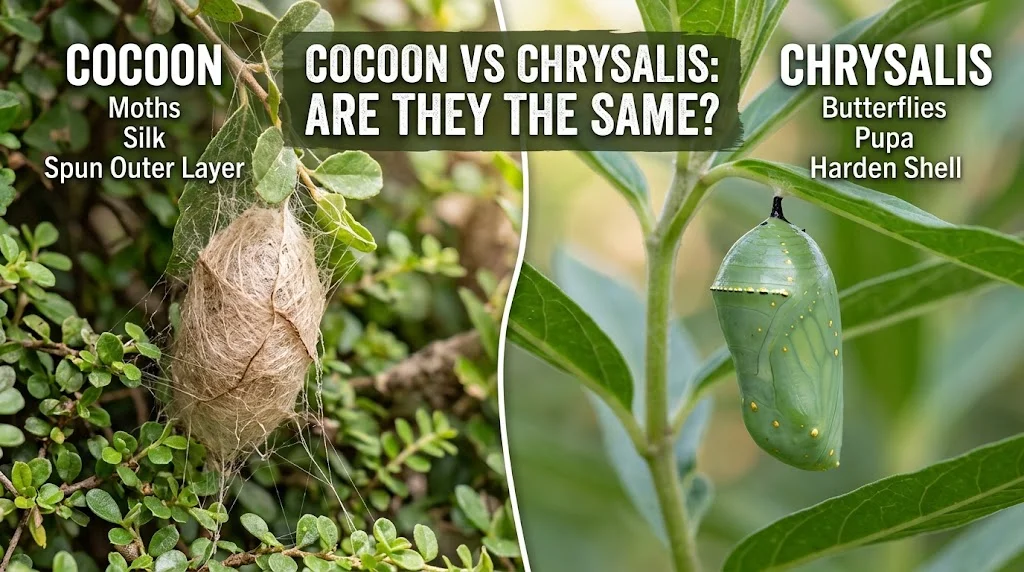
Another common source of confusion is cocoon vs chrysalis.
These terms are related to insect development, but they don’t mean exactly the same thing.
What a Cocoon Is
A cocoon is a protective covering created by certain insects, especially many moth larvae.
It can surround the insect during a developmental stage.
What a Chrysalis Is
A chrysalis is the pupal stage of a butterfly.
Unlike a typical moth cocoon, a butterfly chrysalis isn’t simply a silk case surrounding the pupa.
This distinction matters in scientific writing.
Why the Terms Are Sometimes Confused
In everyday speech, people sometimes use cocoon as a broad term for an insect’s protective developmental covering.
Popular descriptions can blur the technical distinction.
However, scientific writing benefits from using the terms precisely.
Examples Showing the Difference
A simplified comparison looks like this:
| Term | General Meaning |
| Cocoon | Protective covering produced by certain insects |
| Chrysalis | Pupal stage of a butterfly |
| Pupa | Developmental stage between larva and adult in insects with complete metamorphosis |
So if you’re writing a biology article, don’t automatically treat cocoon and chrysalis as synonyms.
How to Remember the Spelling Cocoon
If you frequently forget whether it’s cocoon or cacoon, a few simple memory tricks can help.
Remember the “Co-Co” Pattern
Break cocoon into a memorable pattern:
CO + CO + N
You can think of it as:
CO-CO-N
That repeated CO helps reinforce the correct spelling.
Connect Cocoon With Its Protective Meaning
Picture a moth tucked safely inside a protective covering.
Now connect that image with:
COCOON = protective covering
The meaning becomes a visual memory cue.
Use the Word in a Complete Sentence
Instead of memorizing the spelling by itself, write sentences such as:
The moth emerged from its cocoon.
The blanket created a warm cocoon around her.
Using the word in context strengthens your memory.
Build Visual Recognition Through Repetition
The more often you see cocoon, the more familiar its letter pattern becomes.
Try writing it several times:
cocoon
cocoon
cocoon
Eventually, the spelling begins to look natural.
Common Mistakes With Cocoon and Cacoon
Using Cacoon for an Insect’s Covering
This is the most common mistake in the cocoon or cacoon debate.
Incorrect in an insect context:
The butterfly came out of its cacoon.
Better:
The moth came out of its cocoon.
Remember that cacoon has a separate botanical meaning.
Assuming Cacoon Is Always a Misspelling
This is the opposite mistake.
If you encounter cacoon in a botanical source, don’t automatically correct it.
The word can be legitimate.
Always consider the surrounding context.
Choosing a Spelling Only From Pronunciation
Hearing a word isn’t always enough to determine its spelling.
If you’re unsure, connect the word with its meaning.
Ask:
Am I talking about an insect’s protective covering?
If yes, cocoon is the word you’re looking for.
Treating Rare Dictionary Words as Common Alternatives
A word can be legitimate without being common.
English contains thousands of specialized and archaic terms that rarely appear in everyday communication.
Cacoon falls into that less familiar category.
That doesn’t make it a second spelling of cocoon.
Which Spelling Should You Use in Everyday Writing?
For most everyday situations, the answer is straightforward.
Use Cocoon for Insects and Protective Coverings
If your subject involves a moth or an insect’s protective covering, use:
cocoon
Example:
The larva formed a cocoon on the underside of the leaf.
Use Cocoon for Figurative Meanings
When you’re describing comfort, privacy, protection, or isolation metaphorically, use:
cocoon
Example:
The quiet room felt like a cocoon from the outside world.
Use Cacoon Only When Referring to Its Specific Botanical Meaning
Use cacoon when you’re genuinely referring to the specialized plant-related meaning.
Example:
The text describes the plant’s unusual cacoon seeds.
This isn’t a spelling preference. It’s a difference in vocabulary.
Check the Context Before Correcting the Word
This is particularly important for editors and teachers.
If someone writes cacoon, don’t automatically mark it wrong.
First ask what they mean.
If they mean an insect’s covering, cocoon is appropriate.
If they’re discussing the botanical term, cacoon may be correct.
Cocoon or Cacoon: Practical Writing Guide
Here’s a quick reference you can use while editing.
| If You’re Writing About… | Use |
| A moth’s protective covering | Cocoon |
| Silkworm development | Cocoon |
| A protective enclosure | Cocoon |
| A comfortable private environment | Cocoon |
| Being surrounded by blankets | Cocoon |
| A tropical plant’s bean or seed | Cacoon |
| A specialized botanical reference | Cacoon, when that is the intended term |
For School and Academic Writing
If your assignment discusses insect development, use cocoon.
Don’t use cacoon simply because it looks plausible.
If your subject is botany, however, check the terminology carefully before making a correction.
For Business and Professional Writing
Professional writing usually benefits from the familiar word.
If you’re using cocoon metaphorically, make sure the surrounding sentence makes the comparison clear.
For example:
The redesigned lounge gives employees a quiet cocoon away from the busy office.
That sentence uses cocoon naturally as a metaphor for a protected space.
For Articles and Blog Posts
When writing for a general audience, cocoon will almost always be the relevant word when discussing insects or figurative protection.
If you introduce cacoon, define it clearly because many readers won’t recognize it.
For Scientific or Botanical Writing
Specialized writing demands precision.
Don’t replace a botanical term merely because another word looks more familiar.
Likewise, don’t use cocoon when a source specifically identifies a plant seed as a cacoon.
The right choice depends on the subject.
Mini Quiz: Cocoon or Cacoon?
Test your understanding with these context-based questions.
Choose the Correct Word
The moth emerged from its ____ after several weeks.
A. Cacoon
B. Cocoon
Answer: B. Cocoon
The sentence refers to an insect’s protective covering.
Fill in the Blank
The quiet bedroom became a warm ____ during the winter.
Answer: cocoon
Here, cocoon has a figurative meaning related to comfort and protection.
Identify the Meaning
Which word is associated with a specialized botanical meaning involving a bean or seed?
Answer: Cacoon
Correct the Spelling
The caterpillar formed a cacoon.
Corrected sentence:
The caterpillar formed a cocoon.
Distinguish the Two Words
Are cocoon and cacoon interchangeable spellings?
Answer: No.
They are separate words with different meanings.
True or False
Cacoon is never a real English word.
Answer: False.
Cacoon is a real but uncommon word with a specialized botanical meaning.
Context-Based Question
Which sentence uses the familiar word correctly?
A. The moth entered its cacoon.
B. The moth entered its cocoon.
Answer: B. The moth entered its cocoon.
Frequently Asked Questions About Cocoon or Cacoon
Is Cocoon the Correct Spelling?
Yes, cocoon is the standard word when you’re talking about an insect’s protective covering. It’s also the correct spelling when you’re using the word figuratively to describe a protected or sheltered environment.
Is Cacoon a Real Word?
Yes. Cacoon is a legitimate but uncommon English word. It has a specialized botanical meaning and can refer to a large bean or seed associated with certain tropical plants.
What Does Cocoon Mean?
A cocoon is a protective covering produced by certain insects during development. The word can also describe something that surrounds and protects a person or thing metaphorically.
What Does Cacoon Mean?
Cacoon is a rare botanical term associated with the large bean or seed of certain tropical climbing plants.
Is Cacoon Another Spelling of Cocoon?
No. Cacoon isn’t simply an alternative spelling of cocoon.
Although the words look similar, they have different meanings.
Why Do People Spell Cocoon as Cacoon?
People may confuse the spellings because the words look and sound similar. The unfamiliarity of cacoon can also contribute to the confusion because most English speakers encounter cocoon far more often.
What Is the Difference Between a Cocoon and a Chrysalis?
A cocoon is a protective covering produced by certain insects. A chrysalis is the pupal stage of a butterfly. The terms are related to insect development but aren’t exact synonyms.
Can Cocoon Be Used as a Verb?
Yes. Cocoon can function as a verb meaning to surround, enclose, or protect.
For example:
She cocooned herself in a blanket.
Can Cocoon Have a Figurative Meaning?
Yes. Writers commonly use cocoon metaphorically to describe a protected, comfortable, private, or isolated environment.
For example:
The cabin felt like a warm cocoon during the storm.
How Can I Remember the Spelling of Cocoon?
Remember the repeated CO pattern:
CO + CO + N = COCOON
If you’re referring to an insect’s protective covering, think COCOON.
Cocoon vs Cacoon: The Key Difference at a Glance
Before you finish, keep this simple distinction in mind:
Cocoon = insect covering, protection, or a figurative sheltered space.
Cacoon = a rare botanical word associated with a large bean or seed.
The two spellings are close enough to cause confusion, but their meanings separate them clearly.
If you’re writing a sentence about a moth, silkworm, insect development, or metaphorical protection, cocoon is the spelling you want.
If you’re working with a specialized botanical text and the subject is the plant or its seed, cacoon may be the appropriate term.
That small difference can save you from an awkward spelling mistake—or from “correcting” a word that was actually being used correctly.
Conclusion
The cocoon or cacoon question has a more interesting answer than a simple spelling correction.
Cocoon is the familiar English word for the protective covering associated with certain insects. It can also work as a verb and as a metaphor for comfort, shelter, privacy, or isolation.
Cacoon, meanwhile, is a separate and much rarer word. It has a specialized botanical meaning associated with a large bean or seed from certain tropical plants.
So, don’t treat cacoon as merely a bad spelling of cocoon.
Instead, look at the context.
If you’re writing about a moth’s protective covering, choose cocoon. If you’re discussing a specialized botanical subject where cacoon is the intended term, keep cacoon.
The easiest memory trick is simple:
COCOON = the familiar insect-related word.
Once you connect the spelling with its meaning, the cocoon vs cacoon confusion becomes much easier to avoid.