What Is the Difference Between Recurring and Reoccurring?
Choosing between Recurring vs Reoccurring can be confusing because both words describe something that happens more than once. At first glance, recurring and reoccurring may appear to be interchangeable. However, they can carry slightly different shades of meaning depending on the situation. Understanding this distinction can help you choose the right word in professional writing, business English, everyday communication, and formal writing.
The word recurring generally describes something that happens repeatedly or follows a recognizable repeated pattern. You’ll commonly see it in phrases such as recurring payment, recurring expense, recurring revenue, recurring meeting, recurring event, recurring problem, recurring issue, and recurring theme. Meanwhile, reoccurring emphasizes something happening again or returning after it has happened before.
For example, a monthly subscription involves a recurring payment because the payment follows an established cycle. A technical failure that disappears and later happens again could be described as a reoccurring problem. Still, recurring problem can also be correct when the issue forms a repeated pattern.
Both terms are legitimate English words, so the choice isn’t simply about correct versus incorrect grammar. The real question is what kind of repetition you want to describe.
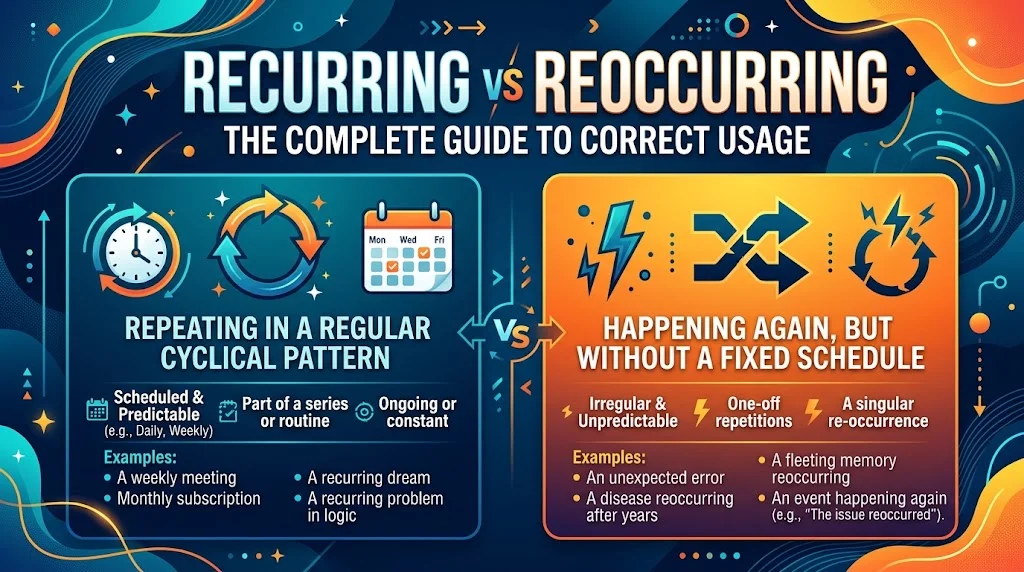
The simplest way to understand recurring vs reoccurring is to focus on the nature of the repetition.
Recurring usually suggests repeated occurrence as part of a pattern. The repetition may be regular, expected, or ongoing.
Reoccurring focuses more directly on something occurring again. It doesn’t necessarily suggest a fixed schedule or predictable cycle.
Consider these examples:
- I have a recurring appointment every Monday.
- The software has a reoccurring error after every major update.
The first sentence describes a planned pattern. The second emphasizes that the error happens again.
There is some overlap, though. A writer could use recurring for the software error too, especially if the error has become a repeated pattern.
Quick Definition of Recurring
Recurring means happening repeatedly or appearing again and again.
It often describes something that follows a recognizable pattern. The pattern doesn’t always have to involve a formal schedule.
Examples include:
- recurring payments
- recurring meetings
- recurring expenses
- recurring dreams
- recurring themes
- recurring problems
- recurring symptoms
- recurring patterns
A recurring event can be predictable, but predictability isn’t strictly required.
For example:
The company continues to face recurring supply problems.
The problems might not happen on a specific day each month. They are recurring because the same type of problem keeps returning.
Quick Definition of Reoccurring
Reoccurring means happening again or occurring another time.
The word can emphasize the fact that something has happened before and has now happened again.
For example:
The reoccurring error appeared after the computer restarted.
The focus is on the error appearing again.
Another example:
She reported reoccurring delays during the construction project.
Here, the delays have happened more than once. The sentence doesn’t necessarily tell us that they follow a fixed schedule.
The Core Difference in One Sentence
A practical distinction is:
Recurring emphasizes repeated patterns, while reoccurring emphasizes something happening again.
Think of recurring as a loop.
Think of reoccurring as a return.
Those meanings overlap, which explains why native speakers sometimes use the terms interchangeably.
Featured Snippet Answer
Recurring and reoccurring are both correct words. Recurring usually describes something that happens repeatedly or follows a pattern, while reoccurring emphasizes something happening again. Use recurring for established patterns such as recurring payments or recurring meetings, and use reoccurring when you want to stress another occurrence.
What Does Recurring Mean?
The word recurring comes from the verb recur. In everyday English, it describes something that returns or happens repeatedly.
The important idea is repetition.
However, repetition can take different forms. A recurring event might happen every week, every year, occasionally, or whenever particular circumstances arise.
For example:
The team holds a recurring meeting every Friday.
This is clearly scheduled.
Now consider:
The company has a recurring problem with damaged shipments.
There is no specific schedule. The problem simply keeps happening.
That’s why it’s too restrictive to define recurring as meaning only “regularly scheduled.”
Recurring as a Pattern of Repetition
A recurring pattern is something that appears repeatedly.
Patterns can occur in many areas of life:
- business
- finance
- technology
- literature
- science
- education
- personal experiences
Suppose you notice that a particular software error appears after every major update. You could call it a recurring error.
Suppose a novelist repeatedly explores the same idea throughout a book. That idea is a recurring theme.
Suppose your electricity bill arrives every month. That’s a recurring expense.
The common thread is repetition.
Common Meanings of Recurring
The word recurring can describe:
Regular events:
A recurring meeting happens repeatedly according to a schedule.
Financial obligations:
A recurring payment happens repeatedly, often automatically.
Repeated problems:
A recurring problem keeps returning over time.
Repeated ideas:
A recurring theme appears multiple times in a piece of writing.
Repeated experiences:
A recurring dream or concern returns repeatedly.
The meaning comes from context.
Examples of Recurring in Sentences
- The company charges a recurring monthly fee.
- We have a recurring meeting every Tuesday.
- She experienced a recurring dream about the ocean.
- The report identifies several recurring problems.
- The author uses a recurring symbol throughout the novel.
- Recurring expenses can make budgeting more difficult.
- The application has a recurring performance issue.
- Rain is a recurring feature of the region’s winter season.
Notice how naturally recurring works across very different contexts.
Read More: Totalling vs Totaling: Which Spelling Is Correct?
What Does Reoccurring Mean?
Reoccurring comes from reoccur, which means to occur again.
The prefix re- commonly carries the sense of “again.” The verb occur means to happen.
Put them together and the basic idea becomes happen again.
For instance:
The same error reoccurred after the update.
The sentence highlights the return of the error.
This doesn’t necessarily mean the error follows a neat schedule.
Reoccurring as Something Happening Again
Imagine a customer reports a billing problem in January. The company fixes it. The problem disappears for several months. Then it appears again in September.
You could describe that as a reoccurring billing problem.
The important detail is that the problem has returned.
The same principle applies to many situations:
- a disagreement happens again
- a technical failure happens again
- a delay happens again
- a symptom appears again
- an unexpected issue returns
Common Meanings of Reoccurring
Reoccurring can describe something that:
- happened previously
- stopped or disappeared
- happened again later
- repeatedly returns
- occurs on multiple occasions without a fixed pattern
For example:
The reoccurring delays affected several shipments.
The sentence doesn’t establish a schedule. It simply tells you that delays happened repeatedly.
Examples of Reoccurring in Sentences
- The reoccurring error was difficult to diagnose.
- The team discussed the reoccurring complaint.
- A reoccurring delay affected the project timeline.
- The technician investigated the reoccurring malfunction.
- The reoccurring disagreement eventually required mediation.
- The issue disappeared but became reoccurring several months later.
Recurring vs Reoccurring: Meaning and Usage Breakdown
The distinction becomes easier when you examine what each word emphasizes.
The Meaning of Recurring
Recurring emphasizes repetition as a pattern.
The pattern might be:
- scheduled
- periodic
- cyclical
- habitual
- repeated under similar circumstances
For example:
The business has recurring monthly expenses.
The repetition is built into the nature of the expense.
Likewise:
The novel contains a recurring image of birds.
The image repeatedly appears throughout the story.
The Meaning of Reoccurring
Reoccurring emphasizes another occurrence.
For example:
The same complaint reoccurred after the policy changed.
The focus isn’t necessarily on a predictable cycle. Instead, the complaint occurred before and then occurred again.
The Key Semantic Distinction
Here’s the practical difference:
| Word | Main emphasis | Typical idea |
| Recurring | Repeated pattern | Something keeps happening |
| Reoccurring | Another occurrence | Something happens again |
| Recurring | Often predictable | Regular or continuing repetition |
| Reoccurring | Not necessarily predictable | Return or repetition |
| Both | Repetition | More than one occurrence |
This distinction isn’t rigid.
English contains plenty of overlapping words. Context often determines which term sounds more natural.
Can They Be Interchangeable?
Sometimes, yes.
For example:
The company has a recurring technical problem.
and
The company has a reoccurring technical problem.
Both sentences can communicate that the technical problem happens repeatedly.
The first sentence sounds more natural when you’re describing an established pattern. The second puts slightly more emphasis on the problem happening again.
That’s why calling one word universally “correct” and the other universally “wrong” creates a misleading rule.
Recurring vs Reoccurring Word Origins
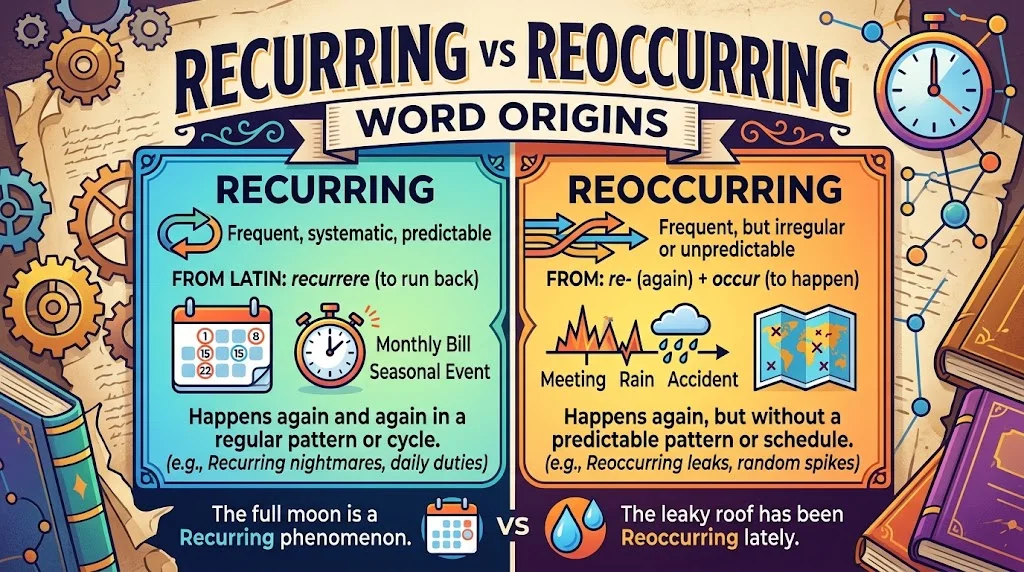
Word origins provide a useful clue to the modern distinction.
Origin and Development of Recurring
Recurring comes from recur, which traces back to the Latin recurrere, meaning “to run back” or “to return.”
Over time, recur developed the sense of something happening repeatedly or returning.
The related noun recurrence refers to the act or fact of occurring again.
That’s why English has familiar expressions such as:
- recurring event
- recurring problem
- recurring theme
- recurring expense
- recurrence of an issue
Origin and Development of Reoccurring
Reoccurring comes from reoccur, which combines re-, meaning “again,” with occur.
The construction makes the basic meaning relatively transparent:
re + occur = occur again
The verb reoccur therefore means to occur again.
Its participial form is reoccurring.
Why Their Origins Help Explain the Difference
Their histories reveal why the meanings overlap.
Both words contain the idea of return or repetition. Their difference isn’t based on completely separate meanings.
Instead, their usage developed around slightly different emphases.
Recur has a long-established connection with repeated return or recurrence.
Reoccur more transparently describes something occurring again.
That difference remains useful in modern writing.
When Should You Use Recurring?
In many situations, recurring is the more natural choice.
It’s especially common when repetition forms part of an established pattern.
Recurring in Business and Finance
Business writing uses recurring extensively.
Common expressions include:
- recurring revenue
- recurring expenses
- recurring payments
- recurring billing
- recurring subscriptions
- recurring costs
- recurring invoices
For example:
The software company earns recurring revenue from annual subscriptions.
The revenue isn’t merely appearing again by coincidence. The business model creates an ongoing stream.
Similarly:
The customer authorized recurring payments for the service.
The payments follow an established arrangement.
Recurring in Scheduling
Use recurring for events that repeat according to a schedule.
Examples include:
- recurring meetings
- recurring appointments
- recurring classes
- recurring reminders
- recurring events
For example:
The calendar contains a recurring meeting every Wednesday.
The event isn’t simply happening again. It’s configured to repeat.
Recurring in Everyday Life
You can also use recurring for personal experiences.
Examples include:
- recurring dreams
- recurring thoughts
- recurring concerns
- recurring habits
- recurring situations
For instance:
He noticed a recurring pattern in his daily routine.
The phrase suggests repetition that has become recognizable.
Recurring in Literature and Media
Writers frequently use recurring theme, recurring character, and recurring motif.
For example:
Freedom is a recurring theme throughout the novel.
The theme appears repeatedly across the work.
A character who appears multiple times might also be described as a recurring character.
This usage is well established because the repetition forms a recognizable literary pattern.
Recurring in Technical and Academic Writing
Technical writers can use recurring when an issue or phenomenon repeatedly appears.
For example:
The researchers observed a recurring pattern in the data.
Or:
The software continues to produce a recurring error.
The word doesn’t require a precise calendar schedule. It simply communicates repeated occurrence.
When Should You Use Reoccurring?
Reoccurring can be useful when the main point is that something has happened again.
It often works well with incidents, problems, and events that return after an earlier occurrence.
Reoccurring Problems
Suppose a customer experiences the same problem several times.
You might write:
The team investigated the reoccurring problem.
The term draws attention to the problem appearing again.
That said, recurring problem would also be perfectly natural.
Reoccurring Symptoms or Conditions
In general descriptions of symptoms, reoccurring can emphasize that something returns after previously appearing.
For example:
The patient reported reoccurring symptoms.
In precise medical writing, terminology should follow the relevant clinical context rather than relying on a simple recurring-versus-reoccurring rule.
A general grammar distinction shouldn’t replace professional terminology.
Reoccurring Technical Issues
Technology provides another useful example.
Imagine a server crashes unexpectedly. Engineers repair it. Several weeks later, the same crash happens again.
You could say:
The team investigated the reoccurring server failure.
The word highlights the return of the failure.
If the failure has become a recognized pattern, recurring server failure may sound equally natural.
Reoccurring Events Without a Fixed Pattern
This is one situation where the distinction can be particularly useful.
Suppose shipping delays happen in January, April, and November. There isn’t enough evidence to say they follow a fixed schedule.
You might describe them as reoccurring delays.
However, once the organization identifies a repeated pattern, recurring delays could become the more natural description.
Recurring vs Reoccurring: A Real-World Workplace Example
Imagine a marketing department that meets every Monday morning.
The meeting appears automatically on everyone’s calendar.
The natural phrase is:
weekly recurring meeting
Now imagine the team keeps encountering the same problem with campaign approvals. The problem doesn’t happen according to a schedule. It simply keeps coming back.
A manager might write:
We need to address this recurring approval problem.
The problem has become a repeated pattern.
Now imagine the issue was fixed six months ago and suddenly returned after a software change.
A manager could emphasize the return by writing:
The approval issue has reoccurred after the latest software update.
Notice the difference between the adjective and verb forms.
Recurring issue describes a repeated pattern.
Has reoccurred emphasizes that the issue happened again.
This is an important distinction because reoccur can sometimes sound more natural as a verb:
The error reoccurred after the update.
rather than:
The error recurred after the update.
Both verbs are legitimate. The writer’s intended emphasis matters.
Recurring vs Reoccurring: Grammar and Sentence Structure
Both recurring and reoccurring can function as adjectives.
They describe nouns.
Examples:
- recurring problem
- recurring payment
- recurring event
- reoccurring problem
- reoccurring issue
- reoccurring event
They also come from present participles of verbs:
- recur → recurring
- reoccur → reoccurring
Recurring as a Present Participle
The verb is recur.
Its forms include:
- recur
- recurs
- recurred
- recurring
Example:
The problem keeps recurring.
Here, recurring participates in the verb phrase.
Reoccurring as a Present Participle
The verb is reoccur.
Its forms include:
- reoccur
- reoccurs
- reoccurred
- reoccurring
Example:
The problem keeps reoccurring.
Again, the word describes an action that happens repeatedly.
Recurring vs Reoccurring in Sentence Patterns
Compare these sentences:
We have a recurring meeting.
The same issue keeps reoccurring.
The first describes an established event.
The second focuses on an issue happening again.
That difference can make your writing more precise.
Recurring vs Reoccurring Comparison Table
| Feature | Recurring | Reoccurring |
| Basic meaning | Happening repeatedly | Happening again |
| Related verb | Recur | Reoccur |
| Suggests repetition | Yes | Yes |
| Suggests a pattern | Often | Sometimes |
| Requires a schedule | No | No |
| Common with payments | Yes | Rare |
| Common with meetings | Yes | Less natural |
| Common with problems | Yes | Yes |
| Common with themes | Yes | Less common |
| Correct English word | Yes | Yes |
| Can overlap with the other word | Yes | Yes |
Common Collocations With Recurring
A collocation is a word combination that sounds natural because English speakers commonly use the words together.
Some especially familiar combinations with recurring include:
- recurring payment
- recurring revenue
- recurring expense
- recurring subscription
- recurring meeting
- recurring event
- recurring problem
- recurring issue
- recurring dream
- recurring theme
- recurring pattern
- recurring character
These established combinations explain why recurring appears so often in professional writing.
Common Business Collocations
In finance and business, recurring revenue is especially common.
It refers to revenue expected to continue through ongoing arrangements such as subscriptions or contracts.
Similarly, recurring expenses are costs that occur repeatedly.
Examples might include:
- rent
- subscription fees
- insurance premiums
- software licenses
- service contracts
The exact classification of a business expense depends on the accounting context. Still, recurring clearly communicates repeated financial activity.
Common Collocations With Reoccurring
Reoccurring appears frequently with situations where something returns.
Common combinations include:
- reoccurring problem
- reoccurring issue
- reoccurring error
- reoccurring symptom
- reoccurring delay
- reoccurring conflict
- reoccurring failure
For example:
The technician couldn’t identify the cause of the reoccurring error.
Here, the emphasis falls on the error happening again.
Why Reoccurring Appears Less Often
One major reason is simple: recurring already covers much of the same territory.
English speakers don’t always need the extra re- construction.
When something repeatedly happens, recurring is already a well-established choice.
That doesn’t make reoccurring incorrect. It simply means the two words don’t have equal usage in every context.
Recurring vs Reoccurring: Which Is More Common?
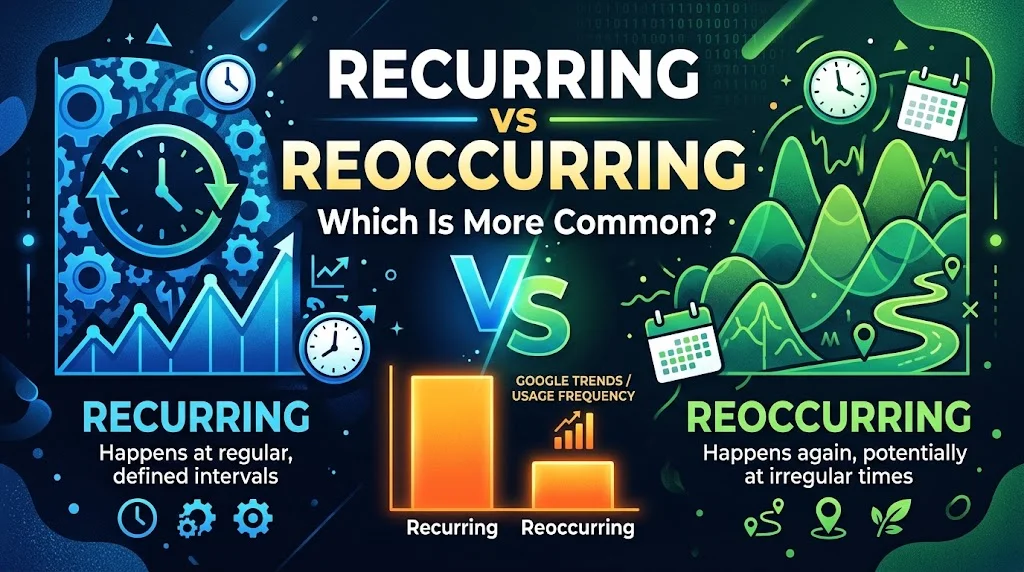
Recurring has broad usage across many areas of English.
You encounter it in:
- business
- finance
- technology
- literature
- scheduling
- education
- everyday conversation
Its frequent appearance in established phrases also reinforces its familiarity.
Why Recurring Has Broader Usage
Many concepts naturally involve repeated patterns.
Businesses have recurring expenses.
Calendars have recurring events.
Books have recurring themes.
People experience recurring dreams.
Systems develop recurring errors.
The word therefore fits a wide range of contexts.
Why Reoccurring Still Exists
Reoccurring remains a valid English word because reoccur is an established verb.
The word can be useful when the writer wants to emphasize that something has happened again.
For example:
The same error reoccurred after the repair.
That sentence focuses on the error’s return.
What Dictionary Usage Shows
Major English dictionaries recognize recur, recurring, reoccur, and reoccurring.
Dictionary definitions generally show considerable semantic overlap.
This matters because online grammar discussions sometimes make an overly simple claim:
“Recurring is correct and reoccurring is wrong.”
That statement doesn’t accurately represent standard English usage.
A better rule is to recognize both words and then choose based on meaning and context.
Common Mistakes With Recurring and Reoccurring
Mistake: Assuming Reoccurring Is Incorrect
This is one of the biggest misconceptions.
Reoccurring is a legitimate English word.
It isn’t simply a spelling error involving recurring.
The verb reoccur is established English, and reoccurring is its present participle.
Mistake: Using Reoccurring for Every Repeated Event
Although reoccurring can describe repeated events, it isn’t always the most natural choice.
For scheduled or established processes, recurring often fits better.
For example:
recurring monthly payment
is more natural than:
reoccurring monthly payment
The first phrase immediately communicates a planned payment cycle.
Mistake: Treating Recurring as Meaning “Scheduled Only”
This is another oversimplification.
A recurring problem doesn’t have to appear every Tuesday at 10 a.m.
For example:
The company faces recurring customer complaints.
The complaints may occur irregularly. They still form a repeated pattern.
Mistake: Treating the Words as Completely Identical
The terms overlap, but they can carry different emphasis.
If you want to stress repetition as a pattern, recurring is usually useful.
If you want to stress another occurrence, reoccurring can make that emphasis clearer.
Mistake: Choosing Based Only on the Prefix
It’s tempting to think:
re- = again
Therefore:
reoccurring = happening again
That reasoning isn’t wrong, but English vocabulary doesn’t always follow perfectly mechanical rules.
Word history, established usage, collocations, and context all influence natural word choice.
Recurring vs Reoccurring: How to Choose the Right Word
When you’re unsure, ask yourself what you’re actually describing.
Use Recurring When…
Choose recurring when:
- something happens repeatedly
- a recognizable pattern exists
- an event follows a schedule
- a payment repeats
- an expense continues
- a theme appears repeatedly
- a problem keeps returning
- an ongoing cycle matters
Examples:
recurring payment
recurring meeting
recurring expense
recurring theme
recurring problem
Use Reoccurring When…
Choose reoccurring when:
- something has happened before
- it happens again
- you’re emphasizing its return
- the repetition isn’t necessarily scheduled
- you want to describe another occurrence
Examples:
reoccurring technical issue
reoccurring delay
reoccurring error
reoccurring conflict
When Either Word Can Work
Some sentences allow either term without creating a serious change in meaning.
For example:
The company continues to experience a recurring problem.
The company continues to experience a reoccurring problem.
Both communicate repetition.
The first sounds more natural when the problem is an established pattern. The second emphasizes that the problem continues to occur again.
In ordinary writing, context usually matters more than forcing an artificial distinction.
Easy Memory Trick
A simple memory trick can make recurring vs reoccurring easier to remember.
Recurring = Repeated Pattern
Think:
Recurring = something keeps coming back.
A recurring meeting keeps coming back every week.
A recurring expense keeps appearing in your budget.
A recurring theme keeps appearing in a book.
Reoccurring = Occurring Again
Think:
Reoccurring = it occurred, and now it occurred again.
The emphasis is on another occurrence.
A Quick Question to Ask Yourself
When you’re stuck, ask:
Am I describing a repeated pattern or emphasizing that something happened again?
If you’re describing a pattern, recurring is often the natural choice.
If you’re highlighting another occurrence, reoccurring may better express the idea.
Recurring vs Reoccurring: Example Sentences
Examples With Recurring
- The customer has a recurring subscription.
- Our team holds a recurring meeting every Friday.
- The business needs to reduce recurring expenses.
- The report identified a recurring error.
- The novel explores a recurring theme of isolation.
- She has a recurring dream about her childhood home.
- The software produces a recurring warning message.
- The organization faces recurring supply-chain challenges.
- A recurring payment is processed automatically each month.
- The researchers noticed a recurring pattern in the results.
Examples With Reoccurring
- The same error kept reoccurring after the update.
- The technician investigated the reoccurring system failure.
- The customer reported a reoccurring billing issue.
- The team discussed the reoccurring delays.
- The dispute became a reoccurring problem.
- The same complaint was reoccurring throughout the project.
- The reoccurring issue returned after several months.
- Engineers searched for the source of the reoccurring malfunction.
- The manager wanted to prevent the error from reoccurring.
- The reoccurring interruption affected several users.
Side-by-Side Examples
| Recurring | Reoccurring |
| We have a recurring meeting. | The meeting issue kept reoccurring. |
| She has recurring dreams. | The same dream kept reoccurring. |
| The company has recurring expenses. | The billing error kept reoccurring. |
| The software has a recurring error. | The error reoccurred after the update. |
| The book contains a recurring theme. | The same theme reoccurs throughout the story. |
The examples show something important: the verb forms can sometimes make the intended distinction even clearer.
Recurring vs Reoccurring in Professional Writing
Professional writing benefits from precision.
You don’t need to avoid reoccurring, but you should choose terminology that communicates your intended meaning quickly.
Business Communication
Use recurring for established business processes.
Examples:
- recurring invoices
- recurring meetings
- recurring payments
- recurring subscriptions
- recurring expenses
These phrases are immediately recognizable.
Technical Documentation
Technical writers can use either word depending on context.
For an established pattern:
The application has a recurring authentication error.
For a failure that has returned:
The authentication error reoccurred after the patch.
That subtle distinction can make technical documentation easier to understand.
Academic Writing
Academic writers often use recurring when describing patterns.
For example:
A recurring pattern emerged across the three studies.
The word works well because academic research frequently examines repeated observations.
Formal Reports
Formal reports should prioritize clarity.
If an issue repeatedly appears, recurring issue is usually straightforward.
If the writer wants to emphasize that a previously resolved issue has returned, reoccurred may provide more precise wording.
Consistency and Clarity
Once you’ve chosen a term for a specific concept, use it consistently.
Don’t switch randomly between recurring and reoccurring simply to avoid repetition in your own writing.
Vocabulary variety is useful, but clarity comes first.
For example, if a report consistently calls a billing problem a recurring issue, suddenly calling it a reoccurring issue could make readers wonder whether the meaning has changed.
Consistency prevents that confusion.
Recurring vs Reoccurring: Quick Reference
If you need an answer in a hurry, use this guide:
| If you mean… | Use |
| Happens every month | Recurring |
| Happens every week | Recurring |
| Repeated expense | Recurring |
| Repeated payment | Recurring |
| Repeated literary theme | Recurring |
| Repeated pattern | Recurring |
| Something happens again | Reoccurring can fit |
| An old problem returns | Reoccurring can fit |
| An issue happens repeatedly | Recurring or reoccurring |
| A previously fixed error returns | Reoccurring can emphasize the return |
The key isn’t to memorize dozens of rigid rules.
Instead, remember the central idea:
Recurring highlights repetition as a pattern. Reoccurring highlights another occurrence.
FAQs
Is Recurring or Reoccurring More Correct?
Both recurring and reoccurring are correct English words. Recurring is especially common for repeated patterns, scheduled events, payments, expenses, and themes. Reoccurring emphasizes something occurring again.
Are Recurring and Reoccurring Synonyms?
They are overlapping synonyms, but they aren’t always identical in emphasis. Recurring often suggests a repeated pattern, while reoccurring can emphasize another occurrence.
Can Recurring and Reoccurring Be Used Interchangeably?
Sometimes. In contexts involving repeated problems or events, either word may communicate the intended idea. However, recurring is generally more natural for established patterns and scheduled activities.
Is Reoccurring a Real Word?
Yes. Reoccurring is a legitimate English word derived from the verb reoccur. It means occurring again.
Is Recurring Used Only for Scheduled Events?
No. A recurring event doesn’t have to follow a strict schedule. A repeated problem, recurring dream, or recurring theme can happen without a predictable timetable.
Is “Recurring Revenue” Correct?
Yes. Recurring revenue is a standard business expression for revenue generated repeatedly through ongoing arrangements such as subscriptions or continuing contracts.
Is “Recurring Payment” Correct?
Yes. Recurring payment is the standard expression for a payment that repeats according to an established arrangement, such as a monthly subscription.
Should I Say Recurring or Reoccurring Problem?
Either can work. Recurring problem is a natural general choice when describing a repeated pattern. Reoccurring problem can emphasize that the problem has appeared again after appearing previously.
Is Reoccurring Less Common Than Recurring?
In many common contexts, yes. Recurring has particularly broad usage in business, finance, scheduling, literature, and general writing. Lower frequency doesn’t make reoccurring incorrect.
What Is the Difference Between Recur and Reoccur?
Recur means to happen repeatedly or return, often suggesting recurrence as a pattern. Reoccur means to occur again. Their meanings overlap, which is why recur and reoccur can sometimes describe the same situation.
What Is the Easiest Way to Remember Recurring vs Reoccurring?
Remember:
Recurring = repeated pattern.
Reoccurring = occurring again.
If you’re describing something that regularly or repeatedly appears, recurring is usually the natural choice. If you’re emphasizing that something happened again, reoccurring may fit.
Conclusion
The difference between recurring vs reoccurring isn’t a simple matter of one word being correct and the other being wrong. Both are valid English words, but they can emphasize repetition in slightly different ways.
Recurring generally describes something that happens repeatedly or forms a recognizable pattern. That’s why you commonly see phrases such as recurring payment, recurring revenue, recurring meeting, recurring expense, and recurring theme.
Reoccurring focuses more directly on something happening again. It can be especially useful when a problem, event, or situation returns after occurring previously.
The meanings overlap, so context remains important.
When you’re describing an established cycle or repeated pattern, recurring is usually the clearest choice. When you want to emphasize another occurrence, reoccurring can communicate that idea effectively.
The best approach isn’t to memorize an artificial rule. Instead, focus on what you want your sentence to say.
Recurring points toward repetition as a pattern. Reoccurring points toward something occurring again.
Once you see that distinction, choosing between the two becomes much easier.



[…] Read More: Recurring vs Reoccurring: The Complete Guide to Correct Usage […]