Introduction
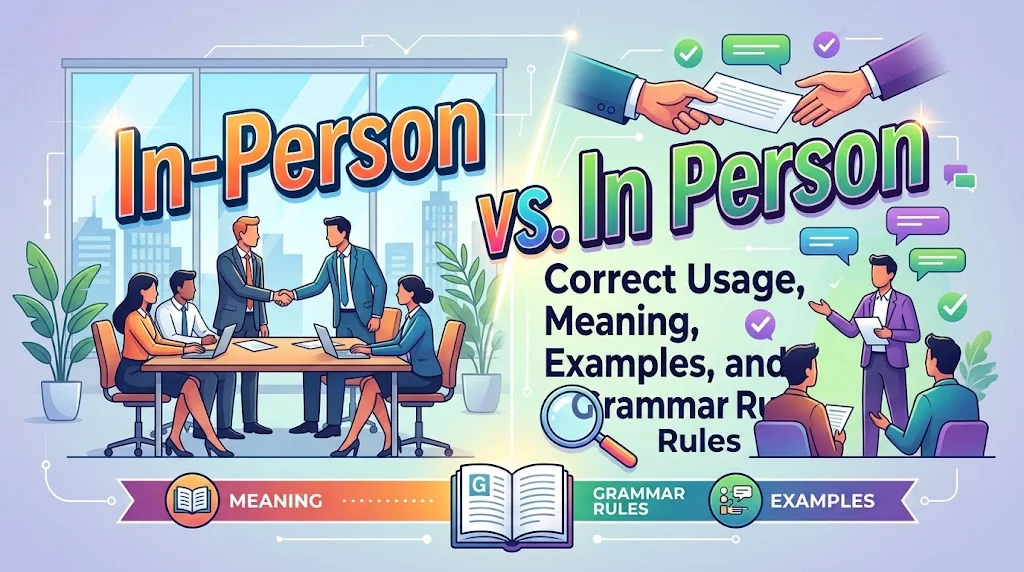
Choosing between in-person vs. in person can seem like a tiny grammar issue, but the hyphen actually tells you how the phrase works in a sentence. Both forms describe something that happens face-to-face, physically, or rather than remotely. The difference comes down mainly to grammatical function and sentence position. Once you understand that pattern, the choice becomes much easier.
Use in-person when the phrase works as a compound adjective before a noun. For example, an in-person meeting, in-person interview, or in-person class uses the hyphen because the two words work together to describe the noun that follows. In contrast, use in person when the phrase functions as an adverbial phrase, usually after a verb. For example, you might meet in person, talk in person, or attend an event in person.
This distinction matters in professional writing, business communication, academic writing, emails, and everyday English. Writers often make the mistake of adding a hyphen whenever they see the phrase or leaving it out when it modifies a noun. Neither approach works consistently.
This guide explains in-person vs. in person, including the meaning, grammar rule, hyphenation, correct usage, common mistakes, and plenty of practical examples. By the end, you’ll have a simple rule you can apply whenever you’re unsure.
In-Person vs. In Person: What’s the Difference?
The difference between in-person and in person is primarily grammatical rather than semantic. Both expressions refer to something happening physically or face-to-face rather than through a phone call, video meeting, message, or other remote method.
The key question is:
Is the phrase describing a noun, or is it describing an action?
If it directly describes a noun, use in-person.
If it describes how an action happens, use in person.
| Form | Function | Typical Position | Example |
| in-person | Compound adjective | Before a noun | an in-person meeting |
| in person | Adverbial phrase | Usually after a verb | We met in person |
| inperson | Incorrect form | — | ❌ an inperson meeting |
Consider these two sentences:
- We scheduled an in-person meeting.
- We scheduled the meeting to happen in person.
The meaning remains closely related, but the grammar changes. In the first sentence, in-person modifies meeting. In the second, in person tells you how the meeting happened.
That’s the central rule.
When to Use “In-Person”
Use in-person when the phrase functions as a compound adjective. Most commonly, it appears immediately before a noun.
The hyphen connects the two words so readers understand that they work together as one descriptive unit.
For example:
The company scheduled an in-person interview.
Here, in-person describes the type of interview. The interview isn’t simply any interview. It’s one conducted face-to-face.
“In-Person” Before a Noun
The most common structure is:
in-person + noun
Examples include:
- in-person meeting
- in-person interview
- in-person class
- in-person appointment
- in-person event
- in-person consultation
- in-person training
- in-person visit
- in-person service
- in-person discussion
- in-person instruction
- in-person support
The noun doesn’t have to refer to a physical object. It can describe an event, service, activity, or experience.
For example:
- The university offers in-person instruction.
- We need an in-person consultation.
- The company requires an in-person interview.
- She booked an in-person appointment.
- The conference includes several in-person events.
Why the Hyphen Is Used
Hyphens often help readers recognize a group of words as a single modifier.
Compare:
an in-person interview
with:
an in person interview
The first version immediately signals that in-person works together to describe interview.
English doesn’t hyphenate every combination of words. However, compound modifiers placed before nouns often benefit from hyphenation when the connection could otherwise be unclear.
Common Examples of “In-Person”
Here are some natural examples across different settings:
Workplace
The company scheduled an in-person meeting for Monday.
Education
Students can choose between online and in-person classes.
Healthcare
The clinic requires an in-person appointment for this service.
Business
The consultant provides in-person training for new employees.
Events
Tickets are available for the in-person event and its virtual version.
Example Sentences With “In-Person”
- We arranged an in-person interview with the candidate.
- The school provides in-person instruction three days a week.
- She requested an in-person consultation.
- The company organized an in-person workshop.
- They offer both virtual and in-person support.
- The doctor scheduled an in-person appointment.
- Our team attended an in-person conference.
- The organization announced an in-person training session.
Notice the same pattern throughout: in-person comes directly before a noun.
Read More: Pre vs Post: Correct Usage, Meaning, Differences, and Examples
When to Use “In Person”
Use in person without a hyphen when the phrase works as an adverbial phrase.
In this role, it describes an action. It tells the reader that someone performed the action physically or face-to-face rather than remotely.
For example:
I’d rather discuss the issue in person.
Here, in person describes discuss. It tells us how the discussion should happen.
“In Person” After a Verb
A common pattern is:
verb + in person
Examples include:
- meet in person
- attend in person
- speak in person
- talk in person
- visit in person
- appear in person
- discuss something in person
- deliver something in person
- see someone in person
Examples:
Let’s meet in person tomorrow.
She wants to speak with you in person.
He attended the hearing in person.
I’d rather explain everything in person.
The phrase doesn’t describe a noun in these examples. Instead, it explains how the action takes place.
Example Sentences With “In Person”
- We should discuss the problem in person.
- She attended the interview in person.
- I’d like to meet you in person.
- The manager spoke with the customer in person.
- He delivered the documents in person.
- They decided to discuss the contract in person.
- The speaker appeared in person at the event.
- She visited the office in person.
The absence of the hyphen isn’t an accident. The phrase has a different grammatical job.
In-Person vs. In Person: Side-by-Side Examples
Sometimes the easiest way to understand the distinction is to place the forms next to each other.
| With “In-Person” | With “In Person” |
| an in-person meeting | meet in person |
| an in-person interview | interview someone in person |
| an in-person class | attend class in person |
| an in-person appointment | visit the clinic in person |
| an in-person discussion | discuss it in person |
| an in-person event | attend the event in person |
| an in-person consultation | consult with someone in person |
| an in-person visit | visit someone in person |
This comparison reveals the pattern immediately.
Before a Noun: Use “In-Person”
When the expression directly modifies a noun, use the hyphenated form.
We scheduled an in-person meeting.
She has an in-person interview tomorrow.
They offer in-person training.
After a Verb: Use “In Person”
When the expression describes the action, use the open form.
We will meet in person tomorrow.
She completed the interview in person.
They provide the training in person.
A Useful Contrast
Look at these pairs:
I have an in-person interview.
I will attend the interview in person.
The first sentence uses in-person because it describes interview.
The second uses in person because it describes attend.
That distinction works in countless sentences.
Why the Hyphen Matters
Hyphens may look small, but they can clarify how words relate to each other.
The Hyphen Creates a Compound Modifier
In in-person meeting, the words in and person work together as a compound modifier.
The structure is:
in-person → meeting
The phrase tells you what kind of meeting you’re talking about.
Similarly:
in-person → interview
in-person → class
in-person → appointment
The hyphen helps visually package the modifier.
Why “In Person” Doesn’t Need a Hyphen
When you write:
We met in person.
the expression isn’t acting as an adjective before a noun. It functions as an adverbial phrase that modifies met.
The structure is:
met → in person
The phrase explains the manner or circumstances of the meeting.
That’s why the standard distinction is:
an in-person meeting
but
meet in person
Common Sentence Patterns
Learning the patterns can make this grammar point almost automatic.
Patterns With “In-Person”
The most common structure is:
in-person + noun
Examples:
- an in-person meeting
- an in-person interview
- an in-person consultation
- an in-person appointment
- an in-person workshop
You can also use the phrase within longer noun phrases:
The company introduced a new in-person customer service program.
Here, in-person helps describe the type of customer service program.
Patterns With “In Person”
The most common structure is:
verb + in person
Examples:
- meet in person
- talk in person
- attend in person
- appear in person
You can also place an object between the verb and the phrase:
We discussed the contract in person.
She spoke with the manager in person.
He delivered the package in person.
Is “In-Person” Always Hyphenated?
No. This is one of the most common misunderstandings.
You shouldn’t simply hyphenate in person every time it appears.
Instead, examine its role in the sentence.
Before a Noun: Usually “In-Person”
When it directly modifies a following noun, the hyphenated form is standard.
- in-person meeting
- in-person interview
- in-person event
- in-person training
After a Verb: “In Person”
When it describes an action, the open form is standard.
- meet in person
- speak in person
- attend in person
- discuss in person
Sentence Position Provides a Helpful Clue
Consider:
The company announced an in-person conference.
Here, in-person comes immediately before conference.
Now compare:
Employees will attend the conference in person.
Here, in person follows the verb attend and explains how employees will participate.
The grammatical position gives you the answer.
Is “Inperson” a Word?
No. Inperson is not the standard spelling of this expression.
Writers sometimes create inperson by treating the phrase like a single word. That’s incorrect in standard English.
Avoid:
❌ We scheduled an inperson meeting.
Use:
✅ We scheduled an in-person meeting.
Also avoid:
❌ We need to meet in-person.
Use:
✅ We need to meet in person.
The two accepted forms are:
- in-person
- in person
There isn’t a standard third form, inperson.
In-Person vs. In Person vs. Personally
Another question often appears alongside this grammar issue: can you replace in person with personally?
Sometimes, but not always.
What “In Person” Means
In person emphasizes physical presence or direct face-to-face interaction.
I’d like to speak with you in person.
This means the speaker wants a direct conversation rather than a phone call, email, or video chat.
What “Personally” Means
Personally can mean directly, individually, or according to one’s own view, depending on context.
For example:
Personally, I prefer the first option.
Here, personally expresses an opinion. It doesn’t mean face-to-face.
That’s why replacing in person with personally can change the meaning.
Compare:
I’d like to meet you in person.
This clearly means face-to-face.
Now:
I’d like to meet you personally.
This can mean directly or individually. Depending on context, it may carry a slightly different emphasis.
In-Person vs. In Person in Professional Writing
The distinction appears frequently in modern professional communication.
Remote work has made these expressions especially common because writers often need to distinguish physical interactions from virtual ones.
Workplace Examples
Professional writing might include:
- in-person meetings
- in-person interviews
- in-person training
- in-person collaboration
- in-person presentations
For example:
New employees must complete an in-person orientation.
But:
New employees must attend orientation in person.
Both sentences communicate a similar idea while using different grammatical structures.
Education Examples
Schools and colleges often distinguish between online and physical instruction.
Examples include:
- in-person classes
- in-person instruction
- in-person lectures
- in-person tutoring
Compare:
The university offers in-person classes.
with:
Students can attend the classes in person.
Healthcare Examples
Healthcare communication also uses the distinction:
The clinic offers in-person appointments.
Some patients prefer to speak with their doctor in person.
The first describes the appointments. The second describes how patients speak with the doctor.
Customer Service Examples
Businesses might write:
Customers can receive in-person support at our downtown location.
Or:
Customers can speak with a representative in person.
Again, the same basic idea appears in two grammatical forms.
What Dictionaries and Style Guides Say
Major English dictionaries and established style resources generally recognize in person as a phrase and in-person as a hyphenated compound modifier.
The most useful approach isn’t memorizing one organization’s preference. Instead, understand the grammatical distinction.
Resources such as Merriam-Webster, Cambridge Dictionary, and Oxford Learner’s Dictionaries can help confirm definitions and usage.
For professional writing, style guides also emphasize consistency and clarity. When a phrase functions as a compound adjective before a noun, hyphenation often prevents readers from misreading the relationship between words.
What to Remember
You don’t need to memorize a complicated list of exceptions.
Keep this basic distinction in mind:
In-person = compound adjective before a noun.
In person = adverbial phrase describing an action.
That’s the practical rule most writers need.
Common Mistakes With In-Person and In Person
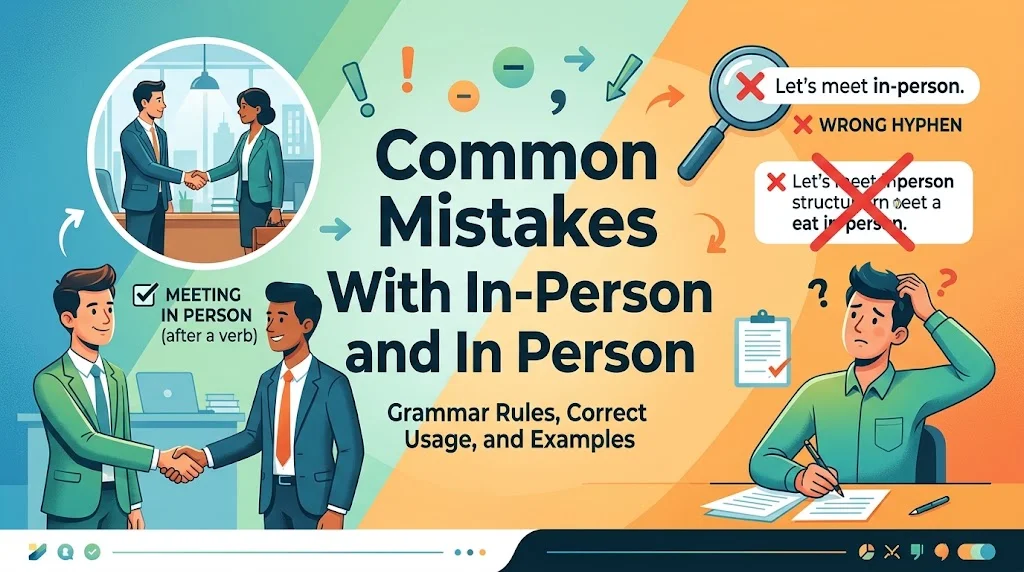
Even experienced writers sometimes stumble over this phrase because the meaning stays almost identical.
Mistake 1: Writing “In Person Meeting”
A common error is:
❌ We scheduled an in person meeting.
The preferred standard form is:
✅ We scheduled an in-person meeting.
The phrase modifies meeting, so the hyphen connects the compound modifier.
Mistake 2: Writing “Meet In-Person”
Another frequent error reverses the pattern:
❌ Let’s meet in-person tomorrow.
The standard form is:
✅ Let’s meet in person tomorrow.
Here, the phrase modifies the verb meet.
Mistake 3: Hyphenating Everything
Some writers learn that in-person is correct and then use it everywhere.
That creates sentences such as:
❌ We should discuss this in-person.
Instead:
✅ We should discuss this in person.
The hyphen belongs to the compound adjective, not every occurrence of the expression.
Mistake 4: Mixing Forms Within the Same Context
Consistency matters in professional writing.
For example:
The company offers in-person training. Employees can complete the training in-person.
The second sentence should use:
Employees can complete the training in person.
The writer should choose the form according to grammar rather than repeat the same spelling mechanically.
Mistake 5: Writing “Inperson”
This is simply a spelling error.
❌ inperson
Use:
✅ in-person
or:
✅ in person
Real-World Case Study: A Company Announcement
Imagine a company publishes this announcement:
“We are introducing in-person interviews for selected applicants.”
Here, in-person modifies interviews.
Now imagine the hiring manager tells a candidate:
“You can complete the interview in person next Thursday.”
Here, in person describes how the candidate will complete the interview.
What Changed?
The meaning didn’t change much. The grammatical function changed.
| Sentence | Correct Form | Why? |
| We offer in-person interviews. | in-person | Modifies “interviews” |
| Candidates can interview in person. | in person | Describes the action |
| We scheduled an in-person meeting. | in-person | Modifies “meeting” |
| Let’s meet in person. | in person | Describes “meet” |
This is why memorizing examples alone isn’t enough. Understanding the underlying pattern makes the rule much easier to apply.
How to Remember the Rule
There’s no need for a complicated grammar trick.
Before a Noun → “In-Person”
Think:
in-person + noun
Examples:
- in-person meeting
- in-person interview
- in-person class
- in-person appointment
After a Verb → “In Person”
Think:
verb + in person
Examples:
- meet in person
- attend in person
- talk in person
- speak in person
The Simple Memory Trick
Before a noun, hyphen it. After a verb, leave it open.
This isn’t a rule for every possible sentence structure in English. However, it works extremely well for the common uses of in-person and in person.
One-Sentence Formula
In-person + noun = adjective
Verb + in person = adverbial phrase
Once you recognize the role of the phrase, the spelling becomes straightforward.
Mini Practice: In-Person or In Person?
Try these sentences before checking the answers.
Choose the Correct Form
1. We scheduled an ___ interview.
2. Let’s discuss the issue ___.
3. The company provides ___ training.
4. She attended the conference ___.
5. They arranged an ___ consultation.
6. I’d rather speak with him ___.
7. The school offers ___ classes.
8. Students can attend the classes ___.
Answer Key
| No. | Correct Answer | Reason |
| 1 | in-person | Modifies “interview” |
| 2 | in person | Describes “discuss” |
| 3 | in-person | Modifies “training” |
| 4 | in person | Describes “attended” |
| 5 | in-person | Modifies “consultation” |
| 6 | in person | Describes “speak” |
| 7 | in-person | Modifies “classes” |
| 8 | in person | Describes “attend” |
Spot the Correct Sentence
A. We need to meet in-person tomorrow.
B. We need to meet in person tomorrow.
The correct choice is B.
Now consider:
A. We scheduled an in-person meeting.
B. We scheduled an in person meeting.
The correct choice is A.
The same phrase follows two different patterns depending on its grammatical role.
Frequently Asked Questions
Is It “Join Us in Person” or “Join Us In-Person”?
The correct standard form is “join us in person.” Here, in person describes how someone will join.
Example:
We hope you’ll join us in person for the event.
If the phrase modifies a noun, use the hyphenated form:
Join us for an in-person event.
Is It “Attend in Person” or “Attend In-Person”?
Use “attend in person.”
For example:
Students may attend in person or participate online.
The phrase describes the verb attend, so it doesn’t need a hyphen.
However:
Students may choose an in-person class.
Here, in-person modifies class.
Is “In-Person Meeting” Correct?
Yes. In-person meeting is the standard hyphenated form when the phrase comes directly before meeting.
Example:
We scheduled an in-person meeting with the client.
The hyphen shows that in-person functions as a compound adjective.
Is “In Person Meeting” Correct?
In standard edited English, in-person meeting is the preferred form when the phrase directly modifies meeting.
So write:
✅ an in-person meeting
rather than:
❌ an in person meeting
Is “Inperson” One Word?
No. Inperson isn’t the standard spelling.
Use either in-person or in person, depending on the grammatical function.
Can “In-Person” Come After a Verb?
In ordinary standard usage, the usual form after a verb is in person, without the hyphen.
Write:
We met in person.
rather than:
We met in-person.
The hyphenated form is most commonly used as a compound modifier before a noun.
Can “In Person” Come Before a Noun?
It can appear in unusual or specially structured constructions, but when the expression directly modifies a noun, in-person is generally the clearer standard choice.
For example:
an in-person interview
is preferable to:
an in person interview
What Is the Difference Between “In-Person” and “In Person”?
The meaning is essentially the same, but their grammatical roles differ.
In-person acts as a compound adjective:
an in-person meeting
In person acts as an adverbial phrase:
We met in person.
Is “In-Person” Correct in Formal Writing?
Yes. In-person is widely used in formal, professional, academic, and business writing when it functions as a compound adjective.
For example:
The university requires an in-person orientation.
Is “In-Person” Hyphenated in AP Style?
AP-style treatment follows the general principle that compound modifiers may be hyphenated when they function together before a noun. However, style guidance can change and individual editorial systems may have their own preferences.
For current professional work, check the specific style guide required by your publication or organization. The grammatical distinction remains useful regardless of house style.
Conclusion
The difference between in-person vs. in person becomes simple once you focus on grammar rather than memorizing isolated examples. Both forms describe face-to-face or physical interaction, but they perform different jobs within a sentence.
Use in-person when the phrase acts as a compound adjective before a noun:
an in-person meeting
an in-person interview
an in-person class
Use in person when the phrase functions as an adverbial expression that describes an action:
meet in person
attend in person
speak in person
The biggest mistake is treating the hyphen as optional decoration. It serves a purpose when in-person works as a compound modifier. At the same time, adding the hyphen after every verb creates another error.
And remember one more thing: inperson isn’t the standard spelling. The accepted forms are in-person and in person.
When you’re unsure, look at the word that follows the phrase. If in-person directly describes a noun, use the hyphen. If in person describes what someone does, leave the phrase open. That simple test will handle most situations correctly.