Choosing between it’s called and it called can seem confusing because the two phrases differ by only one small word. However, that small difference changes the grammar, sentence structure, and sometimes the entire meaning. If you’re introducing the name of something, it’s called is usually the phrase you need. For example, “It’s called a compass” means “It is called a compass.”
On the other hand, it called can be grammatically correct when called works as the past tense verb of “call.” In a sentence such as “The system called me yesterday,” the word called describes an action rather than a name. Understanding this distinction helps you avoid common grammar mistakes, especially when writing explanations, emails, school assignments, or online content.
The confusion often comes from it’s, which is a contraction of it is. Once you expand the contraction, the difference becomes much clearer. This guide explains it’s called vs it called, including passive voice, active voice, past tense, sentence structure, and real-world examples. By the end, you’ll know exactly when to use each phrase and why.
What Is the Difference Between “It’s Called” and “It Called”?
The simplest distinction is this:
- It’s called = It is called and usually tells you the name or label of something.
- It called = called is the past-tense form of call, meaning that it performed a calling action.
- It was called = something or someone gave it a particular name in the past.
Consider these examples:
It’s called a telescope.
Here, it’s means it is. The sentence tells you the object’s name.
Now compare:
The automated system called me yesterday.
Here, called is the main verb. The system performed the action of calling.
The two structures aren’t interchangeable.
Why “It’s Called” Works
“It’s called” works when you identify what something is named or known as.
For example:
- It’s called a thermometer.
- It’s called Central Park.
- It’s called photosynthesis.
- It’s called a semicolon.
- It’s called cold brew.
The underlying structure is:
It + is + called + name/description
The word is acts as the auxiliary verb that forms the passive construction. Called is the past participle of call.
So:
It’s called a compass.
can be expanded to:
It is called a compass.
The meaning remains essentially the same.
Why “It Called” Usually Doesn’t Work for Naming
If you mean “people call it…” or “its name is…”, simply writing “it called” normally creates a grammatical problem.
For example:
❌ It called a compass.
If the intended meaning is that the object has the name compass, this sentence is incorrect.
The correct version is:
✅ It’s called a compass.
Or:
✅ It is called a compass.
The missing element is is.
Without is, called becomes the main past-tense verb. That changes the grammatical structure completely.
Quick Answer: It’s Called vs It Called
| Phrase | Meaning | Example |
| It’s called | It is named/known as | It’s called a kayak. |
| It called | It performed a calling action | The device called me. |
| It is called | Same basic meaning as “it’s called” | It is called a kayak. |
| It was called | It had a particular name in the past | It was called something else before. |
A useful rule is simple:
If you mean “it is named,” use “it’s called.”
If it actually performed the action of calling, “it called” may be correct.
Understanding “It’s Called”
The phrase “it’s called” appears constantly in everyday English. You’ll hear it when people introduce unfamiliar words, objects, places, methods, products, and concepts.
“It’s” Means “It Is”
The first step is understanding the contraction.
It’s = it is
For example:
- It’s cold. → It is cold.
- It’s interesting. → It is interesting.
- It’s called a router. → It is called a router.
- It’s located nearby. → It is located nearby.
This matters because “it’s called” contains two grammatical components before the naming information:
it + is + called
When you’re unsure about it’s, expand it.
Ask yourself:
Can I replace it’s with it is?
If the answer is yes, you’re probably using the contraction correctly.
“It’s” vs “Its”
Don’t confuse it’s with its.
It’s is a contraction meaning it is or sometimes it has.
Its shows possession.
Compare:
It’s called a maple tree.
Here, it’s = it is.
Now:
The tree lost its leaves.
Here, its shows possession.
A quick comparison:
| Word | Function | Example |
| it’s | it is / it has | It’s called a maple tree. |
| its | possessive | The tree lost its leaves. |
This small distinction causes many writing mistakes because the words sound exactly alike.
How “It Is Called” Works
The complete version of “it’s called” is “it is called.”
Look at the sentence:
It is called a keyboard.
Break it into parts:
- It = subject
- is = auxiliary verb
- called = past participle
- a keyboard = name or complement
The contraction simply shortens the first two words:
It is called a keyboard.
becomes:
It’s called a keyboard.
The meaning doesn’t fundamentally change.
“It’s Called” as a Passive Construction
There is an important grammar point here.
“It is called…” uses a passive construction.
The active version might be:
People call it a keyboard.
The passive version changes the focus:
It is called a keyboard.
In the active sentence, people perform the action.
In the passive sentence, it becomes the focus.
You don’t need to mention who gives the name because the identity of the people isn’t important.
For example:
People call this process fermentation.
can become:
This process is called fermentation.
The second sentence sounds natural because the name itself is the important information.
Why Passive Voice Is Useful Here
Passive voice isn’t automatically bad writing. In fact, “it is called” is one of the most natural passive constructions in English.
It works particularly well when:
- The person naming something isn’t important.
- The name is more important than the namer.
- You’re defining a technical term.
- You’re explaining a concept.
- You’re describing an established name.
For example:
The process is called evaporation.
There’s no real need to say:
Scientists call the process evaporation.
Both can work, but the passive construction keeps attention on the process.
Read More: Defence or Defense: Which Spelling Is Correct?
When Is “It Called” Correct?
Here’s where the distinction gets interesting.
“It called” can be grammatical. The problem is that it doesn’t normally mean “it is named.”
In “it called,” the word called is the simple past form of the verb call.
“Called” as a Past-Tense Verb
The verb call has several meanings.
It can mean:
- To contact someone by phone.
- To shout for someone.
- To summon someone.
- To request someone’s attention.
- To name or describe someone or something.
When called means that an entity performed a calling action, it can function as the main verb.
For example:
The machine called the number automatically.
Here, called means that the machine made a phone call.
Another example:
The system called the emergency number.
Again, called is the main verb.
Notice the structure:
It + called + object
There is no is because called already functions as the past-tense verb.
Why “It Called” Often Sounds Incomplete
The phrase “it called” may feel incomplete when you see it by itself.
That’s because call often takes an object.
For example:
It called me.
It called the office.
It called the wrong number.
Without additional context, “it called” leaves the reader wondering what was called.
However, context can sometimes make the sentence complete or understandable.
For example:
The alarm system called.
In a particular context, the reader might understand that the system made a phone call. The sentence can therefore be grammatical even without an explicit object.
The key point is that called is doing the job of the main verb.
“It Called” vs “It Was Called”
These two phrases are especially easy to confuse.
Compare:
It called me.
It was called Bluebird.
The first sentence says it performed a calling action.
The second says someone gave it the name Bluebird.
The difference is dramatic despite the small change.
| Sentence | Meaning |
| It called me. | It made a call to me. |
| It was called Bluebird. | Someone named it Bluebird. |
| It’s called Bluebird. | Its current name is Bluebird. |
Adding was changes the sentence from an active past action to a passive construction.
Context Can Change the Meaning
The word called doesn’t have one fixed meaning.
Consider:
She called her brother.
Here, called means contacted by phone.
Now:
They called the dog Max.
Here, called means named.
And:
The dog was called Max.
Here, was called expresses the dog’s name through passive voice.
The surrounding words determine the meaning.
It’s Called vs It Called: Side-by-Side Comparison
A direct comparison makes the distinction easier to remember.
| Feature | It’s called | It called |
| Full form | It is called | No contraction |
| Main structure | It + is + called | It + called |
| Role of “called” | Past participle | Simple past verb |
| Typical meaning | Named or known as | Performed a calling action |
| Voice | Passive | Active |
| Example | It’s called a drone. | It called me yesterday. |
| Naming something? | Yes | Usually no |
| Can it be correct? | Yes | Yes, depending on context |
Easy Memory Trick for “It’s Called”
Use this simple test:
If you can say “it is called,” use “it’s called.”
For example:
It’s called a dictionary.
Expand it:
It is called a dictionary.
It still works.
Now try:
It called a dictionary.
That doesn’t express the intended naming meaning.
Another useful question is:
Who performed the action?
If it performed the action of calling someone, “it called” may be right.
If someone gave it a name, use a passive structure such as:
It’s called…
or:
It was called…
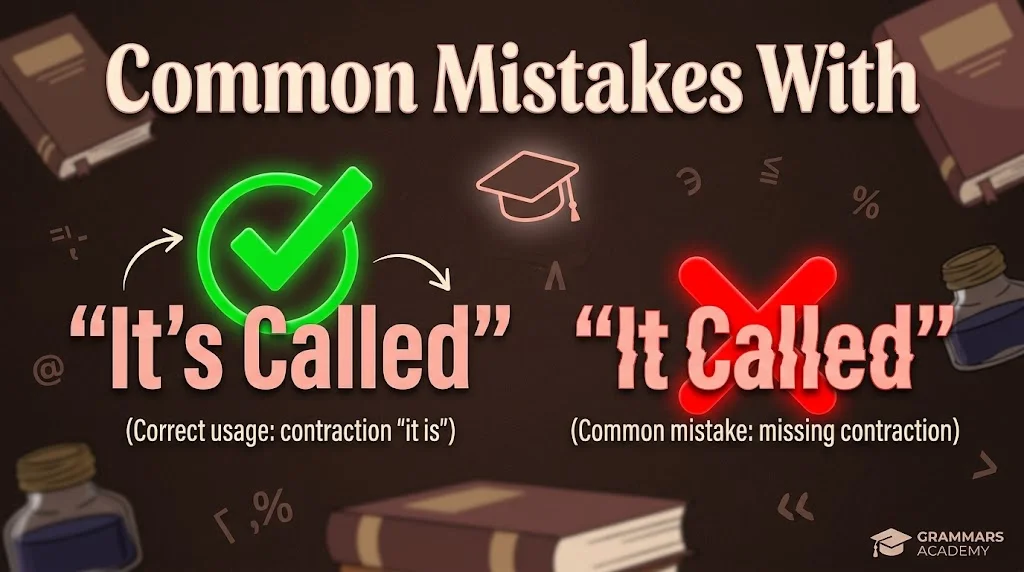
Common Mistakes With “It’s Called” and “It Called”
These errors often happen because the difference is only one small word.
Mistake: Dropping “Is”
Incorrect:
❌ It called a sandwich.
If you mean that the thing is named a sandwich, use:
✅ It’s called a sandwich.
The word is isn’t optional in this construction.
Mistake: Misunderstanding Contractions
Some writers see it’s as an unnecessary shortening.
It isn’t.
In ordinary English, it’s is simply the contracted form of it is.
Both are grammatical:
It is called a comet.
It’s called a comet.
The second version is more compact and common in everyday communication.
Mistake: Confusing Naming With Actions
This is perhaps the most important mistake.
Compare:
It’s called a smartwatch.
with:
It called my phone.
The first sentence identifies a name.
The second describes an action.
The verb call can mean both name and contact, so context matters.
Mistake: Confusing “It’s” With “Its”
This error is particularly common in informal writing.
Incorrect:
❌ Its called a smartphone.
Correct:
✅ It’s called a smartphone.
Remember:
it’s = it is
its = belonging to it
A quick substitution test usually catches the mistake.
Mistake: Using “It Called” When You Mean “It Was Called”
Consider:
❌ It called the Blue House in the past.
If you’re saying the place had that name, a better structure is:
✅ It was called the Blue House in the past.
The difference comes down to who performed the action.
It called means it performed the calling action.
It was called means someone called or named it something.
It’s Called vs It Called in Different Contexts
The intended meaning becomes much clearer when you see these phrases in realistic situations.
Naming an Object
This tool is useful. It’s called a torque wrench.
The speaker introduces the object’s name.
Naming a Place
It’s called Lakeview Park.
The phrase identifies the place.
Naming a Concept
It’s called confirmation bias.
The phrase introduces a recognized term.
Talking About a Phone Call
The automated system called me this morning.
Here, called describes a phone action.
Talking About a Former Name
The restaurant was called The Corner Cafe before it changed owners.
The passive construction tells us about the restaurant’s previous name.
Talking About a Current Name
The restaurant is called The Corner Cafe.
This identifies its current name.
It’s Called vs It Is Called: Is There Any Difference?
In most ordinary contexts, “it’s called” and “it is called” have the same basic meaning.
The difference is mainly stylistic.
“It’s Called”
The contracted form sounds natural in:
- Conversations
- Text messages
- Emails
- Blogs
- Informal explanations
- Everyday writing
Example:
It’s called a pressure cooker.
“It Is Called”
The full form can work well when you want a slightly more deliberate tone.
For example:
This method is commonly known as direct seeding. It is called this because the seeds are planted directly into the soil.
The full form can also create emphasis:
It is called a compound sentence.
In that context, the writer may be emphasizing the word is.
Neither form is inherently more correct.
It’s Called vs It Was Called vs It Had Been Called
Tense adds another layer to the explanation.
“It’s Called”
Use it’s called when you’re identifying what something is currently known as.
It’s called a greenhouse.
“It Was Called”
Use it was called when discussing a past name.
It was called the Old Mill before the renovation.
This doesn’t necessarily tell us what the thing is called now.
“It Had Been Called”
Use it had been called when discussing an earlier name in relation to another past event.
It had been called Riverside Station before the line was rebuilt.
This form places one past event before another past reference point.
Tense Comparison
| Construction | Time reference | Example |
| It’s called | Present | It’s called a greenhouse. |
| It was called | Past | It was called Riverside Station. |
| It had been called | Earlier past | It had been called Riverside Station before the renovation. |
Understanding tense helps you avoid replacing every naming sentence with “it’s called.”
How to Choose the Correct Phrase
When you’re writing quickly, you don’t need to memorize complicated grammar terminology.
Use a few simple checks.
Ask What You Mean
First, determine whether you’re talking about a name or an action.
If you’re introducing a name:
It’s called a tablet.
If you’re describing an action:
It called me twice.
That single distinction solves many problems.
Expand the Contraction
When you see it’s, mentally expand it.
It’s called…
becomes:
It is called…
If the expanded version makes sense, the contraction is appropriate.
Look at the Verb’s Role
Ask whether called is:
- A past participle in a passive construction, or
- A simple past verb describing an action.
Compare:
It is called a tablet.
Here, called works with is.
Compare:
It called me.
Here, called is the main verb.
Check Whether the Sentence Is Complete
Don’t judge “it called” by itself.
Look at the entire sentence.
It called me after midnight.
That’s a complete sentence.
But:
It called a tablet.
If the intended meaning is that the object has the name tablet, the sentence doesn’t work.
The correct version is:
It’s called a tablet.
Real-World Examples of Correct Usage
Here are several examples that show the distinction naturally.
Examples With “It’s Called”
- It’s called a rain gauge.
- It’s called digital literacy.
- It’s called a compound word.
- It’s called cold brew coffee.
- It’s called Lakeview Road.
- It’s called a charging dock.
- It’s called photosynthesis.
- It’s called a semicolon.
In each case, the phrase identifies a name, term, or label.
Examples With “It Called”
- The system called me twice.
- The phone called the emergency contact automatically.
- The robot called the number stored in its memory.
- The service called the customer after the request was submitted.
In these examples, called represents an action.
Examples With “It Was Called”
- It was called the Old Station.
- It was called something different years ago.
- The building was called the Grand Hotel.
- The technique was called experimental at the time.
Here, was called expresses a past naming or description.
A Practical Case Study: Fixing “It Called”

Imagine you’re writing a grammar article and want to explain a new term.
Your first draft says:
It called a compound adjective.
Something doesn’t sound right.
You apply the contraction test.
Can you expand it called into it is called?
No. The word is isn’t there.
Now ask what you mean.
You aren’t saying that the grammar term performed a phone call. You’re introducing its name.
The corrected sentence becomes:
It’s called a compound adjective.
Or, in full:
It is called a compound adjective.
This small correction completely changes the grammatical structure.
What This Example Teaches
The issue wasn’t the word called itself.
The problem was its grammatical role.
In the corrected sentence:
it + is + called
In the original sentence:
it + called
Once you identify the intended meaning, the correct structure becomes much easier to choose.
Why the Difference Matters in Digital Writing
Grammar mistakes can change meaning, especially when readers encounter short phrases without much context.
Compare:
It’s called a smart lock.
with:
It called a smart lock.
The first sentence clearly introduces a name.
The second sounds as if it performed an action involving a smart lock.
In educational articles, product descriptions, instructions, and professional communication, that distinction matters.
Clear grammar helps readers understand your intended meaning without stopping to decode the sentence.
Where This Matters Most
You may encounter the distinction in:
- Blog posts
- Grammar lessons
- Product descriptions
- User manuals
- Emails
- School assignments
- Technical documentation
- Social media posts
- Customer support messages
- Professional reports
A single missing auxiliary verb can make an otherwise clear sentence confusing.
Common Sentence Corrections
| Incorrect or unclear sentence | Better sentence | Reason |
| It called a pressure valve. | It’s called a pressure valve. | You are identifying its name. |
| Its called a pressure valve. | It’s called a pressure valve. | It’s means “it is.” |
| It called the pressure valve. | It called the pressure valve. | Correct if it performed the action. |
| It called the Old Mill. | It was called the Old Mill. | Use passive voice for a past name. |
| It is called the Old Mill. | It’s called the Old Mill. | Contraction is acceptable. |
Notice that “it called the pressure valve” isn’t automatically incorrect. Its meaning depends on the context.
Grammar isn’t just about individual words. Structure determines meaning.
A Simple Four-Step Test
When you’re unsure about it’s called vs it called, use this quick process.
Look for a Name
Are you telling someone what something is named?
If yes, start with:
It’s called…
Expand “It’s”
Replace it’s with it is.
It’s called a router.
becomes:
It is called a router.
If the sentence still works, you’re on the right track.
Look for an Action
Ask:
Did it perform the action of calling?
If yes, it called may be correct.
The automated system called me.
Check the Time
Are you describing an earlier name?
If so, consider:
It was called…
For an even earlier past reference, you may need:
It had been called…
This four-step process takes only a few seconds.
Mini Practice: It’s Called vs It Called
Try these sentences before checking the answers.
Choose the Correct Phrase
The object has the name “hourglass.”
___ an hourglass.
Answer:
It’s called an hourglass.
Spot the Grammar Mistake
Its called a measuring cup.
Correction:
It’s called a measuring cup.
The contraction needs an apostrophe.
Identify the Meaning
The security system called the owner.
Here, called means contacted the owner.
Choose the Correct Past Construction
The building ___ the Royal Theater before 1990.
Answer:
was called
The sentence refers to the building’s former name.
Name or Action?
It’s called a thermostat.
Meaning: name.
It called the technician.
Meaning: action.
That distinction is the heart of the entire topic.
Frequently Asked Questions
Is “it called” grammatically correct?
Yes. “It called” can be grammatically correct when called is the past-tense form of the verb call.
For example:
The automated system called me.
However, “it called” isn’t normally correct when you mean that something has a particular name.
For that meaning, use:
It’s called…
Is “it’s called” grammatically correct?
Yes. “It’s called” is a standard English construction.
It is the contracted form of:
It is called.
You commonly use it to identify the name or label of something.
For example:
It’s called a compass.
What does “it’s called” mean?
“It’s called” generally means “it is called” or “it is known as.”
For example:
It’s called a rain gauge.
This tells the reader the name of the object.
What does “it called” mean?
“It called” generally means that “it” performed the action of calling in the past.
For example:
The computer called the number.
The computer performed the action.
The exact meaning depends on context because call has several meanings.
Can “it called” mean “it was called”?
Not normally.
“It called” and “it was called” have different grammatical structures.
It called me.
This means it contacted me.
It was called Green Valley.
This means someone named it Green Valley.
If you mean a past name, “it was called” is normally the appropriate structure.
Is “it’s called” passive voice?
Yes.
“It is called” follows the passive structure be + past participle.
In:
It is called a telescope.
is is the form of be, while called is the past participle.
The active equivalent could be:
People call it a telescope.
The passive sentence places the named object at the center.
What is the difference between “it’s called” and “it is called”?
There is generally no difference in basic meaning.
“It’s called” is the contracted form.
“It is called” is the full form.
For example:
It’s called a dictionary.
and:
It is called a dictionary.
Both identify the name of the object.
What is the difference between “it’s” and “its”?
It’s means it is or it has.
Its is possessive.
Examples:
It’s called a whale shark.
The whale shark opened its mouth.
The apostrophe changes the grammatical function.
How can I remember when to use “it’s called”?
Use the “it is” test.
If you mean:
It is called…
then you can write:
It’s called…
For example:
It’s called a notebook.
If you’re describing something that actually performed the action of calling, it called may be appropriate:
The device called me.
Final Rule: It’s Called or It Called?
The difference between “it’s called” and “it called” comes down to grammar, meaning, and context.
Use “it’s called” when you’re giving the name or label of something:
It’s called a dictionary.
Remember that it’s = it is.
Use “it called” when it performed a calling action in the past:
The system called me yesterday.
When you’re talking about a previous name, use “it was called”:
It was called the Old Library.
The easiest memory trick is to expand the contraction. If “it is called” expresses what you mean, “it’s called” is the right choice.
Once you recognize whether called describes a name or an action, the distinction becomes much easier. A single word—is—can completely change the structure and meaning of the sentence.