
Have you ever wondered whether Defence or Defense is the correct spelling? If so, you’re not alone. Many English learners notice both forms in books, websites, newspapers, and official documents. The good news is that both spellings are correct, but they belong to different varieties of English.
Defence is the standard spelling in British English, while defense is the standard spelling in American English. Both words have the same basic meaning and can describe protection, resistance, or security against danger or attack. You may also see them in military terminology, legal writing, sports, and personal protection.
For example, British English uses self-defence, national defence, and defence policy. American English uses self-defense, national defense, and defense policy. The difference is mainly a matter of regional spelling rather than meaning.
Understanding British English spelling and American English spelling can help you avoid mistakes in academic writing, professional documents, and online content. It also helps you maintain consistent spelling throughout your work.
In this guide, you’ll learn the difference between defence and defense, understand their meanings, explore their usage, and discover simple ways to remember which spelling to use.
Defence or Defense: The Quick Answer
The simplest answer is:
| Spelling | English variety | Example |
| Defence | British English | The country strengthened its defence system. |
| Defense | American English | The country strengthened its defense system. |
Both forms are nouns. Both have the same basic pronunciation and meaning.
The main difference is regional spelling convention.
If you’re following British English, choose defence.
If you’re following American English, choose defense.
Is Defence or Defense More Correct?
Neither spelling is universally more correct.
English exists in multiple established varieties. British and American English have developed different spelling conventions over several centuries. Words such as colour/color, centre/center, and favour/favor show similar differences.
The important thing is to match your spelling to the variety of English you’re using.
For example:
- A British newspaper may write defence.
- An American newspaper may write defense.
- A British university assignment normally follows defence if it uses British English.
- An American college paper normally follows defense if it uses American English.
The same principle applies to professional documents.
What Does Defence Mean?
Defence is the British English spelling of the noun defense.
It refers broadly to the act or process of protecting someone or something from harm, attack, danger, criticism, or opposition.
For example:
The government announced a new defence strategy.
Here, defence refers to measures designed to protect a country.
However, the word has a much wider range of meanings.
Defence in Military Contexts
In military writing, defence can describe a country’s military protection or its ability to resist an attack.
Common expressions include:
- national defence
- defence forces
- defence policy
- defence spending
- defence minister
- defence system
- air defence
- coastal defence
- defence equipment
For example:
The government reviewed its national defence policy.
A British English writer would normally choose defence in this sentence.
Defence in Legal Contexts
The word can also refer to the side in a legal case that responds to an accusation.
For example:
The defence presented several witnesses.
In British English, defence is used in this legal sense.
The word can also describe the arguments made to protect a person accused of wrongdoing.
The lawyer prepared a strong defence for the client.
American English normally changes the spelling to defense.
Defence in Sports
In sports, defence describes the players, tactics, or actions intended to prevent the opposing team from scoring.
For example:
The team’s defence remained organized throughout the match.
British sports writing commonly uses defence.
The American equivalent is:
The team’s defense remained organized throughout the match.
The meaning remains the same.
What Does Defense Mean?
Defense is the standard American English spelling.
It carries the same basic meanings as defence. It can describe protection, military security, legal representation, sports tactics, or justification.
Consider this sentence:
The country invested heavily in national defense.
The word refers to national protection or military security.
In American English, you would normally use defense in this context.
Defense in Military Writing
American English commonly uses expressions such as:
- national defense
- defense policy
- defense spending
- defense forces
- air defense
- missile defense
- defense system
- defense strategy
For example:
The committee discussed changes to national defense policy.
The spelling defense signals the American English convention.
Defense in Law
American English also uses defense for the legal side of a case.
For example:
The defense called its final witness.
Similarly:
The attorney prepared a detailed defense.
The British versions would use defence.
Defense in Sports
American sports writing commonly uses defense.
For example:
The team’s defense stopped the opposing offense.
Notice something interesting here. American English commonly spells both defense and offense with -se.
British English generally uses:
- defence
- offence
This creates a useful pattern to remember.
Defence vs Defense: The Main Difference
The difference can be summarized in one sentence:
Defence is British English, while defense is American English.
Here’s a more detailed comparison:
| Feature | Defence | Defense |
| English variety | British English | American English |
| Meaning | Protection or resistance | Protection or resistance |
| Pronunciation | Generally the same | Generally the same |
| Military use | Common | Common |
| Legal use | Common | Common |
| Sports use | Common | Common |
| Spelling ending | -ence | -ense |
| Self-protection | self-defence | self-defense |
| National protection | national defence | national defense |
| Sports tactic | defence | defense |
The key distinction is spelling rather than meaning.
Why Do Defence and Defense Have Different Spellings?
The difference comes from the historical development of English spelling.
English did not develop with one perfectly fixed spelling system from the beginning. Its vocabulary contains influences from several languages, including Latin and French. Over time, different English-speaking communities developed their own conventions.
The forms defence and defense ultimately connect to older words associated with defending and protecting.
French influence played an important role in bringing many such words into English. English spelling later developed differently in Britain and North America.
American English eventually adopted a number of spelling forms that differed from British conventions. Some differences were encouraged by efforts to simplify and regularize English spelling.
That history helps explain why you can encounter pairs such as:
- defence / defense
- offence / offense
- colour / color
- favour / favor
- centre / center
- theatre / theater
These differences don’t mean the languages are separate. They’re regional varieties of the same language.
Read More: Gage or Gauge: What’s the Difference? Meaning, Usage, and Correct Spelling
Defence in British English
British English normally uses the spelling defence.
You’ll encounter it in British writing across many fields.
Academic Writing in the UK
Students writing in British English generally use defence.
For example:
The paper examines changes in national defence policy.
Or:
The study discusses the role of collective defence.
If your university requires British English, switching between defence and defense can make your writing look inconsistent.
The safest approach is to follow the institution’s stated style guide.
Government and Official Writing
British government and institutional writing traditionally uses defence.
You may therefore encounter phrases such as:
- defence policy
- defence spending
- defence strategy
- defence minister
- defence industry
The same convention appears in many organizations that follow British English.
International Audiences
International organizations often have their own editorial rules.
If you’re writing for an international publication, don’t automatically assume that British spelling is required. Check the organization’s style guide when one exists.
The goal is consistency.
Defense in American English

American English uses defense as the standard spelling.
This applies across ordinary writing and specialized fields.
Academic Writing in the US
American students and researchers generally write:
The study examines the country’s national defense strategy.
They would normally not replace defense with defence unless they’re quoting a source or discussing the spelling difference itself.
Government and Legal Documents
American government and legal writing uses defense.
You’ll also see the form in military terminology and institutional names.
For example:
- national defense
- defense policy
- defense spending
- defense contractor
- defense strategy
- defense system
When writing for a US audience, defense is the natural choice.
Digital Marketing and Online Writing
If your website targets American readers, defense usually fits your chosen English variety.
A British-focused website may naturally use defence.
This becomes particularly important when your article targets a spelling keyword such as Defence or Defense. In that case, discussing both forms is useful because the searcher may be trying to understand the regional distinction.
However, using both spellings repeatedly just to target keywords can make an article awkward. Natural language should come first.
Defence or Defense in Different Contexts
The spelling changes with the English variety, not with the basic context.
That means you don’t choose defence for military situations and defense for sports situations.
Instead, your English variety determines the spelling.
Military Context
British:
The government announced additional defence measures.
American:
The government announced additional defense measures.
Legal Context
British:
The defence argued that the evidence was incomplete.
American:
The defense argued that the evidence was incomplete.
Sports Context
British:
The team’s defence worked well under pressure.
American:
The team’s defense worked well under pressure.
Personal Protection
British:
She attended a self-defence class.
American:
She attended a self-defense class.
Justification or Explanation
British:
In his defence, he had followed the instructions.
American:
In his defense, he had followed the instructions.
The context changes the meaning slightly, but it doesn’t change the regional spelling rule.
Common Expressions With Defence and Defense
Learning common phrases can make the distinction easier to remember.
British English Expressions
Some common combinations include:
- national defence
- self-defence
- defence policy
- defence spending
- defence attorney
- defence strategy
- defence mechanism
- defence system
- air defence
- in defence of
Examples:
The report discusses national defence.
He acted in defence of his friend.
She teaches self-defence.
American English Expressions
Common American forms include:
- national defense
- self-defense
- defense policy
- defense spending
- defense attorney
- defense strategy
- defense mechanism
- defense system
- air defense
- in defense of
Examples:
The report discusses national defense.
He acted in defense of his friend.
She teaches self-defense.
The phrase remains recognizable in both varieties.
Defence vs Defense in Legal English
Legal writing deserves special attention because the word appears frequently.
In both varieties of English, defence/defense can refer to the position taken by someone responding to an accusation or claim.
However, spelling follows the regional convention.
| British English | American English |
| defence lawyer | defense lawyer |
| defence attorney | defense attorney |
| defence case | defense case |
| defence counsel | defense counsel |
| defence argument | defense argument |
For example:
British English:
The defence challenged the reliability of the evidence.
American English:
The defense challenged the reliability of the evidence.
If you’re reading legal material from another country, don’t “correct” the spelling simply because it differs from your preferred variety. It may be completely standard in that jurisdiction.
Defence vs Defense in Sports
Sports provide another easy way to see the difference.
British English commonly uses defence, while American English uses defense.
Consider soccer or football:
The club’s defence conceded only a few goals.
American sports writing would use:
The team’s defense allowed very few points.
The spelling isn’t determined by the sport itself.
Instead, it depends on the English variety used by the writer or publication.
This is an important distinction because many learners assume defense must be an American sports term. That’s not the case.
American English uses defense in general.
British English uses defence in general.
Defence or Defense in Academic and Professional Writing
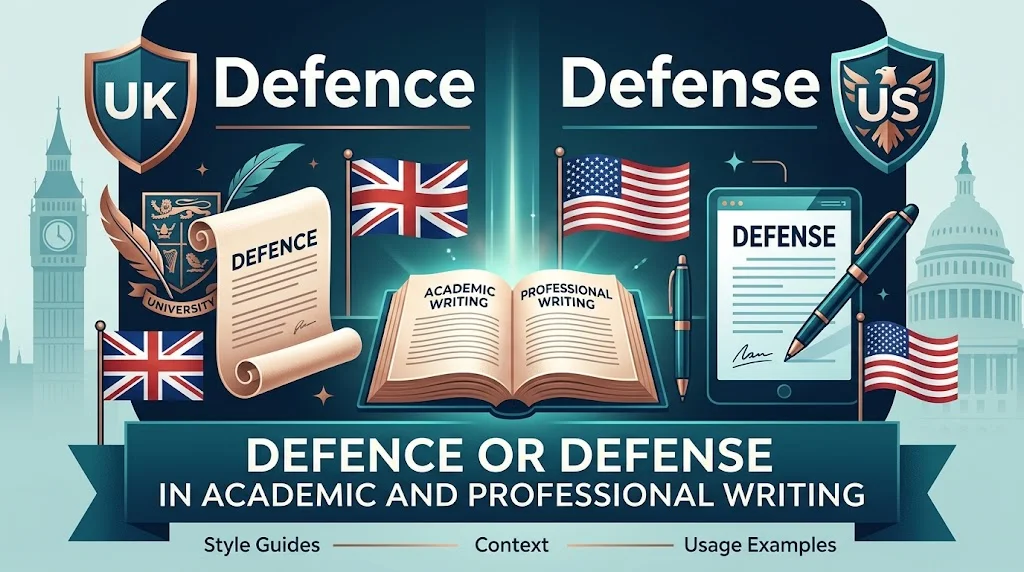
When you’re writing an essay, report, application, presentation, or business document, consistency matters.
Before choosing a spelling, identify the required English variety.
Ask yourself:
- Who will read this?
- Does my school or employer have a style guide?
- Am I expected to use British or American English?
- Have I already chosen one spelling system?
- Am I quoting material from another variety of English?
For example, suppose you’re writing a British English essay.
You might write:
National defence remains an important part of government policy.
Later, writing national defense would introduce an American spelling into an otherwise British document.
That isn’t necessarily a serious communication problem. However, it can create unnecessary inconsistency.
Follow the Required Style Guide
If a professor says to use American English, use defense.
If an institution requires British English, use defence.
If a publisher provides its own editorial guidelines, follow those instructions.
A style guide is more useful than guessing based on personal preference.
Defence or Defense for SEO
Spelling differences can matter when you’re creating online content.
If your target audience primarily uses American English, defense may feel more natural throughout the article.
If your audience primarily uses British English, defence is generally the expected form.
However, an article specifically targeting Defence or Defense can naturally mention both forms.
For SEO, avoid forcing the keyword into every heading or paragraph. Search engines and readers both benefit from useful, natural content.
A good article can cover related terms such as:
- defence vs defense
- defense vs defence
- British spelling of defense
- American spelling of defence
- self-defence vs self-defense
- national defence vs national defense
- British English spelling
- American English spelling
- defense meaning
- defence meaning
The goal is to answer the reader’s question thoroughly rather than repeat the same phrase unnaturally.
Defence or Defense: Common Spelling Mistakes
Because the two forms are so similar, learners sometimes create hybrid spellings.
Using “Defence” in American English
This isn’t necessarily “wrong English.” It is a British spelling.
The issue arises when you’re expected to follow American English.
For example, if your assignment requires American spelling, write:
The country increased its national defense budget.
Rather than:
The country increased its national defence budget.
Using “Defense” in British English
Again, defense is not an invented word. It’s the standard American form.
In British English, however, the conventional spelling is:
national defence
Mixing Both Forms
The biggest practical problem is inconsistency.
For example:
The report examines national defence and later discusses national defense.
If you’re discussing the regional spelling difference, that’s perfectly reasonable.
If you’re simply writing one document in a single English variety, consistency is usually preferable.
Related Words: Defence, Defense, Defensive, and Defend
A useful point often gets overlooked: not every related word changes spelling.
Compare these forms:
| Word | British English | American English |
| Noun | defence | defense |
| Verb | defend | defend |
| Adjective | defensive | defensive |
| Person/role | defender | defender |
| Past form | defended | defended |
Notice that defensive stays the same.
That’s important because you shouldn’t apply the -ence/-ense difference to every related word.
For example:
The team adopted a defensive strategy.
This spelling is standard in both British and American English.
A common mistake would be trying to create a form such as defencive. That is not the standard spelling.
Defence or Defense: A Simple Memory Trick
You don’t need to memorize a complicated historical rule.
Use this simple association:
British = Defence
American = Defense
Think of the final vowel as a regional spelling signal.
If you’re writing for readers in the United States, choose defense.
If you’re writing for readers who follow British English, choose defence.
Remember It With a Pair
Another useful trick is to remember:
British: defence + offence
American: defense + offense
This pairing works because the two words follow the same broad spelling distinction.
You can also connect them with other familiar examples:
British:
- colour
- centre
- defence
- offence
American:
- color
- center
- defense
- offense
Once you recognize the broader spelling pattern, defence vs defense becomes easier.
Practical Examples of Defence vs Defense
Here are several examples showing how the spelling works.
| Meaning | British English | American English |
| Protection | The wall provides defence. | The wall provides defense. |
| Military | National defence is important. | National defense is important. |
| Legal | The defence presented evidence. | The defense presented evidence. |
| Sports | Their defence was strong. | Their defense was strong. |
| Self-protection | She learned self-defence. | She learned self-defense. |
| Justification | In his defence, he apologized. | In his defense, he apologized. |
These examples demonstrate the central rule: the meaning stays the same while the spelling changes according to English variety.
A Real-World Style Scenario
Imagine a company operating in both London and New York.
Its British website might say:
Our services support national defence organizations.
Its American website might say:
Our services support national defense organizations.
The company hasn’t changed the meaning of its service. It has adapted the spelling to its audience and editorial standards.
This approach is common in international communication. Organizations may maintain different regional versions of content or use a single editorial standard across all markets.
The important lesson for writers is simple: know your audience before choosing your spelling convention.
What About Quotes and Names?
Sometimes you’ll encounter defence inside an American document or defense inside a British document.
That doesn’t automatically mean there’s an error.
A writer may be:
- quoting another source,
- referring to an organization,
- reproducing an official title,
- discussing British or American spelling,
- preserving historical wording.
When quoting someone, don’t casually change their spelling unless your editorial rules specifically allow it.
For example, if a British source uses defence, an American writer discussing that source may retain the original spelling inside a direct quotation.
Context matters.
Defence vs Defense and Consistency
Consistency is one of the most useful principles in professional writing.
Suppose your article uses American English. You might write:
The government increased defense spending.
Later, you write:
The new defence policy received attention.
Unless you’re intentionally discussing British terminology, this creates an unnecessary switch.
The same applies to related spelling pairs.
If you use:
- color, don’t randomly switch to colour.
- center, don’t randomly switch to centre.
- defense, don’t randomly switch to defence.
A consistent spelling system makes your writing easier to edit and easier for readers to follow.
How to Choose Between Defence and Defense
Use this practical decision process.
Check Your Audience
If your readers primarily use British English, defence is generally appropriate.
If your readers primarily use American English, defense is generally appropriate.
Check Your Style Guide
Your organization, university, publisher, or employer may specify a particular variety.
Follow that requirement even if you personally prefer another spelling.
Check the Rest of Your Document
Look for other regional spellings.
If you’ve already written:
- colour
- centre
- favour
you’re probably using British English.
If you’ve written:
- color
- center
- favor
you’re probably using American English.
This isn’t an absolute rule, but it can help you identify the spelling system you’re following.
Stay Consistent
Once you choose a variety, keep it consistent unless there’s a specific reason to switch.
Mini Quiz: Test Your Knowledge
Choose defence or defense in each sentence.
British English
- The country strengthened its national ______.
- The lawyer prepared the ______ case.
- She teaches self-______.
- The team’s ______ looked organized.
Answers:
- defence
- defence
- defence
- defence
American English
- The country strengthened its national ______.
- The lawyer prepared the ______ case.
- She teaches self-______.
- The team’s ______ looked organized.
Answers:
- defense
- defense
- defense
- defense
The pattern is consistent because the spelling depends on the variety of English.
Key Facts About Defence vs Defense
Keep these facts in mind:
- Defence is the standard British English spelling.
- Defense is the standard American English spelling.
- Both forms have the same basic meaning.
- Both can refer to protection or resistance.
- Both can be used in military contexts.
- Both can be used in legal contexts.
- Both can be used in sports.
- Both can describe personal protection.
- Self-defence is British English.
- Self-defense is American English.
- Defensive is spelled the same in both varieties.
- The choice should normally follow your audience and style guide.
- Consistency is more important than personal preference when following a defined style.
Defence or Defense: Final Comparison
| Question | Answer |
| Is defence correct? | Yes, in British English. |
| Is defense correct? | Yes, in American English. |
| Do they mean different things? | Generally, no. |
| Are they pronounced differently? | Generally, no. |
| Which is British? | Defence |
| Which is American? | Defense |
| Is self-defence British? | Yes. |
| Is self-defense American? | Yes. |
| Does “defensive” change? | No. |
| Should you use both in one document? | Usually only when context requires it. |
Frequently Asked Questions
Is defence or defense correct?
Both spellings are correct. Defence is the standard British English form, while defense is the standard American English form.
Is defence British or American?
Defence is the standard British English spelling. American English normally uses defense.
Is defense American English?
Yes. Defense is the standard American English spelling.
What is the difference between defence and defense?
The primary difference is spelling. Defence uses -ence, while defense uses -ense. Both generally have the same meaning.
Should I use defence or defense in academic writing?
Follow the English variety required by your school, university, instructor, publisher, or style guide. British English normally uses defence, while American English normally uses defense.
Is self-defence or self-defense correct?
Both are correct regional forms. British English uses self-defence, while American English uses self-defense.
Why does American English use defense?
American English developed spelling conventions that differ from British English. Defense became the standard American form, while defence remained standard in British English.
Are defence and defense pronounced differently?
They are generally pronounced the same. The major difference is their written form.
Is “in my defence” British?
Yes. In my defence follows British spelling. American English normally writes in my defense.
Which spelling should I use for a US audience?
Use defense when writing in American English.
Which spelling should I use for a UK audience?
Use defence when writing in British English.
Is “defensive” different in British and American English?
No. Defensive is normally spelled the same in both varieties.
Conclusion
The difference between defence or defense is straightforward once you identify the English variety you’re using.
Defence is the standard British English spelling. Defense is the standard American English spelling. Both words carry the same basic meanings and can describe protection, military action, legal representation, sports tactics, personal protection, or justification.
The spelling doesn’t change because the subject changes. A British writer uses defence in military, legal, sports, and everyday contexts. An American writer uses defense in those same contexts.
When you’re writing for school or work, check the required style guide first. If no specific guide exists, consider your primary audience and use one English variety consistently.
The easiest rule to remember is:
British English → defence
American English → defense
Once you know that pattern, you won’t need to second-guess defence vs defense every time you type the word.