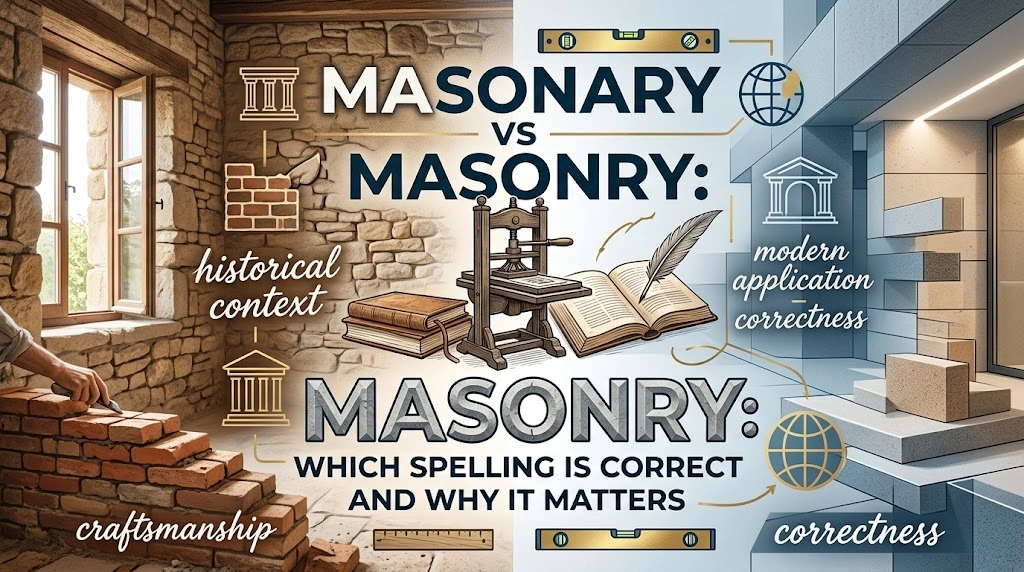
If you’re searching for masonary vs masonry, the answer is simple: masonry is the correct spelling. Masonary is a common misspelling that adds an unnecessary “a” before the final “r.” Although the incorrect form appears in websites, documents, searches, and informal writing, standard dictionaries recognize masonry as the proper English word.
The term masonry has a broad role in construction, architecture, and building trades. It can describe brickwork, stonework, a masonry wall, the craft performed by a mason, or construction made from materials such as brick, stone, and concrete masonry units. In some contexts, Masonry can also refer to Freemasonry, so context matters.
The spelling confusion usually comes from pronunciation. When spoken aloud, the word can make an extra vowel sound seem natural. However, adding that “a” changes the spelling from the accepted form to a mistake.
Understanding the difference helps you write more accurately, especially in construction documents, architectural descriptions, repair estimates, inspection reports, and online content. Once you remember MASONRY without the extra “A,” the distinction becomes easy to spot.
Masonry vs Masonary at a Glance
The difference is simple once you see the spelling side by side.
| Term | Correct spelling? | Meaning | Example |
| Masonry | Yes | Brick, stone, or similar construction and the craft of building with such materials | “The contractor repaired the masonry wall.” |
| Masonary | No | Common misspelling of masonry | “The masonary wall needs repairs.” |
The important detail is the letter A.
Masonry contains no A between N and R:
M-A-S-O-N-R-Y
The incorrect version inserts another vowel:
M-A-S-O-N-A-R-Y
That extra A is the entire spelling problem.
The Correct Spelling Is Masonry
When you’re referring to brickwork, stonework, or the related building craft, write masonry.
For example:
- Masonry walls can last for decades when properly maintained.
- The historic building features exposed stone masonry.
- The engineer inspected the masonry for cracking.
- The contractor specializes in masonry restoration.
The spelling stays masonry whether you’re discussing a brick wall, a stone façade, a concrete block structure, or the broader construction trade.
“Masonary” Is a Spelling Error
Masonary isn’t simply a less common American spelling. It isn’t the standard spelling of the construction term.
This distinction is useful because English contains many words with similar-looking endings. A writer may instinctively expect masonary because the pronunciation seems to support it.
That instinct is understandable. It just doesn’t produce the correct written form.
If a document says masonary construction, masonary wall, or masonary work, replace the word with masonry.
What Does Masonry Mean?
Masonry has several closely related meanings. At its core, however, the word concerns construction with masonry units and the craft of putting those units together.
Cambridge Dictionary defines masonry in relation to building with brick or stone and also recognizes the resulting brick or stone construction. Cambridge Dictionary
In modern construction, the term can cover considerably more than traditional hand-laid stone.
Masonry as a Construction Material or Structure
In everyday construction language, masonry often describes a wall, structure, or portion of a building made from masonry units.
Common masonry materials include:
- Brick
- Natural stone
- Concrete masonry units, commonly called concrete blocks or CMUs
- Manufactured stone units
- Clay masonry units
- Certain specialized masonry products
A masonry wall may serve different purposes depending on its design.
It might carry structural loads. It might simply provide a finished exterior surface. It could also separate spaces inside a building.
That distinction matters because not every masonry wall performs the same structural role.
For example, a historic brick building may use thick load-bearing masonry walls. A modern building may use a thin brick veneer attached to a separate structural wall.
Both involve masonry. Their structural behavior is very different.
Masonry as a Building Method or Craft
Masonry also describes the craft and practice of constructing with masonry units.
A mason works with materials, tools, mortar, layout techniques, and construction methods to create walls and other structures.
The work requires more than stacking bricks.
A properly constructed masonry wall depends on details such as:
- Unit alignment
- Joint thickness
- Mortar selection
- Bond pattern
- Level and plumb
- Moisture management
- Flashing
- Expansion or movement joints
- Connections and reinforcement where required
- Proper curing and workmanship
A small spelling mistake doesn’t change the engineering behind the work. However, accurate terminology becomes especially important when you’re documenting that work.
Masonry in Architecture and Construction
Architects and builders use masonry in both technical and descriptive language.
You might encounter phrases such as:
- Brick masonry
- Stone masonry
- Masonry wall
- Masonry veneer
- Reinforced masonry
- Load-bearing masonry
- Masonry construction
- Masonry restoration
- Masonry repair
- Concrete masonry
- Masonry chimney
These phrases demonstrate why the spelling matters. A construction document can contain the word dozens of times.
Using masonry consistently prevents an avoidable terminology error from spreading throughout the document.
Why Is “Masonry” Spelled Without the Extra A?
The easiest way to remember the modern spelling is to recognize that masonry developed from older forms associated with mason and mason work.
The history doesn’t support adding an extra A simply because that spelling feels natural.
The Word Comes From “Mason”
The words mason and masonry are closely related.
A mason can refer to a person who works with brick, stone, or similar materials. Masonry refers to the craft, work, construction, or material associated with that field.
This relationship makes the following comparison useful:
Mason → the person
Masonry → the work, craft, or construction
However, don’t treat the spelling as a rigid mathematical formula. English word formation doesn’t always work that neatly.
The modern word has its own historical development.
Pronunciation Can Make the Spelling Confusing
Pronunciation is one of the main reasons masonary looks tempting.
When people hear masonry, they may mentally divide it into sounds that resemble:
mason + ary
That can make masonary feel intuitive when writing from memory.
English spelling often creates this kind of trap. Words aren’t always spelled exactly as they sound, and familiar letter patterns can influence what people expect to see.
The solution isn’t to memorize a complicated pronunciation rule.
Instead, remember the visual form:
MASONRY
Once that pattern becomes familiar, the extra A starts looking out of place.
Word History Explains the Modern Form
Historical dictionaries and etymological references show that masonry has older forms connected to mason and French terms for masonry or the mason’s craft.
The Online Etymology Dictionary traces masonry through Middle English masonrie to Old French maçonerie.
That history helps explain why the modern English spelling isn’t masonary.
The word didn’t evolve according to the spelling pattern that a modern writer might instinctively create. Instead, English inherited and reshaped the term over centuries.
That’s typical of English. Its vocabulary contains layers from Old English, French, Latin, Greek, Norse, and many other linguistic sources.
So when masonry looks slightly unusual, that’s not an accident. Its spelling reflects its history.
Mason vs Masonry: What’s the Difference?
The difference between mason and masonry is straightforward, but the two words often get confused.
A Mason Is a Person
A mason can refer to a skilled worker who constructs or repairs structures using brick, stone, concrete blocks, or related materials.
For example:
- The mason laid the brick carefully.
- We hired a mason to repair the damaged wall.
- The mason inspected the joints before beginning the restoration.
In these sentences, mason refers to the person performing the work.
The word can also have another meaning. Mason can refer to a member of the Freemasons, depending on context.
The Cambridge Dictionary entry for mason recognizes both the construction-related meaning and the Freemasonry-related meaning.
Masonry Refers to the Work, Material, or Construction
Masonry, by contrast, generally refers to the construction, craft, or resulting work.
Compare these sentences:
The mason repaired the wall.
The masonry needed repair.
The first sentence identifies who performed the work.
The second identifies what was repaired.
That distinction makes the relationship easy to remember:
| Word | What it generally identifies | Example |
| Mason | A person | “The mason repaired the chimney.” |
| Masonry | Construction, work, craft, or material | “The masonry required repointing.” |
| Masonic | Related to Freemasonry | “The building has a Masonic connection.” |
Mason, Masonry, and Masonic Are Different Words
These three terms look related because they are.
Their meanings aren’t interchangeable, though.
Mason can describe a construction worker or a Freemason.
Masonry can describe brick or stone construction and, in certain contexts, Freemasonry.
Masonic functions as an adjective describing something associated with Freemasons or Freemasonry.
Context does much of the heavy lifting.
A sentence about a brick wall almost certainly uses masonry in the construction sense. A sentence about a fraternal organization may use Masonry in the Freemasonry sense.
Read More: SNM Meaning in Text: What Does SNM Mean in Texting and Social Media?
Common Uses of the Word “Masonry”
The word appears throughout construction, architecture, preservation, engineering, and property maintenance.
Masonry Walls and Buildings
A masonry wall is a wall constructed using masonry units.
Depending on the building system, that wall could be:
- Load-bearing
- Non-load-bearing
- Interior
- Exterior
- Solid masonry
- Composite
- Veneer construction
- Reinforced masonry
A historic brick wall and a modern concrete block wall can both fall under the broad category of masonry.
That doesn’t mean they’re interchangeable. Material properties, structural design, moisture behavior, and construction details can differ substantially.
Masonry Construction
Masonry construction describes a building system or construction approach that uses masonry units.
For example:
The project uses reinforced masonry construction for the stair enclosure.
In technical contexts, the phrase may refer to structural masonry designed to resist gravity loads, lateral forces, or both.
Modern masonry design can involve reinforcement, grout, steel connectors, engineered mortar, and carefully specified unit types.
That’s why the word appears in structural drawings and building specifications, not just everyday descriptions.
Masonry Work and Repairs
Property owners often encounter the term when dealing with repairs.
Common examples include:
- Repointing deteriorated mortar joints
- Replacing damaged bricks
- Repairing cracked masonry
- Restoring historic stonework
- Rebuilding portions of masonry walls
- Repairing masonry chimneys
- Cleaning masonry surfaces
- Addressing water intrusion around masonry assemblies
A contractor might describe a project as masonry restoration even when the work involves several different materials and techniques.
Architectural Descriptions
Architectural writers use masonry to describe both structure and appearance.
Consider:
The nineteenth-century courthouse features heavy stone masonry and decorative brick detailing.
Here, masonry communicates more than “a wall.”
It identifies the building’s construction material and contributes to the reader’s understanding of its architectural character.
Historic masonry can also provide clues about a building’s age, construction techniques, local materials, and past alterations.
Does “Masonry” Have a Meaning Related to Freemasonry?
Yes. Masonry can refer to Freemasonry in the appropriate context.
This secondary meaning can surprise people who normally associate masonry with bricks and mortar.
“Masonry” Can Refer to Freemasonry in Certain Contexts
In discussions about Freemasonry, Masonry can function as a shortened reference to the organization or its system.
For example, a historical text might use Masonry in a discussion of Masonic institutions, traditions, or practices.
The meaning depends heavily on context.
When the surrounding sentence discusses walls, brick, stone, mortar, or construction, the building-related meaning is clear.
When the sentence discusses lodges, Freemasons, or Masonic traditions, the other meaning becomes apparent.
Construction Masonry and Freemasonry Are Different Contexts
These meanings share a historical word but describe completely different subjects in modern usage.
| Context | Meaning of masonry |
| Construction | Brick, stone, block, or related building work |
| Architecture | Mason-built construction or masonry materials |
| Restoration | Repair or preservation of masonry construction |
| Freemasonry | A reference to the Masonic organization or tradition |
Capitalization can also provide a clue in some writing styles. Masonry with a capital letter may appear when the word is used as a proper or conventional name for Freemasonry.
However, capitalization isn’t a universal shortcut. Context remains the stronger signal.
Why Do People Spell “Masonry” as “Masonary”?
The incorrect spelling isn’t random. Several features of the word make the error easy to understand.
The Extra “A” Comes From the Sound
When people spell unfamiliar words, they often rely partly on pronunciation.
The ending of masonry can sound as though it contains a vowel before the final consonant sequence. That can encourage the spelling masonary.
It’s similar to other English words where pronunciation doesn’t provide a perfect roadmap for spelling.
The important point is simple:
Hearing a vowel-like sound doesn’t mean the written word needs the letter A.
“Mason” Makes the Mistake Feel Logical
The word starts with mason, which makes the incorrect extension seem plausible.
A writer may think:
mason + ary = masonary
But the standard word is:
masonry
That tiny difference creates the entire spelling issue.
The best strategy is therefore visual memory rather than trying to reconstruct the word every time.
Similar Word Patterns Can Reinforce the Error
English contains many words ending in -ary, including customary, necessary, and temporary.
That familiar pattern can make masonary appear legitimate at first glance.
But masonry belongs to a different spelling pattern.
Once you’ve seen the correct form repeatedly, the distinction becomes much easier to recognize.
Masonary vs Masonry in Professional and Technical Writing
Spelling matters most when your words carry technical information.
Construction Documents Need the Standard Term
Construction projects generate a surprising amount of written documentation.
A single project might include:
- Architectural specifications
- Engineering reports
- Inspection reports
- Contractor proposals
- Estimates
- Work orders
- Product documentation
- Building assessments
- Maintenance records
- Permit documents
- Restoration reports
If masonry appears throughout those documents, spelling it correctly keeps the terminology consistent.
A typo won’t automatically invalidate an engineering report. Yet repeated terminology errors can make a document look careless.
Correct Terminology Improves Clarity
Technical writing works best when every term has a stable meaning.
Consider these examples:
Masonry wall
Masonry veneer
Reinforced masonry
Load-bearing masonry
Masonry restoration
Each phrase communicates something specific to readers familiar with construction.
Replacing masonry with the misspelled masonary doesn’t create a new technical term. It simply introduces noise.
That’s particularly undesirable when several professionals need to interpret the same document.
Search and Digital Content Also Benefit From Correct Spelling
Correct spelling also matters online.
People searching for construction information generally expect the standard term masonry. Using the correct spelling in page titles, headings, body copy, image descriptions, and technical explanations makes content easier to understand and align with established terminology.
That doesn’t mean an isolated typo automatically causes a search ranking penalty.
Search systems are considerably more sophisticated than a simple spelling counter.
Still, standard terminology supports clarity, relevance, credibility, and user trust. Those are worthwhile goals whether you’re writing for search engines or human readers.
Correct and Incorrect Examples of Masonry
Examples make the difference between masonry and masonary easy to spot.
Correct Construction Examples
- The historic building has exposed brick masonry.
- The contractor repaired the damaged masonry around the window.
- The engineer evaluated the masonry wall for structural cracking.
- The project includes a new masonry veneer.
- Moisture can damage masonry when water enters vulnerable joints.
- The restoration team carefully matched the replacement masonry units.
Incorrect “Masonary” Examples
The following sentences contain the common spelling mistake:
- The masonary wall needs repair.
- The building features decorative masonary.
- The contractor specializes in masonary restoration.
- The inspector found cracks in the masonary.
Correct them by removing the extra A:
- The masonry wall needs repair.
- The building features decorative masonry.
- The contractor specializes in masonry restoration.
- The inspector found cracks in the masonry.
Mason vs Masonry Examples
Compare the two terms:
| Incorrect idea | Better wording | Why |
| “The masonry repaired the wall.” | “The mason repaired the wall.” | A mason is the person. |
| “We hired a mason to inspect the masonry.” | Correct | The mason is the worker; masonry is the construction. |
| “The mason needs replacement.” | “The masonry needs replacement.” | The construction, not the worker, needs replacement. |
| “The masonry laid the bricks.” | “The mason laid the bricks.” | The person performs the action. |
These examples reveal the grammatical distinction as well as the spelling distinction.
How to Remember the Correct Spelling of Masonry
A good memory trick should take seconds, not require a vocabulary lesson.
Remember the Ending: “-ry”
Think of the word as:
MASON + RY
That isn’t a complete explanation of the word’s historical formation. It’s simply a useful spelling aid.
When you write masonary, stop and look at the middle:
MASON-A-RY
That extra A should immediately raise a red flag.
Watch for the Extra A
Here’s the fastest visual test:
MASONRY = correct
MASONARY = extra A
If you see MASONARY, remove the A.
That’s it.
Connect Mason to Masonry
Use the relationship between the words as another memory cue.
A mason works with masonry.
For example:
The mason repaired the masonry.
The sentence puts both words together naturally.
The person is the mason.
The work or construction is masonry.
Check the Word Before Publishing
When spelling matters, a trusted dictionary provides a quick final check.
Useful references include:
- Cambridge Dictionary — masonry
- Merriam-Webster — masonry
- Oxford English Dictionary
- Online Etymology Dictionary — masonry
A dictionary check takes a few seconds. Fixing a misspelled term across a 40-page technical document takes much longer.
A Practical Case Study: One Extra Letter in a Construction Document
Imagine a contractor preparing a proposal for a historic building renovation.
The document contains phrases such as:
- Masonary restoration
- Masonary wall repair
- Masonary joint repointing
- Masonary cleaning
- Masonary replacement units
None of these phrases represents a new construction method. They’re all misspellings of masonry.
Now imagine the proposal goes through several revisions. The same spelling appears in the project website, estimate, scope of work, and client presentation.
The original error has multiplied.
What Should Happen Instead?
The terminology should remain consistent:
- Masonry restoration
- Masonry wall repair
- Masonry joint repointing
- Masonry cleaning
- Masonry replacement units
The technical work hasn’t changed.
The document simply uses the established spelling.
Why This Small Correction Has Value
Professional writing creates an impression before anyone evaluates the underlying technical details.
A client may not know the difference between tuckpointing and repointing. They may not understand structural masonry design.
They can still notice obvious spelling mistakes.
That doesn’t mean spelling determines technical competence. It does mean careful terminology contributes to a document’s overall credibility.
Common Mistakes With Masonry
The extra A isn’t the only issue writers encounter.
Adding an Extra “A”
This is the classic mistake:
Masonary ❌
Masonry ✅
The solution is purely visual. Check the word before submitting or publishing the content.
Confusing Mason and Masonry
Remember:
Mason = person
Masonry = work, craft, material, or construction
A mason installs or repairs masonry.
Capitalizing the Word Unnecessarily
In ordinary construction writing, masonry is generally lowercase.
For example:
The contractor repaired the masonry wall.
There’s no reason to capitalize the word simply because it’s a technical term.
However, capitalization can change according to a particular proper name, title, organization, or usage convention.
Using the Wrong Word in Professional Content
A technical document can use a correctly spelled word in the wrong context.
For example:
The masonry installed the brick.
The spelling is correct, but the word choice isn’t.
A better sentence is:
The mason installed the brick masonry.
Good technical writing requires both correct spelling and correct terminology.
Masonry Spelling Facts Worth Remembering
A few facts capture the issue neatly.
- Masonry is the standard spelling.
- Masonary is a misspelling.
- Masonry relates to mason and the craft of building with masonry materials.
- The word has historical roots in Middle English and Old French.
- Masonry can describe construction, materials, finished work, or the building craft.
- A mason is a person who performs masonry work.
- Masonry can also have a context-specific connection to Freemasonry.
- The extra A in masonary doesn’t belong in the standard spelling.
- The correct spelling is M-A-S-O-N-R-Y.
Masonry vs Masonary: Frequently Asked Questions
Is It “Masonary” or “Masonry”?
Masonry is correct.
Masonary is a common misspelling. If you’re writing about brick, stone, block construction, or the related craft, use masonry.
What Does Masonry Mean?
Masonry refers to construction using materials such as brick, stone, and concrete masonry units. It can also describe the craft or practice of building with those materials.
In construction writing, you’ll see terms such as masonry wall, masonry veneer, and reinforced masonry.
Why Do People Spell Masonry as “Masonary”?
The incorrect spelling likely feels natural because of the word’s pronunciation and familiar English spelling patterns.
Writers may mentally interpret the ending as -ary and insert an A.
The standard spelling, however, is masonry.
How Do You Spell Masonry Correctly?
Spell it:
M-A-S-O-N-R-Y
The most useful memory trick is to remember that masonry has no A between N and R.
What Is the Difference Between a Mason and Masonry?
A mason is a person who performs skilled masonry work.
Masonry refers to the work, craft, construction, or materials involved.
For example:
The mason repaired the masonry wall.
Is Masonry a Noun?
Yes. Masonry is a noun.
Cambridge Dictionary treats masonry as a noun and defines it in connection with brick or stone building and the skill of constructing with those materials.
The word is commonly used as an uncountable noun in construction contexts.
For example:
The masonry was badly damaged.
You generally wouldn’t say:
The masonries were damaged.
Instead, you’d describe the specific walls, structures, or masonry elements that were damaged.
Can Masonry Refer to Freemasonry?
Yes.
In certain contexts, Masonry can refer to Freemasonry. The intended meaning depends on the surrounding language.
A construction document discussing brick walls clearly uses the building-related sense.
A historical or organizational discussion about Freemasons may use Masonry in the fraternal sense.
Is “Masonary” an Alternative Spelling?
No. Masonary isn’t the standard alternative spelling of masonry.
It is best treated as a spelling error and corrected wherever it appears in formal, professional, academic, or published writing.
Is Masonry Only Made of Brick?
No.
Masonry can involve several types of units and materials, including brick, natural stone, concrete masonry units, and other manufactured masonry products.
The exact material depends on the building system and project requirements.
Is Masonry Always Structural?
No.
Some masonry carries structural loads. Other masonry serves primarily as a veneer, partition, enclosure, or architectural finish.
For instance, brick veneer can provide an exterior brick appearance without acting as the building’s primary structural frame.
That distinction is important in technical construction discussions.
A Simple Masonry Spelling Checklist
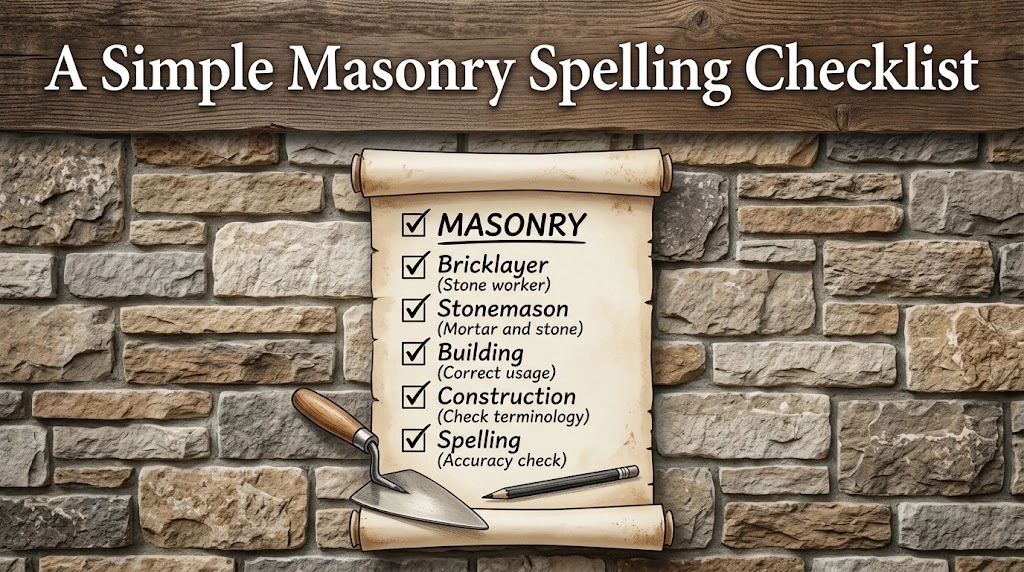
Before publishing construction content, run through this quick check:
- Is the word spelled masonry?
- Did you accidentally add an A?
- Are you referring to a person? Use mason.
- Are you referring to the construction or craft? Use masonry.
- Does the context concern Freemasonry? Check whether Masonry is being used in that specific sense.
- Are technical terms consistent throughout the document?
- Have you checked unfamiliar terminology against a reputable dictionary?
The fastest test remains the simplest:
MASONRY — no extra A.
Masonary vs Masonry: The Bottom Line
When the choice comes down to masonary vs masonry, there’s no real contest.
Masonry is the correct spelling.
The word describes brick, stone, block, and related construction, along with the craft of building with those materials. It appears throughout architecture, engineering, construction, restoration, property maintenance, and technical documentation.
Masonary, despite being a common mistake, isn’t the standard spelling.
The confusion probably feels natural because English pronunciation doesn’t always reveal spelling perfectly. The word’s history also comes from older forms that don’t map neatly onto modern spelling intuition.
Still, the practical rule is easy:
Write masonry, not masonary.
Remember the visual pattern:
MASON + RY = MASONRY
A mason is the person.
Masonry is the work, craft, material, or construction.
Once that distinction sticks, the extra A becomes much easier to spot. Whether you’re describing a historic stone façade, specifying a concrete block wall, writing a contractor proposal, or simply checking a spelling, masonry is the form to use.