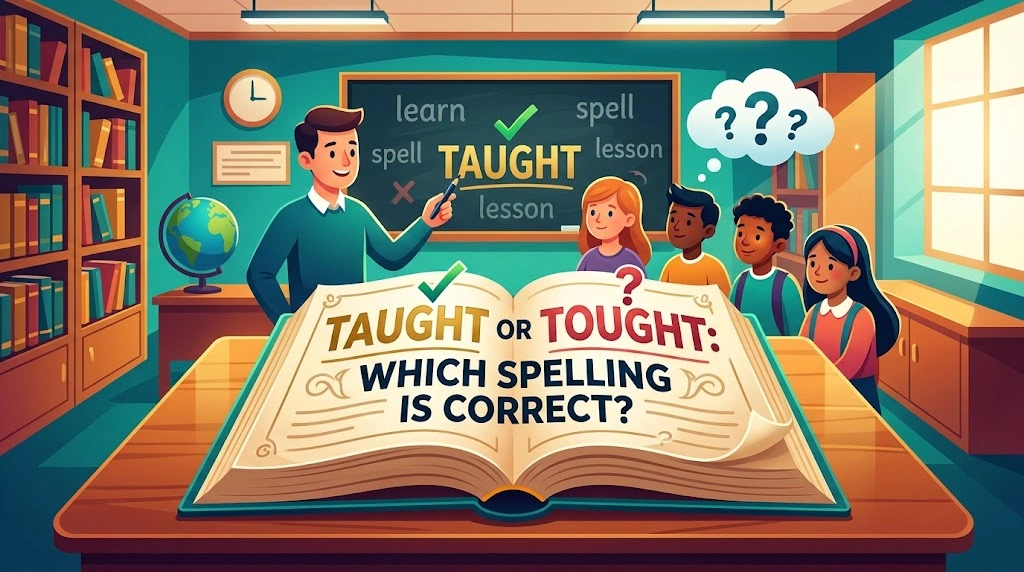
Are you confused about whether Taught or Tought is the correct spelling? You’re not alone. This is a common English spelling mistake because taught and thought look and sound somewhat similar. However, only one spelling represents the past tense of teach: taught.
The word taught is an irregular verb form of teach. You use it when someone gave instruction, explained a skill, or helped another person learn something. For example, “My mother taught me how to cook.” The spelling tought is not the standard form in modern English and should be avoided in formal writing.
It’s also important to distinguish taught vs thought. While taught relates to teaching and learning, thought is the past tense of think and relates to an idea, opinion, belief, or mental process. You might say, “My teacher taught me grammar,” but “I thought the lesson was easy.”
Understanding the difference between teach and taught, taught meaning, taught spelling, and taught vs tought can help you avoid this mistake. Once you remember teach → taught, choosing the correct spelling becomes much easier.
Taught or Tought: The Quick Answer
Taught is the correct spelling.
It comes from the verb teach:
- Teach → present tense
- Taught → past tense
- Taught → past participle
The spelling tought isn’t considered standard English.
Here’s the quickest way to remember it:
Teach → taught, not tought.
For example:
- Correct: She taught me how to cook.
- Incorrect: She tought me how to cook.
Don’t confuse taught with thought, either. Thought comes from think and refers to an idea, belief, opinion, or mental process.
Taught vs. Tought: Quick Comparison
| Word | Correct? | Base verb | Meaning | Example |
| Taught | Yes | Teach | Gave instruction or helped someone learn | She taught mathematics. |
| Tought | No, in standard English | — | Usually a misspelling of taught | ❌ She tought mathematics. |
| Thought | Yes | Think | Had an idea, belief, or opinion | I thought about the problem. |
| Teached | No, in standard English | Teach | Incorrect regularized past form | ❌ He teached English. |
Featured Snippet Answer
Taught is the correct spelling, while tought is a misspelling in standard English. Taught is both the past tense and past participle of teach. For example, “She taught me French.” Thought is a different word and is the past tense of think.
What Does “Taught” Mean?
Taught describes an act of teaching that happened in the past. It can involve formal education, practical skills, advice, training, or lessons learned through experience.
The word can appear in several grammatical structures. Understanding those structures makes the spelling much easier to remember.
Taught as the Past Tense of Teach
Taught is the simple past form of teach.
The verb teach is irregular. That means you can’t form its past tense simply by adding -ed.
For regular verbs, the pattern usually looks like this:
- work → worked
- walk → walked
- learn → learned
However, teach follows a different pattern:
- teach → taught
That’s why teached isn’t the standard past-tense form.
Consider these examples:
- “My mother taught me to read.”
- “The professor taught chemistry at the university.”
- “Our coach taught us several new techniques.”
- “She taught her son how to ride a bicycle.”
- “They taught the children basic safety rules.”
In every example, the teaching happened in the past.
The time expression doesn’t always have to appear. The past tense can be understood from context.
For example:
“Who taught you to play guitar?”
The question asks about an earlier teaching experience even though no specific date appears.
Taught as a Past Participle
Taught also functions as the past participle of teach.
This is important because the past tense and past participle happen to have the same form:
teach → taught → taught
For example:
- “I teach English.”
- “I taught English yesterday.”
- “I have taught English for ten years.”
The third sentence uses taught as a past participle after have.
You can also use it with has and had:
- “She has taught thousands of students.”
- “He has taught at several schools.”
- “They had taught the material before the exam.”
The spelling doesn’t change.
You don’t write tought, teached, or another variation. The correct form remains taught.
Taught Can Refer to Lessons Learned Through Experience
Teaching doesn’t always happen inside a classroom.
English also uses taught when an event or experience causes someone to learn something.
For example:
“That mistake taught me to check my work twice.”
Nobody necessarily stood there giving a formal lesson. The experience itself produced the lesson.
Other examples include:
- “The difficult journey taught him patience.”
- “Her first business failure taught her an important lesson.”
- “Living abroad taught me to appreciate different perspectives.”
- “The experience taught them how quickly plans can change.”
This figurative use is extremely common.
You can think of it as experience acting like a teacher.
Why Is “Tought” Incorrect?
The spelling tought looks plausible because English pronunciation doesn’t always make spelling obvious.
However, standard English spells the past form of teach as taught.
“Tought” Is Not the Standard Past Form of “Teach”
If the intended verb is teach, its past form is taught.
The standard pattern is:
teach → taught
Not:
❌ teach → tought
And not:
❌ teach → teached
This irregular form needs to be learned as part of the verb.
If you’re writing an email, school assignment, report, résumé, article, or professional document, use taught.
The “Thought” and “Taught” Confusion
One major reason people write tought is confusion between taught and thought.
The words have different origins and meanings.
Taught comes from teach.
Thought comes from think.
Compare them:
“My father taught me how to swim.”
“I thought the pool was closed.”
The first sentence concerns learning. The second concerns an idea or belief.
Here’s another comparison:
| Taught | Thought |
| Comes from teach | Comes from think |
| Relates to instruction or learning | Relates to ideas or beliefs |
| “She taught me French.” | “I thought she spoke French.” |
| Past form of teach | Past form of think |
A single spelling difference can completely change the meaning of a sentence.
Why English Learners Often Make This Mistake
English spelling doesn’t always provide a reliable pronunciation-to-letter map.
The pronunciation of taught can make its spelling difficult for learners who haven’t memorized the irregular form. Someone may hear a sound that seems closer to tought and naturally write what they hear.
There’s another problem, too: English contains many words ending in -ought, including:
- thought
- bought
- brought
- fought
- sought
That pattern can encourage someone to assume that teach should become tought.
But English irregular verbs don’t always behave according to one neat spelling formula.
The safest approach is to memorize the verb pair:
teach → taught
Does “Tought” Ever Mean Something Else?
In standard contemporary English, tought isn’t the normal spelling of a separate everyday English word.
If you encounter tought, the writer most likely intended taught or possibly another similarly spelled word.
Historical English contains many spellings that differ from modern standards. However, that doesn’t make tought an appropriate modern spelling of taught.
For ordinary writing today, use taught.
Read More: Ight Meaning in Text: What Does “Ight” Mean?
Taught vs. Thought: Meaning and Spelling
The difference between taught and thought deserves special attention because both are legitimate English words.
Taught Means “Gave Instruction”
Use taught when someone or something helped another person learn.
Examples:
- “My grandfather taught me woodworking.”
- “The instructor taught us first aid.”
- “She taught her daughter to cook.”
- “The book taught me several useful techniques.”
The object can be a person, a group, a skill, a subject, or even a lesson.
Thought Means “Had an Idea or Belief”
Thought is the past tense and past participle of think.
It can describe an opinion, belief, consideration, or mental process.
Examples:
- “I thought you were busy.”
- “She thought about changing careers.”
- “We thought the meeting started at noon.”
- “He thought the answer was obvious.”
Notice how different the meanings are.
The teacher taught the lesson.
The student thought about the lesson.
The teacher taught. The student thought.
Taught vs. Thought in Side-by-Side Sentences
These pairs make the difference easier to see:
| Sentence | Meaning |
| “She taught me Spanish.” | She gave me Spanish instruction. |
| “I thought she spoke Spanish.” | I believed she spoke Spanish. |
| “The experience taught him patience.” | The experience helped him learn patience. |
| “He thought about the experience.” | He considered or reflected on it. |
| “They taught us the rules.” | They explained or instructed us about the rules. |
| “They thought about the rules.” | They considered the rules. |
When you’re unsure, ask yourself one question:
Is the sentence about learning or thinking?
If it’s about giving instruction or learning a lesson, taught may be the word you need.
If it’s about an idea or belief, thought may be correct.
How to Remember the Correct Spelling of “Taught”
The easiest strategy isn’t to invent a complicated spelling rule.
Instead, remember the irregular verb as a unit:
Teach → Taught
The Best Memory Trick: Teach Has “EA,” Taught Has “AU”
Look at the vowel change:
teach → taught
The spelling changes substantially rather than simply adding an ending.
You can memorize it visually:
TEACH = present
TAUGHT = past
The AU in taught is the key spelling feature.
For example:
- teach → taught
- teaches → taught
- teaching → taught
Only the appropriate grammatical form changes with tense.
Connect Taught With Other Common Irregular Verbs
Some other irregular verbs contain similar spelling patterns:
| Present | Past | Past Participle |
| teach | taught | taught |
| buy | bought | bought |
| catch | caught | caught |
| bring | brought | brought |
| think | thought | thought |
| fight | fought | fought |
These similarities can help you recognize the spelling family.
However, don’t assume that every verb follows exactly the same pattern. English irregular verbs developed through different historical changes.
The useful takeaway is simpler:
Remember “teach → taught” as one fixed pair.
Ask Yourself: “What Is the Base Verb?”
Whenever you see or hear a sentence containing taught, identify its base verb.
If the base verb is teach, then the past form is taught.
For example:
“Who taught you that?”
Base verb: teach
Past form: taught
That quick mental check eliminates most tought mistakes.
How to Use “Taught” Correctly in Sentences
Knowing the spelling is only half the job. You also need to know how taught behaves in a sentence.
Using Taught With a Person
A common structure is:
Subject + taught + person + something
Examples:
- “Maria taught me French.”
- “The coach taught the players a new strategy.”
- “My father taught us an important lesson.”
The person receiving instruction can appear directly after taught.
You can also use a structure involving to:
“She taught English to the students.”
Both structures can be grammatical, although taught the students English often sounds more direct.
Using Taught With “How To”
Another common construction is:
taught + someone + how to + verb
Examples:
- “My father taught me how to drive.”
- “She taught her children how to swim.”
- “The instructor taught us how to use the software.”
- “He taught the team how to defend against the attack.”
This structure works especially well when describing practical skills.
Using Taught in Passive Voice
The passive construction focuses on the person receiving instruction rather than the person providing it.
For example:
“We were taught English at school.”
The active version would be:
“Our teachers taught us English at school.”
Both sentences communicate the same basic event. The passive version puts we/us at the center.
Other examples include:
- “The students were taught basic mathematics.”
- “She was taught how to operate the machine.”
- “They were taught the importance of honesty.”
- “The employees were taught new safety procedures.”
Common Examples of Correct Usage
Here are natural examples covering several meanings:
- “Our teacher taught us grammar.”
- “My mother taught me how to cook.”
- “He taught himself to play guitar.”
- “The experience taught her a valuable lesson.”
- “They taught the children about road safety.”
- “I was taught to respect other people’s opinions.”
- “She has taught English for more than a decade.”
- “The coach taught us a better way to train.”
- “Failure taught him not to ignore warning signs.”
- “Who taught you how to do that?”
Common Mistakes to Avoid With Taught
Several mistakes appear repeatedly because teach is an irregular verb.
Mistake 1: Writing “Tought” Instead of “Taught”
Incorrect:
❌ “My teacher tought me science.”
Correct:
✅ “My teacher taught me science.”
The correction is straightforward. Replace tought with taught.
Mistake 2: Using “Teached” Instead of “Taught”
This mistake happens when writers apply the regular -ed pattern to an irregular verb.
Incorrect:
❌ “She teached English last year.”
Correct:
✅ “She taught English last year.”
English has many irregular verbs that don’t follow the usual past-tense pattern.
Mistake 3: Using “Teach” When You Need the Past Tense
Compare:
“I teach English every Monday.”
“I taught English yesterday.”
Teach works for the present. Taught works for the past.
A time expression often makes the distinction obvious:
- every day → teach
- usually → teach
- yesterday → taught
- last year → taught
- in 2024 → taught
- two weeks ago → taught
Context determines the correct tense.
Mistake 4: Confusing Taught With Thought
Incorrect meaning:
❌ “My teacher thought me mathematics.”
Correct:
✅ “My teacher taught me mathematics.”
Here, thought changes the meaning entirely. The sentence would otherwise suggest that the teacher mentally considered the speaker.
Mistake 5: Forgetting the Past Participle Form
Because taught is both the simple past and past participle, learners sometimes try to create another form.
Correct:
“She has taught English for years.”
Incorrect:
❌ “She has teached English for years.”
The form remains taught after has, have, or had.
Taught vs. Tought vs. Thought vs. Teached
These four forms are worth separating clearly.
| Form | Standard English? | Verb | Function |
| taught | ✅ Yes | teach | Past tense and past participle |
| tought | ❌ No | — | Common misspelling |
| thought | ✅ Yes | think | Past tense and past participle |
| teached | ❌ No | teach | Incorrect regularized form |
Consider these examples:
“She taught me mathematics.”
Correct.
“I thought about mathematics.”
Correct.
“She tought me mathematics.”
Incorrect.
“She teached me mathematics.”
Incorrect.
The key isn’t simply memorizing four spellings. You need to connect each word to its meaning.
Taught = teach.
Thought = think.
That distinction does most of the work.
When Should You Use “Taught”?
You should use taught whenever you’re referring to the appropriate past or participle form of teach.
Use Taught for Completed Past Actions
If someone gave instruction in the past, use taught.
Examples:
- “She taught at the university in 2025.”
- “He taught me chess when I was young.”
- “The instructor taught the class yesterday.”
The action doesn’t need to be completely unrelated to the present. The key is that you’re using the past form of teach.
Use Taught With Perfect Tenses
Use taught after forms of have when teach appears in a perfect construction.
Examples:
- “I have taught English for five years.”
- “She has taught hundreds of students.”
- “They had taught the material before the test.”
The pattern is:
have/has/had + taught
Not have teached and not have tought.
Use Taught in Passive Sentences
The passive structure commonly appears as:
was/were + taught
Examples:
- “I was taught English in school.”
- “The students were taught basic grammar.”
- “We were taught how to use the equipment.”
You can also encounter perfect passive forms:
“The students have been taught the fundamentals.”
Again, taught remains unchanged.
Use Taught for Lessons From Experience
Use taught when an experience produces knowledge or wisdom.
For example:
- “The accident taught him to be more careful.”
- “Travel taught her to adapt quickly.”
- “The failure taught us an important lesson.”
- “Parenthood taught him patience.”
This use is often more figurative than literal, but the grammar remains the same.
A Simple Checklist Before Using “Taught”
When you’re writing quickly, use this short test.
A Five-Second Grammar Test
Ask yourself:
- What is the base verb? → Is it teach?
- Am I talking about the past? → Use taught.
- Am I using have, has, or had? → Use taught as the past participle.
- Does the sentence describe instruction or a lesson learned? → Taught probably fits.
- Am I writing “tought”? → Change it to taught.
- Am I talking about an idea or belief? → Check whether thought is actually intended.
For example:
“My mother ___ me how to bake.”
The base verb is teach. The sentence refers to past instruction.
Answer:
“My mother taught me how to bake.”
Simple.
Taught in Different Sentence Patterns

Understanding common structures makes correct usage feel automatic.
“Someone Taught Me Something”
Pattern:
Someone + taught + person + subject/lesson
Examples:
- “My teacher taught me mathematics.”
- “My brother taught me chess.”
- “The trainer taught the athletes proper technique.”
“Someone Taught Me How to Do Something”
Pattern:
Someone + taught + person + how to + verb
Examples:
- “My uncle taught me how to repair bicycles.”
- “She taught her daughter how to swim.”
- “The technician taught us how to operate the system.”
“Someone Was Taught Something”
Pattern:
Person + was/were + taught + subject/skill
Examples:
- “I was taught English at school.”
- “They were taught basic computer skills.”
- “The children were taught road safety.”
“Something Taught Me a Lesson”
Pattern:
Experience/event + taught + person + lesson
Examples:
- “The mistake taught me a valuable lesson.”
- “That experience taught her to be patient.”
- “The failed project taught the team what to avoid next time.”
This final pattern is especially common in personal writing and storytelling.
Mini Quiz: Taught or Tought?
Test yourself before checking the answers.
Choose the Correct Spelling
She ___ me how to use the camera.
- A. tought
- B. taught
- C. teached
Answer: B. taught
Fill in the Blank
My grandfather ___ me how to fish.
Answer: taught
The base verb is teach, and the sentence describes a past action.
Spot the Mistake
“Our instructor tought us the safety procedures.”
The mistake is tought.
Correct version:
“Our instructor taught us the safety procedures.”
Taught or Thought?
Choose the correct word:
“I ___ she was already at home.”
Answer: thought
The sentence expresses a belief or assumption. The base verb is think.
Now compare:
“She ___ me how to bake.”
Answer: taught
The sentence describes instruction. The base verb is teach.
Choose the Right Sentence
Which sentence is correct?
- ❌ “He teached me French.”
- ❌ “He tought me French.”
- ✅ “He taught me French.”
- ❌ “He thought me French.”
The correct answer is “He taught me French.”
FAQs About Taught or Tought
Is “Tought” a correct English word?
No. Tought isn’t the standard spelling of the past tense of teach. The correct word is taught.
What is the correct spelling, taught or tought?
Taught is correct. Tought is a misspelling.
Is taught the past tense of teach?
Yes. Taught is both the simple past tense and past participle of teach.
What does taught mean?
Taught means gave instruction or helped someone learn a skill, subject, fact, or lesson.
What is the difference between taught and thought?
Taught comes from teach and relates to learning. Thought comes from think and relates to ideas, beliefs, or opinions.
Can you say “have taught”?
Yes. Have taught is grammatically correct because taught is the past participle of teach.
Is “teached” correct?
No. The standard past form is taught, not teached. The verb teach is irregular.
How can I remember the spelling taught?
Remember this simple pattern: teach → taught. If you’re describing someone giving instruction in the past, taught is the correct spelling.
Conclusion: Taught or Tought
When deciding between Taught or Tought, the correct choice is always taught when you mean the past tense or past participle of teach. The spelling tought is a common spelling error, but it isn’t the standard English form.
Remember the simple verb pattern: teach → taught → taught. For example, “She taught me Spanish,” uses taught as the past tense of teach. You can also use it as a past participle, as in “She has taught Spanish for many years.”
The biggest source of confusion is usually taught vs thought. These are both legitimate words, but their meanings are completely different. Taught relates to teaching, instruction, education, or lessons learned through experience. Thought comes from think and describes an idea, opinion, or belief.
So, if you’re writing about someone helping another person learn, choose taught. If you’re describing what someone believed or considered, choose thought.
The easiest rule to remember is simple: Teach in the present, taught in the past. Keep that pattern in mind and you’ll never need to wonder about taught or tought again.