Have you ever written dought when you actually meant doubt? You’re not alone. The spelling can feel surprisingly confusing because doubt contains a silent b, while its pronunciation gives you almost no clue that the letter belongs there. When you hear the word aloud, it sounds roughly like “dowt,” which makes spellings such as dought seem perfectly plausible at first glance.
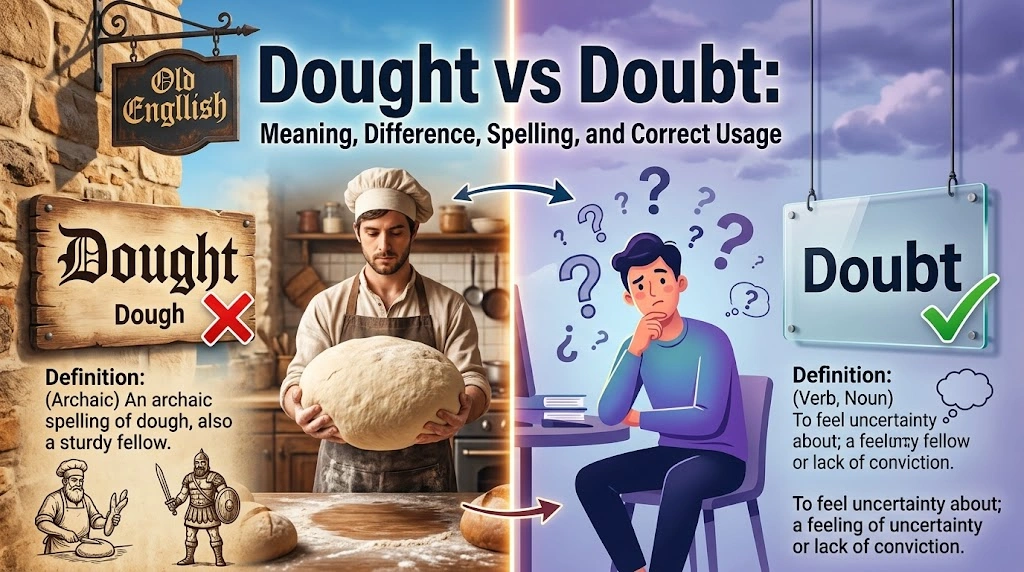
The difference between dought vs doubt becomes much clearer once you look at modern English usage, word history, pronunciation, and grammar. Doubt is the standard modern English word for uncertainty, lack of confidence, or questioning whether something is true. You can use it as both a noun and a verb: “I have some doubt” and “I doubt his explanation” are both correct.
But what about dought? Historical English contains related forms, so simply calling it meaningless isn’t quite accurate. However, dought isn’t the standard modern spelling when you mean uncertainty. Understanding that distinction can help you avoid spelling mistakes in essays, emails, professional writing, and everyday communication.
In this guide, you’ll learn the exact difference between dought and doubt, why the b is silent, when each form may appear, and how to remember the correct spelling.
Dought vs Doubt: What’s the Difference?
The simplest answer is straightforward:
Doubt is the standard modern English spelling when you mean uncertainty or a lack of confidence.
Dought isn’t the standard modern spelling for that meaning.
For example:
- Correct: “I doubt that he’ll come.”
- Incorrect in standard modern English: “I dought that he’ll come.”
The confusion happens because doubt is pronounced roughly like dowt. The b isn’t pronounced at all.
That creates a spelling trap. When you hear the word, dought can look perfectly reasonable.
It isn’t, however, the spelling you should normally use in contemporary English.
Dought vs Doubt: Quick Comparison
| Word | Standard modern English? | Main meaning or use | Example |
| doubt | Yes | Uncertainty, skepticism, lack of confidence | “I doubt his explanation.” |
| dought | No, not for this modern meaning | Historical or specialized usage may occur | Depends on the historical context |
| doubted | Yes | Past tense of doubt | “She doubted the claim.” |
| doubting | Yes | Present participle/gerund | “He is doubting the results.” |
| doubtful | Yes | Uncertain or unlikely | “That outcome seems doubtful.” |
| undoubtedly | Yes | Certainly; without question | “She is undoubtedly talented.” |
The key distinction is simple: modern readers expect “doubt,” not “dought,” when discussing uncertainty.
The One-Second Memory Trick
Think of the familiar phrase:
“Without a doubt.”
The word is always spelled doubt, even though you don’t hear the b.
You can also connect doubt with related words such as doubtful and doubtless. That spelling family makes the silent letter easier to remember.
When you’re unsure, don’t spell the word entirely by sound. English has plenty of words whose spelling preserves historical information that pronunciation no longer reveals.
What Does “Doubt” Mean?
Doubt describes uncertainty about something.
You can doubt whether a statement is true. You can doubt someone’s explanation. You can have doubts about a decision. You can even doubt your own ability.
The exact shade of meaning depends on context.
At its core, though, doubt involves uncertainty, questioning, or reduced confidence.
Doubt as a Noun
As a noun, doubt refers to the feeling or state of uncertainty itself.
Consider these examples:
“I have some doubt about his story.”
Here, doubt means uncertainty about whether the story is true.
“There is no doubt that she worked hard.”
In this sentence, the phrase no doubt indicates certainty rather than uncertainty.
“The result remains in doubt.”
Here, the outcome hasn’t been settled or established.
Merriam-Webster defines the noun doubt with meanings that include uncertainty, lack of confidence, and an inclination not to believe or accept something. Merriam-Webster’s definition of doubt provides further usage information.
Common noun patterns include:
- a doubt
- some doubt
- serious doubt
- reasonable doubt
- little doubt
- no doubt
- doubt about something
- doubt concerning something
For example:
- “She expressed serious doubt about the proposal.”
- “There is little doubt about the team’s ability.”
- “His explanation raised doubts about the decision.”
Doubt as a Verb
Doubt can also function as a verb.
As a verb, it means to question whether something is true, reliable, possible, or likely.
For example:
- “I doubt his story.”
- “She doubts that they’ll arrive.”
- “They doubted the accuracy of the report.”
- “He doubted whether the plan would work.”
Notice the difference:
“I have doubts about the plan.”
“I doubt the plan will work.”
The first sentence uses doubt as a noun.
The second uses doubt as a verb.
That distinction matters when you’re building sentences correctly.
Doubt Can Express Different Degrees of Uncertainty
Not every use of doubt expresses the same level of skepticism.
Compare:
- “I have some doubt.” — mild uncertainty
- “I doubt it.” — fairly strong skepticism
- “I seriously doubt it.” — strong skepticism
- “There is little doubt.” — near certainty
- “There is no doubt.” — complete confidence
Context does much of the work.
For instance, saying “I doubt he’ll win” normally suggests that you think he probably won’t win. Saying “There is little doubt he’ll win” communicates almost the opposite idea.
The surrounding words can therefore change the strength of the statement dramatically.
Is “Dought” a Real Word?
This question needs a more careful answer than simply saying “no.”
Dought can appear in historical English contexts, and related spellings occur in older forms of the language. That doesn’t make it the correct modern substitute for doubt.
Historical English had considerable spelling variation. Writers didn’t always follow the standardized spelling conventions familiar to modern readers.
Why “Dought” Appears in Historical English
Modern English doubt has a long linguistic history.
Merriam-Webster traces doubt through Middle English and Anglo-French forms to Latin dubitare, meaning “to doubt.” Merriam-Webster’s etymology discusses this development.
Etymological sources also explain that the written b became associated with the word because of its Latin origin.
This is an important point.
The spelling wasn’t simply designed to frustrate English learners. Historical spelling changes often leave letters behind after pronunciation shifts.
That’s why modern English contains words such as:
- doubt
- debt
- subtle
- receipt
Their spellings preserve pieces of linguistic history that their modern pronunciations don’t fully reveal.
Why “Dought” Can Be Confusing
A reader encountering an older spelling may assume that it represents a modern alternative.
That’s risky.
English has changed enormously over centuries. A form that appears in an old manuscript, historical dictionary, literary edition, or linguistic discussion doesn’t automatically belong in contemporary writing.
The distinction is similar to finding an old spelling of a familiar place name. Historical evidence tells you something important about the language, but it doesn’t necessarily tell you how to spell the word today.
When You Might Encounter “Dought”
You may encounter dought or related historical forms when reading:
- medieval English
- historical manuscripts
- older literary works
- etymological discussions
- historical dictionaries
- scholarly discussions of English spelling
In those settings, the original form may matter.
If you’re quoting a historical source, changing its spelling could actually remove useful information.
When Should You Use “Doubt”?
For ordinary modern writing, use doubt.
That includes:
- emails
- school assignments
- essays
- articles
- business documents
- social media
- websites
- reports
- everyday messages
- contemporary fiction
If your sentence means “I am uncertain” or “I question whether this is true,” doubt is the word you want.
Why Is the “B” Silent in “Doubt”?
The silent b is probably the biggest reason people search for dought vs doubt in the first place.
The pronunciation doesn’t give you much help.
Doubt is pronounced approximately /daʊt/, which sounds like dowt.
The b remains silent.
The Spelling Reflects the Word’s History
The modern spelling connects to the word’s Latin ancestry.
The Latin verb dubitare meant “to doubt” or “to waver.” The word traveled through French and Middle English before reaching its modern English form.
According to Etymonline’s entry for doubt, the written b was restored under the influence of the Latin form.
That historical spelling influence helps explain something that otherwise looks strange:
Why write a letter nobody pronounces?
Because English spelling doesn’t only represent today’s sounds. It also reflects centuries of borrowing, pronunciation change, and spelling conventions.
Why Does “Doubt” Sound Like “Dowt”?
The b is silent because modern English pronunciation no longer includes the consonant represented by that letter.
So you pronounce:
doubt → /daʊt/
You don’t pronounce:
doubt → /daʊbt/
That distinction is worth remembering.
If you’re learning English, don’t assume every written consonant must produce a sound. English spelling contains many historical leftovers.
Other English Words Have Silent Letters
Doubt belongs to a much larger pattern.
Consider:
| Word | Silent letter |
| doubt | b |
| debt | b |
| subtle | b |
| receipt | p |
| island | s |
| knight | k and gh |
These words demonstrate why pronunciation alone can’t always determine spelling.
That’s especially important when writing unfamiliar words. Your ears can suggest the sound, but a dictionary can confirm the spelling.
Why Do People Confuse “Dought” and “Doubt”?
The confusion isn’t random. Several features of English make dought vs doubt an unusually tempting spelling mistake.
Pronunciation Doesn’t Reveal the Spelling
When someone hears doubt, they hear something close to dowt.
Nothing in that pronunciation tells them to insert a silent b.
A person encountering the word for the first time could therefore reasonably wonder whether it’s spelled dout, dowt, or dought.
English spelling simply doesn’t operate as a perfect sound-to-letter system.
“Dought” Looks Plausible
The spelling dought feels believable because English already contains words ending in -ought, such as:
- thought
- brought
- fought
- sought
- bought
That familiar pattern can influence how people reconstruct an unfamiliar spelling.
There’s a catch, though.
Doubt doesn’t belong to the same spelling pattern as thought or bought.
Its historical development is different.
Typing Errors Can Reinforce Themselves
A misspelling can become familiar surprisingly quickly.
If someone repeatedly types dought and doesn’t notice the error, the incorrect form may start to look normal. That’s one reason spell-checking remains useful.
However, spell-checkers aren’t perfect. They can miss errors when a mistaken form happens to match another legitimate word.
The safest approach combines:
- knowledge of the correct spelling
- context
- proofreading
- a reliable dictionary when necessary
Historical Forms Add Another Layer
Someone who has read older English may have encountered unfamiliar forms that resemble modern words.
That experience can blur the distinction between historical spelling and modern standard spelling.
For contemporary writing, the answer remains simple:
Use “doubt” when you mean uncertainty.
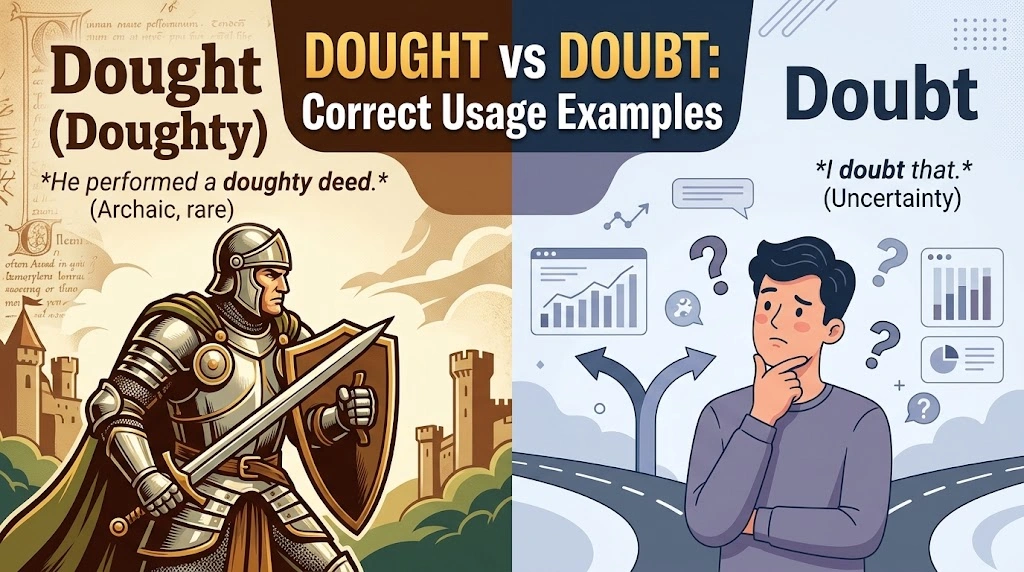
Dought vs Doubt: Correct Usage Examples
The easiest way to understand the distinction is to see doubt working in real sentences.
Expressing Uncertainty
“I doubt that he’ll arrive before noon.”
Here, doubt is a verb.
The speaker believes an event is unlikely.
You could also say:
“I have doubts about whether he’ll arrive before noon.”
The meaning is similar, but the grammar changes.
Questioning a Claim
“The editor doubts the accuracy of the statistic.”
Here, the editor questions whether the statistic is accurate.
This use commonly appears in academic, journalistic, and professional writing.
Using the Noun Form
“She had doubts about the company’s decision.”
Here, doubts is a plural noun.
It refers to uncertainties or reservations about the decision.
Using a Common Idiom
“Without a doubt, she was the strongest candidate.”
The phrase without a doubt means certainly or unquestionably.
Interestingly, the expression uses doubt while communicating the absence of uncertainty.
Formal Writing
“The available evidence casts doubt on the original conclusion.”
This construction is particularly useful in analytical writing.
Cast doubt on means to make something seem less certain, credible, or convincing.
For example:
“The new evidence casts doubt on the earlier theory.”
That’s more precise than simply saying:
“The new evidence is bad.”
The first sentence tells readers exactly what changed: confidence in the earlier conclusion decreased.
Read More: DTM Meaning in Text: What Does DTM Mean in Texting and Social Media?
Common Expressions With “Doubt”
Knowing common phrases can make your writing sound more natural.
Without a Doubt
Meaning: certainly; unquestionably.
“She is without a doubt the most experienced person on the team.”
No Doubt
Meaning: certainly, probably, or clearly depending on context.
“No doubt, the announcement will attract attention.”
The phrase can also suggest an expectation:
“He’ll no doubt hear about it soon.”
Beyond a Reasonable Doubt
This phrase has a specific legal meaning in criminal proceedings in the United States.
It refers to the standard of proof required for a criminal conviction. It does not mean absolute mathematical certainty.
Because this is a legal expression, writers should avoid casually treating it as synonymous with “100% certain.”
In Doubt
Meaning: uncertain or unresolved.
“The future of the project is still in doubt.”
Cast Doubt on
Meaning: make something less believable or certain.
“The conflicting testimony cast doubt on his account.”
Have Doubts About
Meaning: feel uncertain or unconvinced about something.
“Investors had doubts about the company’s expansion plan.”
Doubt as a Noun vs Doubt as a Verb
The spelling doesn’t change when doubt switches grammatical roles.
Its function changes instead.
| Function | Pattern | Example |
| Noun | have doubt(s) | “I have doubts about the plan.” |
| Noun | no/little doubt | “There is little doubt about the result.” |
| Noun | cast doubt on | “The evidence cast doubt on the claim.” |
| Verb | doubt + noun | “I doubt his explanation.” |
| Verb | doubt + clause | “I doubt that he’ll agree.” |
| Verb | doubt whether | “She doubts whether it will work.” |
How to Recognize the Noun
The noun often appears after words such as:
- a
- some
- little
- no
- serious
- reasonable
Examples:
“There is some doubt about the result.”
“She expressed serious doubt about the proposal.”
How to Recognize the Verb
The verb often appears directly before the thing being questioned.
“I doubt his explanation.”
“They doubt the results.”
“She doubts that he’ll agree.”
The grammatical role becomes much easier to recognize once you look at what comes immediately after doubt.
Doubt vs Similar Words
Doubt overlaps with several words that describe uncertainty. They aren’t always interchangeable.
Doubt vs Uncertainty
Uncertainty is the broader term.
It simply means that something isn’t known, settled, or predictable.
Doubt often adds an element of questioning or reduced confidence.
Compare:
“There is uncertainty about the election result.”
This tells you the result isn’t settled.
“There is doubt about the accuracy of the result.”
This suggests that someone questions whether the result is reliable.
Doubt vs Suspicion
Suspicion often suggests a belief that something may be wrong, dishonest, or improper.
“She suspected that he was lying.”
That goes beyond simply lacking certainty.
Doubt vs Skepticism
Skepticism usually describes a questioning attitude toward claims or evidence.
“The scientist approached the extraordinary claim with skepticism.”
Doubt can describe one specific uncertainty. Skepticism can describe a broader intellectual stance.
Doubt vs Disbelief
Disbelief generally goes further than doubt.
If you doubt a claim, you remain uncertain about it.
If you reject it in disbelief, your confidence that it is false may be much stronger.
Doubt vs Hesitation
Hesitation usually concerns whether to act or decide.
Doubt concerns whether something is true, reliable, possible, or likely.
For example:
“Her doubt about the plan made her hesitate.”
Both concepts can appear in the same situation without meaning the same thing.
How to Remember the Correct Spelling of “Doubt”
A few simple associations make doubt much easier to remember.
Remember the Silent B
Think:
doubt = d + ou + b + t
The b is written but not pronounced.
Don’t try to make the pronunciation match every letter.
Connect Doubt With Related Words
Remember its word family:
- doubt
- doubts
- doubted
- doubting
- doubtful
- undoubtedly
- doubtless
Seeing the spelling repeatedly helps reinforce the pattern.
Use “Without a Doubt”
This is one of the easiest memory anchors because the phrase is extremely common.
When you remember:
without a doubt
you automatically retrieve the correct spelling.
Think About Meaning Before Spelling
Ask yourself:
“Am I talking about uncertainty?”
If the answer is yes, choose doubt.
This works better than trying to remember a complicated spelling rule.
Dought vs Doubt: A Simple Decision Guide
When you’re writing and suddenly wonder whether dought or doubt is correct, use this quick process.
Identify the Meaning
If you’re describing uncertainty, skepticism, or lack of confidence, choose:
doubt
Check the Grammatical Role
Ask whether you need a noun or verb.
- “I have doubts.” → noun
- “I doubt it.” → verb
Check the Context
If you’re writing modern English, doubt is the standard form.
If you’re reproducing historical material, investigate the original spelling before changing it.
Use the Standard Modern Spelling
For contemporary communication, write:
“I doubt that it’s true.”
Not:
“I dought that it’s true.”
Read the Sentence Naturally
Finally, read the sentence once.
If it sounds like a modern English sentence but the spelling looks unusual, check the word. A quick dictionary search can prevent an embarrassing typo from reaching publication.
Common Mistakes With “Doubt”
Mistake: Writing “Dought” for Modern Usage
This is the central error.
When you mean uncertainty, use doubt.
Mistake: Pronouncing the B
Don’t pronounce doubt as though it were spelled dowbt.
The standard pronunciation has a silent b.
Mistake: Treating Doubt as the Same as “Don’t Know”
These expressions aren’t identical.
“I don’t know whether he’ll come.”
means you lack the information.
“I doubt he’ll come.”
suggests you think he probably won’t come.
That’s a subtle but important difference.
Mistake: Misunderstanding “Doubt That”
Consider:
“I doubt that she’ll agree.”
This doesn’t normally mean:
“I have no information about whether she’ll agree.”
It communicates skepticism or an expectation that she probably won’t agree.
Context still matters, especially in conversation.
Mistake: Forgetting Related Forms
The spelling remains consistent across the word family:
- doubt
- doubts
- doubted
- doubting
- doubtful
- undoubtedly
Notice that the b remains in these forms even though pronunciation doesn’t make it obvious.
Mistake: Changing Historical Spellings Without Checking
When reproducing an older text, don’t automatically modernize unusual spellings.
Historical spelling can be part of the evidence.
If the purpose is historical analysis, preserving the original form may matter more than making it look contemporary.
How to Use “Doubt” in Different Types of Writing
The word works across almost every major form of English.
In Everyday Conversation
Conversation often uses short, direct forms:
- “I doubt it.”
- “I doubt he’ll come.”
- “There’s no doubt about it.”
- “I have my doubts.”
- “Without a doubt.”
These expressions sound natural because they communicate uncertainty quickly.
In Academic Writing
Academic writers often use doubt when discussing evidence and competing interpretations.
For example:
“These findings cast doubt on the earlier assumption.”
That’s useful because it doesn’t claim the earlier assumption has been completely disproved.
Academic writing benefits from this kind of precision.
Doubt doesn’t necessarily mean rejection. It can simply signal that the available evidence no longer supports strong confidence.
In Professional Writing
Business writing often needs to communicate uncertainty without sounding careless.
Compare:
“I don’t think this deadline is realistic.”
with:
“There is some doubt about whether the proposed deadline is achievable.”
The second sounds more formal and analytical.
However, clarity should still come first. Don’t choose doubt merely to make simple writing sound sophisticated.
In Creative Writing
Authors can use doubt to reveal internal conflict.
For example:
“She trusted the plan until one quiet question began to take root: What if she was wrong?”
That emotional uncertainty can then become:
“Doubt followed her through the empty hallway.”
In creative writing, doubt can describe an intellectual question as well as a deeply personal struggle.
A Practical Case Study: How One Letter Changes the Reader’s Impression
Imagine two versions of the same sentence on a professional website:
“There is no doubt that our process works.”
and
“There is no dought that our process works.”
The meaning is still recoverable. Most readers will understand what the writer intended.
But the second sentence creates friction.
A reader may pause. They may wonder whether the writer knows the standard spelling. In a business context, that tiny interruption can undermine confidence in the surrounding content.
This matters because written communication carries more than literal meaning.
A spelling mistake can become a credibility signal.
That doesn’t mean every typo destroys trust. Humans make mistakes. But repeated errors in an article, report, academic paper, or business proposal can make readers question how carefully the underlying information was prepared.
What This Example Teaches
The lesson isn’t “never make a typo.”
It’s more practical:
When a word has an unusual spelling, verify it instead of relying on pronunciation.
The unusual spelling of doubt makes it especially worth remembering.
Quick Facts About “Doubt”
- Modern spelling: doubt
- Pronunciation: approximately /daʊt/
- Silent letter: b
- Part of speech: noun and verb
- Common noun meaning: uncertainty or lack of confidence
- Common verb meaning: question whether something is true or likely
- Common phrase: without a doubt
- Related adjective: doubtful
- Related adverb: undoubtedly
- Historical origin: connected through French and Middle English to Latin dubitare
- Common spelling error: dought
The most important fact is also the simplest: “dought” should not replace “doubt” in ordinary modern English.
Dought vs Doubt: Quick Reference
| If you want to say… | Use… | Example |
| You question something | doubt | “I doubt his claim.” |
| You feel uncertain | doubt | “I have some doubt.” |
| Something is uncertain | in doubt | “The result remains in doubt.” |
| Something is certainly true | without a doubt | “She is without a doubt qualified.” |
| Evidence weakens a claim | cast doubt on | “The findings cast doubt on the theory.” |
| You describe uncertainty | doubtful | “The outcome seems doubtful.” |
| You mean certainly | undoubtedly | “He is undoubtedly capable.” |
Mini Quiz: Dought vs Doubt
Test yourself before moving on.
Which spelling is correct when you mean uncertainty?
Answer: Doubt
Fill in the blank
“I ______ that he will arrive on time.”
Answer: doubt
Which sentence is correct?
- “I dought his explanation.”
- “I doubt his explanation.”
Answer: “I doubt his explanation.”
Complete the expression
“Without a ______, she made the right decision.”
Answer: doubt
What does “doubt” usually express?
Answer: It usually expresses uncertainty, questioning, skepticism, or lack of confidence.
Which letter is silent in “doubt”?
Answer: B
Is “doubt” both a noun and a verb?
Answer: Yes.
For example:
- Noun: “I have doubts.”
- Verb: “I doubt it.”
Is “dought” the standard modern spelling for uncertainty?
Answer: No.
Historical forms related to dought can occur in older English contexts. Modern standard English uses doubt for this meaning.
Frequently Asked Questions About Dought vs Doubt
Is “Dought” or “Doubt” Correct?
Doubt is correct in modern standard English when you mean uncertainty, skepticism, or lack of confidence.
Dought may appear in historical material, but it isn’t the normal modern spelling for this meaning.
What Does “Doubt” Mean?
Doubt means uncertainty or a lack of confidence about something.
As a verb, it means to question whether something is true, reliable, possible, or likely.
Is “Dought” a Word?
Historical English contains forms related to dought, so calling it simply a meaningless collection of letters isn’t accurate.
However, dought isn’t the standard modern spelling of the word meaning uncertainty. Contemporary writers should normally use doubt.
Why Is the B Silent in “Doubt”?
The spelling reflects the word’s historical development and later Latin influence.
The word ultimately connects to Latin dubitare. The written b became part of the English spelling even though modern pronunciation doesn’t retain that consonant sound.
How Do You Pronounce “Doubt”?
Doubt is pronounced approximately /daʊt/.
It sounds like “dowt.”
The b is silent.
Can “Doubt” Be Used as Both a Noun and a Verb?
Yes.
As a noun:
“I have some doubt about the proposal.”
As a verb:
“I doubt the proposal will succeed.”
What Is Another Word for “Doubt”?
Depending on the context, possible alternatives include:
- uncertainty
- skepticism
- suspicion
- disbelief
- hesitation
- reservation
- distrust
These aren’t perfect substitutes in every sentence.
For example, skepticism can describe a general questioning attitude, while uncertainty doesn’t necessarily imply skepticism.
Is “Dought” Used in Modern English?
Not as the standard spelling for uncertainty.
You may encounter historical forms in older English sources or discussions of language history. Modern readers generally expect doubt.
Does “Doubt” Always Mean You Think Something Is False?
No.
Doubt often indicates uncertainty rather than absolute rejection.
If you say:
“I doubt that he’ll win.”
you’re expressing skepticism about his chances.
You aren’t necessarily claiming that victory is impossible.
Final Takeaway: Dought vs Doubt
The dought vs doubt question has a simple modern answer.
When you mean uncertainty, hesitation, skepticism, or lack of confidence, use doubt.
The spelling contains a silent b, which is why the word can seem strange when you first encounter it. Its unusual spelling also reflects centuries of linguistic development, including influence from its Latin ancestry.
Dought may appear in historical English contexts or discussions of older spelling. That doesn’t make it the standard modern replacement for doubt.
Keep these examples in mind:
I doubt his explanation.
She has doubts about the plan.
Without a doubt, they made the right decision.
The evidence casts doubt on the original claim.
When in doubt, remember the word that contains the silent letter:
D-O-U-B-T.
That’s the spelling modern English expects.