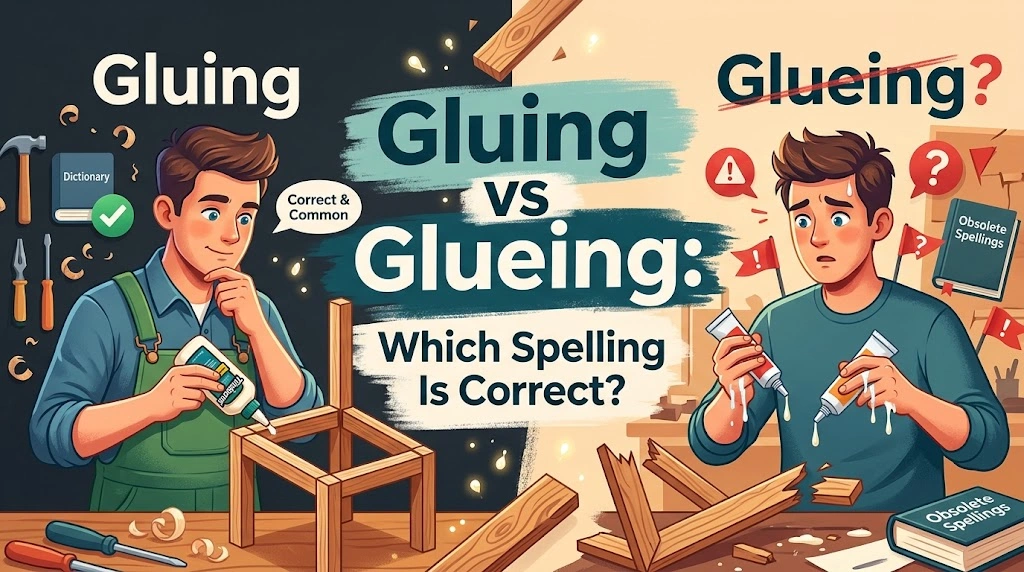
If you’ve ever hesitated between gluing and glueing, you’re not alone. The two spellings look nearly identical, yet only one is the standard choice in modern English. That extra e creates more confusion than you’d expect, particularly when you’re writing an essay, instruction, blog post, or professional document.
The correct spelling is gluing. It is the standard -ing form of glue, meaning to attach or join something with an adhesive. The spelling follows a familiar English pattern: when many verbs end in a silent e, that final letter disappears before -ing. That’s why we write make → making, write → writing, and glue → gluing.
But what about glueing? You may still encounter this spelling in real-world writing, older material, or less common usage. It doesn’t represent a different action or meaning. Instead, it is a less-preferred spelling variant.
Understanding the difference between gluing vs glueing helps you avoid unnecessary spelling mistakes. Whether you’re preparing a school assignment, writing DIY instructions, creating technical content, or simply checking a sentence, gluing is the safest standard form to use.
Gluing vs Glueing: The Quick Answer
If you’re wondering whether to write gluing or glueing, use gluing.
Here’s the distinction at a glance:
| Spelling | Status | Meaning |
| Gluing | Standard and preferred | Attaching something with glue |
| Glueing | Less common variant | The same basic meaning |
Gluing vs Glueing at a Glance
Consider these sentences:
She is gluing the pieces together.
The technician is gluing the damaged component back into place.
In both examples, gluing describes an action involving glue.
The spelling follows the usual English pattern in which a final silent e disappears before the suffix -ing.
Other familiar examples include:
- make → making
- bake → baking
- write → writing
- take → taking
- use → using
- glue → gluing
The important point is that the spelling changes while the underlying meaning stays the same.
Which Spelling Should You Use?
For ordinary modern writing, choose gluing.
It’s the better default for:
- School assignments
- College essays
- Business writing
- Technical documentation
- DIY instructions
- Craft tutorials
- Websites and blogs
- Product instructions
- Professional correspondence
If you see glueing somewhere, don’t assume the writer means something different. The extra e doesn’t create a new definition.
What Does “Gluing” Mean?
Gluing is the -ing form of the verb glue.
The verb glue means to join or attach something using glue or another adhesive. Depending on context, it can describe anything from sticking pieces of paper together to bonding materials during manufacturing.
For example:
- I’m gluing the cardboard pieces together.
- He spent the afternoon gluing the broken model.
- The workers are gluing the panels into position.
- She is gluing a photograph into her scrapbook.
The exact object changes, but the central idea remains the same: something is being attached with an adhesive.
Gluing as the -ing Form of “Glue”
English verbs can take -ing to create forms that describe ongoing actions or function as nouns.
The base verb is:
glue
Add -ing after applying the appropriate spelling rule:
glue → gluing
The resulting word can fit into several grammatical structures.
For instance:
They are gluing the pieces together.
Here, gluing helps form the present progressive construction are gluing.
The action is underway.
Gluing as a Present Participle
A present participle is the -ing form of a verb. It often appears with a form of be to create progressive verb constructions.
Look at these examples:
- I am gluing the label onto the box.
- She is gluing the tiles together.
- They were gluing decorations onto the poster.
- We have been gluing the components into place.
In each sentence, gluing describes an action.
Notice how the auxiliary verb changes while gluing remains the same.
She is gluing.
They were gluing.
We have been gluing.
The grammatical structure changes. The spelling of gluing doesn’t.
Gluing as a Gerund
The same -ing form can also function as a gerund.
A gerund is an -ing form that functions grammatically as a noun.
For example:
Gluing requires patience.
Here, gluing isn’t describing what someone is currently doing. Instead, it names an activity.
Compare that with:
Maria is gluing the pieces together.
In this sentence, gluing forms part of the verb phrase.
That’s an important distinction because the spelling remains identical even though the grammatical function changes.
More examples include:
- Gluing the pieces incorrectly can ruin the project.
- I enjoy gluing paper models together.
- Careful gluing produces a cleaner finish.
- Gluing wood requires the right adhesive and surface preparation.
Gluing in Different Contexts
The word appears in many practical settings.
Crafting:
She is gluing sequins onto the card.
DIY:
He’s gluing the loose trim back onto the cabinet.
Woodworking:
The carpenter is gluing two boards together.
Manufacturing:
The machine applies adhesive before gluing the components.
Schoolwork:
The students are gluing pictures onto their science posters.
So, gluing isn’t limited to arts and crafts. It can describe a wide range of bonding processes.
Why Is It “Gluing” Instead of “Glueing”?
The spelling comes from a common English spelling convention involving silent e.
When many verbs end in a final silent e, that letter disappears before -ing.
This gives us patterns such as:
- hope → hoping
- drive → driving
- save → saving
- move → moving
- write → writing
- glue → gluing
The final e isn’t simply deleted at random. It reflects a broader spelling pattern used to form many English -ing words.
The Silent-E Rule
A useful general rule is:
When a verb ends in a silent e, the e is usually dropped before -ing.
Examples make the pattern easier to recognize.
| Base verb | Correct -ing form |
| make | making |
| bake | baking |
| write | writing |
| drive | driving |
| take | taking |
| use | using |
| close | closing |
| glue | gluing |
The rule helps explain why gluing looks different from the base word glue.
However, English spelling rules aren’t mathematical laws. Exceptions exist, and some words require individual attention.
That’s why it’s better to think of the silent-e pattern as a strong spelling convention, rather than an exception-proof formula.
Applying the Rule to “Glue”
Start with the base verb:
GLUE
Now add -ing.
If you kept every letter mechanically, you’d get:
GLUE + ING = GLUEING
But standard spelling applies the silent-e convention:
GLUE → GLU + ING
The result is:
GLUING
That form may look slightly unusual at first. Once you recognize the pattern, though, it becomes easier to remember.
Why “Glueing” Looks Plausible
The confusion is understandable.
If you simply attach -ing to the written form glue, the result appears to be glueing. English learners often use this kind of direct attachment when forming new words.
The pronunciation can add to the uncertainty. The word glue already contains a distinctive vowel combination, so removing the e may initially look strange.
Compare:
glue → gluing
with:
blue → bluing
The spelling feels less intuitive than glue + ing. Yet gluing follows the established spelling pattern.
This is one of those cases where English spelling asks you to trust the convention rather than the visual appearance of the base word.
Is “Glueing” Wrong?
The answer needs a little nuance.
Gluing is the standard and preferred spelling. However, glueing can be found in real English usage.
That distinction matters.
Calling every occurrence of glueing an incomprehensible or meaningless error would go too far. Variant spellings can appear in historical sources, dictionaries, publications, or personal writing.
Still, if you’re deciding which form to use yourself, gluing is the safer and more widely accepted choice.
Why “Glueing” Appears in English
English has accumulated spelling variations over centuries.
Words don’t always change in a perfectly tidy fashion. Dictionaries record actual usage, historical forms, regional preferences, and established variants.
As a result, readers may encounter glueing even though gluing is the preferred modern spelling.
You might find the less common form in:
- Older texts
- User-generated content
- Informal writing
- Publications using particular editorial conventions
- Search queries
- Material written by non-native English speakers
- Sources that preserve variant spellings
Seeing a word in print doesn’t automatically make that spelling the best choice for every context.
Why “Gluing” Is the Better Default
Gluing offers the simplest choice for modern writers.
It follows the standard spelling convention and avoids distracting readers who expect the conventional form.
That matters particularly in formal writing.
Imagine reading an instruction manual that says:
Start by glueing the two surfaces together.
The meaning is perfectly understandable. Yet many readers may pause at glueing because gluing is more familiar.
That tiny pause is unnecessary.
Clear writing should remove friction whenever possible.
Does “Glueing” Have a Different Meaning?
No.
The extra e doesn’t turn glueing into a separate grammatical concept.
Both forms refer to the process or action of using glue to attach something.
Compare:
She is gluing the pieces together.
and:
She is glueing the pieces together.
The intended meaning is essentially the same. The difference lies in spelling preference, not meaning.
Read More: Imbed vs Embed: Which Spelling Is Correct? Meaning, Usage, Examples, and Grammar
Gluing vs Glueing in American and British English
One common misconception deserves special attention: the idea that gluing is American while glueing is British.
That’s too simplistic.
British and American English have many well-known spelling differences. For example, color/colour, center/centre, and organize/organise can vary by variety and style.
Gluing vs glueing doesn’t fit neatly into that famous pattern.
American English
In standard American English, gluing is the preferred spelling.
Examples:
- I’m gluing the broken handle back together.
- The students are gluing their projects together.
- Gluing the pieces requires a steady hand.
If you’re writing for a US audience, gluing is the straightforward choice.
British English
British English also uses gluing as the standard form.
The existence of glueing doesn’t establish it as the normal British equivalent.
That’s an important distinction because writers sometimes assume that every unusual spelling ending in -e must represent British English.
It doesn’t.
Other Varieties of English
English is used across many regions, and individual writers may encounter or use variants.
Nevertheless, gluing is the most useful standard form when you want broadly recognizable English.
If you’re writing for an international audience, choosing the familiar standard spelling helps prevent needless distraction.
Regional Usage at a Glance
| Variety | Recommended spelling |
| American English | Gluing |
| British English | Gluing |
| International English | Gluing |
Regional spelling preferences can be complicated in English. In this particular case, however, the practical recommendation is simple.
Use gluing.
How to Use “Gluing” Correctly in a Sentence
Knowing the spelling isn’t enough. You also need to understand how gluing functions in actual sentences.
The word can describe an ongoing action, name an activity, or appear inside more complex constructions.
Everyday Examples
Here are some natural examples:
- I’m gluing the torn pages back together.
- She is gluing beads onto the fabric.
- We’re gluing the cardboard pieces together.
- He spent an hour gluing the model airplane.
- The children are gluing shapes onto colored paper.
These examples use gluing to describe practical activities.
Academic and School Examples
In school writing, precision matters.
For example:
The students are gluing photographs onto their presentation boards.
Or:
Gluing the materials together created a stronger model.
The first sentence uses gluing as part of a progressive verb phrase. The second uses it as a gerund.
Professional and Technical Examples
The word also appears in technical contexts:
The operator is gluing the protective layer to the surface.
The manufacturing process involves gluing several components together.
Proper surface preparation improves the quality of the gluing process.
Technical writing often requires greater precision because adhesives differ according to material, temperature, curing method, and intended use.
For that reason, gluing may appear alongside terms such as adhesive, bonding, substrate, curing, and application.
Figurative or Extended Uses
Gluing can occasionally appear in figurative language.
For example:
The two groups were glued together by a shared goal.
However, writers often use glued more naturally than gluing in figurative expressions.
A familiar phrase is:
He was glued to the television.
That expression means someone was watching television with intense attention.
The important lesson is simple: don’t force a figurative use merely to include the target word. Natural language always comes first.
Gluing vs Glueing in Formal Writing
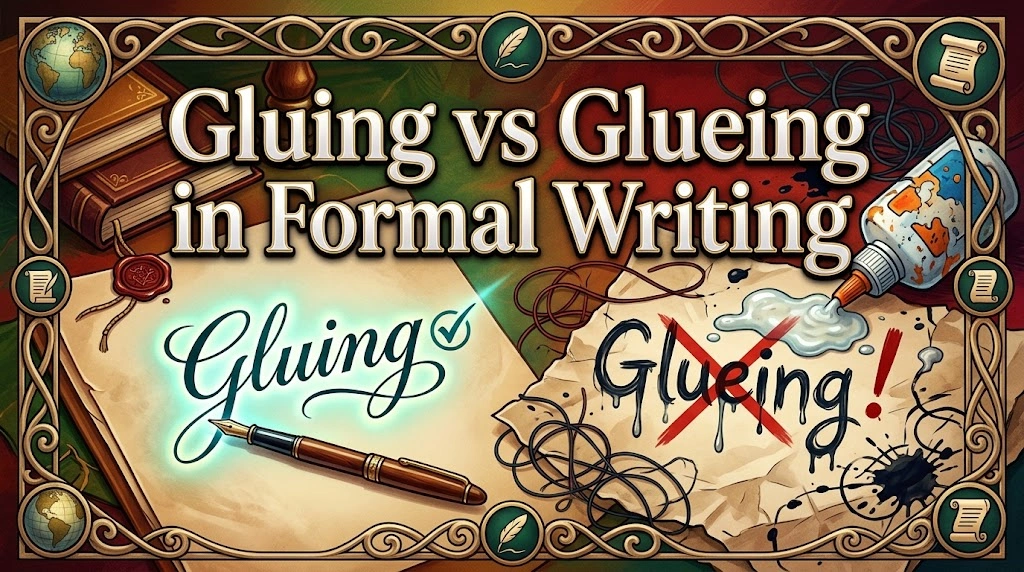
Formal writing benefits from standard spelling.
That doesn’t mean every unusual variant is automatically unacceptable. It means you should generally choose the form that readers recognize as conventional unless you have a specific reason not to.
Which Form Should You Use in an Essay?
Use gluing.
For example:
The experiment involved gluing the two materials together before testing their strength.
That’s clear, conventional, and grammatically sound.
Writing glueing instead may cause a teacher, editor, or reader to question the spelling. Even when they understand your meaning, you’ve introduced a distraction that serves no purpose.
Which Form Should You Use in Professional Content?
Again, gluing is the practical choice.
This applies to:
- Technical manuals
- Product descriptions
- Assembly instructions
- Business reports
- Training materials
- Educational content
- Websites
- Blog posts
- Marketing copy
Consistency matters even more when multiple people contribute to the same document.
A technical manual that alternates between gluing and glueing can look poorly edited.
What If You Quote a Source That Says “Glueing”?
That’s different.
If you’re quoting a historical document or another source directly, preserving its original wording may be appropriate.
For example:
The original document uses the spelling “glueing.”
Here, you’re discussing the source rather than adopting its spelling.
The distinction is important:
Your writing: use gluing.
A direct quotation: preserve the source’s wording when accuracy requires it.
Common Mistakes With Gluing and Glueing
The spelling issue creates several predictable mistakes.
Mistake: Assuming Both Spellings Have Different Meanings
They don’t.
The difference is primarily orthographic. The extra e doesn’t create another type of adhesive action.
Mistake: Keeping the E Automatically
Some writers think:
glue + ing = glueing
That approach treats suffixation as simple letter attachment.
English spelling doesn’t always work that way.
The standard form is:
glue → gluing
Mistake: Assuming “Glueing” Must Be British English
This assumption has little basis.
British English does have many spelling differences from American English. Gluing isn’t a good example of one.
Mistake: Switching Between Both Spellings
Consistency improves credibility.
If one paragraph says gluing while another says glueing, readers may wonder whether the writer intended a distinction.
Choose one standard form and stick with it.
Mistake: Applying Every Silent-E Rule Without Checking
Spelling rules are useful. They’re not infallible algorithms.
English contains exceptions and words with different historical patterns. You shouldn’t assume that every verb ending in e behaves identically in every grammatical form.
The safest approach combines:
- The general spelling rule
- Familiar word patterns
- Standard dictionary usage
- Context
The Grammar and Spelling Rule Behind “Gluing”
The key spelling principle is simple: many verbs ending in silent e drop that e before -ing.
What Happens When a Verb Ends in Silent E?
Consider these transformations:
- hope → hoping
- ride → riding
- write → writing
- make → making
- save → saving
The same basic pattern applies to glue:
glue → gluing
The spelling change doesn’t alter the word’s basic identity. It simply creates the conventional -ing form.
Examples of the Same Pattern
| Base verb | Standard -ing form |
| hope | hoping |
| make | making |
| take | taking |
| write | writing |
| drive | driving |
| use | using |
| move | moving |
| glue | gluing |
This table reveals why glueing stands out.
The standard pattern isn’t:
Keep every letter + add -ing
Instead, many silent-e verbs undergo a spelling adjustment first.
Important Exceptions and Different Spelling Patterns
English has exceptions to many spelling rules.
For example, be → being doesn’t become bing. The word see becomes seeing, not seing. These forms reflect different spelling and pronunciation patterns.
That’s why memorizing a single rule without context can lead you astray.
For glue, though, the standard form is well established:
glue → gluing
An Easy Way to Remember “Gluing”
Think of the transformation as a three-part sequence:
GLUE → remove silent E → add ING → GLUING
Or simply remember this pair:
glue → gluing
The visual relationship becomes familiar after you see it several times.
A useful mental comparison is:
make → making
glue → gluing
Both remove the final e before -ing.
A Real-Life Writing Example: Why One Extra Letter Creates Doubt
Imagine you’re preparing instructions for a children’s craft kit.
One version says:
Step 3: Begin gluing the paper shapes to the cardboard.
Another says:
Step 3: Begin glueing the paper shapes to the cardboard.
Most readers will understand both sentences immediately.
Yet the first version looks more familiar to many modern English readers. The second may trigger a quick spelling check.
That moment matters in professional communication.
Good instructional writing should feel effortless. Readers should focus on the task, not wonder whether the writer has made a spelling mistake.
This is especially important when you’re publishing content for a broad audience. A standard form minimizes unnecessary friction.
Gluing vs Glueing: Why Consistency Matters
Spelling consistency isn’t merely cosmetic.
When readers encounter inconsistent terminology, they may wonder whether two forms carry different meanings.
For example, suppose a technical guide says:
The technician starts by gluing the panel.
Later, it says:
After glueing, allow the adhesive to cure.
A knowledgeable reader can understand the intended meaning. Still, the variation looks accidental.
A Simple Writing Checklist
Before publishing content that uses the word, check:
- Did you write “gluing” consistently?
- Did you accidentally retain the final e?
- Are quoted sources being preserved accurately?
- Does your style guide specify a preferred dictionary?
- Have you avoided implying that the two spellings have different meanings?
That’s enough for most situations.
What About SEO Writing?
Search optimization doesn’t require you to use every spelling variant as though it were standard.
If your target keyword is gluing vs glueing, naturally mentioning both forms makes sense because the article is specifically answering that comparison.
However, the body should still use the preferred spelling where appropriate.
For example:
Gluing is the standard spelling, while glueing is a less common variant that readers may encounter.
That’s useful SEO writing because it satisfies the search intent without sacrificing linguistic accuracy.
Gluing vs Glueing in Search Queries and Everyday Writing
People often search for “gluing vs glueing” precisely because the difference is confusing.
Search behavior can reveal what people are uncertain about. It doesn’t necessarily tell you which spelling is correct.
Why People Search for “Glueing”
The spelling glueing looks logical if someone simply adds -ing to glue.
A learner might reason:
glue + ing = glueing
That’s perfectly understandable as a first attempt.
English spelling, however, follows established conventions rather than pure letter-by-letter logic.
Should You Use “Glueing” for SEO?
If you’re writing an article specifically about gluing vs glueing, you can mention glueing naturally.
You don’t need to distort the article by repeating the less common spelling dozens of times.
A good approach is:
- Use gluing when referring to the standard form.
- Use glueing when discussing the variant.
- Include the comparison in headings where it helps search intent.
- Answer the spelling question early.
- Don’t stuff either keyword unnaturally.
Search engines increasingly reward useful content that satisfies the reader’s actual question. Keyword repetition isn’t a substitute for clarity.
Gluing vs Glueing: Real-World Examples
Context makes spelling rules easier to remember.
In Craft Instructions
Apply a thin layer of adhesive before gluing the paper pieces together.
Allow the glue to dry completely after gluing the decorations in place.
Both examples use gluing naturally.
In DIY Instructions
Clean the surface before gluing the loose trim back into position.
This sentence also demonstrates why precise instructions matter. The spelling is only one small part of effective technical communication.
In Technical Instructions
The operator checks the surface before gluing the component into the housing.
Here, gluing describes a specific manufacturing step.
In Formal Writing
Gluing the samples together changed the structure of the test specimen.
The word works perfectly well in formal prose when the activity itself is relevant.
Gluing vs Glueing: Quick Reference Table
| Question | Answer |
| What is the standard spelling? | Gluing |
| What is the base verb? | Glue |
| What is the -ing form? | Gluing |
| Why does the e disappear? | The final silent e is dropped before -ing |
| Is glueing understandable? | Yes |
| Is glueing the preferred modern spelling? | No |
| Do the two spellings have different meanings? | No |
| Should you use gluing in an essay? | Yes |
| Should you use gluing in professional writing? | Yes |
| Is gluing limited to American English? | No |
Gluing vs Glueing: Mini Case Study
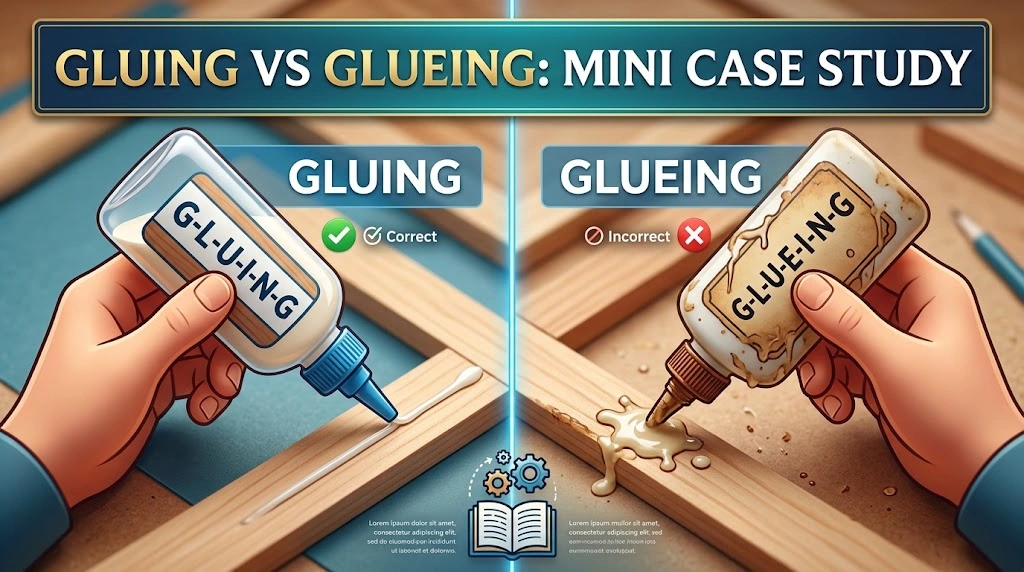
Consider two writers preparing a woodworking guide.
Writer A writes:
After measuring the boards, begin gluing the joints.
Writer B writes:
After measuring the boards, begin glueing the joints.
The practical instructions remain understandable in both versions.
However, Writer A uses the standard spelling. Writer B uses a variant that many readers may perceive as unusual.
Now imagine the guide contains fifty references to the process. Repeatedly using glueing could make the document look inconsistent with other professional material.
The lesson isn’t that one extra letter destroys communication.
It doesn’t.
The lesson is that standard spelling reduces unnecessary reader hesitation.
That’s especially valuable in educational, technical, and professional writing where precision carries weight.
Facts About the Word “Gluing”
A few basic facts make the distinction easier to understand:
- Gluing comes from the verb glue.
- It is the standard -ing form of that verb.
- The final e is dropped before -ing.
- Gluing can function as a present participle.
- Gluing can also function as a gerund.
- Glueing may appear as a variant spelling.
- The two spellings don’t represent separate meanings.
- Gluing is the safer choice for formal and general writing.
These facts answer the question without turning a simple spelling issue into a maze of unnecessary terminology.
Gluing vs Glueing: A Practical Decision Guide
When you’re unsure, use this quick process.
Start With the Base Verb
Identify the verb:
glue
You’re forming its -ing form.
Apply the Standard Pattern
Drop the final silent e and add -ing:
glue → gluing
Consider Your Audience
If you’re writing for students, customers, colleagues, editors, or a general online audience, the standard spelling is usually best.
Follow Your Style Guide
Some organizations use specific dictionaries or editorial guides.
If your workplace, publisher, university, or publication has a required style authority, follow it consistently.
Use the Simple Default
When no special requirement exists, choose:
gluing
That’s the easiest answer and the one most writers need.
Common Questions About Gluing and Glueing
Is “gluing” or “glueing” correct?
Gluing is the standard and preferred spelling.
Glueing can be encountered as a variant, but it’s not the usual choice for modern general writing.
Why is “gluing” spelled without an E?
Because glue ends with a final e, and many English verbs drop that silent e before -ing.
Thus:
glue → gluing
The same general pattern appears in words such as make → making and write → writing.
Is “glueing” wrong in British English?
It’s inaccurate to describe glueing simply as the British version of gluing.
Gluing is the standard form used in both American and British English.
Is “gluing” a verb or a noun?
It can function as either part of a verb construction or as a gerund.
In:
She is gluing the pieces.
gluing is part of the verb phrase.
In:
Gluing requires patience.
gluing functions as a noun-like gerund.
Should I use “gluing” in an essay?
Yes.
Gluing is the recommended spelling for an essay unless you’re quoting a source that uses another spelling.
Does gluing have a different meaning from glueing?
No.
The spelling difference doesn’t create a separate meaning. Both refer to the action or process of using glue to attach something.
How do you spell the -ing form of glue?
The standard spelling is:
gluing
Not glueing.
What is the past tense of glue?
The standard past tense and past participle are glued.
For example:
She glued the pieces together yesterday.
This is separate from the -ing spelling issue.
Final Verdict: Gluing vs Glueing
When choosing between gluing vs glueing, there’s a clear winner for standard modern writing:
Gluing
Gluing is the standard -ing form of glue. It follows the common spelling pattern in which a final silent e is dropped before -ing.
The form glueing may appear in real-world English, but its existence doesn’t make it the preferred spelling. It also doesn’t carry a different meaning.
So when you’re writing an essay, instruction, report, blog post, technical document, or everyday message, use gluing.
The easiest rule to remember is:
glue + -ing → gluing
One small spelling decision can save readers a moment of doubt. When the standard form is this straightforward, there’s little reason to add the extra e.