Weiner or Wiener can be confusing because the two words look almost identical and are often pronounced similarly. A single letter changes their spelling, yet that small difference can change what the word means.
If you’re talking about a sausage, wiener is the standard spelling. If you’re writing someone’s surname, however, Weiner can be completely correct. The key is context.
The confusion becomes even more interesting because Wiener has a connection to Vienna. In German, Vienna is called Wien, and Wiener means something associated with Vienna. The word later became established in English food vocabulary.
Meanwhile, Weiner exists primarily as a surname. It isn’t simply an alternative spelling you can freely substitute for wiener when discussing food.
So, which one should you use? Let’s break down the difference carefully.
What Is the Difference Between Weiner and Wiener?
The main difference between Weiner and Wiener comes down to meaning and context.
Wiener is an established English word. It commonly refers to a type of sausage or hot dog. It can also describe something associated with Vienna, especially in historical or culinary expressions. Wiener is also used as a surname.
Weiner, on the other hand, is primarily encountered as a family name. Someone whose surname is Weiner should have their name written exactly that way.
Here’s the basic distinction:
| Word | Common use | Example |
| wiener | Sausage or hot dog | I ordered a grilled wiener. |
| Wiener | Something associated with Vienna | The dish has Wiener origins. |
| Wiener | Family name | Professor Wiener published the paper. |
| Weiner | Family name | Ms. Weiner joined the meeting. |
| weiner | Common misspelling of wiener | He accidentally typed “weiner.” |
The most important rule is simple:
Use “wiener” for the food unless you’re referring to a specific proper name.
If you’re writing a person’s surname, don’t change Weiner to Wiener just because the latter is a familiar word.
Quick Answer: Weiner or Wiener?
If you’re referring to the food, wiener is the correct spelling.
For example:
- We bought two wieners for the barbecue.
- The restaurant serves grilled wieners.
- He ordered a wiener with mustard.
If you’re referring to someone’s surname, either spelling can be correct.
For example:
- The author’s name is Weiner.
- The scientist’s surname is Wiener.
The spelling of a person’s name depends on that person’s actual name. You shouldn’t “correct” a surname simply because another spelling looks more familiar.
Why Do People Confuse Weiner and Wiener?
The confusion isn’t surprising. The two spellings differ by only one letter.
Similar Pronunciation
In ordinary American English, wiener and Weiner can sound very similar. When people hear a word rather than see it written, they don’t get any visual clue about whether the middle letters are ie or ei.
That creates a classic spelling problem.
You might hear someone say the word and mentally write:
“Weiner.”
The intended spelling may actually be:
“Wiener.”
Pronunciation alone doesn’t always reveal spelling. English contains many words whose sounds provide little help with their written forms.
Typing Habits
People also make simple transposition errors while typing.
The letters i and e appear next to each other in both versions. When someone types quickly, reversing their order is easy.
The problem becomes more noticeable online because people often write quickly and rely heavily on automatic spelling tools.
Surname Recognition
Weiner is a genuine surname. That makes the situation slightly different from an ordinary misspelling.
A spell-checker may recognize Weiner as a valid name. It therefore might not flag the word, even when the writer intended to describe a sausage.
For example, consider this sentence:
We grilled several weiners for dinner.
A person may have intended wieners, but software can’t always determine that from the surrounding sentence.
Internet Searches
Search engines also encounter both spellings frequently. A search for one spelling may return results involving the other because search systems often try to understand user intent.
That doesn’t mean the two spellings are interchangeable.
Search behavior and dictionary usage are two different things.
What Does “Wiener” Mean?
The word wiener has several related uses. Its history helps explain why.
Wiener as a Type of Sausage
In American English, a wiener can refer to a small sausage, particularly one served as a hot dog.
You might encounter the word on restaurant menus, in recipes, at cookouts, or in casual conversation.
Examples include:
- We grilled some wieners for lunch.
- She put the wiener in a toasted bun.
- The children wanted hot dogs and wieners.
- Add the cooked wieners to the buns before serving.
The exact relationship between wiener, frankfurter, and hot dog can vary by region and context. American food terminology isn’t perfectly uniform.
Wiener as Something From Vienna
The word has a geographic connection as well.
Wien is the German name for Vienna, the capital of Austria. The German adjective Wiener means “Viennese” or “of Vienna.”
This connection explains why Wiener appears in names associated with Viennese food and culture.
The word therefore isn’t merely an arbitrary spelling for a sausage. Its history is tied to Vienna.
Wiener as a Family Name
Wiener is also a surname.
That means capitalization and context matter.
Compare these sentences:
We ate a wiener at the baseball game.
Here, wiener is a common noun.
Professor Wiener wrote the article.
Here, Wiener is a proper name.
The spelling happens to be identical, but the grammatical function is different.
Is “Weiner” Ever Correct?

Yes. Weiner can absolutely be correct when it is someone’s established surname.
That’s an important distinction.
Weiner as a Family Name
A person’s surname is not something you should alter based on a spelling rule.
Suppose someone’s legal or established family name is Weiner. Writing Wiener instead would change their name.
For example:
Sarah Weiner spoke at the conference.
You shouldn’t change it to:
Sarah Wiener spoke at the conference.
unless that is actually her surname.
The same principle applies to names such as Smith, Smyth, Johnson, and Johnston. Similar-looking names aren’t interchangeable.
Weiner as a Misspelling
When someone writes weiner while talking about food, the word is generally a misspelling of wiener.
For example:
Incorrect: We grilled three weiners.
A standard correction would be:
Correct: We grilled three wieners.
The plural is formed by adding -s, just as with many other English nouns.
Correct and Incorrect Examples
| Sentence | Status | Reason |
| We cooked three wieners. | Correct | Food term |
| The restaurant sells wieners. | Correct | Food term |
| Weiner is her surname. | Correct | Proper name |
| Wiener is his surname. | Correct | Proper name |
| We ate two weiners. | Usually incorrect | Intended food spelling is wieners |
| Please grill the weiner. | Usually incorrect | Intended food spelling is wiener |
The context determines whether Weiner is a name or a mistaken spelling.
Common Contexts Where “Wiener” Is Used
The word appears in more places than casual conversations about hot dogs.
Food and Cooking
You’ll find wiener in recipes, restaurant descriptions, grocery products, and informal food writing.
For example:
Place the cooked wiener inside the toasted bun.
The term can sound more traditional or regional than simply saying hot dog.
Food terminology also varies considerably across English-speaking regions. One writer may use hot dog, another may use frankfurter, and another may use wiener.
Historical References
The Vienna connection gives Wiener a historical and cultural dimension.
Terms containing Wiener can refer to things associated with Vienna or Viennese traditions. In these cases, understanding the German word Wien makes the spelling easier to remember.
Dictionaries
Major English dictionaries recognize wiener as an English word. Dictionary entries generally identify its food-related meaning and its connection with Vienna.
When you’re unsure about an unfamiliar spelling, a reputable dictionary is more reliable than a social-media post or a random search result.
Read More: Choose vs Chose: What’s the Difference and How to Use Them?
The Origin and History of “Wiener”
The history of wiener explains much of the spelling.
The German name for Vienna is Wien. From that name comes Wiener, meaning something associated with Vienna.
The word became connected with sausage terminology through the expression Wiener Wurst, literally referring to a Viennese sausage. English later adopted wiener as a food term.
This history gives you a useful memory connection:
Wien → Wiener → Vienna
Once you understand that relationship, the spelling becomes easier to remember.
Timeline of the Word “Wiener”
A simplified history looks like this:
| Period | Development |
| Earlier German usage | Wien is the German name for Vienna |
| German adjective | Wiener develops the sense “Viennese” or “from Vienna” |
| Sausage terminology | Wiener Wurst becomes associated with Viennese sausage |
| English adoption | wiener enters English food vocabulary |
| Modern American English | wiener is commonly used for a sausage or hot dog |
The exact history of sausage terminology is more complicated than this simplified timeline. Different regions developed overlapping terms for similar foods.
Still, the Wien/Vienna connection is the key fact for understanding the spelling.
Why Do People Spell Wiener as Weiner?
There isn’t one single reason.
Several factors can contribute to the mistake.
The “I Before E” Rule Isn’t Always Helpful
Many English speakers learn a spelling guideline involving i and e:
“I before E except after C.”
It’s useful in some words, but English has plenty of exceptions. It shouldn’t be treated as an absolute rule.
In wiener, the spelling comes from the word’s linguistic history rather than from a simple English spelling formula.
Trying to solve every spelling question with a memorized rhyme can therefore lead you astray.
Pronunciation Doesn’t Reveal the Correct Spelling
Someone saying wiener doesn’t visually distinguish the spelling from Weiner.
That’s why listening isn’t enough.
If you encounter the word in writing, look at the context. If you hear it aloud, confirm the spelling when accuracy matters.
Autocorrect Doesn’t Always Catch It
Modern spelling software isn’t a perfect grammar teacher.
Because Weiner exists as a surname, a spell-checker may consider it a valid word. It can’t always know that you intended the food term wiener.
This is a broader lesson about automated writing tools:
A word can be spelled correctly while still being wrong for the sentence.
Weiner vs. Wiener: Side-by-Side Comparison
| Feature | Wiener | Weiner |
| Standard food term | Yes | No |
| Can refer to a sausage | Yes | No, unless it’s part of a proper name |
| Connected with Vienna | Yes | Not simply as an alternative spelling |
| Can be a surname | Yes | Yes |
| Common spelling mistake | No | Yes, when intended to mean wiener |
| Capitalized as a common noun | Usually no | Not applicable |
| Capitalized as a surname | Yes | Yes |
This table captures the central distinction.
Wiener has established common-word meanings. Weiner is primarily relevant as a proper surname.
How to Use Wiener Correctly in Sentences
Understanding the definition is useful. Seeing the word in context makes the difference much clearer.
Food Examples
We grilled several wieners for the family barbecue.
The vendor served a wiener with mustard and onions.
She ordered a cheese-covered wiener at the stadium.
These wieners taste better when they’re grilled.
Notice that the lowercase spelling works because the word functions as an ordinary food noun.
Cultural Examples
The term Wiener reflects the word’s connection with Vienna.
The restaurant specializes in traditional Viennese dishes.
When Wiener forms part of a proper name or established expression, capitalization may depend on the specific term and context.
Name Examples
Professor Wiener gave a lecture.
The report was written by Dr. Weiner.
In these sentences, the spelling belongs to the person’s surname. Don’t change it based on the food word.
How to Use Weiner Correctly in a Sentence
Using Weiner as a Surname
Weiner is correct when it accurately represents someone’s surname.
Examples:
David Weiner joined the research team.
The article was written by Weiner and his colleagues.
Ms. Weiner spoke during the interview.
The capital W signals that you’re dealing with a proper name.
Using Weiner as a Food Word
If you mean the sausage, use wiener.
For example:
Incorrect: We bought five weiners.
Correct: We bought five wieners.
The difference may seem tiny, but correct spelling matters in published writing, educational work, menus, and professional communication.
Wiener or Weiner: Common Mistakes to Avoid
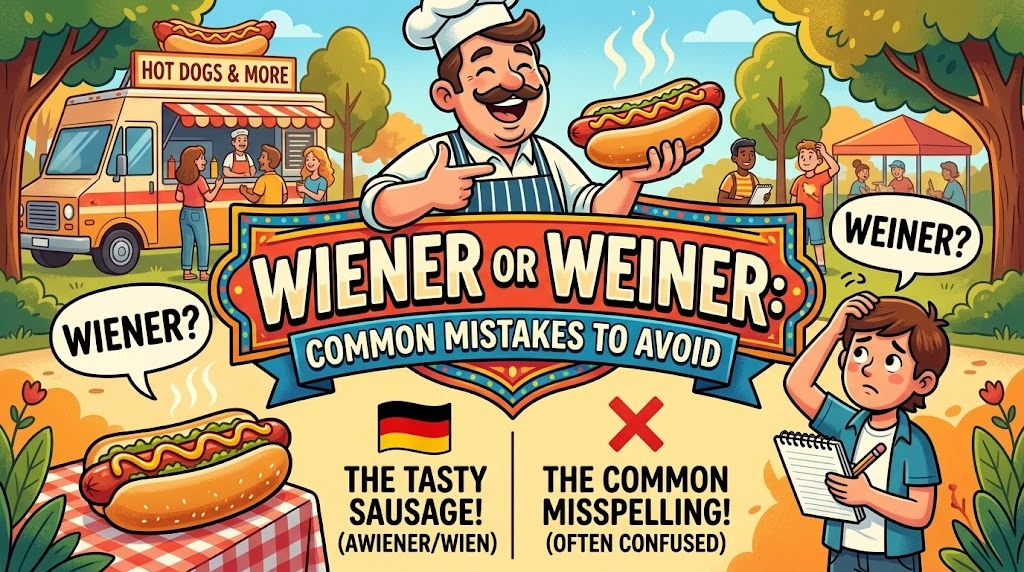
Mistake: Assuming Both Spellings Mean the Same Thing
They don’t.
A spelling difference can represent a difference in meaning or function.
Wiener can be a common noun. Weiner can be a surname.
Mistake: Copying the Wrong Spelling From Social Media
Online spelling isn’t always a reliable authority.
A misspelling can spread quickly when thousands of people repeat it. Search frequency doesn’t transform an incorrect spelling into the standard spelling.
Mistake: Forgetting the German Origin
The connection between Wien and Wiener gives you a powerful memory aid.
If you remember that Wien is Vienna in German, the spelling Wiener becomes much easier to recall.
Mistake: Trusting Spell-Check Completely
Spell-check software checks patterns against dictionaries and language models. It doesn’t always understand your intended meaning.
A surname such as Weiner may be perfectly valid. That doesn’t make it appropriate when you mean a sausage.
Is “Wiener” Capitalized?
Usually, capitalization depends on how the word functions.
Lowercase “wiener”
When wiener refers to the food as a common noun, it normally appears in lowercase.
We ordered a wiener for lunch.
The grill is full of wieners.
Capitalized “Wiener”
When Wiener appears as someone’s surname, it is capitalized.
Wiener published the study.
It can also appear capitalized in particular proper names or established titles.
The important point is that capitalization follows the grammatical and naming context. It isn’t simply a matter of choosing your favorite spelling.
Pronunciation of Wiener and Weiner
In many American English contexts, wiener is pronounced approximately like WEE-ner.
The surname Weiner can also be pronounced similarly, although surnames don’t always follow predictable pronunciation rules.
That’s another reason these words create confusion.
When two spellings sound similar, you need to rely on context and visual spelling rather than pronunciation alone.
For learners, the safest approach is straightforward:
Learn the spelling together with the meaning.
Don’t memorize only the sound.
Wiener vs. Hot Dog: Are They the Same?
The words overlap, but they’re not perfect synonyms in every context.
What “Wiener” Means in American English
In American English, a wiener commonly refers to a sausage, particularly one used as a hot dog.
For example:
The children roasted wieners over the campfire.
In casual conversation, many Americans would simply say:
The children roasted hot dogs over the campfire.
Both expressions can refer to the same food in ordinary situations.
Wiener and Frankfurter
Frankfurter is another sausage term associated with Frankfurt, Germany. Wiener is associated linguistically with Vienna.
Food terminology developed differently across regions, which is why these words can overlap in modern English.
The terms aren’t necessarily interchangeable in every culinary or historical context. However, everyday American usage often treats them as closely related sausage terms.
Wiener Dog
Wiener dog is an informal name for the dachshund.
The nickname comes from the breed’s long, low body shape, which people associate with a sausage.
For formal writing, especially veterinary or breed-related writing, dachshund is the more precise breed name.
When Should You Use Weiner?
Use Weiner when it is the established spelling of a person’s surname.
Use wiener when you’re talking about the food.
A simple decision process can help:
- Talking about a sausage? → wiener
- Talking about a hot dog? → wiener can be appropriate
- Talking about something associated with Vienna? → Wiener may be appropriate
- Writing someone’s surname? → Check whether it is Weiner or Wiener
- Unsure about a food spelling? → Use a reputable dictionary
The most important habit is to identify the meaning before choosing the spelling.
Weiner or Wiener in Formal and Academic Writing
Accuracy becomes especially important in formal writing.
Imagine an academic paper that discusses a researcher named Weiner. Changing the name to Wiener would be an actual factual error.
The same applies in journalism, biographies, citations, business documents, and historical writing.
When a proper name appears in a source, preserve its documented spelling.
For common vocabulary, use the standard dictionary form.
That gives you a useful two-part rule:
Names belong to the person. Common words belong to the language.
This distinction prevents many unnecessary spelling mistakes.
Weiner or Wiener: A Simple Memory Trick
The easiest memory trick connects Wiener to Vienna.
Remember:
Wien = Vienna
Then:
Wien + er = Wiener
You don’t need to memorize a complicated spelling rule. Instead, remember the word’s origin.
If you’re writing about a sausage, think:
Wiener → Wien → Vienna
If you’re writing someone’s surname, check the actual spelling:
Weiner or Wiener? → Use the person’s real name.
This approach works better than relying on pronunciation.
Quick Reference: Weiner or Wiener?
Here’s the entire distinction in a compact form:
| If you mean… | Use… |
| A sausage | wiener |
| A hot dog in common usage | wiener can be used |
| Something associated with Vienna | Wiener |
| A person whose surname is Wiener | Wiener |
| A person whose surname is Weiner | Weiner |
| The food spelled “weiner” | Usually incorrect |
A Quick Decision Guide
Is it food?
→ Write wiener.
Is it someone’s surname?
→ Check whether their name is Weiner or Wiener.
Is it related to Vienna?
→ Wiener may be the appropriate form.
Did you write “weiner” for a sausage?
→ Change it to wiener.
Examples of the Most Common Confusions
Wiener vs. Weiner in Food Writing
Incorrect:
The restaurant serves grilled weiners.
Correct:
The restaurant serves grilled wieners.
The food word takes the ie spelling.
Wiener vs. Weiner in Names
Correct:
Michael Weiner gave the presentation.
If that is his actual surname, changing it to Wiener would be incorrect.
Likewise:
Michael Wiener gave the presentation.
This is correct if Wiener is his actual surname.
Wiener vs. Weiner in Online Writing
Online writing creates a special problem because both spellings may appear in search results.
Don’t decide based on which version appears more often.
Instead, determine what the writer means.
If the subject is food, wiener is the standard choice.
If the subject is a person, verify the person’s surname.
Wiener vs. Weiner in Formal Writing
Formal writing demands extra care.
A spelling error in a food description is one problem. A misspelled person’s name can be more serious because names identify specific people.
Always preserve proper names accurately.
Frequently Asked Questions
Is Wiener the correct spelling?
Yes, wiener is the standard spelling for the common food term referring to a type of sausage or hot dog. Wiener is also used as a surname and in terms associated with Vienna.
Is Weiner a real word?
Weiner is a real surname. It shouldn’t automatically be treated as an incorrect word simply because wiener is the standard spelling for the food.
However, when someone intends to write the food term, weiner is generally a misspelling of wiener.
Is Weiner a correct surname?
Yes. Weiner can be a legitimate family name. If a person’s surname is Weiner, that exact spelling should be preserved.
Does Wiener always mean a hot dog?
No. Wiener has broader uses. It can refer to a type of sausage, and it can also relate to Vienna or appear as a surname.
The meaning depends on context.
Why do people spell Wiener as Weiner?
The two spellings look and sound similar. People may reverse the i and e, especially when writing quickly. Pronunciation doesn’t provide enough information to distinguish the spellings.
How do you pronounce Wiener?
In common American English usage, wiener is generally pronounced approximately WEE-ner.
Exact pronunciation can vary with accent and context.
Are Wiener and Weiner pronounced the same?
They can be pronounced similarly, particularly in American English. However, pronunciation doesn’t establish which spelling is correct.
Context still matters.
Is Wiener related to Vienna?
Yes. Wien is the German name for Vienna, and Wiener is the German form meaning “Viennese” or associated with Vienna. This connection also helps explain the word’s use in sausage terminology.
Is Wiener an English word?
Yes. Wiener is established in English, particularly in food-related usage. English adopted the term from German and developed its own uses for it.
Should Wiener be capitalized?
When wiener is used as a common noun for food, it is normally lowercase.
When Wiener is someone’s surname, it is capitalized.
Capitalization can also depend on whether the word appears within a particular proper name or established expression.
Is “wiener dog” the same as a dachshund?
Wiener dog is an informal name for a dachshund. The nickname refers to the breed’s long, low body shape.
Final Takeaway
The difference between Weiner and Wiener is small in spelling but important in meaning.
For the food, use wiener. That spelling connects with Wien, the German name for Vienna, and it is the established English form of the sausage term.
Weiner isn’t simply a second acceptable spelling for the food. However, it can be completely correct as a person’s surname.
The easiest rule to remember is:
Food = wiener. Name = check the person’s spelling.
When you see Weiner, don’t automatically “correct” it. It may be someone’s legitimate family name. Likewise, when you’re writing about a sausage, don’t let the familiar surname spelling lead you toward weiner.
A little attention to context solves the entire problem.
Wiener and Weiner may sound similar, but their written forms serve different purposes. Once you connect Wiener with Vienna and remember that surnames must retain their established spelling, choosing the right form becomes much easier.