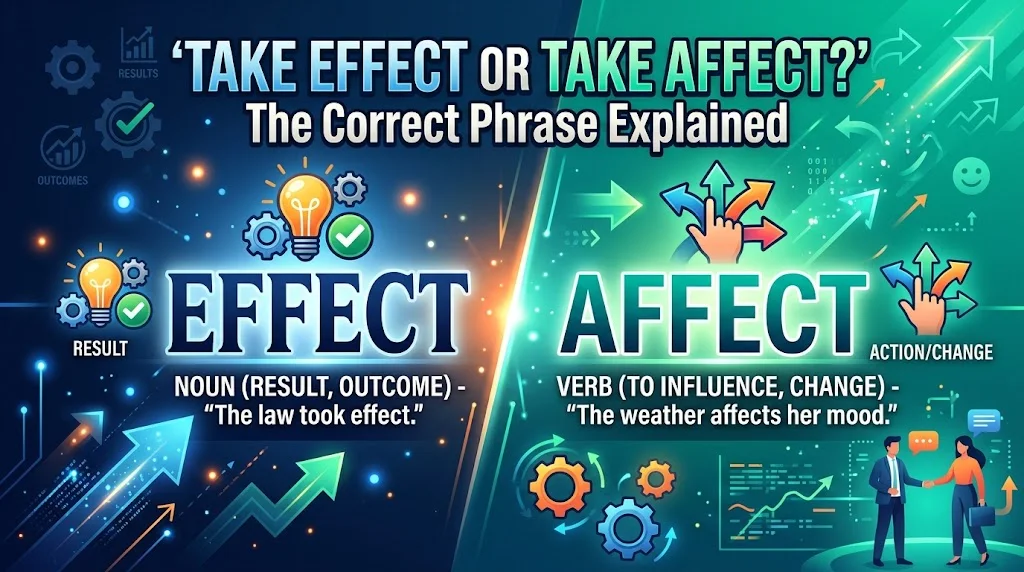
Have you ever wondered whether you should write Take Effect or Take Affect? These two expressions look almost identical, but only one works as the standard phrase. The correct expression is take effect, which means to become active, become effective, or start producing a result. You’ll often see it in formal writing, professional communication, legal documents, government regulations, workplace policies, and medical contexts.
The confusion usually comes from mixing up affect and effect, two commonly confused English words. In everyday grammar, affect usually works as a verb meaning to influence or change something, while effect usually works as a noun meaning a result or consequence. Understanding this grammar difference makes the correct phrase much easier to remember.
For example, “The new policy will take effect next month” means the policy will become operational at that time. On the other hand, “The policy may affect employees” means it may influence workers.
Once you understand the meaning of take effect, the difference between affect and effect, and common grammar mistakes, choosing the right expression becomes simple.
Take Effect or Take Affect: Which One Is Correct?
The correct phrase is take effect.
Take effect means that something becomes active, begins operating, or starts producing its intended result. It often describes a change that has moved from being planned or announced to actually being applied.
For example:
- The new policy will take effect on July 1.
- The medication began to take effect after thirty minutes.
- The price increase will take effect next month.
- The software update takes effect after you restart the device.
- The new safety rules will take effect immediately.
In each sentence, something begins to operate or produce a result.
What Does “Take Effect” Mean?
The phrase take effect has two closely related meanings.
First, it can mean to become officially active or legally operative.
“The new regulations will take effect on January 1.”
Here, the regulations already exist, but they don’t become applicable until the stated date.
Second, take effect can mean to begin producing a result or influence.
“The pain medication took effect within twenty minutes.”
The medicine has started working. It has moved from being administered to producing its intended effect.
So, depending on context, take effect can mean:
- become active
- become operative
- become applicable
- begin working
- begin producing a result
- start having an effect
Is “Take Affect” Ever Correct?
In ordinary English, take affect is not the correct phrase.
If you mean that something becomes active or starts working, use take effect.
For example:
Incorrect:
The new policy will take affect Monday.
Correct:
The new policy will take effect Monday.
The important point is that affect itself isn’t an incorrect word. The problem is its use in this particular expression.
For instance:
The weather can affect your travel plans.
Here, affect is a verb meaning “influence.”
You can also encounter affect as a noun in specialized psychological or clinical writing. That’s a separate use entirely.
Take Effect Examples
Here are some natural examples of take effect:
| Context | Example |
| Law | The new law will take effect in January. |
| Workplace | The revised schedule takes effect Monday. |
| Healthcare | The medication should take effect within an hour. |
| Education | The new attendance policy takes effect next semester. |
| Business | The new pricing structure will take effect next quarter. |
| Technology | The security settings take effect after the system restarts. |
| Everyday English | The discount takes effect at checkout. |
Notice the common idea. Something is moving into operation or beginning to produce a result.
Affect vs. Effect: Understanding the Difference
To understand take effect vs. take affect, you need to understand the two words separately.
They’re easy to confuse because their spelling differs by only one letter. Their meanings overlap in some contexts, too.
However, they aren’t interchangeable.
What Does Affect Mean?
In everyday English, affect is most commonly used as a verb.
As a verb, affect means to influence or change something.
For example:
Heavy rain can affect traffic.
The rain influences traffic.
Another example:
Lack of sleep can affect your concentration.
Here, lack of sleep influences your ability to concentrate.
Common sentence patterns include:
- X affects Y.
- X can affect Y.
- X affected Y.
- X may affect Y.
Consider these examples:
- The new rule may affect employees.
- Rising costs can affect prices.
- Stress can affect your sleep.
- The decision affected the entire department.
- A software error could affect system performance.
The key idea is influence.
What Does Effect Mean?
In everyday English, effect is most commonly a noun.
It means a result, consequence, or outcome produced by something.
For example:
The new policy had an immediate effect on sales.
The policy is the cause. The change in sales is the result.
Another example:
The medication had a noticeable effect on her symptoms.
The change in symptoms is the result associated with the medication.
Common patterns include:
- have an effect
- produce an effect
- cause an effect
- the effect of something
- an immediate effect
- a lasting effect
Examples:
- The decision had a major effect on the company.
- Exercise can have a positive effect on your health.
- The storm had little effect on local traffic.
- The new rule produced an unexpected effect.
- We noticed the effect almost immediately.
Why “Take Effect” Is the Correct Phrase
The phrase works because effect relates to the result or operation produced by something.
When something takes effect, it begins to operate or starts producing its intended result.
Think about a new workplace rule.
Before its effective date, the rule may have been announced, approved, and documented. Once its effective date arrives, the rule takes effect.
The same logic applies to medicine.
A medication may be taken at 8:00 a.m. It doesn’t necessarily produce its intended result instantly. When it starts working, it takes effect.
That’s why take effect is the established expression.
What Does “Take Effect” Mean in Everyday English?
The phrase appears across many areas of modern English. You’ll find it in government notices, medical instructions, workplace communications, software documentation, school policies, contracts, and ordinary conversation.
Take Effect for Laws and Regulations
Legal and government writing frequently uses take effect.
A law can be passed on one date but become legally operative on another date.
For example:
The new regulations will take effect on October 1.
The regulations already exist as an approved legal measure. The phrase tells readers when they become operative.
You’ll also see related expressions such as:
- effective date
- go into effect
- become effective
- take effect immediately
For example:
The rule takes effect immediately.
This means there is no waiting period before the rule becomes applicable.
Take Effect in Medicine and Healthcare
Healthcare provides another common use.
When people say that a medicine takes effect, they usually mean that it begins producing a noticeable or intended result.
For example:
The pain reliever took effect after about thirty minutes.
The phrase can also describe treatments or interventions more broadly:
The treatment began to take effect after several sessions.
However, take effect doesn’t guarantee that a treatment will work completely or successfully. It simply describes the point at which an effect begins to occur.
That’s an important distinction.
Take effect describes the beginning of an effect. It doesn’t automatically mean “work perfectly.”
Take Effect in Business and the Workplace
Companies regularly use the phrase when discussing changes to policies, schedules, salaries, contracts, and procedures.
Examples include:
The new vacation policy will take effect next month.
The revised work schedule takes effect Monday.
The updated pricing will take effect at the beginning of the quarter.
The contract takes effect once both parties sign it.
In professional writing, take effect is especially useful because it’s concise and precise.
Take Effect in Technology and Software
Technology writing uses the expression in much the same way.
A setting, update, configuration, or change may not operate immediately after someone selects it.
For example:
The new security settings take effect after you restart the application.
Or:
The update will take effect the next time you log in.
The phrase tells the reader when a change becomes operational.
Take Effect vs. Take Affect: Quick Comparison
| Phrase | Standard English? | Meaning | Example |
| Take effect | Yes | Become active or begin producing a result | The new rule takes effect Friday. |
| Take affect | No, not as the standard phrase | Not the normal expression | Avoid this construction. |
| Affect | Yes | Usually means to influence | The rule may affect employees. |
| Effect | Yes | Usually means a result | The rule had an effect on employees. |
The easiest distinction is this:
Take effect = become active or start producing a result.
Meanwhile:
Affect = influence something.
The Simple Rule to Remember
When you want to say that something starts working, becomes active, or becomes applicable, use take effect.
Don’t write take affect.
For example:
Correct:
The new policy will take effect tomorrow.
Incorrect:
The new policy will take affect tomorrow.
There’s no need to overthink the phrase. Take effect is the standard expression.
Why Do People Confuse “Take Effect” and “Take Affect”?
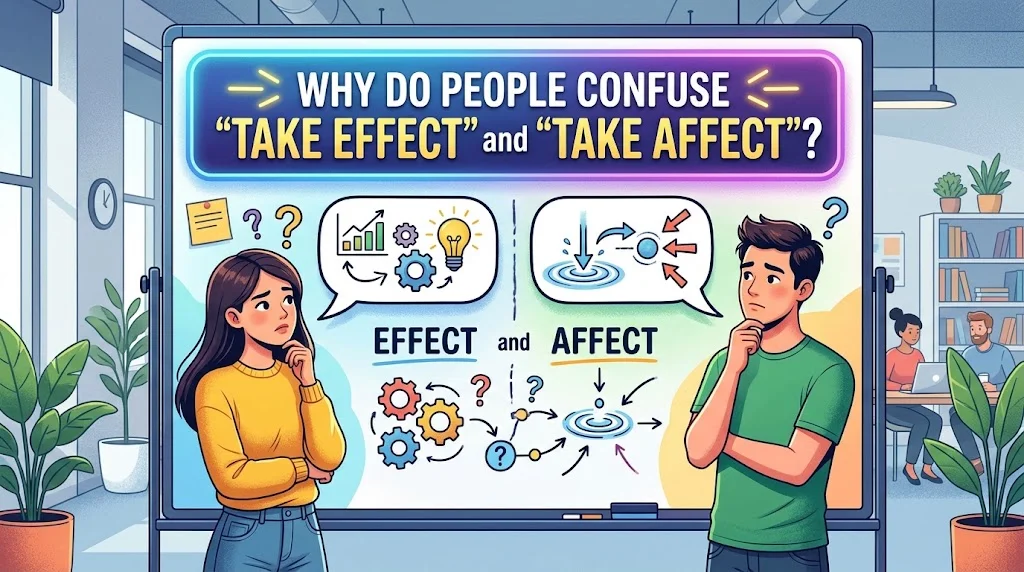
The confusion isn’t surprising. The words are close in spelling, pronunciation, and meaning.
Several factors make the mistake especially common.
Affect and Effect Look and Sound Similar
Both words begin with the same three letters:
- affect
- effect
They also have similar pronunciations in many common uses.
When you’re writing quickly, it’s easy to select the wrong word.
This becomes even more likely when you’re dealing with a sentence about change or influence because both words can appear in similar discussions.
Both Words Appear in Similar Contexts
Consider these two sentences:
The new law will affect businesses.
The new law will take effect next year.
Both sentences discuss the same law, but they communicate different ideas.
In the first sentence, affect means influence.
In the second sentence, take effect means become operative.
Here’s another pair:
The medication may affect your appetite.
The medication should take effect soon.
Again, both sentences concern medicine, but the grammatical roles differ.
Autocorrect Doesn’t Always Help
Spellcheck tools can identify misspelled words. They don’t always recognize incorrect word choices.
Both affect and effect are correctly spelled English words.
Therefore, a program may not flag a sentence such as:
The new rule will take affect Monday.
The problem isn’t spelling. It’s word usage.
This is a useful reminder: grammar tools can assist with writing, but context still matters.
Lack of Grammar Awareness
Many people learn affect and effect as a pair without learning how each word behaves in sentences.
Memorizing a vague rule such as “affect is a verb and effect is a noun” can help, but it isn’t complete.
There are exceptions and less common uses.
For everyday writing, however, the following distinction works well:
- Affect usually functions as a verb meaning influence.
- Effect usually functions as a noun meaning result.
- Take effect is a fixed expression meaning become active or begin working.
The Grammar Rule Behind Affect and Effect
The simplest way to understand these words is to focus on their role in the sentence.
Affect as a Verb
When affect acts as a verb, it usually means influence.
Try replacing it with “influence.”
The weather affected our plans.
Becomes:
The weather influenced our plans.
The meaning remains essentially the same.
More examples:
- Noise can affect your concentration.
- The decision may affect thousands of customers.
- Temperature can affect battery performance.
- The delay affected the entire schedule.
Effect as a Noun
When effect acts as a noun, it usually means result.
Try replacing it with “result.”
The decision had a significant effect.
You can think of it as:
The decision had a significant result.
Although “result” isn’t always a perfect replacement stylistically, the basic relationship is clear.
More examples:
- The medicine had an immediate effect.
- The changes produced a positive effect.
- The storm had little effect on the event.
- The policy had an unexpected effect on costs.
Effect Can Also Be a Verb
Here’s where the simple “affect = verb, effect = noun” rule becomes incomplete.
Effect can also function as a verb.
As a verb, effect can mean to bring about or cause something to happen.
For example:
The reforms effected major changes in the organization.
This use is more formal than the everyday noun effect.
It’s important because it shows why grammar rules based solely on word endings aren’t enough. Context matters.
Still, this verb use doesn’t make take affect correct.
The established phrase remains:
take effect
Affect Can Also Be a Noun in Specialized Contexts
Affect can also function as a noun, particularly in psychology, psychiatry, and clinical writing.
In that context, it refers broadly to the observable expression of emotion.
For example, a clinical text might describe someone’s affect as flat or restricted.
That’s a specialized use. It doesn’t change the ordinary distinction most writers need when choosing between affect and effect.
Read More: Long Term or Longterm: Which Spelling Is Correct in 2026?
Take Effect in Different Contexts
Understanding examples across different fields makes the phrase much easier to recognize.
Government and Public Policy
Government announcements frequently specify when a law or regulation will become operative.
Examples:
- The regulation takes effect next week.
- The tax change will take effect in January.
- The new requirements take effect immediately.
- The revised rules will take effect after publication.
Healthcare and Medicine
Examples include:
- The medication should take effect within an hour.
- The treatment began to take effect gradually.
- The anesthetic took effect quickly.
- The medication’s effects became noticeable after several hours.
Remember that take effect describes the onset of an effect. It doesn’t necessarily promise a particular outcome.
Education
Schools and universities may use the phrase when announcing policy changes.
Examples:
The revised attendance policy takes effect next semester.
The new grading policy will take effect in September.
The updated admission requirements take effect for next year’s applicants.
Business and Finance
Business communication often needs precise dates and conditions.
Examples:
The new pricing structure takes effect on June 1.
The revised contract takes effect once all parties sign.
The salary adjustment will take effect with the next pay period.
Technology
Technical writing also uses the phrase naturally:
The configuration change takes effect after restarting the server.
The new permissions take effect immediately.
The software update will take effect during the next system restart.
Take Effect vs. Similar Expressions
Take effect has several close alternatives. Understanding them helps you avoid unnecessary repetition.
Take Effect vs. Become Effective
These expressions can often communicate nearly the same idea.
The policy takes effect Monday.
The policy becomes effective Monday.
Both tell the reader when the policy becomes operative.
However, take effect is a very natural and widely used phrase when describing the point at which something starts operating.
Take Effect vs. Go Into Effect
Go into effect is another close equivalent.
Compare:
The law takes effect on January 1.
The law goes into effect on January 1.
Both sentences indicate that the law becomes operative at that time.
The difference is mostly one of phrasing rather than core meaning.
Take Effect vs. Have an Effect
These expressions are related but aren’t interchangeable.
Take effect means:
become active or begin producing a result.
Have an effect means:
produce an influence or result.
Compare:
The medicine will take effect soon.
This focuses on when the medicine begins working.
The medicine had a strong effect on her symptoms.
This focuses on the result produced.
The distinction becomes much clearer when you look at the grammar.
Take Effect vs. Affect
Compare these examples:
The new policy will take effect next month.
The new policy will affect employees next month.
The first sentence focuses on the policy becoming active.
The second focuses on the policy influencing employees.
One policy can both take effect and affect people.
The words simply describe different aspects of the situation.
Common Mistakes With Take Effect and Take Affect
Knowing the common errors can help you catch them before publishing an email, report, essay, or article.
Writing “Take Affect”
This is the most direct mistake.
Incorrect:
The new schedule will take affect Monday.
Correct:
The new schedule will take effect Monday.
The correction is simple. Replace affect with effect.
Confusing Affect With Effect
Consider:
The new policy may effect employees.
If the intended meaning is “influence employees,” the sentence should use affect:
The new policy may affect employees.
But:
The new policy may have an effect on employees.
is also correct.
These two constructions express closely related ideas through different grammatical structures.
Using Effect as a Verb Without Understanding Its Meaning
The verb effect is legitimate, but it has a more specific meaning than ordinary affect.
Compare:
The changes affected the company.
This means the changes influenced the company.
The changes effected a major transformation.
This means the changes brought about a transformation.
The distinction is subtle but important.
Assuming Every Affect Is Wrong
Some writers become so cautious about affect and effect that they start replacing every affect with effect.
That’s another mistake.
For example:
Lack of sleep can affect your judgment.
Here, affect is exactly right because it means influence.
The goal isn’t to avoid affect. The goal is to use each word according to its meaning and grammatical role.
How to Remember Take Effect Correctly
A good memory trick doesn’t need to be complicated.
Think “Effect = Result”
One useful connection is:
Effect = result
If you’re talking about the result of something, effect is often the word you need.
For example:
The policy had a noticeable effect.
Then remember the established expression:
take effect
Think “Take Effect = Start Working”
When something takes effect, imagine a switch being turned on.
Before that moment, the rule, medicine, setting, or change isn’t operating in the relevant way.
Then it starts.
Take effect = start working or become active.
This mental picture works especially well with:
- laws
- policies
- medicine
- rules
- software
- contracts
- schedules
Use the Sentence-Swap Test
If you’re uncertain, replace take effect with:
become active
or:
start working
For example:
The new rules will take effect tomorrow.
Try:
The new rules will become active tomorrow.
The meaning fits.
Now consider:
The new rules will take affect tomorrow.
There’s no comparable standard construction with affect.
Memorize the Fixed Phrase
Sometimes the simplest solution is the most effective one.
Learn take effect as a fixed phrase rather than trying to rebuild it every time.
Other common fixed expressions include:
- have an effect
- cause an effect
- affect someone
- be affected by
- take effect
- go into effect
- become effective
Seeing these combinations repeatedly makes correct usage more automatic.
Take Effect or Take Affect: Examples With Corrections
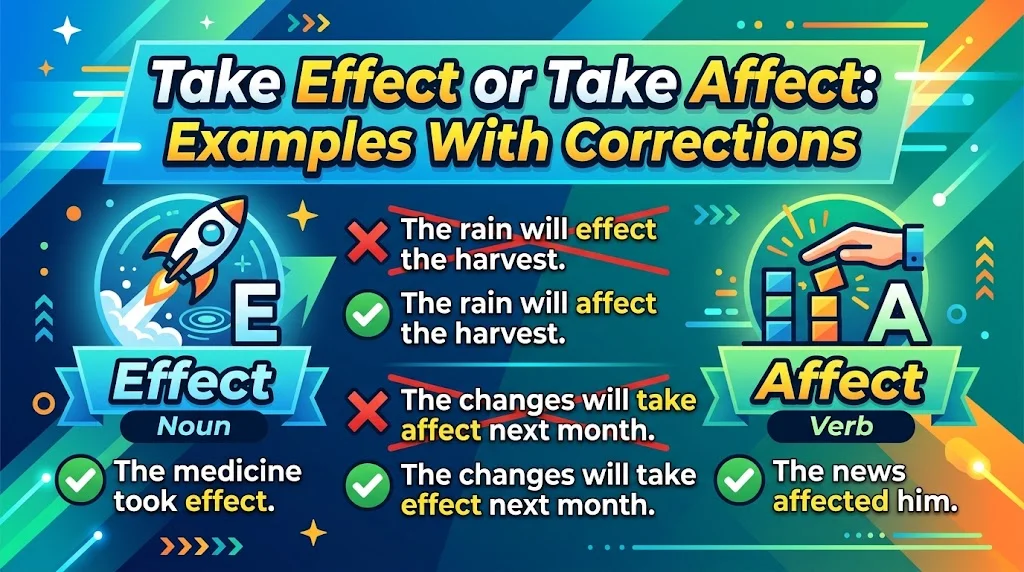
The following examples show how the phrase works in realistic situations.
Workplace Examples
Incorrect:
The new vacation policy will take affect next month.
Correct:
The new vacation policy will take effect next month.
Incorrect:
The revised schedule takes affect Monday.
Correct:
The revised schedule takes effect Monday.
Now compare a different use of affect:
The revised schedule may affect employees with evening shifts.
Here, affect means influence.
Government Examples
Incorrect:
The new regulation takes affect on January 1.
Correct:
The new regulation takes effect on January 1.
Another correct sentence is:
The new regulation may affect businesses across the state.
Again, both words can appear in the same topic without being interchangeable.
Healthcare Examples
Incorrect:
The medication should take affect soon.
Correct:
The medication should take effect soon.
But:
The medication may affect your appetite.
is also correct.
The first sentence describes when the medication begins working. The second describes something the medication may influence.
Everyday Examples
Incorrect:
The discount will take affect at midnight.
Correct:
The discount will take effect at midnight.
Incorrect:
The change takes affect immediately.
Correct:
The change takes effect immediately.
These corrections follow the same rule every time.
Formal Writing Examples
Professional writing often benefits from precise wording.
Instead of:
The updated procedure will take affect next quarter.
Write:
The updated procedure will take effect next quarter.
Instead of:
The policy will take affect once approved.
Write:
The policy will take effect once approved.
This wording is clear, concise, and appropriate for formal communication.
Take Effect or Take Affect: Quick Practice
A short practice exercise can reinforce the distinction.
Choose the Correct Phrase
Fill in each blank with take effect or take affect.
- The new rules will ______ next Monday.
- The medication should ______ within an hour.
- The price increase will ______ in January.
- The new policy may ______ small businesses.
- The software changes will ______ after the restart.
Answers
- take effect
- take effect
- take effect
- affect
- take effect
The fourth sentence is different because affect functions as a verb meaning “influence.”
Correct the Mistake
Sentence:
The new law will take affect next year.
Correction:
The new law will take effect next year.
Sentence:
The treatment should take affect shortly.
Correction:
The treatment should take effect shortly.
Sentence:
The weather may effect our travel plans.
Correction:
The weather may affect our travel plans.
These examples demonstrate why you need to consider the entire sentence rather than relying only on spelling.
A Simple Affect vs. Effect Cheat Sheet
| Word or Phrase | Typical Role | Meaning | Example |
| affect | Verb | Influence or change | Stress can affect sleep. |
| effect | Noun | Result or consequence | Stress can have an effect on sleep. |
| effect | Verb | Bring about or cause | The reforms effected major changes. |
| affect | Noun | Observable emotional expression in specialized contexts | The clinician noted a flat affect. |
| take effect | Verb phrase | Become active or begin producing a result | The rule takes effect tomorrow. |
| have an effect | Verb phrase | Produce a result or influence | The rule had an effect on costs. |
| go into effect | Verb phrase | Become operative | The law goes into effect Friday. |
The table reveals an important point: affect and effect aren’t simply interchangeable versions of the same word.
Their grammatical roles and meanings matter.
Why “Take Effect” Is So Common
English frequently uses effect when discussing changes that produce outcomes.
That’s why phrases such as these are common:
- take effect
- effective immediately
- effective date
- have an effect
- produce an effect
- side effect
- cause an effect
- long-term effects
- immediate effects
The word effect naturally fits situations involving outcomes, operation, and results.
Meanwhile, affect often describes the action of influencing something:
The change affects prices.
The distinction isn’t arbitrary. The meanings fit different parts of the situation.
Take Effect in Professional Writing
If you’re writing an email, policy document, report, contract summary, academic paper, or workplace announcement, accuracy matters.
A phrase such as take affect can distract readers because it looks like a basic word-choice error.
Consider:
The updated terms will take affect on September 1.
The intended meaning is easy to understand, but the phrase is incorrect.
The polished version is:
The updated terms will take effect on September 1.
The correction takes only one letter, yet it makes the sentence standard and professional.
For formal communication, clarity matters more than clever wording. Take effect is both precise and widely understood.
Take Effect vs. Take Affect: Frequently Asked Questions
Is “Take Affect” Ever Correct?
Not as the standard phrase meaning “become active” or “start working.” Use take effect instead.
The word affect is perfectly legitimate in other constructions, especially as a verb meaning “influence.”
What Does “Take Effect” Mean?
Take effect means to become active, become operative, or begin producing a result.
For example:
The new policy takes effect Monday.
It can also describe something beginning to work:
The medication took effect after thirty minutes.
Why Is “Take Effect” Correct?
Effect commonly refers to a result or the operation produced by something. In the established phrase take effect, the expression means that something begins operating or producing its intended result.
Take affect isn’t the standard English construction.
What Is an Example of “Take Effect” in a Sentence?
The new safety regulations will take effect on July 1.
Another example is:
The medicine began to take effect after about twenty minutes.
What Is the Difference Between Affect and Effect?
In everyday usage, affect is usually a verb meaning influence, while effect is usually a noun meaning result.
For example:
Loud noise can affect your concentration.
Loud noise can have an effect on your concentration.
Both sentences discuss influence, but they use different grammatical structures.
Is Affect a Verb or a Noun?
Affect is most commonly a verb meaning “influence.”
It can also function as a noun in specialized psychological and clinical contexts, where it refers to observable emotional expression.
Is Effect a Verb or a Noun?
Effect is most commonly a noun meaning “result” or “consequence.”
It can also function as a verb meaning “bring about” or “cause.”
For example:
The reforms effected significant changes.
This formal verb use is less common in everyday conversation.
What Is an Easy Way to Remember Affect vs. Effect?
A useful everyday shortcut is:
Affect = influence.
Effect = result.
Then memorize:
Take effect = become active or start working.
This won’t cover every specialized use of the two words, but it works well for ordinary writing.
Can “Go Into Effect” Replace “Take Effect”?
Often, yes.
For example:
The new law takes effect Monday.
and:
The new law goes into effect Monday.
Both describe the point at which the law becomes operative.
Is “Take Effect” Appropriate in Formal Writing?
Yes. Take effect is standard and widely used in formal, professional, legal, medical, academic, and everyday writing.
For example:
The revised policy will take effect at the beginning of the fiscal year.
Final Takeaway: Take Effect or Take Affect?
When you’re choosing between take effect or take affect, the answer is straightforward: take effect is the correct standard phrase.
Use take effect when something:
- becomes active
- becomes operative
- becomes applicable
- starts working
- begins producing a result
For example:
The new policy will take effect next month.
Don’t write:
The new policy will take affect next month.
The confusion comes from the broader affect vs. effect problem. In everyday English, affect usually works as a verb meaning influence, while effect usually works as a noun meaning result.
Compare:
The new policy will affect employees.
with:
The new policy will take effect next month.
The first sentence describes influence. The second describes when the policy becomes active.
If you remember only one thing, remember this:
Take effect = become active or start working.
Once that phrase becomes familiar, take affect should stand out immediately as the wrong choice.