Height vs Hight can be confusing because both spellings look almost identical. If you’re writing about height measurement, vertical distance, or how tall someone is, choosing the right word matters. In modern English, height is the correct spelling. It works as a noun and commonly describes the vertical measurement of a person, building, tree, wall, or other object.
For example, you might ask about someone’s body height, record a building’s total height, or measure the height of an object. The word also appears in figurative expressions, such as “at the height of his career” or “at the height of summer.”
But what about hight? Surprisingly, it isn’t simply a misspelling with no history. Hight is an archaic English word that appears in older forms of English. It can carry historical meanings such as called or named. You may encounter it in historical literature, old poetry, or writing that intentionally uses archaic language.
Understanding this distinction makes the spelling much easier. In this guide, you’ll learn the difference between height and hight, discover practical examples, compare height, high, and tall, and learn a simple trick for remembering the correct spelling.
Height vs Hight: What’s the Difference?
The simplest distinction is straightforward:
Height is the standard modern English noun for the measurement or extent of something from bottom to top.
Hight is an archaic English word that has historical meanings and isn’t normally used in contemporary writing.
For example:
- What is your height? ✅
- The height of the building is 150 feet. ✅
- The mountain reaches a great height. ✅
- What is your hight? ❌ in ordinary modern English
The last sentence might appear in an old text or a deliberately archaic piece of writing. In contemporary English, however, height is the word you want.
Height Is the Standard Modern Word
Height is a noun. It refers to the measurement of something vertically or, in some contexts, the highest point or level something reaches.
You can use it for people, buildings, trees, mountains, furniture, waves, walls, ceilings, shelves, and many other things.
Examples:
- The player’s height is 6 feet 4 inches.
- The height of the table is 30 inches.
- We measured the height of the wall.
- The airplane reached an altitude of 35,000 feet.
It also appears in figurative expressions:
- At the height of summer
- At the height of his career
- At the height of the crisis
- At the height of excitement
Hight Is an Archaic or Historical Word
Hight is not simply a misspelled version of height. It has its own history.
In older forms of English, hight could function as a verb meaning called, named, or named as. Historical English sources also show related forms and uses that don’t match the meaning of modern height.
That’s why replacing height with hight in a modern sentence is usually incorrect.
For example:
The child’s height is 52 inches.
This is standard modern English.
Writing:
The child’s hight is 52 inches.
is a spelling error unless you’re intentionally reproducing a historical form.
Height vs Hight: Quick Comparison
| Word | Modern status | Main meaning | Part of speech | Typical use |
| Height | Standard modern English | Vertical measurement or level | Noun | Everyday and formal writing |
| Hight | Archaic/historical | Historically, “called” or “named,” among other older uses | Mainly verb in historical usage | Old texts and historical/literary contexts |
| High | Standard modern English | At a considerable distance above the ground or another reference point | Usually adjective/adverb | Describing position, level, or degree |
| Tall | Standard modern English | Greater than average vertical stature | Adjective | People, buildings, trees, and objects |
The Easiest Way to Remember the Difference
If you’re describing how tall something is, remember:
Height = measurement
Hight = historical word
A useful spelling reminder is the E in height. Although the spelling isn’t perfectly predictable from pronunciation, the word height is the standard form you’ll need in modern English.
Think of it this way:
High → height
Tall → height
If you’re turning high into the noun for its vertical measurement, you get height, not hight.
What Does “Height” Mean?
Height has several closely related meanings. Its most basic meaning involves vertical measurement, but English also uses it to describe a high point, level, degree, or peak.
Height as a Measurement of How Tall Something Is
The most familiar use of height describes how tall a person or object is.
For a person, height usually means the distance from the bottom of the feet to the top of the head while standing upright.
For example:
Jordan’s height is 5 feet 10 inches.
In metric measurement:
Jordan’s height is 178 centimeters.
You can also describe the height of an object:
The refrigerator has a height of 70 inches.
In everyday English, though, speakers often use a more natural structure:
The refrigerator is 70 inches tall.
Both sentences communicate the same basic measurement.
Height as Vertical Distance
Height doesn’t always mean the total physical size of something.
It can also describe the vertical distance between a point and a reference level.
For example:
The drone reached a height of 200 meters.
Here, height refers to how far above the reference point the drone traveled.
You might also see the word in technical contexts involving:
- aviation
- engineering
- architecture
- construction
- geography
- physics
- sports
- manufacturing
A specification sheet might state:
Maximum operating height: 2,000 meters.
That use is precise and completely standard.
Height in Figurative and Abstract Contexts
Here’s where height becomes more interesting.
English doesn’t limit height to physical measurements. The word can describe the peak or highest point of an experience, period, condition, or achievement.
Consider these examples:
She was at the height of her career.
The festival reached its height on Saturday evening.
At the height of the storm, the roads became dangerous.
In these sentences, height means something closer to peak, highest point, or greatest intensity.
The idea is metaphorical. Physical height provides the image, while the sentence applies that image to something abstract.
Common Expressions With “Height”
Several established expressions use height in this figurative sense.
| Expression | Meaning | Example |
| At the height of | At the peak or strongest point | At the height of summer, temperatures soared. |
| Height of success | The greatest level of success | She reached the height of her career. |
| Height of fashion | Extremely fashionable | That style was once the height of fashion. |
| Height of excitement | The most exciting point | The crowd cheered at the height of the match. |
| Height of the crisis | The most intense stage | Aid arrived at the height of the crisis. |
These expressions reinforce an important idea: height can describe degree as well as physical measurement.
What Does “Hight” Mean?
The word hight has a genuine place in English history. The problem comes from assuming that its existence makes it a modern spelling option for height.
It doesn’t.
“Hight” Has an Archaic Meaning
In historical English, hight could mean called or named.
You may encounter constructions such as:
A warrior hight Alfred.
In modern English, that would normally become:
A warrior named Alfred.
The historical form can feel strange because modern English no longer commonly uses hight this way.
Historical dictionaries document the word and its older forms. Merriam-Webster’s entry for “hight” provides historical information about the word.
The Oxford English Dictionary also provides extensive historical documentation of English words and their development.
How “Hight” Was Used in Older English
English has changed dramatically over hundreds of years.
Words that once appeared naturally in everyday writing can become rare, obsolete, or restricted to literary contexts. Hight belongs to that category.
Older English contains many forms that modern readers rarely use. You might encounter them while reading:
- Middle English literature
- Early Modern English texts
- historical poetry
- older translations
- folklore
- fantasy writing that imitates older language
- scholarly discussions of English history
The important point is context.
If you’re writing a modern email, school assignment, business report, article, résumé, or social media post, hight isn’t the spelling to use for vertical measurement.
Why “Hight” Rarely Appears in Modern English
Modern English gradually replaced many older grammatical forms.
Language doesn’t remain frozen. Pronunciation changes, vocabulary shifts, and grammatical patterns disappear or become specialized. A word can survive in dictionaries even after ordinary speakers stop using it.
That’s exactly why dictionary recognition doesn’t automatically mean a word is appropriate for everyday writing.
Hight is real, but it isn’t a modern synonym for height.
That distinction matters.
Where You Might Still Encounter “Hight” Today
You could encounter hight in a historical or deliberately old-fashioned context.
For example, an author might use archaic language to make a fantasy story sound medieval.
You might also find it while studying older literature or reading a historical dictionary.
In such cases, the unusual spelling is intentional.
If you see hight in a modern sentence such as:
The player’s hight is six feet.
the writer almost certainly intended height.
Height vs Hight: Why Are They Confused?
The confusion isn’t completely random. Several features make these words easy to mix up.
Their Connection to the Word “High”
Height is closely related to high.
That relationship can create a spelling trap.
A learner might naturally think:
high → hight
After all, many English words form related nouns in ways that seem predictable.
But English spelling doesn’t always follow a neat mathematical pattern.
The correct noun is:
high → height
not:
high → hight
The -ght ending remains in height, while the vowel pattern changes.
Similar Spelling and Pronunciation
Height and hight look nearly identical.
That visual similarity makes the error particularly easy when you’re typing quickly.
Pronunciation creates another layer of confusion. Height is pronounced approximately like “hite” /haɪt/. The spelling doesn’t clearly reveal every part of the word’s history.
When pronunciation and spelling don’t line up neatly, memory can become unreliable.
Typing Mistakes and Autocorrect
Digital writing makes this confusion even more noticeable.
When you’re writing quickly, hight can appear as a typo for height. A spell-checker may catch it depending on the software and context, but you shouldn’t rely entirely on automatic correction.
A spelling checker can recognize words. It doesn’t always understand what you intended.
That’s why proofreading still matters.
Why “Hight” Can Look Like a Logical Spelling
English contains many words where a final t forms a familiar-looking pattern.
Because high ends with a sound related to height, a writer who hasn’t memorized the spelling may produce hight instinctively.
This is a classic example of a spelling error that feels logical but doesn’t match standard usage.
Height vs Hight: Correct Usage Rules
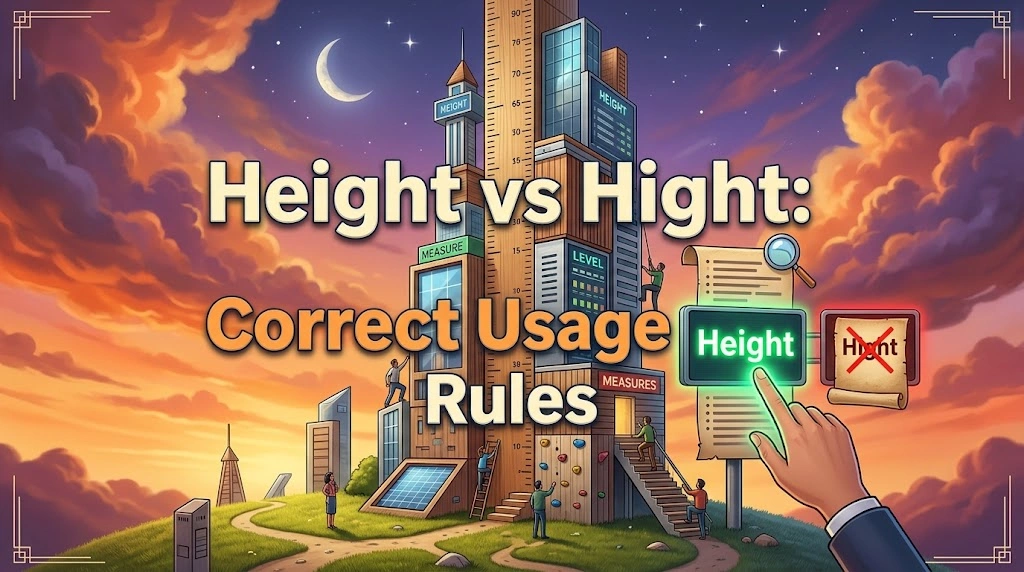
A few simple rules can eliminate most mistakes.
Use “Height” for a Person’s or Object’s Measurement
When you’re answering the question “How tall is it?”, use height.
Examples:
- What is the building’s height?
- Her height is 5 feet 6 inches.
- The tree has an estimated height of 40 feet.
- The athlete’s height gives him an advantage in basketball.
Use “Height” for Vertical Distance
Use height when describing distance above a surface or reference point.
Examples:
- The helicopter maintained a safe height.
- The platform has a height of two meters.
- The water reached a height of three feet.
- The aircraft climbed to a considerable height.
Use “Height” in Figurative Expressions
The word also works when you’re talking about a peak or extreme point.
Examples:
- At the height of the celebration, fireworks filled the sky.
- She achieved the height of her profession.
- The disagreement reached its height during the final meeting.
Some expressions have become fixed phrases, so it’s worth learning them as complete units.
Use “Hight” Only When the Historical Context Calls for It
Don’t use hight as a casual spelling of height.
Use it only when you’re deliberately dealing with historical language or reproducing a source where the form is appropriate.
For ordinary modern writing, choose height.
Read More: People Do or People Does? Correct Grammar Rule, Examples & Tips
Height, High, and Tall: Understanding the Difference
These three words are closely related, but they don’t perform the same grammatical job.
Height Is a Noun
Height names a measurement, condition, level, or peak.
Examples:
The height of the tower is 300 feet.
His height makes him easy to spot in a crowd.
You can usually identify height because it functions as a noun.
High Is Usually an Adjective or Adverb
High describes something positioned far above the ground or another reference point.
Examples:
The shelf is high.
The plane is flying high.
She climbed high into the mountains.
You can often use high when you’re describing position or degree rather than naming the measurement itself.
Compare:
The shelf is high.
with:
The height of the shelf is 7 feet.
The first describes the shelf’s position. The second names its measurement.
Tall Describes People, Buildings, and Other Vertical Things
Tall is an adjective.
It’s commonly used for people, trees, buildings, and objects that have considerable vertical extent.
Examples:
She is tall.
They built a tall office tower.
That tree is incredibly tall.
You wouldn’t normally say:
She is height.
Instead, say:
She is tall.
Or:
Her height is 5 feet 11 inches.
Compare “Height,” “High,” and “Tall” With Examples
| Word | Type | Example | Main idea |
| Height | Noun | His height is 6 feet. | Measurement |
| High | Adjective/adverb | The shelf is high. | Position or level |
| Tall | Adjective | He is tall. | Vertical stature |
| Height | Noun | The tower has a height of 200 feet. | Vertical extent |
A useful shortcut is:
Tall describes. Height measures. High indicates position or level.
Height in Everyday English
The word height appears in far more situations than casual questions about someone’s stature.
Talking About a Person’s Height
When discussing a person’s measurement, height is the standard noun.
Examples:
What is your height?
The form asks for your height and weight.
His height is listed as 183 centimeters.
However, everyday conversation often sounds more natural with tall:
How tall are you?
She’s about 5 feet 7 inches tall.
Both structures are correct. The choice depends on sentence construction.
Describing the Height of Buildings and Objects
Architects, engineers, manufacturers, and consumers regularly use height.
Examples include:
- building height
- ceiling height
- table height
- wall height
- cabinet height
- vehicle height
- fence height
A product specification might say:
| Dimension | Measurement |
| Length | 80 inches |
| Width | 36 inches |
| Height | 30 inches |
Here, height clearly identifies the vertical dimension.
Discussing Height in Sports and Physical Activities
Height often matters in sports.
Basketball, volleyball, high jumping, swimming, and many other activities can involve height-related measurements or advantages.
For example:
The player’s height gives her an advantage near the basket.
The word can describe a physical measurement without implying that being taller automatically makes someone better.
Using Height in Measurements and Specifications
Technical writing often uses height because precision matters.
Examples:
Maximum height: 2.5 meters.
Installation height: 1.2 meters.
Recommended mounting height: 48 inches.
In these contexts, replacing height with hight would be a straightforward spelling mistake.
Common Mistakes With “Height”
Knowing the rules is useful. Recognizing common mistakes is even better.
Mistaking “Hight” for a Modern Alternative
The existence of hight in historical dictionaries can create confusion.
It doesn’t mean that modern English accepts it as an alternative spelling of height.
Incorrect:
The hight of the building is 100 meters.
Correct:
The height of the building is 100 meters.
Writing “Hight” When Describing Someone’s Height
This is one of the most common errors.
Incorrect:
My hight is six feet.
Correct:
My height is six feet.
Even though the pronunciation doesn’t reveal the spelling clearly, height is the established modern form.
Confusing “Height” With “High”
The words are related, but they’re not interchangeable.
Incorrect:
The high of the building is 50 meters.
Correct:
The height of the building is 50 meters.
Use high as a descriptor:
The building is 50 meters high.
Use height as the noun:
The building’s height is 50 meters.
Using “Tall” Where “Height” Is Required
Sometimes writers choose tall when the sentence requires a noun.
Incorrect:
What is the tall of the building?
Correct:
What is the height of the building?
However:
How tall is the building?
is perfectly correct.
Missing the Spelling Error During Proofreading
Because hight looks so close to height, your eyes may skip over it during a quick review.
A useful proofreading trick is to search specifically for:
hight
If you aren’t intentionally discussing historical English, that search may reveal an accidental spelling error.
How to Remember the Spelling of “Height”
The spelling of height can be annoying because pronunciation doesn’t make it obvious.
Fortunately, a few memory tricks help.
Remember the “E” in Height
The simplest trick is:
Height has an E.
Write:
H-E-I-G-H-T
not:
H-I-G-H-T
When you’re unsure, stop and check whether the E is present.
Connect “Height” With “High” and Measurement
Think of this relationship:
High → Height
Tall → Height
The adjective high describes something above a reference level. The noun height names its vertical measurement or level.
That mental connection can help reinforce the spelling.
Use the Sentence Test
Ask yourself:
“Am I talking about how tall or vertically extended something is?”
If yes, you almost certainly need height.
For example:
The height of the wall is 10 feet.
The answer is obvious because the sentence concerns a measurement.
Keep “Hight” for Historical Contexts
A second memory trick is to give hight a completely different mental category.
Don’t think:
hight = another spelling of height
Think:
hight = old/historical English
That separation prevents the two words from competing in your memory.
Height vs Hight Examples in Sentences
Examples make the difference much easier to recognize.
Correct Examples With “Height”
- The height of the mountain attracts experienced climbers.
- What is the height of the basketball player?
- The bridge has a clearance height of 16 feet.
- We measured the height of the tree.
- The height of the ceiling makes the room feel spacious.
- The aircraft reached a considerable height.
- His height helped him in the competition.
- The waves reached an impressive height.
- The fence has a height of six feet.
- She is proud of her height.
Examples of “Height” in Figurative Expressions
- The company was at the height of its success.
- The singer became famous at the height of her career.
- The storm reached its height before midnight.
- At the height of the celebration, everyone started dancing.
- The scandal attracted attention at the height of the election campaign.
These examples show why height isn’t restricted to physical dimensions.
Historical Examples of “Hight”
Because hight belongs to older English usage, its appearance depends heavily on the historical source.
A historical or literary sentence might use it in the sense of named or called.
For example:
A knight hight Edward entered the tale.
In modern English:
A knight named Edward entered the tale.
This kind of construction is intentionally old-fashioned. It shouldn’t be copied into ordinary modern prose simply because the word appears in a dictionary.
Incorrect Modern Examples and Their Corrections
| Incorrect | Correct |
| What is your hight? | What is your height? |
| The hight of the wall is 8 feet. | The height of the wall is 8 feet. |
| The tower’s hight is impressive. | The tower’s height is impressive. |
| His hight was listed on the form. | His height was listed on the form. |
| The hight of the ceiling is 12 feet. | The height of the ceiling is 12 feet. |
Height vs Hight in Formal and Professional Writing
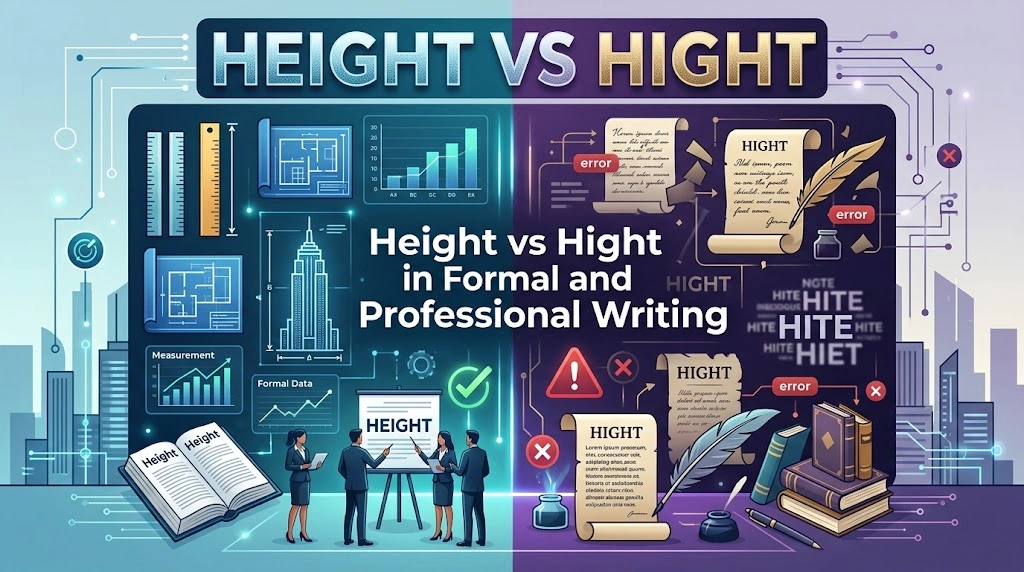
Professional writing leaves little room for spelling uncertainty.
If you’re preparing a résumé, report, academic paper, product description, technical document, or business email, use height when discussing vertical measurement.
For example:
The product has a height of 24 inches.
is appropriate for technical documentation.
So is:
Please provide the patient’s height in centimeters.
By contrast:
Please provide the patient’s hight.
looks like a simple spelling mistake.
Which Spelling Should You Use in Modern Writing?
For virtually all ordinary modern contexts involving vertical measurement, use:
height
This applies to both American and British English.
Examples:
- building height
- human height
- tree height
- ceiling height
- height measurement
- maximum height
- average height
The spelling doesn’t change to hight in American English.
Why “Height” Is the Safe Choice
Height is understood immediately by modern readers.
It appears across everyday communication, education, science, engineering, sports, medicine, architecture, and commerce.
Choosing it isn’t merely a matter of preference. It’s the standard modern form.
When Historical or Literary Texts May Use “Hight”
There are legitimate situations where hight can appear.
For example, you’re:
- quoting an old text
- studying historical English
- analyzing medieval literature
- discussing word history
- writing intentionally archaic dialogue
- reproducing historical spelling
In those circumstances, preserving the original form can be appropriate.
Context changes everything.
Height vs Hight: A Quick Decision Guide
When you’re stuck between height and hight, run through these questions.
Are You Talking About How Tall Something Is?
Use height.
The height of the building is 500 feet.
Are You Describing Vertical Distance?
Use height.
The balloon reached a height of 1,000 feet.
Are You Writing About Modern English?
Use height for the measurement.
The form requires your height.
Are You Quoting or Discussing Historical English?
Then hight might be appropriate if the historical source uses it.
The key is intentionality. Don’t use an archaic word accidentally.
Height vs Hight Practice Quiz
Test your understanding with these quick questions.
Choose “Height” or “Hight”
The ___ of the tower is 300 feet.
Answer: height
Fill in the Blank
How ___ is the new building?
Answer: high or tall, depending on the intended meaning and construction. Height doesn’t fit directly in this sentence.
Identify the Incorrect Sentence
A. Her height is 5 feet 8 inches.
B. The height of the wall is 10 feet.
C. His hight is six feet.
D. The tree has considerable height.
Answer: C
Check Your Understanding
Which statement is correct?
- Height is the standard modern noun for vertical measurement.
- Hight is simply another modern spelling of height.
- High and height are always interchangeable.
- Tall is a noun meaning vertical measurement.
Correct answer: Height is the standard modern noun for vertical measurement.
Frequently Asked Questions
Is It “Height” or “Hight”?
For modern English, the correct spelling is height when you mean vertical measurement or how tall something is.
For example:
What is the height of the building?
Hight is an archaic English word with historical uses. It isn’t the normal modern spelling of height.
Is “Hight” a Real Word?
Yes. Hight is a real historical English word.
However, its historical meanings differ from the modern meaning of height. Older English sources may use hight in the sense of called or named.
That doesn’t make it a modern alternative spelling for height.
What Is the Correct Spelling of a Person’s Height?
The correct spelling is height.
Examples:
Her height is 5 feet 5 inches.
His height is 180 centimeters.
You can also say:
She is 5 feet 5 inches tall.
Both are standard modern English.
Why Is “Height” Spelled With “Ei”?
The spelling of height reflects the historical development of the word and English spelling conventions. Modern English contains many words whose spelling can’t be predicted reliably from pronunciation alone.
The safest approach isn’t to invent a spelling from the sound. Memorize the established form:
H-E-I-G-H-T
Can “Hight” Be Used in Modern English?
It can appear in modern writing when the writer intentionally uses historical or archaic language.
For ordinary modern prose, however, hight isn’t an appropriate replacement for height.
If you’re discussing someone’s measurement, write height.
What Is the Difference Between “Height” and “High”?
Height is a noun. High is usually an adjective or adverb.
Compare:
The building is high.
The height of the building is 200 feet.
High describes a position or level. Height names the measurement or vertical extent.
What Is the Difference Between “Height” and “Tall”?
Tall is an adjective used to describe something with considerable vertical stature.
Height is a noun referring to the measurement or extent of that stature.
Compare:
Maria is tall.
Maria’s height is 6 feet.
You wouldn’t normally say Maria is height. The grammatical roles are different.
Is “Height” Used in Both American and British English?
Yes. Height is the standard spelling in both American and British English.
The word doesn’t become hight in one variety of English.
How Can I Remember the Spelling of “Height”?
Remember:
Height has an E.
You can also connect the word with high and tall:
Something can be high or tall, and its measurement is its height.
That simple association helps prevent the common hight spelling error.
Conclusion
The difference between height vs hight becomes clear once you separate modern English from historical English.
Height is the standard modern word. Use it when discussing how tall a person or object is, describing vertical distance, giving measurements, or referring to a peak or highest point.
Hight, meanwhile, is an archaic or historical word. It can appear in older English and literary contexts, particularly with historical meanings such as called or named. It isn’t a modern alternative spelling of height.
The most useful rule is simple:
If you’re talking about vertical measurement, spell it “height.”
So write:
- What is your height?
- The height of the building is 200 feet.
- The tree has reached an impressive height.
- The aircraft climbed to a greater height.
Don’t write hight in these modern contexts.
When in doubt, remember the E. That small letter makes a big difference.