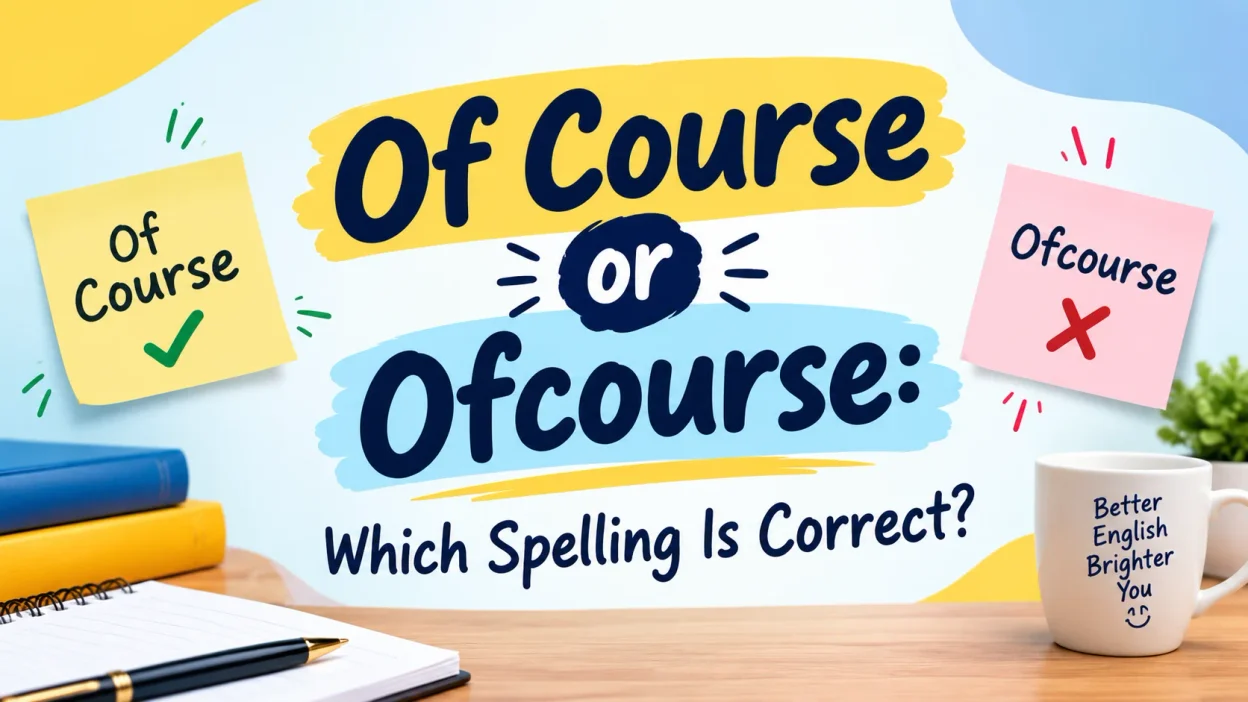
When you’re unsure whether to write Of Course or Ofcourse, the answer is surprisingly simple: of course is the correct standard spelling. The phrase of course consists of two separate words, while ofcourse is a common spelling mistake found in casual writing, text messages, and online communication. Although both forms may be understood by readers, only of course follows standard English usage.
The expression of course has several useful meanings. It can show agreement, certainty, permission, obviousness, or something considered natural or expected. You might use it in everyday conversation, a professional email, an academic sentence, or a simple text message. Its meaning depends on the context, but its spelling stays the same.
Understanding the difference between of course vs. ofcourse can help you avoid unnecessary grammar errors and improve your writing skills. This guide explains the correct spelling, meaning, grammar rules, punctuation, and sentence usage of the phrase. You’ll also find examples, common mistakes, practical tips, and answers to frequently asked questions.
What Does “Of Course” Mean?
Of course is a common English expression with several closely related meanings. Most often, speakers use it to show that something is expected, obvious, accepted, or readily agreed to.
For example:
Of course, I’ll help you with your project.
Here, of course expresses willingness and agreement.
Consider another example:
She was nervous before the interview, of course.
In this sentence, the expression suggests that her nervousness was understandable or expected.
The phrase can also answer a question:
“Can I borrow your notes?”
“Of course!”
In that context, it means something like yes, certainly, or you’re welcome to.
Definition and Meaning of “Of Course”
The phrase of course commonly communicates one of these ideas:
- Certainly — something is accepted without hesitation.
- Naturally — something seems expected from the circumstances.
- Obviously — something is presented as clear or self-evident.
- Yes — the speaker agrees to a request or statement.
- As expected — an event happened in a predictable way.
The exact meaning depends on the sentence and tone.
Compare these examples:
| Sentence | Meaning of “of course” |
| Of course, you can come with us. | Permission |
| Of course I remember you. | Certainty |
| It rained during the storm, of course. | Expected result |
| “Are you coming?” “Of course!” | Strong agreement |
| Of course, there’s another problem. | Something expected or unsurprising |
This flexibility explains why the phrase appears so frequently in natural English.
Examples of “Of Course” in Sentences
Here are several examples showing how of course works in different situations:
- Of course, you can use my laptop.
- I’ll call you tomorrow, of course.
- Of course she knows the answer.
- You should, of course, check the instructions first.
- “Did you enjoy the movie?” “Of course!”
- Of course, mistakes can happen.
- He was tired after working all day, of course.
- Of course we’ll be there on time.
- You can ask questions, of course.
- Of course, that explanation makes sense.
Notice that the phrase doesn’t always appear at the beginning. It can occur at the beginning, middle, or end of a sentence.
Is “Ofcourse” a Word?
In standard English, ofcourse is not the correct spelling of the expression.
The standard form is:
of course
Not:
ofcourse
The error happens because English contains many legitimate compounds and closed compounds. Words such as anywhere, sometimes, and although are written as single words. That can make it tempting to combine of and course.
However, familiarity doesn’t make ofcourse standard.
If you’re writing an email, article, essay, report, application, or other polished material, use of course.
Of Course vs. Ofcourse: What’s the Difference?
The difference is straightforward. Of course consists of two separate words. Ofcourse combines them incorrectly into one word.
| Form | Standard English? | Example |
| of course | Yes | Of course, I’ll help. |
| ofcourse | No | Ofcourse, I’ll help. |
| of-course | No in ordinary usage | Of-course, I’ll help. |
“Of Course” Is the Standard Form
Of course is the established written form used in standard English.
The phrase contains the preposition of followed by the noun course. Together, the words form a familiar expression whose meaning often differs from the literal meanings of the individual words.
For example:
Of course, she passed the exam.
The sentence doesn’t refer to a physical course. Instead, of course indicates that the speaker considers the result expected or unsurprising.
“Ofcourse” Is a Common Spelling Mistake
People often write ofcourse because the phrase sounds connected in normal speech.
When you say the expression aloud, you don’t normally pause noticeably between of and course. Spoken language therefore provides little help with the word boundary.
Writing works differently.
The eye needs to recognize the established spelling. That’s why learning the phrase as a complete unit can prevent the error.
Quick Comparison Table
| Question | Answer |
| Correct spelling? | Of course |
| One word or two? | Two words |
| Can it begin a sentence? | Yes |
| Can it appear in the middle? | Yes |
| Can it appear at the end? | Yes |
| Can it stand alone as a response? | Yes |
| Is “ofcourse” standard? | No |
| Is “of-course” normally correct? | No |
Easy rule: If you mean certainly, naturally, or yes, write of course.
Why Do People Write “Ofcourse”?
The spelling mistake doesn’t usually come from misunderstanding the meaning. Most people who type ofcourse understand exactly what they want to say.
The problem usually involves word boundaries.
Fast Typing and Casual Messaging
Digital communication encourages speed. People type quickly, use abbreviations, omit punctuation, and sometimes combine words unintentionally.
A person who repeatedly sees or types of course may eventually produce ofcourse without noticing.
This happens especially in:
- Text messages
- Social media comments
- Online chats
- Gaming conversations
- Informal posts
- Quick workplace messages
Casual communication can tolerate more spelling variation than formal writing. That doesn’t make the one-word spelling standard.
Confusion With Compound Words
English contains thousands of compound words.
Some started as separate expressions and eventually became compounds. Others remain permanently open phrases. This makes English spelling less predictable than learners might expect.
For example:
- of course → two words
- of course does not become ofcourse
- in fact → two words
- at least → two words
- as well → two words
- of course → two words
The appearance of other closed compounds doesn’t provide a rule for combining every familiar phrase.
Influence of Internet Usage
Search engines and social platforms can expose readers to nonstandard spellings repeatedly.
When you see ofcourse hundreds of times, the form can begin to look familiar. Familiarity, however, isn’t the same as correctness.
A useful editing habit is to question words that look unusual rather than trusting visual familiarity.
Read More: Trailer or Trailor: Which Spelling Is Correct? Meaning, Usage, and Examples
How to Use “Of Course” Correctly
Learning the spelling is only the first step. You also need to understand how of course behaves inside a sentence.
“Of Course” at the Beginning of a Sentence
When of course introduces a sentence as an introductory expression, a comma often follows it.
Of course, you can join us.
Of course, I understand your concern.
Of course, we should check the figures first.
The comma creates a brief pause and separates the introductory expression from the main statement.
However, punctuation can depend on how tightly the phrase connects to the rest of the sentence.
“Of Course” in the Middle of a Sentence
The phrase can appear in the middle of a sentence.
You can, of course, contact us if you need assistance.
Here, of course functions as an interruption or parenthetical expression. Commas help set it apart.
Another example:
The answer is, of course, more complicated than it first appears.
The phrase adds commentary without changing the basic grammatical structure.
“Of Course” at the End of a Sentence
You can also place of course at the end.
You knew that already, of course.
We’ll see you tomorrow, of course.
At the end, the phrase often reinforces an idea or suggests that the statement should be expected.
Tone matters here. Depending on context, of course can sound warm and reassuring. In another situation, it can sound sarcastic or dismissive.
For example:
Of course you can ask me.
This usually sounds welcoming.
But:
Of course you forgot your keys.
Depending on tone and context, this could sound teasing or critical.
“Of Course” in Different Contexts
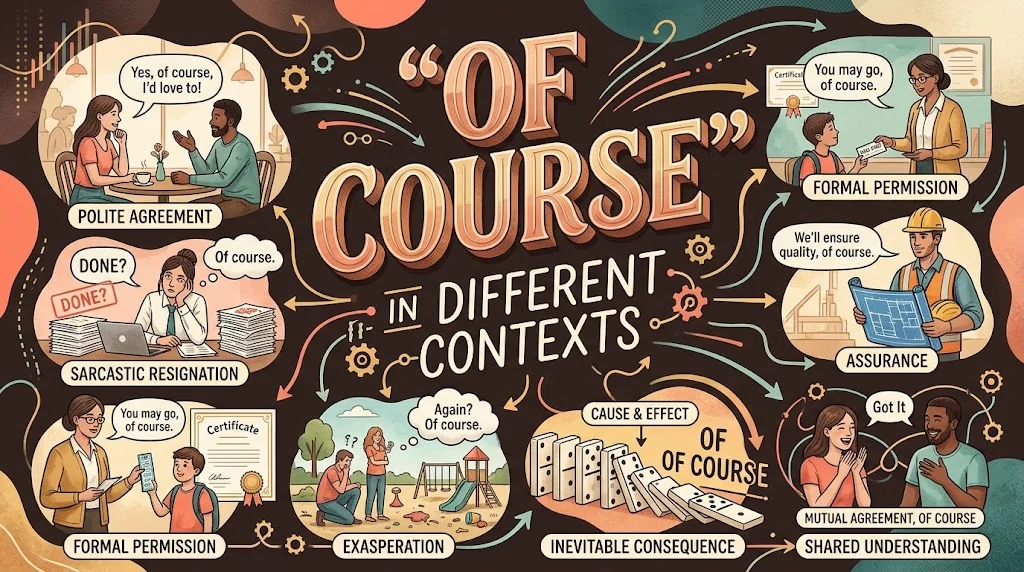
The phrase works across many forms of communication. Still, context changes how it sounds.
Everyday Conversation
In conversation, of course is extremely common.
“Can you help me?”
“Of course.”
It can communicate immediate agreement without requiring a long response.
You might also hear:
“Are you coming to dinner?”
“Of course I am!”
Here, the phrase adds emphasis to the speaker’s agreement.
Professional Communication
Of course is acceptable in workplace communication when the tone fits the situation.
For example:
Of course, I can send the revised report this afternoon.
That’s polite and natural.
However, avoid using it repeatedly. If every response begins with of course, your writing can become repetitive.
Instead, vary your language when appropriate:
- Certainly
- Absolutely
- Yes
- I’d be happy to
- That’s fine
- I can do that
Choose the wording that accurately reflects the intended tone.
Academic and Formal Writing
There is nothing inherently ungrammatical about using of course in academic writing.
However, formal writing rewards precision. If the phrase adds no meaningful information, removing it may make the sentence sharper.
Compare:
Of course, researchers must consider the limitations of the study.
with:
Researchers must consider the limitations of the study.
The second sentence is more direct if the introductory phrase contributes nothing.
That doesn’t mean of course is forbidden in academic writing. It simply means you should use it deliberately.
Grammar Behind “Of Course”
Understanding the grammar makes the spelling easier to remember.
Why “Of Course” Is Written as Two Words
Of and course are separate words.
In the expression of course, they work together to create a conventional phrase. English does not normally combine them into one word.
The fact that the expression has a unified meaning doesn’t require unified spelling.
Consider similar expressions:
- of course
- in fact
- at once
- as well
- at least
- for sure
- in general
These expressions contain separate words even though speakers often pronounce them smoothly as units.
Is “Of Course” a Prepositional Phrase?
The structure begins with of, which is a preposition, followed by course, a noun.
However, of course commonly functions as an adverbial expression in modern sentences.
For example:
Of course, I’ll attend.
The phrase modifies the statement by expressing certainty or obviousness.
Its grammatical behavior is therefore more useful to understand than trying to force every occurrence into a single rigid category.
Is “Of Course” an Idiom?
Of course is commonly described as an idiomatic or fixed expression because its practical meaning often isn’t the literal combination of of and course.
When someone says:
Of course!
they aren’t talking about a course of study, a race course, or a route.
Instead, they usually mean:
Certainly.
Naturally.
Yes.
That established meaning explains why the phrase operates as a familiar unit while remaining two words in writing.
Of Course vs. Similar Expressions
Several expressions overlap with of course, but they aren’t always interchangeable.
Of Course vs. Certainly
Certainly often expresses strong agreement or confidence.
Of course, I’ll attend the meeting.
Certainly, I’ll attend the meeting.
Both can work, although certainly may sound slightly more formal in some contexts.
Of Course vs. Naturally
Naturally emphasizes that something follows logically or is expected.
Naturally, she was disappointed.
Of course can express a similar idea:
Of course, she was disappointed.
The best choice depends on the intended tone and meaning.
Of Course vs. Sure
Sure is especially common in casual conversation.
“Can I sit here?”
“Sure.”
“Can I sit here?”
“Of course.”
Both can communicate permission. Of course can sometimes sound more emphatic or reassuring.
Of Course vs. Certainly Not
These expressions serve different purposes.
Of course can express agreement:
Of course I’ll help.
Certainly not strongly rejects an idea:
Certainly not! That’s not what I meant.
Don’t treat these phrases as simple substitutes. Context determines the appropriate expression.
Common “Of Course” Mistakes
Small spelling mistakes can undermine otherwise polished writing. Fortunately, this one is easy to fix.
Writing “Ofcourse” as One Word
Incorrect:
Ofcourse, I’ll send the document tonight.
Correct:
Of course, I’ll send the document tonight.
Adding an Unnecessary Hyphen
You may occasionally see:
of-course
In ordinary modern English, this isn’t the standard spelling of the expression.
Use:
of course
Misusing Commas With “Of Course”
A common punctuation issue involves placing commas mechanically.
For example:
Of course, I’ll help you.
The introductory comma works naturally.
Another structure is:
I’ll, of course, help you.
Here, the commas mark the phrase as an interruption.
But don’t assume every sentence requires two commas. Punctuation depends on the grammatical role and placement of the expression.
Overusing “Of Course”
Spelling isn’t the only issue.
Consider this paragraph:
Of course, we reviewed the report. Of course, we checked the numbers. Of course, we contacted the client. Of course, we updated the file.
The repetition quickly becomes distracting.
A stronger version varies the construction:
We reviewed the report, checked the numbers, contacted the client, and updated the file.
Good writing isn’t simply about using correct words. It’s also about using them with purpose.
Of Course in Professional and Academic Writing
Is “Of Course” Formal or Informal?
Of course works in both conversational and formal contexts.
Its register depends on how you use it.
| Context | Appropriate? | Example |
| Casual conversation | Yes | Of course! |
| Text message | Yes | Of course, no problem. |
| Professional email | Yes | Of course, I’ll review it. |
| Academic writing | Yes, when useful | Of course, this interpretation has limitations. |
| Formal report | Yes, selectively | The results are, of course, subject to limitations. |
The phrase itself isn’t inherently informal.
Can You Use “Of Course” in an Email?
Yes.
For example:
Of course, I’ll send the updated file before the meeting.
That’s perfectly natural.
In a formal email, though, consider whether the phrase contributes anything. Sometimes a direct response is cleaner:
I’ll send the updated file before the meeting.
The choice depends on the relationship, purpose, and desired tone.
Can You Use “Of Course” in Academic Writing?
Yes, but moderation matters.
Academic writing often aims for precision and evidence. If of course makes a claim sound self-evident when the evidence is actually debatable, the wording may weaken the sentence.
Compare:
Of course, social factors influence language development.
with:
Research on language development considers several social factors.
The second statement is more specific because it identifies the basis of the discussion rather than assuming the conclusion is obvious.
Of Course or Ofcourse: Examples at a Glance
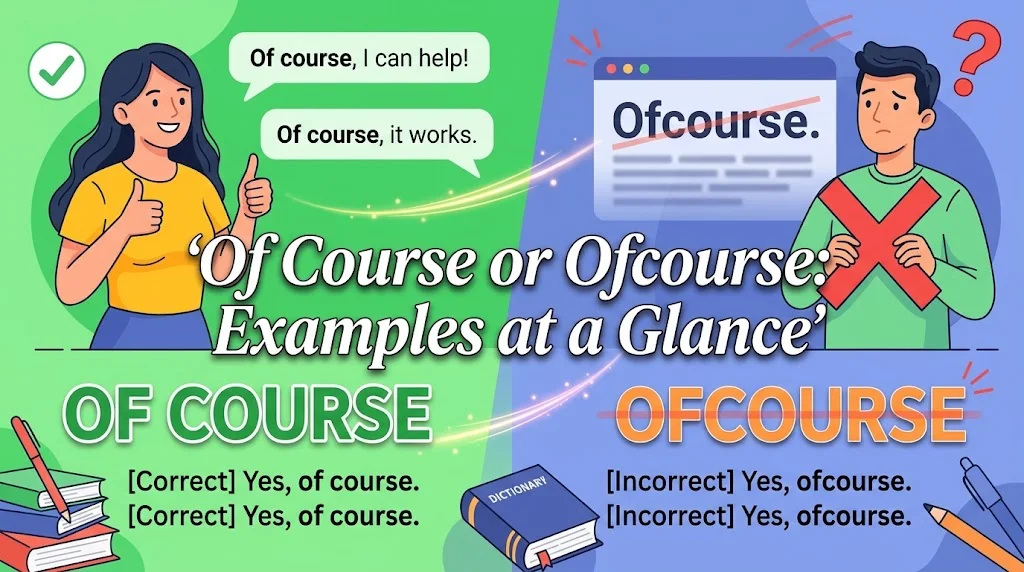
| Incorrect | Correct |
| Ofcourse, I’ll come. | Of course, I’ll come. |
| She is ofcourse right. | She is of course right. |
| Ofcourse you can ask. | Of course you can ask. |
| I’ll help, ofcourse. | I’ll help, of course. |
| Of-course, that’s fine. | Of course, that’s fine. |
Examples in Text Messages
Of course! 😊
Of course, I’ll be there.
Even in casual texting, the standard spelling remains of course.
Examples in Emails
Of course, I’ll review the document and respond tomorrow.
Of course, please let me know if you have any questions.
Examples in School Assignments
Of course, historical context can influence how readers interpret a text.
However, don’t add the phrase simply to make a sentence sound more sophisticated.
Examples in Business Writing
The figures should, of course, be verified before publication.
This can work when the writer deliberately emphasizes an expected precaution.
A Practical Case Study: Fixing “Ofcourse” in Published Content
Imagine a website publishes an otherwise well-written article containing the sentence:
Ofcourse, there are several differences between the two terms.
The reader understands the sentence immediately. The meaning remains clear.
Yet the spelling still creates a visible editing problem.
A simple revision fixes it:
Of course, there are several differences between the two terms.
Now consider the same error appearing repeatedly throughout a long article. One typo might be overlooked. Repeated errors can make the page appear less carefully edited.
The lesson is simple: correct spelling supports credibility, especially in educational and professional content.
This doesn’t mean one spelling mistake determines the quality of an entire article. Content quality involves accuracy, usefulness, organization, clarity, and many other factors.
SEO and Writing Importance of Correct Spelling
Correct spelling matters for readers first.
A page about grammar or spelling should take particular care with basic language accuracy. Readers often expect educational content to demonstrate the rules it explains.
If an article repeatedly uses ofcourse while explaining English grammar, the mismatch can distract readers.
Why Bloggers Should Avoid “Ofcourse”
Using ofcourse can:
- Make polished writing look careless.
- Distract readers.
- Reduce perceived editorial quality.
- Create unnecessary proofreading issues.
- Undermine confidence in educational content.
- Introduce inconsistency across published pages.
However, don’t confuse spelling correctness with SEO performance.
There isn’t a reliable rule saying that simply writing of course more often will make an article rank higher. Search visibility depends on many factors, including relevance, content quality, technical accessibility, authority, and user needs.
For grammar content, the better approach is straightforward: answer the reader’s question accurately and use the standard spelling naturally.
Easy Ways to Remember the Correct Spelling
Remember: Two Words, Not One
The easiest rule is also the most reliable:
OF + COURSE = OF COURSE
Keep the two words separate.
Think of It as a Phrase
Instead of memorizing of course as one sound, recognize it as a two-word expression.
When proofreading, mentally separate the phrase:
of | course
That tiny pause can help catch the error.
Read It Slowly
If you’re unsure, read the sentence aloud while deliberately noticing the word boundary.
For example:
Of … course, I’ll help.
You don’t need to speak this way in normal conversation. It’s simply a proofreading trick.
Use Grammar and Spell-Checking Tools
Digital writing tools can catch many spelling mistakes. Still, automated tools aren’t perfect.
A good proofreading process combines:
- Spell-checking
- Grammar checking
- Dictionary verification
- Reading the sentence aloud
- Manual review
For a phrase this common, a standard English dictionary or reputable style reference can also settle the question quickly.
Common Questions About “Of Course”
Before moving to the quiz, here are a few useful distinctions to keep in mind.
Of course is not difficult because its grammar is unusually complicated. The main challenge comes from remembering the word boundary.
It behaves like many familiar English expressions that contain multiple words but sound like one unit when spoken.
The same principle appears in expressions such as:
- in fact
- at least
- as well
- for sure
- in general
- at once
You shouldn’t automatically combine familiar phrases simply because they sound connected.
Of Course or Ofcourse: Quick Grammar Quiz
Test your understanding with these questions.
Which Spelling Is Correct?
A. Ofcourse
B. Of course
Answer: B. Of course
Choose the Correct Sentence
A. Ofcourse, I’ll call you later.
B. Of course, I’ll call you later.
Answer: B
Fill in the Blank
________, you can borrow my book.
Answer: Of course
Correct the Mistake
Ofcourse she knows the answer.
Correct version:
Of course she knows the answer.
True or False
“Ofcourse” is the standard spelling in modern English.
Answer: False.
The standard form is of course.
Which Form Should You Use in Professional Writing?
A. Ofcourse
B. Of-course
C. Of course
Answer: C. Of course
Quick Check!
Complete this sentence:
I can help you with that, ________.
Answer: of course
If you remembered the two-word form, you’ve got the central rule.
Frequently Asked Questions About Of Course or Ofcourse
Is “Ofcourse” Ever Correct?
In standard English writing, ofcourse is not the accepted spelling of the phrase. Write of course as two words.
You may encounter ofcourse in informal online writing, messages, comments, or user-generated content. Seeing it in those settings doesn’t make it the standard form.
For essays, articles, professional communication, and other polished writing, use of course.
Why Do People Write “Ofcourse”?
The most common reason is that the expression sounds like one connected unit when spoken. Fast typing and casual online communication can also encourage people to combine the words.
English contains many compound words, which may add to the confusion. However, familiarity with compounds doesn’t change the established spelling of of course.
Is “Of Course” Formal or Informal?
Of course can work in both formal and informal contexts.
You’ll hear it in everyday conversation, and you’ll also see it in professional or academic writing.
The important factor is context. In formal writing, use it when it adds a useful shade of meaning rather than inserting it automatically.
Can I Use “Of Course” in Academic Writing?
Yes.
There is no general grammar rule that prohibits of course in academic writing. However, academic prose often benefits from precise, evidence-based statements.
If the phrase merely announces something as obvious without adding useful meaning, you may want to remove it.
Is “Of Course” Always Followed by a Comma?
No.
When of course appears at the beginning as an introductory expression, a comma is often appropriate:
Of course, we need more evidence.
When it appears in the middle as a parenthetical expression, commas may surround it:
The results are, of course, preliminary.
At the end, punctuation depends on the sentence:
You knew that, of course.
Don’t apply a comma rule mechanically. Consider the phrase’s position and grammatical function.
Is “Of Course” an Idiom?
Of course functions as a fixed expression with meanings such as certainly, naturally, or obviously.
Its meaning often goes beyond the literal meanings of of and course. That’s why learners may find it easier to remember as a complete expression.
What Is the Easiest Way to Remember “Of Course”?
Remember this simple formula:
Of + course = two words
If you’re writing ofcourse, stop and separate the words.
Of course is the form to use in standard English.
Is “Ofcourse” Acceptable in Text Messages?
People may understand ofcourse in a text message, but it remains a nonstandard spelling.
If you want to write correctly, even in casual communication, use:
Of course
Informal communication may tolerate many shortcuts, but standard spelling remains the same.
What Is the Difference Between “Of Course” and “Certainly”?
Both expressions can communicate agreement or certainty.
Of course, I’ll help.
Certainly, I’ll help.
Of course often sounds more conversational and can also imply that something is expected or obvious. Certainly can sound more formal or deliberate.
The surrounding context determines which expression fits best.
Conclusion
The answer to of course or ofcourse is simple: of course is the correct standard spelling.
The phrase consists of two separate words, even though speakers often pronounce them as a closely connected expression. Of course can express agreement, certainty, permission, obviousness, or an expected result. Its meaning changes with context, but its spelling remains consistent.
The incorrect form ofcourse commonly appears because of fast typing, casual messaging, pronunciation, and confusion with compound words. Those factors explain the mistake, but they don’t make the one-word version standard.
You can use of course in conversations, text messages, emails, professional writing, and academic work. Just make sure the phrase serves a clear purpose, especially in formal prose. Punctuation also depends on where the expression appears and how it functions within the sentence.
If there’s one rule worth remembering, make it this:
Write “of course” as two words—not “ofcourse.”
That small distinction keeps your writing clear, polished, and consistent with standard English usage.


