If you’ve ever wondered whether Vendor or Vender is the correct spelling, you’re not alone. The two words look almost identical and sound the same in many varieties of English. That small spelling difference can create confusion, especially when you’re writing a business email, contract, website, invoice, or professional document.
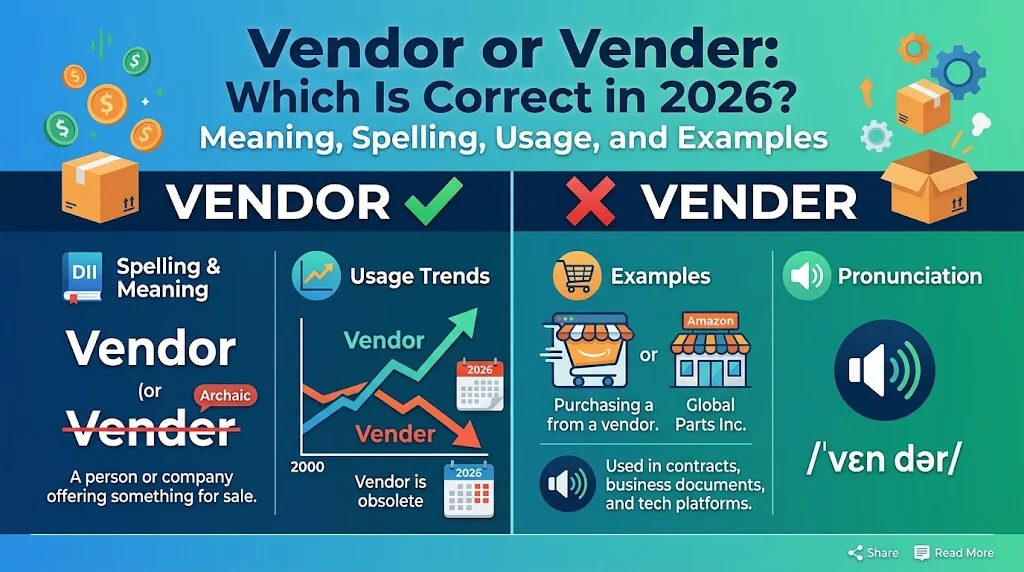
The good news is that the answer is straightforward: vendor is the standard and overwhelmingly preferred spelling in modern English. It refers to a person, company, or business that sells goods or services. You’ll see it in phrases such as software vendor, food vendor, online vendor, third-party vendor, and vendor management.
But what about vender? The word isn’t simply a random misspelling in every context. Some dictionaries recognize vender as a variant spelling of vendor. Still, that doesn’t make both forms equally useful today. In contemporary American English, business writing, technology, commerce, and everyday professional communication, vendor is the spelling you should normally choose.
This guide explains the vendor meaning, vender meaning, spelling difference, pronunciation, usage, common phrases, examples, and related terms such as seller, supplier, and merchant. You’ll also learn why people confuse these spellings and how to remember the correct form.
Vendor or Vender: Which Spelling Is Correct?
The short answer is vendor.
Vendor is the standard modern spelling for someone or a business that sells products or services. It works naturally in both everyday and professional English.
For example:
The company selected a new vendor for its office supplies.
You might also see vender in dictionaries or historical texts. In sources that recognize it, vender generally carries the same basic meaning: a person who sells something.
However, frequency and convention matter. If you’re writing an email to a client, preparing a procurement document, creating business content, or submitting an academic paper, vendor is the clear choice.
Vendor Is the Standard Spelling
The noun vendor commonly describes someone who sells something or a business that provides goods or services to customers or another organization.
It appears across many industries:
- Food vendor
- Street vendor
- Retail vendor
- Online vendor
- Software vendor
- Cloud vendor
- Technology vendor
- Third-party vendor
- Approved vendor
- Service vendor
The word has become especially common in corporate and technology language.
For example:
Our company is reviewing three software vendors before renewing the contract.
Here, vendor doesn’t necessarily mean a person standing behind a market stall. It can describe a large corporation providing sophisticated software to another organization.
Is “Vender” a Correct Word?
Vender can be found as a spelling variant of vendor in some dictionaries. That distinction matters.
Calling vender a completely meaningless word would be inaccurate. At the same time, treating vendor and vender as equally common modern spellings would also be misleading.
In contemporary writing, vendor is much more established.
Think of it this way:
Vender may be recognized, but vendor is the spelling you normally want.
If you encounter vender in an older document or a less formal online text, the context may explain why it appears. It doesn’t mean you should automatically adopt it in your own writing.
Vendor or Vender: Quick Answer
| Word | Meaning | Modern Usage | Recommendation |
| Vendor | A person or business that sells goods or services | Very common | Preferred |
| Vender | A seller; variant spelling | Uncommon | Usually avoid |
So, if you’re asking “Is it vendor or vender?”, choose vendor in almost every modern writing situation.
What Does “Vendor” Mean?
The meaning of vendor depends slightly on the setting, but the central idea remains the same.
A vendor is generally a person or organization that sells goods or provides services.
Vendor Definition
The noun vendor refers to a seller.
That seller might be an individual, a small business, a retailer, a manufacturer, or a large technology company.
For example:
- A person selling fruit at a roadside stand is a vendor.
- A company selling accounting software is a software vendor.
- A business supplying catering services for an event can be an event vendor.
- An organization selling equipment to a government agency can be a government vendor.
The term is broad enough to cover many forms of commercial activity.
Common Vendor Usage Contexts
You’ll encounter vendor particularly often in business and commerce.
Retail
Retail businesses may refer to companies that sell products as vendors.
The store added five new clothing vendors this season.
Food
Food vendors sell prepared food, snacks, beverages, or ingredients.
Several food vendors served customers at the festival.
Technology
Technology companies frequently use vendor to describe external providers.
The company changed its cloud vendor after reviewing its security requirements.
Procurement
Procurement teams often evaluate vendors before purchasing products or services.
The procurement department compared four vendors before signing the agreement.
Events
Event planners regularly work with vendors for catering, photography, entertainment, decoration, transportation, and equipment.
The wedding planner contacted each vendor two weeks before the event.
Why the Word Matters
Vendor isn’t just another word for seller. In professional settings, it often signals an ongoing commercial relationship.
A company may purchase something once from a seller. A vendor relationship can involve:
- Contracts
- Recurring payments
- Service agreements
- Product delivery
- Technical support
- Performance reviews
- Compliance requirements
- Renewals
- Negotiations
That’s why phrases such as vendor management and vendor evaluation are common in organizations.
Vendor vs. Vender: Key Differences Explained
At first glance, vendor and vender differ by only one letter. Their practical usage, however, isn’t quite equal.
| Feature | Vendor | Vender |
| Basic meaning | Seller | Seller |
| Standard modern spelling | Yes | No |
| Common in business | Yes | Rare |
| Common in technology | Yes | Rare |
| Common in professional writing | Yes | Uncommon |
| Dictionary recognition | Yes | Recognized as a variant in some dictionaries |
| Recommended choice | Yes | Generally no |
The most important distinction is usage preference rather than a completely different meaning.
Key Takeaway
When you’re unsure, use vendor.
It is familiar to readers, widely used across industries, and appropriate for formal and informal contexts.
You don’t need to complicate the decision.
Vendor is the safest and most natural spelling in modern English.
Read More: Knaw or Gnaw: Correct Spelling, Meaning, Pronunciation, and Examples
Why Do People Confuse Vendor and Vender?
The confusion isn’t surprising. English spelling often doesn’t provide a perfect roadmap to pronunciation.
Pronunciation Similarity
Vendor and vender can sound the same or extremely similar.
That creates a classic spelling problem. If you hear the word during a conversation, you can’t always determine which letters the speaker intends to use.
For example, someone might say:
“We’re changing our software vendor.”
If you’ve never seen the word written down, you might reasonably guess vender.
That’s why people who understand the meaning can still misspell the word.
The Familiar “-er” Pattern
English contains many words ending in -er. That spelling pattern can make vender look intuitive.
Words such as:
- Seller
- Worker
- Provider
- Retailer
- Supplier
- Buyer
all use familiar -er endings.
Someone may therefore assume that a person who sells something should be spelled vender. The problem is that vendor is the established spelling used for this particular noun.
Lack of Awareness
Many people learn vocabulary through speech before they encounter it in writing.
If you’ve heard vendor repeatedly but haven’t read it often, spelling becomes a guessing exercise.
The same issue occurs with many English words whose pronunciation doesn’t clearly reveal their spelling.
Typing Habits and Autocorrect
Typing quickly can also produce vender.
Someone might simply type what seems natural. Depending on the software, spell-check may not always flag the form because vender can be recognized as a legitimate variant in some dictionaries.
That creates an interesting problem: a word can be technically recognized while still being a poor choice for modern professional writing.
Vendor in Different Contexts

The word vendor becomes easier to understand when you see how widely it appears.
Retail and E-Commerce
Online marketplaces often deal with multiple vendors.
A vendor may list products, manage inventory, handle orders, or provide customer support.
Common expressions include:
- Online vendor
- Retail vendor
- Marketplace vendor
- Third-party vendor
- Authorized vendor
Example:
The marketplace removed the vendor after repeated policy violations.
Food and Events
A vendor doesn’t have to operate a large company.
At a local festival, for example, a person selling tacos, drinks, desserts, or handmade products can be called a vendor.
The food vendor sold out of sandwiches before noon.
Similarly, event planners often use vendor as a broad category for businesses involved in an event.
Business and Procurement
Procurement departments frequently use vendor-related terminology.
You might see:
- Vendor selection
- Vendor onboarding
- Vendor approval
- Vendor evaluation
- Vendor contract
- Vendor invoice
- Vendor payment
- Vendor relationship
- Vendor risk management
These expressions aren’t interchangeable with casual terms such as seller in every situation.
Software and Technology
The technology industry relies heavily on the term vendor.
A company might purchase software from a vendor or outsource a service to one.
Examples include:
- Software vendor
- Hardware vendor
- Cloud vendor
- Security vendor
- Technology vendor
- SaaS vendor
- Third-party vendor
Example:
The IT team is negotiating a new contract with its cybersecurity vendor.
Here, vendor refers to a business relationship rather than a simple retail transaction.
Government and Organizations
Government agencies and large organizations also use vendor in purchasing and contracting.
A vendor may provide:
- Office equipment
- Construction services
- IT systems
- Consulting
- Transportation
- Maintenance
- Food services
- Professional services
In these settings, vendor relationships can involve detailed contracts, compliance requirements, pricing agreements, and performance standards.
Vendor vs. Seller vs. Supplier vs. Merchant
These words overlap, but they’re not always interchangeable.
Vendor vs. Seller
Seller is the broader everyday term.
Anyone who sells something can be described as a seller.
Vendor often sounds more commercial or business-oriented.
Compare:
She is selling her old laptop.
with:
The company selected a laptop vendor.
The first sentence describes a transaction. The second suggests an ongoing commercial relationship.
Vendor vs. Supplier
A supplier typically provides goods, materials, or resources to another business or organization.
A vendor may sell products or services directly to consumers or businesses.
The distinction isn’t absolute. Companies sometimes use the terms interchangeably.
For example, a restaurant might call a company that provides vegetables its supplier. A business purchasing payroll software might call the software company its vendor.
Vendor vs. Merchant
Merchant traditionally refers to someone engaged in buying and selling goods.
The word can sound more commercial or traditional.
Vendor, meanwhile, is extremely common in modern business terminology.
Comparison Table
| Term | General Meaning | Typical Context |
| Vendor | Person or business selling goods/services | Business, retail, technology |
| Seller | Someone who sells something | General conversation |
| Supplier | Business providing goods/resources | Procurement, manufacturing |
| Merchant | Person/business engaged in trade | Commerce, retail |
Common Phrases With “Vendor”
Learning common phrases can help you remember the correct spelling.
Business Phrases
- Vendor management
- Vendor agreement
- Vendor contract
- Vendor selection
- Vendor evaluation
- Vendor payment
- Vendor invoice
- Vendor relationship
- Approved vendor
- Preferred vendor
- Third-party vendor
- Authorized vendor
Everyday and Commercial Phrases
- Food vendor
- Street vendor
- Market vendor
- Local vendor
- Online vendor
- Retail vendor
- Event vendor
Why “Vendor” Appears So Often
The word fits situations where someone or something provides goods or services as part of commerce.
That’s why vendor has become especially common in professional vocabulary. It doesn’t merely identify someone who sells an item. It can describe a business relationship that includes purchasing, contracts, delivery, support, and ongoing service.
Vendor or Vender in Professional Writing
Professional writing demands clarity.
When you’re preparing a report, proposal, email, contract, article, or business document, vendor gives readers the spelling they’re most likely to expect.
Consider these examples.
Preferred:
We contacted the vendor regarding the delayed shipment.
Less suitable:
We contacted the vender regarding the delayed shipment.
The second sentence may be understandable. However, it looks unusual to many modern readers.
Business Writing Example
Our purchasing team evaluated several vendors based on pricing, reliability, customer support, and delivery times.
Here, vendors clearly refers to companies providing products or services.
Academic Writing Example
The study examined how organizations manage relationships with external technology vendors.
Again, vendor fits naturally.
Website and Content Writing
If you’re writing website copy, product information, or educational content, consistency matters.
Use vendor unless you’re specifically discussing the variant spelling vender.
Common Mistakes Related to Vendor
Mistake 1: Assuming “Vender” Is Always a Typo
This isn’t completely accurate.
Some dictionaries recognize vender as a variant. Therefore, it can appear as a legitimate spelling in certain sources.
The more useful rule is this:
Recognized doesn’t always mean preferred.
For modern writing, vendor remains the better choice.
Mistake 2: Treating Both Spellings as Equally Common
They’re not equally common in contemporary usage.
Vendor dominates professional, commercial, technical, and general writing.
Choosing the more familiar form reduces distraction for your readers.
Mistake 3: Thinking Pronunciation Determines Spelling
English doesn’t work that way.
Many words share pronunciations or contain sounds that can represent several spellings.
Always verify the written form when accuracy matters.
Mistake 4: Confusing Vendor With Supplier
Although the words overlap, their typical contexts differ.
A supplier often provides goods or materials to another organization. A vendor can sell goods or services to businesses or consumers.
Mistake 5: Using “Vender” in Formal Documents
Even if a reader understands the word, uncommon spelling can make professional writing look less polished.
That’s especially important in:
- Contracts
- Proposals
- Reports
- Procurement documents
- Business emails
- Resumes
- Academic papers
- Website content
Vendor Example Sentences
Here are practical examples showing how vendor works in different contexts.
Business
The company signed a two-year agreement with its primary software vendor.
Retail
The store added a new clothing vendor to its marketplace.
Food
A local food vendor served fresh sandwiches at the event.
Technology
The IT department contacted the vendor about a security update.
Procurement
The purchasing team compared three vendors before making its decision.
Events
The wedding planner confirmed every vendor one week before the ceremony.
Government
The agency selected a qualified vendor through its procurement process.
Online Commerce
Customers can contact the vendor directly about product-specific questions.
With the Plural Form
Several vendors submitted proposals for the project.
Notice that the plural simply becomes vendors.
How to Remember the Correct Spelling

A simple memory trick can save you from second-guessing the word.
Think “Vendor = Business Seller”
When you think about a business that sells something, connect it with:
Vendor → Business → Seller
That association makes the spelling easier to recall.
Remember Common Phrases
If you remember phrases such as vendor contract, vendor management, and software vendor, the standard spelling becomes more familiar.
Use the Practical Rule
When you’re writing and hesitate between vendor and vender, choose:
Vendor
That’s the spelling your readers will expect in modern English.
Vendor or Vender: Quick Reference
| Question | Answer |
| Which spelling is standard? | Vendor |
| What does vendor mean? | A person or business that sells goods or services |
| Is vender recognized? | Yes, as a variant in some dictionaries |
| Which form is more common? | Vendor |
| Which form should you use professionally? | Vendor |
| Is vendor used in technology? | Yes |
| Is vendor used in retail? | Yes |
| Is vendor used internationally? | Yes |
| Are vendor and seller related in meaning? | Yes |
| Are vendor and supplier always identical? | No |
A Practical Case Study: Choosing a Vendor for a Business
Imagine a small company needs new accounting software.
The company contacts three software providers. Each provider offers different pricing, features, customer support, and contract terms.
The company refers to each provider as a vendor.
Its procurement team might create a comparison like this:
| Vendor | Price | Support | Features | Contract |
| Vendor A | $5,000/year | 24/7 | Advanced | Annual |
| Vendor B | $4,200/year | Business hours | Standard | Annual |
| Vendor C | $6,000/year | 24/7 | Advanced | Two-year |
In this context, calling the companies vendors makes perfect sense.
The term describes their role in supplying software to the business.
Calling them venders would be unusual and potentially distracting even though some dictionaries recognize that variant.
Lesson From the Example
Professional vocabulary often favors established conventions.
Vendor isn’t merely more familiar. It’s the form that fits naturally into the language of procurement, technology, commerce, and corporate operations.
Is “Vendor” a Formal Word?
Yes.
Vendor is perfectly appropriate in formal and professional English.
You can use it in:
- Business reports
- Academic writing
- Contracts
- Government documents
- Procurement records
- Technical documentation
- Professional emails
It can also appear in casual contexts.
The food vendor near the park makes great sandwiches.
So the word isn’t limited to formal writing. Its broad usefulness is one reason vendor remains so common.
Does “Vendor” Mean a Person or a Company?
It can mean either.
A vendor may be an individual who sells something or an organization that provides products or services.
For example:
The street vendor sold handmade bracelets.
Here, vendor refers to an individual.
Now consider:
Microsoft is a major software vendor.
Here, vendor refers to a company.
The surrounding context tells you which meaning applies.
Is Vendor Used Globally?
Yes.
Vendor is widely understood in varieties of English around the world. It appears in international business, technology, retail, procurement, and commerce.
Regional vocabulary can vary, but vendor remains a broadly recognizable term.
That makes it a particularly useful choice when you’re writing for an international audience.
Does “Vender” Affect SEO?
Spelling accuracy and search intent are separate issues.
If your target keyword is vendor, using the standard spelling naturally throughout an article helps ensure that the content matches the wording readers commonly use.
However, don’t treat SEO as a reason to repeat the same word unnaturally.
Good content should use:
- Vendor
- Vendor meaning
- Vendor definition
- Vendor vs. vender
- Software vendor
- Online vendor
- Vendor management
- Vendor contract
- Third-party vendor
Use these terms where they genuinely fit the subject.
If you’re specifically explaining the spelling confusion, mention vender naturally rather than repeatedly forcing it into unrelated sentences.
Mini Quiz: Vendor or Vender?
Test your understanding.
Choose the Correct Spelling
Which sentence uses the preferred modern spelling?
A. We contacted the vender about the invoice.
B. We contacted the vendor about the invoice.
Answer: B — vendor
Complete the Sentence
The company selected a new software _______.
Answer: vendor
Business Writing Challenge
Which is more appropriate for a formal procurement document?
A. Vender agreement
B. Vendor agreement
Answer: B — Vendor agreement
True or False
“Vender” can appear as a recognized variant spelling in some dictionaries.
Answer: True.
However, recognition doesn’t make it the preferred modern spelling.
Fill in the Blank
The food _______ sold fresh sandwiches at the festival.
Answer: vendor
FAQs About Vendor or Vender
Is “vender” ever correct?
Yes. Vender is recognized as a variant spelling in some dictionaries and sources. However, it is much less common than vendor in modern English. For most contemporary writing, especially professional writing, vendor is the better choice.
Which spelling should I use in business writing?
Use vendor. It is the standard and familiar form used throughout business, commerce, procurement, retail, and technology.
For example:
We need to review the vendor contract before signing it.
Is vendor used globally?
Yes. Vendor is widely understood and used in international English, particularly in business and commercial contexts. It isn’t limited to American English.
Why does “vender” still appear sometimes?
Several factors can explain its appearance. Some dictionaries recognize vender as a variant, older texts may use it, and writers sometimes spell words according to pronunciation. Online content can also preserve uncommon variants.
Are vendor and seller the same?
They overlap in meaning, but seller is broader and more general. Vendor often sounds more commercial or business-oriented. A person selling something can be called a seller, while a company providing software to another business is commonly called a vendor.
Is a vendor the same as a supplier?
Not always. A supplier commonly provides goods, materials, or resources to another business. A vendor can provide products or services to either businesses or consumers. In some industries, however, the terms overlap.
Is vendor a formal word?
Yes. Vendor works well in formal, professional, academic, technical, and everyday writing.
Can a person be a vendor?
Yes. A street seller, food seller, market seller, or independent business owner can all be described as a vendor.
Can a company be a vendor?
Yes. Companies frequently act as vendors when they provide goods or services to customers or other organizations.
What is a third-party vendor?
A third-party vendor is an external company or provider that supplies products or services to an organization. For example, a business might hire a third-party vendor for cloud hosting, payroll, cybersecurity, or customer support.
What is vendor management?
Vendor management is the process of selecting, coordinating, monitoring, and maintaining relationships with external vendors. Businesses may evaluate pricing, performance, security, contracts, compliance, and service quality as part of that process.
Should I use “vendor” or “vender” in an article?
Use vendor when referring to a seller in ordinary modern writing. Mention vender when discussing the spelling variant itself. This approach keeps your writing clear and aligned with common contemporary usage.
Conclusion: Vendor or Vender?
When choosing between vendor or vender, the practical answer is simple: use vendor.
Vendor is the standard and widely preferred spelling for a person or organization that sells goods or services. You’ll encounter it in retail, procurement, technology, e-commerce, food service, government contracting, and countless other commercial settings.
Vender deserves a little more nuance. It isn’t merely an invented spelling. Some dictionaries recognize it as a variant of vendor. Still, its modern usage is uncommon compared with vendor.
That distinction gives you an easy rule to follow:
If you’re writing about someone who sells goods or services, choose “vendor.”
Whether you’re writing a business email, preparing a contract, publishing an article, or describing a software provider, vendor is the spelling that will look natural to most readers.
When in doubt, don’t overthink it. Vendor is the clear modern choice.