Choose vs Chose can be confusing because both words come from the same verb, yet they don’t serve the same grammatical purpose. The difference becomes clear once you understand verb tense, past tense, and the base form of a verb. In simple terms, choose generally describes a present action or appears in structures that refer to the future, while chose describes a completed action in the past.
For example, you might say, “I choose the blue shirt,” when describing a current decision. If the decision happened yesterday, you would say, “I chose the blue shirt.” The third form, chosen, creates another important distinction because it functions as the past participle of choose.
These three forms often cause mistakes in English grammar, especially in sentences containing did, to, have, has, or had. You may have seen errors such as “did chose,” “to chose,” or “have chose.” Each one follows a different grammar rule.
Understanding choose, chose, and chosen doesn’t require memorizing complicated terminology. Once you recognize the verb form, sentence structure, and time reference, the correct choice becomes much easier. This guide breaks down choose vs chose, explains their meanings and pronunciation, and provides practical examples you can use in everyday, academic, and professional writing.
Choose vs Chose: The Quick Answer
The easiest way to understand choose vs chose is to focus on time.
Choose refers to an action in the present or a choice discussed in a future context.
Chose refers to a completed action in the past.
| Word | Verb form | Main use | Example |
| Choose | Base/present form | Present, general, or future construction | I choose the blue one. |
| Chose | Simple past | Completed past action | I chose the blue one yesterday. |
| Chosen | Past participle | Perfect tenses and passive constructions | I have chosen the blue one. |
Choose When the Action Is Present or Future
Use choose when the action happens now, happens regularly, or appears in a construction referring to the future.
For example:
I usually choose tea instead of coffee.
The sentence describes a regular preference. It doesn’t point to one finished decision.
You can also use choose in future constructions:
I will choose my major next semester.
Here, the actual choice hasn’t happened yet. The auxiliary will carries the future meaning, while choose remains in its base form.
Chose When the Action Happened in the Past
Use chose when someone completed the act of selecting something.
Sarah chose the red dress last night.
The choice happened in the past and is finished. That’s why chose is correct.
Compare:
- Today, Sarah chooses the red dress.
- Yesterday, Sarah chose the red dress.
The time reference changes the verb form.
The One-Line Rule to Remember
Choose now or in a future construction; chose for a completed past action.
There’s one more form worth remembering:
Choose → Chose → Chosen
Once you understand that pattern, most choose vs chose questions become much easier.
What Does “Choose” Mean and When Should You Use It?
The verb choose means to select one person, thing, action, or option from two or more possibilities.
You might choose a meal from a menu, choose a college, choose a career, choose a color, or choose what to do next.
The word can describe a decision happening right now or a general habit.
Choose as the Present-Tense Form
Choose functions as the base form of the verb and works as the present form with I, you, we, and they.
Examples:
- I choose carefully.
- You choose the restaurant.
- We choose our own schedules.
- They choose different options.
With he, she, or it, the present-tense form normally becomes chooses.
- She chooses the healthier option.
- He chooses his words carefully.
- The customer chooses a larger size.
This distinction matters because choose and chooses both describe present-time actions, while chose describes the simple past.
Choose After “To”
English uses the base form of a verb after to in an infinitive construction.
Therefore:
I want to choose a new laptop.
Not:
I want to chose a new laptop.
The same pattern appears in many sentences:
- She decided to choose another route.
- We need to choose a date.
- They plan to choose a winner.
- He hopes to choose the right candidate.
A useful rule is:
to + choose
Never use to chose when to introduces an infinitive.
Choose After Modal Verbs
Modal verbs require the base form of the following verb.
Common modal verbs include:
- can
- could
- may
- might
- must
- shall
- should
- will
- would
So you write:
- I will choose tomorrow.
- You should choose carefully.
- We can choose later.
- She might choose the cheaper option.
- They could choose another supplier.
Notice something important: even though will can indicate the future, the verb stays choose.
We will choose a winner tomorrow.
Not:
We will chose a winner tomorrow.
The modal already controls the grammar. The following verb stays in its base form.
What Does “Chose” Mean and When Should You Use It?
Chose is the simple past form of choose.
It tells readers that the selection happened at an earlier point in time.
For example:
Mark chose the blue car last Saturday.
The decision occurred in the past. The action is complete.
Chose Describes a Finished Decision
The strongest clue for chose is a completed decision.
Consider:
I chose the chicken sandwich for lunch.
The sentence describes a choice that has already happened.
Past-time expressions often make this especially obvious:
- yesterday
- last week
- last month
- last year
- earlier
- this morning
- two days ago
- when I was younger
- during the meeting
Examples:
We chose the hotel yesterday.
She chose accounting last year.
They chose a different supplier during the meeting.
However, you don’t always need an explicit past-time word. Context can establish that the decision happened earlier.
I looked at all the options and chose the simplest one.
The verbs looked and chose clearly place the actions in the past.
Chose Is Not Used After “Did”
This is one of the most common choose vs chose mistakes.
When did acts as the auxiliary in a question or negative sentence, the main verb returns to its base form.
Correct:
Did you choose this restaurant?
Incorrect:
Did you chose this restaurant?
Why?
Because did already carries the past-tense meaning. The main verb doesn’t need to carry it again.
The same rule applies to statements with didn’t:
I didn’t choose the expensive package.
Not:
I didn’t chose the expensive package.
Think of it this way:
did + choose
The past tense belongs to did, so choose stays in its base form.
Chose Is an Irregular Past-Tense Form
English verbs generally form their simple past in one of two broad ways.
Regular verbs commonly add -ed:
- walk → walked
- work → worked
- select → selected
But choose is irregular:
- choose → chose
You don’t add -ed to make its standard past form.
Therefore:
She chose the winner.
Not:
She choosed the winner.
This irregular pattern is worth memorizing because there’s no simple -ed rule that produces chose.
Choose, Chose, and Chosen: Understanding All Three Verb Forms
Understanding choose vs chose becomes much easier when you include chosen.
These three forms belong to the same verb:
choose → chose → chosen
Each form has a different grammatical job.
Choose: Present or Base Form
Choose is the base form.
It appears in:
- present-tense constructions
- infinitives
- commands
- modal constructions
- future constructions using auxiliary verbs
Examples:
I choose this option.
Please choose one answer.
We need to choose today.
She will choose tomorrow.
Chose: Simple Past Form
Chose is the simple past form.
Examples:
I chose the first option.
He chose a different career.
They chose the blue seats.
The action occurred in the past.
Chosen: Past Participle
Chosen is the past participle.
It commonly appears with have, has, or had in perfect constructions.
Examples:
I have chosen my topic.
She has chosen a new apartment.
They had chosen the venue before we arrived.
It can also appear in passive constructions:
She was chosen as team captain.
Here, chosen isn’t the simple past form. It functions as a past participle.
The Complete Choose Verb Pattern
| Form | Grammar role | Example |
| Choose | Base form | Please choose one. |
| Chooses | Present, third-person singular | He chooses carefully. |
| Chose | Simple past | He chose carefully yesterday. |
| Chosen | Past participle | He has chosen carefully. |
| Choosing | Present participle/gerund | He is choosing now. |
This table shows why replacing chose with chosen isn’t always correct. Each form has its own grammatical environment.
How to Decide Between Choose and Chose Every Time
When you’re unsure about choose vs chose, don’t rely on how the sentence sounds alone. Use a quick grammar check.
Step 1: Find the Action
Identify what the person actually did.
If the action involves selecting an option, you’re probably working with choose or one of its forms.
Maya ___ a new laptop.
The verb you’re looking for is choose.
Step 2: Ask When the Action Happened
Now identify the time.
If it happens now or describes a regular action:
I choose tea every morning.
If it happened in the past:
I chose tea yesterday.
If you’re describing an experience completed using the perfect tense:
I have chosen tea already.
This time test solves many problems quickly.
Step 3: Look for Grammar Signals
Certain words strongly influence which form you need.
| Signal | Correct form | Example |
| to | choose | to choose |
| did | choose | did choose |
| Modal verb | choose | will choose |
| have/has/had | chosen | have chosen |
| Completed simple past | chose | chose yesterday |
These patterns provide a reliable shortcut.
Step 4: Check for “Did”
If you see did before the verb, use choose.
- Did you choose?
- I did choose the right option.
- Why did she choose that one?
Never use did chose in standard English.
Step 5: Check for Have, Has, or Had
If have, has, or had is being used to form the perfect tense, choose chosen.
- I have chosen.
- She has chosen.
- We had chosen.
This is where many learners confuse chose and chosen.
Choose vs Chose Examples in Real Sentences
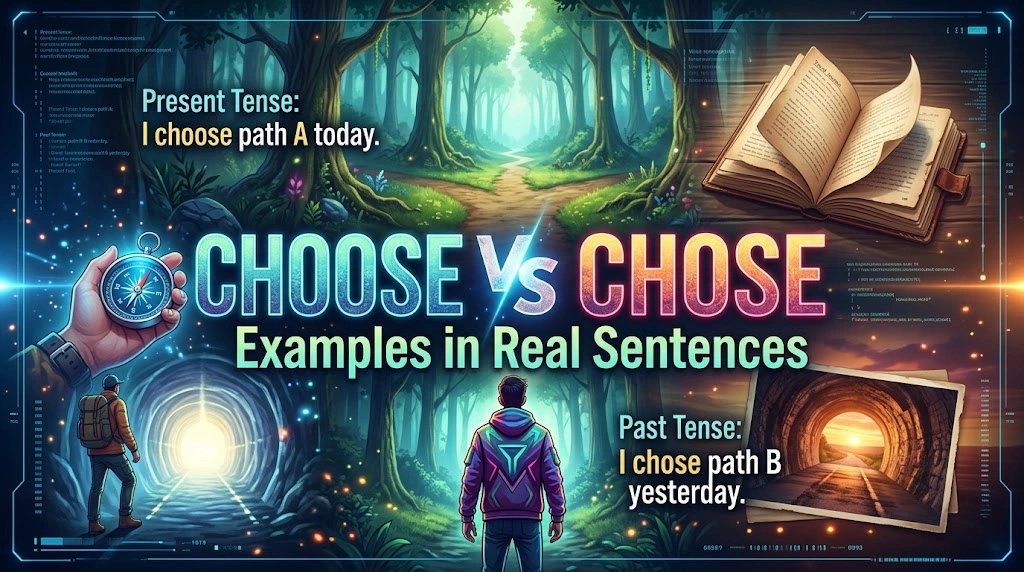
Seeing the words in realistic contexts makes the distinction easier to remember.
At School
I choose English as my favorite subject.
This describes a present preference.
I chose English as my major last year.
This describes a completed past decision.
I have chosen my research topic.
This uses the past participle after have.
At Work
We choose the most practical solution.
This describes a current approach or general practice.
We chose the cheaper supplier last month.
The decision happened last month.
We will choose a new supplier next quarter.
The decision is expected in the future.
While Shopping
I usually choose products with simple packaging.
This describes a regular habit.
I chose the black jacket yesterday.
The purchase decision happened in the past.
I haven’t chosen a gift yet.
The sentence uses the present perfect with chosen.
Making Future Plans
I’ll choose the destination tonight.
We are going to choose a hotel tomorrow.
She might choose the earlier flight.
All three sentences refer to a future decision. The verb remains choose because the surrounding grammar creates the future meaning.
In Everyday Conversation
“Which one did you choose?”
“I chose the blue one.”
This short exchange demonstrates both forms naturally.
The question uses did + choose. The answer uses chose because it stands alone as a simple past verb.
Choose vs Chose in Different Sentence Patterns
The verb choose appears in several common patterns. Learning these structures helps you use the correct form without hesitation.
Choose Between Two Options
Use choose between when describing a selection involving alternatives.
You must choose between the two plans.
Past:
We chose between the two plans yesterday.
However, in many contexts, choose between A and B sounds more natural than simply saying choose between two things.
She chose between the red dress and the black dress.
Choose From Several Options
Use choose from when selecting from a group or range.
Customers can choose from five meal options.
Past:
Customers chose from five meal options.
Perfect:
Customers have chosen from the available options.
Choose to Do Something
The pattern choose to + base verb is extremely common.
I choose to stay home.
She chose to leave early.
Notice the difference:
- Present: choose to leave
- Past: chose to leave
The word following to remains leave in both cases.
Choose Someone or Something
You can use choose with a direct object.
They choose a new leader.
They chose a new leader.
The tense changes the first verb while the object remains the same.
Choose Someone for Something
English also uses choose when someone selects a person for a role or purpose.
The committee chose Maria for the position.
The coach will choose a new captain.
Maria was chosen as captain.
These examples demonstrate all three forms in related constructions.
Read More: Window Seal vs Window Sill: Meaning, Differences, and Correct Usage
Common Choose vs Chose Mistakes and How to Fix Them
Certain mistakes appear repeatedly because learners treat choose, chose, and chosen as interchangeable.
Mistake: Using “Chose” for the Present
Incorrect:
I chose this option every time.
If you’re describing a current habit, use choose:
I choose this option every time.
If you’re talking about one completed decision, however, chose is correct:
I chose this option yesterday.
Context determines the form.
Mistake: Using “Choose” for a Completed Past Action
Incorrect:
Yesterday, I choose the blue shirt.
Correct:
Yesterday, I chose the blue shirt.
The word yesterday provides a clear past-time signal.
Mistake: Writing “To Chose”
Incorrect:
I want to chose a new phone.
Correct:
I want to choose a new phone.
After to, use the base form.
Mistake: Writing “Did Chose”
Incorrect:
Did you chose this option?
Correct:
Did you choose this option?
The auxiliary did already marks the past.
Mistake: Writing “Have Chose”
Incorrect:
I have chose my answer.
Correct:
I have chosen my answer.
After have, use the past participle.
Mistake: Using “Choosed”
Incorrect:
We choosed the best candidate.
Correct:
We chose the best candidate.
Choosed isn’t the standard past-tense form of choose.
The correct irregular form is chose.
Mistake: Confusing “Chose” With “Chosen”
This distinction is especially important.
She chose the red dress.
Simple past.
She has chosen the red dress.
Present perfect.
She had chosen the red dress before the store closed.
Past perfect.
The surrounding auxiliary verb determines whether chosen is required.
A Real-Life Writing Example: How One Small Verb Changed the Meaning
Imagine a manager writes this message:
“We choose the new supplier yesterday.”
The meaning is understandable, but the grammar is wrong because yesterday places the decision in the past.
The corrected sentence is:
“We chose the new supplier yesterday.”
Now consider a different message:
“We will choose the new supplier tomorrow.”
Here, choose is correct because will creates the future construction.
A third version changes the structure again:
“We have chosen the new supplier.”
The decision is presented as completed with relevance to the present.
These three sentences describe closely related events:
| Sentence | Form | Meaning |
| We choose the supplier. | Choose | Present/general action |
| We chose the supplier yesterday. | Chose | Completed past action |
| We have chosen the supplier. | Chosen | Completed action in a perfect construction |
A single verb family can therefore express different relationships between an action and time.
Why Choose vs Chose Matters in Modern English
Correct verb forms aren’t merely academic rules. They help readers understand when an event happened and how it relates to the present.
Why Correct Verb Tense Builds Clarity
Compare:
The company chooses a new provider last year.
The sentence creates a tense mismatch. Chooses suggests present time, while last year clearly points backward.
Now compare:
The company chose a new provider last year.
The timing is immediately clear.
In professional writing, that clarity matters. A small tense error can make a timeline confusing, especially when several decisions appear in the same paragraph.
A Practical Data Perspective
English has thousands of irregular verbs and verb forms. Choose belongs to the familiar pattern where the simple past doesn’t use the regular -ed ending.
Its core forms are:
choose — chose — chosen
Because these forms differ substantially, learners often memorize them as a set rather than trying to derive one mechanically from another.
The important point isn’t memorizing a complicated chart. It’s recognizing the grammatical environment where each form belongs.
Easy Memory Tricks for Choose and Chose
Remember the “OO” in Choose
Choose contains oo, just like several familiar base-form words.
Think:
Choose = now or base form
For example:
I choose the healthier meal.
Remember: Chose Has Already Closed the Decision
The word chose can remind you of a decision that’s already finished.
I chose the blue one yesterday.
The decision is closed.
This isn’t a grammatical rule. It’s simply a memory association that can make the distinction easier to recall.
Use the Verb Pattern
Memorize this short sequence:
choose → chose → chosen
Then attach a basic meaning to each:
- choose = base/present
- chose = past
- chosen = past participle
Use a Time Test
Ask yourself:
“Has the decision already happened?”
If yes, chose may be right for simple past.
I chose the restaurant yesterday.
If the decision is happening now or appears in a base-form construction:
I choose the restaurant.
If the sentence uses have, has, or had:
I have chosen the restaurant.
This three-question test catches most everyday errors.
Choose vs Chose Pronunciation
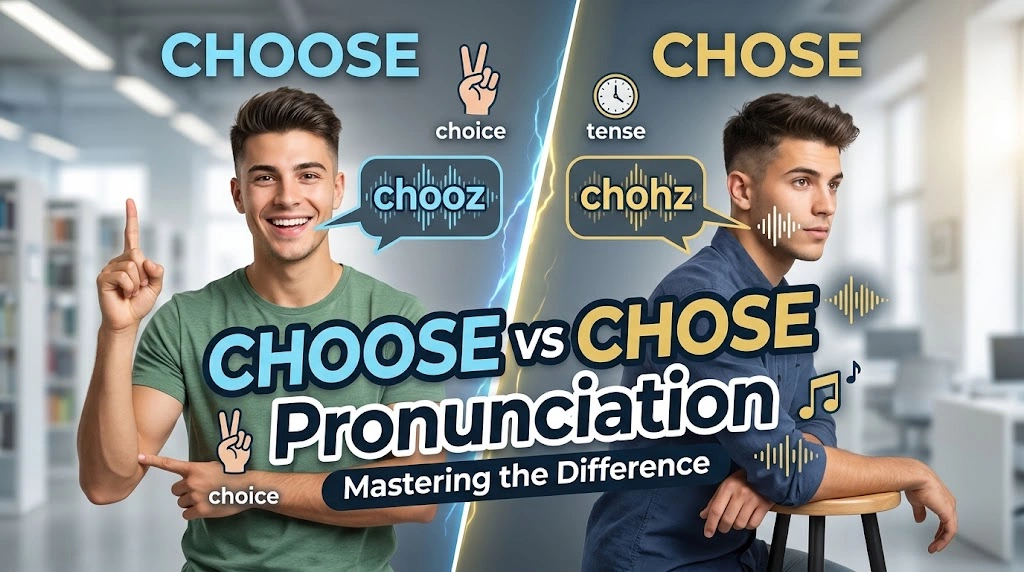
Spelling isn’t the only difference between these words. Their vowel sounds differ as well.
How to Pronounce “Choose”
In standard US English, choose is pronounced approximately:
/tʃuːz/
The vowel sounds like the oo in food.
The final consonant is a z sound.
You can hear the same general vowel quality in words such as:
- food
- moon
- school
- blue
How to Pronounce “Chose”
Chose is pronounced approximately:
/tʃoʊz/
The vowel is similar to the sound in:
- go
- home
- phone
- those
The ending again has a z sound.
Choose vs Chose Pronunciation Comparison
| Word | IPA | Approximate sound |
| Choose | /tʃuːz/ | “chooz” |
| Chose | /tʃoʊz/ | “chohz” |
The spelling difference reflects a real pronunciation difference.
Choose vs Chose: Quick Comparison Table
| Feature | Choose | Chose | Chosen |
| Basic role | Base/present form | Simple past | Past participle |
| Time | Present or future construction | Past | Perfect/passive constructions |
| Example | I choose carefully. | I chose carefully. | I have chosen carefully. |
| After “to” | Yes | No | No |
| After “did” | Yes | No | No |
| After modal verbs | Yes | No | No |
| After have/has/had | No | No | Yes |
| Regular or irregular | Irregular verb family | Irregular past | Irregular participle |
The fastest pattern to remember is:
to choose
did choose
chose yesterday
have chosen
Those four structures cover a large portion of everyday usage.
When Should You Use “Choose” or “Chose” in Formal Writing?
Formal writing follows the same grammar rules as everyday English. The difference is that mistakes can become more noticeable when you’re writing for school, work, business, or publication.
In Professional Emails
Use choose when discussing current or future decisions.
Please choose your preferred meeting time.
Use chose when explaining a completed decision.
We chose the second proposal after reviewing both options.
Use chosen in perfect constructions.
We have chosen the final supplier.
In Academic Writing
Academic writing often discusses decisions made during research.
The researchers chose participants based on specific criteria.
When describing an ongoing methodological principle:
Researchers often choose participants according to predefined criteria.
The tense should match the actual meaning and timeline.
In Business Writing
Business documents frequently contain multiple decisions. Accurate verb forms make those timelines easier to follow.
Compare:
The board chose the new strategy last quarter.
with:
The board will choose the new strategy next quarter.
The first decision has already happened. The second remains in the future.
Mini Quiz: Choose vs Chose vs Chosen
Test yourself before checking the answers.
Fill in the Blank
I ___ the blue option yesterday.
A. choose
B. chose
C. chosen
Answer: B. chose
Choose the Correct Sentence
A. Did you chose this plan?
B. Did you choose this plan?
Answer: B. Did you choose this plan?
Complete the Perfect Construction
She has ___ a new apartment.
A. choose
B. chose
C. chosen
Answer: C. chosen
Identify the Correct Present Form
I usually ___ the vegetarian option.
A. choose
B. chose
C. chosen
Answer: A. choose
Correct the Sentence
We choosed the cheapest option.
Correct version:
We chose the cheapest option.
Future Challenge
We will ___ a final answer tomorrow.
A. chose
B. choose
C. chosen
Answer: B. choose
Did-Test Challenge
Why did she ___ that restaurant?
A. choose
B. chose
C. chosen
Answer: A. choose
Past-Time Challenge
They ___ a different route last night.
A. choose
B. chose
C. chosen
Answer: B. chose
Perfect-Tense Challenge
He had ___ the winner before the ceremony began.
A. choose
B. chose
C. chosen
Answer: C. chosen
Final Quick Challenge
Which sentence is correct?
A. I have chose the red one.
B. I have chosen the red one.
C. I have choose the red one.
Answer: B. I have chosen the red one.
Frequently Asked Questions
Is “Chose” the Past Tense of “Choose”?
Yes. Chose is the simple past form of choose.
I choose the blue one today.
I chose the blue one yesterday.
The past participle is chosen.
Should I Say “I Choose” or “I Chose”?
It depends on when the action occurs.
Use I choose for a present action, regular choice, or base-form construction.
I choose tea every morning.
Use I chose for a completed past action.
I chose tea yesterday.
Is It “Did You Choose” or “Did You Chose”?
The correct form is “Did you choose?”
After did, use the base form of the verb.
Correct:
Did you choose?
Incorrect:
Did you chose?
Is It “Have Chose” or “Have Chosen”?
The correct form is “have chosen.”
Chosen is the past participle required after have.
I have chosen my answer.
Not:
I have chose my answer.
Can “Choose” Refer to the Future?
Yes, but choose itself isn’t a simple future-tense ending.
English commonly creates future constructions with auxiliary verbs.
Examples include:
I will choose tomorrow.
She is going to choose later.
They might choose another option.
The base form choose follows these structures.
Is “Choosed” a Word?
Choosed isn’t the standard simple past form of choose in modern standard English.
The correct forms are:
choose → chose → chosen
Therefore, write:
We chose the best option.
Not:
We choosed the best option.
What Is the Difference Between “Chose” and “Chosen”?
Chose is the simple past form.
She chose the red dress.
Chosen is the past participle.
She has chosen the red dress.
The difference depends on the grammatical construction, not simply on whether the action happened in the past.
What Is the Easiest Way to Remember Choose vs Chose?
Use this quick rule:
Choose = base/present
Chose = simple past
Chosen = past participle
Then remember these patterns:
to choose
did choose
chose yesterday
have chosen
Final Thoughts
The difference between choose vs chose becomes straightforward once you focus on grammar and time.
Choose is the base form. It appears in present constructions and after words such as to, did, and modal verbs.
Chose is the simple past form. Use it when someone completed a decision in the past.
Chosen is the past participle. It usually appears with have, has, or had, as well as in passive constructions.
Keep the core pattern close at hand:
Choose → Chose → Chosen
When you’re unsure, check the words around the verb. If you see did, use choose. If you see have, has, or had, use chosen. If you’re describing one completed past decision without an auxiliary, chose is usually the form you need.
Once these patterns become familiar, choose vs chose stops being a spelling trap and becomes an easy grammar decision.