If you’ve ever written about psychology, medicine, biology, or emotional health, you may have paused over dysregulated vs disregulated. Both spellings look reasonable at first glance, especially because dis- is a familiar English prefix. However, dysregulated is the established form used when describing a process, system, or response that is functioning abnormally or is poorly controlled. The related noun is dysregulation, while the verb is dysregulate.
Understanding this distinction becomes particularly useful in professional writing, academic writing, medical terminology, and psychology terminology. You’ll often encounter phrases such as emotional dysregulation, nervous system dysregulation, hormonal dysregulation, and immune dysregulation. In these expressions, the word describes a problem with normal regulation, rather than simply an absence of control.
The confusion becomes easier to resolve when you understand the prefixes. Dys- can indicate something abnormal, impaired, or difficult, while dis- has several different functions in English. This difference explains why dysregulated fits the intended meaning more precisely.
This guide examines dysregulated vs disregulated, their meanings, spelling, word formation, professional usage, examples, and common mistakes. By the end, you’ll know which form to choose and why.
What Does Dysregulated Mean?
Dysregulated is the adjective form associated with dysregulate and dysregulation. It describes something whose normal regulatory process isn’t working properly.
In simple terms, imagine a thermostat controlling the temperature in a room. The system still has a thermostat and heating or cooling mechanisms, but the regulation doesn’t work as expected. You could describe the system as dysregulated if its control process has become abnormal or impaired.
The word appears frequently in scientific and professional contexts, particularly when writers discuss complex biological or psychological systems.
Definition of Dysregulated
Dysregulated generally means abnormally regulated, poorly regulated, or affected by a disruption in normal regulation.
The exact meaning depends on the subject being discussed.
For example:
The study examined how stress affects a dysregulated immune response.
Here, dysregulated doesn’t necessarily mean that the immune system has stopped working. Instead, it indicates that the normal regulatory mechanisms aren’t functioning appropriately.
This distinction matters.
A dysregulated system can still operate. Its problem lies in how regulation occurs, rather than necessarily in whether regulation exists at all.
Dysregulated, Dysregulate, and Dysregulation
These words belong to the same word family:
| Word | Part of speech | Meaning |
| Dysregulate | Verb | To cause or contribute to abnormal regulation |
| Dysregulated | Adjective/past participle | Abnormally or improperly regulated |
| Dysregulation | Noun | Abnormal or impaired regulation |
| Regulate | Verb | To control or adjust |
| Regulation | Noun | The process of controlling or adjusting something |
For example:
- Chronic stress may dysregulate normal physiological processes.
- The system became dysregulated.
- Researchers investigated dysregulation of the system.
That word family provides a useful clue when you’re deciding which spelling belongs in your sentence.
What Does the Prefix “Dys-” Mean?
The prefix dys- comes from Greek and is associated with ideas such as abnormality, impairment, difficulty, or faulty functioning.
You can see this pattern in several established English words:
- Dysfunction — impaired or abnormal functioning
- Dyslexia — a condition involving difficulties with reading and language processing
- Dysphagia — difficulty swallowing
- Dysplasia — abnormal development of cells or tissues
- Dysregulation — abnormal or impaired regulation
The prefix doesn’t simply mean “bad.” Its meaning depends on the word it forms.
That’s important because dysregulated describes a problem involving regulation itself.
Why the Prefix Matters
Consider these two constructions:
dys + regulated → dysregulated
dis + regulated → disregulated
Both might look grammatically possible to someone encountering them for the first time. English word formation, however, isn’t simply a matter of attaching whichever prefix seems logical.
Established terminology develops through usage, specialized fields, dictionaries, research literature, and linguistic convention.
In modern medical, psychological, and scientific writing, dysregulated is the established form for the concept of abnormal or impaired regulation.
Common Contexts Where Dysregulated Is Used
You’ll find dysregulated in several fields. The surrounding noun usually tells you exactly what kind of regulation is being discussed.
Emotional Dysregulation
Emotional dysregulation refers broadly to difficulty modulating emotional responses.
For example:
The therapist discussed strategies for managing emotional dysregulation.
The phrase doesn’t simply mean that someone has emotions. Everyone experiences emotions. Instead, it concerns difficulties with how emotional responses are regulated.
Nervous System Dysregulation
Scientific and health-related writing may discuss nervous system dysregulation when describing altered regulation within nervous-system processes.
For example:
Researchers examined changes associated with nervous system dysregulation.
The term should be interpreted according to the specific research or clinical context.
Hormonal Dysregulation
Hormonal dysregulation describes abnormal regulation involving hormones or endocrine processes.
For example:
The researchers investigated hormonal dysregulation in the study population.
Again, the term doesn’t automatically identify a particular diagnosis. The surrounding evidence and medical context matter.
Immune Dysregulation
Immune dysregulation appears in scientific and medical discussions involving abnormal immune responses or regulatory processes.
For example:
The paper examined mechanisms involved in immune dysregulation.
Metabolic Dysregulation
Researchers may also discuss metabolic dysregulation when describing disrupted or abnormal regulation of metabolic processes.
The broader lesson is simple: dysregulated is especially useful when you’re describing a system that has regulatory mechanisms but isn’t regulating normally.
Read More: Nominator vs Nominee: Meaning, Key Differences, Examples, and Legal Responsibilities
Dysregulated vs Disregulated: Key Differences
The central difference is terminology and established usage.
| Feature | Dysregulated | Disregulated |
| Standard term for abnormal regulation | Yes | Generally not |
| Related noun | Dysregulation | Disregulation is uncommon |
| Common in psychology | Yes | Rare |
| Common in medical writing | Yes | Rare |
| Common in scientific writing | Yes | Limited |
| Prefix | Dys- | Dis- |
| General sense | Abnormally or improperly regulated | Context-dependent and uncommon |
| Preferred modern terminology | Yes | Usually no |
When your intended meaning is abnormally regulated, dysregulated is normally the appropriate choice.
Dysregulated
Use dysregulated when describing abnormal, impaired, disrupted, or poorly functioning regulation.
Examples:
- dysregulated emotions
- dysregulated immune response
- dysregulated nervous system
- dysregulated hormonal processes
- dysregulated metabolic pathways
Disregulated
Disregulated can appear in actual writing, but its occurrence doesn’t automatically make it the preferred form for the modern scientific concept of dysregulation.
People often create it because dis- is a highly productive and familiar English prefix.
That’s one reason the spelling can feel natural even when it’s not the established terminology you need.
Is “Disregulated” a Real Word?
This question requires more nuance than simply saying “yes” or “no.”
English contains many words that appear in limited, historical, regional, technical, or inconsistent usage. A word’s appearance somewhere doesn’t necessarily mean it’s the standard term for a particular modern concept.
Disregulated is encountered occasionally, but it isn’t the usual modern term used for the concept represented by dysregulated.
That distinction is especially important in professional writing.
If you’re writing about emotional, physiological, neurological, hormonal, immune, or other forms of abnormal regulation, dysregulated is the established choice.
Why People Write “Disregulated”
There are several understandable reasons.
First, the prefix “dis-” is familiar.
English uses dis- in words such as:
- disagree
- disconnect
- dislike
- disorder
- distrust
- disapprove
A writer may therefore assume that disregulated should mean “not properly regulated.”
Second, “disregulated” looks logical.
Someone might reason:
regulate → disregulate → disregulated
That pattern feels plausible. However, established terminology doesn’t always follow the most obvious word-building pattern.
Third, online repetition reinforces mistakes.
Once an uncommon spelling appears online, other writers may copy it without checking authoritative sources or specialized literature.
That’s how a plausible-looking form can gain visibility without becoming the preferred technical term.
Dysregulated vs Unregulated vs Deregulated
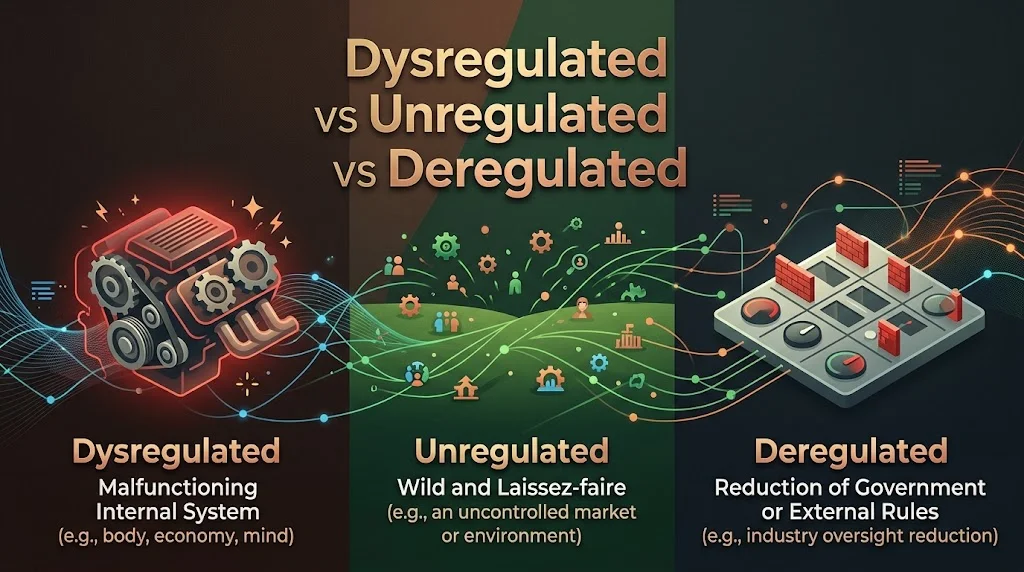
A major source of confusion is that dysregulated, unregulated, and deregulated can all involve regulation. They don’t mean exactly the same thing.
Dysregulated
Dysregulated means regulation is abnormal, impaired, disrupted, or functioning improperly.
The researchers investigated a dysregulated inflammatory response.
Unregulated
Unregulated generally means something isn’t regulated or controlled by an applicable regulatory mechanism, authority, or system.
The industry operated in an unregulated market.
The emphasis is different. Dysregulated focuses on abnormal regulation. Unregulated focuses on a lack of regulation.
Deregulated
Deregulated commonly means that regulations or controls have been removed, reduced, or changed.
For example:
The government deregulated parts of the industry.
The three terms can therefore be summarized like this:
| Term | Core idea |
| Dysregulated | Regulation is abnormal or impaired |
| Unregulated | Regulation is absent or not applied |
| Deregulated | Existing regulation has been reduced or removed |
These aren’t interchangeable in careful writing.
How Dysregulated Is Used in Psychology
Psychology is one of the fields where you’ll frequently encounter dysregulated.
Emotional Dysregulation
Emotional dysregulation is a broad descriptive term concerning difficulty managing or modulating emotional responses.
For example:
The child showed difficulty managing intense emotional responses.
A clinical or academic text might describe such a pattern in terms of emotional dysregulation, depending on the assessment and context.
Importantly, emotional dysregulation isn’t itself a universal synonym for a specific psychiatric diagnosis.
That’s an important distinction for responsible writing.
A person can experience difficulty regulating emotions without that phrase alone establishing a particular diagnosis.
Behavioral Regulation
The concept can also appear when discussing behavior.
A researcher might describe difficulties involving:
- impulse control
- emotional responses
- attention
- behavioral inhibition
- stress responses
- coping processes
However, the precise meaning depends on the study or clinical framework.
Why “Emotionally Dysregulated” Appears So Often
The phrase emotionally dysregulated combines the adjective with an adverb that identifies the domain.
For example:
He felt emotionally dysregulated after the stressful event.
The wording communicates that the person’s emotional regulation felt disrupted or difficult.
In formal writing, however, specificity often improves clarity:
The participant reported difficulty regulating intense emotions.
The second sentence explains the phenomenon rather than relying entirely on specialist terminology.
Dysregulated in Medicine and Science
The word also has broad applications outside psychology.
Nervous System Dysregulation
Researchers may use dysregulation when discussing altered regulatory processes involving the nervous system.
The exact meaning depends on the biological mechanism under discussion.
A careful scientific article should therefore identify what process is dysregulated, rather than using the word as a vague catch-all.
Hormonal Dysregulation
Hormones operate through complex feedback systems. When researchers discuss hormonal dysregulation, they may be referring to abnormalities involving hormone production, signaling, feedback, or control.
The term is descriptive. It doesn’t automatically identify one disease.
Immune Dysregulation
The immune system relies on tightly coordinated regulatory mechanisms.
Scientific literature may use immune dysregulation when discussing abnormal immune activity or impaired control of immune responses.
For example:
The researchers investigated mechanisms associated with immune dysregulation.
The surrounding research determines what “dysregulation” specifically means.
Metabolic Dysregulation
Metabolism also involves multiple regulatory pathways.
A scientific article might discuss metabolic dysregulation when describing abnormal control of metabolic processes.
This is another example of why dysregulated is more precise than simply saying “not regulated.”
Common Mistakes With Dysregulated and Disregulated
Mistake #1: Assuming “Dis-” Fits Every Negative Meaning
English doesn’t work like a mathematical formula.
You can’t always take a familiar word and attach dis- to create the correct opposite or negative form.
For example:
- agree → disagree
- connect → disconnect
- approve → disapprove
That doesn’t mean:
- regulate → disregulate
is the established form for every context involving abnormal regulation.
Mistake #2: Confusing Dysregulated With Unregulated
These terms describe different situations.
A dysregulated process may still have active regulatory mechanisms.
An unregulated process may lack effective regulation altogether.
Consider a thermostat again.
If the thermostat exists but repeatedly maintains the wrong temperature, you could use the idea of dysregulation.
If there is no thermostat or applicable control system, unregulated may better capture the situation.
Mistake #3: Using Deregulated as a Substitute
Deregulated often refers to deliberately reducing or removing rules, restrictions, or controls.
For example:
The sector was deregulated after regulatory reforms.
That isn’t the same concept as a biological system becoming dysregulated.
Mistake #4: Assuming Online Frequency Proves Correctness
Search engines can show many forms of a word. Frequency alone doesn’t establish preferred terminology.
When terminology matters, check:
- established dictionaries
- medical terminology resources
- academic literature
- professional organizations
- style guides
- reputable reference works
How to Use Dysregulated Correctly in Sentences
Here are examples across different contexts.
General Examples
The system became dysregulated after prolonged disruption.
Researchers observed signs of dysregulated activity.
The study focused on mechanisms involved in dysregulation.
Psychology Examples
The patient reported difficulty managing intense emotions.
The researchers examined emotional dysregulation among participants.
Stress may affect processes involved in emotional regulation.
Medical and Scientific Examples
The study examined immune dysregulation.
Researchers investigated hormonal dysregulation in the experimental model.
The findings suggest altered regulation within the metabolic pathway.
Professional Writing Examples
For technical audiences:
The researchers identified evidence of dysregulated inflammatory signaling.
For general audiences:
The researchers found that the body’s normal regulatory process wasn’t working properly.
Both sentences can communicate the same basic idea. The second simply explains the technical term.
Dysregulated vs Disregulated: Incorrect and Correct Examples
| Less appropriate | Preferred |
| The patient appeared disregulated. | The patient appeared dysregulated. |
| Researchers studied emotional disregulation. | Researchers studied emotional dysregulation. |
| The study examined a disregulated immune response. | The study examined a dysregulated immune response. |
| Hormonal disregulation affected the process. | Hormonal dysregulation affected the process. |
For modern professional and scientific writing, the right-hand forms are the safer established choices when abnormal regulation is intended.
How to Remember Dysregulated

A simple memory trick can make this distinction easier.
Remember “Dysregulation”
Instead of memorizing only dysregulated, remember the whole word family:
dysregulate → dysregulated → dysregulation
If you know that the noun is dysregulation, the adjective becomes easier to recall.
Think “Abnormal Regulation”
Another useful association is:
Dysregulated = regulation isn’t working normally.
That gives you the meaning without relying on an oversimplified prefix rule.
Don’t Force the “Dis-” Pattern
When you see regulate, don’t automatically assume disregulated is the correct derivative.
Ask yourself:
Am I describing abnormal or impaired regulation?
If the answer is yes, dysregulated is generally the form you want.
A Practical Editing Checklist
Before publishing an article, report, essay, or professional document, check these points:
- Dysregulated is the intended adjective.
- Dysregulation is the intended noun.
- Dysregulate is the intended verb.
- Unregulated isn’t actually the intended meaning.
- Deregulated isn’t the intended meaning.
- The surrounding context explains what is being regulated.
- Technical terminology is appropriate for the intended audience.
- Medical or psychological claims aren’t broader than the available evidence.
This quick check can prevent a surprisingly noticeable terminology error.
Dysregulated vs Disregulated: Quick Reference
| Question | Answer |
| Which spelling is normally preferred? | Dysregulated |
| What does dysregulated mean? | Abnormally, improperly, or poorly regulated |
| What is the noun? | Dysregulation |
| What is the verb? | Dysregulate |
| Is disregulated commonly preferred in modern scientific writing? | No |
| Is emotional dysregulation an established phrase? | Yes |
| Is dysregulated the same as unregulated? | No |
| Is dysregulated the same as deregulated? | No |
| Which prefix appears in dysregulated? | Dys- |
| Why is disregulated confusing? | The familiar dis- prefix makes the form look plausible |
Frequently Asked Questions
Is “Dysregulated” a Real Word?
Yes. Dysregulated is an established English term used extensively in medical, scientific, psychological, and other technical contexts. It describes something that is regulated abnormally, poorly, or improperly.
Its related noun is dysregulation, while its verb is dysregulate.
Is “Disregulated” a Real Word?
Disregulated does occur in written English, but it isn’t the standard modern term for the concept of abnormal regulation in most medical, psychological, and scientific contexts.
When that meaning is intended, dysregulated is generally the appropriate choice.
Is Dysregulated a Medical Term?
Yes. Dysregulated and dysregulation are used in medical and scientific literature to describe abnormal regulation of biological processes.
The specific meaning depends on the system being discussed, such as immune, hormonal, metabolic, or neurological processes.
What Does Emotionally Dysregulated Mean?
Emotionally dysregulated generally describes difficulty regulating or modulating emotional responses.
It doesn’t automatically mean that someone has a particular mental health diagnosis. The phrase is descriptive, and its precise interpretation depends on the context.
Is Dysregulated the Same as Unregulated?
No.
Dysregulated generally means regulation is abnormal or impaired. Unregulated generally suggests that regulation is absent, lacking, or not applied.
The distinction becomes especially important in technical writing.
Is Dysregulated the Same as Deregulated?
No.
Dysregulated describes abnormal or impaired regulation. Deregulated commonly describes a deliberate reduction or removal of rules, controls, or regulatory restrictions.
For example, a biological process can become dysregulated, while an industry can be deregulated.
Why Do People Confuse Dysregulated and Disregulated?
The confusion largely comes from the familiar dis- prefix.
English has many common words beginning with dis-, so disregulated can look perfectly logical. However, modern specialized terminology generally uses dysregulated for abnormal regulation.
Which Is Correct: Dysregulated or Disregulated?
When you’re describing abnormal, impaired, or disrupted regulation, dysregulated is the established modern choice.
For example:
The study examined dysregulated immune responses.
Can I Use Dysregulated in Academic Writing?
Yes. Dysregulated is appropriate in academic writing when it accurately describes the subject.
However, always make the term specific enough for your audience. If readers may not understand the technical vocabulary, briefly explain what is being dysregulated.
What Is the Noun Form of Dysregulated?
The noun form is dysregulation.
For example:
The researchers investigated dysregulation of the immune response.
The related verb is dysregulate:
Chronic stress may dysregulate physiological processes.
Conclusion
The distinction between dysregulated vs disregulated becomes much easier once you focus on established terminology rather than simply looking at the prefixes.
Dysregulated is the standard modern form for describing abnormal, impaired, disrupted, or poorly functioning regulation. You’ll commonly see it in phrases such as emotional dysregulation, immune dysregulation, hormonal dysregulation, and nervous system dysregulation.
Disregulated may appear in some writing, but it isn’t generally the preferred term for this concept. The related word family provides a useful reminder: dysregulate, dysregulated, and dysregulation.
It’s also worth keeping dysregulated, unregulated, and deregulated separate. They can overlap conceptually, but they describe different kinds of relationships with regulation.
When you mean that a system’s normal regulatory process is impaired or abnormal, dysregulated is the spelling to choose.