
Choosing between long term and long-term can seem like a tiny grammar issue. Yet this small hyphen often changes how a sentence works. If you’ve ever paused while writing long term goals, long-term planning, or in the long term, you’re certainly not alone.
English frequently combines words into compound adjectives, and hyphenation helps readers understand how those words function together. The key isn’t simply memorizing where the hyphen goes. You need to recognize whether long term functions as a noun phrase or whether long-term acts as a compound modifier.
Once you understand that distinction, the rule becomes surprisingly easy. In standard US English, long-term usually appears before a noun when the two words work together as an adjective. By contrast, long term remains open when it functions as a noun phrase, especially in expressions such as in the long term and over the long term. The spelling longterm is generally not standard.
This guide explains the correct spelling, grammar rule, hyphenation rule, sentence structure, and common usage patterns with practical examples. By the end, you’ll know exactly when to write long term and when to write long-term.
Quick Answer: Long Term or Long-Term?
The correct form depends on how the phrase functions in your sentence.
- Long-term is normally used before a noun as a compound adjective.
- Long term is normally used as a noun phrase.
- Longterm is generally not the standard spelling in US English.
Compare these sentences:
She developed a long-term strategy for the company.
Here, long-term describes the noun strategy.
Now consider:
The company is thinking about the long term.
Here, long term acts as a noun phrase. It refers to a future period or perspective.
That’s the central distinction.
Is “longterm” correct?
In standard modern US English, longterm is generally not the accepted form.
You should normally write either:
- long term
- long-term
The one-word spelling can appear as a mistake, informal usage, or occasionally in specialized branding. However, it isn’t the standard spelling to use in ordinary formal writing.
When should you write “long term”?
Use long term when the phrase functions as a noun phrase or appears in established expressions such as:
- in the long term
- over the long term
- for the long term
- the long term
For example:
We need to consider the long term.
When should you write “long-term”?
Use long-term when the phrase directly modifies a noun.
Examples include:
- long-term goals
- long-term investment
- long-term effects
- long-term relationship
- long-term solution
- long-term care
The easiest rule to remember
Before a noun → long-term.
As a noun phrase → long term.
Think of it this way:
long-term plan
but:
plan for the long term
That simple contrast will solve most cases.
What Does “Long Term” Mean?
Long term refers to an extended period of time or a future period considered as a whole.
It often describes a perspective rather than a specific number of months or years.
For example:
We need to think about the long term.
The speaker isn’t necessarily defining the period as five, ten, or twenty years. Instead, the phrase contrasts with the short term.
You might therefore see this contrast:
| Shorter perspective | Longer perspective |
| short term | long term |
| short-term plan | long-term plan |
| in the short term | in the long term |
The exact length of the period depends on context.
For a technology company, the long term might mean several years. For a retirement plan, it could mean decades. In medicine, a long-term effect might refer to an outcome that develops or persists over an extended period.
“Long term” as a noun phrase
The word term is the main noun, while long modifies it.
Consider:
The long term matters more than immediate results.
Here, long term refers to a period or future outlook.
The phrase doesn’t directly modify another noun.
That’s why it remains open.
“Long term” after prepositions
Several common expressions use the open form:
- in the long term
- over the long term
- for the long term
- from the long-term perspective — note the hyphenated adjective here
Examples:
The investment should pay off in the long term.
We need a strategy that works over the long term.
She is building the business for the long term.
Notice how the grammatical role changes when another noun follows.
Compare:
We need to think in the long term.
with:
We need a long-term strategy.
The first contains a noun phrase. The second contains a compound adjective.
Read More: Judgement or Judgment: The Correct Spelling, Meaning, and Usage
What Does “Long-Term” Mean?
Long-term means lasting, intended to last, or relating to an extended period.
It usually works as a compound adjective.
A compound adjective consists of two or more words that work together to describe a noun.
For example:
They created a long-term plan.
The words long and term work together to describe plan.
The hyphen signals that connection.
Why the hyphen matters before a noun
Consider:
We discussed a long-term investment.
The hyphen tells the reader that long and term belong together as one descriptive unit.
Without the hyphen:
We discussed a long term investment.
The meaning may still be understandable. However, the standard compound-adjective treatment calls for long-term before the noun.
This pattern appears throughout English:
- long-term plan
- full-time employee
- high-speed connection
- well-known author
- short-term solution
The hyphen helps readers process the words as a unit.
Examples of “long-term” in sentences
She has a long-term goal of opening her own business.
The treatment may produce long-term effects.
They need a long-term solution rather than a temporary fix.
He made a long-term investment in the company.
The organization developed a long-term strategy.
In each sentence, long-term comes directly before a noun.
Long Term vs Long-Term: The Main Difference
The difference becomes much easier when you look at the grammatical function.
| Form | Function | Example |
| long term | Noun phrase | We should consider the long term. |
| long term | Part of a prepositional expression | It will help in the long term. |
| long-term | Compound adjective | They created a long-term plan. |
| long-term | Compound modifier | She needs long-term care. |
| longterm | Nonstandard spelling | Avoid it in standard writing. |
The important question isn’t simply, “Does this phrase describe something?”
Instead, ask:
Does “long” + “term” directly modify a noun immediately afterward?
If yes, long-term is usually the correct choice.
If the phrase stands on its own as a noun phrase, use long term.
The Simple Grammar Rule for Long Term vs Long-Term
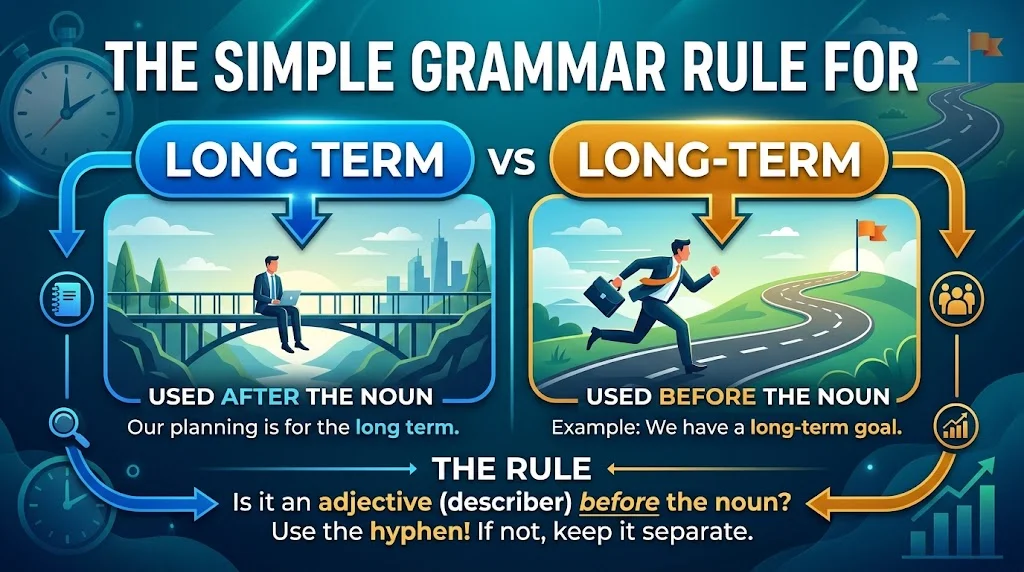
Here’s the rule worth remembering:
Use “long-term” before a noun. Use “long term” when the phrase functions as a noun or appears in expressions such as “in the long term.”
Before a noun: use “long-term”
Examples:
- long-term success
- long-term growth
- long-term planning
- long-term contract
- long-term consequences
As a noun phrase: use “long term”
Examples:
- Think about the long term.
- This strategy works in the long term.
- The benefits become clearer over the long term.
A quick substitution test
When you’re unsure, look at the word immediately after the phrase.
If a noun follows directly, the hyphenated form will often be appropriate:
long-term + noun
For example:
long-term strategy
long-term goal
long-term care
But if the phrase stands independently:
in the long term
over the long term
for the long term
Use the open form.
Long Term or Long-Term in Common Sentences
Context makes the distinction clearer.
Long-term relationship
They have maintained a long-term relationship with the client.
Here, long-term modifies relationship.
Long-term goals
She wrote down her long-term goals before starting the project.
Again, the compound adjective comes before the noun.
Long-term planning
Successful organizations usually invest in long-term planning.
The hyphenated phrase describes planning.
Long-term care
Some patients require long-term care.
Long-term functions as an adjective before care.
Long-term effects
Researchers continue to study the long-term effects of the treatment.
The phrase modifies effects.
Long-term investment
Real estate can be considered a long-term investment.
The phrase modifies investment.
Think about the long term
Before making a decision, think about the long term.
Here, the phrase doesn’t directly modify another noun.
In the long term
The changes could save money in the long term.
This is one of the most common open-form constructions.
Over the long term
Small improvements can produce significant results over the long term.
Again, long term functions within a prepositional phrase.
For the long term
The company needs a solution designed for the long term.
The phrase remains open because it functions as a noun phrase following for.
Is “Longterm” One Word?
In standard US English, longterm is generally not the correct spelling.
The standard choices are long term and long-term, depending on grammatical function.
Why “longterm” is usually incorrect
English frequently combines words over time. Some compounds eventually become single words, while others remain open or hyphenated.
For example:
- online is one word.
- long-term remains hyphenated in its common adjectival use.
- long term remains open when functioning as a noun phrase.
There’s no general rule saying that frequently used phrases automatically become one word.
Therefore, don’t turn long-term into longterm simply because you see the phrase often.
Longterm vs long-term
| Incorrect in standard usage | Standard form |
| longterm plan | long-term plan |
| longterm goal | long-term goal |
| longterm effects | long-term effects |
| in the longterm | in the long term |
If you’re writing an article, report, academic paper, business document, or professional email, avoid longterm.
Long-Term as a Compound Modifier
Hyphens often function like small grammatical road signs.
They show readers that multiple words should be interpreted together.
Compare:
a long-term strategy
The hyphen links long and term into one compound modifier.
English uses this structure extensively.
Consider:
- short-term
- long-term
- full-time
- part-time
- high-level
- low-cost
- well-known
However, hyphenation depends on grammatical position.
For example:
She is a full-time employee.
But:
She works full time.
The same basic principle helps explain long-term versus long term.
Do You Hyphenate “Long Term” After the Noun?
Usually, you don’t need the hyphen when the phrase comes after the noun and functions differently.
For example:
The effects were long term.
Here, long term follows the noun effects and acts as a predicate complement.
Compare:
We studied the long-term effects.
Before the noun, the compound modifier is hyphenated.
This gives you another useful comparison:
| Before a noun | After a noun |
| long-term effects | effects are long term |
| long-term solution | solution is long term |
| long-term consequences | consequences are long term |
| long-term benefits | benefits are long term |
This pattern isn’t limited to long-term. English commonly changes hyphenation according to grammatical position.
Long Term vs Longer Term
Longer-term is also possible.
It means something has a longer duration or horizon when compared with another period.
For example:
We need a longer-term solution.
This suggests that the solution should last longer than another solution under consideration.
Compare:
We need a long-term solution.
This simply describes a solution designed for an extended period.
But:
We need a longer-term solution.
This introduces comparison.
Examples
The company adopted a long-term strategy.
This describes the strategy generally.
The company needs a longer-term strategy than its competitors.
Now the writer makes a comparison.
The distinction is subtle but useful.
Long Term or Long-Term in Different Contexts
Business and workplace writing
Business writing frequently uses long-term as an adjective.
Examples include:
- long-term growth
- long-term planning
- long-term strategy
- long-term partnership
- long-term objectives
Example:
The company is focused on long-term growth rather than short-term gains.
Finance and investing
Financial writing also uses the hyphenated form extensively.
Investors often consider long-term returns when evaluating an asset.
But:
Investors should consider the long term rather than reacting to every daily price movement.
The same grammar rule applies despite the specialized context.
Education
Schools and students commonly discuss:
- long-term learning
- long-term academic goals
- long-term development
- long-term educational planning
Example:
Consistent reading can support long-term vocabulary development.
Healthcare
Healthcare writing contains many established examples:
- long-term care
- long-term treatment
- long-term effects
- long-term recovery
- long-term condition
Example:
Doctors may monitor patients for long-term effects.
Technology
Technology companies often discuss:
- long-term support
- long-term compatibility
- long-term maintenance
- long-term security
- long-term performance
Example:
The update should improve the software’s long-term stability.
Relationships and personal goals
Everyday writing uses the phrase just as naturally:
They are in a long-term relationship.
She has several long-term goals.
He is thinking about his career in the long term.
The grammatical rule doesn’t change because the subject changes.
Long Term vs Long-Term: Real-Life Examples

The easiest way to master the distinction is to compare correct and incorrect constructions.
| Common mistake | Better form | Why |
| longterm plan | long-term plan | Compound adjective |
| long term plan | long-term plan | Hyphenated before noun |
| in the long-term | in the long term | Noun phrase |
| over the long-term | over the long term | Noun phrase |
| long-term is important | long term is important | Predicate noun phrase |
| longterm effects | long-term effects | Compound adjective |
Before-and-after corrections
Incorrect:
We need a long term strategy.
Correct:
We need a long-term strategy.
Incorrect:
This should benefit us in the long-term.
Correct:
This should benefit us in the long term.
Incorrect:
The company needs a longterm solution.
Correct:
The company needs a long-term solution.
Correct:
The company needs to think about the long term.
Here, no hyphen is necessary.
What Do Major Style Guides Say?
Style guides generally support the underlying grammatical distinction, although individual guides can vary in their treatment of particular compounds.
Associated Press style
AP style generally uses hyphens when multiple words function together as a compound modifier before a noun and the hyphen improves clarity.
That principle supports constructions such as:
long-term strategy
and:
long-term investment
AP style also emphasizes consistency and clarity.
Chicago style
The Chicago Manual of Style treats hyphenation as a matter of grammatical function, readability, and established usage.
Compound modifiers appearing before nouns commonly receive hyphens when needed to show that the words function together.
Thus:
long-term planning
is a natural construction.
However:
planning for the long term
doesn’t normally require a hyphen.
APA style
APA style also uses hyphens in compound modifiers when appropriate.
Academic writers therefore commonly use:
long-term effects
long-term outcomes
long-term study
But:
over the long term
remains open.
Oxford and British English usage
British English generally follows the same basic distinction.
You’ll commonly encounter:
long-term consequences
and:
in the long term
Some dictionaries and style references may differ on individual compounds or editorial preferences. That’s why checking the style guide required by your publication or institution remains useful.
For standard US English, however, the practical rule is straightforward.
Common Mistakes With Long Term and Long-Term
Writing “longterm”
This is the most obvious mistake.
❌ longterm goals
✅ long-term goals
Using “long term” before a noun
Writers often omit the hyphen because the meaning remains obvious.
❌ long term investment
✅ long-term investment
The sentence isn’t difficult to understand, but the hyphenated form follows standard compound-modifier conventions.
Adding unnecessary hyphens
The opposite mistake also happens.
❌ in the long-term
✅ in the long term
Don’t automatically add a hyphen every time you see long term.
Hyphenating every occurrence
A hyphen isn’t simply part of the phrase’s spelling.
Its function depends on grammar.
Compare:
long-term planning
with:
planning for the long term
Both are correct.
Confusing “long-term” with “longer-term”
These forms aren’t interchangeable.
Long-term describes an extended period.
Longer-term makes a comparison.
Treating headline style as ordinary sentence grammar
Titles sometimes use capitalization and punctuation differently from body text.
For example:
Long-Term Investment Strategies
That doesn’t mean every occurrence should be hyphenated.
The grammatical role still matters.
Long Term or Long-Term in Titles and Headlines
For a title such as:
Long Term or Long-Term? Which Form Is Correct?
the distinction remains visible in the title itself.
If long-term directly modifies another noun, retain the hyphen:
Long-Term Investment Strategies
If you’re discussing the phrase as a grammatical expression, you may write:
Long Term or Long-Term?
For SEO titles, don’t remove a necessary hyphen simply to match a keyword phrase exactly. Search engines can generally understand variations, while readers still benefit from correct grammar.
Synonyms for Long Term and Long-Term
Sometimes you can avoid repetition by choosing a context-appropriate alternative.
Alternatives for “long term”
Depending on meaning, you might use:
- over an extended period
- in the future
- over time
- eventually
- in the years ahead
- over the years
- from a future perspective
For example:
We should consider the long term.
Could become:
We should consider the future implications.
Alternatives for “long-term”
Possible alternatives include:
- lasting
- sustained
- extended
- ongoing
- enduring
- future-oriented
- permanent, when permanence is actually intended
Be careful with synonyms, though. Long-term doesn’t always mean permanent.
A long-term arrangement can eventually end.
Quick Grammar Test
Try these examples before checking the answers.
Choose the correct form
1. The company needs a ___ strategy.
- A. long term
- B. long-term
- C. longterm
Answer: B. long-term
2. We should think about the ___.
- A. long term
- B. long-term
- C. longterm
Answer: A. long term
3. The treatment may have ___ effects.
- A. long term
- B. long-term
- C. longterm
Answer: B. long-term
4. The benefits should become clearer ___.
- A. in the long term
- B. in the long-term
- C. in the longterm
Answer: A. in the long term
5. They want a ___ relationship with their customers.
- A. long term
- B. long-term
- C. longterm
Answer: B. long-term
The pattern should now feel familiar.
Frequently Asked Questions
Is “long term” one word or two words?
Long term is two words when it functions as a noun phrase, as in “in the long term.” When it modifies a noun directly, it is commonly written long-term.
Is “long-term” always hyphenated?
No. The hyphen is generally used when long-term functions as a compound modifier before a noun. For example, long-term goals. In in the long term, the phrase remains open.
Is “longterm” a correct spelling?
Longterm is generally not the standard spelling in US English. Use long-term as a compound adjective or long term as a noun phrase.
Does “long-term care” need a hyphen?
Yes. In long-term care, the phrase directly modifies the noun care, so long-term is hyphenated.
Is it “in the long term” or “in the long-term”?
The standard form is in the long term.
Example:
The decision should help the company in the long term.
Is “long term” or “long-term” correct in a sentence?
Both can be correct. The choice depends on grammatical function.
We need a long-term solution.
We need to think about the long term.
Is “longer-term” grammatically correct?
Yes. Longer-term is appropriate when making a comparison.
For example:
The company needs a longer-term solution.
This implies a solution lasting longer than another option or period.
Should “long-term” be hyphenated in a title?
If it functions as a compound adjective before a noun, keep the hyphen.
Example:
Long-Term Investment Strategies
However, Long Term or Long-Term? is different because the title discusses the phrase itself.
Is there a US and UK English difference?
The basic distinction is broadly the same in US and UK English. Both varieties commonly use long-term before nouns and long term in expressions such as in the long term.
Individual style guides can differ in their treatment of specific compounds.
Does Grammarly flag “longterm”?
Many writing tools recognize longterm as a problem because standard English normally uses long-term or long term, depending on the sentence. However, automated tools shouldn’t replace grammatical judgment.
Can “long term” be used before a noun?
In informal writing, you’ll sometimes see long term before a noun. Standard edited English generally prefers the hyphenated compound modifier:
long-term plan
What is the easiest way to remember the rule?
Use this shortcut:
Before a noun = long-term.
As a noun phrase = long term.
Remember these two examples:
long-term goal
in the long term
If you can distinguish those two structures, you’ll get most cases right.
Final Thoughts: Long Term or Long-Term?
The difference between long term and long-term is small but important. The hyphen isn’t random punctuation. It helps show how the words function within a sentence.
When the phrase directly modifies a noun, use long-term:
long-term goals
long-term effects
long-term strategy
When the phrase functions as a noun phrase, use long term:
in the long term
over the long term
the long term
And when you’re tempted to write longterm, stop there. In standard US English, that one-word form is generally not the correct choice.


