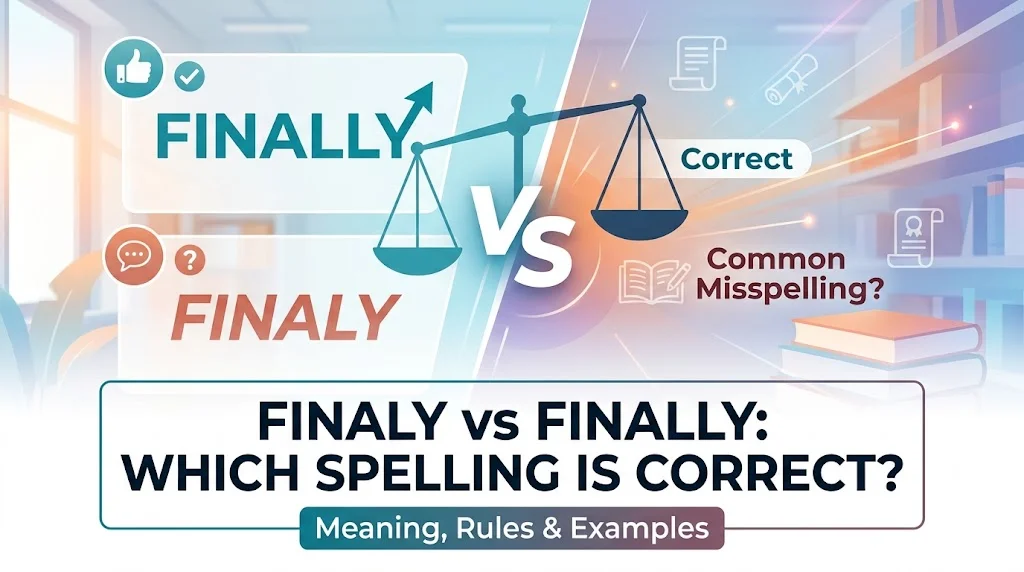
Have you ever typed finaly and wondered whether the word needs another l? You’re not alone. This small spelling mistake appears often because finally looks as though it should be formed by simply adding -ly to final. The correct spelling, however, is finally, with two l’s.
Understanding finaly vs finally matters because one spelling is standard English while the other is simply an error. Finally is a common adverb used to describe something that happens after a long wait, at the end of a process, or as the last point in a sequence. You’ll encounter it in everyday conversation, formal writing, emails, academic work, news reports, and professional communication.
The incorrect form finaly has only one l after the “a.” Although readers can usually understand what the writer means, it can make your writing look careless or poorly checked.
This guide explains the correct spelling, finally meaning, pronunciation, grammar, sentence structure, common mistakes, and differences from similar words. You’ll also find practical examples that make the rule easy to remember.
The short version is simple: finally is correct. Finaly is not.
Quick Answer: Finaly or Finally?
The correct spelling is finally.
Finaly is a misspelling and should not be used in standard English.
The word finally contains two consecutive l’s:
final + ly = finally
For example:
- ✅ Finally, we reached our destination.
- ❌ Finaly, we reached our destination.
Another example:
- ✅ She finally finished her assignment.
- ❌ She finaly finished her assignment.
The easiest rule is to remember that finally keeps the double “l” from the word final.
| Spelling | Correct? | Example |
| finally | ✅ Yes | We finally arrived. |
| finaly | ❌ No | We finaly arrived. |
So if you’re choosing between finaly vs finally, always choose finally.
What Does Finally Mean?
Finally is an adverb. It generally tells the reader that something happens at the end of a period, sequence, process, or wait.
The word can express several closely related ideas. Context determines the exact shade of meaning.
Finally Meaning and Definition
The most common meanings of finally include:
- After a long time
- Eventually
- At the end
- As the last point
- After a delay or difficulty
- At the conclusion of a process
For example:
We finally found the missing keys.
Here, finally suggests that finding the keys took some time.
Consider another sentence:
Finally, we discussed the budget.
In this example, finally indicates that discussing the budget came last in a sequence.
The word can also carry emotional weight.
I finally passed my driving test!
Here, finally communicates relief or satisfaction after repeated effort.
Finally Meaning “After a Long Time”
One of the most common uses of finally describes something that happens after waiting.
For example:
The bus finally arrived.
The sentence suggests that the speaker had been waiting for the bus.
More examples include:
- She finally received her package.
- We finally solved the problem.
- He finally called me back.
- The rain finally stopped.
- They finally reached an agreement.
- I finally understood the lesson.
In each sentence, finally highlights a result that came later than expected or after some effort.
Finally Meaning “At the End”
Finally can also introduce the last item in a sequence.
For example:
First, wash the vegetables. Next, cut them. Finally, cook them.
Here, finally means as the last step.
You’ll often see this use in:
- Instructions
- Essays
- Presentations
- Speeches
- Reports
- Explanations
- Lists of arguments
For example:
First, identify the problem. Second, examine the evidence. Finally, choose the best solution.
In this context, finally doesn’t necessarily suggest a long wait. It simply identifies the final stage.
Finally as a Way to Show Relief or Completion
Sometimes finally tells you how the speaker feels.
Compare:
The project ended.
with:
The project finally ended.
The second sentence suggests that the project took longer than expected. It may also express relief.
Similarly:
She finally got the job.
This sentence can imply that she had applied several times or had waited for a long time.
That small adverb can therefore add emotional context without requiring a lengthy explanation.
Read More: Let Past Tense Explained: What Is the Past Tense of “Let”?
What Does Finaly Mean?
Finaly is not the standard spelling of the English word.
It is a common misspelling of finally.
The mistake usually happens because writers remember the pronunciation but forget the second l when typing. Since final already ends in l, the correct form visually contains two l’s before the y:
final + ly → finally
The incorrect version removes one of them:
finaly ❌
You should therefore use finally in:
- School assignments
- Essays
- Business emails
- Reports
- Resumes
- Articles
- Applications
- Professional messages
- Formal documents
For example:
❌ We finaly completed the project.
Correct it to:
✅ We finally completed the project.
Finaly vs Finally: The Key Difference
The difference between finaly and finally is spelling.
There isn’t a difference in meaning because finaly isn’t the standard English word. It represents an incorrectly spelled version of finally.
The correct word has two l’s:
FINALLY
A useful way to break it down is:
FINAL + LY
Because final ends with l, adding -ly produces:
final + ly = finally
This gives you a practical spelling pattern rather than a rule you simply have to memorize.
Why Does Finally Have Two Ls?
The double l becomes easier to remember when you look at the word’s structure.
The adjective is:
final
The adverb is:
finally
The base word already ends with l. When the adverbial ending -ly is added, the result contains two l’s next to each other.
Think of it visually:
final + ly
finally
The same visual pattern appears in other words:
- Final → finally
- Real → really
- Usual → usually
- Equal → equally
- Careful → carefully
The spelling of finally becomes much easier once you recognize its connection to final.
Finally Pronunciation Guide

Finally is generally pronounced:
FY-nuh-lee
Its pronunciation has three syllables:
fi-nal-ly
The primary stress falls on the first syllable.
You can say it slowly:
FY — nuh — lee
Then blend the syllables together:
finally
The pronunciation doesn’t tell you that the word contains two l’s. That’s one reason people sometimes spell it as finaly.
In other words, pronunciation can help you say the word, but its spelling must be learned separately.
Finally in American vs British English
There is no spelling difference between American and British English for this word.
Both varieties use:
finally
So these forms are correct in both:
- American English: finally
- British English: finally
Finaly isn’t an alternative British spelling.
This distinction matters because English has several words with genuine US and UK spelling differences. For example, American English commonly uses color, while British English uses colour.
Finally doesn’t work that way.
The spelling remains the same.
Finally vs Similar Words
Several English words look or sound somewhat similar to finally, but their meanings differ.
Finally vs Eventually
Finally and eventually can overlap when something happens after a period of waiting.
She finally arrived.
She eventually arrived.
Both can indicate that her arrival happened later. However, finally often emphasizes the end of a wait or the speaker’s reaction, while eventually focuses more strongly on the eventual outcome.
Compare:
After three hours, the train finally arrived.
This emphasizes the frustrating wait.
After several attempts, he eventually succeeded.
This emphasizes the result after repeated attempts.
Finally vs Lastly
Finally and lastly can both introduce the final item in a list.
Finally, we need to review the budget.
Lastly, we need to review the budget.
However, lastly often sounds more explicitly organizational. Finally is more flexible because it can also express completion, delay, or relief.
Finally vs At Last
At last often expresses strong relief or satisfaction.
We finally found a solution.
At last, we found a solution.
Both work, but at last can sound more emotional.
For everyday writing, finally is usually the more flexible choice.
Finally vs Finale
These words aren’t interchangeable.
Finally is an adverb.
Finale is a noun meaning the final part of a performance, event, or series.
For example:
The singer finally came onto the stage.
But:
The concert’s finale was spectacular.
You shouldn’t replace finally with finale.
Finally vs Finely
Finely is a completely different word.
It can mean in a delicate, precise, or very small manner.
For example:
Finely chop the onions.
Here, finely tells you how to chop the onions.
Compare:
We finally finished dinner.
We finely chopped the onions.
The words may look similar, but their meanings are entirely different.
| Word | Part of speech | Meaning | Example |
| finally | Adverb | At the end or after a delay | She finally arrived. |
| finely | Adverb | In a fine or precise manner | Finely chop the herbs. |
| finale | Noun | Final part of an event | The finale was exciting. |
| final | Adjective/Noun | Last or concluding | This is the final round. |
Common Uses of Finally in Sentences
Where you place finally can slightly affect the rhythm or emphasis of a sentence.
Finally at the Beginning of a Sentence
When finally introduces the last point in a sequence, it commonly appears at the beginning.
For example:
Finally, we reviewed the final proposal.
A comma often follows finally when it functions as an introductory word.
More examples:
- Finally, the team reached a decision.
- Finally, we can discuss the results.
- Finally, add the remaining ingredients.
- Finally, let’s consider the costs.
Finally in the Middle of a Sentence
Finally can appear between the subject and main verb.
For example:
She finally understood the instructions.
Here, finally emphasizes when she understood them.
More examples:
- He finally answered the question.
- They finally reached the station.
- I finally found my wallet.
- The company finally released the update.
Finally at the End of a Sentence
The word can also appear toward the end.
For example:
We completed the project finally.
Although grammatically possible in some contexts, this placement can sound less natural than:
We finally completed the project.
In everyday English, placing finally before the main verb often creates a smoother sentence.
Finaly vs Finally Examples
Correct Examples With Finally
Here are practical examples from different contexts:
Conversation
I finally finished my homework.
Workplace
We finally received approval from the manager.
Finally, I’d like to thank everyone who helped with the project.
Academic writing
Finally, the evidence supports the proposed explanation.
Travel
After several delays, our flight finally departed.
Shopping
The store finally restocked the product.
Technology
The software finally installed correctly.
Personal achievement
She finally completed her degree.
Incorrect Examples With Finaly
These sentences contain the common spelling mistake:
❌ I finaly finished the report.
Correct:
✅ I finally finished the report.
Another example:
❌ The team finaly reached an agreement.
Correct:
✅ The team finally reached an agreement.
And:
❌ Finaly, we need to discuss the budget.
Correct:
✅ Finally, we need to discuss the budget.
The meaning remains understandable in the incorrect sentences. The spelling does not.
Common Mistakes With Finally
Writing Finaly With One L
This is the most obvious mistake.
Incorrect:
finaly
Correct:
finally
Remember that final already ends in l. Adding -ly produces finally.
Confusing Finally With Finely
These words differ by only one letter, but their meanings aren’t related in the same way.
We finally arrived.
means we arrived after waiting or at the end.
Finely chop the carrots.
means chop them into small or fine pieces.
Confusing Finally With Finale
A finale is a concluding event or section.
The show’s finale attracted millions of viewers.
Finally describes when or how something happens.
The show finally ended.
The two words belong to different grammatical categories.
Using Finally When Eventually Fits Better
Sometimes writers use finally and eventually as though they’re always identical.
They’re close, but not identical.
Use finally when you want to emphasize an ending, completion, or relief.
Use eventually when you mainly mean that something happened at some later point.
For example:
After months of negotiations, they finally signed the agreement.
The sentence emphasizes the long-awaited completion.
Misplacing Finally in a Sentence
Correct placement improves clarity.
Less natural:
We completed finally the assignment.
Better:
We finally completed the assignment.
Also natural:
Finally, we completed the assignment.
The best position depends on what you want to emphasize.
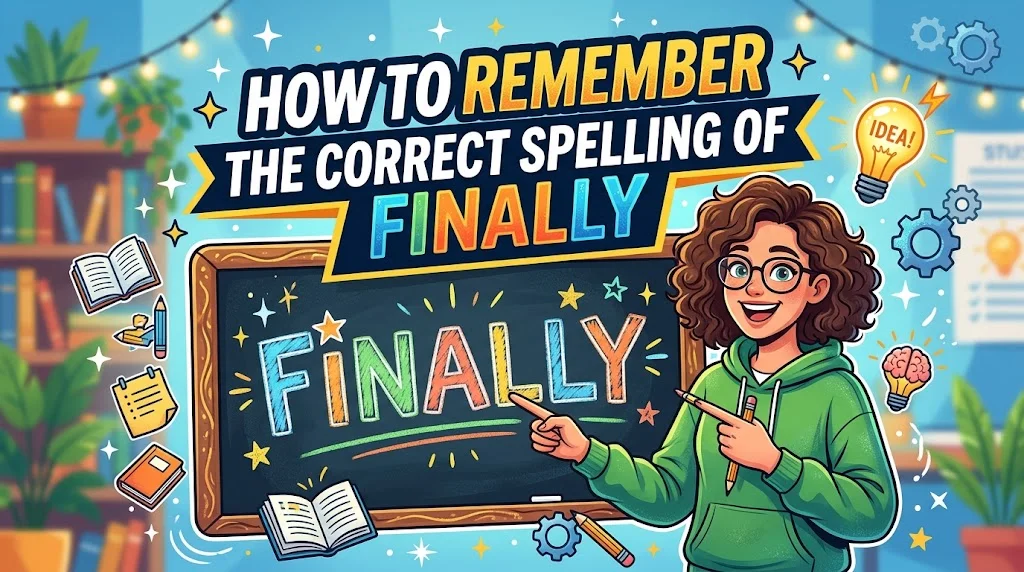
How to Remember the Correct Spelling of Finally
Change block type or style
Move Image block from position 258 up to position 257
Move Image block from position 258 down to position 259
Change alignmentReplace
Remember “Final” + “Ly”
This is probably the simplest trick.
Start with:
final
Add:
ly
You get:
finally
The second l comes from the beginning of -ly when it follows the final l in final.
Remember the Double-L Pattern
Visually memorize:
FINALLY
The middle of the word contains:
LL
If you’re unsure, stop and check whether you’ve written both letters.
Use the “Final” Word Family
Connect finally to related forms:
- final
- finalize
- finalized
- finalist
- finally
Seeing the shared root can help reinforce the spelling.
Practice With Short Sentences
Write a few sentences repeatedly:
I finally understand.
She finally arrived.
We finally finished.
Finally, we can leave.
He finally agreed.
The goal isn’t endless repetition. It’s creating a reliable visual memory of finally.
Finally Synonyms and Alternatives
Depending on the sentence, you can replace finally with several alternatives.
| Alternative | Typical meaning | Example |
| eventually | After some time | He eventually agreed. |
| at last | After a long wait | At last, the rain stopped. |
| in the end | Considering the final result | In the end, we chose the cheaper option. |
| ultimately | In the final result | Ultimately, the decision was yours. |
| lastly | As the final point | Lastly, check the figures. |
| at long last | After a very long wait | At long last, the repairs were complete. |
| in conclusion | At the end of an argument or discussion | In conclusion, the evidence is strong. |
These aren’t perfect substitutes in every sentence.
For example, lastly works well when you’re listing points. At last often carries stronger emotional relief. Ultimately focuses more on the final result or conclusion.
Is Finally Formal or Informal?
Finally is a neutral English word.
You can use it in casual conversation:
I finally got home.
You can also use it in professional communication:
We finally received confirmation from the client.
It’s equally useful in academic writing:
Finally, the results demonstrate a significant difference between the two groups.
The word itself isn’t overly formal or overly casual. Context determines the overall tone.
Finaly vs Finally: Quick Comparison Table
| Feature | Finaly | Finally |
| Standard spelling | ❌ No | ✅ Yes |
| Contains double L | ❌ No | ✅ Yes |
| Standard dictionary form | ❌ No | ✅ Yes |
| Part of speech | — | Adverb |
| Can mean “at the end” | — | ✅ Yes |
| Can mean “after a long wait” | — | ✅ Yes |
| Used in formal writing | ❌ No | ✅ Yes |
| Used in casual writing | ❌ No | ✅ Yes |
| American English | ❌ Incorrect | ✅ Correct |
| British English | ❌ Incorrect | ✅ Correct |
Finaly vs Finally: Final Verdict
When choosing between finaly vs finally, there is only one correct standard-English spelling:
Finally ✅
The spelling finaly is a common error caused by dropping one of the two l’s.
Remember:
final + ly = finally
Use finally when you mean after a long wait, at the end, as the last point, or after a process has been completed.
If you remember the word final inside finally, the spelling becomes much easier to get right.
Frequently Asked Questions About Finaly vs Finally
Is “finaly” a correct spelling?
No. Finaly is a misspelling. The correct spelling is finally, with two l’s.
Why does finally have two Ls?
The word comes from final plus the adverbial ending -ly. The final l in final combines with the l beginning -ly, producing finally.
What does finally mean?
Finally can mean after a long time, eventually, at the end, or as the final point in a sequence.
For example:
We finally reached home.
Is finally the same in American and British English?
Yes. Finally has the same standard spelling in both American and British English.
Can finally mean “eventually”?
Yes, in some contexts. Both words can describe something that happens after a period of time. However, finally can place more emphasis on completion, an ending, or relief.
What is the difference between finally and eventually?
Finally often emphasizes the end of a wait or process. Eventually generally emphasizes that something happened at some later point.
For example:
She finally answered my message.
This can suggest that the speaker had been waiting.
She eventually answered my message.
This focuses more neutrally on the later outcome.
What is the difference between finally and lastly?
Finally can describe completion, delay, or the final point in a sequence. Lastly mainly introduces the last item in a list or series.
Is finally a formal word?
Yes, finally works in formal and informal English. You can use it in conversation, emails, essays, reports, presentations, and professional writing.
What is the easiest way to remember finally?
Remember:
FINAL + LY = FINALLY
The correct word contains two l’s.
What is the difference between finally, finale, and finely?
Finally is an adverb meaning at the end or after a delay.
Finale is a noun referring to the final part of a performance or event.
Finely is an adverb meaning in a fine, delicate, or precise manner.
For example:
We finally finished the work.
The concert finale was impressive.
Finely chop the onions.
Conclusion
The Finaly vs Finally confusion is easy to solve once you recognize the spelling pattern. Finally is the correct word, while finaly is a misspelling that leaves out one l.
The most useful memory trick is simple:
final + ly = finally
The word finally works in many situations. It can describe something that happens after a long wait, indicate the final stage of a process, introduce the last point in a list, or express relief after completing something difficult.
It also has the same spelling in American and British English. There is no regional spelling that makes finaly acceptable.
When you write an email, essay, report, social post, or everyday message, choose finally.
If you’re ever uncertain, look at the middle of the word. Does it contain LL?
If yes, you’ve got it:
Finally ✅
If there’s only one l, you’ve written:
Finaly ❌
That tiny extra letter makes all the difference.