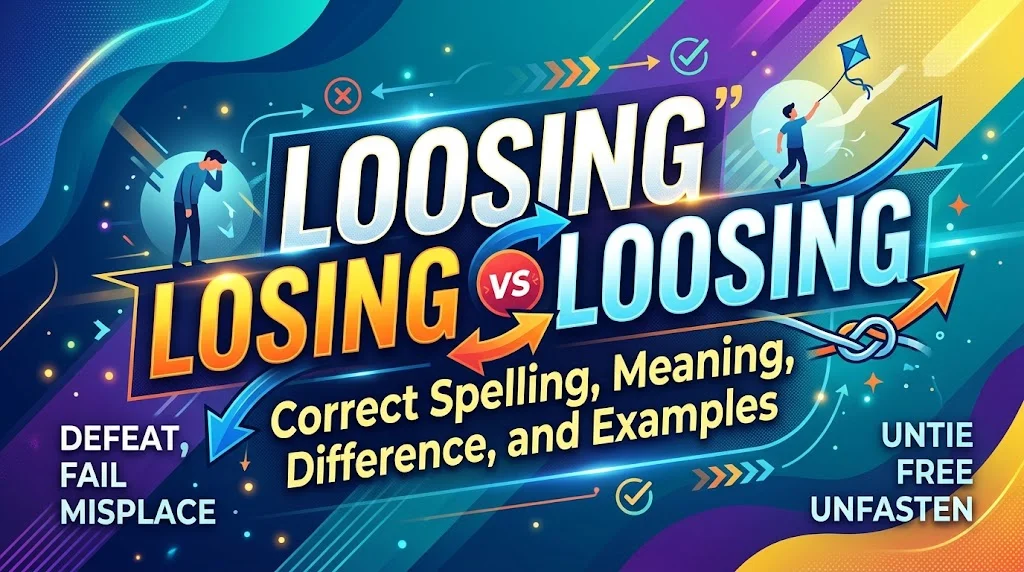
Loosing vs Losing is a common English spelling confusion because the two words look almost identical. That extra o, however, changes the word completely. If you’re talking about failing to win a game, misplacing your keys, losing money, or no longer having something, losing is the correct spelling. Loosing is also a real English word, but it has a much narrower meaning. It refers to releasing, freeing, or setting something loose.
The confusion usually comes from the related words lose, loose, and loosing. Many learners assume that because loose has two o’s, its -ing form must be the word they need when discussing something they no longer have. That assumption leads to common mistakes such as “loosing a game” or “loosing weight.” In standard English, those expressions should be losing a game and losing weight.
Understanding the difference becomes much easier once you connect each form to its base word. Losing comes from lose, while loosing comes from loose. One describes failure to keep, win, find, or retain something. The other describes releasing something.
This guide explains losing vs loosing, their definitions, grammar, pronunciation, spelling rules, and everyday usage. You’ll also find practical examples, comparison tables, common mistakes, and a short quiz to help you choose the right word confidently.
Loosing vs Losing: Quick Comparison
The easiest way to understand loosing vs losing is to compare their base words and meanings.
| Word | Base Word | Part of Speech | Meaning | Example |
| Losing | Lose | Verb form | Failing to win, keep, find, or retain something | “We’re losing the game.” |
| Loosing | Loose | Verb form | Releasing or setting something free | “The archer is loosing an arrow.” |
| Loose | Loose | Adjective/verb | Not tight, fixed, or secure; to release | “My shoelace is loose.” |
| Lose | Lose | Verb | To no longer have, fail to win, or misplace | “Don’t lose your keys.” |
| Loss | Lose | Noun | The act or result of losing | “The team suffered a heavy loss.” |
The key point is simple:
Losing comes from lose. Loosing comes from loose.
Although losing and loosing look similar, they don’t mean the same thing.
What Does Losing Mean?
Losing is the present participle or gerund form of the verb lose. It describes an action or situation in which someone fails to win, stops having something, misplaces something, or no longer retains something.
The verb lose has several meanings, so losing can appear in many different situations.
For example:
- “Our team is losing the game.”
- “I keep losing my phone.”
- “She is losing money.”
- “He is losing patience.”
- “They are losing interest.”
- “We’re losing valuable time.”
In every example, losing comes from lose, not loose.
Losing a Game or Competition
One of the most common uses appears when someone isn’t winning a competition.
“The team is losing the championship game.”
Here, losing means failing to win.
You might also say:
- “We’re losing by two points.”
- “They were losing the match.”
- “She hates losing competitions.”
- “Our team started losing momentum.”
Writing “loosing a game” would be incorrect because a game isn’t being released.
Losing an Object
Losing can also mean misplacing something.
“I’m always losing my keys.”
The speaker hasn’t necessarily thrown the keys away. They simply can’t remember where they put them.
Other examples include:
- “I keep losing my glasses.”
- “He’s afraid of losing his wallet.”
- “She lost her phone yesterday.”
- “Don’t risk losing the documents.”
Losing Money
Another common use describes financial loss.
“The business is losing money.”
Here, losing means experiencing a reduction in money or financial value.
You might hear:
- “The company is losing thousands of dollars.”
- “I don’t want to keep losing money.”
- “They are losing revenue every month.”
Again, loosing money would be incorrect in this context.
Losing a Person or Relationship
The word can also describe separation from another person.
“She was afraid of losing her best friend.”
Depending on context, this could mean a relationship is ending, someone is moving away, or someone has died.
Examples include:
- “He doesn’t want to lose his family.”
- “They were slowly losing touch.”
- “She felt like she was losing her closest friend.”
What Does Loosing Mean?
Loosing is a legitimate English word. It isn’t simply a misspelling of losing.
It comes from the verb loose, which can mean to release, free, or set something loose.
For example:
“The archer was loosing an arrow.”
The archer isn’t failing to keep the arrow. The archer is releasing it.
Other examples include:
- “The soldiers were loosing the prisoners.”
- “They were loosing the horses into the field.”
- “The hunter was loosing an arrow.”
- “The dogs were loosed from their enclosure.”
However, loosing is much less common in modern everyday English than losing. You’re more likely to encounter it in literary writing, historical descriptions, formal prose, or contexts involving weapons and release.
Why Loosing Is Rare in Everyday English
Modern speakers usually don’t need loosing very often.
For instance, instead of saying:
“The owner was loosing the animals.”
A modern writer might choose:
“The owner was releasing the animals.”
Likewise, loosing an arrow is grammatically correct, but many everyday speakers simply say shooting an arrow or releasing an arrow.
That doesn’t make loosing incorrect. It simply means the word has a more limited range of common uses.
Read More: Didn’t or Doesn’t: What’s the Difference and Which One Should You Use?
Loosing vs Losing: The Main Difference
The biggest difference between loosing vs losing is their base verb.
Losing Comes From Lose
Lose → losing
The verb lose refers to things such as:
- Failing to win
- Misplacing something
- No longer having something
- Failing to retain something
- Missing an opportunity
- Losing control
- Experiencing someone’s death or departure
Examples:
“I’m losing my keys.”
“We’re losing the game.”
“She is losing confidence.”
Loosing Comes From Loose
Loose → loosing
The verb loose can mean:
- Release
- Set free
- Let go
- Free from restraint
Example:
“The hunter was loosing arrows.”
The meanings are completely different even though the spellings look closely related.
Why Do People Confuse Losing and Loosing?

Several factors make these words easy to mix up.
The Words Look Nearly Identical
Compare:
losing
loosing
Only one letter separates them. That tiny difference can cause a surprisingly large change in meaning.
Loose Has Two O’s
Many learners know that loose contains two o’s:
loose
They then assume that losing should preserve those two o’s.
That isn’t how English spelling works here.
The correct relationship is:
lose → losing
not:
loose → losing
If you need the -ing form of loose, the result is:
loose → loosing
Lose and Loose Have Different Meanings
This distinction solves most spelling problems.
Lose means to fail to keep or win something.
Loose means not tight or, as a verb, to release something.
Compare:
- “Don’t lose your keys.”
- “My keys are loose in my pocket.”
The first sentence describes misplacing something. The second describes something that isn’t firmly secured.
How to Spell Losing Correctly
The spelling rule is straightforward.
Start with:
lose
Then add -ing:
lose + ing = losing
The final e drops before the -ing ending.
Compare:
| Base Verb | -ing Form |
| lose | losing |
| use | using |
| write | writing |
| make | making |
| take | taking |
This is why losing has only one o.
By contrast, loose ends in a double o, and its -ing form becomes:
loose + ing = loosing
So:
- lose → losing
- loose → loosing
Losing vs Loose vs Loosing
These three words deserve special attention because they frequently appear together in spelling mistakes.
Lose
Lose is a verb.
It can mean to misplace something, fail to win, or stop having something.
“Try not to lose your passport.”
Losing
Losing is the -ing form of lose.
“I’m losing my patience.”
Loose
Loose usually works as an adjective meaning not tight or not firmly attached.
“This shirt is too loose.”
It can also function as a verb meaning to release something.
“The dogs were loose in the yard.”
Loosing
Loosing is the -ing form of the verb loose.
“The archer was loosing arrows.”
Here’s the complete relationship:
| Word | Meaning |
| Lose | Fail to keep, find, or win |
| Losing | Currently failing to keep, find, or win |
| Loose | Not tight; free or unsecured |
| Loosing | Releasing or setting free |
| Loss | The result or experience of losing |
When to Use Losing
Use losing whenever the sentence relates to the verb lose.
Losing a Game
“Our team is losing the game.”
Losing Your Keys
“I keep losing my keys.”
Losing Money
“The store is losing money.”
Losing Weight
“She is losing weight through regular exercise.”
Losing Patience
“I’m losing patience with this situation.”
Losing Focus
“The students are losing focus.”
Losing Hope
“Don’t start losing hope.”
Losing an Opportunity
“We could be losing a valuable opportunity.”
Losing Touch
“We don’t want to start losing touch.”
In all these examples, losing describes something being lost, rather than something being released.
When to Use Loosing
Use loosing when you specifically mean releasing or setting something free.
This use is considerably less common.
Loosing an Arrow
“The archer was loosing an arrow toward the target.”
Here, the arrow is being released from the bow.
Loosing Animals
“The farmer was loosing the horses into the pasture.”
The animals are being released.
Loosing Prisoners
“The guards were loosing the prisoners.”
The sentence means that the prisoners were being set free.
Loosing Something From Restraint
“The handler was loosing the dog from its chain.”
The meaning is release rather than loss.
When Not to Use Loosing
This is where most everyday mistakes occur.
Don’t use loosing when you’re talking about losing something.
| Incorrect | Correct | Why? |
| “I’m loosing the game.” | “I’m losing the game.” | You aren’t winning. |
| “I’m loosing my keys.” | “I’m losing my keys.” | You’re misplacing them. |
| “She’s loosing weight.” | “She’s losing weight.” | Her weight is decreasing. |
| “He’s loosing money.” | “He’s losing money.” | He’s experiencing financial loss. |
| “I’m loosing my mind.” | “I’m losing my mind.” | You’re describing loss of control. |
| “We’re loosing time.” | “We’re losing time.” | Time is being wasted or slipping away. |
| “They’re loosing interest.” | “They’re losing interest. | Their interest is declining. |
A useful test is to replace the word with releasing.
If releasing makes sense, loosing might be appropriate.
If it doesn’t, you probably need losing.
Losing or Loosing: A Simple Decision Guide
When you’re unsure, ask one question:
Are You Talking About Loss?
If the answer is yes, use losing.
losing a game
losing money
losing weight
losing keys
losing patience
losing hope
Are You Talking About Release?
If the answer is yes, loosing may be correct.
loosing an arrow
loosing prisoners
loosing animals
Are You Describing Something That Isn’t Tight?
Use loose.
loose clothing
a loose screw
a loose tooth
loose wires
The three-way distinction is easy to remember:
Lose = no longer have or fail to win
Loose = not tight or free
Loosing = releasing
Pronunciation: Why They Sound So Similar

Pronunciation contributes to the confusion, although the words aren’t exactly identical.
Lose is commonly pronounced with a sound similar to “looz.”
Loose has a sound similar to “loos.”
The difference lies mainly in the final consonant sound.
The related forms follow the same distinction:
- losing → similar to “LOO-zing”
- loosing → similar to “LOO-sing”
For many learners, especially when speaking quickly, these sounds can seem almost indistinguishable.
Spelling therefore matters. You can’t always rely on hearing the word alone.
Common Expressions With Losing
Some phrases appear so often that they’re worth memorizing.
Losing Your Mind
“I’m losing my mind trying to solve this problem.”
This usually means becoming extremely frustrated, confused, or overwhelmed.
Losing Your Patience
“I’m losing my patience with the constant delays.”
It means becoming less patient.
Losing Track
“I lost track of time.”
This means you stopped being aware of the exact time or sequence.
Losing Touch
“We lost touch after college.”
This means people stopped communicating regularly.
Losing Interest
“He is losing interest in the project.”
This means his level of interest is declining.
Losing Hope
“They refused to lose hope.”
This means they refused to stop believing that a positive outcome was possible.
None of these expressions uses loosing.
Real-World Examples of Losing
Here are practical examples across different situations.
Everyday Life
- “I’m losing my keys again.”
- “She keeps losing her phone.”
- “We’re losing daylight.”
- “He’s losing his patience.”
School and Work
- “The student is losing focus.”
- “The company is losing customers.”
- “We’re losing valuable time.”
- “The project is losing momentum.”
Sports
- “Our team is losing the match.”
- “They were losing by ten points.”
- “She hates losing races.”
- “The player is losing confidence.”
Relationships
- “I don’t want to lose you.”
- “They are losing touch.”
- “She fears losing her closest friend.”
Real-World Examples of Loosing
Because loosing has a narrower meaning, its examples tend to involve release.
- “The archer was loosing arrows.”
- “The handler was loosing the dogs.”
- “The guards were loosing the prisoners.”
- “The riders were loosing the horses.”
- “The hunters were loosing arrows toward the target.”
These examples all involve something being released from restraint.
A Practical Context Test
Consider these two sentences:
“The archer was losing an arrow.”
This suggests the archer somehow no longer had the arrow. It doesn’t communicate the intended action clearly.
“The archer was loosing an arrow.”
This means the archer was releasing the arrow.
The single extra o changes the meaning.
Case Study: Why One Letter Matters
Imagine someone writing an article about a basketball game.
They write:
“The home team was loosing the game.”
The reader immediately encounters a spelling problem. The intended meaning is clearly that the team wasn’t winning.
The correct sentence is:
“The home team was losing the game.”
Now consider a historical scene involving an archer:
“The archer was losing arrows toward the enemy.”
That wording suggests the archer was somehow misplacing the arrows.
The intended meaning is:
“The archer was loosing arrows toward the enemy.”
This second sentence demonstrates why the distinction isn’t merely cosmetic. Losing and loosing describe different actions.
Common Mistakes Learners Make
Mistake 1: “Loosing a Game”
Incorrect: “We’re loosing the game.”
Correct: “We’re losing the game.”
A game can be lost, not released.
Mistake 2: “Loosing Weight”
Incorrect: “She is loosing weight.”
Correct: “She is losing weight.”
Weight decreases or is lost. It isn’t being released.
Mistake 3: “Loosing Your Mind”
Incorrect: “He’s loosing his mind.”
Correct: “He’s losing his mind.”
The expression refers to losing control or becoming overwhelmed.
Mistake 4: “Loosing Money”
Incorrect: “The company is loosing money.”
Correct: “The company is losing money.”
The company is experiencing financial loss.
Mistake 5: Confusing Loose With Lose
This is a related but separate error.
Incorrect: “I don’t want to loose my wallet.”
Correct: “I don’t want to lose my wallet.”
Meanwhile:
“My wallet is loose in the bag.”
Here, loose describes its position rather than the act of misplacing it.
A Simple Memory Trick
Here’s a quick way to remember the difference:
You lose a game, but you loose an arrow.
The first phrase describes failure to win.
The second describes release.
Another useful formula is:
Lose → Losing → Loss
Loose → Loosing → Loosen
For example:
- “I might lose the game.”
- “I am losing the game.”
- “The loss was disappointing.”
Then:
- “The rope is loose.”
- “They are loosing the animal.”
- “They need to loosen the rope.”
This pattern makes the spelling easier to recall.
Self-Assessment: Losing or Loosing?
Choose losing or loosing for each sentence.
- Our team is ___ the championship.
- The archer was ___ an arrow.
- She keeps ___ her phone.
- The company is ___ money.
- The guards were ___ the prisoners.
- He is ___ patience.
- They are ___ interest in the project.
- The hunter was ___ arrows toward the target.
- I don’t want to keep ___ valuable time.
- The farmer was ___ the horses into the field.
- She is ___ weight.
- We’re ___ control of the situation.
Answers
- losing
- loosing
- losing
- losing
- loosing
- losing
- losing
- loosing
- losing
- loosing
- losing
- losing
The pattern becomes obvious once you focus on meaning. If something is being released, loosing works. If something is being lost, use losing.
Losing vs Loosing: Quick Reference Table
| Situation | Correct Word | Example |
| Failing to win | Losing | “We’re losing the game.” |
| Misplacing something | Losing | “I’m losing my keys.” |
| Experiencing financial loss | Losing | “They’re losing money.” |
| Becoming less patient | Losing | “She’s losing patience.” |
| Becoming less interested | Losing | “He’s losing interest.” |
| Releasing an arrow | Loosing | “He’s loosing an arrow.” |
| Freeing an animal | Loosing | “They’re loosing the horses.” |
| Freeing a prisoner | Loosing | “They were loosing prisoners.” |
| Not tight | Loose | “The screw is loose.” |
| Failing to keep something | Lose | “Don’t lose your keys.” |
Is Loosing a Correct Word?
Yes. Loosing is a legitimate English word, but that doesn’t mean it’s interchangeable with losing.
The word comes from the verb loose, meaning to release or set free.
Its limited everyday use is the main reason people sometimes assume it’s simply a spelling error. In fact, it has a legitimate grammatical role.
Still, if you mean that someone failed to win a match, misplaced an object, experienced financial loss, or stopped retaining something, losing is the correct choice.
Is There a US and UK Spelling Difference?
No. The distinction between losing and loosing isn’t a standard American-versus-British spelling difference.
American English uses losing for the relevant forms of lose.
British English does the same.
For example:
- US: “The team is losing.”
- UK: “The team is losing.”
The word loosing retains its separate meaning in both varieties.
So you shouldn’t choose between losing and loosing based on whether you’re writing for an American or British audience. Choose based on meaning.
Frequently Asked Questions
Is It Losing or Loosing a Game?
Losing is correct. You lose a game when you fail to win it.
Correct: “Our team is losing the game.”
Incorrect: “Our team is loosing the game.”
What Does Losing Mean in Simple Terms?
Losing generally means failing to keep, win, find, or retain something. For example, losing a game means failing to win it, while losing your keys means misplacing them.
Is It Losing or Loosing a Person?
Losing is correct when you mean no longer having someone in your life, becoming separated from them, or experiencing their death.
For example:
“She was afraid of losing her best friend.”
What Does Losing My Mind Mean?
Losing my mind is an informal expression that can mean becoming extremely frustrated, confused, overwhelmed, or unable to think clearly.
The correct spelling is losing, not loosing.
Why Do People Confuse Losing and Loosing?
People confuse them because they look almost identical and both relate visually to the words lose and loose. The extra o in loosing can also make learners incorrectly assume it is the normal -ing form of lose.
The base-word rule clears up the confusion:
lose → losing
loose → loosing
Is Loosing Ever Grammatically Correct?
Yes. Loosing is grammatically correct when it means releasing or setting something free.
For example:
“The archer was loosing an arrow.”
It isn’t correct when you mean failing to win, misplacing something, or experiencing a loss.
Is There a Difference Between Losing and Loosing in American and British English?
No major regional spelling difference separates these words. Both American and British English use losing for the -ing form of lose, while loosing has the separate meaning of releasing something.
Is It Losing or Loosing Weight?
Losing weight is correct.
For example:
“She is losing weight through diet and exercise.”
Loosing weight is incorrect because weight isn’t being released in the sense required by the verb loose.
Is It Losing or Loosing Money?
Losing money is correct.
For example:
“The company is losing money this year.”
The company is experiencing financial loss, so the word comes from lose.
Is “Loosing” a Misspelling of “Losing”?
Not always. Loosing is a real word with a different meaning. However, people often use it accidentally when they actually mean losing.
If the sentence describes failure, misplacement, deprivation, or loss, use losing.
Final Verdict: Loosing vs Losing
The difference between loosing vs losing comes down to their base verbs and meanings.
Losing comes from lose. Use it when something is being lost, misplaced, surrendered, or no longer retained.
Loosing comes from loose. Use it when something is being released or set free.
The easiest rule to remember is:
You lose a game, but you loose an arrow.
When you’re talking about losing a game, losing money, losing weight, losing keys, losing patience, losing hope, or losing someone, always choose losing.
When you’re describing the release of an arrow, animal, prisoner, or restrained object, loosing can be correct.
And if you’re describing something that isn’t tight, choose loose.
Once you connect each spelling to its base word, the confusion largely disappears:
Lose → Losing → Loss
Loose → Loosing → Loosen
That small distinction is all you need to keep these three commonly confused words straight.


