Understanding the fight past tense can be tricky because fight is an irregular verb. Unlike regular verbs that usually take -ed, this verb changes its form completely. The correct past tense of fight is fought, not “fighted.” Once you learn the basic verb forms of fight, using them becomes much easier in everyday English.
The word fight can describe a physical conflict, argument, competition, struggle, or effort to achieve something. In the present tense, you might say, “They fight every weekend.” When describing a completed past action, you would say, “They fought yesterday.” The past participle of fight is also fought, as in “They have fought before.”
This guide explains fight vs fought, the simple past of fight, and the difference between fight, fought, and fighting. You’ll also learn how to use fought in a sentence, understand fight verb forms, and avoid the common mistake of saying fighted. Examples, tense tables, pronunciation tips, and practical explanations will make the past form of fight easier to remember and use correctly.
What Is the Past Tense of Fight?
The past tense of fight is fought.
That’s the key answer.
Fight → Fought
Here are a few examples:
- They fought yesterday.
- We fought for the championship.
- She fought with her brother.
- He fought against a strong opponent.
- The two teams fought hard until the final whistle.
When you’re describing something that happened in the past, fought usually does the job.
Why Isn’t It “Fighted”?
Because fight is an irregular verb.
Regular verbs usually form their past tense by adding -ed:
| Present | Past |
| walk | walked |
| talk | talked |
| jump | jumped |
| play | played |
| work | worked |
Fight doesn’t follow that pattern:
| Present | Past |
| fight | fought |
So fighted isn’t the standard English past tense of fight.
Think of irregular verbs as verbs that refuse to follow the usual recipe. You can’t always predict their past forms by adding three letters.
Fight, Fought, and Fighting: What’s the Difference?
These words all come from the same verb, but they perform different jobs.
What Does “Fight” Mean?
Fight is the base form of the verb.
It can describe physical conflict, disagreement, competition, or a determined effort to achieve something.
For example:
- They fight every weekend.
- I fight for my family.
- Athletes fight for the title.
- We fight against unfair treatment.
You can also use fight as a noun:
- The two players had a fight.
- He got into a fight at school.
As a verb, however, fight refers to the action itself.
What Does “Fought” Mean?
Fought is both the simple past tense and the past participle of fight.
The simple past describes a completed action:
- They fought yesterday.
- She fought bravely.
- We fought for our team.
The past participle appears with helping verbs:
- They have fought before.
- She has fought many battles.
- We had fought hard for the victory.
This is one reason English learners sometimes find fought confusing. The same word can perform two grammatical jobs.
What Does “Fighting” Mean?
Fighting is the present participle and gerund form of fight.
It’s commonly used with forms of be to create continuous tenses:
- They are fighting.
- They were fighting.
- He is fighting for his rights.
- We were fighting against the current.
It can also function as a noun:
- Fighting isn’t the answer.
- The constant fighting became exhausting.
So the basic pattern is:
fight → fought → fought → fighting
Fight Verb Forms at a Glance
Here’s the complete basic form set:
| Verb form | Word | Example |
| Base form | fight | I fight for my goals. |
| Third-person singular | fights | She fights for justice. |
| Simple past | fought | They fought yesterday. |
| Past participle | fought | He has fought before. |
| Present participle | fighting | They are fighting now. |
This table is worth memorizing because it covers most everyday uses.
Notice something important: the past tense and past participle are identical.
Both are fought.
Full Tense Table for “Fight”
The verb fight can appear in all major English tenses.
| Tense | Example |
| Present simple | I fight for my beliefs. |
| Present continuous | I am fighting for my beliefs. |
| Present perfect | I have fought for my beliefs. |
| Present perfect continuous | I have been fighting for my beliefs. |
| Past simple | I fought for my beliefs. |
| Past continuous | I was fighting for my beliefs. |
| Past perfect | I had fought for my beliefs. |
| Past perfect continuous | I had been fighting for my beliefs. |
| Future simple | I will fight for my beliefs. |
| Future continuous | I will be fighting for my beliefs. |
| Future perfect | I will have fought for my beliefs. |
| Future perfect continuous | I will have been fighting for my beliefs. |
The pattern becomes easier once you separate the verb forms from the tense names.
For instance, the simple past needs fought:
She fought hard.
Perfect tenses need fought after a form of have:
She has fought hard.
Continuous tenses use fighting:
She was fighting hard.
Read More: Finaly vs Finally: Which Spelling Is Correct? Meaning, Rules & Examples
Why Is “Fighted” Incorrect?
The biggest mistake surrounding the fight past tense is adding -ed and creating fighted.
That happens because English learners often learn a basic rule:
Verb + -ed = past tense.
That rule works for many regular verbs. It doesn’t work for irregular verbs.
For example:
- talk → talked
- clean → cleaned
- open → opened
- watch → watched
But:
- fight → fought
- think → thought
- buy → bought
- teach → taught
- catch → caught
So you need to memorize fight as an irregular verb.
Is “Fighted” Ever Correct?
In standard modern English, fighted isn’t the accepted past tense or past participle of fight.
Use fought instead.
❌ They fighted yesterday.
✅ They fought yesterday.
❌ He has fighted for his team.
✅ He has fought for his team.
The correction is straightforward: whenever you need the past form of fight, use fought.
How to Use “Fought” Correctly
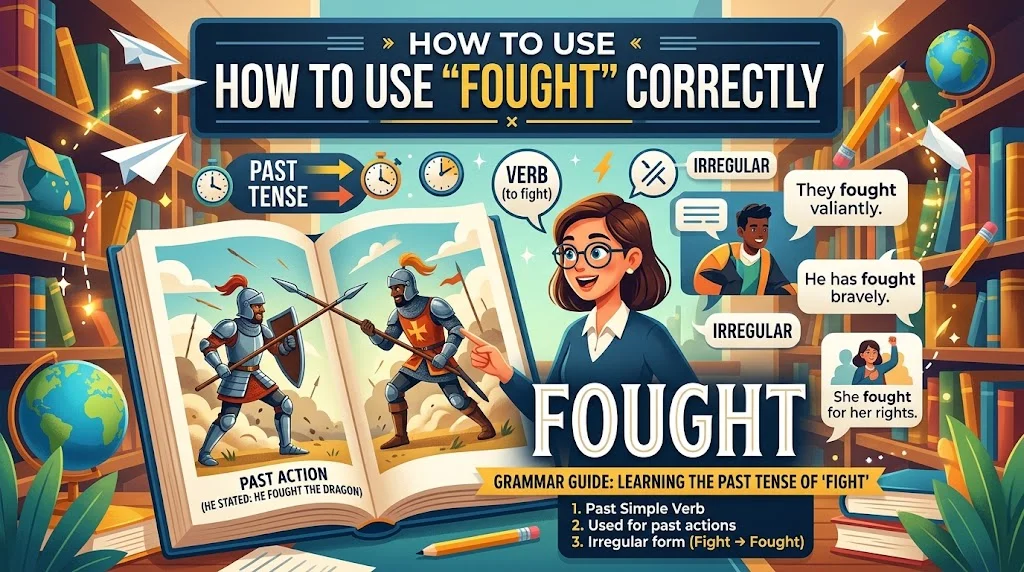
The word fought works in several different contexts.
Fought in a Physical Conflict
You can use fought when people physically battled.
- The soldiers fought bravely.
- The two men fought outside the restaurant.
- The warriors fought until sunset.
The context usually makes the meaning clear.
Fought in Sports
Sports writers and fans often use fought to describe intense competition.
- The two teams fought for the championship.
- She fought hard in the final round.
- The boxer fought for twelve rounds.
- Our team fought back after falling behind.
Here, fought doesn’t necessarily mean a physical street fight. It can describe determined competition.
Fought With Someone
Fought with often describes an argument or conflict between people.
- I fought with my brother yesterday.
- She fought with her friend over money.
- They fought with each other for years.
Depending on context, fought with can refer to either an argument or physical conflict.
Fought Over Something
Use fought over when people disagree about an object, issue, decision, or relationship.
- They fought over the last piece of cake.
- The children fought over the toy.
- The brothers fought over the inheritance.
The preposition over identifies the subject of the disagreement.
Fought For Something
Fought for often expresses effort, defense, or support.
- She fought for her rights.
- They fought for freedom.
- He fought for his family.
- The players fought for every point.
This use can be literal or figurative.
Fight Past Tense Examples in Real Situations
Understanding grammar becomes easier when you see it in ordinary situations.
Physical Conflict
Imagine two people argued outside a store yesterday.
You could say:
The two men fought outside the store.
The action happened in the past, so fought is appropriate.
You wouldn’t say:
The two men fight outside the store yesterday.
The word yesterday clearly places the action in the past.
Sports and Competition
Suppose a basketball team played a difficult game last night.
You could write:
The team fought until the final second.
Here, fought means the players continued competing with determination.
Another example:
The players fought back after losing the lead.
Again, the action has already happened.
Arguments and Disagreements
Consider a family argument:
My sister and I fought about whose turn it was.
The word fought describes a completed disagreement.
You can also say:
We fought over the decision.
The preposition over tells readers what caused the disagreement.
Personal Struggles
The verb fight doesn’t always involve another person.
For example:
She fought through a difficult year.
Or:
He fought to keep his business alive.
In these examples, fought has a figurative meaning. It describes persistence rather than physical combat.
Historical or Fictional Events
You might read:
The soldiers fought for three days.
Or:
The hero fought the monster in the final scene.
Both examples describe completed events.
Fight vs. Fought vs. Fighting Examples
A quick comparison makes the distinction much clearer.
| Word | Typical use | Example |
| fight | Present/base form | They fight every weekend. |
| fought | Past/past participle | They fought yesterday. |
| fighting | Continuous/gerund form | They are fighting now. |
Consider these three sentences:
They fight every year.
This suggests a repeated or present situation.
They fought last year.
This describes a completed past event.
They are fighting now.
This tells you the action is happening at the moment.
A small change in the verb can completely change the time reference.
Fought as the Past Participle
Here’s an important grammar point: fought isn’t only the simple past tense.
It’s also the past participle.
That means you can use it after have, has, or had.
Present Perfect
- I have fought for this opportunity.
- She has fought many battles.
- They have fought against injustice.
Past Perfect
- He had fought before the final match.
- They had fought for years before reaching an agreement.
The structure looks like this:
have/has/had + fought
Don’t add -ed after the helping verb.
❌ She has fighted.
✅ She has fought.
Fight in the Passive Voice
The verb fight can also appear in passive constructions.
For example:
The battle was fought on open ground.
Here, was fought is passive.
The sentence doesn’t focus on who fought. Instead, it focuses on the battle.
Other examples include:
- The match was fought under difficult conditions.
- The battle was fought over disputed territory.
- The case was fought in court.
This structure is especially common when the event itself matters more than the people involved.
Common Mistakes With the Past Tense of Fight
Several mistakes appear repeatedly among English learners.
Using “Fighted”
This is the most obvious error.
❌ We fighted yesterday.
✅ We fought yesterday.
Remember the irregular form.
Using “Fight” for a Completed Past Action
Another common mistake involves keeping the base form after a past-time expression.
❌ They fight yesterday.
✅ They fought yesterday.
Words such as yesterday, last night, last week, and two years ago often signal a completed past event.
Confusing “Fought” and “Fighting”
These forms aren’t interchangeable.
❌ They were fought in the park.
That sentence has a completely different passive meaning.
If you mean the people were actively engaged in the action, say:
✅ They were fighting in the park.
For a completed event, say:
✅ They fought in the park.
Forgetting the Base Form After “Did”
This mistake deserves special attention.
After did, use the base form fight, not fought.
❌ Did they fought yesterday?
✅ Did they fight yesterday?
Why?
Because did already carries the past tense.
The structure is:
Did + subject + base verb
So:
Did + they + fight?
Not:
Did + they + fought?
The same principle applies to negatives:
❌ They didn’t fought.
✅ They didn’t fight.
Fight Past Tense in Questions and Negative Sentences
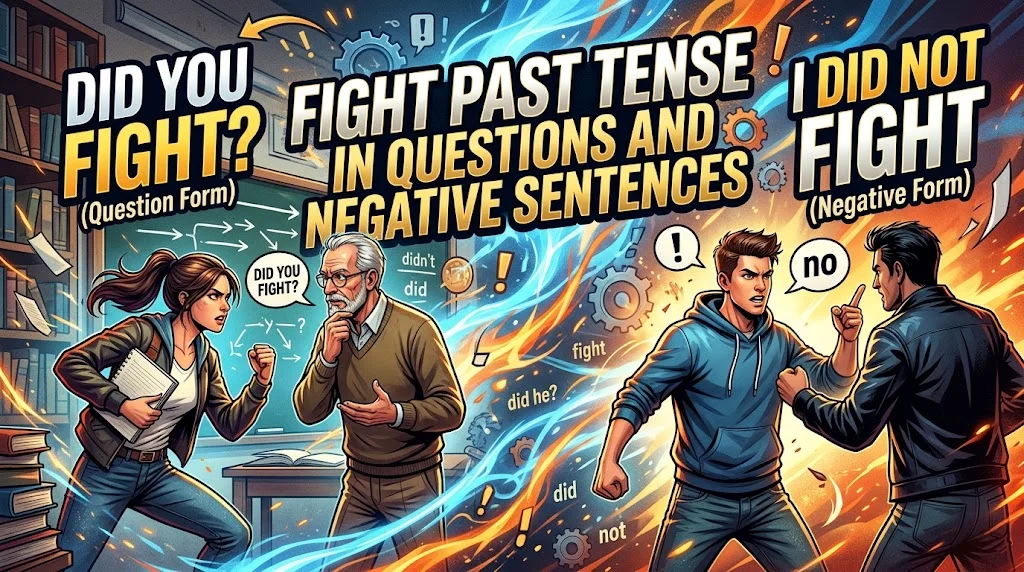
Questions often expose mistakes with irregular verbs.
Questions
Use did + fight:
- Did they fight?
- Did he fight yesterday?
- Why did she fight?
- When did you fight?
Notice that fought disappears after did.
Negative Sentences
Use did not + fight:
- They did not fight.
- He didn’t fight back.
- We didn’t fight about it.
- She didn’t fight yesterday.
The contraction didn’t is especially common in everyday American English.
The Basic Pattern
| Sentence type | Correct structure | Example |
| Statement | Subject + fought | They fought yesterday. |
| Question | Did + subject + fight? | Did they fight yesterday? |
| Negative | Subject + did not + fight | They didn’t fight yesterday. |
This little table can prevent a surprisingly common grammar mistake.
Fight Past Tense Pronunciation
The pronunciation also changes between fight and fought.
Fight is pronounced approximately:
/faɪt/
The vowel sounds like the vowel in light or night.
Fought is pronounced approximately:
/fɔːt/
In many American English pronunciations, the vowel differs noticeably from fight.
So don’t assume that because the spelling looks related, the vowel should sound the same.
Compare:
- fight — rhymes with light
- fought — rhymes closely with caught in accents where those words rhyme
The spelling may look unusual at first, but hearing the forms together makes the difference easier to remember.
Similar Irregular Verbs Like Fight
The past form of fight belongs to a broader group of irregular verbs.
Some have similar-looking changes:
| Base verb | Past tense |
| fight | fought |
| buy | bought |
| bring | brought |
| think | thought |
| seek | sought |
| teach | taught |
| catch | caught |
These forms don’t all follow one perfect rule. Still, noticing patterns can help you remember them.
For example, fight → fought and think → thought both contain the -ought spelling.
That doesn’t mean you can apply -ought to every verb. English has plenty of irregular surprises.
Easy Ways to Remember Fight → Fought
Memorization doesn’t have to feel like grinding through a vocabulary list.
Try these methods instead.
Learn the Three Main Forms Together
Say them as one unit:
Fight — fought — fought
Repeat the sequence several times.
Then put it into a sentence:
I fight today.
I fought yesterday.
I have fought before.
That creates a useful mental connection between form and meaning.
Use the Yesterday Test
When you see yesterday, ask yourself:
Has the action already happened?
If yes, use fought.
- Today: I fight for my team.
- Yesterday: I fought for my team.
Use the “Did” Test
If you put did into a question, return to the base form.
Did they fight?
Never:
Did they fought?
This trick works with many irregular verbs.
Practice Speaking Aloud
Say these sentences naturally:
I fight.
I fought.
I am fighting.
I have fought.
Hearing the differences can reinforce the forms better than silently reading them.
Fight Past Tense in American English
In American English, the standard past tense of fight is fought.
The same form appears in standard British English as well.
So whether you’re writing for an American audience or reading British English, the basic form remains:
fight → fought
There isn’t a separate American past-tense form such as fighted.
That’s useful if you’re studying English as a second language. You don’t need to memorize different past forms for these two major varieties.
A Quick Case Study: Choosing the Correct Form
Consider this short paragraph:
Yesterday, two teams fought for the championship. The players had fought hard throughout the season. Today, they fight for recognition. Right now, the coaches are fighting to improve their strategies.
Four forms appear here, each with a different grammatical role.
| Example | Form | Why? |
| Teams fought yesterday | Past | Completed past action |
| Had fought throughout the season | Past participle | Used with had |
| They fight today | Base/present | Current or general action |
| Are fighting now | Present participle | Ongoing action |
This is the heart of the topic.
You don’t choose a verb form because it “sounds right.” You choose it based on the grammatical structure and time reference.
Quick Reference: Fight Past Tense
If you only need the essential information, remember this:
Base form: fight
Past tense: fought
Past participle: fought
Present participle: fighting
Third-person singular: fights
Examples
Present:
They fight for their team.
Past:
They fought for their team.
Present continuous:
They are fighting for their team.
Present perfect:
They have fought for their team.
Past perfect:
They had fought for their team.
Question:
Did they fight for their team?
Negative:
They didn’t fight for their team.
Frequently Asked Questions
What is the past tense of fight?
The past tense of fight is fought.
Example:
They fought yesterday.
Is fought the past tense of fight?
Yes. Fought is the simple past form of fight.
It’s also the past participle.
Is “fighted” a word?
Fighted isn’t the standard past tense or past participle of fight. The correct form is fought.
Is fight a regular or irregular verb?
Fight is an irregular verb. Its past form doesn’t follow the regular -ed pattern.
The correct forms are:
fight → fought → fought
What is the past participle of fight?
The past participle is fought.
For example:
She has fought for years.
What is the difference between fight and fought?
Fight is the base or present form, while fought is the past tense and past participle.
Compare:
They fight every week.
They fought last week.
Is “fought” used in American English?
Yes. Fought is the standard past form in American English.
It is also standard in British English.
How do you use fought in a sentence?
You can use fought to describe a completed conflict, competition, disagreement, or struggle.
Examples include:
- They fought yesterday.
- She fought for her rights.
- The teams fought for the title.
- We fought over the decision.
Why do we say fought instead of fighted?
Because fight is an irregular verb. Its past form developed as fought rather than the regular fighted.
The same general idea appears in other irregular verbs such as think → thought and buy → bought.
Final Takeaway: Fight → Fought → Fought
The fight past tense is fought.
That’s the one form to remember.
Fight → Fought → Fought
Use fight for the base or present form:
They fight for their team.
Use fought for a completed past action:
They fought yesterday.
Use fought after have, has, or had:
They have fought before.
Use fighting for continuous forms:
They are fighting now.
And remember one especially useful rule: after did, use fight, not fought.
✅ Did they fight?
❌ Did they fought?
Once you connect these forms with real sentences, the pattern becomes much easier to remember. The key is simple: fight is irregular, and its past form is fought—not fighted.