If you’ve ever paused over challenge or challange, you’re not alone. The two spellings look remarkably similar, especially when you type quickly or rely on pronunciation. However, only one is correct in standard English: challenge. The spelling challange is a common misspelling that appears in casual writing, online posts, messages, and other informal communication.
Understanding the difference becomes easier when you look at the correct spelling, word meaning, English grammar, vocabulary, and pronunciation together. The word challenge can describe a difficult task, a problem, a test, a competition, an obstacle, or an act of questioning something. It works as both a noun and a verb, which makes it especially useful in everyday and professional English usage.
This guide explains challenge meaning, challenge pronunciation, challenge spelling, challange meaning, common spelling errors, word forms, and sentence examples. You’ll also learn why people write challange, how to remember the correct spelling, and how to use challenge naturally in different contexts. By the end, the Challenge or Challange confusion should be easy to spot and fix.
Challenge or Challange: Which Is Correct?
The correct spelling is challenge.
Challange is incorrect in standard English. It isn’t an alternative spelling that you can freely use in formal writing.
| Spelling | Status | Meaning |
| Challenge | ✅ Correct | A difficult task, test, competition, or act of questioning |
| Challange | ❌ Incorrect | Common misspelling of challenge |
For example:
Correct: Learning a new language can be a challenge.
Incorrect: Learning a new language can be a challange.
The difference comes down to one important letter sequence. Challenge contains -enge, while the incorrect form challange inserts an unnecessary a before the final nge.
Challenge — Correct Spelling
The standard spelling is:
C-H-A-L-L-E-N-G-E
The word begins with chall- and ends with -enge.
Examples include:
- The exam was a serious challenge.
- She decided to challenge the decision.
- Running a marathon presents a physical challenge.
- The lawyer decided to challenge the evidence.
Challange — Incorrect Spelling
Challange is a spelling error.
You may encounter it online because people often write words according to how they hear them. Fast typing can also produce the mistake. Once you’ve seen an incorrect spelling repeatedly, it can start looking strangely familiar.
That familiarity doesn’t make it correct.
For formal writing, academic work, business communication, websites, applications, and professional documents, use challenge.
Challenge vs. Challange at a Glance
| Feature | Challenge | Challange |
| Standard spelling | Yes | No |
| Dictionary word | Yes | No |
| Noun | Yes | No |
| Verb | Yes | No |
| Common online error | Sometimes | Yes |
| Correct for formal writing | Yes | No |
| Example | She accepted the challenge. | She accepted the challange. ❌ |
Why Is “Challenge” the Correct Spelling?
The spelling challenge follows the established English form of the word. English has many words whose pronunciation doesn’t provide a perfect map of their letters.
That’s one reason spelling by sound can cause trouble.
If you pronounce challenge quickly, the middle and final sounds may blend together. A writer might then imagine an extra a belongs in the word. It doesn’t.
The Correct Letter Pattern in Challenge
The most useful part to remember is the ending:
-enge
So the word is:
chall + enge
Not:
chall + ange
This distinction matters because the incorrect spelling often comes from replacing -enge with -ange.
Compare them visually:
challenge ✅
challange ❌
The correct word contains e after the double l.
Why “Challange” Looks and Sounds Plausible
English spelling doesn’t always behave like a simple sound-to-letter system.
Consider words such as change, range, and danger. Their familiar spelling patterns may influence how someone mentally constructs another word.
When people hear challenge, they may focus on the strong sounds rather than every individual letter. As a result, the internal vowel can become uncertain.
This is particularly common when someone has learned a word mainly through speech rather than reading.
A useful rule is simple:
Don’t let the pronunciation decide the middle spelling. Remember the written form: challenge.
Challenge Spelling Breakdown
You can visually divide the word like this:
chal + lenge
That isn’t a formal pronunciation rule. It’s simply a memory aid.
Another useful approach is to focus on the final sequence:
lenge
Once you remember -lenge, the extra a in challange becomes easier to spot.
What Does Challenge Mean?
The word challenge has several related meanings. In general, it describes something that tests ability, creates difficulty, invites competition, or questions an idea.
The exact meaning depends on context.
Challenge as a Noun
As a noun, challenge usually refers to something difficult that requires effort, skill, courage, or careful thought.
For example:
Completing the project in two days was a major challenge.
Here, challenge means a difficult task or situation.
It can also describe a competitive invitation:
He accepted the champion’s challenge.
In another context, it can mean an objection or questioning:
The attorney issued a challenge to the evidence.
Common noun meanings include:
- A difficult task
- A demanding situation
- A test of ability
- A competition
- An invitation to compete
- An objection
- A request to prove something
- A problem that requires effort
Challenge as a Verb
As a verb, challenge means to test, question, confront, or invite someone to compete.
For example:
The coach challenged the team to improve its performance.
Here, the coach isn’t necessarily confronting the players aggressively. Instead, the coach is encouraging them to push their abilities.
Consider another example:
The journalist challenged the official’s claim.
Here, challenged means questioned or disputed.
The verb can therefore carry different shades of meaning depending on context.
Challenge as an Adjective or Modifier
The word challenge primarily functions as a noun and verb. However, English frequently places nouns before other nouns to modify them.
You’ll see this in expressions such as:
- challenge question
- challenge level
- challenge course
- challenge event
- challenge program
In these combinations, challenge helps describe the type or purpose of another noun.
Read More: Vendor or Vender: Which Is Correct in 2026? Meaning, Spelling, Usage, and Examples
Challenge in Different Contexts
One reason challenge appears so often is its flexibility. You can use it in education, employment, sports, technology, relationships, and everyday conversation.
Challenge in Everyday Conversation
People commonly use challenge to describe situations that aren’t easy.
For example:
- Moving to a new city can be a challenge.
- Cooking for twenty people was quite a challenge.
- Finding enough time to exercise is a challenge.
- Learning to drive can feel like a challenge at first.
The word doesn’t always suggest failure. In fact, it often implies that success is possible with enough effort.
Challenge in Academic Writing
In education, challenge often describes a difficult question, theory, assumption, or task.
For example:
The study challenges the assumption that students learn best through memorization.
Here, the verb means the study questions an existing belief.
Another example:
Students faced several challenges during the research project.
The noun refers to difficulties encountered during the project.
Academic writing often uses challenge in a more analytical sense than everyday speech.
Challenge in Business and Work
At work, a challenge can describe anything that demands problem-solving or adaptation.
For example:
Meeting the deadline was our biggest challenge.
You might also hear:
- financial challenges
- staffing challenges
- operational challenges
- technical challenges
- management challenges
- communication challenges
Importantly, calling something a challenge can sound more constructive than simply calling it a problem.
Compare:
We have a problem with customer retention.
with:
Customer retention is one of our current challenges.
The second sentence frames the issue as something the organization can work to overcome.
Challenge in Sports and Competition
Sports provide one of the clearest examples of the word’s competitive meaning.
The boxer challenged the reigning champion.
Here, challenged means invited the champion to compete.
As a noun:
The final match presented the toughest challenge of the season.
The word can describe both competition and difficulty.
Challenge in Technology and Problem-Solving
Technology creates plenty of situations that qualify as challenges.
For example:
Data security remains a major challenge for many organizations.
Or:
The engineers faced several technical challenges during development.
In these examples, challenge refers to a complex issue that requires expertise and effort.
Challenge or Challange: Examples in Sentences
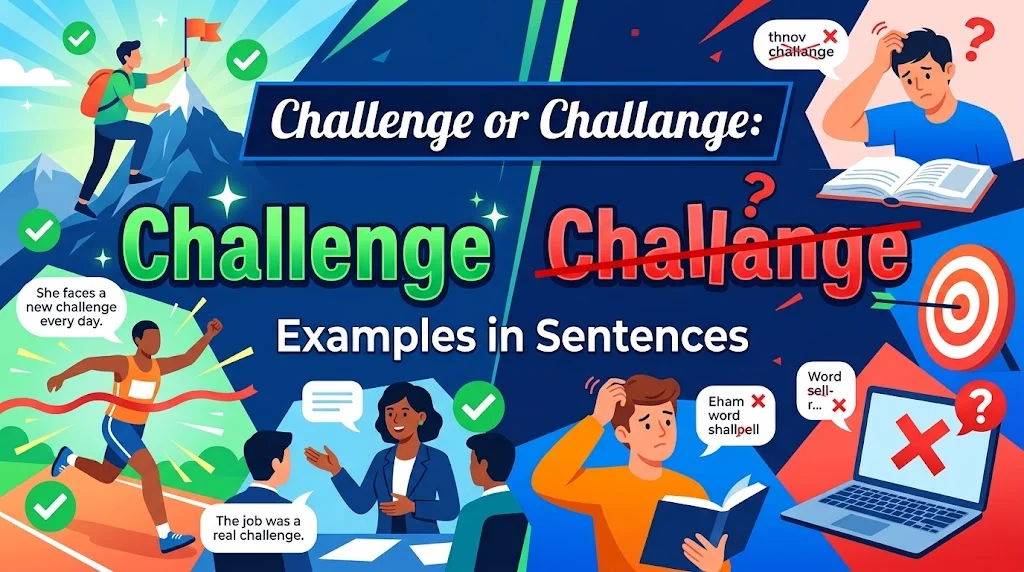
Seeing the correct spelling repeatedly can help reinforce it.
Correct Examples With “Challenge”
Here are examples covering several meanings:
- The final exam was a difficult challenge.
- She accepted the challenge without hesitation.
- Learning another language can be a rewarding challenge.
- The team overcame a major financial challenge.
- The athlete issued a challenge to her rival.
- The researchers challenged the existing theory.
- Don’t be afraid to challenge an unfair decision.
- The project presented several technical challenges.
- He enjoys taking on new challenges.
- The mountain climb was the biggest challenge of his career.
Notice that the word keeps its essential spelling across different grammatical forms.
Incorrect Examples With “Challange”
These sentences contain the common spelling mistake:
- ❌ This assignment is a difficult challange.
- ❌ She accepted the challange.
- ❌ The project presents a major challange.
- ❌ He decided to challange the ruling.
Correct versions:
- ✅ This assignment is a difficult challenge.
- ✅ She accepted the challenge.
- ✅ The project presents a major challenge.
- ✅ He decided to challenge the ruling.
Side-by-Side Examples
| Incorrect | Correct |
| The test was a challange. | The test was a challenge. |
| I accepted the challange. | I accepted the challenge. |
| She will challange the decision. | She will challenge the decision. |
| We face many challanges. | We face many challenges. |
| He challanged the claim. | He challenged the claim. |
Why Do People Spell Challenge as “Challange”?
The mistake isn’t random. Several factors can make challange look tempting.
Pronunciation-Based Spelling
People often spell unfamiliar words based on how they sound.
That strategy works occasionally. It fails when English pronunciation doesn’t clearly reveal the spelling.
Challenge falls into that category.
Someone who rarely sees the word in writing might hear it and reconstruct the letters incorrectly.
Confusion About the “-enge” Ending
The ending causes much of the confusion.
The correct ending is:
-enge
The common incorrect version uses:
-ange
This single vowel creates the spelling difference.
A quick visual check can help:
challENGE ✅
challANGE ❌
Influence of Familiar Spelling Patterns
English contains many words ending in -ange, including:
- change
- range
- exchange
- arrange
- strange
That familiar pattern may influence someone’s spelling of challenge.
However, challenge follows a different spelling pattern.
Don’t assume that words with similar sounds must share the same internal letters.
Typing Errors and Autocorrect
Fast typing can produce accidental substitutions. If you type quickly, your fingers may insert a nearby or familiar letter pattern.
Autocorrect doesn’t always catch every spelling mistake, especially when the incorrect form resembles a plausible word.
That’s why proofreading still matters.
How to Remember the Spelling of Challenge
You don’t need a complicated mnemonic. A few simple habits can make the spelling stick.
Remember the “-enge” Ending
The easiest trick is to remember:
challenge = -enge
Think:
Challenge ends with ENGE, not ANGE.
That one distinction eliminates the most common error.
Avoid the Extra “A”
Look closely at the two spellings:
Challenge
Challange
The incorrect version contains an extra a where the correct spelling uses e.
If you’re unsure, slow down and inspect the middle:
chall-e-nge
Learn the Word Through Sentences
Words become easier to remember when you use them in meaningful contexts.
Instead of repeating:
challenge, challenge, challenge
write sentences such as:
Every new skill brings a new challenge.
She enjoys taking on a difficult challenge.
The project challenged the entire team.
Context gives the spelling a mental anchor.
Practice Related Forms
Learning related forms helps reinforce the same spelling pattern.
| Word Form | Example |
| Challenge | This is a difficult challenge. |
| Challenges | We face several challenges. |
| Challenged | The idea was challenged. |
| Challenging | The assignment is challenging. |
Notice something important: the base word remains challenge.
When -ing is added, the final silent e drops:
challenge → challenging
When -ed is added, the e stays:
challenge → challenged
Challenge Word Forms and Grammar
Understanding the word’s grammatical forms can make your writing more accurate.
Challenge
The base form works as both a noun and verb.
Noun:
The task is a challenge.
Verb:
I challenge that conclusion.
Challenges
Challenges can be a plural noun or third-person singular verb.
Plural noun:
The company faces several challenges.
Verb:
She challenges traditional assumptions.
Challenged
Challenged is the past tense and past participle.
Examples:
The team challenged the decision.
The theory has been challenged by newer research.
Challenging
Challenging functions as the present participle and can also work as an adjective.
Examples:
The students are challenging themselves.
It was a challenging assignment.
A useful spelling pattern is:
challenge → challenged
challenge → challenging
challenge → challenges
Common Mistakes With Challenge
Knowing the main spelling isn’t enough. Writers can also misuse the word or its related forms.
Writing “Challange”
This remains the biggest spelling problem.
Remember:
challenge ✅
not:
challange ❌
Confusing Challenge With Challenging
These forms aren’t interchangeable.
This assignment is a challenge.
Here, challenge is a noun.
This assignment is challenging.
Here, challenging works as an adjective.
Both sentences can communicate a similar idea, but their grammar differs.
Misusing Challenge as a Synonym
A challenge isn’t always exactly the same as a problem.
A problem generally requires a solution.
A challenge often emphasizes the effort required to overcome something.
For example:
The broken server is a problem.
Managing the growing server load is a challenge.
The distinction isn’t absolute. In many contexts, the words overlap. Still, understanding the difference can make your writing more precise.
Confusing Challenge With Similar Words
Writers sometimes confuse challenge with words that look or sound similar.
Consider these:
| Word | Meaning |
| Challenge | A difficult task, test, competition, or objection |
| Change | To make something different |
| Chance | An opportunity or possibility |
| Charge | A demand for payment, accusation, or act of powering something |
| Challenger | A person or team that challenges another |
The meanings differ even though the words share some letters or sounds.
Challenge Synonyms and Related Words
Choosing a synonym depends heavily on context.
| Related Word | Meaning | Example |
| Difficulty | Something hard to deal with | The course presented a difficulty. |
| Problem | Something requiring attention or a solution | We found a technical problem. |
| Obstacle | Something blocking progress | Cost became an obstacle. |
| Test | Something measuring ability | The exam was a real test. |
| Contest | A competitive event | She entered the contest. |
| Dispute | A disagreement or objection | The decision sparked a dispute. |
| Trial | A difficult experience or test | The journey became a trial. |
| Hurdle | A difficulty that must be overcome | Funding was the biggest hurdle. |
| Demand | Something requiring effort or resources | The job makes heavy demands. |
| Adversity | Difficult or unfavorable circumstances | He succeeded despite adversity. |
These words aren’t perfect substitutes in every sentence.
For example, replacing challenge with obstacle can change the meaning. An obstacle specifically blocks progress, while a challenge can simply demand effort.
Challenge vs. Similar-Looking Words

Some spelling comparisons deserve special attention because they can cause mistakes.
Challenge vs. Change
Challenge means a difficult task, test, competition, or act of questioning.
Change means to make something different or become different.
Examples:
The project was a challenge.
We need to change the project schedule.
The two words shouldn’t be treated as interchangeable.
Challenge vs. Chance
A chance is an opportunity or possibility.
A challenge is something that tests ability or requires effort.
Compare:
This job is a challenge.
This job gives me a chance to learn.
The first emphasizes difficulty. The second emphasizes opportunity.
Challenge vs. Charge
Charge has several meanings, including a fee, accusation, electrical energy, or rushing toward something.
For example:
The store will charge $20.
That has nothing to do with:
The store’s biggest challenge is customer retention.
The words may look somewhat similar, but their meanings are entirely different.
Challenge vs. Challenger
A challenge can be the difficult task or competitive invitation.
A challenger is the person or team that challenges someone.
For example:
The challenge was accepted.
The challenger entered the tournament.
That distinction becomes especially useful in sports and competitions.
Challenge in Formal and Informal Writing
The word works comfortably across different levels of English.
Formal Examples
In academic or professional writing, challenge often appears in analytical statements.
The findings challenge several assumptions about consumer behavior.
Organizations face significant challenges when implementing new technology.
The proposal presents a practical challenge for smaller institutions.
These examples use the word precisely without sounding overly casual.
Informal Examples
In everyday conversation, people often use challenge to describe personal difficulties.
Getting everyone ready on time was a challenge.
I’m up for the challenge.
That sounds like a fun challenge.
These expressions are natural and common.
When “Challenge” Sounds More Natural Than “Problem”
The choice can affect tone.
Calling something a problem often highlights the negative situation.
Calling it a challenge can emphasize the opportunity to solve or overcome it.
For example:
We have a problem with the schedule.
versus:
The schedule presents a challenge.
Neither sentence is automatically better. The right choice depends on what you want to emphasize.
Common Collocations With Challenge
English speakers frequently use challenge with certain verbs and phrases.
Learning these combinations can improve both vocabulary and naturalness.
Face a Challenge
Every new business faces challenges.
This means encountering something difficult.
Accept a Challenge
She accepted the challenge immediately.
This means agreeing to attempt something difficult or competitive.
Take on a Challenge
He decided to take on the challenge.
This emphasizes willingly tackling a difficult task.
Overcome a Challenge
The team overcame several challenges.
This means successfully dealing with difficulties.
Meet the Challenge
The organization rose to meet the challenge.
This means responding successfully to a demanding situation.
Pose a Challenge
Limited resources pose a challenge for small businesses.
This means creating or presenting a difficulty.
Rise to the Challenge
She rose to the challenge and delivered the project early.
This expression suggests responding successfully when circumstances become difficult.
How to Use Challenge Correctly in a Sentence
Placement matters because challenge can function as both a noun and a verb.
Challenge as the Subject
The challenge requires careful planning.
Here, challenge is the subject of the sentence.
Challenge as the Object
The team accepted the challenge.
Here, challenge receives the action of the verb accepted.
Challenge as a Verb
The researchers challenged the assumption.
Here, challenged is the main verb.
The grammatical structure changes even though the spelling remains recognizable.
Challenge With Prepositions
Some common constructions are especially useful:
challenge someone to something
He challenged his friend to a race.
challenge an idea
The evidence challenges that idea.
face a challenge
The company faces a serious challenge.
meet a challenge
The team met the challenge successfully.
overcome a challenge
She overcame the challenge through careful planning.
Learning these patterns can help you sound more natural than simply memorizing a dictionary definition.
A Practical Case Study: How One Letter Changes the Word
Imagine a student writing an essay about education.
The student writes:
Online learning creates a significant challange for students who struggle with time management.
The meaning is clear. However, the spelling is wrong.
A corrected version reads:
Online learning creates a significant challenge for students who struggle with time management.
Only one letter changed.
Yet that small error matters in an academic setting because spelling contributes to the overall quality and credibility of written communication.
Now consider a workplace email:
The migration project presents several challanges.
The correction is:
The migration project presents several challenges.
This example also demonstrates why learning the word family helps. Once you know challenge, the plural becomes challenges, not challanges.
The lesson is straightforward: learn the base spelling first, then apply the correct grammatical ending.
Does Spelling Challenge Correctly Matter?
Yes, particularly when you’re writing for an audience that expects accuracy.
A single spelling error rarely destroys the meaning of a sentence. Still, repeated errors can distract readers and reduce confidence in the writer.
This matters in:
- School assignments
- College essays
- Resumes
- Cover letters
- Business emails
- Reports
- Website content
- Product descriptions
- Professional documents
- Applications
Spelling accuracy is one small part of effective communication. It isn’t everything, but it helps readers focus on your ideas instead of your mistakes.
Challenge and Online Content
Online writing adds another reason to use the correct spelling.
Search engines can often understand misspellings and infer user intent. However, deliberately publishing incorrect spelling isn’t a strong content strategy.
A page targeting challenge or challange should explain the distinction clearly rather than repeatedly using the incorrect spelling as though it were a legitimate variant.
Good content serves readers first.
Challenge or Challange: Quick Reference
| Question | Answer |
| Correct spelling | Challenge |
| Incorrect spelling | Challange |
| Part of speech | Noun and verb |
| Correct ending | -enge |
| Main noun meaning | A difficult task, test, competition, or objection |
| Main verb meaning | To test, question, confront, or invite competition |
| Plural | Challenges |
| Past tense | Challenged |
| Present participle | Challenging |
| Common mistake | Adding an a before nge |
Quick Quiz: Challenge or Challange?
Test yourself before moving to the answers.
Choose the Correct Spelling
Which spelling is correct?
A. Challange
B. Challenge
The answer is B. Challenge.
Complete the Sentence
Fill in the blank:
Learning to manage a large team can be a difficult ________.
Answer: challenge
Identify the Correct Sentence
Which sentence is correct?
A. The assignment was a serious challange.
B. The assignment was a serious challenge.
Answer: B
Correct the Misspelling
Fix this sentence:
She decided to challange the decision.
Correct version:
She decided to challenge the decision.
Choose the Correct Ending
Which ending appears in the correct spelling?
A. -ange
B. -enge
Answer: B. -enge
A Simple Memory Trick for Challenge
When you hesitate, use this quick mental check:
Challenge has an E before NGE.
Write it mentally as:
chall + enge
Then compare it with the common error:
chall + ange
The first one is correct.
Another useful sentence is:
Every challenge begins with E.
It’s a simple memory device rather than a formal spelling rule. The goal is to make the correct visual pattern easier to recall.
Challenge or Challange: What Should You Use?
Use challenge every time you mean the standard English word.
Avoid challange in:
- Formal documents
- Academic writing
- Professional emails
- Website content
- Resumes
- Reports
- Essays
- Social media posts where accuracy matters
- Business presentations
If you’ve written challange, replace it with challenge.
If you’ve written challanges, replace it with challenges.
If you’ve written challanged, replace it with challenged.
If you’ve written challanging, replace it with challenging.
Once the base spelling becomes familiar, these related forms become much easier.
Frequently Asked Questions About Challenge or Challange
Is “challange” ever correct?
No. Challange isn’t the standard English spelling of the word. The correct spelling is challenge.
You may see challange in online comments, informal messages, or other writing containing spelling errors. Its appearance doesn’t make it an accepted spelling variant.
Why do people write challange instead of challenge?
People may write challange because they rely on pronunciation, confuse the -enge ending with -ange, type quickly, or haven’t encountered the correct spelling often enough.
The most useful correction is to remember that challenge contains -enge.
What is the correct spelling of challenge?
The correct spelling is:
C-H-A-L-L-E-N-G-E
The common incorrect spelling is challange, which contains an unnecessary a.
Is challenge a noun or a verb?
Challenge can be both a noun and a verb.
As a noun:
The assignment was a challenge.
As a verb:
The lawyer challenged the decision.
Its grammatical role depends on how you use it in the sentence.
What does challenge mean?
As a noun, challenge can mean a difficult task, demanding situation, competition, test, or objection.
As a verb, it can mean to test someone, question something, confront an idea, or invite someone to compete.
What is the plural of challenge?
The plural is challenges.
Example:
The project created several new challenges.
Don’t write challanges. The correct form retains the e:
challenge → challenges
What is the past tense of challenge?
The past tense is challenged.
Example:
The researchers challenged the earlier conclusion.
The spelling is:
challenge → challenged
The final e remains before -d.
What is the difference between challenge and challenging?
Challenge can function as a noun or verb.
The task is a challenge.
Challenging can describe something difficult or function as the present participle of challenge.
The task is challenging.
The two words are related but serve different grammatical roles.
How can I remember how to spell challenge?
Remember the ending -enge.
Think:
chall + enge = challenge
The common mistake changes that ending to -ange.
Writing the word in several meaningful sentences can also reinforce the correct pattern.
What are some common phrases with challenge?
Common expressions include:
- face a challenge
- accept a challenge
- take on a challenge
- overcome a challenge
- meet a challenge
- pose a challenge
- rise to the challenge
- challenge an idea
- challenge a decision
- challenge someone to a competition
These phrases occur frequently in everyday, academic, business, and professional English.
Is challenge the same as problem?
Not always.
A problem usually refers to something that needs to be solved or dealt with. A challenge often emphasizes the difficulty or effort involved.
The meanings overlap in many situations, but they can create different tones.
Is challenge the same as difficulty?
They’re closely related, but they’re not always identical.
A difficulty describes something that makes an activity hard. A challenge can describe that difficulty while also suggesting an opportunity to test skills or overcome an obstacle.
For example:
The lack of funding created a difficulty.
The lack of funding created a major challenge.
Both can work, but the second often sounds more active and goal-oriented.
Conclusion: Challenge Is the Correct Spelling
When choosing between challenge or challange, the answer is clear: challenge is the correct spelling.
The incorrect form challange usually results from pronunciation-based spelling, confusion about the -enge ending, or simple typing mistakes. It may look familiar because people use it accidentally online, but it isn’t the standard spelling.
The easiest way to remember the word is to focus on its middle and ending:
challenge → -enge
Not:
challange → -ange
The word itself has several useful meanings. As a noun, it can describe a difficult task, competition, test, or objection. As a verb, it can mean to test, question, confront, or invite someone to compete.
Its related forms follow predictable patterns:
- challenge
- challenges
- challenged
- challenging
Whether you’re writing an essay, sending a professional email, creating website content, or simply texting a friend, choose challenge. One small spelling detail makes the difference between a standard English word and a common spelling error.