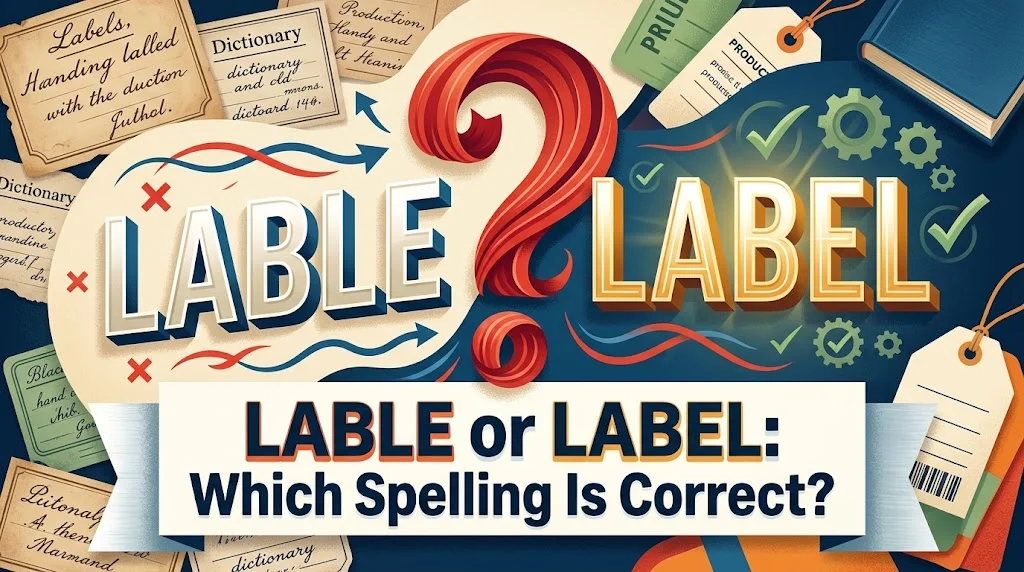
Lable or label? If you’ve ever hesitated before typing this word, you’re not alone. The two spellings look remarkably similar, especially when you’re writing quickly. However, only one is the standard English spelling.
The correct spelling is label.
Lable is a misspelling. It isn’t an accepted alternative spelling of the word in standard American or British English.
The word label has several common uses. It can describe a tag attached to an object, a name that identifies something, a category used to organize information, or an action that identifies or classifies something. It works as both a noun and a verb.
There’s also a small wrinkle when you move from American to British English. The basic word remains label in both varieties, but some derived forms use different spellings. American English generally uses labeled and labeling, while British English commonly uses labelled and labelling.
Let’s look at the difference carefully so you can use label confidently in your writing.
Label vs. Lable: The Quick Answer
The simplest answer is this:
Label is correct. Lable is incorrect.
| Spelling | Correct? | Usage |
| label | ✅ Yes | Standard English spelling |
| lable | ❌ No | Common misspelling |
| labeled | ✅ Yes in US English | Past tense/past participle |
| labelled | ✅ Yes in British English | Past tense/past participle |
| labeling | ✅ Yes in US English | Present participle |
| labelling | ✅ Yes in British English | Present participle |
For example:
- Correct: Please read the label before using the product.
- Incorrect: Please read the lable before using the product.
The mistake usually involves leaving out the e in the middle of the word. That small omission changes a correct spelling into an error.
What Does “Label” Mean?
The word label has several related meanings. At its core, it involves identifying, describing, naming, or classifying something.
You encounter labels constantly. A cereal box has a label. A shirt has a label showing its size. A folder might have a label identifying its contents. A diagram can contain labels that identify different parts.
The word also has broader meanings. Someone might label an idea as unrealistic, for example. In that sentence, the word doesn’t refer to a physical sticker. Instead, it means to describe or classify something in a particular way.
Label as a Noun
As a noun, label refers to a name, tag, description, or category used to identify something.
Consider these examples:
- The label on the bottle lists the ingredients.
- Check the clothing label for washing instructions.
- The box had a fragile label on the outside.
- The file has a clear label so everyone can find it.
- The product carries the company’s brand label.
A label can be physical or conceptual.
A physical label might be printed on paper, plastic, cardboard, fabric, or another material. A digital label might appear in an email system, database, website, or software application.
The word can also refer to a descriptive category. For example:
The term “classic” is often used as a label for products that have remained popular over time.
Here, label means a descriptive name or classification rather than a physical tag.
Label as a Verb
Label also functions as a verb. As a verb, it means to attach a label to something or to identify, describe, or classify something.
For example:
- Please label each container.
- The teacher labeled the parts of the diagram.
- Workers label the packages before shipping them.
- The researcher labeled each sample carefully.
- Don’t label someone based on one mistake.
Notice how the meaning changes slightly depending on context.
In the first examples, label involves physically identifying an object. In the final example, it means assigning a description or category to a person.
Common Meanings of Label
You can generally group the word’s uses into several categories:
- Identification: A label tells you what something is.
- Description: A label provides information about an object or idea.
- Classification: A label places something into a category.
- Branding: A label can identify a company, brand, or product line.
- Organization: Labels help people sort files, messages, products, or information.
This flexibility explains why label appears in everyday conversation, education, business, science, technology, and many other fields.
Why Is “Label” the Correct Spelling?
The standard spelling is label, with an e before the final l.
The word is written:
L-A-B-E-L
Not:
L-A-B-L-E
The incorrect form lable often happens because people pronounce the word quickly. The unstressed vowel can be easy to overlook when you’re trying to reproduce the sound in writing.
English spelling doesn’t always mirror pronunciation perfectly. That’s one reason some words require memorization rather than simple sound-to-letter conversion.
The important point is straightforward: the standard English spelling is label.
Major English dictionaries list label as the standard word. The misspelling lable doesn’t become correct simply because it appears frequently online or in informal writing.
Correct Usage
Use label whenever you’re referring to the word in standard English.
For example:
The label contains important safety information.
Please label the folders before putting them in the cabinet.
The manufacturer labeled each package with a tracking number.
She is labeling the samples for the experiment.
In each sentence, the spelling changes according to grammar, but the base word remains label.
Why Do People Spell “Label” as “Lable”?
If label is the correct spelling, why does lable appear so often?
There are several practical reasons.
Pronunciation Can Cause Confusion
English pronunciation doesn’t always reveal every letter in a word.
When people say label naturally, the middle vowel can sound weak. Someone who learns words primarily through speech may therefore write the word according to how it sounds.
This creates a simple problem: the pronunciation doesn’t provide a perfect spelling guide.
Compare the spoken form with the written form:
- Spoken: approximately LAY-buhl
- Written: label
The second syllable is relatively weak in ordinary speech. That can make the spelling easy to misremember.
Letter Order and Omission
Another common reason is simply forgetting the e.
A writer may know the word perfectly well but type:
lable
instead of:
label
This is similar to many ordinary typing mistakes. The writer doesn’t necessarily misunderstand the word. One letter simply disappears or moves.
The difference is only one character, but spelling accuracy depends on that character.
Fast Typing
Typing quickly can create accidental omissions.
When your fingers move faster than your attention, short words can suffer from missing letters. A person might type lable without noticing the mistake, especially when writing a long document.
That’s why proofreading still matters even when you know the correct spelling.
Familiarity With Informal Writing
Online writing contains plenty of typos. When people repeatedly encounter an incorrect spelling, it can begin to look familiar.
Familiarity, however, doesn’t make a spelling standard.
If you see lable in comments, messages, social media posts, or other informal material, treat it as a spelling error rather than a second version of label.
Read More: Flier vs Flyer: Which Spelling Is Correct in 2026?
Label in American and British English
Here’s where the topic gets slightly more interesting.
The base word label is spelled the same way in both American and British English.
The difference appears in some forms derived from the verb.
American English Verb Forms
American English generally uses:
- label
- labels
- labeled
- labeling
Examples:
The assistant labeled every folder.
She is labeling the storage containers.
British English Verb Forms
British English commonly uses:
- label
- labels
- labelled
- labelling
Examples:
The assistant labelled every folder.
She is labelling the storage containers.
The additional l in labelled and labelling follows a broader spelling pattern found in British English.
Most importantly, British English does not change label into lable.
So this is correct:
British English: label → labelled → labelling
This is incorrect:
label → lable → labled → labling
American vs. British Label Forms
| Meaning | American English | British English |
| Base form | label | label |
| Third-person singular | labels | labels |
| Past tense | labeled | labelled |
| Present participle | labeling | labelling |
| Plural noun | labels | labels |
If you’re writing for an American audience, use labeled and labeling. If you’re following British spelling conventions, use labelled and labelling.
Label as a Noun: Examples in Context
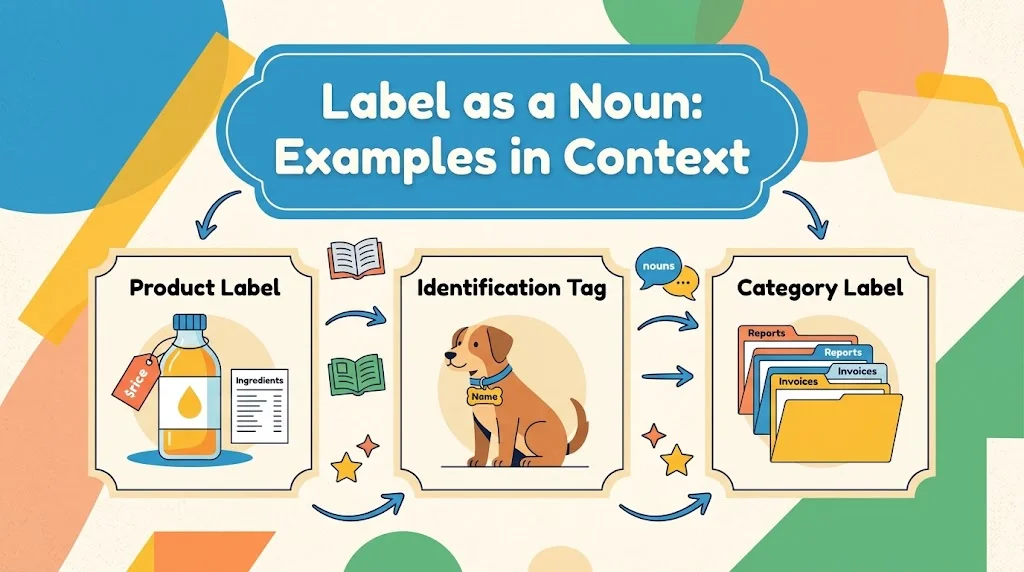
The easiest way to understand label is to see how people actually use it.
Products and Packaging
Product packaging is one of the most familiar places you’ll see labels.
A food label may provide:
- Product name
- Ingredients
- Nutrition information
- Net quantity
- Manufacturer information
- Storage instructions
- Warnings
- Dates or other required information
For example:
Always check the food label for ingredient information.
A clothing label can provide information about:
- Size
- Fabric
- Care instructions
- Country of manufacture
- Brand
For example:
The shirt’s label says to wash it in cold water.
Brands and Businesses
Label can also refer to a brand or company associated with a product.
You might hear expressions such as:
- fashion label
- record label
- clothing label
- private label
- designer label
For example:
The designer launched a new clothing label.
In the music industry, a record label is a company involved in recording, producing, marketing, and distributing music.
Files and Organization
Labels aren’t limited to physical objects.
Digital systems use labels to organize information. An email service, project-management platform, or database might allow users to attach labels to messages or records.
For example:
Add a label to the message so you can find it later.
In this context, the label functions as an organizational tool.
Social and Descriptive Uses
The word also appears when people discuss categories or descriptions.
For example:
Some people dislike being given a particular social label.
Here, label doesn’t mean a sticker. It refers to a word or category assigned to a person or group.
This usage requires some care. Labels can simplify complicated situations, and a label may not fully describe the person or idea being discussed.
Label as a Verb: Examples in Context
The verb label follows the same basic spelling rule.
Labeling an Object
You can label an object by attaching a physical identifier to it.
Label the containers before placing them in storage.
The technician labeled each cable.
We are labeling the boxes by room.
These sentences describe a direct physical action.
Labeling Information
Teachers, researchers, and professionals frequently label diagrams, charts, samples, and other information.
For example:
The student labeled each part of the human heart.
Please label the axes on the graph.
The researcher labeled the samples before testing them.
The purpose is identification. A reader can understand what each item represents because the appropriate label is attached.
Labeling People and Ideas
The verb can also describe classification.
It’s easy to label someone based on a single mistake.
The article labels the proposal as unrealistic.
This use can be neutral or critical depending on context. In some situations, classification helps people communicate efficiently. In others, a label can oversimplify a complicated subject.
Digital and Technical Uses
Technology provides another common setting.
You might:
- Label an email
- Label a file
- Label a dataset
- Label a diagram
- Label a database field
- Label an image
- Label a category
For example:
The analyst labeled each data point before creating the chart.
Again, the central idea is identification.
Label Word Forms You Should Know
Learning the related forms makes the spelling easier to remember.
| Word form | Function | Example |
| label | Noun/verb | Put a label on the box. |
| labels | Plural noun/verb | The labels are easy to read. |
| labeled | US past tense/past participle | She labeled the folders. |
| labeling | US present participle | He is labeling the samples. |
| labelled | UK past tense/past participle | She labelled the folders. |
| labelling | UK present participle | He is labelling the samples. |
Why Are “Labelled” and “Labelling” Spelled With Two Ls?
This is a common source of confusion.
The British forms labelled and labelling add another l before the endings. American English generally keeps a single l:
- US: labeled
- UK: labelled
- US: labeling
- UK: labelling
Neither form uses lable.
That’s the key distinction.
Label vs. Lable: Common Mistakes
Most errors involving these words are simple spelling problems.
Mistake 1: Omitting the “e”
Incorrect: The lable contains the washing instructions.
Correct: The label contains the washing instructions.
The easiest way to catch this error is to remember the middle e.
Mistake 2: Using “Lable” in Professional Writing
A typo in a casual text may go unnoticed. In professional content, it can make the writing look careless.
You should be especially careful with label when writing:
- Product descriptions
- Business emails
- Reports
- Academic papers
- Instruction manuals
- Website copy
- Marketing materials
- Technical documentation
- Educational materials
If you’re describing a product, spelling label correctly is particularly important because the word may appear several times throughout the page.
Mistake 3: Confusing Label With Related Words
Sometimes the problem isn’t spelling. It’s word choice.
Label, tag, title, caption, and category can overlap, but they aren’t always interchangeable.
Label vs. Tag vs. Title vs. Category
| Word | Basic meaning | Example |
| Label | Identifies or describes something | Read the product label. |
| Tag | Marks or identifies something | Attach a price tag. |
| Title | Names a work or section | The article has a clear title. |
| Category | Groups similar things | Choose a product category. |
| Caption | Describes an image or figure | Read the photo caption. |
Consider an online article.
The title tells readers what the article is called. A category groups the article with related content. A tag can identify a topic. A caption explains an image. A label can identify or classify something more generally.
The words overlap in some contexts, but their meanings aren’t identical.
How to Remember the Spelling “Label”
If you regularly type lable, a simple memory strategy can help.
Remember the Middle “E”
The most important detail is the e:
lab + e + l = label
Don’t let the pronunciation trick you into removing it.
Connect It to Related Forms
Think about the word family:
- label
- labels
- labeled
- labeling
Seeing the base word inside these forms reinforces the spelling.
For British English, you can remember:
- label
- labelled
- labelling
The base remains label.
Write It in a Sentence
Instead of repeatedly writing the isolated word, use it naturally:
I checked the label before buying the product.
Please label the boxes.
She labeled the samples.
Context helps turn spelling into a usable habit.
Read the Word Frequently
Regular reading exposes you to correct spelling in context.
Pay attention to label when you encounter it on:
- Product packaging
- Websites
- Books
- News articles
- Instructions
- Software interfaces
- Educational materials
The more often you see the correct form, the more familiar it becomes.
How to Avoid Writing “Lable”
A few simple habits can prevent the mistake.
Learn the Correct Version First
Start with one rule:
Label is correct. Lable is not.
You don’t need a complicated spelling rule to remember it.
Use Spell Check as a Safety Net
Spell-checking software can catch many instances of lable. It shouldn’t replace proofreading, though.
Automated tools can miss context-based problems, and they may not catch every mistake.
Proofread Important Writing
Before publishing an article, sending a business document, or submitting an assignment, scan for commonly misspelled words.
A targeted check is often faster than rereading every sentence equally.
Watch for Repeated Errors
If you repeatedly write lable, treat it as a personal spelling trap.
Keep a short list of words you commonly misspell. Review that list occasionally.
Read the Final Version
A final read can reveal errors that weren’t obvious while drafting.
For important content, check headings, tables, image text, product descriptions, and metadata as well as the main body.
Commonly Confused Words Similar to “Label”
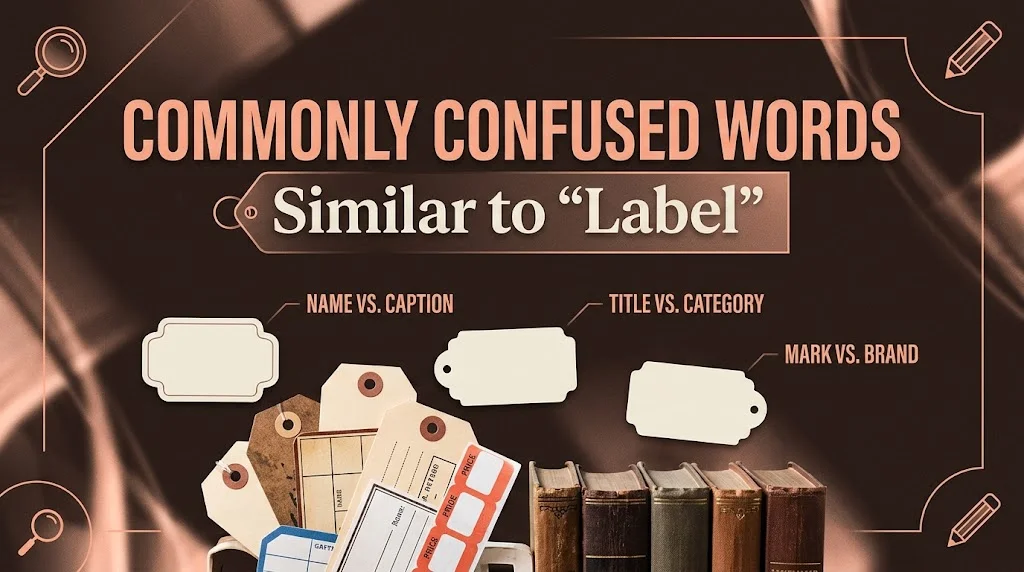
Label belongs to a broader group of words that can identify or describe things.
Label vs. Tag
A label identifies or describes something. A tag can also identify something, especially in physical or digital contexts.
The shirt has a label inside the collar.
The price tag is attached to the sleeve.
Label vs. Title
A title gives a name to a work, article, book, section, or other named item.
The article’s title is easy to understand.
A label has a broader identification or classification role.
Label vs. Caption
A caption normally provides explanatory text for an image, photograph, chart, or figure.
The photo caption explains where the picture was taken.
A label may identify an individual part within the image.
Label vs. Category
A category groups items that share a particular characteristic.
Shoes are listed under the Footwear category.
A label can help identify or classify something, but category specifically emphasizes grouping.
A Simple Case Study: Labeling Product Packages
Consider a small business preparing 100 packages for shipment.
Each package needs identifying information so workers can sort and deliver the orders correctly.
The business could label each package with:
- Customer name
- Order number
- Shipping information
- Product type
- Handling instructions
If the business creates an instruction sheet, it might say:
Label each package before placing it in the shipping area.
The word label works as a verb because it describes an action.
Later, an employee might say:
The label on this package is damaged.
Now label functions as a noun because it refers to the physical identification attached to the package.
This small example shows why understanding both grammatical roles matters. The spelling doesn’t change between the noun and the base verb.
Label or Lable: Practical Examples
Here are several examples that show the correct spelling in different situations.
Product Example
Check the label for storage instructions.
Clothing Example
The label inside the jacket lists the fabric composition.
School Example
Label each part of the diagram clearly.
Science Example
The researcher labeled each sample before beginning the experiment.
Technology Example
Create a label for messages related to the project.
Business Example
The company uses a private label for several products.
Social Context
A single label doesn’t always describe a person’s entire identity or experience.
British English Example
The technician labelled each component before testing the machine.
All of these examples use label, not lable.
Mini Practice Quiz: Label or Lable?
Test your spelling with these examples.
Choose the Correct Spelling
1. Please check the product ______ before opening it.
- A. lable
- B. label
Answer: B. label
2. The teacher asked students to ______ the diagram.
- A. lable
- B. label
Answer: B. label
3. The package was ______ with a tracking number.
- A. labeled
- B. labled
Answer: A. labeled
Correct the Mistake
Incorrect:
The lable on the bottle is difficult to read.
Correct:
The label on the bottle is difficult to read.
Choose the Correct Verb Form
She is ______ the folders before filing them.
For American English, the answer is:
labeling
For British English, the answer is:
labelling
American or British English?
Which version follows American spelling?
- labeled
- labelled
Answer: labeled
Which version is commonly used in British English?
Answer: labelled
Quick Challenge
Correct this sentence:
Please lable all the boxes before delivery.
The corrected version is:
Please label all the boxes before delivery.
Label or Lable: Final Comparison
| Question | Correct answer |
| Which spelling is correct? | Label |
| Is lable standard English? | No |
| Can label be a noun? | Yes |
| Can label be a verb? | Yes |
| US past tense | Labeled |
| British past tense | Labelled |
| US present participle | Labeling |
| British present participle | Labelling |
| Does British English use lable? | No |
| Does American English use lable? | No |
The most important distinction is simple:
Label = correct
Lable = misspelling
Don’t let the difference between labeled and labelled confuse the issue. Those are legitimate regional spelling differences. Lable, however, isn’t the British alternative.
Frequently Asked Questions
Is “lable” a word?
Lable is not the standard spelling of the English word label. When you mean the word for a tag, identifying name, classification, or related action, use label.
Which is correct, label or lable?
Label is correct. Lable is a common misspelling.
For example:
Please read the label carefully.
Not:
Please read the lable carefully.
Why do people spell label as lable?
The mistake can happen because the pronunciation doesn’t make every letter obvious. Fast typing, letter omission, and unfamiliarity with the written form can also contribute to the error.
How do you spell label in American English?
The standard spelling is label.
Common American forms include:
- label
- labels
- labeled
- labeling
How do you spell label in British English?
The base word is also label in British English.
Common British forms include:
- label
- labels
- labelled
- labelling
The difference occurs in some derived forms, not in the basic word itself.
Is labeling or labelling correct?
Both can be correct depending on the variety of English.
Labeling is the standard American English spelling.
Labelling is commonly used in British English.
Is labeled or labelled correct?
Both are standard forms.
Labeled is generally used in American English.
Labelled is commonly used in British English.
Can label be used as a verb?
Yes. Label can function as a verb meaning to attach an identifying mark or to identify, describe, or classify something.
For example:
Please label each container.
What is the plural of label?
The plural is labels.
For example:
The manufacturer printed new labels for the products.
What is the easiest way to remember the spelling of label?
Remember the middle e:
LAB + E + L = LABEL
If you’re tempted to write lable, pause and check whether you’ve accidentally removed that e.
Conclusion
When you’re deciding between lable or label, the answer is clear: label is the correct spelling.
The word label works as both a noun and a verb. As a noun, it can mean a tag, identifying name, description, or classification. As a verb, it can mean attaching a label or identifying and classifying something.
The spelling remains label in both American and British English. The main regional difference appears in forms such as labeled/labelled and labeling/labelling.
The easiest rule to remember is simple:
Always keep the “e” in label.
So if you’re writing about a product, diagram, package, file, brand, category, or classification, choose label. Save lable for your list of spellings to avoid.