Have you ever wondered whether seel or seal is the correct spelling? These two words look almost identical, but they don’t have the same meaning or everyday use. In most situations, seal is the word you’re looking for. It can refer to an animal, a watertight closure, an official mark, or the action of closing something securely. For example, you might see a seal on an envelope, watch a seal swimming in the ocean, or seal a package before sending it.
The word seel, meanwhile, is a much less common term. It has appeared in older or specialized English and may have specific historical meanings. That’s why the two spellings can cause confusion when you’re writing quickly or relying on how the word sounds.
Understanding the difference between seal and seel becomes especially useful when you’re writing emails, school assignments, articles, business documents, or everyday messages. Choosing the right spelling, meaning, and word usage helps your writing stay clear.
In this guide, you’ll learn exactly when to use seal, what seel means, how the words differ, and how to remember the correct choice.
What Is the Correct Spelling: Seel or Seal?
For normal modern English, seal is the correct spelling when you mean to close, secure, confirm, stamp, or refer to the marine animal.
For example:
- Please seal the envelope before mailing it.
- We need to seal the package securely.
- The two companies finally sealed the deal.
- We saw a seal swimming near the rocks.
- The document carries the official seal of the organization.
Seel isn’t a general alternative spelling of seal. It is a separate, uncommon word with a specialized historical meaning.
Quick Answer
If you’re writing an ordinary sentence and you’re wondering whether to use seel or seal, choose seal in almost every everyday situation.
| Word | Main meaning | Modern usage |
| Seal | Close, secure, stamp, confirm, or a marine mammal | Very common |
| Seel | A specialized falconry term | Rare and historical |
The key point is simple:
Seal is the standard spelling for everyday English. Seel has a separate, specialized meaning.
What Does “Seal” Mean?
The word seal has several meanings. Its exact definition depends on how you use it in a sentence.
It can function as a verb or a noun. It can also refer to an animal.
That makes seal one of those short English words that carries much more meaning than its four letters suggest.
Seal as a Verb
As a verb, seal generally means to close something tightly or securely.
For example:
Please seal the box before you send it.
Here, seal means to close the box so that it stays shut.
You can seal an envelope, container, package, bottle, crack, opening, or other object.
Consider these examples:
- Seal the bag tightly.
- She sealed the envelope with tape.
- The workers sealed the opening around the pipe.
- Make sure you seal the container after using it.
- The technician sealed the leak.
The word also has a figurative meaning.
When you seal a deal, you finalize an agreement. Nothing physical necessarily gets closed.
For example:
The two businesses sealed the deal after weeks of negotiations.
The phrase doesn’t mean someone physically placed a seal on the agreement. Instead, it means the agreement became final.
Another common expression is seal your fate. This means to do something that determines or fixes the outcome of a situation.
For example:
His decision to leave the team sealed his fate.
So, when seal appears as a verb, think about closing, securing, finalizing, or confirming.
Seal as a Noun
As a noun, seal has several meanings.
One common meaning is a substance or device used to close something and prevent material from passing through an opening.
For example:
The bottle has a tight rubber seal.
Here, seal refers to the material that keeps the bottle closed.
A seal can also mean an official mark or emblem.
Organizations, governments, schools, and institutions may use official seals on documents.
For example:
The certificate bears the university’s official seal.
Historically, seals were often physical objects pressed into wax or another material. The resulting mark could identify a person or organization and help demonstrate that a document had not been tampered with.
The word also appears in phrases such as:
- official seal
- corporate seal
- government seal
- seal of approval
- seal of office
The exact meaning depends on context.
Seal as an Animal
Seal also refers to a marine mammal.
Seals are aquatic mammals found in various parts of the world’s oceans and coastal regions. They belong to the broader group of pinnipeds.
For example:
We watched a seal resting on the rocks.
This meaning has nothing to do with envelopes, packages, or official documents.
The same spelling simply represents another meaning of the word.
That gives us three especially common uses of seal:
- Seal something = close or secure it.
- A seal = an official mark or closure.
- A seal = a marine mammal.
What Does “Seel” Mean?
Here’s where things get interesting.
Seel is a genuine English word, but it is extremely uncommon in ordinary modern writing.
The historical verb seel is associated with falconry. In traditional falconry terminology, it referred to sewing or closing the eyelids of a hawk or falcon, historically as part of preparing or controlling a bird.
This meaning is very different from the everyday verb seal.
For most readers, the word seel will appear mainly in historical writing, dictionaries, specialized discussions of falconry, or older literature.
The Rare Historical Meaning of “Seel”
Traditional falconry developed a specialized vocabulary over centuries. Because falconers needed precise terms for training, handling, and caring for birds, some words acquired meanings that aren’t familiar today.
Seel belongs to that specialized vocabulary.
Its historical use is one reason dictionaries may list seel even though most modern speakers never use it.
This distinction is important:
A word can be real without being common.
English contains thousands of rare, archaic, technical, and specialized terms. Their presence in a dictionary doesn’t make them suitable replacements for common words.
For example, if you’re writing:
Please ___ the envelope.
The answer is seal, not seel.
If you’re writing about historical falconry and using the specialized term, seel may be appropriate.
Why “Seel” Is Usually Not the Word You Want
Most people searching for seel or seal aren’t actually trying to use the historical falconry term.
They’re usually dealing with a spelling question such as:
Is it seel the package or seal the package?
The answer is seal the package.
Likewise:
- seal the envelope
- seal the bottle
- seal the crack
- seal the agreement
- seal the deal
All use seal.
Using seel in these sentences would create a spelling error because the intended meaning is not the historical meaning of seel.
Read More: Wether vs. Weather vs. Whether: What’s the Difference?
Seel vs. Seal: Key Differences
The easiest way to understand seel vs. seal is to stop thinking of them as two spellings of the same word.
They aren’t.
| Feature | Seal | Seel |
| Common modern English word | Yes | No |
| Means “close securely” | Yes | No |
| Refers to a marine mammal | Yes | No |
| Can mean an official mark | Yes | No |
| Associated with historical falconry | No in this specific sense | Yes |
| Common in everyday writing | Yes | Extremely rare |
The difference becomes obvious once you look at the meanings instead of the pronunciation.
The Easy Rule to Remember
Use seal when you mean:
- close something
- secure something
- prevent leakage
- finalize an agreement
- place an official mark
- refer to the marine animal
Use seel only when the context specifically calls for its rare historical meaning.
A useful memory line is:
Seal closes things and seals deals.
If you’re talking about a package, envelope, container, agreement, document, or marine animal, seal is almost certainly the word you need.
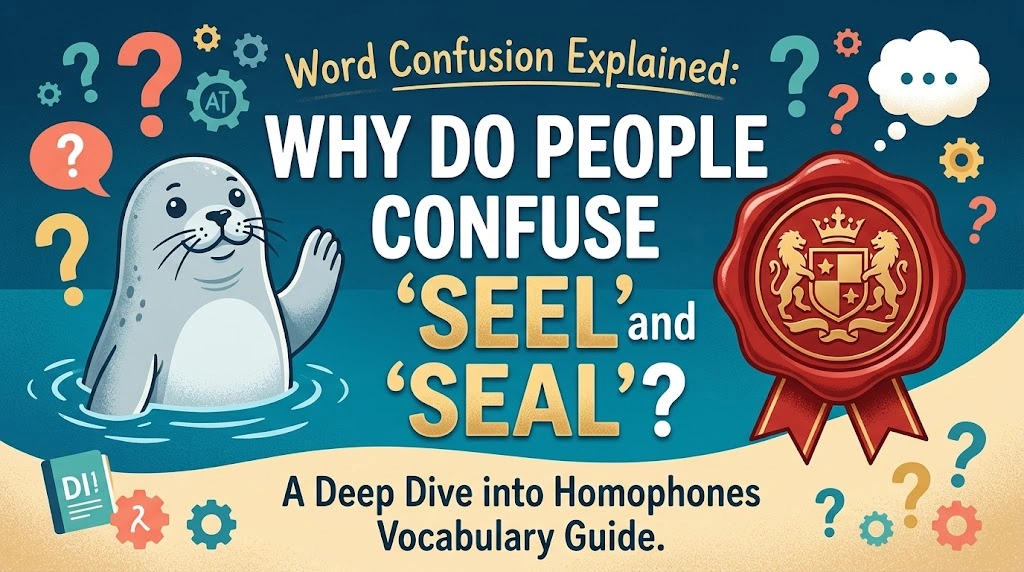
Why Do People Confuse “Seel” and “Seal”?
The main reason is straightforward: they sound alike or nearly alike in many varieties of English.
When you hear a word, you don’t see its spelling. Your brain has to reconstruct the written form from memory.
That becomes difficult when two spellings correspond to similar pronunciation.
Similar Pronunciation
English spelling isn’t perfectly phonetic.
Words such as see, sea, and seize demonstrate how spelling and pronunciation don’t always line up neatly. The same issue can create confusion with seal and seel.
Someone might know exactly what they want to say but hesitate when typing it:
“Do I write seel or seal?”
That’s a spelling problem rather than a vocabulary problem.
The solution is to connect the word to its meaning.
Fast Typing and Spelling Errors
Typing quickly can produce simple vowel substitutions.
When someone already knows the word seal, they might accidentally type seel without noticing. The letters are close enough visually and phonetically that the typo can slip through proofreading.
This becomes more likely when you’re:
- texting quickly
- writing on a phone
- taking notes
- drafting under time pressure
- copying speech into written form
A quick reread usually catches the problem.
Autocorrect and Spell Check
Spell checkers don’t understand every mistake.
If software recognizes seel as a legitimate dictionary entry, it may not mark it as misspelled. The software can identify that the word exists, but it may not understand whether you used the correct word for your intended meaning.
That’s an important distinction:
A correctly spelled word can still be the wrong word.
For example, if you write:
Please seel the package.
A dictionary-based checker may recognize seel. But the sentence doesn’t express the normal intended meaning. Seal is the correct choice.
Context-aware grammar tools can sometimes detect such problems, but human proofreading still matters.
Seal in Different Contexts
One reason seal appears so often in English is its versatility.
Business and Professional Writing
Business writing uses seal in both literal and figurative ways.
Common examples include:
- seal a deal
- seal an agreement
- seal a contract
- official seal
- company seal
- seal of approval
Consider this sentence:
The final signature helped seal the agreement.
Here, seal means finalize or make something definite.
Another example:
The document includes the organization’s official seal.
In this sentence, seal is a noun referring to an identifying official mark.
Home and Everyday Life
You’ll encounter seal constantly around the house.
For example:
- Seal the food container.
- Check the door seal.
- Seal the package with tape.
- The window needs a new seal.
- Use caulk to seal the gap.
- Make sure the lid forms a tight seal.
These uses are practical and literal.
When something needs to remain closed or protected from air, water, dust, or other materials, seal is often the word you need.
School and Academic Writing
Students may encounter seal when writing about documents, experiments, history, government, or institutions.
For example:
The envelope was sealed before the examination began.
Or:
The university’s official seal appears on the certificate.
In historical writing, students may also encounter rare words such as seel. If that happens, the surrounding context matters because specialized historical vocabulary doesn’t always match modern everyday usage.
Nature and Wildlife
When talking about marine wildlife, the spelling is always seal for the animal.
For example:
A gray seal appeared near the shoreline.
Or:
The researchers observed several seals in the coastal habitat.
The plural is seals.
This meaning is completely separate from the verb seal.
Common Expressions With “Seal”
English contains several familiar expressions built around seal.
Seal the Deal
Seal the deal means to finalize an agreement.
Example:
The final contract sealed the deal.
The phrase is especially common in business and informal conversation.
Seal of Approval
A seal of approval means official or strong approval.
Example:
The safety inspection gave the product its seal of approval.
The expression can be literal or figurative.
Signed, Sealed, and Delivered
Signed, sealed, and delivered traditionally describes something that has been formally completed and delivered.
Today, people also use the expression figuratively.
Example:
The partnership is signed, sealed, and delivered.
In casual speech, it can simply mean that something is settled.
Put Your Seal on Something
To put your seal on something can mean to leave your distinctive mark or influence on it.
Example:
The new director quickly put her seal on the organization.
Here, the phrase is figurative.
Seel or Seal: Common Sentence Mistakes
Because seel exists as a real word, these errors can be surprisingly tricky.
Incorrect: Using “Seel” for “Close”
Incorrect:
Please seel the envelope.
Correct:
Please seal the envelope.
The intended action is closing the envelope securely.
Incorrect: Using “Seel” for an Official Mark
Incorrect:
The certificate has the school’s official seel.
Correct:
The certificate has the school’s official seal.
Here, seal means an official mark or emblem.
Correct: Using “Seel” in Its Specialized Meaning
In a historical discussion of falconry, seel can be appropriate.
For example:
The historical text describes the practice of seeling a falcon.
This is a completely different word from the everyday verb seal.
The lesson is simple: don’t automatically assume that a rare dictionary word is a spelling alternative.
Seel vs. Seal Example Sentences
Seeing the words in context makes the distinction much easier.
Examples With “Seal”
Closing something:
She used tape to seal the box.
Preventing leakage:
The rubber gasket helps seal the opening.
Finalizing an agreement:
The new contract sealed the deal.
Official mark:
The document carries the organization’s official seal.
Marine animal:
We watched a seal swimming near the boat.
Figurative use:
His decision sealed his fate.
Notice how every example connects naturally with a familiar modern meaning.
Examples With “Seel”
Because seel has a specialized historical meaning, examples tend to appear in historical or technical discussions.
The falconry manuscript describes the practice of seeling a bird.
The old text uses seel as a specialized falconry term.
These examples shouldn’t be confused with everyday sentences such as seal the package.
How to Remember Seal vs. Seel
A good memory trick should connect spelling with meaning.
Think “Seal” When Something Gets Closed
Picture an envelope.
You close it.
You seal it.
Now picture a package.
You close it.
You seal it.
That connection makes the spelling easier to remember.
Remember the Animal
Imagine a seal swimming through the ocean.
The animal gives you another strong spelling anchor.
You don’t spell the animal seel. You spell it seal.
So if you’re talking about the animal, the answer is immediate.
Don’t Treat Every Rare Word as a Spelling Alternative
This is perhaps the most important lesson.
English has many rare words that look like common words. Some are historical. Others are technical or regional.
That doesn’t mean they can replace the familiar word.
Seel isn’t a casual variant of seal.
When your sentence means close, secure, finalize, stamp, or marine mammal, use seal.
A Quick Comparison: Seel or Seal?
| Sentence | Correct word | Why? |
| Please ___ the envelope. | seal | Close the envelope |
| The company ___ the agreement. | sealed | Finalized the agreement |
| We saw a ___ at the beach. | seal | Marine mammal |
| The certificate has an official ___. | seal | Official mark |
| The bottle needs a tight ___. | seal | Closure |
| The historical text discusses ___ in falconry. | seel | Specialized historical term |
This table gives you the practical distinction at a glance.
Common Questions About Seel and Seal

Is “Seel” a Correct English Word?
Yes. Seel is a genuine English word with a specialized historical meaning associated with falconry.
However, it isn’t the ordinary spelling of seal.
If you’re writing about closing an envelope or package, use seal.
Is “Seal” Always the Correct Choice?
Not literally always.
If you’re discussing the specialized historical falconry term, seel may be the appropriate word.
For normal modern English, however, seal is the word you’ll almost always need.
What Is the Difference Between Seel and Seal?
The two words have different meanings.
Seal can mean to close or secure something. It can also mean an official mark, a closure, or a marine mammal.
Seel is a rare historical term associated with falconry.
They shouldn’t be treated as interchangeable spellings.
Why Do People Spell Seal as Seel?
The most obvious reason is their similar pronunciation.
When people hear a word rather than see it written, they may have to guess which vowel combination represents the sound.
Fast typing and unfamiliarity with the word can make the problem worse.
Can Seal Be Used as Both a Noun and a Verb?
Yes.
As a verb:
Please seal the package.
As a noun:
The package has a strong seal.
The noun can also refer to an official mark:
The document bears the official seal.
And, of course, seal can refer to the marine animal.
What Does Seel Mean in Falconry?
Seel is a specialized historical falconry term associated with closing or sewing a bird’s eyelids.
The term comes from older falconry practices and is rarely encountered in ordinary modern English.
Is Seel Common in Modern English?
No. Seel is very uncommon compared with seal.
Most modern readers encounter it only in specialized dictionaries, historical texts, literature, or discussions involving traditional falconry.
Key Takeaways: Seel or Seal
The difference between seel and seal becomes straightforward once you focus on meaning.
Remember these points:
- Seal is the normal modern spelling.
- Seal can be a noun or a verb.
- You can seal an envelope, package, container, crack, or agreement.
- A seal can be an official mark or closure.
- A seal is also a marine mammal.
- Seel is a genuine but extremely rare word.
- Seel has a specialized historical connection to falconry.
- Seel isn’t a general alternative spelling for seal.
- Spell checkers may recognize seel even when it doesn’t fit your sentence.
- Meaning and context should guide your word choice.
The easiest rule is this:
If you mean close, secure, finalize, stamp, or the marine animal, use “seal.”
So, when you’re wondering whether to write seel or seal, don’t let pronunciation make the decision for you. Look at the meaning first. In ordinary modern English, seal is the spelling you want.