Have you ever wondered whether dwarfs or dwarves is the correct plural of dwarf? You may have seen both spellings in English grammar, fantasy literature, science, and popular culture. At first glance, the difference looks like a simple spelling variation, but there’s more to it. Both plural forms are accepted in modern English usage, although each one tends to appear in different contexts.
The word dwarfs is especially common in astronomy, where terms such as white dwarfs, red dwarfs, and brown dwarfs are standard. Meanwhile, dwarves is strongly associated with fantasy characters, mythology, folklore, fictional races, and fantasy worlds. The influence of J.R.R. Tolkien also played an important role in making “dwarves” familiar to modern readers.
Understanding this distinction can help you avoid grammar mistakes, choose the right plural noun, and write more naturally. Whether you’re working on an academic essay, discussing scientific terminology, analyzing fantasy fiction, or simply checking a dictionary definition, knowing when to use each form makes your writing clearer.
What Is the Correct Plural of Dwarf?
The word dwarf has two accepted plural forms: dwarfs and dwarves.
Neither form is automatically wrong. Instead, the appropriate choice depends heavily on context and established usage.
Dwarfs as the Traditional Plural
Dwarfs follows a regular English plural pattern.
Many English nouns form their plural simply by adding -s:
- dwarf → dwarfs
- roof → roofs
- chief → chiefs
- belief → beliefs
- proof → proofs
Historically, dwarfs was a standard plural form of dwarf. It remains perfectly legitimate today.
You’ll particularly encounter it in scientific and general nonfiction contexts.
For example:
Astronomers have discovered thousands of white dwarfs in the Milky Way.
Here, dwarfs is the established scientific plural.
Dwarves as an Established Alternative
Dwarves developed as an alternative plural and became strongly associated with legendary or fictional dwarf-like beings.
It follows an older English pattern in which some nouns ending in -f or -fe developed plurals ending in -ves.
Compare:
- knife → knives
- wife → wives
- life → lives
- wolf → wolves
- loaf → loaves
However, English doesn’t apply this pattern consistently to every word ending in -f. That’s why forms such as roofs, chiefs, and beliefs remain standard.
The history of dwarves is more complicated than simply saying that every -f word should become -ves.
Why Both Forms Are Correct in Different Contexts
Modern English recognizes both forms, but their usage has developed along different paths.
A useful distinction is:
| Context | Common plural |
| Astronomy | dwarfs |
| General nonfiction | dwarfs |
| Fantasy literature | dwarves |
| Mythological creatures | dwarves |
| Fictional fantasy races | dwarves |
| Famous established titles | Follow the original title |
This isn’t an absolute grammatical law. Writers can encounter exceptions, especially when a work deliberately follows a particular fictional tradition.
Quick Answer: Dwarfs vs Dwarves
If you need a quick rule, remember this:
Use “dwarfs” mainly for scientific and general contexts. Use “dwarves” mainly for fantasy, mythology, and fictional beings.
For example:
- White dwarfs are stellar remnants.
- The wizard met several dwarves in the mountain kingdom.
Both sentences use the plural correctly.
Dwarfs vs Dwarves: What Is the Difference?
The biggest difference between dwarfs and dwarves is usually context rather than basic meaning.
Both forms can refer to more than one dwarf. What changes is the tradition or subject in which the word appears.
Meaning of Dwarf and Its Plural Forms
A dwarf can refer to a person or creature described by that term, depending on context.
The word also appears in scientific terminology. In astronomy, a dwarf star is a star or stellar object described using the astronomical classification system. Terms include red dwarf, brown dwarf, and white dwarf.
The plural of those scientific terms is normally formed with dwarfs:
- red dwarf → red dwarfs
- white dwarf → white dwarfs
- brown dwarf → brown dwarfs
Fantasy uses a different convention.
A fictional race inspired by European folklore might be described as dwarves. Fantasy games, novels, films, and role-playing settings frequently use this form.
How Context Determines the Preferred Plural
Consider these two sentences:
Astronomers study red dwarfs because they can remain active for extremely long periods.
The dwarves forged powerful weapons beneath the mountain.
The subject tells you which plural fits naturally.
The first sentence concerns astronomy. Dwarfs is the established term.
The second sentence describes fictional fantasy characters. Dwarves is the conventional choice.
Why the Two Forms Cannot Always Be Treated as Interchangeable
Technically, both forms can function as plurals. Yet established terminology matters.
If you write white dwarves in an astronomy article, readers may understand you. Still, white dwarfs is the conventional astronomical expression.
Likewise, describing Tolkien-inspired characters as dwarfs may look unusual because modern fantasy generally favors dwarves.
Language isn’t just a collection of dictionary definitions. Specialized communities develop conventions that readers learn to recognize.
When Should You Use “Dwarfs”?
The plural dwarfs works especially well in scientific, general, and factual writing.
General and Modern Nonfiction Usage
When you’re discussing the word in an ordinary nonfiction context, dwarfs can be entirely appropriate.
For example:
Several dwarfs appeared in the historical illustration.
The exact choice can depend on the subject and the style of the publication.
If you’re writing about people in a historical or descriptive context, it’s also important to consider modern terminology and the preferences of the people or community being discussed. The word can carry different implications depending on how it’s used.
Scientific and Astronomical Writing
Astronomy provides the clearest example of why dwarfs matters.
Scientists use several established terms containing the plural:
- white dwarfs
- red dwarfs
- brown dwarfs
A white dwarf is the dense stellar remnant left after a star like the Sun has exhausted its nuclear fuel and shed its outer layers.
A red dwarf is a small, relatively cool star. These stars are extremely common in the Milky Way.
A brown dwarf occupies a category between the largest planets and the smallest stars. Brown dwarfs don’t sustain ordinary hydrogen fusion in their cores like main-sequence stars do.
The plural dwarfs is standard across these astronomical terms.
Medical and Descriptive Contexts
The terminology surrounding human height and dwarfism requires more care than simply choosing between two spellings.
Modern medical and respectful usage generally refers to dwarfism when discussing the medical condition. When discussing people, terminology preferences can vary by individual and community.
Therefore, writers shouldn’t assume that changing dwarfs to dwarves makes a sentence more respectful. The issue involves terminology and context rather than spelling alone.
Examples of “Dwarfs” in Real Sentences
Here are several examples:
- Astronomers continue to observe distant white dwarfs.
- The telescope detected several faint red dwarfs.
- Scientists study brown dwarfs to better understand objects between stars and planets.
- The article discusses how English historically used dwarfs as a plural.
- Several scientific papers refer to nearby red dwarfs.
The pattern is clear: dwarfs has a strong place in factual and scientific English.
Why “White Dwarfs” Is Common in Astronomy
The phrase white dwarfs is not a stylistic accident.
Astronomy has established terminology that uses dwarf as part of a classification. Once technical communities settle on a term, writers generally follow that terminology for clarity and consistency.
This is why an astronomy textbook, scientific article, or educational website will normally use:
white dwarfs
rather than:
white dwarves
The latter may be understandable, but it doesn’t match the standard scientific terminology.
Read More: Hola or Ola? Which Is Correct? Meaning, Usage, Pronunciation, and Examples
When Should You Use “Dwarves”?
The plural dwarves is especially common in fantasy, folklore, and fictional settings.
Fantasy Literature and Fiction
If you’re writing about a fictional race of small, often human-like beings associated with underground kingdoms, mining, metalworking, or magical worlds, dwarves is usually the natural choice.
For example:
The dwarves built an enormous fortress beneath the mountain.
Or:
Three dwarves entered the ancient hall carrying axes and shields.
This usage has become deeply established in modern fantasy.
Mythological and Folkloric Contexts
Traditional European folklore contains many types of supernatural beings associated with dwarfs or dwarf-like figures.
When a modern writer discusses these beings through a fantasy-literary lens, dwarves often appears.
However, historical terminology varies across languages and periods. Folklore shouldn’t be treated as though every culture used exactly the same creature or spelling.
Fantasy Characters and Imaginary Races
Modern fantasy franchises frequently use dwarves as the name for a fictional people or race.
The word can therefore signal something about the setting before the reader even knows the details.
Compare:
The astronomer observed five dwarfs.
with:
The adventurers negotiated with five dwarves.
The first immediately suggests astronomy. The second sounds like fantasy.
Examples of “Dwarves” in Real Sentences
- The dwarves lived beneath the northern mountains.
- The novel describes several clans of dwarves.
- The game allows players to create dwarves with different abilities.
- The wizard asked the dwarves to protect the ancient mine.
- The story follows a group of dwarves searching for a lost kingdom.
Dwarfs vs Dwarves in Fantasy Literature
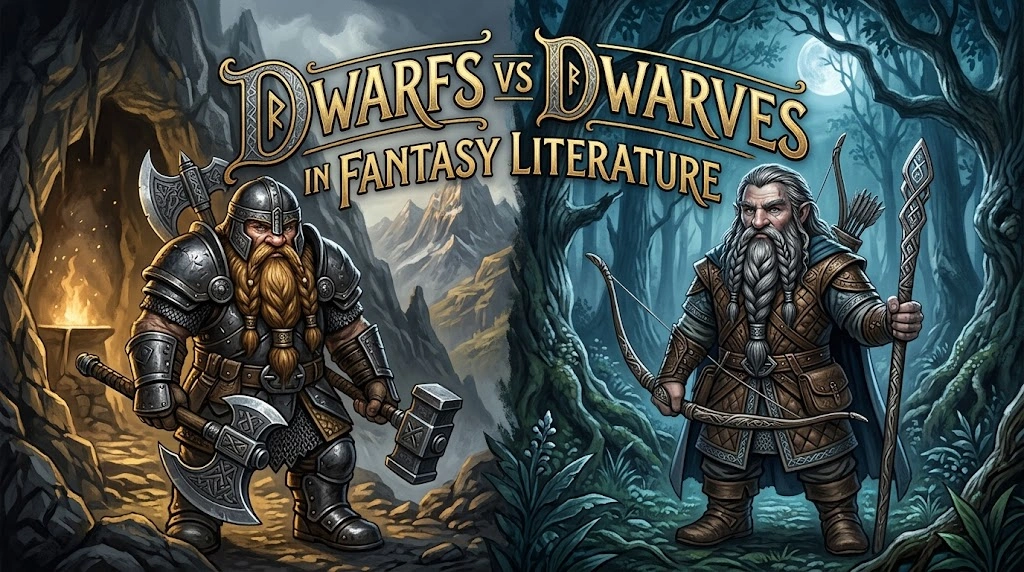
Fantasy literature played an enormous role in popularizing dwarves.
Tolkien’s Influence on “Dwarves”
J.R.R. Tolkien had a major influence on modern fantasy vocabulary.
In The Hobbit and The Lord of the Rings, Tolkien generally used dwarves as the plural of dwarf.
He also created a distinctive linguistic framework around his fictional peoples and languages.
Tolkien famously had an unusual relationship with the word’s plural because he was deeply interested in historical English. He used dwarves in his fiction while also discussing older forms such as dwarrow.
This helped establish dwarves as a recognizable fantasy spelling.
Tolkien did not invent the word dwarves from nothing. The form existed before his major works. His enormous influence, however, helped cement the form within modern fantasy.
Tolkien’s Use of “Dwarves” and “Dwarrow”
Tolkien’s fictional world contains multiple linguistic layers.
In The Lord of the Rings, Dwarves is the familiar plural used for the people. Tolkien also used Dwarrow in compounds and historical expressions connected with the same tradition.
This reflects his broader interest in constructing languages and giving words historical depth.
The Difference Between Tolkien’s Usage and General English
Tolkien’s preference shouldn’t be mistaken for a universal grammatical rule.
His decision to use dwarves doesn’t mean that dwarfs became grammatically incorrect.
Instead, his writing helped establish a strong literary convention:
Dwarves → fantasy and Tolkien-influenced fiction
Meanwhile:
Dwarfs → science and many general contexts
Modern fantasy authors often follow that distinction because readers immediately understand it.
How Modern Fantasy Writers Use “Dwarves”
Contemporary fantasy games, novels, comics, and films commonly use dwarves for fictional populations.
That convention has become so familiar that readers may find dwarfs unusual when discussing fantasy characters.
This is a good example of how literary tradition can influence everyday language.
Why Do Both “Dwarfs” and “Dwarves” Exist?
The existence of two plurals reflects the messy history of English.
English didn’t develop from one perfectly consistent set of grammatical rules. It evolved through contact among Germanic languages, French, Latin, Scandinavian languages, and many other influences.
The Older English Plural Pattern
Some older English nouns developed plural forms that changed the final consonant.
For example:
- wife → wives
- knife → knives
- wolf → wolves
- life → lives
These changes reflect historical sound patterns rather than a simple spelling trick.
However, not every noun ending in -f follows the same pattern.
How “Dwarfs” Developed as the Regular Plural
The form dwarfs follows the straightforward English plural pattern of adding -s.
That’s why it remained natural in many contexts.
The plural didn’t disappear simply because another form existed.
English often keeps competing forms when speakers find both understandable and useful.
The Historical Development of “Dwarves”
Dwarves developed through historical variation in the plural of dwarf. The form became associated with older Germanic plural patterns and later gained additional literary significance.
Its popularity in fantasy grew particularly strongly through influential literature.
Therefore, today’s distinction isn’t simply a battle between “correct” and “incorrect.”
It’s a story of historical variation plus specialized usage.
The Influence of Other English Plurals Ending in “-f”
English offers several competing patterns:
| Singular | Plural |
| dwarf | dwarfs / dwarves |
| wolf | wolves |
| knife | knives |
| roof | roofs |
| chief | chiefs |
| belief | beliefs |
| leaf | leaves |
Notice something important: English doesn’t have one universal rule for words ending in -f.
That’s why learners should memorize common forms rather than applying a mechanical rule to every noun.
Why English Has More Than One Accepted Plural
English regularly preserves alternative forms.
Sometimes the alternatives develop different meanings. Sometimes they become associated with different regions, styles, or fields.
Dwarfs and dwarves are a particularly interesting example because context has helped divide their modern usage.
Dwarfs vs Dwarves in Different Contexts
Context is your best guide when you’re unsure.
Dwarfs in Science and Astronomy
Use dwarfs in established astronomical terms:
- white dwarfs
- red dwarfs
- brown dwarfs
For example:
Red dwarfs are among the most common types of stars in the Milky Way.
Dwarves in Fantasy Fiction
Use dwarves when referring to fictional fantasy beings:
The dwarves defended the underground city.
Dwarfs in General Descriptive Writing
Dwarfs can also appear in general writing when the context doesn’t specifically invoke fantasy traditions.
However, writers discussing people should pay attention to current respectful terminology and the preferences of the people involved.
Dwarves in Mythology and Folklore
When discussing dwarf-like beings through a fantasy or literary framework, dwarves is common.
Historical sources may use different forms, though, so the terminology of the original source should be considered when writing scholarly material.
Dwarfs and Dwarves in Titles and Proper Names
Titles are a special case.
If a book, film, story, organization, or other established work uses Dwarfs, don’t automatically change it to Dwarves.
For example:
Snow White and the Seven Dwarfs
The title uses Dwarfs, so changing the spelling would alter the established title.
Dwarfs vs Dwarves in Famous Names and Titles
Popular culture provides some memorable examples of both forms.
Snow White and the Seven Dwarfs
The Disney title is:
Snow White and the Seven Dwarfs
The spelling Dwarfs is part of the established title.
This is a useful reminder that you shouldn’t “correct” a proper name simply because another form seems more familiar.
The Hobbit and Tolkien’s Dwarves
Tolkien generally used Dwarves for the members of the fictional race in Middle-earth.
The distinction became highly influential because Tolkien’s books shaped modern fantasy literature.
The Seven Dwarfs in Popular Culture
The seven characters associated with Snow White are traditionally referred to as the Seven Dwarfs in the established English title.
Meanwhile, a fantasy novel might describe an entirely different fictional people as dwarves.
Neither choice creates a contradiction.
The spelling reflects the tradition surrounding the particular work.
Why Established Titles Should Keep Their Original Spelling
Proper names function differently from ordinary vocabulary.
If a title officially uses Dwarfs, changing it to Dwarves can create an inaccurate quotation or title.
When writing about a specific work, preserve the original form.
Dwarfs vs Dwarves in Academic and Formal Writing
Formal writing requires consistency more than personal preference.
Which Form Works Better in School Essays?
The answer depends on your subject.
If your essay discusses Tolkien’s fictional race, dwarves is appropriate:
Tolkien portrays the dwarves of Middle-earth as skilled craftsmen and warriors.
If you’re writing about astronomy, use dwarfs:
White dwarfs are extremely dense stellar remnants.
Choosing the Form for Scientific Subjects
Scientific writing should follow established terminology.
For astronomy, that means:
white dwarfs
red dwarfs
brown dwarfs
Changing established terminology simply to follow a general spelling pattern can make technical writing look less precise.
Choosing the Form for Literature and Fantasy Analysis
Literary analysis should generally preserve the terminology used by the author or work.
If you’re discussing Tolkien, dwarves is the natural choice because that’s the convention associated with his fictional people.
Following the Style Guide or Dictionary Used by Your Institution
Academic institutions sometimes require specific dictionaries or style manuals.
When a formal assignment gives you a style guide, follow it consistently.
More importantly, distinguish between grammar and house style.
A style preference doesn’t necessarily mean the alternative form is grammatically wrong.
Examples of Formal Sentences
Tolkien’s dwarves occupy an important place in the mythology of Middle-earth.
Astronomers use telescopes to study distant white dwarfs.
The article compares the historical use of dwarfs and dwarves.
Each sentence uses the form that fits its context.
Common Mistakes With Dwarfs and Dwarves
The two forms create several predictable mistakes.
Assuming “Dwarves” Is Always the Correct Form
This is probably the most common modern misconception.
Because fantasy has made dwarves extremely familiar, some writers assume it’s the only correct plural.
That’s incorrect.
Dwarfs remains standard in astronomy and other contexts.
Assuming “Dwarfs” Is Always the Correct Form
The opposite mistake also occurs.
A writer may learn that dwarf becomes dwarfs and use that form everywhere.
That can sound awkward when discussing fantasy literature.
For example:
The seven dwarfs marched into the fantasy kingdom.
The sentence isn’t necessarily impossible. However, dwarves would usually fit a modern fantasy context better unless a specific work uses another form.
Using Fantasy Usage in Scientific Writing
Writing white dwarves in an astronomy article can make the terminology look unfamiliar.
The standard scientific expression is:
white dwarfs
Changing the Spelling of a Famous Title
Don’t rewrite an established title just because you prefer the other plural.
Snow White and the Seven Dwarfs should retain its established spelling.
Confusing Context With Grammar
The biggest lesson is this:
Context can determine which accepted form is appropriate.
You don’t need to label one spelling “correct” and the other “wrong” in every situation.
Dwarfs vs Dwarves Comparison Table
| Feature | Dwarfs | Dwarves |
| Singular | dwarf | dwarf |
| Plural | dwarfs | dwarves |
| Grammatical status | Accepted | Accepted |
| Astronomy | Standard | Uncommon |
| Fantasy | Less common | Standard/common |
| Tolkien’s fantasy world | Generally not the preferred form | Preferred |
| White dwarf plural | White dwarfs | Unusual |
| Fictional fantasy race | Possible but less conventional | Dwarves |
| General English | Accepted | Accepted |
| Famous titles | Depends on established title | Depends on established title |
Quick Checklist
Before choosing the plural, ask:
- Am I writing about astronomy? Use dwarfs.
- Am I writing about fantasy characters? Use dwarves.
- Am I discussing Tolkien? Use dwarves when referring to his fictional people.
- Am I naming an established title? Preserve the original spelling.
- Am I writing academically? Follow the terminology appropriate to the subject.
- Am I unsure? Check the context before assuming one form is wrong.
Dwarfs vs Dwarves: Examples in Sentences
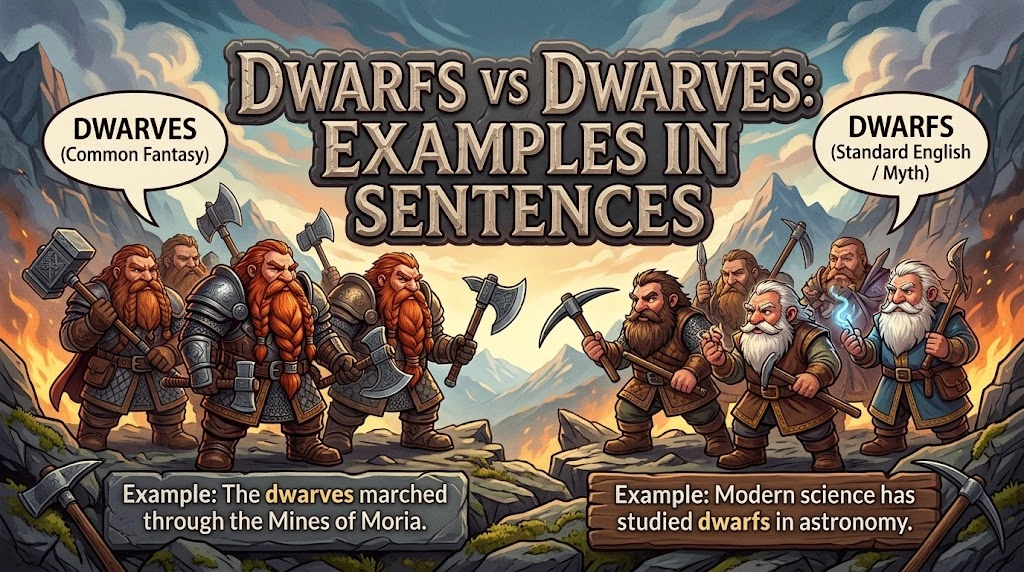
Seeing both forms side by side makes the distinction easier.
Examples With “Dwarfs”
Scientists discovered several white dwarfs in the star system.
The telescope can detect distant red dwarfs.
Astronomers study brown dwarfs to understand their unusual properties.
The textbook explains how white dwarfs form.
Examples With “Dwarves”
The dwarves lived in a vast underground kingdom.
The novel follows a group of dwarves searching for a lost city.
The wizard asked the dwarves for help.
Several dwarves guarded the entrance to the mountain.
Examples From Scientific Contexts
White dwarfs are compact stellar remnants.
Red dwarfs are small and relatively cool stars.
Brown dwarfs don’t maintain sustained hydrogen fusion like ordinary main-sequence stars.
Examples From Fantasy Contexts
The dwarves forged swords beneath the mountain.
The kingdom traded precious metals with neighboring dwarves.
The young warrior joined a company of dwarves.
Related Words: Dwarf, Dwarfed, Dwarfism, and Dwarfish
The plural forms aren’t the only words related to dwarf.
Singular and Plural Forms
The basic forms are:
- singular: dwarf
- plural: dwarfs
- alternative plural: dwarves
Both plural forms can be found in modern English.
The Verb “Dwarf”
Dwarf can also function as a verb.
It means to make something appear small by comparison.
For example:
The enormous skyscraper dwarfed the surrounding buildings.
Here, dwarfed has nothing to do with fantasy creatures.
The Adjective “Dwarfish”
Dwarfish is another related form that appears in some contexts.
It can describe something associated with a dwarf-like appearance or characteristics.
However, writers should use such terminology thoughtfully when referring to real people.
Why Related Words Should Not Be Confused With the Plural
The existence of words such as dwarfed and dwarfism doesn’t change the plural rule.
The question remains context-specific:
dwarf → dwarfs / dwarves
Is “Dwarves” More Correct Than “Dwarfs”?
No single form is universally “more correct.”
Both are established English plurals, but their usage patterns differ.
Grammar vs Context
Grammar tells you that both forms can function as plurals.
Context tells you which one is appropriate.
That’s why:
white dwarfs
and
fantasy dwarves
can both be correct at the same time.
Dictionary Recognition of Both Forms
Major English dictionaries recognize the two plural forms, although dictionary entries may describe differences in usage or frequency.
For reference, see:
- Merriam-Webster: dwarf
- Cambridge Dictionary: dwarf
- Oxford Learner’s Dictionaries: dwarf
These resources are useful when you need to verify current dictionary treatment.
Why Usage Frequency Does Not Make One Form Universally Correct
A word can be more common in one field without becoming the only grammatically valid option.
Think of dwarfs and dwarves as two roads leading from the same singular noun. One road is heavily used by science. The other is strongly associated with fantasy.
How to Choose the Appropriate Form
Use the subject as your guide.
Science → dwarfs
Fantasy → dwarves
Established title → preserve the title
General context → consider the intended meaning and surrounding convention
That simple framework handles most situations.
Dwarfs or Dwarves: Easy Rule to Remember
Here’s the easiest practical rule:
Dwarfs for science. Dwarves for fantasy.
Remember these examples:
Astronomy:
White dwarfs
Fantasy:
Mountain dwarves
Tolkien:
Tolkien’s dwarves
Established title:
Snow White and the Seven Dwarfs
This rule won’t cover every historical or stylistic exception. It will, however, solve the vast majority of everyday usage questions.
Dwarfs vs Dwarves: Common Questions About Usage
Is “Dwarfs” Grammatically Correct?
Yes. Dwarfs is a legitimate plural of dwarf and is especially common in scientific terminology.
Is “Dwarves” Grammatically Correct?
Yes. Dwarves is also an established plural form. It’s particularly common when discussing fantasy beings and fictional races.
Can “Dwarfs” Be Used in Fantasy?
It can appear in fantasy, especially if an author deliberately chooses that spelling. However, dwarves is generally the more familiar modern fantasy form.
Can “Dwarves” Be Used Outside Fantasy?
Yes, but context matters. In astronomy, established terminology normally uses dwarfs, such as white dwarfs and red dwarfs.
Is “White Dwarves” Correct?
In standard astronomical terminology, the conventional expression is white dwarfs.
Is “Seven Dwarfs” Correct?
Yes. Snow White and the Seven Dwarfs uses the established spelling Dwarfs.
Mini Grammar Challenge: Dwarfs or Dwarves?
Test yourself with these examples.
Choose “Dwarfs” or “Dwarves”
The astronomer studied several white _____.
Answer: dwarfs
The wizard met three _____ beneath the mountain.
Answer: dwarves
Identify the Scientific Context
Brown _____ are objects that occupy a category between planets and stars.
Answer: dwarfs
Identify the Fantasy Context
The _____ defended their underground kingdom.
Answer: dwarves
Correct the Sentence
The astronomer published a paper about white dwarves.
Better standard astronomical usage:
The astronomer published a paper about white dwarfs.
Explain Why the Chosen Form Fits
The first sentence concerns astronomy, so dwarfs is the established technical plural.
The fantasy sentence refers to fictional beings, so dwarves fits the conventional literary usage.
Usage Trends and Language Insights
The distinction between dwarfs and dwarves illustrates an important feature of English: words can develop specialized meanings and conventions within different communities.
Modern fantasy has made dwarves highly recognizable. Tolkien’s influence, followed by decades of fantasy novels, games, films, and tabletop role-playing games, reinforced that spelling.
Science developed differently.
Astronomers retained dwarfs in technical terms such as white dwarfs, red dwarfs, and brown dwarfs.
This means modern readers often process the two spellings almost as signals:
dwarfs → science or factual terminology
dwarves → fantasy or fictional culture
That association isn’t an absolute grammatical rule. It’s a strong usage convention.
A Useful Language Lesson
The story also demonstrates why spelling rules aren’t always enough.
If you learn that words ending in -f sometimes change to -ves, you might expect every such word to follow that pattern.
English quickly proves otherwise.
Consider:
- roof → roofs
- chief → chiefs
- belief → beliefs
- wolf → wolves
- knife → knives
- dwarf → dwarfs / dwarves
The safest approach is to learn common forms alongside their contexts.
Frequently Asked Questions
Is “Dwarfs” or “Dwarves” Grammatically Correct?
Both dwarfs and dwarves are accepted plural forms of dwarf. Their preferred use depends on context. Dwarfs is standard in astronomy, while dwarves is strongly associated with fantasy and fictional beings.
Why Does Tolkien Use “Dwarves”?
J.R.R. Tolkien used dwarves for the fictional people of Middle-earth. His enormous influence on modern fantasy helped strengthen the association between dwarves and fantasy literature.
Which Plural Do Dictionaries Recognize?
Major English dictionaries recognize both dwarfs and dwarves. Their entries may note differences in usage or context. Always consider the dictionary’s specific explanation rather than assuming one form replaces the other.
Is “White Dwarves” Correct?
The standard astronomical term is white dwarfs. Astronomical terminology consistently uses dwarfs in this expression.
Should I Use Dwarves in School Essays?
Use the form that matches your subject. If you’re analyzing Tolkien or another fantasy work, dwarves will usually be appropriate. If you’re discussing astronomy, use dwarfs.
Is “Snow White and the Seven Dwarfs” Wrong?
No. Snow White and the Seven Dwarfs is the established English title. The spelling Dwarfs should be preserved when referring to the title.
Can “Dwarfs” Be Used for Fantasy Characters?
Yes, an author can choose dwarfs, and the form isn’t automatically ungrammatical. However, dwarves is the conventional choice in much modern fantasy writing.
Can “Dwarves” Be Used in Scientific Writing?
The word would usually be inappropriate for established astronomical terms. Scientific writing normally uses dwarfs, as in white dwarfs, red dwarfs, and brown dwarfs.
Conclusion: Dwarfs or Dwarves?
So, dwarfs or dwarves? The answer depends on what you’re talking about.
Both forms are legitimate plurals of dwarf, but modern English has developed a strong contextual distinction between them.
Use dwarfs when you’re dealing with established scientific terminology, particularly astronomy. You’ll see this in expressions such as white dwarfs, red dwarfs, and brown dwarfs.
Use dwarves when you’re discussing fantasy characters, fictional races, or many literary and folkloric settings. Tolkien’s influential use of dwarves helped establish this form as a major convention in modern fantasy.
The easiest rule is worth remembering:
Science uses “dwarfs.” Fantasy usually uses “dwarves.”
There are exceptions, especially in historical writing and established titles. That’s why context matters more than blindly applying a spelling rule.
When you see both forms, don’t assume one must be wrong. Instead, look at the subject, the tradition behind the text, and any established terminology. Once you recognize that pattern, choosing between dwarfs and dwarves becomes much easier.