The difference between Any Time vs Anytime looks tiny, but that single space can change how a sentence works. Both forms relate to an unspecified time, yet they don’t always serve the same grammatical purpose. If you’ve ever wondered whether to write any time or anytime, you’re not alone. Many writers hesitate when phrases such as at any time, call anytime, and anytime soon appear in the same piece of writing.
The good news is that the rule becomes much easier once you understand the grammar, sentence structure, and part of speech behind each form. Any time is a two-word phrase in which time functions as a noun. It’s especially common after a preposition, as in “You can contact us at any time.” Anytime, on the other hand, functions as an adverb and commonly means “at any time,” as in “You can contact us anytime.”
This distinction matters in formal writing, professional communication, academic writing, and everyday conversation. Understanding the difference also helps you avoid common grammar mistakes such as writing “at anytime.” Once you know what role the word plays, choosing between any time and anytime becomes far more straightforward.
Any Time vs Anytime: What’s the Difference?
The simplest distinction is based on grammar.
Any time consists of two separate words:
any + time
Here, time functions as a noun.
Anytime is a single adverb:
anytime = at any time
This means that the two forms can sometimes communicate the same basic idea without being interchangeable in every grammatical position.
Consider these examples:
| Sentence | Form | Why it works |
| You can call me anytime. | Anytime | Adverb |
| You can call me at any time. | Any time | Noun phrase after a preposition |
| The meeting could happen at any time. | Any time | Standard prepositional phrase |
| Come over anytime. | Anytime | Adverb |
| You can leave at any time. | Any time | “Time” follows at |
A useful rule is:
Use “at any time” rather than “at anytime.”
However, don’t take that to mean that any time is always correct or anytime is always correct. Context determines the appropriate form.
Understanding “Any Time”
Any time is a two-word expression.
The word any acts as a determiner modifying the noun time. Depending on the sentence, the phrase can refer to any possible point or period of time.
For example:
You may visit us at any time.
Here, time is a noun. The preposition at introduces the phrase.
Another example:
We haven’t selected any time for the meeting.
In this sentence, any time functions as a noun phrase referring to a possible meeting time.
The two-word form becomes particularly important when grammar requires time to remain a noun.
Understanding “Anytime”
Anytime is a one-word adverb.
It generally means at any time or whenever it is convenient or possible, depending on context.
For example:
Call me anytime.
You could rewrite that sentence as:
Call me at any time.
The meaning remains nearly identical.
Other natural examples include:
- Come by anytime.
- You can email me anytime.
- Stop in anytime.
- We can discuss it anytime.
- Feel free to ask questions anytime.
In each example, anytime modifies the action by describing when it can happen.
Quick Rule to Remember
A practical memory trick is:
At + any time
Adverb + anytime
So write:
- Call me at any time.
- Call me anytime.
Avoid:
- Call me at anytime.
This rule handles many everyday situations, although sentence structure can create more complicated cases.
What Does “Any Time” Mean?
The phrase any time generally refers to an unspecified time or any possible point in time.
It can describe a time that hasn’t been selected, identified, or restricted.
For example:
We can schedule the interview at any time next week.
The speaker isn’t identifying one specific hour. Any suitable time could work.
Likewise:
The weather could change at any time.
This means the change could happen at an unspecified point.
The word any gives the phrase its open-ended meaning. It removes the restriction to one particular time.
When to Use “Any Time”
Use any time when time functions as a noun phrase, especially after a preposition.
The most important construction is:
at any time
Examples include:
- The service may be interrupted at any time.
- You can cancel your subscription at any time.
- The manager may contact you at any time.
- Conditions can change at any time.
- Customers can request assistance at any time.
The phrase also appears in other structures:
We haven’t agreed on any time for the appointment.
Here, any time isn’t functioning as an adverb. It refers to a possible appointment time.
Another example:
Is there any time that works for you?
Again, time remains a noun.
Common Sentence Patterns With “Any Time”
Several patterns occur frequently in everyday and professional English.
At any time
You can leave at any time.
At any time during…
You may receive an update at any time during the process.
At any time before…
Please submit the form at any time before Friday.
Any time that…
Choose any time that works for your schedule.
Any time when…
This construction can occur in certain contexts, although any time that is often more natural when referring to a specific possible time.
What Does “Anytime” Mean?
Anytime is an adverb meaning at any time.
It indicates that something can happen at an unspecified time.
For example:
You can call me anytime.
The sentence doesn’t identify a particular hour. The person can call whenever they choose.
According to Cambridge Dictionary, anytime is recognized as an adverb meaning at any time.
That matters because some writers mistakenly assume anytime is simply a casual misspelling of any time. It isn’t.
It’s an established English word.
When to Use “Anytime”
Use anytime when it naturally functions as an adverb.
Common examples include:
- Call me anytime.
- Come over anytime.
- You can ask questions anytime.
- We can talk anytime.
- Feel free to stop by anytime.
It can appear in several positions.
Anytime, you can change your settings.
More naturally:
You can change your settings anytime.
It can also appear with another clause:
Call me anytime you need help.
Here, anytime introduces a time-related condition.
Anytime in American English
Anytime is well established in American English.
That doesn’t mean any time has disappeared. Both forms remain useful.
The important point is grammatical function.
In US English, these are both natural:
You can contact us anytime.
You can contact us at any time.
The second version contains the preposition at, which naturally takes the noun phrase any time.
British English can show somewhat different preferences in some contexts. Dictionary references such as Cambridge Dictionary document this variation rather than treating one form as universally wrong.
Any Time vs Anytime: Side-by-Side Comparison
The following table makes the distinction easier to remember.
| Feature | Any Time | Anytime |
| Number of words | Two | One |
| Basic meaning | Any possible time | At any time |
| Grammatical role | Noun phrase | Adverb |
| Common construction | at any time | call anytime |
| Follows “at” naturally | Yes | Generally no |
| Can appear at sentence end | Yes, in suitable structures | Very common |
| Used in American English | Yes | Yes |
| Example | Call me at any time. | Call me anytime. |
The easiest way to see the difference is to compare paired sentences.
You can contact the office at any time.
You can contact the office anytime.
Both are grammatical.
Now compare:
The policy may change at any time.
Not:
The policy may change at anytime.
The issue isn’t the meaning. It’s the grammatical structure.
The Most Important Grammar Rules for Any Time and Anytime

Understanding a few core rules will prevent most mistakes.
Rule 1: Use “Any Time” After “At”
This is the most useful rule to remember.
When at directly precedes the expression, use:
at any time
Examples:
- You may cancel at any time.
- The price can change at any time.
- The store may close at any time.
- She could arrive at any time.
- The situation could become serious at any time.
The construction works because time functions as a noun.
The phrase follows the preposition at.
That’s why at any time is the standard choice.
Rule 2: Use “Anytime” as an Adverb
When you need an adverb meaning at any time, anytime is often appropriate.
For example:
You can call me anytime.
Here, anytime tells the reader when the action can happen.
More examples:
- Visit us anytime.
- Ask questions anytime.
- You can return anytime.
- We can meet anytime next week.
The word works much like other adverbs that describe when an action happens.
Rule 3: Use “Whenever” When You Mean “Every Time”
This distinction is easy to overlook.
Anytime and whenever can overlap, but they aren’t always exact synonyms.
Consider:
Call me anytime you need help.
Here, the meaning is close to:
Call me whenever you need help.
However, consider:
Whenever I visit my grandmother, she makes tea.
Here, whenever means something closer to every time that.
You wouldn’t normally replace it with anytime while expecting exactly the same meaning and tone.
According to Cambridge Dictionary, whenever can express ideas such as “every time” or “at any time,” depending on context.
Rule 4: Check the Word Before “Any Time”
When you’re unsure, inspect the sentence structure.
Ask:
Is “at” immediately before the phrase?
If yes, use:
at any time
If the word simply functions as an adverb meaning “at any time,” then:
anytime
may be appropriate.
For example:
You can message me anytime.
But:
You can message me at any time.
Both work.
The mistake occurs when the two structures are mixed:
You can message me at anytime.
Rule 5: Consider Style and English Variety
Language doesn’t always divide neatly into “correct” and “incorrect.”
Dictionaries record how English is actually used. They also document differences between varieties of English.
For American English, anytime is a standard adverb.
At the same time, any time remains essential in noun phrases and constructions such as at any time.
For formal writing, consistency matters. If you’re following a particular publication’s style guide, use its preferred conventions.
Read Moore: Masonary vs Masonry: Which Spelling Is Correct and Why It Matters
Any Time vs Anytime With Common Sentence Patterns
Seeing the forms in realistic sentences makes the rule easier to apply.
“At Any Time”
This is one of the most common phrases containing any time.
Examples:
You may request a refund at any time.
The company can update its policy at any time.
The device could shut down at any time.
You can change your password at any time.
The phrase can also contain additional information:
You may contact customer support at any time during the trial period.
Here, any time remains a noun phrase.
“Anytime” at the End of a Sentence
Anytime frequently appears at the end of a sentence.
Examples:
Come visit anytime.
Call us anytime.
You can stop by anytime.
We can talk about it anytime.
This placement is especially common in conversational American English.
“Anytime Soon”
The expression anytime soon has a slightly different practical meaning.
It usually suggests that something is expected to happen within the near future.
For example:
The repairs won’t be finished anytime soon.
This means the speaker doesn’t expect the repairs to finish in the near future.
Another example:
Do you think the results will arrive anytime soon?
Here, the speaker is asking whether the results are likely to arrive soon.
“Anytime Now”
Anytime now means that something is expected very soon, although the exact moment isn’t known.
For example:
The delivery should arrive anytime now.
The speaker expects the delivery shortly.
Another example:
The guests could arrive anytime now.
The phrase combines uncertainty about the exact moment with an expectation of immediacy.
“Anytime You…”
The construction anytime + clause is also common.
Examples:
Call me anytime you need help.
You can visit anytime you want.
Stop by anytime you’re in town.
In these sentences, anytime introduces a condition involving an unspecified time.
Any Time vs Anytime in Different Contexts
The choice can become clearer when you look at real-world writing.
Everyday Conversation
Casual conversation frequently uses anytime.
Examples:
Come over anytime.
Text me anytime.
We can talk anytime.
These sentences sound natural and relaxed.
You can also use at any time when you want a slightly more explicit structure:
You can call me at any time.
Neither version needs to sound excessively formal.
Workplace Communication
Both forms appear in professional communication.
For example:
Employees may submit requests at any time.
This construction is particularly natural in policies and official instructions.
A less formal message might say:
Feel free to contact me anytime.
The choice can therefore reflect sentence structure and tone without creating a strict formal-versus-informal divide.
Academic and Formal Writing
Formal writing often contains constructions where any time is required naturally.
For example:
Participants may withdraw from the study at any time.
Here, at any time fits the grammatical structure perfectly.
However, there’s no universal rule saying that anytime must disappear from formal writing.
If an academic sentence uses the adverb naturally, it can be appropriate:
Participants may contact the research team anytime.
Still, writers should follow the style guide required by their institution or publication.
Website and Professional Copy
Website copy often uses both forms.
For customer support:
Contact our support team anytime.
For a policy:
You may cancel your subscription at any time.
Notice how the two forms naturally fit different sentence structures.
The key isn’t to force one spelling throughout an entire website. Instead, choose the form that fits the grammar of each sentence.
Common Mistakes With Any Time and Anytime
These mistakes appear frequently because the two forms sound almost identical when spoken.
Mistake 1: Writing “At Anytime”
A common error is:
You can cancel at anytime.
The standard construction is:
You can cancel at any time.
The preposition at is followed by the noun phrase any time.
Mistake 2: Assuming “Anytime” Is Always Wrong
Some writers learn the phrase at any time and then conclude that anytime is incorrect.
That’s not true.
For example:
You can call me anytime.
This sentence is perfectly natural.
Cambridge Dictionary recognizes anytime as an adverb.
Mistake 3: Assuming “Any Time” Is Always Wrong
The opposite mistake also happens.
A writer might think anytime should replace any time everywhere.
That creates problems:
Contact us at anytime.
The standard form is:
Contact us at any time.
The two-word form remains necessary in this construction.
Mistake 4: Treating Anytime and Whenever as Perfect Synonyms
These words overlap, but their meanings aren’t identical in every context.
Compare:
You can visit anytime.
This means you can visit at any suitable time.
Now consider:
Whenever I visit, the store is busy.
Here, whenever has the sense of every time that.
Replacing it blindly with anytime can change the meaning or make the sentence less natural.
Mistake 5: Following One Spelling Rule Everywhere
A simple rule can be helpful, but an overly rigid rule creates new errors.
Don’t memorize:
“Always use any time.”
Don’t memorize:
“Always use anytime.”
Instead, remember the grammatical roles.
Anytime functions as an adverb.
Any time functions as a two-word noun phrase in constructions where time acts as a noun.
How to Remember Any Time vs Anytime
Grammar becomes much easier when you have a quick test.
The “At” Test
Look for at.
If the sentence requires at, use:
at any time
Example:
You can cancel at any time.
This is the single most useful shortcut.
The “Whenever” Test
Ask whether the intended meaning is:
at any time
or:
every time that
If you mean at any time, anytime may work.
If you mean every time that, whenever is often the better choice.
Compare:
Call me anytime.
Meaning: Call me at any time.
Whenever I call her, she answers.
Meaning: Every time I call her, she answers.
Those meanings aren’t identical.
The Simple Memory Trick
Remember this:
At → any time
Adverb → anytime
Then test your sentence.
At any time ✔
Call anytime ✔
At anytime ✘ in standard edited usage
This small distinction solves most everyday questions.
Any Time vs Anytime: Quick Decision Guide
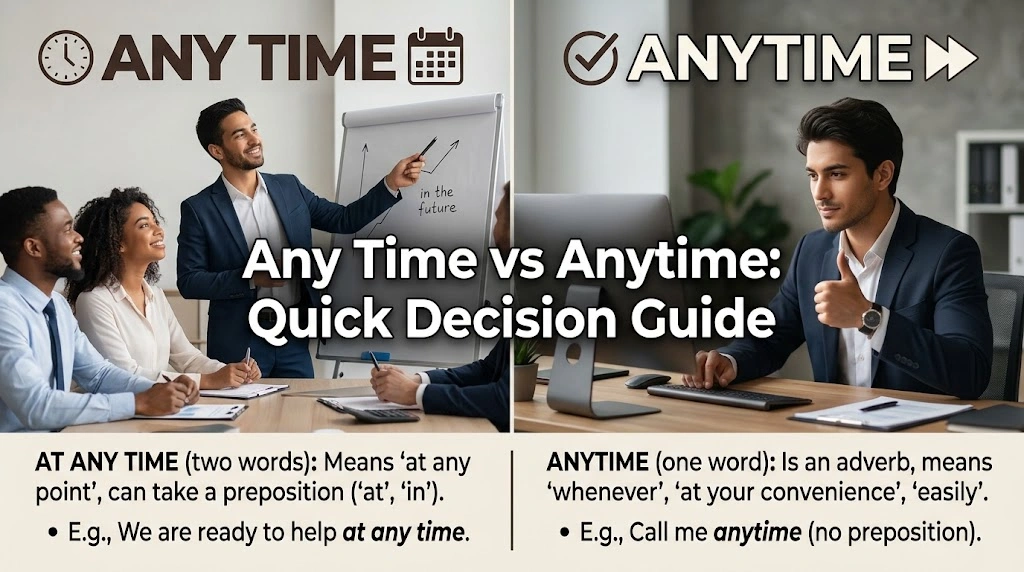
When you’re editing a sentence, follow this process.
Step 1: Look for “at.”
If you have:
at + ___
Use:
at any time
Step 2: Check whether the word functions as an adverb.
If it means:
at any time
and modifies an action, anytime may be the natural choice.
Step 3: Check the intended meaning.
If you mean every time, consider whenever instead.
Step 4: Read the complete sentence.
Don’t choose the spelling in isolation. Grammar depends on the surrounding words.
Quick Examples
| Sentence | Correct form | Reason |
| Call me ___ you need help. | anytime | Adverbial use |
| You may leave ___ any time. | at any time | Preposition + noun phrase |
| Come over ___. | anytime | Adverb |
| The rules may change ___ any time. | at any time | Standard prepositional phrase |
| ___ I visit, the shop is busy. | Whenever | Means “every time” |
Any Time vs Anytime Mini Quiz
Test your understanding with these examples.
Choose the Correct Form
Fill in each blank with any time, anytime, or whenever.
A. You can contact me ______.
B. You may cancel the service ______.
C. ______ I visit the restaurant, it’s crowded.
D. The weather can change ______.
E. Come by ______ you are in the neighborhood.
Answers
A. anytime
You can contact me anytime.
B. at any time
You may cancel the service at any time.
C. Whenever
Whenever I visit the restaurant, it’s crowded.
Here, whenever means every time.
D. at any time
The weather can change at any time.
E. anytime
Come by anytime you are in the neighborhood.
Correct the Mistake
Consider these sentences.
Example 1
You can contact us at anytime.
Correct:
You can contact us at any time.
Example 2
Come over any time.
This can be grammatical depending on the intended construction and style. However, when using the adverb meaning “at any time,” anytime is a clear one-word choice:
Come over anytime.
Example 3
Whenever you need assistance, call me.
This sentence is already correct.
It means roughly:
Every time you need assistance, call me.
Example 4
You can reach me at any time.
Correct.
The preposition at is followed by the two-word noun phrase any time.
Frequently Asked Questions About Any Time vs Anytime
Is “Anytime” One Word or Two?
Anytime is one word when it functions as an adverb.
For example:
You can call me anytime.
Any time is two words when time functions as a noun.
For example:
You can call me at any time.
Both forms are legitimate.
Which Is Correct: Any Time or Anytime?
Both are correct in the right grammatical context.
Use anytime as an adverb:
Visit anytime.
Use any time in constructions such as:
Visit at any time.
The important issue isn’t which spelling is universally “correct.” It’s whether the form fits the sentence.
Can I Use “Anytime” in Formal Writing?
Yes.
Anytime is a recognized English adverb. It isn’t automatically incorrect or unsuitable for formal writing.
However, formal documents may have specific style requirements. If a publisher, school, employer, or organization provides a style guide, follow its preferred convention.
Is “At Anytime” Correct?
In standard edited American English, the preferred construction is:
at any time
rather than:
at anytime
For example:
You may cancel at any time.
The same pattern applies to many similar sentences.
Can “Anytime” Mean “Whenever”?
Sometimes.
In a sentence such as:
Call me anytime you need help.
Anytime is close in meaning to whenever.
However, whenever can also mean every time, which gives it a broader range of uses.
For example:
Whenever she visits, we cook dinner.
Here, whenever means every time she visits.
Is “Any Time” More Correct Than “Anytime”?
No.
Neither form is universally better.
Any time and anytime perform different grammatical jobs, although their meanings overlap in certain sentences.
The correct choice depends on sentence structure.
Is “Anytime Soon” Correct?
Yes.
Anytime soon is a common expression referring to the near future.
Example:
The project won’t be finished anytime soon.
It suggests that completion isn’t expected in the immediate future.
Is “Anytime Now” Correct?
Yes.
Anytime now means something is expected very soon, although the exact moment isn’t known.
Example:
The delivery should arrive anytime now.
Do American and British English Use These Forms Differently?
There are differences in usage preferences between varieties of English.
American English commonly uses anytime as an adverb. Any time remains standard in constructions such as at any time.
Dictionaries document these patterns rather than reducing the issue to a simple right-versus-wrong rule. For additional reference, see Cambridge Dictionary’s entry for anytime.
Key Takeaways: Any Time vs Anytime
The distinction becomes straightforward once you focus on grammar rather than spelling alone.
- Any time contains two words.
- Anytime contains one word.
- Anytime commonly functions as an adverb.
- Any time commonly functions as a noun phrase.
- At any time is the standard construction.
- At anytime is generally avoided in standard edited English.
- Anytime can often mean “at any time.”
- Whenever can overlap with anytime, but it can also mean “every time.”
- Both any time and anytime are legitimate forms.
- Sentence structure determines which one fits.
The most useful shortcut remains:
At → any time
Adverb → anytime
Once you recognize the grammatical role, the choice becomes much easier.
Conclusion
The difference between any time vs anytime isn’t as complicated as it first appears. Both forms relate to an unspecified time, but they don’t always occupy the same grammatical position.
Anytime is a one-word adverb. You can use it when you mean at any time:
You can call me anytime.
Any time is a two-word phrase in which time functions as a noun. It appears naturally after prepositions such as at:
You can call me at any time.
That’s the key distinction.
When you’re unsure, don’t rely solely on how the words sound. Look at the sentence around them. If you’re writing at, the standard choice is any time. If you’re using the word as an adverb, anytime often fits naturally.
And remember that whenever deserves separate attention. It can mean “at any time” in some contexts, but it can also mean “every time,” giving it a different meaning.
Once you understand these patterns, choosing between any time, anytime, and whenever becomes much less of a guessing game. A quick look at the sentence structure is usually all you need.