Window Seal vs Window Sill: What’s the Difference?
Window seal vs window sill can be confusing because the two terms look and sound remarkably similar. Yet they describe different parts of a window and serve very different purposes. A window seal helps close gaps around window components, limiting air leakage, water infiltration, drafts, and unwanted moisture. A window sill, meanwhile, is the horizontal section located at the bottom of the window opening. It can provide support, create a finished surface, and help with water drainage.
Knowing the difference becomes especially useful when you’re discussing window repairs, home maintenance, or window problems. For example, a damaged window seal may cause drafts or condensation, while a deteriorated window sill may show cracks, staining, rot, or signs of water exposure. Confusing these terms could make it harder to explain the problem accurately.
You’ll also encounter related terms such as window frame, window weatherstripping, window gasket, window sealant, exterior window sill, and interior window sill. Understanding how these components work together gives you a clearer picture of the entire window system.
In this guide, you’ll learn the exact window seal meaning, window sill meaning, key differences, common problems, correct usage, and practical examples that make the distinction easy to remember.
The simplest distinction is this:
A seal closes gaps. A sill forms the bottom ledge of a window opening.
A window seal is primarily concerned with sealing and preventing unwanted movement of air or water. A window sill is a physical part of the window or building opening that sits along the bottom.
Although both components can be involved in moisture problems, they don’t perform the same job.
Window Seal and Window Sill Have Different Jobs
Think about a window as a small system rather than a single object.
Several components work together to keep the interior comfortable and protected. The frame holds the window in place. The glass lets light through. Weatherstripping and other seals close gaps. The sill sits at the bottom and helps support the window while managing water.
Here’s the basic distinction:
| Feature | Window Seal | Window Sill |
| Main purpose | Close gaps and prevent infiltration | Form and support the bottom of the window opening |
| Typical location | Around or between window components | Along the bottom of the window |
| Main concern | Air, water, and moisture infiltration | Support, drainage, and protection |
| Common materials | Rubber, silicone, foam, EPDM, sealants | Wood, vinyl, aluminum, stone, composite |
| Can fail? | Yes | Yes |
| Can contribute to leaks? | Yes | Yes |
| Usually flexible? | Often | Usually rigid |
| Typical repair | Replace seal, gasket, weatherstripping, or sealant | Repair, reseal, or replace damaged sill |
The exact construction varies by window type. However, the basic difference remains consistent.
The Easiest Way to Remember the Difference
Use this quick memory trick:
Seal = stop.
Sill = shelf.
A seal helps stop air and water from passing through unwanted gaps.
A sill resembles a shelf at the bottom of the window.
If you can see a horizontal ledge where the window meets the wall, you’re probably looking at the sill, not the seal.
If you’re talking about the material that closes a gap around a window, you’re probably talking about a seal.
What Is a Window Seal?
A window seal is a sealing component that helps close spaces between parts of a window or between the window and surrounding construction.
Its exact form depends on the window design.
A seal might be a rubber gasket, weatherstripping, foam material, or sealant. In insulated glass units, specialized seals also help keep the space between panes properly enclosed.
Window Seal Definition and Meaning
In general use, a window seal refers to a component or material that creates a barrier against unwanted air, water, moisture, or sometimes sound.
For example:
- A rubber gasket can seal glass against a frame.
- Weatherstripping can seal the moving parts of a window.
- Caulk can seal a joint between the frame and surrounding wall.
- An insulated glass unit uses seals around its edges to keep the space between panes enclosed.
This is why the term can sometimes feel confusing.
“Window seal” doesn’t always identify one single physical part. It can describe different sealing components depending on the window’s construction.
What Does a Window Seal Do?
A good seal performs several important functions.
It Helps Prevent Air Leakage
Gaps around a window can allow outdoor air to enter and conditioned indoor air to escape.
Weatherstripping and other sealing materials reduce those unwanted pathways.
It Helps Control Water Infiltration
Proper seals help keep rainwater from entering through joints and gaps.
However, a seal isn’t the only part responsible for water management. Window design also relies on drainage paths, flashing, weep systems, and proper installation.
It Improves Energy Efficiency
A poorly sealed window can make a room feel drafty.
During winter, heated air can escape through gaps. During summer, outdoor heat can enter more easily. Sealing appropriate gaps can therefore improve comfort and reduce unnecessary energy loss.
It Helps Reduce Noise
Some sealing systems also reduce the pathways through which outside sound can travel.
The effect varies considerably depending on the window, glass, frame, installation, and size of the gaps.
Where Is a Window Seal Located?
There isn’t one universal location.
Depending on the window design, you may find seals:
- Around the movable sash
- Between the glass and frame
- Around insulated glass units
- Between the window frame and wall
- Along opening portions of the window
- Around joints exposed to weather
This point is important because “window seal” describes a function as much as it describes a component.
Common Types of Window Seals
Different windows use different sealing methods.
Weatherstripping
Weatherstripping is commonly installed around movable window components. It helps close the gap when the window is shut.
Materials can include:
- Foam
- Rubber
- Vinyl
- Felt
- Brush-style materials
The right replacement depends on the window’s design.
Rubber Gaskets
Gaskets create a controlled seal between components.
They’re common around glass and frames in many modern window systems.
Silicone and Other Sealants
Sealants can close joints between materials.
For example, a sealant may be used around a frame where it meets another surface. The correct sealant depends on the materials, exposure, and application.
Insulated Glass Seals
Double- and triple-pane windows use edge seals around the insulated glass unit.
These seals help keep the enclosed space between panes isolated from outside conditions.
When the insulated glass seal fails, you may notice fogging or condensation between the panes.
What Happens When a Window Seal Fails?
A failed seal can produce several symptoms.
You might notice:
- Drafts
- Water infiltration
- Air leakage
- Damaged sealant
- Moisture problems
- Increased condensation
- Fogging between insulated glass panes
- Reduced comfort near the window
The symptom depends on which seal has failed.
A failed weatherstrip isn’t the same problem as a failed insulated-glass edge seal. They may both be called window seal problems, but they require different solutions.
What Is a Window Sill?
A window sill is the horizontal portion at the bottom of a window opening.
In everyday language, people often picture the sill as the ledge where you might place a small plant, decoration, or other object.
The sill can also play an important technical role in supporting the window and managing water.
Window Sill Definition and Meaning
A window sill is the bottom horizontal part of a window assembly or window opening.
Its exact design varies.
Some sills are wide and decorative. Others are narrow and mostly functional. Exterior sills may have a slope or other drainage features designed to move water away from the building.
The word sill can therefore refer to a structural, architectural, or finished component depending on context.
Where Is the Window Sill Located?
Look at the bottom of the window.
The horizontal surface or ledge beneath the window is generally the sill.
A simple diagram makes the distinction clearer:
TOP OF WINDOW
┌─────────────────────┐
│ │
│ GLASS │
│ │
│ │
└─────────────────────┘
WINDOW SILL
─────────────────────
BOTTOM
A seal, meanwhile, may sit around the edges of the window, glass, or moving components.
So location provides one useful clue:
Sill = bottom horizontal component.
Seal = gap-closing component.
What Does a Window Sill Do?
The sill can perform several functions.
It Supports the Window
Depending on the construction, the sill helps support the window assembly or provides a base within the opening.
It Helps Manage Water
Exterior sill designs often help move water away from the window.
A properly designed sill may use slope, edges, drainage channels, or other details to prevent water from sitting against vulnerable materials.
It Protects the Wall
Water that remains around a window can eventually damage surrounding materials.
The sill and associated drainage details help reduce that risk.
It Provides a Finished Appearance
Interior sills can also provide a clean transition between the window and interior wall.
That’s why sills appear in both technical construction discussions and everyday home conversations.
Interior vs Exterior Window Sills
Not every sill looks or functions exactly the same.
An interior window sill is the ledge you see from inside the room. It may be made from wood, composite material, stone, tile, or another finish.
An exterior sill is exposed to weather and must deal with rain, drainage, temperature changes, and other outdoor conditions.
Exterior window design often incorporates additional water-management details that aren’t obvious from inside the room.
Common Window Sill Materials
Window sills can use various materials, including:
- Wood
- Vinyl
- Aluminum
- PVC
- Composite materials
- Stone
- Concrete
- Other manufactured materials
Material choice affects durability and maintenance.
For instance, untreated or poorly protected wood can be vulnerable to moisture and rot. Modern synthetic materials generally resist some forms of moisture damage better, although installation quality still matters.
Window Seal vs Window Sill: Key Differences Explained
The biggest mistake is treating these words as interchangeable.
They’re not.
Function: Sealing vs Supporting and Directing Water
A seal closes a gap.
A sill forms the bottom portion of the window opening and can support the assembly and help manage water.
That’s the core distinction.
Imagine a rain jacket with a pocket.
The seal is like the zipper or closure that keeps water from entering through a gap. The sill is more like the ledge that catches and directs water away from the opening.
The analogy isn’t technically exact, but it makes the difference easier to visualize.
Location: Around the Window vs Along the Bottom
A sill has a relatively clear location.
It’s at the bottom.
A seal doesn’t have one fixed location. It can appear around the frame, between components, around glass, or at joints.
This makes location useful for identifying a sill but less useful for identifying a seal.
Purpose: Preventing Air and Water Infiltration vs Managing Water
Seals primarily address unwanted movement through gaps.
Sills can contribute to water management by helping direct water outward.
However, window water management involves more than the sill alone.
Proper installation may also depend on:
- Flashing
- Drainage paths
- Weep holes
- Sealants
- Window geometry
- Building-envelope design
- Properly integrated materials
That’s why replacing one piece without finding the actual source can leave a leak unresolved.
Construction: Flexible Sealing Materials vs Structural or Finish Materials
Sealing components are commonly made from flexible or resilient materials.
Sills are usually more rigid.
A rubber gasket can compress and recover. A stone or wood sill generally can’t perform that same sealing function.
Repair: Replacing a Seal vs Repairing or Replacing a Sill
The repair depends on the damaged component.
A deteriorated weatherstrip may need replacement.
A cracked sealant joint may need careful removal and resealing.
A rotten wood sill may require a more substantial repair.
Correct diagnosis comes before the repair.
Can a Window Seal and Window Sill Both Cause Leaks?
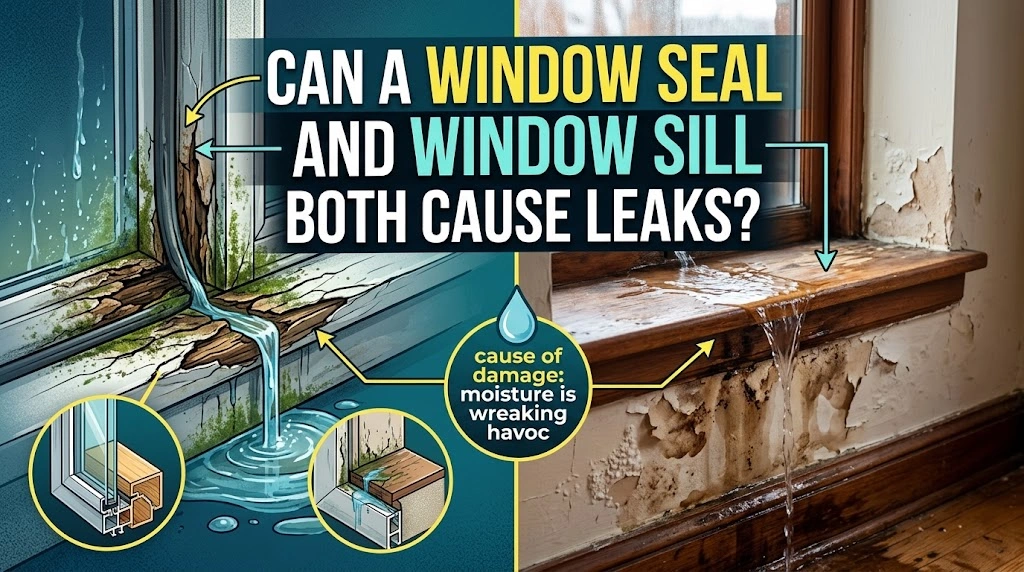
Yes, but they can contribute to water problems in different ways.
This is where terminology becomes especially important.
How Failed Window Seals Allow Water Inside
If a seal or sealant joint has deteriorated, water can potentially find a pathway through the window assembly or its perimeter.
Common warning signs include:
- Water around the frame
- Damp interior surfaces
- Staining
- Peeling paint
- Deteriorated sealant
- Moisture appearing during heavy rain
However, visible water doesn’t necessarily identify the exact failure point.
Water can travel through building materials before appearing indoors.
How Damaged or Poorly Sloped Sills Affect Drainage
A sill that doesn’t properly shed water can allow moisture to remain where it shouldn’t.
Problems may arise from:
- Cracking
- Rot
- Poor slope
- Deteriorated materials
- Blocked drainage paths
- Improper installation
Exterior window components should generally work together to move water away from vulnerable areas.
Why Finding the Actual Source of a Leak Matters
Suppose water appears beneath a window.
It might seem logical to blame the sill immediately.
That’s not always correct.
The source could involve a failed perimeter seal, flashing problem, drainage issue, damaged frame, or another installation detail.
The location where water appears isn’t necessarily the location where water entered.
That’s a crucial home-maintenance principle.
Other Window Components That Can Cause Water Problems
A window system contains several components that influence moisture control.
These may include:
- Frame
- Sash
- Glass
- Seals
- Sealants
- Flashing
- Sill
- Weep openings
- Drainage channels
A complete diagnosis considers the whole assembly.
Read More: Taught or Tought: Which Spelling Is Correct?
How to Tell Whether You Mean “Window Seal” or “Window Sill”
When you’re unsure, don’t focus only on how the words sound.
Focus on what the component does.
Use “Window Seal” for the Sealing Component
Use window seal when discussing something that closes or protects a gap.
For example:
“The window seal is allowing cold air into the room.”
Another example:
“The insulated glass unit may have a failed seal.”
Both sentences focus on sealing performance.
Use “Window Sill” for the Bottom Horizontal Part
Use window sill when you’re talking about the bottom ledge.
For example:
“The plant is sitting on the windowsill.”
Or:
“The wooden window sill has started to rot.”
The word identifies a physical part rather than a sealing function.
A Simple Location-and-Function Test
Ask yourself two questions:
Is it the bottom ledge?
→ Sill
Does it close a gap or prevent infiltration?
→ Seal
This two-question test works in most everyday situations.
Quick Identification Checklist
| If you’re describing… | Correct term |
| A rubber strip around a window | Window seal |
| The bottom ledge | Window sill |
| A draft around a closed window | Possible seal problem |
| A rotten wooden ledge | Sill problem |
| Moisture between double panes | Insulated-glass seal problem |
| A place where you put a plant | Windowsill |
| A gap being sealed with sealant | Seal/sealant |
| The bottom horizontal window component | Sill |
Window Seal vs Window Sill in Home Repairs
Using the right term can make a repair conversation much easier.
Imagine telling a contractor, “The window seal is rotten.”
That description creates confusion because seals generally aren’t described as rotten in the same way wooden sills are.
A clearer description would identify the material and location.
When You May Need to Replace a Window Seal
Replacement may be appropriate when a sealing component has:
- Cracked
- Hardened
- Shrunk
- Torn
- Detached
- Lost its flexibility
- Become visibly deteriorated
The correct replacement depends on the window system.
Don’t assume any generic strip will work.
When a Window Sill May Need Repair
A sill may need attention if you notice:
- Wood rot
- Cracks
- Soft spots
- Persistent moisture
- Surface deterioration
- Poor drainage
- Damaged finishes
Wooden sills deserve particular attention because hidden moisture can cause damage beneath painted surfaces.
When a Professional Inspection Makes Sense
Professional help can be worthwhile when:
- Water repeatedly enters during rain.
- Damage extends into surrounding walls.
- The window frame appears distorted.
- Rot affects structural areas.
- You can’t identify the source of moisture.
- An insulated glass unit has failed.
- Previous repairs haven’t solved the problem.
Small cosmetic issues and complex water-intrusion problems aren’t the same thing.
Why Using the Correct Term Helps When Describing a Problem
Clear terminology saves time.
Compare:
“My window seal is damaged.”
with:
“The rubber weatherstripping around the opening is cracked, and cold air comes through.”
The second description gives a repair professional much more useful information.
Signs of a Window Seal Problem
A failed seal doesn’t always announce itself dramatically.
Sometimes the first clue is simply an uncomfortable draft.
Drafts Around the Window
If you feel outdoor air around a closed window, the weatherstripping or another sealing component may be compromised.
Check the entire perimeter rather than assuming one visible crack explains everything.
Water or Moisture Infiltration
Water around the window can indicate a sealing or installation problem.
However, don’t automatically blame the seal.
As discussed earlier, water can travel from another part of the assembly.
Condensation Between Glass Panes
This symptom deserves special attention.
If moisture or fogging appears between the panes of an insulated glass unit, the edge seal may have failed.
That’s different from ordinary condensation on the room-facing surface of the glass.
Damaged, Cracked, or Deteriorated Sealing Material
Visible deterioration provides a useful clue.
Look for:
- Gaps
- Cracks
- Shrinking
- Brittleness
- Separation
- Missing sections
Still, visual inspection alone may not reveal every problem.
Higher Heating or Cooling Costs
Poor air sealing can affect indoor comfort and energy use.
However, rising utility bills have many possible causes. A damaged window seal is only one possibility.
Signs of a Window Sill Problem
Sill damage can range from cosmetic deterioration to significant moisture damage.
Cracks, Rot, or Deterioration
Wooden sills can develop rot when moisture repeatedly reaches the material.
Soft or crumbly wood is more concerning than minor surface wear.
Water Pooling on the Sill
Standing water suggests that drainage may not be working properly.
Exterior window systems should move water away rather than allowing it to remain against vulnerable components.
Staining or Moisture Damage
Dark stains, discoloration, peeling finishes, or damp areas can indicate repeated moisture exposure.
Don’t ignore recurring staining simply because the surface eventually dries.
Peeling Paint or Damaged Finishes
Paint can deteriorate when moisture repeatedly reaches the substrate.
Peeling paint doesn’t prove that the sill is the source, but it deserves investigation.
Poor Drainage Around the Window
A sill that doesn’t properly shed water can contribute to moisture problems.
Look at the entire drainage system rather than inspecting only the visible surface.
Window Seal vs Window Sill: Correct Usage in Sentences
Learning the difference becomes much easier when you see both terms in context.
Correct Examples Using “Window Seal”
- “The window seal needs to be replaced because it has cracked.”
- “A damaged window seal can allow drafts into the room.”
- “The technician checked the window seal around the insulated glass.”
- “The old window seal has become brittle.”
Correct Examples Using “Window Sill”
- “The flower pot is sitting on the window sill.”
- “The wooden window sill has signs of water damage.”
- “She wiped dust from the window sill.”
- “The contractor repaired the damaged window sill.”
Examples Using Both Terms Together
Here’s where the distinction becomes obvious:
“The window seal prevents gaps around the frame, while the window sill forms the bottom ledge.”
Another example:
“The damaged window sill needs repair, while the worn window seal needs replacement.”
Each word refers to a different component.
Common Incorrect Uses and Their Corrections
| Incorrect or unclear wording | Better wording |
| “The bottom seal is rotten.” | “The wooden window sill is rotten.” |
| “The sill is causing a draft.” | “The window seal may be allowing a draft.” |
| “Put the plant on the window seal.” | “Put the plant on the windowsill.” |
| “The sill around the glass failed.” | “The seal around the glass failed.” |
Context can change the best terminology, especially in technical construction language. Still, these corrections work for ordinary usage.
Is It “Windowsill” or “Window Sill”?
Both windowsill and window sill appear in English.
In American English, windowsill is a common one-word spelling.
For example:
“She placed a small plant on the windowsill.”
You may also encounter window sill, particularly in technical, architectural, or construction contexts.
Is “Windowsill” One Word?
Yes.
Windowsill is an established compound noun.
It refers to the horizontal ledge at the bottom of a window.
Is “Window Sill” Also Correct?
Yes.
Window sill is also widely used, particularly when writers want to make the two components visually separate.
You’ll see both forms in dictionaries, construction documents, product descriptions, and general writing.
Which Form Should You Use in American English?
For general writing, windowsill is a natural choice.
For technical writing, window sill may appear depending on the terminology used by a manufacturer, architect, contractor, or building standard.
The important point is that neither spelling turns the sill into a seal.
They’re still different concepts.
Examples of “Windowsill” in Sentences
- “The cat jumped onto the windowsill.”
- “Dust had collected along the windowsill.”
- “The old windowsill needs a fresh coat of paint.”
- “Rainwater was collecting near the exterior window sill.”
Window Seal vs Window Sill: Common Mistakes
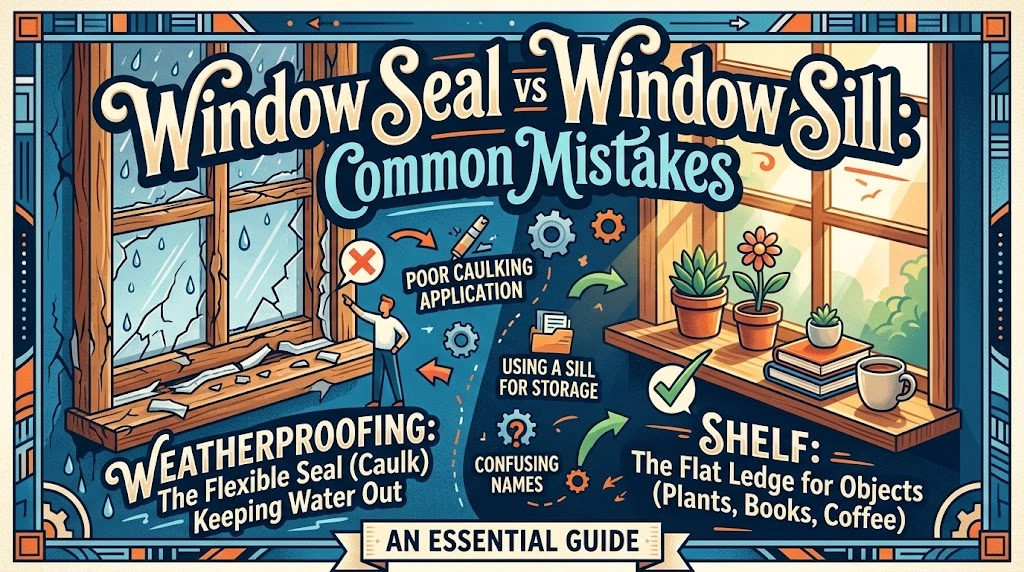
These words cause confusion because they look similar.
The underlying concepts, however, are quite different.
Mistaking the Sill for the Seal
The bottom ledge is the sill.
It isn’t called a seal simply because it helps with water management.
Assuming Every Window Leak Comes From the Sill
A leak near the bottom of a window doesn’t automatically mean the sill failed.
Water can enter elsewhere and travel before appearing at the bottom.
Using “Seal” to Describe the Entire Window
A window contains multiple components.
Calling the whole window a “seal” isn’t accurate. A seal is one sealing component or system within the assembly.
Confusing a Seal With Caulk or Glazing
Caulk and sealant can provide sealing functions, but the words aren’t always interchangeable.
Glazing also has a specific meaning in window construction. It can refer to the glass or the process/material used to secure and seal glass within a frame.
The exact terminology depends on the construction system.
Ignoring the Difference Between Interior and Exterior Components
A visible interior windowsill doesn’t necessarily tell you how the exterior drainage system works.
A window can look fine indoors while developing problems outside.
Window Seal vs Window Sill: Real-Life Examples
Real situations make the terminology easier to remember.
Example 1: Cold Air Coming Through a Closed Window
Imagine you’re sitting beside a closed window during winter.
You feel a steady draft around the moving sash.
The likely concern involves air sealing, potentially including weatherstripping or another sealing component.
You’d say:
“The window seal may be damaged.”
You wouldn’t normally call the bottom ledge the seal.
Example 2: Water Collecting Along the Bottom
After heavy rain, you notice water collecting around the lower portion of the window.
The sill may be involved, but don’t stop there.
Check drainage, seals, flashing, frame joints, and other components before identifying the source.
Example 3: Rotting Wood Beneath a Window
Suppose the wooden ledge has become soft and dark.
That’s a strong indication of moisture-related deterioration.
In everyday language, you’d describe this as window sill damage.
The appropriate repair could involve replacing damaged material and addressing the moisture source.
Example 4: Moisture Between Double-Pane Glass
Now imagine the glass looks cloudy.
You clean both surfaces, but the fog remains.
If the moisture sits inside the sealed space between panes, the insulated glass unit may have experienced seal failure.
That’s a window seal issue rather than a windowsill issue.
Example 5: Cracked Sealant Around the Frame
You notice a visible gap where the window frame meets the surrounding surface.
The joint’s sealant has cracked and separated.
That’s another example of a sealing problem.
The exact repair depends on the materials and installation.
Window Seal vs Window Sill: Which One Are You Talking About?
When the terms blur together, return to their basic functions.
If It Stops Air or Water, Think “Seal”
A seal creates a barrier.
It helps prevent unwanted movement through a joint or gap.
Seal = barrier.
If It Forms the Bottom Ledge, Think “Sill”
A sill occupies the lower portion of the window opening.
It may support the window and help manage water.
Sill = bottom ledge.
If You’re Describing Damage, Identify the Component First
Instead of saying:
“The window is damaged.”
Be more specific.
Say:
“The exterior sill has cracked.”
Or:
“The weatherstripping around the sash has deteriorated.”
Specific language makes troubleshooting much easier.
One-Line Memory Trick: Seal Stops, Sill Supports and Sheds
Here’s the easiest phrase to remember:
Seal stops. Sill supports and sheds.
The seal helps stop unwanted air or water movement.
The sill forms the bottom portion of the window and can help support and shed water.
Window Seal vs Window Sill: Quick Reference
Before moving on, here’s the entire distinction in one table.
| Question | Window Seal | Window Sill |
| What is it? | A sealing component or sealing system | Bottom horizontal part of a window |
| Where is it? | Around/between various window components | At the bottom |
| Main role? | Close gaps | Support, finish, and help manage water |
| Prevents drafts? | Yes, when properly designed and intact | Not its primary function |
| Helps manage water? | Yes | Yes |
| Common materials? | Rubber, foam, vinyl, sealant, gaskets | Wood, vinyl, aluminum, stone, composite |
| Can it crack? | Yes | Yes |
| Can it deteriorate? | Yes | Yes |
| Typical symptom | Drafts, infiltration, fogging | Rot, cracks, pooling, staining |
| Memory word | Stop | Shelf |
Frequently Asked Questions About Window Seal vs Window Sill
What Is the Difference Between a Window Seal and a Window Sill?
A window seal closes gaps and helps prevent air, water, or moisture infiltration. A window sill is the horizontal part at the bottom of the window opening.
The seal performs a sealing function. The sill forms a physical ledge and can support the window while helping manage water.
Is the Bottom of a Window Called a Sill or a Seal?
The bottom horizontal part is generally called the window sill.
A seal may be located near the bottom, but its defining feature is its sealing function rather than its location.
What Does a Window Seal Do?
A window seal helps close gaps between window components or between the window and surrounding construction.
Depending on its design, it can reduce air leakage and help prevent water infiltration.
What Happens When a Window Seal Fails?
A failed seal can cause drafts, water infiltration, damaged joints, or condensation.
If an insulated glass seal fails, moisture can also appear between double- or triple-pane glass.
The specific symptom depends on the type of seal involved.
Can a Window Sill Cause Water Damage?
Yes.
A damaged, poorly drained, cracked, or deteriorated sill can contribute to water problems. However, water appearing near a sill doesn’t automatically prove that the sill caused the leak.
The entire window drainage and installation system may need inspection.
Is “Windowsill” One Word or Two?
Windowsill is a standard one-word spelling in American English.
Window sill is also commonly used, particularly in technical or construction contexts.
Are Window Seals and Weatherstripping the Same Thing?
Not exactly.
Weatherstripping is a type of sealing material used around movable parts of windows and doors. Window seal is a broader term that can refer to several types of sealing components.
Can You Replace a Window Seal Without Replacing the Window?
Often, yes.
Some window seals, gaskets, and weatherstripping can be replaced separately.
However, the answer depends on the window’s construction and the specific failed component.
How Can You Tell if a Window Seal Is Broken?
Look for drafts, visible gaps, cracked or deteriorated sealing material, water infiltration, or persistent moisture.
For insulated glass, fogging or condensation between panes can indicate a failed edge seal.
Does a Window Sill Need to Be Sloped?
Many exterior sill designs use a slope to help shed water away from the window and building.
The exact design depends on the window type and installation system. Proper drainage is an important part of preventing moisture problems.
Conclusion
The difference between window seal vs window sill becomes simple once you focus on function.
A window seal is about closing gaps and limiting unwanted air or water movement. A window sill is the horizontal bottom portion of the window opening. It can provide support, create a finished ledge, and help direct water away from vulnerable areas.
Remember the shortcut:
Seal = stop. Sill = shelf.
When you feel a draft, investigate the sealing components. When you see a damaged bottom ledge, you’re likely dealing with the sill. If water appears around either area, look beyond the obvious surface and consider the entire window system.
Using the correct term isn’t just a grammar detail. It helps you describe problems clearly, communicate with contractors, understand repair advice, and avoid confusion when researching window maintenance.