What Is the Difference Between Cancellation and Cancelation?
Have you ever typed cancellation and wondered whether the extra L actually belongs there? You’re not alone. The spelling cancellation vs cancelation creates confusion because both forms can appear in English writing. However, they aren’t equally common or equally suitable for everyday use.
The standard spelling is cancellation, with two Ls. This form works in both American and British English. The spelling cancelation also appears as a variant, but it’s far less common and generally isn’t the preferred choice in polished writing.
The confusion becomes even greater when you compare cancellation with canceled and cancelled. American English typically uses canceled, while British English generally uses cancelled. Interestingly, both varieties normally use cancellation for the noun.
Understanding this distinction can save you from an easy spelling mistake. Whether you’re writing a cancellation policy, cancellation notice, business email, academic assignment, travel update, or customer-service message, choosing the familiar spelling makes your writing clearer.
In this guide, you’ll learn the difference between cancellation and cancelation, why cancellation has two Ls, how US and UK English handle related forms, and which spelling you should use in formal writing.
At first glance, cancellation and cancelation appear to be competing spellings of different words. They aren’t.
Both forms refer to the same basic idea: the act of canceling something.
For example, if a flight will no longer operate, you can describe it as a flight cancellation. If a customer ends a subscription, that’s a subscription cancellation.
The main difference isn’t meaning. It’s spelling and frequency of use.
The Quick Answer
Here’s the answer in one glance:
| Word | Status | Meaning | Recommended? |
| Cancellation | Standard spelling | The act of canceling something | Yes |
| Cancelation | Rare variant | The act of canceling something | Usually no |
Cancellation is the spelling you should normally use.
This applies to both major varieties of English:
- American English: cancellation
- British English: cancellation
- Canadian English: cancellation is widely used
- Australian English: cancellation is widely used
The important point is that cancellation isn’t a British-only spelling.
That’s a common misconception.
American English does simplify some doubled consonants. For example, American writers usually use canceled instead of British cancelled. Yet the noun remains cancellation in standard usage.
Cancellation vs Cancelation at a Glance
Consider these examples:
The airline announced the cancellation of the flight.
Your subscription cancellation has been confirmed.
The event was postponed after the unexpected cancellation of the venue.
In each sentence, cancellation is the natural standard spelling.
You may occasionally encounter cancelation, particularly online or in less carefully edited material. Seeing it doesn’t automatically mean the writer has invented a word. However, rarity matters when you’re deciding which spelling to use.
For most readers, cancellation will look familiar and immediately correct.
The Simple Memory Trick
Here’s an easy way to remember it:
Cancel + ation = cancellation
More specifically, keep the double L in the noun:
cancel → cancellation
Think of the common phrase “cancellation policy.”
You see it everywhere:
- cancellation policy
- cancellation fee
- cancellation request
- cancellation notice
- cancellation confirmation
If you remember cancellation policy, the spelling becomes much easier to recall.
Why Is Cancellation Spelled With Two Ls?
The double L isn’t random. It comes from the spelling history and formation of the word.
The word cancellation developed from cancel, ultimately tracing back through French to Latin cancellare, meaning to make something ineffective or cancel it.
Modern English then formed the noun cancellation from the verb.
Cancellation Comes From Cancel
The simplest way to understand the relationship is to start with the base verb:
cancel → cancellation
The verb cancel already ends in -el.
When English forms the noun cancellation, the spelling retains the double-L sequence:
cance + ll + ation
The result is:
cancellation
This is why you shouldn’t automatically apply the spelling pattern from canceled to the noun.
The words belong to the same family, but English spelling doesn’t always behave like a perfectly mathematical formula.
For comparison:
| Word | Standard US English | Standard UK English |
| Verb | cancel | cancel |
| Past tense | canceled | cancelled |
| Present participle | canceling | cancelling |
| Noun | cancellation | cancellation |
Notice something important.
The American form canceled has one L, yet cancellation still has two.
That’s not an error.
It’s a normal feature of English spelling.
Why the Double L Causes Confusion
The confusion often begins when American English removes an L from cancelled.
American English commonly spells the past tense:
canceled
British English commonly spells it:
cancelled
A learner may then reason:
If American English writes canceled with one L, shouldn’t it write cancelation with one L too?
That logic seems reasonable.
But it doesn’t match standard usage.
The noun is normally:
cancellation
The past tense is:
canceled in American English
cancelled in British English
English contains many word families where related forms don’t share exactly the same spelling pattern. Memorizing the established forms is often more reliable than trying to force one rule across every form.
The Role of the Suffix “-ation”
The suffix -ation frequently forms nouns describing an action, process, or result.
For example:
- organize → organization
- educate → education
- inform → information
- nominate → nomination
- cancel → cancellation
However, English morphology doesn’t always produce a perfectly predictable spelling when a suffix is added.
Cancellation has become the established spelling of the noun. That’s the form readers encounter most often in edited English.
So don’t assume that removing one L from canceled automatically creates the preferred noun cancelation.
It doesn’t.
Cancellation vs Cancelation: US and UK English
The US/UK distinction is where this spelling question gets especially interesting.
Some English words genuinely change spelling between American and British English:
- color / colour
- center / centre
- realize / realise
- traveled / travelled
- canceled / cancelled
But cancellation isn’t one of the clearest examples of a regional spelling split.
Is Cancellation the American Spelling?
Yes.
Cancellation is the standard spelling used in American English.
You’ll see it in ordinary American writing, including:
- airline policies
- hotel booking pages
- legal documents
- customer-service messages
- business emails
- academic writing
- newspaper articles
- software interfaces
For example:
Please review our cancellation policy before booking.
The airline issued a notice about the flight cancellation.
Customers can request cancellation within 24 hours.
The American spelling doesn’t require you to change cancellation to cancelation.
Is Cancellation the British Spelling?
Yes.
British English also commonly uses cancellation.
That’s important because some writers mistakenly assume that the double-L noun must be British because British English uses cancelled.
The forms don’t line up that neatly.
British English:
cancel → cancelled → cancelling → cancellation
American English:
cancel → canceled → canceling → cancellation
The noun remains cancellation in both varieties.
Is Cancelation Used in American English?
Cancelation does appear in American English, but it is much less common than cancellation.
That distinction matters.
A spelling can exist without being the spelling you should normally choose.
English contains many rare variants, historical spellings, regional forms, and dictionary-listed alternatives. Their existence doesn’t make them equally useful in modern professional writing.
If your goal is clarity, familiarity, and conventional usage, cancellation wins easily.
Cancellation, Canceled, and Cancelled
These three forms deserve special attention because they’re frequently mixed up.
Cancellation is the noun.
The flight cancellation caused major delays.
Canceled is the standard American past-tense form.
The airline canceled the flight.
Cancelled is the standard British past-tense form.
The airline cancelled the flight.
Here’s the pattern:
| Form | American English | British English |
| Base verb | cancel | cancel |
| Past tense | canceled | cancelled |
| -ing form | canceling | cancelling |
| Noun | cancellation | cancellation |
This is one of the most useful tables to remember.
It shows exactly where the regional difference occurs.
Is Cancelation Actually Wrong?
The answer needs a little nuance.
Calling cancelation simply “wrong” can be misleading because the spelling has appeared in English usage and is recognized as a variant in some reference works.
However, that doesn’t make it the best choice.
Is Cancelation a Real Word?
Cancelation is found as a variant spelling of cancellation.
The key distinction is between valid and preferred.
English dictionaries sometimes record uncommon variants. A dictionary entry can tell you that a form exists without telling you that it’s the spelling most writers should use.
Think of it this way:
A road can exist without being the main highway.
Cancelation exists, but cancellation is the main road.
For ordinary modern writing, the double-L spelling is the safer and more recognizable option.
You can check major dictionary resources such as Merriam-Webster and Dictionary.com when checking individual word forms.
Why You May See Cancelation Online
If you search the web, you’ll probably encounter cancelation from time to time.
That doesn’t necessarily indicate a new American spelling rule.
Several factors can produce unusual spellings online:
- user-generated content
- unedited websites
- old documents
- inconsistent house styles
- spelling mistakes
- automated content
- regional variation
- copied material containing an original error
The internet is enormous. Not every published sentence has passed through an editor.
Search engines index what people publish. They don’t act as universal spelling judges.
Therefore, finding cancelation on a website isn’t enough evidence to conclude that it’s the preferred spelling.
Should You Use Cancelation in Formal Writing?
Generally, no.
If you’re writing something that needs to look polished, use cancellation.
That includes:
- academic papers
- business reports
- professional emails
- website copy
- legal or contractual language
- customer-service documentation
- school assignments
- formal notices
- marketing material
The conventional spelling removes unnecessary doubt.
If a reader sees cancellation, the word looks immediately familiar. If the same reader sees cancelation, they may pause and wonder whether it’s a typo.
That’s a needless distraction
Read More: What Kind of vs. What Kinds of: What’s the Difference?
Cancellation Meaning and Definition
Before focusing entirely on spelling, it’s useful to understand exactly what cancellation means.
What Does Cancellation Mean?
Cancellation means the act of stopping, calling off, or ending something that had been planned, scheduled, ordered, or arranged.
For example:
The cancellation of the concert disappointed thousands of fans.
The concert was planned, but it will no longer take place.
Another example:
I requested the cancellation of my membership.
The membership existed, but the customer asked for it to end.
The word can describe both a decision and the process associated with ending something.
Cancellation in Different Contexts
You can use cancellation in many situations.
Travel
The airline announced the cancellation of Flight 208.
Events
Heavy rain forced the cancellation of the outdoor festival.
Subscriptions
Your cancellation will take effect at the end of the billing period.
Appointments
We received a notice about the cancellation of tomorrow’s appointment.
Orders
The store processed the cancellation of the order.
Contracts
The agreement includes conditions for cancellation.
The meaning stays consistent even though the context changes.
Cancellation vs Canceling
These words are related, but they play different grammatical roles.
Cancellation is a noun.
The cancellation surprised everyone.
Canceling is a gerund or present participle in American English.
Canceling the meeting wasn’t an easy decision.
In British English, you’ll usually see:
Cancelling the meeting wasn’t an easy decision.
This distinction helps you choose the correct form naturally.
Cancellation vs Cancelled vs Canceled
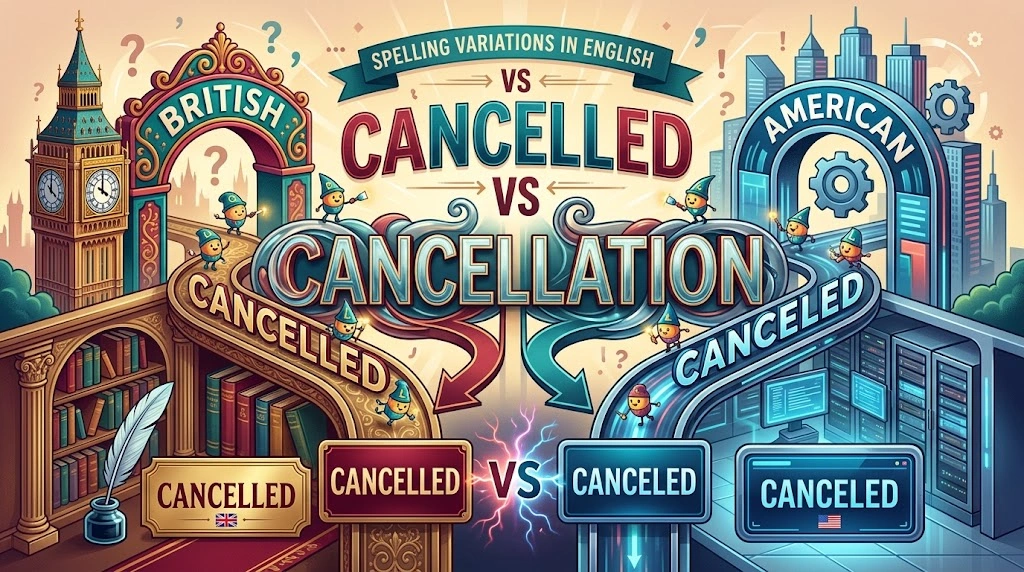
These forms belong together, but they aren’t interchangeable.
Cancellation
Cancellation names the act or event.
The cancellation happened two hours before departure.
Canceled
Canceled is the standard American English past-tense and past-participle form.
The manager canceled the appointment.
Cancelled
Cancelled is the standard British English form.
The manager cancelled the appointment.
The difference is primarily regional.
Neither canceled nor cancelled changes the meaning.
Canceling vs Cancelling
The same regional pattern appears with the -ing form.
American English:
She is canceling the reservation.
British English:
She is cancelling the reservation.
But again, the noun remains:
cancellation
This is the spelling pattern worth remembering.
When Should You Use Cancellation?
Because cancellation is the standard spelling, you can use it in practically any context where the noun fits grammatically.
Business Writing
Business communication frequently uses cancellation.
Common phrases include:
- cancellation policy
- cancellation request
- cancellation fee
- cancellation notice
- cancellation charge
- cancellation confirmation
- cancellation terms
- cancellation deadline
For example:
A $25 cancellation fee applies to appointments canceled less than 24 hours in advance.
That sentence sounds natural and professional.
Academic and Professional Writing
Formal writing benefits from conventional spelling.
Consider:
The study examined the effects of event cancellation on attendance rates.
Using cancellation here creates no regional ambiguity.
In academic and professional settings, consistency matters. Your readers shouldn’t have to stop and wonder whether an unusual spelling is intentional.
Websites and Customer Communication
Businesses often use the word on booking and subscription pages.
For example:
Cancellation Policy
You may request cancellation before your renewal date.
A full refund is available after qualifying cancellation requests.
If you’re creating website content, cancellation is the natural choice.
International Communication
When your audience includes readers from different English-speaking regions, conventional spelling becomes even more valuable.
Cancellation works comfortably across American and British English.
There’s no practical reason to switch to cancelation simply because your audience is American.
Cancellation Examples in Everyday Writing
Examples make spelling rules easier to remember because you can see the word working naturally.
Travel and Reservations
The airline sent an email confirming the cancellation of our flight.
We requested cancellation before the hotel deadline.
The weather caused the cancellation of several flights.
Please read the hotel’s cancellation policy before booking.
Events and Appointments
The sudden cancellation of the concert surprised everyone.
The doctor’s office called about the cancellation of my appointment.
Due to severe weather, the school announced the cancellation of classes.
We received a cancellation notice this morning.
Subscriptions and Services
Your subscription cancellation has been processed.
The company offers free cancellation within seven days.
I submitted a cancellation request through the website.
Check the cancellation fee before ending the service.
Business and Legal Contexts
The contract explains the conditions for cancellation.
The customer requested cancellation of the order.
The company received written notice of cancellation.
The agreement contains a 30-day cancellation period.
Everyday Communication
The meeting’s cancellation gave everyone an unexpected afternoon off.
We heard about the cancellation this morning.
The event was postponed after the original cancellation.
Notice how naturally cancellation fits each sentence.
That’s partly why the double-L spelling has become so firmly established.
Common Mistakes With Cancellation
A few recurring mistakes cause most of the confusion.
Mistake: Writing Cancelation
The most obvious mistake is dropping one L:
Incorrect or nonpreferred: cancelation
Standard: cancellation
While cancelation can be found as a variant, cancellation is the spelling to choose in normal edited writing.
Mistake: Assuming Cancellation Is Only British
This misconception comes from the difference between canceled and cancelled.
American English does use:
canceled
But American English also uses:
cancellation
So don’t assume that every double-L form is British.
Mistake: Applying Canceled to Cancellation
Seeing canceled may tempt you to write:
cancelation
That’s not the standard pattern.
Remember:
The American past tense loses an L. The noun doesn’t.
That simple distinction prevents a lot of spelling errors.
Mistake: Mixing Regional Spellings
If you’re writing for an American audience, consistency matters.
For example, this combination is normally appropriate in American English:
The airline canceled the flight because of the weather. The cancellation notice arrived later.
For British English:
The airline cancelled the flight because of the weather. The cancellation notice arrived later.
Avoid switching randomly between canceled and cancelled.
Mistake: Treating the Two Nouns as Different in Meaning
Cancellation and cancelation don’t describe two different actions.
The spelling difference doesn’t create a different definition.
If you’re choosing between them, you’re primarily making a spelling and style decision, not a meaning decision.
How to Remember Cancellation
A good memory trick should be quick enough to use when you’re actually writing.
Remember the Double L
The easiest rule is:
Cancellation has two Ls.
Write it visually:
C A N C E L L A T I O N
The middle LL is the part worth remembering.
Connect It to Cancel
Start with the base verb:
cancel
Then remember the noun:
cancellation
Don’t try to derive the noun by copying the spelling of canceled.
Instead, memorize the established noun as its own form.
Memorize Common Phrases
Some phrases appear so often that they can reinforce the spelling naturally.
- cancellation policy
- cancellation fee
- cancellation notice
- cancellation request
- cancellation confirmation
- cancellation charge
- cancellation deadline
- cancellation terms
If you regularly write these phrases, the correct spelling will become automatic.
Cancellation vs Cancelation: Which One Should You Use?
When there’s no special reason to use a variant, choose cancellation.
Best Choice for American English
Use:
cancellation
Not:
cancelation
American English recognizes cancellation as the standard spelling.
Best Choice for British English
Use:
cancellation
British English also uses the double-L noun.
Remember that British English generally writes:
cancelled
Yet the noun remains:
cancellation
Best Choice for Formal Writing
For formal writing, cancellation is the strongest choice.
It is familiar, conventional, and widely understood.
That makes it especially suitable for documents where precision matters.
Best Choice for SEO and Web Content
If you’re writing online, don’t deliberately use cancelation simply because you find examples of it in search results.
SEO shouldn’t override normal language quality.
Search engines increasingly rely on context and meaning rather than crude exact-match repetition. A well-written article should use the spelling that readers expect.
For a page targeting cancellation vs cancelation, it’s perfectly natural to mention both spellings while consistently explaining that cancellation is the preferred standard form.
The target phrase itself can appear naturally in headings and body copy without awkward repetition.
A Real-World Case Study: Cancellation in Professional Communication

Imagine a hotel publishing this notice:
Cancellation Policy: Reservations canceled within 24 hours of arrival may incur a fee.
Now imagine the same policy using:
Cancelation Policy: Reservations canceled within 24 hours of arrival may incur a fee.
Most readers will understand both.
Yet the first version looks more polished because cancellation is the familiar standard spelling.
This illustrates an important principle in professional writing:
The clearest spelling is often the one that creates the least friction for the reader.
A spelling question might seem tiny. In a customer-facing policy, however, tiny details contribute to credibility.
A misspelling doesn’t necessarily make a business look untrustworthy. Repeated unusual spellings can make a page feel less carefully edited.
That’s why conventional spelling remains valuable.
Quick Comparison: Cancellation vs Cancelation
| Feature | Cancellation | Cancelation |
| Meaning | Act of canceling | Act of canceling |
| Standard modern spelling | Yes | Less common variant |
| American English | Preferred | Rare |
| British English | Preferred | Rare |
| Formal writing | Recommended | Usually avoid |
| Business writing | Recommended | Usually avoid |
| Common phrase | Cancellation policy | Cancelation policy |
| Double L | Yes | No |
The practical conclusion is straightforward: choose cancellation.
Practice: Cancellation vs Cancelation
A quick quiz can help lock the spelling into memory.
Choose the Correct Spelling
Which sentence is correct?
A. The airline announced the cancelation of the flight.
B. The airline announced the cancellation of the flight.
Answer: B — cancellation
Fill in the Blank
Please review our __________ policy before making a reservation.
Answer: cancellation
Identify the Regional Spelling
Which form is standard in American English?
A. canceled
B. cancelled
Answer: A — canceled
Which form is standard in British English?
A. canceled
B. cancelled
Answer: B — cancelled
The Double-L Challenge
Complete the word:
cance__ation
The answer is:
cancellation
The missing letters are LL.
Choose the Correct Sentence
A. I requested a cancelation.
B. I requested a cancellation.
Answer: B
Meaning Check
What does cancellation mean?
A. Starting something new
B. Stopping or calling off something planned
C. Changing something slightly
Answer: B
Related US Spelling
Choose the standard American forms:
- canceled / cancelled
- canceling / cancelling
- cancellation / cancelation
The answers are:
- canceled
- canceling
- cancellation
Related UK Spelling
Choose the standard British forms:
- canceled / cancelled
- canceling / cancelling
- cancellation / cancelation
The answers are:
- cancelled
- cancelling
- cancellation
Final Consistency Challenge
Complete the sentence:
The airline ______ the flight, and the ______ caused hundreds of passengers to change their plans.
For standard American English:
The airline canceled the flight, and the cancellation caused hundreds of passengers to change their plans.
For standard British English:
The airline cancelled the flight, and the cancellation caused hundreds of passengers to change their plans.
That’s the pattern worth remembering.
Frequently Asked Questions
Is cancellation or cancelation correct?
Cancellation is the standard and preferred spelling in modern English.
Cancelation does appear as a rare variant, but it isn’t the spelling most writers should choose. For professional, academic, business, and website writing, use cancellation.
Is cancelation an American spelling?
Cancelation can be found in American English, but it isn’t the standard spelling most American writers use.
The normal American spelling is cancellation.
Don’t confuse this with canceled, which is the standard American past-tense form.
Why does cancellation have two Ls?
The noun cancellation developed from the verb cancel and has an established double-L spelling.
Although American English normally uses canceled with one L, the noun remains cancellation.
So the spelling difference isn’t an error or contradiction.
What Is the UK Spelling of Cancellation?
The standard British spelling is cancellation.
British English also commonly uses cancelled and cancelling.
Therefore:
- British: cancelled
- British: cancelling
- British: cancellation
Does American English Use Cancellation?
Yes.
Cancellation is the standard American English noun.
For example:
The airline confirmed the cancellation of the flight.
American English generally differs from British English in the related forms canceled and canceling, not in the standard spelling of the noun.
Should I Write Cancellation Policy or Cancelation Policy?
Use cancellation policy.
It’s the established and much more familiar spelling.
You’ll commonly see this phrase in hotels, airlines, restaurants, appointments, subscription services, and other businesses.
Is Cancelation Acceptable in Formal Writing?
It’s best to avoid it in formal writing unless you’re reproducing a source that specifically uses that spelling.
Cancellation is clearer and more conventional.
If you’re writing your own material, there’s little benefit to choosing the rarer variant.
Is Canceled or Cancelled Correct?
Both are correct, but they belong to different regional spelling conventions.
Canceled is standard American English.
Cancelled is standard British English.
For example:
American: The company canceled the meeting.
British: The company cancelled the meeting.
Why Is Cancellation Different From Canceled?
English spelling doesn’t always apply one uniform rule to every member of a word family.
American English commonly simplifies cancelled to canceled and cancelling to canceling.
However, the noun remains conventionally spelled cancellation.
That’s why these combinations are normal:
US: canceled → cancellation
UK: cancelled → cancellation
Final Verdict: Cancellation vs Cancelation
When choosing between cancellation and cancelation, there’s a clear winner.
Cancellation is the standard spelling you should normally use in both American and British English.
Cancelation exists as a rare variant, but its lower frequency makes it a poor default choice for polished writing.
The biggest source of confusion is the related verb forms. American English uses canceled and canceling, while British English generally uses cancelled and cancelling. Yet both varieties normally use cancellation for the noun.
Here’s the rule to keep handy:
Use cancellation with two Ls.
If you’re writing a cancellation policy, sending a business email, preparing an academic paper, or publishing website content, stick with the familiar standard.
The Bottom Line
- Cancellation is the preferred spelling.
- Cancelation is a rare variant.
- Both spellings refer to the same basic concept.
- American English uses canceled.
- British English uses cancelled.
- Both varieties commonly use cancellation.
- Cancellation policy is the standard phrase.
- For formal and professional writing, cancellation is the safest choice.
When in doubt, remember the double L. It’s the small detail that keeps your spelling on solid ground.
Related Spelling Guides
If you’re sorting out other American and British spelling differences, these related comparisons can help:
- Canceled vs. Cancelled
- Merriam-Webster Dictionary
- Cambridge Dictionary
- Oxford Learner’s Dictionaries
Final answer: Cancellation.