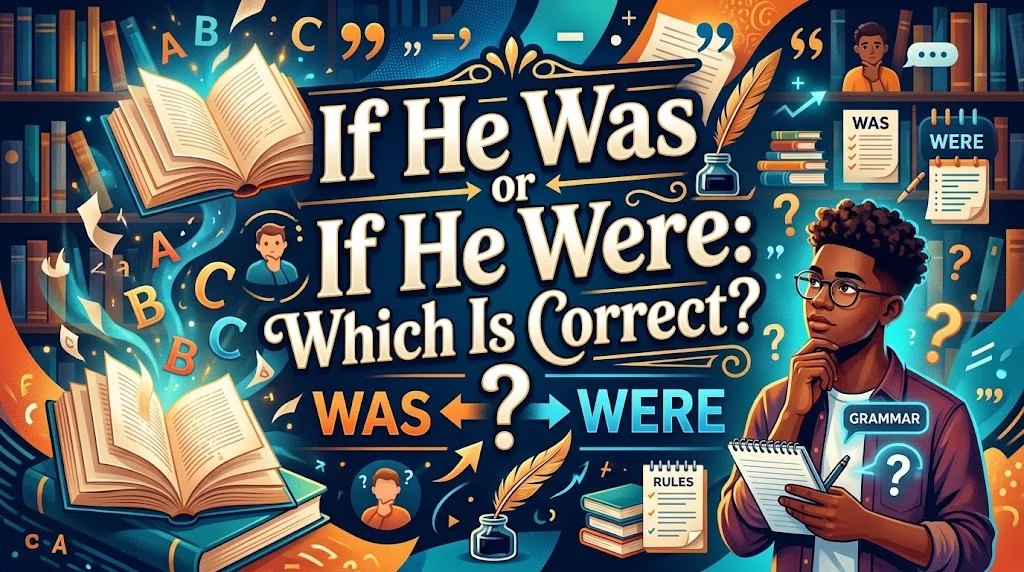
Choosing between if he was and if he were can feel surprisingly tricky. Both phrases are grammatical in English, but they don’t communicate exactly the same idea. The difference usually depends on whether you’re talking about a real possibility, an uncertain past event, or an imaginary situation.
In everyday American English, people often use if he was when they aren’t sure whether something happened. For example, “If he was at the meeting, I didn’t see him.” Here, the speaker considers his presence a real possibility.
On the other hand, if he were usually introduces a hypothetical or unreal situation. Consider “If he were here, he would know what to do.” The speaker isn’t saying that he is actually here. The sentence imagines a different reality.
The distinction becomes clearer when you understand the subjunctive mood, conditional sentences, hypothetical situations, and past-tense verbs. Although “were” looks like an ordinary past-tense form, it can serve a special grammatical purpose after “if.”
This guide explains if he was or if he were with clear rules, practical examples, comparison tables, and easy tests. By the end, you’ll know which form fits your sentence and why.
If He Was or If He Were: The Basic Difference
The simplest way to remember the distinction is this:
- If he was generally refers to something that may have actually happened.
- If he were generally refers to an imaginary, hypothetical, or contrary-to-fact situation.
Compare these sentences:
If he was at the party, I didn’t notice him.
The speaker doesn’t know whether he was there.
If he were at the party, he would probably be dancing.
The speaker imagines him being there.
That small change from was to were can change the entire meaning.
| Expression | Typical meaning | Example |
| If he was | Possible or uncertain past reality | If he was tired, he didn’t show it. |
| If he were | Hypothetical or unreal condition | If he were tired, he would go home. |
The important point is that the choice isn’t simply about past tense. Meaning matters more than time.
Understanding “Was” and “Were” in Conditional Sentences
Both was and were are forms of the verb be, but English uses them differently depending on the subject and grammatical construction.
In ordinary past-tense statements, was normally appears with singular subjects:
- He was tired.
- She was busy.
- I was late.
- It was cold.
Were normally appears with plural subjects:
- We were tired.
- They were busy.
- You were late.
Yet conditional sentences create an important exception.
English sometimes uses were with singular subjects to express an unreal or hypothetical condition.
If he were taller, he could reach the shelf.
Here, were doesn’t follow the ordinary subject-verb pattern. It signals the subjunctive mood.
What “If He Was” Means
If he was often leaves the truth of the situation open.
For example:
If he was angry, he didn’t let anyone know.
The speaker doesn’t necessarily know whether he was angry. It remains a possibility.
Another example:
If he was at work yesterday, he must have left early.
Again, the sentence concerns a potentially real past situation.
What “If He Were” Means
If he were typically introduces an imagined condition.
If he were here, we’d ask him.
The speaker implies that he isn’t here.
Another example:
If he were my manager, I’d handle the situation differently.
The speaker isn’t claiming that he is the manager. The sentence imagines what would happen under that condition.
When to Use “If He Was”
There are several situations where if he was is the natural choice.
Real or Possible Past Situations
Use if he was when you’re considering something that could genuinely have happened.
For example:
- If he was sick yesterday, that explains his absence.
- If he was driving, he couldn’t answer the phone.
- If he was at the office, someone probably saw him.
- If he was upset, nobody noticed.
- If he was responsible for the mistake, he’ll need to explain it.
These sentences don’t necessarily describe imaginary worlds. They examine possibilities connected to reality.
Asking Whether Something Actually Happened
If he was can also introduce uncertainty about a past event.
If he was there, why didn’t anyone mention him?
The speaker is questioning whether he actually attended.
Compare that with:
If he were there, why would nobody mention him?
This second sentence can sound more hypothetical, especially if the speaker believes he wasn’t there.
Examples of “If He Was” in Context
Consider this short situation:
Mark left work early yesterday. Nobody knows why.
You might say:
If he was feeling sick, leaving early made sense.
You’re considering a possible explanation for something that happened.
You wouldn’t necessarily say:
If he were feeling sick, leaving early made sense.
That version can sound more hypothetical or contrary to the facts.
Read More: Too Many vs To Many: Which One Is Correct?
When to Use “If He Were”
If he were is especially useful when you imagine a condition that isn’t currently true.
Hypothetical or Unreal Situations
Consider:
If he were the president, he would change the policy.
The speaker isn’t saying he is president. The sentence imagines an alternative reality.
Other examples include:
- If he were older, he could apply.
- If he were taller, he’d play basketball.
- If he were here, he’d help us.
- If he were my neighbor, I’d invite him over.
- If he were serious, he’d have called already.
Imagined Present or Future Situations
The hypothetical condition doesn’t have to involve the past.
If he were available tomorrow, we could meet.
The sentence refers to tomorrow, but were expresses the hypothetical nature of the condition.
Likewise:
If he were more confident, he’d speak in public.
This describes an imagined present condition.
Wishes, Suggestions, and Contrary-to-Fact Conditions
Were often appears when someone imagines a reality that differs from the known situation.
If he were here, everything would be easier.
The implication is clear: he isn’t here.
You can think of were as a grammatical signpost saying, “Imagine this situation.”
If He Was vs If He Were: Side-by-Side Comparison
The difference becomes much easier when the sentences sit next to each other.
| If He Was | If He Were |
| If he was tired, I didn’t notice. | If he were tired, he’d go home. |
| If he was there, nobody saw him. | If he were there, we’d ask him. |
| If he was sick, that explains his absence. | If he were sick, we’d take him to a doctor. |
| If he was driving, he couldn’t answer. | If he were driving now, he couldn’t answer. |
| If he was responsible, he’ll explain. | If he were responsible, he’d apologize. |
The first column tends toward real or uncertain circumstances.
The second tends toward hypothetical circumstances.
The Subjunctive Mood Explained Simply
The word subjunctive sounds technical, but the idea isn’t difficult.
The subjunctive mood helps English express situations that aren’t presented as ordinary facts. These include:
- hypothetical situations
- wishes
- imagined conditions
- contrary-to-fact ideas
- certain demands and recommendations
The clearest example is if he were.
If he were taller, he could reach the top shelf.
The sentence doesn’t establish that he is tall. Instead, it asks you to imagine a different condition.
Why “He Were” Sounds Different
Normally, you’d say:
He was tired.
But in a hypothetical construction, traditional English allows:
If he were tired, he’d rest.
That’s why were can appear with he, even though standard past-tense agreement normally calls for was.
This construction is sometimes called the past subjunctive or irrealis were.
The term “irrealis” highlights the key idea: the situation isn’t being presented as an established reality.
Why “If He Was” Is Sometimes Correct
One of the biggest mistakes people make is assuming that if he were is always correct after “if.”
That’s not true.
Consider:
If he was at the restaurant, he probably ordered pasta.
This sentence discusses whether he actually visited the restaurant.
Using were would change the tone:
If he were at the restaurant, he would probably order pasta.
Now the sentence sounds like an imagined situation.
The Difference Between Reality and Hypothesis
A useful question is:
Am I wondering whether this actually happened, or am I imagining what would happen?
If you’re investigating reality, was often works.
If you’re imagining an alternative reality, were often works.
For example:
If he was responsible for the report, we need to speak with him.
Possible real responsibility.
If he were responsible for the report, we’d expect him to know the details.
Hypothetical responsibility.
How Context Changes the Correct Choice
Grammar doesn’t operate in a vacuum.
The surrounding sentence can determine whether the condition feels real or hypothetical.
Compare:
If he was at the office, he should have received the message.
This suggests uncertainty about whether he was there.
Now compare:
If he were at the office, he would receive the message.
This creates an imagined condition.
The difference comes from meaning and context, not simply the word that follows “if.”
If He Was vs If He Were in Everyday American English
Modern American English uses both forms.
However, conversational English often uses was in situations where traditional grammar might encourage were, particularly in informal speech.
For example, you may hear:
If I was you, I’d leave.
Many speakers use this naturally.
Traditional standard grammar generally prefers:
If I were you, I’d leave.
The second version remains the safest choice in formal writing.
Formal Writing
In academic, professional, and carefully edited writing, if he were is usually preferred for clearly hypothetical conditions.
If he were the director, he would have greater authority.
This construction is precise and grammatically conventional.
Casual Conversation
Casual speech is more flexible.
People may say:
If I was in your position, I’d wait.
The meaning is usually understood without difficulty.
That doesn’t mean the traditional form has disappeared. If I were remains common and widely recognized.
Professional and Academic Writing
When clarity and conventional grammar matter, choose the form that matches the intended meaning.
For a hypothetical condition:
If he were responsible, the company would need to investigate.
For an uncertain past fact:
If he was responsible, the company should interview him.
Common Mistakes With “If He Was” and “If He Were”
Mistake: Using “Were” for Every Conditional Sentence
Not every conditional requires were.
Incorrect assumption:
If he were at the meeting yesterday, he heard the announcement.
If you’re genuinely uncertain whether he attended, was may be more appropriate:
If he was at the meeting yesterday, he heard the announcement.
Mistake: Using “Was” for Every Hypothetical Situation
The opposite mistake also occurs.
If he was the manager, he’d change the policy.
In formal standard English, were is stronger when the sentence clearly imagines something contrary to fact:
If he were the manager, he’d change the policy.
Mistake: Confusing Past Time With Hypothetical Meaning
This is the most important distinction.
Were doesn’t always mean past time.
If he were here tomorrow, we’d celebrate.
Tomorrow hasn’t happened yet. The were signals a hypothetical condition.
Examples: If He Was vs If He Were
Examples With Real Past Events
- If he was sick yesterday, he probably stayed home.
- If he was at the store, he bought groceries.
- If he was driving, he couldn’t answer.
- If he was angry, he hid it well.
Examples With Imaginary Situations
- If he were here, we’d ask his opinion.
- If he were taller, he’d reach the shelf.
- If he were the owner, he’d renovate the building.
- If he were more careful, he wouldn’t make that mistake.
Examples With Unknown or Uncertain Facts
- If he was at the conference, I didn’t see him.
- If he was the person who called, he didn’t leave a message.
- If he was working late, he probably missed dinner.
These sentences leave the factual question open.
Examples With Advice and Wishes
If he were more patient, he’d avoid unnecessary arguments.
If he were here, we’d ask him for advice.
If he were willing to help, the project would move faster.
These sentences imagine conditions rather than establish facts.
If I Was or If I Were?
The same basic distinction applies to if I was and if I were.
Traditional standard English strongly favors:
If I were you, I’d apologize.
This is one of the most familiar examples of the subjunctive.
However, if I was can be appropriate when referring to an uncertain past event.
If I was rude yesterday, I apologize.
Here, the speaker isn’t imagining being rude. The speaker is unsure whether it actually happened.
Compare:
If I were rude to everyone, nobody would like me.
That’s hypothetical.
If She Was or If She Were?
The same principle applies to she.
If she was at home, she didn’t answer the phone.
Possible real past situation.
If she were at home, she would answer the phone.
Hypothetical situation.
Again, the choice depends on whether the condition represents uncertain reality or imagined reality.
If There Was or If There Were?
This pair deserves special attention because it follows a related but slightly different pattern.
Use there was for a singular noun:
If there was a problem, nobody reported it.
Use there were for plural nouns:
If there were problems, nobody reported them.
However, there were can also appear in hypothetical constructions:
If there were a better solution, we’d use it.
Here, were helps express a hypothetical possibility.
A Simple Test for Choosing Was or Were
When you’re stuck, ask one question:
The Reality Test
Could this situation actually have happened, and am I uncertain whether it did?
If yes, was will often fit.
If he was at work, he probably saw the email.
The Hypothetical Test
Am I imagining a situation that isn’t presented as reality?
If yes, were is usually the better choice.
If he were at work, he would see the email.
This quick test won’t solve every unusual sentence, but it handles most everyday cases.
If He Was or If He Were: Quick Reference Chart
| Situation | Best choice | Example |
| Uncertain past event | Was | If he was there, I didn’t see him. |
| Possible past condition | Was | If he was sick, that explains it. |
| Imaginary present | Were | If he were here, he’d help. |
| Contrary-to-fact situation | Were | If he were the boss, things would change. |
| Imaginary future condition | Were | If he were available tomorrow, we’d meet. |
| Formal “advice” expression | Were | If I were you, I’d wait. |
The shortcut is simple:
Was = possible reality.
Were = hypothetical reality.
That distinction won’t cover every edge case in English, but it’s an excellent practical guide.
Why the Two Forms Confuse So Many Writers
English creates confusion because was and were can both refer to past-looking situations while serving different grammatical purposes.
The problem becomes even harder because spoken English doesn’t always follow traditional written conventions.
A speaker might say:
If I was you…
while a formal editor might change it to:
If I were you…
Neither listener is likely to misunderstand the intended meaning.
The difference often concerns grammatical convention, hypothetical meaning, and level of formality rather than basic comprehension.
A Practical Memory Trick
Think of were as the “imagination word.”
If you can mentally add:
Imagine that…
then were may be the right choice.
For example:
If he were rich, he’d travel more.
You can mentally hear:
Imagine that he were rich.
But with:
If he was at the store, he bought milk.
You’re investigating a possibility.
That’s why was feels more connected to reality.
Frequently Asked Questions
Is “If He Was” grammatically correct?
Yes. If he was is grammatically correct when the sentence refers to a possible, uncertain, or potentially real situation.
Is “If He Were” grammatically correct?
Yes. If he were is grammatically correct for hypothetical, unreal, or contrary-to-fact conditions.
What is the difference between “If He Was” and “If He Were”?
If he was generally considers whether something actually happened. If he were generally imagines a condition that isn’t presented as reality.
Should I use “If He Was” or “If He Were” in formal writing?
Use if he were when expressing a clearly hypothetical or contrary-to-fact situation. Use if he was when discussing an uncertain real-world event.
Can “If He Was” refer to a hypothetical situation?
Yes. Modern English sometimes uses was in hypothetical constructions, especially in informal speech. However, were remains the traditional standard choice for clearly unreal conditions.
Is “If He Were” old-fashioned?
No. Although it has a traditional grammatical history, if he were remains standard modern English, especially in formal writing.
Does the same rule apply to “If I Was” and “If I Were”?
Yes, broadly speaking. If I were is preferred for hypothetical situations, while if I was can describe uncertainty about an actual past event.
Which sounds more natural in American English?
Both occur naturally. If he was is common when discussing uncertain facts. If he were is especially natural when the sentence clearly describes an imagined or contrary-to-fact situation.
Conclusion
The choice between if he was and if he were isn’t really about memorizing one rigid rule. It comes down to understanding what the sentence means.
Use if he was when you’re considering whether something may actually have happened. Use if he were when you’re imagining a situation, discussing an unreal condition, or describing an alternative reality.
Compare these two sentences one final time:
If he was there, I didn’t see him.
If he were there, I would ask him for help.
The first sentence examines a possibility. The second creates a hypothetical scenario.
Once you learn to spot that difference, the choice becomes much easier. When you’re talking about possible reality, think was. When you’re stepping into imagined reality, think were.
And when formal writing demands the traditional subjunctive, if he were remains the clear and reliable choice.