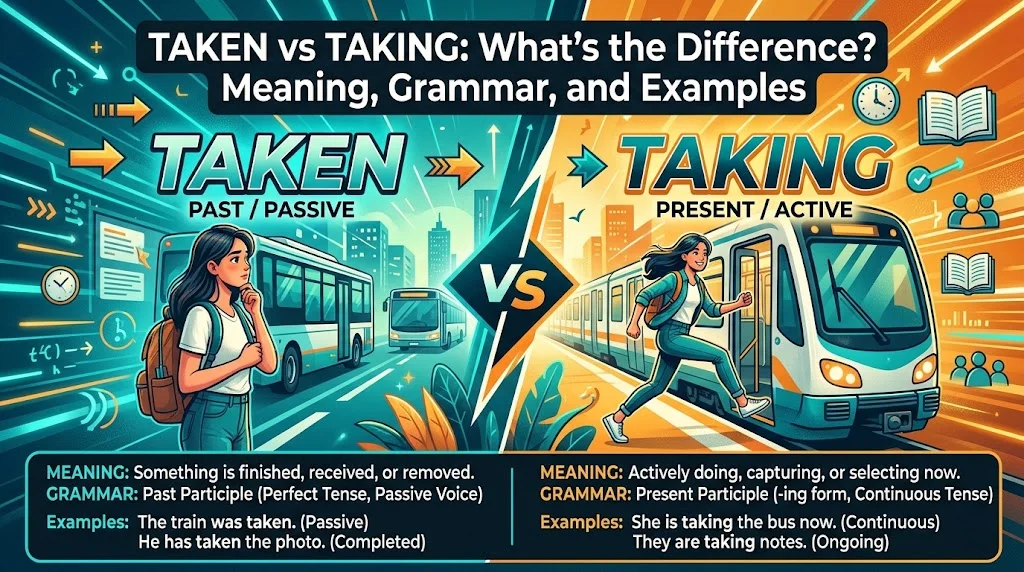
If you’ve ever wondered whether to use taken or taking, you’re dealing with two forms of the same irregular verb: take. They look similar, but they perform very different grammatical jobs. Choosing the right one depends on the verb tense, sentence structure, and intended meaning.
The word taking usually describes an action in progress or works as a gerund, while taken normally functions as a past participle. For example, “She is taking a class” describes an ongoing activity. In contrast, “She has taken the class” describes a completed action.
Understanding this distinction becomes easier once you recognize the role of auxiliary verbs, progressive tenses, perfect tenses, and passive voice. The difference also matters when take, took, taken, and taking appear in everyday expressions.
In this guide, you’ll learn exactly when to use taken vs taking, how each form works, and how to avoid common grammar mistakes. You’ll also see practical examples, comparison tables, sentence patterns, and quick memory tricks that make the difference easier to remember.
Taken vs Taking: The Core Difference
The simplest way to understand taken vs taking is to look at their grammatical forms.
Taking is the present participle of take. It commonly appears in progressive tenses, where it describes an action that is happening or was happening over a period of time. It can also function as a gerund, meaning it behaves like a noun.
Taken is the past participle of take. It commonly appears with have, has, or had in perfect tenses. It also appears in many passive constructions and can function as an adjective.
| Word | Form | Common Function | Example |
| Take | Base form | Present/base verb | I take the train. |
| Took | Simple past | Past action | I took the train yesterday. |
| Taken | Past participle | Perfect/passive | I have taken the train. |
| Taking | Present participle/gerund | Progressive/gerund | I am taking the train. |
A useful shortcut is:
Taking usually points toward an ongoing action, while taken usually works as a past participle.
However, context matters. English grammar isn’t always a one-word puzzle.
Understanding the Verb “Take”
Before comparing taken vs taking, it helps to understand the verb from which both forms come.
What Does “Take” Mean?
Take has many meanings in English. Its meaning changes according to the context.
For example:
- Please take this book. — carry or receive something
- I take the bus to work. — use transportation
- She took a photograph. — capture an image
- He took the opportunity. — accept or use an opportunity
- The medicine takes effect quickly. — begin producing an effect
- It takes two hours. — require a particular amount of time
This flexibility makes take one of the most frequently used English verbs.
Because it’s irregular, its forms don’t follow the normal -ed pattern.
The Forms of “Take”
The main forms are:
- Take — base form
- Takes — third-person singular present
- Took — simple past
- Taken — past participle
- Taking — present participle and gerund
Consider this progression:
I take the bus every morning.
I took the bus yesterday.
I have taken the bus many times.
I am taking the bus now.
The basic meaning remains related to take, but the grammar changes with each form.
What Does “Taking” Mean?
Taking is formed by adding -ing to take.
It can perform more than one grammatical function. Most often, you’ll see it in progressive constructions or as a gerund.
For example:
She is taking a shower.
Here, taking forms part of the present progressive tense.
But consider:
Taking regular breaks can improve concentration.
Here, taking acts as a noun. The entire phrase taking regular breaks functions as the subject of the sentence.
So, taking doesn’t always mean an action happening right now.
Taking in Progressive Tenses
The progressive aspect describes an action that is ongoing around a particular time.
Present Progressive
Use am/is/are + taking.
Examples:
- I am taking a class.
- She is taking the train.
- They are taking photographs.
- We are taking a short break.
The structure is:
Subject + am/is/are + taking + object
For example:
Daniel is taking notes during the meeting.
The action is currently in progress.
Past Progressive
Use was/were + taking.
Examples:
- I was taking notes.
- She was taking a shower.
- They were taking pictures.
- We were taking a walk.
Example:
When you called, I was taking a break.
The action was already in progress when another event occurred.
Future Progressive
Use will be + taking.
Examples:
- I will be taking the exam tomorrow.
- She will be taking a flight at noon.
- They will be taking part in the ceremony.
This describes an action that will be in progress at a particular future time.
Taking as a Gerund
A gerund is an -ing form that functions as a noun.
Consider:
Taking notes helps students remember information.
The word taking isn’t describing an ongoing action here. Instead, the phrase taking notes acts as the subject.
More examples include:
- I enjoy taking pictures.
- She dislikes taking unnecessary risks.
- Taking responsibility requires maturity.
- He talked about taking a different approach.
A quick test can help.
If the -ing phrase can function as a thing, activity, or concept, it may be a gerund.
Compare:
Taking photos is fun.
with:
She is taking photos.
In the first sentence, taking photos is the subject. In the second, taking forms a progressive verb phrase.
Taking in Common Expressions
English contains many fixed expressions using taking.
Taking care of
She is taking care of her younger brother.
This means looking after someone or something.
Taking part in
Many students are taking part in the competition.
This means participating.
Taking place
The meeting is taking place at noon.
This means happening.
Taking advantage of
The company is taking advantage of new technology.
This can mean making effective use of something. It can also have a negative meaning when someone exploits another person.
Taking responsibility
He is taking responsibility for the mistake.
This means accepting accountability.
Read More: Wifes or Wives? The Correct Plural Form Explained
What Does “Taken” Mean?
Taken is the past participle of take.
Unlike took, which functions as the simple past form, taken usually needs an auxiliary verb when it works as a verb.
For example:
She took the book.
But:
She has taken the book.
You generally can’t replace taken with took after has, have, or had.
Incorrect:
She has took the book.
Correct:
She has taken the book.
Taken in Perfect Tenses
Perfect tenses use forms of have together with a past participle.
Since taken is the past participle of take, it appears in these constructions.
Present Perfect
has/have + taken
Examples:
- I have taken the test.
- She has taken the medicine.
- They have taken several photographs.
The present perfect often connects a completed action with the present.
Past Perfect
had + taken
Examples:
- She had taken the train before I arrived.
- They had taken the wrong road.
- He had already taken the documents.
The past perfect places one past action before another past event.
Future Perfect
will have + taken
Examples:
- By Friday, I will have taken three exams.
- They will have taken the necessary steps by then.
The action will be completed before a specified future point.
Taken in the Passive Voice
Taken also appears frequently in passive constructions.
For example:
The patient was taken to the hospital.
The patient didn’t perform the action. Someone else took the patient.
Compare:
Active:
The nurse took the patient to the hospital.
Passive:
The patient was taken to the hospital.
The structure changes because the grammatical focus shifts from the person performing the action to the person receiving it.
Taken as an Adjective
Taken can also function as an adjective.
One familiar example appears in relationship language:
I’m taken.
Here, taken means someone is already in a romantic relationship.
It can also describe something that’s occupied or unavailable:
That seat is taken.
In this sentence, taken means another person is already using the seat.
Another example:
The position has already been taken.
The exact meaning depends on context.
Taken vs Taking: Grammar Comparison

The difference becomes much clearer when the forms appear side by side.
| Feature | Taking | Taken |
| Basic form | Present participle/gerund | Past participle |
| Main use | Progressive tenses | Perfect tenses |
| Passive use | Appears in being taken | Common in passive voice |
| Gerund use | Yes | No |
| Example | She is taking a test. | She has taken a test. |
| Common auxiliaries | am, is, are, was, were | have, has, had |
| Adjective use | Limited | Common |
| Action status | Often ongoing | Often completed or received |
This table captures the central distinction.
Taken vs Taking in Different Sentence Structures
After “Have,” “Has,” and “Had”
When have, has, or had functions as an auxiliary for the perfect aspect, use taken.
Correct:
- I have taken the course.
- She has taken the opportunity.
- They had taken the wrong exit.
Incorrect:
- I have taking the course.
- She has taking the opportunity.
- They had taking the wrong exit.
The reason is straightforward: perfect constructions require a past participle.
Since taken is the past participle of take, it fits the structure.
After “Am,” “Is,” “Are,” “Was,” and “Were”
When these forms of be introduce a progressive construction, use taking.
Examples:
- I am taking notes.
- She is taking a break.
- They are taking a test.
- He was taking a walk.
- We were taking pictures.
However, be + taken can also be grammatical when the sentence uses the passive voice.
Compare:
She is taking the child home.
This is active.
The child is being taken home.
This is passive progressive.
That distinction is crucial.
After “Be” in Passive Constructions
A passive construction can use taken as the past participle.
Examples:
- He was taken to the station.
- The documents were taken from the office.
- The package was taken upstairs.
For a progressive passive, add being:
The patient is being taken to the operating room.
The structure is:
Subject + be + being + past participle
Therefore:
The patient is being taken.
not:
The patient is being taking.
Taken vs Taking in Active and Passive Voice
Voice determines whether the subject performs or receives the action.
Consider:
The driver is taking the passengers to the airport.
The driver performs the action. This is active voice.
Now change the sentence:
The passengers are being taken to the airport.
The passengers receive the action. This is passive voice.
Notice the forms:
Active progressive:
is taking
Passive progressive:
are being taken
This is one of the most useful patterns for remembering taken vs taking.
Active and Passive Comparison
| Voice | Example | Main Form |
| Active | She is taking the child home. | taking |
| Passive | The child is being taken home. | taken |
| Active perfect | She has taken the child home. | taken |
| Active past | She took the child home. | took |
Common Confusions With Taken and Taking
“I Have Taken” vs “I Am Taking”
These sentences describe different time relationships.
I have taken the exam.
The exam is completed.
I am taking the exam.
The exam is happening now or around now.
The auxiliary verb gives you the clue.
Have + taken = perfect
Am + taking = progressive
“She Took” vs “She Has Taken”
Both can describe completed actions, but they aren’t interchangeable in every context.
She took the test yesterday.
The sentence refers to a specific completed past event.
She has taken the test.
The present perfect focuses more on the current relevance or experience. It doesn’t normally pair with a finished past-time expression such as yesterday.
“He Is Taking” vs “He Was Taken”
These sentences differ in both voice and tense.
He is taking the package.
He is performing the action now.
He was taken to the hospital.
Someone else transported him.
The words may look similar, but their grammatical roles are completely different.
Common Prepositions and Phrases With Take
The verb take forms numerous phrasal verbs and fixed expressions.
Take to
She took to the new job quickly.
This can mean developing a liking or adapting well to something.
Take from
Don’t take anything from the drawer.
This means remove or receive something from a source.
Take on
She took on a new responsibility.
This means accept responsibility, work, or a role.
Take over
The new manager took over the department.
This means assume control.
Take up
He took up photography last year.
This means begin an activity or hobby.
Take off
The plane took off at 8 a.m.
It can also mean remove something:
She took off her jacket.
These expressions are worth learning as complete phrases rather than translating take literally every time.
Common Mistakes to Avoid
Even advanced learners sometimes mix up taken and taking.
Mistake: Using “Taking” After Have
Incorrect:
I have taking the test.
Correct:
I have taken the test.
Mistake: Using “Taken” for an Ongoing Active Action
Incorrect:
She is taken the bus.
Correct:
She is taking the bus.
Mistake: Confusing Took and Taken
Incorrect:
I have took the book.
Correct:
I have taken the book.
But:
I took the book yesterday.
Here, took is correct because the sentence uses the simple past.
Mistake: Forgetting “Being” in a Progressive Passive
Incorrect:
The patient is taken to the hospital right now.
This can be grammatical depending on context, but if you specifically mean the action is currently in progress, use:
The patient is being taken to the hospital right now.
The word being makes the progressive passive structure clear.
Taken vs Taking: Real English Examples
Here are practical examples from different contexts.
Everyday English
- I’m taking a shower.
- She’s taking the dog for a walk.
- We’ve taken the wrong bus.
- That chair is taken.
Workplace English
- I’m taking notes during the meeting.
- She has taken responsibility for the project.
- The manager is taking the proposal seriously.
- The documents were taken to the legal department.
Academic English
- Students are taking their final exams.
- He has taken several advanced courses.
- Taking notes can improve recall.
- The examination papers were taken to the grading room.
Travel English
- We’re taking a flight to Chicago.
- They have taken the train already.
- The passengers are being taken to the terminal.
- She took the wrong exit.
Relationship Context
- I’m taken.
- She’s already taken.
- He’s taking his partner to dinner.
The context determines the meaning. Grammar and vocabulary work together.
Taken vs Taking: Side-by-Side Sentence Patterns

| Sentence | Correct Form | Explanation |
| I am ___ a break. | taking | Progressive |
| I have ___ a break. | taken | Present perfect |
| She was ___ notes. | taking | Past progressive |
| She had ___ notes. | taken | Past perfect |
| The patient was ___ to the hospital. | taken | Passive |
| ___ notes helps students. | Taking | Gerund |
| He ___ the bus yesterday. | took | Simple past |
| The child is being ___ home. | taken | Progressive passive |
The auxiliary verb often gives away the answer.
How to Choose Between Taken and Taking
When you’re unsure, don’t guess based on how the sentence sounds. Check the structure.
Ask These Questions
Is the action ongoing?
If yes, taking may be appropriate.
She is taking a test.
Does the sentence use have, has, or had as a perfect auxiliary?
If yes, use taken.
She has taken a test.
Is the sentence passive?
If yes, the past participle taken may be required.
She was taken to the hospital.
Does “taking” function as a noun?
If yes, you’re probably dealing with a gerund.
Taking tests can be stressful.
A Simple Decision Path
TAKE
|
———————
| |
Ongoing action? Completed/perfect?
| |
TAKING TAKEN
| |
“is taking” “has taken”
|
Gerund possible
“Taking notes helps.”
This isn’t a complete map of every grammatical use, but it works well for the most common cases.
Quick Memory Trick for Taken vs Taking
Here’s an easy rule:
Taking goes with progressive action. Taken goes with perfect or passive structures.
Think of the endings this way:
TAKING → happening
She is taking a class.
TAKEN → completed/received
She has taken a class.
Then remember took separately:
TOOK → simple past
She took a class last year.
So the three forms line up like this:
| Form | Memory Cue | Example |
| Take | Base | I take the bus. |
| Took | Past | I took the bus. |
| Taken | Perfect/passive | I have taken the bus. |
| Taking | Ongoing/gerund | I am taking the bus. |
Case Study: Fixing Taken vs Taking Mistakes
Consider this short paragraph:
Maria is taken a course this semester. She has taking three exams already. Yesterday, she has took her final quiz.
Several errors appear here.
Sentence One
Incorrect:
Maria is taken a course.
Correct:
Maria is taking a course.
Why? Is + taking forms the present progressive.
Sentence Two
Incorrect:
She has taking three exams already.
Correct:
She has taken three exams already.
Why? Has + taken forms the present perfect.
Sentence Three
Incorrect:
Yesterday, she has took her final quiz.
Correct:
Yesterday, she took her final quiz.
Why? Yesterday identifies a finished time in the past, so the simple past took is appropriate.
The corrected paragraph becomes:
Maria is taking a course this semester. She has taken three exams already. Yesterday, she took her final quiz.
Three different forms appear naturally:
- taking → ongoing activity
- taken → completed action with present relevance
- took → completed past event
That’s the difference in action.
Self-Assessment: Test Yourself
Choose take, took, taken, or taking.
- She is ___ a photography class.
- I have ___ this route before.
- They ___ the train yesterday.
- He was ___ to the hospital.
- ___ regular breaks can improve productivity.
- We had ___ several photographs before sunset.
- She is ___ notes during the lecture.
- I ___ responsibility for the mistake last week.
- The package was ___ upstairs.
- They have ___ advantage of the opportunity.
Self-Assessment Answers
- taking
- taken
- took
- taken
- Taking
- taken
- taking
- took
- taken
- taken
The key is to look at the surrounding words rather than the verb alone.
Frequently Asked Questions About Taken vs Taking
What is the main difference between taken and taking?
Taken is the past participle of take, while taking is the present participle and gerund form. Taking commonly appears in progressive constructions such as “She is taking a class.” Taken commonly appears in perfect and passive constructions such as “She has taken a class” and “She was taken home.”
Is “taking” present tense or past tense?
Taking itself isn’t a tense. It’s a present participle or gerund. When combined with am, is, or are, it commonly forms the present progressive:
She is taking a test.
With was or were, it forms the past progressive:
She was taking a test.
Is “taken” the past tense of take?
No. Took is the simple past form.
The main forms are:
take → took → taken → taking
For example:
- Present: I take the train.
- Past: I took the train.
- Perfect: I have taken the train.
- Progressive: I am taking the train.
What is the difference between take, took, taken, and taking?
Take is the base form. Took is the simple past. Taken is the past participle. Taking is the present participle and gerund.
Each form serves a different grammatical purpose.
Should I use “taken” after have or has?
Yes, when have or has functions as a perfect auxiliary.
Correct:
I have taken the test.
She has taken the opportunity.
Don’t use taking or took in those structures.
Should I use “taking” after am, is, or are?
Usually, yes, when you’re forming an active progressive verb phrase.
Examples:
I am taking notes.
She is taking a class.
They are taking photographs.
However, am/is/are + taken can appear in passive constructions, such as:
The patient is taken to the hospital.
And is being taken specifically expresses a progressive passive action.
Can “taken” be used as an adjective?
Yes. Taken can describe something that’s occupied or unavailable.
That seat is taken.
It can also describe someone who is romantically unavailable:
I’m taken.
The exact meaning depends on context.
Can “taking” be used as a noun?
Yes. Taking can function as a gerund.
For example:
Taking notes helps me remember information.
Here, taking notes acts as the subject of the sentence.
Is “being taken” grammatically correct?
Yes. Being taken is the passive progressive form.
For example:
The patient is being taken to the hospital.
The structure emphasizes an action that is currently happening to the subject.
Which is correct: “I have taken” or “I have taking”?
I have taken is correct.
I have taken the exam.
The present perfect requires the past participle taken.
Which is correct: “I am taking” or “I am taken”?
Both can be grammatical, but they mean different things.
I am taking the child home.
The subject performs the action.
I am taken to the hospital.
The subject receives the action. This is passive voice.
What is the difference between “took” and “taken”?
Took is the simple past form:
I took the bus yesterday.
Taken is the past participle:
I have taken the bus before.
A useful rule is that taken usually needs an auxiliary verb when it functions as the verb’s past participle.
Conclusion: Taken vs Taking Made Simple
The difference between taken vs taking becomes much easier once you focus on grammar rather than appearance.
Taking is the present participle and gerund form of take. It commonly appears in progressive constructions:
She is taking a class.
It can also act as a noun:
Taking notes improves learning.
Taken, meanwhile, is the past participle of take. It commonly appears with have, has, or had:
She has taken a class.
It also appears frequently in passive constructions:
She was taken to the hospital.
Don’t forget took, either. It’s the simple past form:
She took a class yesterday.
The quickest way to remember the difference is to check the structure around the verb. Am/is/are/was/were + taking commonly signals progressive action. Have/has/had + taken signals a perfect construction. Passive sentences can also require taken, particularly in structures such as was taken or is being taken.
Once you recognize those patterns, choosing between taken, taking, took, and take becomes far less confusing.