
If someone says, “Have a great day!”, how would you reply?
“You too!” is the natural answer.
But what happens when you write “you to” instead? The two expressions sound almost identical in everyday speech, which makes this spelling mistake surprisingly common. The difference becomes much easier once you understand what too and to actually do in a sentence.
The short answer is simple:
Use “you too” when you mean “you also” or “you as well.”
For example:
- “Have a wonderful weekend!” → “You too!”
- “Good luck with your test!” → “You too!”
- “I hope you enjoy the concert.” → “I hope you do too.”
However, you to can also appear correctly. It just doesn’t function as a fixed phrase meaning “you also.” Instead, to must have a grammatical job in the surrounding sentence.
For example:
- “I want you to come with us.”
- “She asked you to wait.”
- “I sent the message to you.”
So, you too or you to isn’t really a choice between two interchangeable phrases. The correct spelling depends on the meaning and structure of the sentence.
You Too or You To: Quick Answer
The easiest rule is this:
You too means “you also” or “you as well.”
You to occurs when to functions as an infinitive marker or preposition.
Compare these sentences:
“Have a safe trip!”
“You too!”
Here, too means also. The complete idea is essentially “I hope you have a safe trip too.”
Now consider:
“I want you to come with me.”
Here, to introduces the base verb come. It doesn’t mean “also.”
That single distinction solves most you too vs. you to questions.
| Expression | Meaning | Example |
| you too | you also | “Have fun!” → “You too!” |
| you to | grammatical combination involving to | “I need you to help.” |
| you two | two people | “You two can sit here.” |
Notice the third option. You two is different from both you too and you to.
What Does “You Too” Mean?
The word too has two major uses in English.
It can mean also, as in:
“I like coffee too.”
It can also mean excessively, as in:
“This coffee is too hot.”
In you too, the first meaning applies. Too means also or as well.
“You Too” as “You Also”
Consider this conversation:
Person A: “I hope you have a great weekend.”
Person B: “You too!”
The response means:
“I hope you have a great weekend too.”
The longer version sounds perfectly grammatical, but everyday conversation usually shortens it. English speakers frequently leave out words that the context already makes obvious.
That’s why “You too!” feels complete even though it contains only two words.
“You Too” in Full Sentences
You too doesn’t always appear as a short reply.
It can also occur inside a complete sentence:
You too can learn the difference.
Here, too still means also. The sentence means:
“You can also learn the difference.”
Another example:
You too deserve a chance.
This means:
“You also deserve a chance.”
So, you too can work as a conversational response or as part of a longer sentence.
Is “You Too” a Complete Sentence?
Yes, in conversational English, “You too!” can function as a complete utterance.
Grammarians often describe this kind of construction as ellipsis. That means some words have been left unstated because the listener can easily recover them from context.
For example:
“Have a nice evening.”
“You too.”
The second speaker doesn’t need to repeat the entire sentence.
The meaning is understood automatically:
“I hope you have a nice evening too.”
This kind of shortened response is extremely common in natural English.
Read More: It’s Called vs It Called: Which One Is Correct?
When Is “You To” Correct?
Here’s where the confusion usually starts.
You to can be grammatically correct, but it isn’t normally a standalone expression meaning “you also.”
Instead, you and to happen to appear next to each other because the sentence requires them.
For example:
I want you to stay.
The structure is:
want + you + to + base verb
Here, to introduces the verb stay.
Changing to to too would create an error:
❌ I want you too stay.
✅ I want you to stay.
The meaning isn’t “you also stay.” The sentence says that the speaker wants the listener to stay.
“You To” Before a Verb
One of the most common patterns is:
verb + you + to + base verb
Examples include:
- I need you to help.
- She wants you to listen.
- They asked you to wait.
- We expect you to arrive early.
- He reminded you to call.
- I encouraged you to apply.
In each sentence, to connects you with the following base verb.
Look closely:
I want you to learn.
The word after to is learn, a base-form verb.
You wouldn’t write:
❌ I want you too learn.
The extra o changes the word from the infinitive marker to into the adverb too.
“You To” With Direction or Movement
The word to also works as a preposition.
For example:
I spoke to you yesterday.
She sent the email to you.
He gave the keys to you.
Here, to shows a relationship involving direction, communication, transfer, or a recipient.
The order is worth noticing:
to + you
rather than:
you + to
Still, these examples help explain why to and you can appear together naturally without too being involved.
Why “You To” Usually Needs More Words
Unlike you too, you to doesn’t normally communicate a complete idea by itself.
If someone says:
“Have a wonderful evening!”
Writing:
❌ “You to!”
is incorrect if the intended meaning is “you also.”
The correct response is:
✅ “You too!”
However, you to can appear naturally inside a larger sentence:
“I need you to finish this today.”
That’s the key distinction.
You Too vs. You To: Side-by-Side Comparison
The difference becomes clearer when the expressions sit next to each other.
| Feature | You too | You to |
| Main word | too | to |
| Function | Adverb | Infinitive marker or preposition |
| Common meaning | You also | Depends on sentence structure |
| Standalone reply | Yes | Usually no |
| Example | “Enjoy your trip!” → “You too!” | “I want you to go.” |
| Replacement test | “You also” | “To” cannot normally be replaced with “too” |
Consider these examples:
Have a great day. You too!
Here, too = also.
Now:
I want you to have a great day.
Here, to introduces have.
The words look almost the same. Their grammatical jobs are completely different.
“Too” vs. “To”: The Grammar Behind the Confusion
Understanding the individual words makes the entire problem easier.
What Does “Too” Mean?
Too commonly has two meanings.
Meaning one: also
“I want to go too.”
This means:
“I also want to go.”
Meaning two: excessively
“The soup is too salty.”
This means the soup contains more salt than desired.
In you too, only the first meaning applies:
You too = You also.
That’s your most useful shortcut.
What Does “To” Mean?
To has several grammatical roles, but two are especially important here.
To as an Infinitive Marker
It appears before the base form of a verb:
- to eat
- to sleep
- to learn
- to write
- to travel
- to understand
So:
“I want you to learn.”
is correct.
To as a Preposition
It can show direction, destination, connection, or a recipient:
“She walked to school.”
“I gave the book to him.”
“He spoke to you.”
This is why you shouldn’t decide between to and too simply by looking at the sound.
A Simple Memory Trick
When you mean also, choose too.
Think:
You too = You also.
If you’re introducing a verb, to is usually the right choice:
You to learn ❌
You to learn can only be part of a larger structure, such as “I want you to learn.” ✅
The easiest approach isn’t memorizing dozens of rules. Instead, ask what the word means in that particular sentence.
Why People Confuse You Too and You To
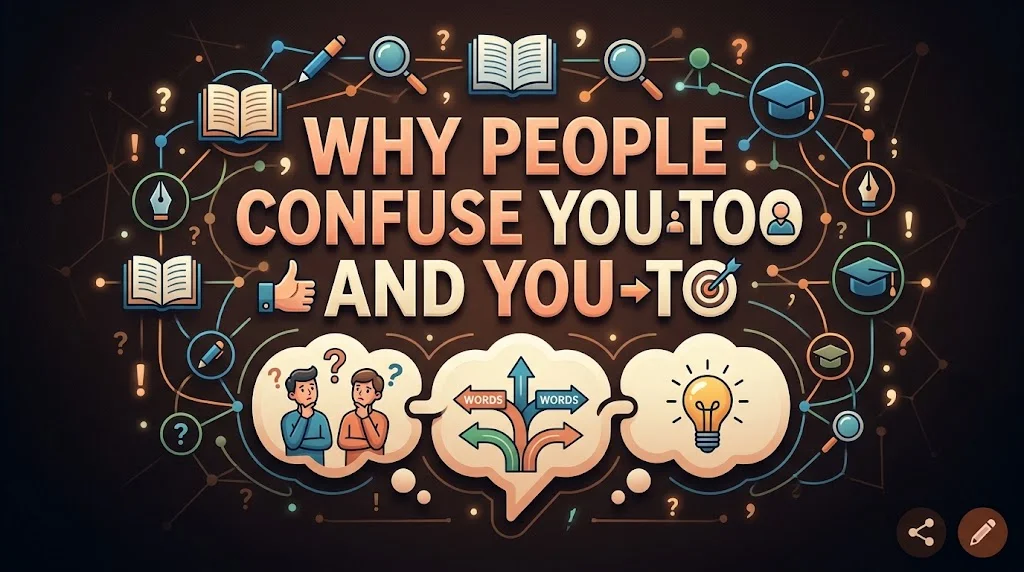
The main culprit is pronunciation.
In ordinary speech, to and too can sound the same. When you hear:
“You too!”
there’s no extra sound telling you that the speaker used too.
English has many pairs of words like this. They’re called homophones when they share pronunciation while differing in meaning or spelling.
Other familiar examples include:
- there / their / they’re
- your / you’re
- two / too / to
- right / write
- hear / here
Because pronunciation doesn’t reveal the spelling, you need to use context.
Texting Makes the Problem Easier to Miss
Quick messages often encourage people to type without checking.
Someone might write:
“Have a good night you to”
The meaning is obvious to the reader, but the spelling is still incorrect.
This is particularly common when someone relies on sound rather than sentence structure.
Autocorrect Doesn’t Understand Everything
Autocorrect can catch many spelling errors, but it doesn’t always understand intended meaning.
Both to and too are legitimate English words. A spell-checker may therefore accept either one.
That’s why a sentence can contain a real word in the wrong grammatical position.
The problem isn’t spelling alone. It’s word choice.
Common “You Too” and “You To” Mistakes
Writing “You To” When You Mean “You Also”
This is the classic error.
❌ “Have a nice weekend. You to!”
✅ “Have a nice weekend. You too!”
The speaker means “You also.”
A quick substitution confirms it:
“Have a nice weekend. You also!”
The sentence sounds slightly more formal but preserves the intended meaning.
Writing “You Too” When “To” Introduces a Verb
This mistake works in the opposite direction.
❌ “I need you too finish this.”
✅ “I need you to finish this.”
Here, to introduces finish.
Try replacing it with also:
“I need you also finish this.”
That doesn’t work.
Therefore, too isn’t appropriate.
Confusing “You Too” With “You Two”
This one deserves attention because you two has an entirely different meaning.
Compare:
You too should attend.
This means:
You also should attend.
Now:
You two should attend.
This means:
The two of you should attend.
The difference is just one letter, but the meaning changes dramatically.
| Expression | Meaning |
| you too | you also |
| you to | you + grammatical to |
| you two | two people |
How to Know Whether You Need “Too” or “To”
You don’t need to guess. Use a few quick tests.
The “Also” Test
Ask:
Can I replace “too” with “also”?
If yes, too is probably correct.
Example:
“Have a great day. You too!”
Replace it:
“Have a great day. You also!”
The meaning remains clear.
Another example:
“You too deserve a break.”
Becomes:
“You also deserve a break.”
It works.
Therefore, too is correct.
The Verb Test
Look for a structure such as:
you + to + base verb
Examples:
- you to go
- you to stay
- you to learn
- you to finish
These combinations normally appear as part of a larger sentence:
“I want you to go.”
“She asked you to stay.”
“They expect you to finish.”
If to introduces the base verb, don’t replace it with too.
The Sentence Structure Test
Finally, ask what job the word performs.
If the word adds the meaning also, use too.
If it introduces a verb or acts as a preposition, use to.
That approach is more reliable than trying to remember how each phrase sounds.
You Too in Everyday English
You Too in Text Messages
Texting is where you too appears constantly.
For example:
Friend: “Good luck with your interview!”
You: “You too!”
Or:
Friend: “Have fun tonight!”
You: “You too!”
In both cases, too means also.
Another common exchange is:
Person A: “Take care!”
Person B: “You too!”
The response is short, friendly, and completely natural.
You Too in Workplace Emails
You can also use you too in professional communication when the context is friendly and conversational.
For example:
“Have a great weekend!”
A natural reply is:
“Thanks! You too.”
There’s nothing grammatically wrong with this.
If you want a slightly more formal tone, you could write:
“Thank you. I hope you have a great weekend as well.”
Both are correct. The difference is primarily one of tone and style.
You Too in School and Academic Writing
You too is grammatically valid in academic writing when the sentence requires it.
For example:
“You too can contribute to the discussion.”
However, academic writing often benefits from more precise context. A sentence such as:
“Students too can benefit from regular practice.”
may be more appropriate when discussing students generally.
The important point is that too itself isn’t informal or incorrect.
You Too in Family and Social Conversations
Everyday conversations are filled with short reciprocal responses.
“Enjoy your dinner!”
“You too!”
“Have a safe trip!”
“You too!”
“Good luck tomorrow!”
“You too!”
These examples all use too because the speaker is returning the same sentiment.
You Too in Professional and Formal Communication
Some people assume that you too is too casual for professional communication. That’s not necessarily true.
Grammar and formality are separate questions.
The phrase is grammatically correct. Whether it fits a particular message depends on the relationship and context.
For example:
“Thanks for your help. Have a great weekend!”
A natural reply:
“You’re welcome. You too!”
For a more formal exchange:
“Thank you for your kind message. I hope you have a wonderful weekend as well.”
Both versions work. The second simply has a more formal tone.
You Too, You To, and You Two: Three Different Expressions
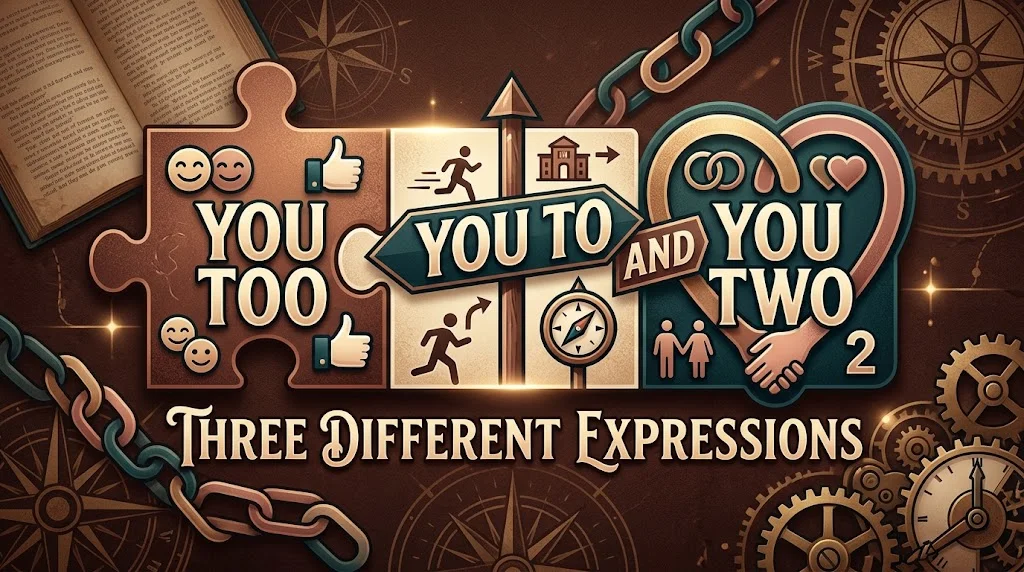
These three expressions deserve a final comparison because they can easily get mixed up.
You Too
Means you also.
“I love hiking.”
“You too?”
You To
Usually forms part of a larger grammatical structure.
“I want you to come.”
You Two
Refers to two people.
“You two can work together.”
A useful memory chart looks like this:
| Expression | Easy meaning | Example |
| you too | you also | “Have fun!” → “You too!” |
| you to | grammatical to | “I asked you to wait.” |
| you two | two people | “You two look happy.” |
Don’t let the similar pronunciation fool you. Context does the heavy lifting.
Real-Life Editing Examples
Here are several situations where the difference becomes obvious.
Example: A Text Message
Incorrect:
“Have a good night! You to.”
Correct:
“Have a good night! You too.”
Why?
The intended meaning is “You also have a good night.”
Example: A Workplace Email
Incorrect:
“I hope you have a great weekend to.”
Correct:
“I hope you have a great weekend too.”
The writer is adding the same wish to another person.
Example: An Infinitive
Incorrect:
“I need you too call the client.”
Correct:
“I need you to call the client.”
Here, to introduces call.
Example: Two People
Incorrect:
“You too should review the document.”
This sentence could mean “you also should review it.”
But if the writer means two specific people, the correct form is:
“You two should review the document.”
One letter can completely change the message.
Quick Reference Table: You Too or You To?
Use this table when you’re unsure:
| If you mean… | Use… | Example |
| you also | you too | “Good luck!” → “You too!” |
| you as well | you too | “Enjoy yourself!” → “You too!” |
| an infinitive after you | you to | “I want you to stay.” |
| a recipient or destination | to you | “I sent it to you.” |
| two people | you two | “You two can go first.” |
The most useful shortcut is still the simplest one:
If you mean “also,” use “too.”
Mini Practice: You Too or You To?
Try these examples before checking the answers.
“Have a wonderful evening. ___”
Answer: You too.
The intended meaning is “You also have a wonderful evening.”
“I need ___ finish this report.”
Answer: you to
The sentence requires the structure need + you + to + verb.
“She asked ___ wait outside.”
Answer: you to
The word to introduces the base verb wait.
“I hope ___ have a great time.”
Answer: you too only if the construction is a reciprocal expression such as “I hope you have a great time too.” In the exact sentence “I hope you have a great time,” no extra word is needed.
This example highlights an important point: don’t force too into a sentence just because you’re thinking about the phrase you too.
“Good luck on your exam. ___!”
Answer: You too!
The speaker is returning the good wish.
“___ should come with us.”
If you mean you also, write:
You too should come with us.
If you mean two people, write:
You two should come with us.
Context determines the answer.
Frequently Asked Questions
Is “You Too” Correct Grammar?
Yes. “You too” is grammatically correct when too means “also” or “as well.”
For example:
“Have a great day!”
“You too!”
The phrase can also appear within a complete sentence:
“You too deserve a chance.”
Is “You To” Ever Correct?
Yes. You to can be correct when to has a grammatical function.
For example:
“I want you to stay.”
Here, to introduces the base verb stay.
However, you to isn’t the correct spelling when you mean you also.
Should I Say “You Too” or “You To”?
If you’re replying to a wish or greeting, you almost certainly want:
You too!
For example:
“Have a nice day!” → “You too!”
Use to when the sentence requires the infinitive marker or preposition.
Is “You Too” a Complete Sentence?
In conversation, yes. “You too!” can function as a complete conversational response.
The longer meaning is usually understood from context.
For example:
“Have a safe journey.”
“You too.”
The second speaker doesn’t need to repeat the entire sentiment.
Can I Use “You Too” in a Professional Email?
Yes. It’s grammatically correct and can work well in friendly professional communication.
For example:
“Have a great weekend!”
“Thanks! You too.”
For especially formal communication, “I hope you have a wonderful weekend as well” may sound more polished.
What Is the Difference Between “You Too” and “You Two”?
You too means you also.
You two means the two of you.
Compare:
“You too should apply.”
“You two should apply.”
The first sentence includes the person as an additional participant. The second specifically refers to two people.
Why Do “Too” and “To” Sound the Same?
In standard English pronunciation, to and too can sound alike in many contexts. That makes them homophones.
Because pronunciation doesn’t show the spelling, you need to use meaning and sentence structure to choose the correct word.
How Can I Remember the Difference Between “Too” and “To”?
Use the also test.
If you can replace the word with also, choose too.
“You too.” → “You also.”
If the word introduces a verb or functions as a preposition, to is generally required.
Is “You Too” Formal or Informal?
You too is grammatically neutral, but its conversational use is especially common in casual and professional-friendly communication.
For highly formal writing, you may choose a fuller expression such as:
“I hope you have a pleasant weekend as well.”
The choice depends on the tone of the situation.
What Is the Correct Reply to “Have a Nice Day”?
The natural reply is:
“You too!”
It means:
“I hope you have a nice day too.”
Writing “You to” in this situation is a spelling and word-choice error.
Conclusion: You Too or You To?
The difference between you too and you to becomes straightforward once you focus on meaning rather than sound.
Use you too when you mean “you also” or “you as well.”
“Have a great day!”
“You too!”
Use you to when to belongs to the grammar of a larger sentence:
“I want you to come.”
And don’t forget you two, which refers to two people:
“You two should sit together.”
When you’re unsure, run the also test. If also fits, too is likely the right choice. If to introduces a verb or acts as a preposition, stick with to.
The words may sound alike, but their jobs aren’t the same. Once you recognize those jobs, choosing between you too or you to becomes much easier.