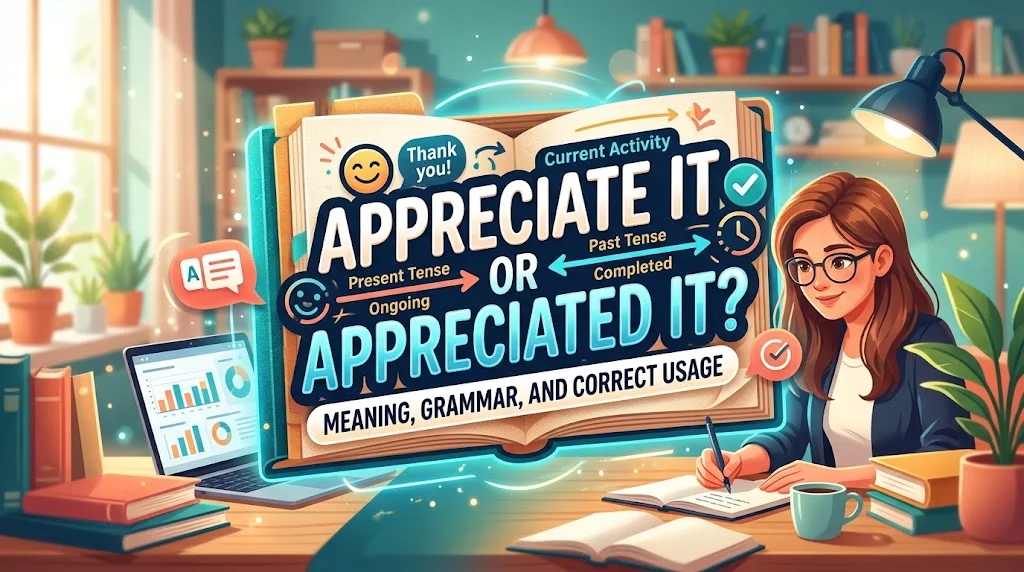
Have you ever wondered whether to say “I appreciate it” or “I appreciated it” after someone helps you? Both phrases express gratitude, but they don’t always fit the same context, time frame, or verb tense. Understanding this small grammar difference can make your spoken English, professional writing, and everyday communication sound much more natural.
The main difference between appreciate it and appreciated it is present tense versus past tense. “I appreciate it” usually expresses current gratitude, while “I appreciated it” describes past appreciation or a feeling connected to a completed past experience. However, there’s an important detail: you can use “I appreciate it” even when the help, favor, or kindness happened earlier.
For example, you might say, “Thanks for helping me yesterday. I appreciate it.” The action happened in the past, but your gratitude exists now. In contrast, “I appreciated your help when I was starting my first job” looks back at a past situation.
In this guide, you’ll learn the correct usage, grammar rules, sentence structure, common mistakes, real-life examples, and professional alternatives so you can confidently choose between these two phrases.
Appreciate It or Appreciated It: What’s the Difference?
The basic difference comes down to verb tense.
- I appreciate it uses the present tense.
- I appreciated it uses the simple past tense.
The present form normally expresses gratitude that exists now. The past form describes appreciation that existed at an earlier point in time.
| Phrase | Tense | Basic meaning | Typical use |
| I appreciate it | Present | I am grateful for it now. | Current gratitude |
| I appreciated it | Past | I was grateful for it then. | Past experiences |
| I really appreciate it | Present | I am especially grateful now. | Strong current gratitude |
| I really appreciated it | Past | I was especially grateful then. | Strong past gratitude |
Here’s an important point: the action and the appreciation don’t necessarily happen at the same time.
Someone could help you on Monday. You could thank them on Tuesday by saying, “I appreciate it.”
Why?
Because the help happened in the past, but your gratitude is still a present feeling.
What “I Appreciate It” Means
“I appreciate it” means that you are grateful for something.
The verb appreciate is in the present tense. The phrase therefore usually communicates that your gratitude is relevant right now.
For example:
“Thanks for helping me move. I appreciate it.”
The moving happened earlier. However, the speaker is expressing gratitude in the current conversation.
You can use “I appreciate it” after someone:
- Gives you advice
- Helps you solve a problem
- Does you a favor
- Gives you extra time
- Provides useful information
- Offers support
- Sends you something you needed
- Takes care of a task
- Listens to you
- Makes an effort on your behalf
The phrase is also flexible. You can use it with friends, coworkers, customers, managers, teachers, neighbors, and strangers.
For example:
“Thanks for sending that document. I appreciate it.”
“I appreciate it. That advice really helped.”
“Thanks for staying late. I appreciate it.”
The common thread is simple: the speaker is expressing gratitude in the present moment.
What “I Appreciated It” Means
“I appreciated it” uses the simple past tense.
It generally means that you were grateful for something during a past situation or at a previous point in time.
For example:
“I appreciated it when you checked on me during the trip.”
Here, the speaker is looking back on a past situation.
Another example:
“I really appreciated your help when I was starting my first job.”
The appreciation is being discussed as part of a past experience.
This form works especially well when the sentence contains a clear past-time reference:
- Yesterday
- Last week
- Last year
- When I was younger
- During the trip
- At the time
- Back then
- During my first year
- When we worked together
For instance:
“I appreciated your advice when I was in college.”
The sentence looks backward. That’s why the past tense fits naturally.
Appreciate vs. Appreciated at a Glance
Think of the distinction as a camera pointed at time.
When you say “I appreciate it,” the camera is focused on the present.
When you say “I appreciated it,” the camera points backward.
Consider these examples:
“Thanks for helping me today. I appreciate it.”
“When you helped me last year, I appreciated it.”
Both sentences can be correct. They simply present the appreciation from different time perspectives.
When to Use “I Appreciate It”
The phrase “I appreciate it” is extremely common in everyday English because people frequently express gratitude for something that matters to them now.
When Someone Helps You Now
If someone has just helped you, “I appreciate it” is a natural response.
Imagine that a coworker fixes a problem with your computer.
You might say:
“Thanks for fixing that. I appreciate it.”
The repair is complete, but your gratitude is current.
Another example:
“Thanks for carrying those boxes. I appreciate it.”
The person already carried the boxes. Still, the speaker is expressing gratitude now.
This is why it would be misleading to think that “appreciate” always means the action happened in the present.
It doesn’t.
The verb describes the speaker’s current appreciation.
When You’re Thanking Someone for a Recent Favor
Recent favors often take “I appreciate it”, even though the favor has already happened.
Suppose your friend drives you home.
You could say:
“Thanks for the ride. I appreciate it.”
You don’t need to say:
“Thanks for the ride. I appreciated it.”
The second sentence isn’t necessarily grammatically wrong. However, it can sound as though you’re describing a past feeling rather than expressing direct gratitude.
That subtle difference matters.
In Work Emails and Professional Messages
“I appreciate it” works well in many professional situations.
For example:
“Thanks for reviewing the report. I appreciate it.”
Or:
“I appreciate your help with this project.”
Or:
“Thank you for taking the time to explain the process. I appreciate it.”
The phrase sounds polite without being overly formal.
For workplace communication, you can also make the object more specific:
“I appreciate your quick response.”
“I appreciate your flexibility.”
“I appreciate your patience.”
“I appreciate your assistance.”
Specific wording often sounds more thoughtful than a generic thank-you.
Why “I Appreciate It” Sounds Natural
English speakers often use “I appreciate it” as a direct expression of gratitude.
It can function almost like:
- Thank you.
- Thanks for helping.
- I’m grateful.
- That means a lot.
- Thanks. I value your help.
Its flexibility explains why it appears frequently in spoken English and informal professional communication.
It also doesn’t require a complicated sentence.
“Thanks. I appreciate it.”
Short. Clear. Natural.
Read More: Cocoon or Cacoon: Which Spelling Is Correct?
When to Use “I Appreciated It”
Although “I appreciate it” is common for direct thanks, “I appreciated it” has an important role.
Use it when you are describing appreciation from a past perspective.
When Referring to a Completed Past Experience
Suppose you’re telling someone about a trip you took several years ago.
You might say:
“The hotel staff were incredibly helpful. I appreciated everything they did for us.”
You’re not necessarily thanking them directly at that moment. You’re describing how you felt during that past experience.
The past tense fits because the sentence belongs to a past narrative.
Another example:
“I appreciated the extra time my teacher gave me before the exam.”
The sentence focuses on a previous situation.
When Describing a Past Favor or Gesture
You can use “I appreciated it” when looking back at a favor.
For example:
“When I was going through a difficult period, you called me every week. I appreciated it.”
The speaker is reflecting on something that happened in the past.
Compare that with:
“Thanks for calling me. I appreciate it.”
The first sentence recounts a past experience. The second expresses current gratitude.
That’s the key distinction.
In Stories, Memories, and Personal Reflections
Past tense becomes especially useful in storytelling.
Imagine someone describing their first day at a new company:
“I was nervous on my first day. My manager showed me around the office, introduced me to everyone, and answered all my questions. I really appreciated it.”
The entire passage uses a past-time perspective.
Using “appreciated” helps maintain that timeline.
This also applies to:
- Personal essays
- Memoirs
- Reviews
- Stories
- Recollections
- Historical descriptions
- Past workplace experiences
- Reflections about relationships
When “I Appreciated It” Can Sound Unnatural
The phrase isn’t wrong simply because someone uses it after a recent favor.
However, context can make it sound slightly distant.
Imagine someone hands you a glass of water.
You say:
“Thank you. I appreciated it.”
That sounds unusual in an immediate conversation.
A more natural response would be:
“Thank you. I appreciate it.”
Why?
The situation is happening in the present conversational context. You’re expressing gratitude now.
By contrast:
“When you brought me water during the long meeting, I appreciated it.”
Now the past tense feels natural because you’re looking back.
Why “Appreciate It” and “Appreciated It” Get Confused
The confusion usually comes from one simple misunderstanding: people connect the verb tense to the action rather than to the speaker’s perspective.
That’s where things get interesting.
The Main Tense Difference
The grammar itself is straightforward:
Appreciate = present
“I appreciate your help.”
Appreciated = past
“I appreciated your help.”
The challenge is deciding which time frame the speaker intends.
Why a Past Action Can Still Take “I Appreciate It”
This is probably the most important point in the entire topic.
A completed action doesn’t automatically require a past-tense expression of gratitude.
Consider:
“Thanks for helping me yesterday. I appreciate it.”
The help occurred yesterday.
The appreciation exists now.
Therefore, “I appreciate it” works naturally.
Now compare:
“When you helped me yesterday, I appreciated it.”
This sentence places the appreciation inside the past situation.
Both sentences can be correct.
The difference is the speaker’s time perspective.
How Context Changes the Meaning
Look at these examples:
“Thanks for the advice. I appreciate it.”
Current gratitude.
“When you gave me that advice last year, I appreciated it.”
Past reflection.
“I appreciate everything you did for me.”
Current gratitude toward past actions.
“I appreciated everything you did during that difficult period.”
Past reflection about a completed period.
The surrounding words provide important clues.
Common Errors to Avoid
One common mistake is assuming that every completed action requires “appreciated.”
That’s not true.
For example:
“Thanks for helping me yesterday. I appreciated it.”
This is possible, but if you’re directly thanking the person now, “I appreciate it” often sounds more natural.
Another mistake is using present tense when the entire sentence clearly describes a finished past perspective:
“When I worked there ten years ago, I appreciate the support I received.”
A better version is:
“When I worked there ten years ago, I appreciated the support I received.”
The time frame controls the verb.
The Grammar Rule Behind “Appreciate It” vs. “Appreciated It”
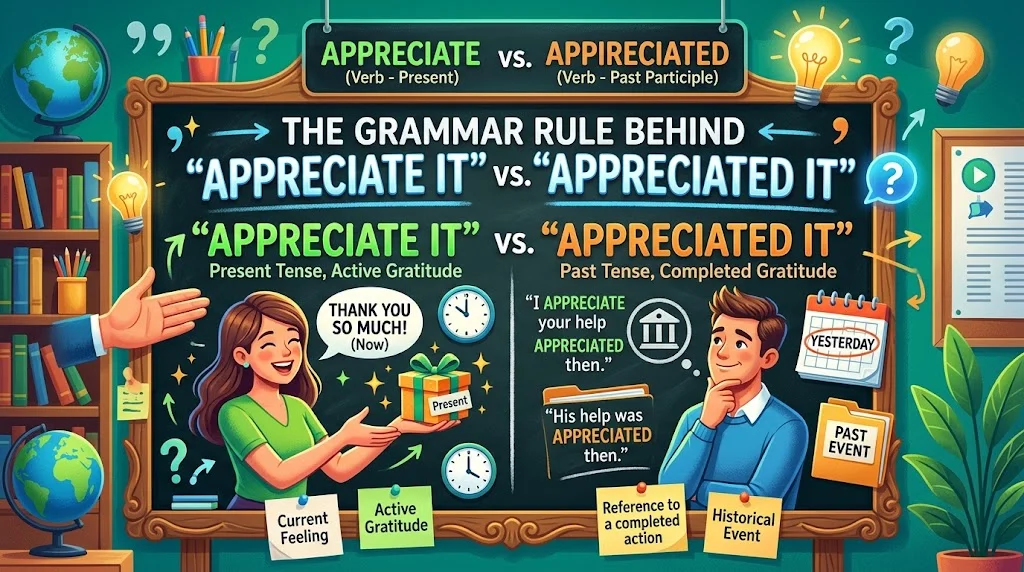
Understanding the basic tense rule makes this choice much easier.
“Appreciate” as a Present-Tense Verb
In:
“I appreciate it.”
The verb appreciate is in the simple present.
The subject is I, so the base form is used.
Other present-tense forms include:
- I appreciate
- You appreciate
- We appreciate
- They appreciate
- He appreciates
- She appreciates
- It appreciates
Notice the -s with third-person singular subjects.
“She appreciates your help.”
But:
“I appreciate your help.”
This distinction is important when constructing longer sentences.
“Appreciated” as a Simple Past Verb
The past form is appreciated.
Unlike some irregular verbs, appreciate forms its simple past regularly by adding -d because the base verb already ends in e.
appreciate → appreciated
Examples:
“I appreciated your support.”
“She appreciated the opportunity.”
“They appreciated the extra time.”
The form remains appreciated across subjects in the simple past.
Why the Pronoun “I” Matters
The most common versions in this comparison are:
I appreciate it.
and
I appreciated it.
The subject I doesn’t change the basic distinction. The verb does.
- I appreciate = present
- I appreciated = past
That’s why the choice isn’t about whether “I” is correct. Both structures are grammatical.
The real question is which tense expresses your intended meaning.
Present Gratitude Can Refer to a Past Action
This point deserves another look because it causes so many mistakes.
Consider:
“Thank you for helping me last week. I appreciate it.”
The word last week tells us when the help happened.
The phrase I appreciate it tells us how the speaker feels now.
There is no grammatical contradiction.
English allows you to describe a past action while expressing a present response to that action.
Appreciate It or Appreciated It in Different Contexts
The best choice becomes easier when you see how each phrase behaves in real situations.
Text Messages and Casual Conversations
For everyday texting, “I appreciate it” is very common.
“Thanks for picking me up. I appreciate it!”
“You sent me the notes? I appreciate it.”
“Thanks for covering my shift. I really appreciate it.”
If you’re telling a story about something that happened earlier, use the past form:
“She helped me when I was new. I appreciated it.”
Workplace Communication
Professional communication often uses “I appreciate it” for direct thanks.
For example:
“Thanks for reviewing this before the deadline. I appreciate it.”
You can also use a more specific construction:
“I appreciate your feedback on the proposal.”
When discussing an old professional experience, however, “appreciated” may be appropriate:
“During my first year at the company, I appreciated the support from my team.”
Customer Service and Business Communication
Businesses frequently use appreciation to acknowledge help, patience, or cooperation.
A customer might write:
“Thank you for resolving the issue. I appreciate it.”
A company representative might say:
“We appreciate your patience.”
If describing an earlier interaction, past tense can work:
“I appreciated how quickly the representative resolved my issue.”
The context determines the tense.
Thank-You Notes and Formal Writing
Both forms can appear in formal writing.
For current gratitude:
“I sincerely appreciate your assistance.”
For a past experience:
“I greatly appreciated the opportunity to participate in the program.”
Notice how the second sentence frames the opportunity as a completed experience.
Personal Stories and Reflections
Personal narratives naturally favor the past tense when describing completed events.
“My neighbors helped us after the storm. I appreciated their kindness.”
But if you’re speaking directly to those neighbors now, you might say:
“Thank you for helping us after the storm. I appreciate your kindness.”
The event happened in the past. The gratitude is present.
Appreciate It vs. Appreciated It Examples
Examples make this distinction much easier to remember.
Examples of “I Appreciate It”
Here are natural examples of current gratitude:
- “Thanks for helping me with the report. I appreciate it.”
- “I appreciate it when you give me honest feedback.”
- “Thanks for waiting for me. I appreciate it.”
- “I really appreciate your patience.”
- “I appreciate everything you’ve done.”
- “Thanks for explaining that. I appreciate it.”
- “I appreciate your flexibility.”
- “I appreciate the extra effort.”
- “Thanks for taking care of that. I appreciate it.”
- “I appreciate you checking in.”
Notice something important: several of these examples refer to actions that may already be completed.
That’s perfectly normal.
Examples of “I Appreciated It”
These examples describe past appreciation:
- “I appreciated your help during my first week.”
- “I really appreciated the advice you gave me last year.”
- “I appreciated how welcoming everyone was.”
- “I appreciated the opportunity to work with the team.”
- “I appreciated your support during that difficult period.”
- “I appreciated everything you did while I was recovering from the trip.”
- “I appreciated the extra time you gave me.”
- “Looking back, I appreciated how patient she was.”
- “I appreciated the kindness everyone showed us.”
- “During that period, I appreciated having good friends around me.”
Here, the sentences look backward.
Side-by-Side Examples
| Situation | Natural sentence | Reason |
| Someone just helped you | “I appreciate it.” | Gratitude is current |
| Someone helped you yesterday | “I appreciate it.” | You are thanking them now |
| You are describing yesterday’s feelings | “I appreciated it.” | Past perspective |
| You are remembering an old favor | “I appreciated your help.” | Past reflection |
| Someone supports you regularly | “I appreciate your support.” | Ongoing gratitude |
| You describe support from a former job | “I appreciated their support.” | Past context |
| You are writing a current thank-you email | “I appreciate your assistance.” | Current gratitude |
| You are discussing an old experience | “I appreciated the opportunity.” | Completed experience |
A Real-Life Case Study: Choosing the Right Phrase
Imagine a job applicant named Daniel who recently completed an interview.
The hiring manager spent extra time explaining the position and answering Daniel’s questions.
After the interview, Daniel sends an email:
“Thank you for taking the time to answer my questions. I appreciated it.”
The sentence isn’t necessarily grammatically impossible. However, it may sound as though Daniel is simply describing his past reaction rather than expressing direct gratitude.
A more natural email would be:
“Thank you for taking the time to answer my questions. I really appreciate it.”
Why does this version work better?
Because Daniel is communicating now. His interview happened earlier, but his gratitude exists at the moment he sends the email.
Now imagine Daniel writes about the experience several months later:
“The hiring manager spent extra time answering my questions. I really appreciated it.”
This version works because Daniel is describing a completed past experience.
The Lesson From the Case Study
Don’t ask only:
“When did the action happen?”
Ask:
“When am I expressing or describing the appreciation?”
That single question solves many appreciate it or appreciated it problems.
How to Choose Between “Appreciate It” and “Appreciated It”
When you’re unsure, use this simple process.
Step 1: Ask When the Gratitude Exists
Ask yourself:
“Am I grateful now, or am I describing how I felt then?”
If your gratitude is current, choose:
I appreciate it.
If you’re describing a past feeling, choose:
I appreciated it.
Step 2: Look for Time Indicators
Words that often signal a past context include:
- Yesterday
- Last month
- Last year
- Years ago
- When I was younger
- At the time
- During that period
- Back then
- When I worked there
These words don’t automatically force the past tense. Context still matters.
For example:
“Thanks for helping me yesterday. I appreciate it.”
The word yesterday describes the action, not necessarily the current gratitude.
Step 3: Separate the Action From Your Appreciation
This is the most useful mental trick.
Imagine two separate timelines:
Action: Someone helped you yesterday.
Appreciation: You are thanking them today.
That produces:
“Thanks for helping me yesterday. I appreciate it.”
Now imagine both the action and the appreciation belong to a past story:
Action: Someone helped you last year.
Appreciation: You describe your gratitude at that time.
That produces:
“When she helped me last year, I appreciated it.”
Step 4: Match the Verb Tense
Once you understand the timeline, choose the form:
Present perspective → appreciate
Past perspective → appreciated
This is much more reliable than memorizing isolated sentences.
Step 5: Read the Complete Sentence
Finally, read the entire sentence.
Does it sound like a direct thank-you?
“Thanks for your help. I appreciate it.”
Probably present.
Does it sound like a story or reflection?
“During that difficult year, I appreciated all the support I received.”
Probably past.
Context acts like a compass. It points the verb toward the intended time.
Common Alternatives to “I Appreciate It”

Sometimes you want to avoid repeating “I appreciate it.” English gives you plenty of alternatives.
Casual Alternatives
For friends, family, or relaxed conversations, you can say:
- “Thanks!”
- “Thanks a lot.”
- “I really appreciate that.”
- “That means a lot.”
- “You’re a lifesaver.”
- “Thanks for doing that.”
- “I owe you one.”
The last two are especially conversational.
Professional Alternatives
For workplace communication, consider:
- “Thank you for your help.”
- “I appreciate your assistance.”
- “Thank you for your time.”
- “Thanks for your quick response.”
- “I appreciate your patience.”
- “Thank you for taking the time.”
- “I’m grateful for your support.”
For example:
“Thank you for taking the time to review the proposal.”
This can sound polished without becoming overly formal.
More Formal Alternatives
When the situation calls for a formal tone, you could write:
- “I sincerely appreciate your assistance.”
- “I greatly appreciate your consideration.”
- “Thank you for your continued support.”
- “I am grateful for your assistance.”
- “Your support is greatly appreciated.”
Use these when the situation actually calls for formality. Everyday messages rarely need fancy language.
Alternatives for Past Gratitude
When describing a past experience, you can write:
- “I was grateful for your help.”
- “I really valued your support.”
- “I was thankful for your assistance.”
- “Your support meant a lot to me.”
- “I valued the opportunity.”
- “I was grateful for the experience.”
For example:
“I was grateful for the guidance I received during my first year.”
This makes the past perspective clear.
A Simple Comparison: Present Gratitude vs. Past Reflection
One of the easiest ways to remember the difference is to separate direct gratitude from historical reflection.
| Present gratitude | Past reflection |
| I appreciate it. | I appreciated it. |
| I appreciate your help. | I appreciated your help. |
| I really appreciate that. | I really appreciated that. |
| I appreciate your support. | I appreciated your support. |
| I appreciate the opportunity. | I appreciated the opportunity. |
The words may look almost identical, but the viewpoint changes.
Compare:
“Thank you for helping me. I appreciate it.”
with:
“When I needed help last year, I appreciated it.”
The first sentence speaks directly from the present.
The second looks backward.
Does “I Appreciated It” Mean You No Longer Appreciate It?
Not necessarily.
This is an important nuance.
The simple past “appreciated” tells readers that the appreciation belonged to a past context. It doesn’t automatically declare that the speaker has stopped feeling grateful.
For example:
“I appreciated everything you did for me during college.”
This sentence doesn’t necessarily mean:
“I no longer appreciate you.”
It simply focuses on the speaker’s past experience.
If you want to emphasize continuing gratitude, use the present:
“I appreciate everything you did for me during college.”
Now the past actions remain connected to the speaker’s current gratitude.
Context does the heavy lifting.
Quick Practice Quiz: Appreciate It or Appreciated It?
Test yourself with these examples.
Choose the Correct Phrase
1. “Thanks for helping me with the project. I ___ it.”
- A. appreciate
- B. appreciated
Answer: A — appreciate
The speaker is expressing gratitude now.
2. “When I worked there, I ___ the support from my coworkers.”
- A. appreciate
- B. appreciated
Answer: B — appreciated
The sentence describes a past period.
3. “Thank you for your patience. I really ___ it.”
- A. appreciate
- B. appreciated
Answer: A — appreciate
This is a current expression of thanks.
4. “Looking back, I ___ everything my teacher did for me.”
- A. appreciate
- B. appreciated
Answer: B — appreciated
The phrase “looking back” establishes a retrospective viewpoint.
5. “Thanks for sending the information. I ___ it.”
- A. appreciate
- B. appreciated
Answer: A — appreciate
The speaker is thanking the person in the current conversation.
Correct the Mistake
Consider this sentence:
“When I was working there, I appreciate the support I received.”
A natural correction is:
“When I was working there, I appreciated the support I received.”
The phrase “when I was working there” establishes a past context.
Now consider:
“Thanks for helping me yesterday. I appreciated it.”
This isn’t automatically ungrammatical. However, if the speaker is directly expressing current gratitude, this is usually more natural:
“Thanks for helping me yesterday. I appreciate it.”
That’s an important distinction: grammar and natural usage aren’t always identical questions.
Common Questions About “Appreciate It” and “Appreciated It”
Is “I Appreciate It” Grammatically Correct?
Yes.
“I appreciate it” is grammatically correct and extremely common in English.
It uses the simple present tense:
I + appreciate + it
You can use it to express current gratitude for someone’s help, kindness, time, effort, advice, or support.
Is “I Appreciated It” Grammatically Correct?
Yes.
“I appreciated it” is also grammatically correct.
It uses the simple past tense:
I + appreciated + it
Use it when describing appreciation from a past perspective.
For example:
“I appreciated your help when I was starting my new job.”
What Is the Main Difference Between “Appreciate It” and “Appreciated It”?
The main difference is tense and perspective.
“I appreciate it” expresses present gratitude.
“I appreciated it” describes past appreciation.
The action being appreciated may have happened in the past in either sentence.
Can I Say “I Appreciate It” After Someone Already Helped Me?
Yes.
In fact, this is one of the most common uses of the phrase.
You can say:
“Thanks for helping me yesterday. I appreciate it.”
The help happened yesterday, but your gratitude is being expressed now.
Does “I Appreciated It” Mean I Don’t Appreciate It Anymore?
No.
The past tense doesn’t automatically mean your current feelings have disappeared.
It simply presents the appreciation from a past viewpoint.
If you want to make continuing gratitude especially clear, the present form can help:
“I appreciate everything you did for me.”
Which Phrase Is More Common in Everyday English?
“I appreciate it” is very common when directly thanking someone.
That’s because everyday conversations often involve immediate or current expressions of gratitude.
“I appreciated it” is more likely when someone tells a story, reflects on a past experience, or describes a previous situation.
Is “I Appreciate It” Professional?
Yes.
The phrase works well in many professional settings.
For example:
“Thank you for reviewing the document. I appreciate it.”
However, professional writing sometimes benefits from being specific:
“I appreciate your feedback on the proposal.”
Specific gratitude tells the reader exactly what you value.
Can I Use “I Really Appreciate It”?
Absolutely.
“I really appreciate it” adds emphasis to your gratitude.
Compare:
“I appreciate it.”
with:
“I really appreciate it.”
The second sounds warmer and more emphatic.
You can also say:
“I truly appreciate it.”
“I greatly appreciate it.”
“I sincerely appreciate it.”
The best choice depends on the tone of the situation.
Appreciate It or Appreciated It: The Easy Rule to Remember
If you only remember one thing from this guide, remember this:
Use “I appreciate it” when you are expressing gratitude now. Use “I appreciated it” when you are describing gratitude from a past perspective.
The favor itself may have happened yesterday, last week, or years ago. That doesn’t automatically determine your verb.
Instead, consider your perspective.
Use “I Appreciate It” When:
- You are thanking someone now.
- Your gratitude is current.
- You are responding to a recent favor.
- You are thanking someone for ongoing support.
- You are writing a current thank-you message.
- You want to express present appreciation for a past action.
Use “I Appreciated It” When:
- You are describing a past experience.
- You are telling a story.
- You are reflecting on an earlier situation.
- You are discussing how you felt at a particular time.
- The entire sentence has a past-time perspective.
- You are writing about a completed historical experience.
The difference is small in spelling but significant in meaning.
Once you focus on time perspective rather than simply the timing of the action, the choice becomes much easier.
Conclusion: Appreciate It or Appreciated It?
The difference between “appreciate it” and “appreciated it” comes down to a simple grammatical idea: present versus past tense.
Use “I appreciate it” when you’re expressing gratitude now. This remains true even when the favor happened earlier.
For example:
“Thanks for helping me yesterday. I appreciate it.”
The help happened yesterday. The gratitude is current.
Use “I appreciated it” when you’re looking back at a past situation and describing the appreciation you felt then.
For example:
“When I was new to the company, I appreciated all the support I received.”
The entire sentence belongs to a past perspective.
The biggest mistake is assuming that a past action always requires “appreciated.” It doesn’t. What matters is the relationship between the time of the action and the time perspective of your appreciation.
When you’re unsure, ask yourself one question:
“Am I thanking someone now, or am I describing how I felt then?”
If you’re thanking them now, “I appreciate it” will usually fit.
If you’re looking back at a past experience, “I appreciated it” may be the better choice.
Once that distinction clicks, this little grammar puzzle becomes much less puzzling.
FAQs
Is “I Appreciate It” Correct?
Yes. “I appreciate it” is grammatically correct and commonly used to express current gratitude.
Is “I Appreciated It” Correct?
Yes. “I appreciated it” is also grammatically correct. It normally describes appreciation from a past perspective.
Can “I Appreciate It” Refer to Something That Happened Yesterday?
Yes. You can say, “Thanks for helping me yesterday. I appreciate it.” The help happened yesterday, while the gratitude is being expressed now.
Does “I Appreciated It” Mean I No Longer Appreciate It?
No. The past tense simply presents the appreciation in a past context. It doesn’t automatically say anything about your current feelings.
Which Is Better: “I Appreciate It” or “I Appreciated It”?
Neither phrase is universally better. “I appreciate it” fits current gratitude, while “I appreciated it” fits a past perspective.
Is “I Really Appreciate It” Correct?
Yes. “I really appreciate it” is a natural way to add emphasis to current gratitude.
Is “I Appreciate It” Professional?
Yes. It works naturally in many professional emails, workplace conversations, and business messages. For formal situations, you can also use “I appreciate your assistance” or “Thank you for your help.”
Can Both Phrases Be Used in the Same Conversation?
Yes. The correct choice depends on the context and time perspective.
For example:
“Thanks for helping me today. I appreciate it.”
Later, while discussing the experience:
“I appreciated how patient you were.”
Both sentences can be correct because they describe different perspectives.
What Is the Simplest Way to Remember the Difference?
Remember:
Appreciate = gratitude now.
Appreciated = gratitude viewed from the past.
That simple distinction will help you choose the right phrase in most everyday situations.