Have you ever typed coach when you meant couch, or wondered which word belongs in a sentence? You’re not alone. Coach vs Couch is a common spelling confusion because both words look and sound remarkably similar. However, they describe completely different things.
A coach usually refers to a trainer or instructor who helps people develop skills. You might have a sports coach, fitness coach, career coach, or team coach. The word can also work as a verb, as in “She coaches young athletes.” In transportation, coach can describe a standard class of travel.
A couch, meanwhile, usually means a piece of furniture designed for sitting or relaxing. You might find a couch in the living room, place pillows on it, or stretch out after a busy day. Couch can also function as a verb when someone expresses an idea in particular language.
The spelling difference is tiny, but the meaning of coach and couch changes completely. Understanding their definitions, pronunciation, grammar, and context will help you avoid awkward mistakes.
Whether you’re writing an email, school assignment, article, or casual message, knowing the difference between coach and couch makes your writing clearer and more precise.
Coach vs Couch: The Quick Answer
The simplest way to remember coach vs couch is this:
- Coach usually refers to a trainer, instructor, or transportation class.
- Couch usually refers to a piece of furniture used for sitting or lying down.
- Coach can also function as a verb meaning to train or instruct.
- Couch can function as a verb meaning to express or phrase something in particular words.
Here’s a quick comparison:
| Word | Main Meaning | Common Context | Example |
| Coach | A person who trains or instructs | Sports, fitness, education | The coach trained the players. |
| Coach | A transportation class or vehicle | Buses, trains, travel | We traveled by coach. |
| Couch | A piece of furniture | Home, living room | She relaxed on the couch. |
| Couch | To express something in particular words | Formal writing | He couched his criticism carefully. |
Coach Meaning
Coach has several meanings, but its most familiar meaning describes someone who trains or instructs another person or group.
For example:
- The coach prepared the team for the final.
- Her basketball coach taught her a new technique.
- The fitness coach created a workout plan.
- Our career coach helped us prepare for interviews.
The word can also describe an action. As a verb, coach means to train, teach, or guide someone.
There is another important meaning. In transportation, coach can refer to a standard class of travel or a passenger vehicle.
Couch Meaning
Couch most commonly means a long, comfortable piece of furniture designed for sitting or reclining.
For example:
- We bought a new couch for the living room.
- The dog jumped onto the couch.
- She fell asleep on the couch.
- Everyone gathered around the couch to watch television.
Couch also works as a verb. In formal English, to couch something in certain terms means to express or frame an idea in particular language.
For example:
The manager couched the criticism in polite language.
This meaning is less common in everyday conversation than the furniture meaning.
Coach vs Couch at a Glance
| Feature | Coach | Couch |
| Common noun meaning | Trainer or instructor | Furniture |
| Verb meaning | Train or instruct | Express or phrase |
| Transportation meaning | Yes | No |
| Sports context | Very common | Incorrect |
| Living-room context | Usually incorrect | Very common |
| Example | The coach called a timeout. | The couch is comfortable. |
The key is meaning, not appearance. Although the spellings are similar, the words don’t have interchangeable meanings.
What Does Coach Mean?
The word coach has a surprisingly broad range of uses. Its meaning depends heavily on context.
In everyday American English, you might encounter coach in sports, fitness, education, professional development, transportation, and other settings.
A Coach Is Someone Who Trains Others
The most familiar meaning of coach describes someone who trains, guides, or instructs another person.
Sports provide the clearest example.
A basketball coach may design practices, teach techniques, develop strategies, and manage players during games. A soccer coach performs similar duties for a soccer team.
Examples include:
- The coach organized practice for Tuesday.
- Our football coach changed the defensive strategy.
- The tennis coach corrected my serve.
- The swim coach helped the athletes improve their technique.
The word isn’t limited to sports, though.
People also use coach for professionals who help others develop skills or reach specific goals.
You may hear:
- career coach
- fitness coach
- life coach
- business coach
- executive coach
- vocal coach
The exact role varies by field. However, the basic idea remains similar: someone provides guidance, instruction, or training.
Coach Can Also Be a Verb
Coach doesn’t always describe a person. It can also describe an action.
As a verb, coach means to train, teach, prepare, or guide someone.
Compare these sentences:
The coach trained the players.
Here, coach is a noun.
The manager coached the new employees.
Here, coached is a verb.
Common forms include:
- coach
- coaches
- coached
- coaching
Examples:
- She coaches young athletes.
- He coached me before the presentation.
- The trainer is coaching the team.
- They coach employees in communication skills.
This grammatical flexibility makes coach useful in many situations.
Coach Can Refer to Transportation
Here’s a meaning that sometimes surprises learners: coach can refer to transportation.
In the United States, coach commonly describes a standard or economy class of travel, especially on airplanes and trains.
For example:
We booked coach for the flight.
On trains, coach can also refer to a passenger car or standard seating section.
In some English-speaking contexts, particularly British English, coach can refer to a long-distance bus.
For example:
We traveled from London to Manchester by coach.
So, coach isn’t exclusively connected to sports.
Its transportation meaning is completely different from its training meaning, yet context makes the intended meaning clear.
Coach in Everyday English
You can recognize the intended meaning of coach by looking at the surrounding words.
For example:
Sports context:
The coach selected the starting lineup.
Career context:
She hired a career coach.
Transportation context:
They traveled by coach.
Verb context:
He coached the students before the competition.
A useful clue is the noun or verb surrounding coach. Words such as team, players, practice, and training usually point toward the trainer meaning.
Words such as flight, train, seat, and travel can point toward transportation.
What Does Couch Mean?
Unlike coach, the everyday meaning of couch is strongly connected to furniture.
When most people hear the word couch, they picture a long, upholstered seat in a home.
A Couch Is Furniture
A couch is a piece of furniture designed primarily for sitting or reclining. It commonly appears in living rooms, family rooms, lounges, offices, and waiting areas.
Examples:
- The new couch has three seats.
- My cat sleeps on the couch.
- We moved the couch closer to the window.
- The children were sitting on the couch.
A couch may have cushions, armrests, and a backrest. Styles vary widely, from compact apartment couches to large sectional designs.
Is a Couch the Same as a Sofa?
In everyday American English, couch and sofa are often used interchangeably.
For most ordinary conversations, there is no important distinction between:
We bought a new couch.
and
We bought a new sofa.
Both normally describe a similar piece of furniture.
The word sofa can sound somewhat more formal or furniture-oriented, while couch is extremely common in casual American English.
The distinction matters far less than the distinction between couch and coach.
Couch Can Also Be a Verb
There’s another meaning worth knowing.
As a verb, couch can mean to express or frame something in particular language.
You’ll often see it in the structure:
couch something in terms/language
For example:
She couched her response in diplomatic language.
This doesn’t mean she placed her response on furniture. Instead, it means she expressed the response in a particular way.
Another example:
The proposal was couched in very technical language.
This use appears more often in formal writing than casual conversation.
Common Expressions With Couch
The word couch appears in several familiar expressions.
One well-known phrase is couch potato.
A couch potato is an informal term for someone who spends a lot of time sitting and watching television or otherwise remaining inactive.
For example:
After a long week, he turned into a complete couch potato.
The phrase is informal and often humorous.
You’ll also commonly hear:
- sit on the couch
- lie on the couch
- sleep on the couch
- relax on the couch
- jump on the couch
These phrases reinforce the most common meaning of couch: furniture.
Coach vs Couch: Side-by-Side Comparison
Seeing the two words together makes the distinction easier to remember.
| Category | Coach | Couch |
| Main everyday meaning | Trainer or instructor | Furniture |
| Common verb use | Train or instruct | Express or phrase |
| Transportation use | Yes | No |
| Sports | Yes | No |
| Living room | No, unless referring to a person | Yes |
| Common phrase | Head coach | Couch potato |
| Example | The coach trained us. | We sat on the couch. |
The Meaning Test
When you’re unsure about coach vs couch, don’t stare at the spelling first.
Start with the meaning.
Ask:
Is this sentence talking about training, instruction, or travel?
If so, coach may be the correct word.
Then ask:
Is this sentence talking about furniture?
If the answer is yes, couch is probably correct.
For example:
The ___ helped the players improve.
The subject trains players. Therefore:
The coach helped the players improve.
Now consider:
The children sat on the ___.
The sentence describes furniture:
The children sat on the couch.
The Context Clue Method
Context often provides enough information to identify the correct word immediately.
Consider:
The coach called the players together.
Words such as called and players support the sports-related meaning.
Now look at:
The couch was covered with pillows.
Words such as pillows strongly suggest furniture.
Context is especially important because both words are legitimate English words. A spell checker may not recognize a problem when you accidentally choose one instead of the other.
Coach vs Couch Pronunciation Explained
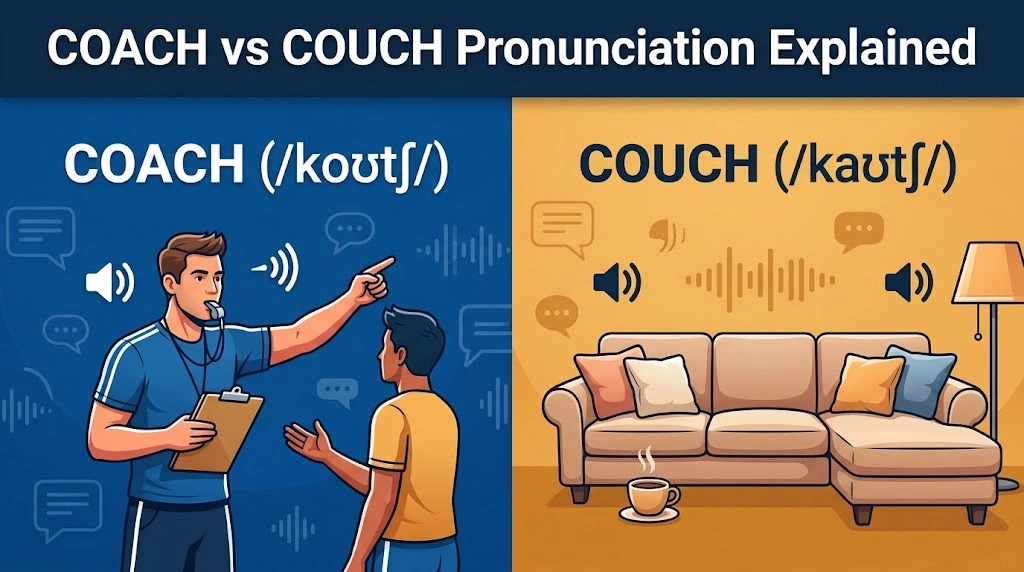
The coach vs couch pronunciation difference is subtle but important.
Both words begin with a /k/ sound. Their final consonant sounds are also closely related. The main difference occurs in the vowel sound.
How to Pronounce Coach
In standard US English, coach is commonly pronounced approximately:
/koʊtʃ/
The middle vowel has the long oʊ sound heard in words such as:
- go
- home
- road
- open
Think:
coach → kohch
The pronunciation begins with a clear oʊ sound.
How to Pronounce Couch
In standard US English, couch is commonly pronounced:
/kaʊtʃ/
The vowel is the aʊ sound heard in words such as:
- house
- out
- sound
- mouse
Think:
couch → kowch
The vowel moves from an a-like sound toward an oo-like sound.
Say Them Side by Side
Try saying these slowly:
coach — couch
Then compare:
/koʊtʃ/ — /kaʊtʃ/
The consonants are similar. The vowel is the key difference.
That’s why learners who hear the words quickly may confuse them.
Accent also matters. People from different regions can produce vowel sounds somewhat differently. When pronunciation isn’t clear, context becomes an even more useful clue.
Read More: What Kind of vs. What Kinds of: What’s the Difference?
Why Do People Confuse Coach and Couch?
The confusion between coach and couch makes sense. The words share several visual and phonetic features.
Their Spellings Differ by Only One Letter
Look closely:
COACH
COUCH
Only the fourth letter changes.
That small visual difference creates two completely different words.
Fast typing makes this kind of mistake easy. If you’re writing quickly, your fingers may produce couch when your brain intended coach.
Their Pronunciations Are Closely Related
Both words begin with the same basic consonant sound.
They also share the ch ending.
The vowel separates them:
- coach → /oʊ/
- couch → /aʊ/
Because the overall shape and sound are similar, the distinction can disappear during fast speech.
Typing Errors Can Change the Meaning
A single letter can turn an ordinary sentence into something unintentionally funny.
Suppose someone writes:
The couch will train the basketball team today.
Unless your furniture has suddenly developed coaching qualifications, something went wrong.
The intended sentence is:
The coach will train the basketball team today.
Likewise:
We bought a new coach for the living room.
That sounds as though you purchased a sports trainer and placed them beside the television.
The correct sentence is:
We bought a new couch for the living room.
These examples show why spelling isn’t merely cosmetic. A one-letter mistake can change the entire meaning.
Autocorrect Doesn’t Always Catch the Error
Spell checkers usually identify misspelled words. They don’t always identify incorrectly chosen real words.
Both coach and couch are correctly spelled English words.
Therefore, a sentence containing the wrong one may still pass a basic spelling check.
For example:
The coach is in the living room.
The sentence isn’t necessarily misspelled. It could mean a trainer is in the living room.
But if you meant furniture, couch is the intended word.
This is called a contextual word-choice error. Proofreading should check meaning as well as spelling.
How to Tell Coach and Couch Apart
A simple process can help you choose correctly.
Think About the Meaning First
Don’t begin by asking which spelling looks familiar.
Ask what the word needs to mean.
If you’re referring to someone who trains people, choose coach.
If you’re referring to furniture, choose couch.
For example:
The ___ taught the players a new drill.
That’s a coach.
The ___ needs new cushions.
That’s a couch.
Look at the Words Around It
Nearby words often reveal the answer.
Words associated with coach include:
- players
- team
- practice
- training
- athlete
- strategy
- instructor
- tournament
Words associated with couch include:
- cushions
- living room
- pillows
- furniture
- television
- sitting
- relaxing
- blanket
These aren’t strict rules. They’re useful context clues.
Use the “Training or Furniture?” Test
When you’re in a hurry, ask:
Training or furniture?
Training → Coach
Furniture → Couch
This simple association handles most everyday cases.
However, remember that coach also has a transportation meaning and couch has a less common verb meaning.
Check the Spelling Before You Publish
If you’re writing an article, assignment, email, or professional document, check the sentence as a whole.
Don’t simply ask:
“Is this word spelled correctly?”
Ask:
“Does this correctly express what I mean?”
That second question catches errors that ordinary spell checking can miss.
Common Coach vs Couch Mistakes
Some mistakes appear repeatedly because the words look and sound so similar.
Mistake: Using Couch for a Sports Trainer
Incorrect:
The couch gave the players new instructions.
Correct:
The coach gave the players new instructions.
A person who trains or instructs athletes is a coach.
Mistake: Using Coach for Furniture
Incorrect:
We bought a comfortable coach.
Correct:
We bought a comfortable couch.
When you mean the furniture in your home, use couch.
Mistake: Mixing Them Up While Typing
A rushed message might contain:
I’ll ask the couch about practice.
The intended sentence is:
I’ll ask the coach about practice.
This is a classic one-letter typing error.
Mistake: Assuming Similar Spelling Means Similar Meaning
The fact that coach and couch look similar doesn’t mean they belong to the same meaning group.
English contains many words that differ by only one letter while having unrelated meanings.
The safest approach is to learn each word as a complete unit:
Coach = trainer
Couch = furniture
That association is much more useful than memorizing individual letters.
Coach vs Couch in Sentences
Examples make the difference easier to recognize.
Examples Using Coach
Here are several natural examples:
- The coach prepared the team for the championship.
- Our soccer coach scheduled practice for Friday.
- The basketball coach changed the lineup.
- She works as a swimming coach.
- My career coach helped me improve my résumé.
- The teacher coached the students before the competition.
- He coached me through the interview process.
- We traveled by coach instead of first class.
Notice how context changes the exact meaning of coach.
Examples Using Couch
Now look at couch:
- The dog is sleeping on the couch.
- We moved the couch against the wall.
- She bought a gray couch for her apartment.
- The children left their toys on the couch.
- He spent the afternoon relaxing on the couch.
- The old couch needs new cushions.
- We sat together on the couch.
- The writer couched the criticism in gentle language.
The final example uses couch as a verb rather than a noun.
Examples Using Both Words
These sentences put both words together:
The coach sat on the couch after practice.
After meeting the coach, the players returned to the couch in the lounge.
The exhausted coach rested on the couch while reviewing the game.
These examples create a useful mental picture. A coach can sit on a couch.
Incorrect vs Correct Sentences
| Incorrect | Correct | Explanation |
| The couch trained the players. | The coach trained the players. | A trainer is a coach. |
| We sat on the coach. | We sat on the couch. | Furniture is a couch. |
| The couch planned practice. | The coach planned practice. | A coach can organize training. |
| They bought a new coach. | They bought a new couch. | The sentence refers to furniture. |
| The coach had soft cushions. | The couch had soft cushions. | Cushions belong to furniture. |
Coach vs Couch in Different Contexts
Context is the strongest tool for separating these words.
Sports and Fitness
Sports almost always point toward coach.
Examples:
- baseball coach
- basketball coach
- soccer coach
- tennis coach
- swimming coach
- fitness coach
You might say:
Our coach scheduled an extra practice session.
You wouldn’t use couch for the trainer.
Home and Furniture
Home seating contexts usually point toward couch.
For example:
The new couch fits perfectly in the living room.
Other clues include:
- cushions
- pillows
- blankets
- living room
- sitting
- reclining
- furniture
These words strongly support the furniture meaning.
Travel and Transportation
Travel can point toward coach.
Examples:
We traveled in coach.
The train’s coach section was crowded.
They took a coach to the next city.
The exact use can vary by transportation system and regional variety of English, but couch isn’t the transportation term in these examples.
Formal and Written Communication
The distinction also matters in professional and academic writing.
Imagine writing:
The company hired a business couch.
That sentence changes the intended meaning because couch refers to furniture in its common noun use.
The correct sentence is:
The company hired a business coach.
Likewise:
The proposal was couched in formal language.
Here, couched is correct because the writer means that the proposal was expressed or framed in a particular way.
Coach vs Couch: Easy Memory Tricks
You don’t need a complicated rule to remember these words.
Coach = Coaching
Connect coach with coaching.
A coach trains people.
Coach → Coaching → Training
The spelling contains coa, just like coaching.
Couch = Comfort
Think about relaxing after a long day.
You sit on a couch.
Couch → Comfort → Furniture
The u helps separate couch from coach visually.
Remember the Vowel Difference
You can also remember their pronunciation:
- coach → /koʊtʃ/
- couch → /kaʊtʃ/
Think:
Coach says “oh.”
Couch has the “ow” sound.
That isn’t a complete pronunciation lesson, but it’s a convenient memory aid.
A Real-Life Style Example: One Letter Changes Everything

Imagine receiving this message before a soccer game:
“Our couch wants everyone at practice by 5.”
You’d probably understand the intended meaning. Still, the sentence contains the wrong word.
A piece of furniture doesn’t normally organize soccer practice.
The corrected version is:
“Our coach wants everyone at practice by 5.”
Now the meaning is clear.
Here’s another example:
“I bought a new coach yesterday.”
Without context, that could mean several things. Perhaps the writer means a transportation service or a trainer.
But if they add:
“It has soft cushions and fits perfectly in my living room.”
The intended word is obviously:
couch
This demonstrates an important writing principle:
Context can reveal meaning, but correct spelling communicates that meaning precisely.
Coach vs Couch: Which Word Should You Use?
Choosing the correct word becomes easy when you focus on the intended meaning.
Use Coach When You Mean:
Use coach when referring to:
- A sports trainer
- Someone who trains or guides others
- A professional coach
- The act of training or instructing
- A standard transportation class
- A passenger vehicle in certain English varieties
Examples:
The coach motivated the players.
She works as a career coach.
He coached the team for five years.
We traveled in coach.
Use Couch When You Mean:
Use couch when referring to:
- Living-room furniture
- A sofa
- A comfortable seat for several people
- The act of expressing something in particular terms when used as a verb
Examples:
The couch is next to the window.
We relaxed on the couch.
She couched her answer in polite language.
The easiest everyday distinction remains:
Coach = trainer
Couch = furniture
Coach vs Couch: A Practical Decision Guide
When you’re proofreading, run through this quick checklist.
Is the word about training?
↓
COACH
Is it about furniture?
↓
COUCH
Is it about standard travel class?
↓
COACH
Does it mean “express or phrase”?
↓
COUCH
This isn’t a substitute for understanding context. It simply gives you a fast starting point.
Coach vs Couch Mini Quiz
Test yourself before moving on.
Choose the Correct Word
The ___ taught the players a new strategy.
A. couch
B. coach
Answer: Coach
A person who trains players is a coach.
We bought a new ___ for the family room.
A. coach
B. couch
Answer: Couch
Furniture belongs on the couch side of the distinction.
The ___ was covered with colorful pillows.
A. coach
B. couch
Answer: Couch
Pillows and furniture provide strong context clues.
Our basketball ___ arrived early.
A. couch
B. coach
Answer: Coach
Basketball training requires a coach.
Fill in the Blank
She hired a personal ___ to help improve her fitness.
Answer: coach
The children jumped onto the ___.
Answer: couch
The team listened carefully to its ___.
Answer: coach
We relaxed on the ___ after dinner.
Answer: couch
Fix the Mistake
Incorrect: The couch gave the athletes instructions.
Correct: The coach gave the athletes instructions.
Incorrect: We ordered a new coach for the living room.
Correct: We ordered a new couch for the living room.
Incorrect: The coach has three large cushions.
Correct: The couch has three large cushions.
Challenge: Use Both Words
Complete the sentence:
After practice, the tired ___ sat on the ___.
Answer:
After practice, the tired coach sat on the couch.
This sentence is a useful memory image because both words are correct in the same sentence.
Frequently Asked Questions About Coach vs Couch
Is “coach” or “couch” correct for a trainer?
Coach is correct when you mean a person who trains, teaches, or guides others.
For example:
The coach trained the soccer team.
Couch doesn’t mean a trainer.
Is a couch the same as a sofa?
In everyday American English, couch and sofa generally refer to the same type of furniture.
There can be differences in style or regional preference, but most everyday speakers use the terms interchangeably.
How do you pronounce coach and couch?
In standard US English, coach is commonly pronounced /koʊtʃ/, while couch is commonly pronounced /kaʊtʃ/.
The main difference is the vowel sound.
Can coach be used as a verb?
Yes.
Coach can mean to train, teach, prepare, or guide someone.
For example:
She coaches young athletes.
He coached me before the interview.
Can couch be used as a verb?
Yes.
As a verb, couch can mean to express or frame something in particular words.
For example:
The speaker couched the criticism in diplomatic language.
This use is more formal than the common furniture meaning.
Why are coach and couch easy to confuse?
They look almost identical and share several sounds.
The spelling difference is only one letter:
coach
couch
Their vowel sounds also differ, but fast speech can make the distinction harder to notice.
What is the easiest way to remember coach vs couch?
Use this simple association:
Coach = coaching and training
Couch = comfort and furniture
If someone trains a team, they’re a coach.
If you’re sitting on it, it’s probably a couch.
Is coach used for transportation?
Yes. Coach can describe a standard class of transportation or a passenger vehicle in certain contexts.
For example:
We booked seats in coach.
The exact transportation usage varies by country and type of service.
Can coach and couch appear in the same sentence?
Absolutely.
For example:
The coach sat on the couch after practice.
This is actually a useful way to remember the difference. A coach can sit on a couch.
Final Thoughts: Coach vs Couch
The difference between coach vs couch comes down to meaning, context, and one important vowel.
Coach commonly refers to a person who trains or guides others. It can also function as a verb and describe a standard class of transportation.
Couch usually refers to furniture used for sitting or relaxing. As a verb, it can mean expressing an idea in particular words.
Remember the easiest distinction:
Coach = trainer or training
Couch = furniture or comfort
When you encounter either word, look at the surrounding sentence. If players, practice, training, or instruction appear nearby, coach is likely the word you need. If cushions, pillows, living rooms, or sitting appear nearby, couch usually fits.
One letter separates them. Context separates their meanings.
Once that distinction becomes familiar, coach vs couch is a spelling confusion you won’t have to think twice about.