Choosing between what kind of and what kinds of can seem confusing, especially when a plural noun, uncountable noun, or count noun follows the phrase. Many learners assume that a singular form must take “kind” while a plural form must take “kinds.” However, that isn’t a reliable grammar rule.
The real difference involves meaning, context, classification, and the scope of the question. The singular kind often refers to one general category, type, or classification, while plural kinds emphasizes several categories, types, varieties, or forms. That’s why what kind of books can be perfectly correct even though “books” is plural.
Understanding this distinction helps you choose the more natural expression in everyday English usage, spoken English, formal writing, academic writing, and professional communication. It also makes tricky examples involving plural nouns, uncountable nouns, collective categories, and different varieties much easier to understand.
Whether you’re asking about books, music, food, movies, jobs, products, problems, or skills, the same basic idea applies: focus on whether you’re asking about one broad type of thing or emphasizing multiple types of things.
What’s the Difference Between “What Kind of” and “What Kinds of”?
The basic difference is the number of categories being considered.
“What kind of” treats kind as a singular category or general type:
What kind of music do you like?
The speaker wants to know the person’s general musical preference. The answer could be “jazz,” “rock,” “classical music,” or another category.
“What kinds of” uses the plural kinds to focus on several possible categories:
What kinds of music are popular at the festival?
Here, the question invites information about multiple varieties. An answer might mention jazz, rock, folk, classical music, and electronic music.
The distinction becomes clearer when you replace kind with type:
- What kind of car? → What type of car?
- What kinds of cars? → What types of cars?
Quick Comparison: “What Kind of” vs. “What Kinds of”
| Phrase | Main focus | Typical meaning | Example |
| What kind of | One category or general type | Asking for a classification | What kind of book is this? |
| What kinds of | Multiple categories or varieties | Asking about different types | What kinds of books does the library have? |
However, the distinction isn’t always absolute. English speakers frequently use “what kind of” with plural nouns.
That’s why this sentence is perfectly natural:
What kind of books do you read?
The word books is plural, but kind remains singular because the speaker is asking about the general category of books the person reads.
The Core Rule in One Sentence
Use “what kind of” for a general category or type, and use “what kinds of” when multiple categories or varieties are the focus.
That rule is more reliable than trying to match kind mechanically with the noun after of.
What Does “What Kind of” Mean?
The noun kind can mean a category, type, class, or variety of something.
When English uses “what kind of”, the phrase works as a classification question. It asks the listener to identify what category something belongs to.
For example:
What kind of car is that?
The speaker isn’t asking how many cars exist. They’re asking about the vehicle’s category or type.
The answer could be:
It’s an electric car.
Or:
It’s a sports car.
Or:
It’s a compact hybrid.
The noun after of doesn’t have to be singular. What matters is the classification the speaker wants.
“What Kind of” + Singular Countable Noun
The most straightforward pattern is:
what kind of + singular countable noun
Examples include:
- What kind of car do you drive?
- What kind of book is this?
- What kind of job are you looking for?
- What kind of computer do you need?
- What kind of restaurant should we try?
- What kind of dog do you have?
Here, the noun following of is singular because the question concerns one countable item.
Consider:
What kind of car do you want?
The expected answer might be:
I want an electric car.
The question identifies a category before selecting a particular member of that category.
“What Kind of” + Uncountable Noun
“What kind of” also works naturally with uncountable nouns.
Examples:
- What kind of music do you like?
- What kind of information do you need?
- What kind of advice are you looking for?
- What kind of food do you prefer?
- What kind of equipment does the gym provide?
- What kind of research are you conducting?
This construction makes sense because kind supplies the idea of a category.
Take music as an example. Music is generally treated as an uncountable noun when discussing it as a general substance or concept.
You can still divide music conceptually into categories:
- jazz
- rock
- classical
- folk
- electronic
- hip-hop
So:
What kind of music do you listen to?
is completely natural.
The phrase asks for a category of music rather than a quantity of music.
“What Kind of” + Plural Noun
This is where many grammar learners get tripped up.
You can absolutely say:
What kind of books do you read?
You can also say:
What kind of movies do you enjoy?
And:
What kind of shoes are you looking for?
The plural noun doesn’t force kind to become plural.
Why?
Because the two nouns perform different jobs:
- kind identifies the category.
- books, movies, or shoes identify the things within that category.
For example:
What kind of books do you read?
This can mean:
What category of books do you generally read?
The answer could be:
I mostly read historical novels.
The speaker isn’t necessarily asking the listener to list every category they read. They’re asking for a general classification.
When Should You Use “What Kinds of”?
Use “what kinds of” when the question naturally points toward multiple categories, varieties, or types.
The plural kinds signals that more than one classification may be relevant.
For example:
What kinds of books does the library carry?
This question could invite an answer such as:
It carries textbooks, biographies, novels, reference books, and children’s books.
Multiple categories are clearly part of the question.
“What Kinds of” + Plural Noun
The most common structure is:
what kinds of + plural noun
Examples:
- What kinds of books do you sell?
- What kinds of cars are available?
- What kinds of problems can occur?
- What kinds of courses does the university offer?
- What kinds of products does the company manufacture?
- What kinds of jobs are available?
The plural noun and plural kinds work naturally together because the sentence discusses several categories of several things.
Use “What Kinds of” When Variety Matters
The word variety provides a useful way to understand the difference.
Compare these questions:
What kind of food do you like?
This often asks about a person’s general preference.
Now compare:
What kinds of food are served at the event?
This focuses on the range of food categories available.
The difference isn’t that one sentence is grammatical and the other isn’t. Both are grammatical.
The emphasis changes.
Kind often points toward a broad classification.
Kinds makes the existence of several classifications more prominent.
“Kinds” Can Make Multiple Categories Clearer
Suppose a teacher asks:
What kind of questions are on the test?
The question may simply ask what category of questions appears on the test.
A student might answer:
Mostly multiple-choice questions.
Now imagine the teacher asks:
What kinds of questions are on the test?
That wording more strongly suggests a range:
There are multiple-choice, short-answer, essay, and matching questions.
The second version makes variety more noticeable.
Why “What Kind of Books?” Is Correct
One of the most important points in the what kind of vs. what kinds of debate is that kind doesn’t have to match the noun after of.
Many learners see:
books
and immediately think:
plural noun → plural kinds
That reasoning doesn’t work in every sentence.
Consider:
What kind of books do you enjoy?
Grammatically, kind is singular. Books is plural. There’s no contradiction.
The phrase means something like:
What category of books do you enjoy?
The category can contain many individual books.
Think of a filing cabinet. “Kind” identifies the drawer; the plural noun identifies the items inside it.
A question about one category can therefore contain a plural noun.
“Kind” Does Not Have to Match the Noun After “Of”
Compare these examples:
What kind of car do you want?
What kind of cars does the dealership sell?
What kind of music do you enjoy?
All three use “what kind of.”
The nouns are different in grammatical number, yet the classification phrase remains the same.
The key question is:
Are you asking about one broad category or emphasizing several categories?
That is the real decision point.
Read More: Acception vs Exception: What’s the Difference? Meanings, Examples, and Easy Ways to Remember
What Kind of vs. What Kinds of: How Meaning Changes
The difference can be subtle because both constructions often describe categories.
General Category vs. Multiple Categories
Compare:
What kind of exercise do you do?
with:
What kinds of exercise are available at the gym?
The first question can be answered with a general activity:
I mainly do strength training.
The second invites a broader list:
The gym offers strength training, cardio, swimming, yoga, and Pilates.
The first focuses on a person’s general activity.
The second focuses on the range of categories available.
One Expected Category vs. Several Possible Categories
The expected answer test can help.
Ask yourself:
What sort of answer am I looking for?
If you expect one broad classification, “what kind of” will often sound natural.
If you want someone to identify several categories, “what kinds of” may communicate your intention more clearly.
For example:
What kind of software do you use?
A natural response might be:
I use accounting software.
Meanwhile:
What kinds of software does your company use?
could invite:
We use accounting, project-management, design, and communication software.
The distinction comes from the scope of the question.
Why Context Can Make Both Forms Natural
Real English doesn’t always draw a sharp line between the two expressions.
Two speakers might use:
What kind of books do you like?
and
What kinds of books do you like?
in nearly the same conversation.
Neither speaker necessarily makes a grammatical mistake.
The second version simply places more emphasis on the possibility of multiple categories.
That’s why rigid rules can create more confusion than they solve. English grammar often interacts with meaning, context, and conversational intent.
“What Kind of” vs. “What Kinds of” With Plural Nouns
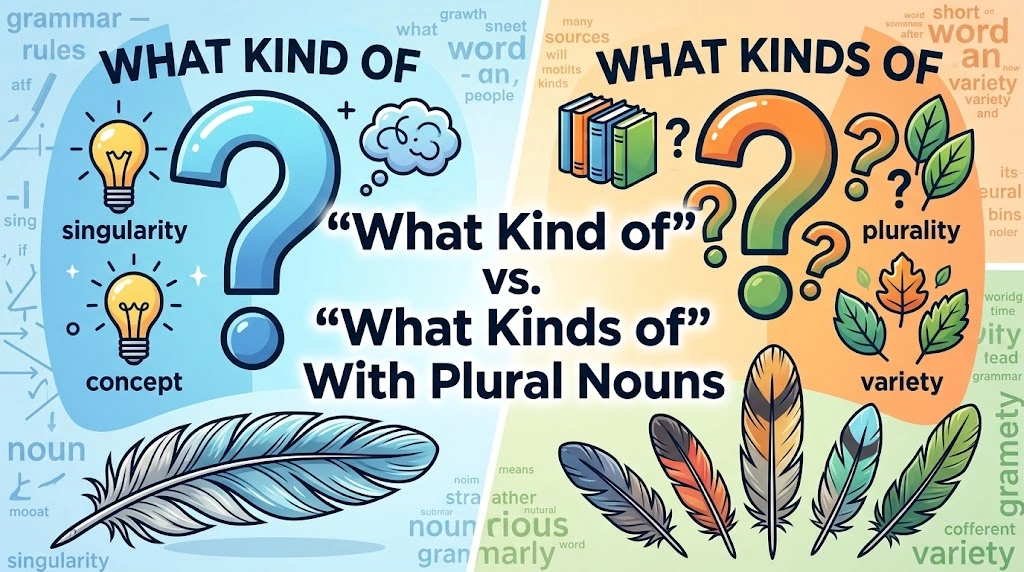
Plural nouns create the most interesting cases.
“What Kind of Books” vs. “What Kinds of Books”
Both are grammatical:
What kind of books do you read?
What kinds of books do you read?
But they can suggest different scopes.
The first often sounds like a general question about reading preferences.
The second can suggest that the speaker wants several categories.
For example:
What kind of books do you read?
Mostly science fiction.
What kinds of books do you read?
Science fiction, biographies, history, and mystery novels.
The context can make either wording appropriate.
“What Kind of Movies” vs. “What Kinds of Movies”
Compare:
What kind of movies do you like?
This sounds like a broad question about movie preference.
Now:
What kinds of movies are shown at the festival?
This strongly suggests multiple genres or categories.
The answer could include:
- documentaries
- dramas
- comedies
- short films
- experimental films
“What Kind of Problems” vs. “What Kinds of Problems”
Consider:
What kind of problem is this?
This asks for a classification of a particular problem.
Now compare:
What kinds of problems can this software prevent?
Here, the question asks about categories of problems the software can address.
The plural kinds makes the range of possible problems more explicit.
Why the Plural Noun Alone Doesn’t Decide
This is worth remembering:
The noun after “of” doesn’t automatically determine whether you need “kind” or “kinds.”
Instead, consider three things:
- What is being classified?
- Is one broad category enough?
- Are multiple categories important to the question?
Once those questions become automatic, the choice becomes much easier.
What Kind of vs. What Kinds of With Uncountable Nouns
Uncountable nouns add another layer because they don’t normally take a plural form in their ordinary usage.
Examples include:
- music
- information
- advice
- equipment
- research
- furniture
- traffic
Yet speakers can still discuss different types or varieties of these things.
“What Kind of Music?”
This is extremely natural:
What kind of music do you like?
Here, kind identifies the musical category.
Possible answers include:
- jazz
- classical music
- rock
- folk
- electronic music
“What Kinds of Music?”
This is also possible:
What kinds of music are performed at the festival?
Here, kinds highlights multiple varieties.
The answer might list several genres.
So an uncountable noun doesn’t automatically mean that “what kind of” is mandatory.
Why “Uncountable” Doesn’t Mean “Always Singular”
Countability and classification are different grammatical concepts.
Music can be uncountable as a general noun while still having many conceptual categories.
The same applies to:
What kinds of information does the report contain?
The noun information remains uncountable. The plural noun kinds refers to the categories of information.
This distinction prevents a common grammatical misunderstanding.
What Kind of vs. What Kinds of: Common Mistakes
Mistake: Assuming a Plural Noun Requires “Kinds”
Incorrect reasoning:
Books is plural, so I need “what kinds of books.”
That’s not necessarily true.
Correct examples include:
What kind of books do you enjoy?
What kind of shoes are you looking for?
What kind of movies do you watch?
The plural noun doesn’t force the classification word to become plural.
Mistake: Assuming “Kind” Must Be Followed by a Singular Noun
This is another common misconception.
These are all possible:
- What kind of car…?
- What kind of cars…?
- What kind of music…?
- What kind of information…?
The grammatical number of the following noun depends on what that noun represents.
Mistake: Using “Kinds” Whenever Several Answers Are Possible
A question can have several possible answers without requiring “kinds.”
For example:
What kind of food do you like?
The person could answer:
I like Italian, Mexican, and Indian food.
Several answers are possible. Yet “what kind of” remains perfectly natural.
The number of answers isn’t the same thing as the number of categories being emphasized.
Mistake: Treating “Kind” and “Type” as Completely Different
In many contexts, kind and type are close synonyms.
Compare:
What kind of car is it?
What type of car is it?
Both ask for classification.
However, type can sound slightly more technical or formal in certain contexts.
Mistake: Applying a Rule Without Considering Meaning
Grammar rules work best when they describe how English actually functions.
If a rule tells you that every plural noun requires “what kinds of,” the rule is simply too broad.
Meaning comes first.
How to Choose Between “What Kind of” and “What Kinds of”
When you’re unsure, use this simple process.
Identify the Thing Being Classified
First, determine what you’re asking about.
Is it:
- a product?
- a person?
- a type of food?
- a category of books?
- a problem?
- a skill?
- an activity?
- a material?
For example:
What ___ books do you recommend?
The thing being classified is books.
Ask What “Kind” Means
Now replace kind mentally with type or category.
What type of books do you recommend?
If that sounds natural, you’re dealing with a classification question.
Decide Whether Variety Is the Main Focus
Ask:
Am I asking for one general category, or do I want to emphasize several categories?
For a general classification:
What kind of books do you recommend?
For several categories:
What kinds of books should a new library stock?
Consider the Expected Answer
Imagine the response before choosing the phrase.
If you expect:
Science fiction.
“What kind of books?” sounds natural.
If you expect:
Science fiction, history, biographies, and mystery.
“What kinds of books?” makes the range clearer.
Read the Sentence Naturally
Finally, say the question aloud.
English isn’t a collection of mathematical formulas. Natural usage matters.
If both forms sound possible, check what emphasis you want. Often the difference is one of scope rather than grammatical correctness.
What Kind of vs. What Kinds of: Examples Side by Side
| Context | What kind of | What kinds of |
| Books | What kind of books do you read? | What kinds of books does the library carry? |
| Food | What kind of food do you like? | What kinds of food are served here? |
| Music | What kind of music do you enjoy? | What kinds of music are featured? |
| Exercise | What kind of exercise do you prefer? | What kinds of exercise improve flexibility? |
| Jobs | What kind of job do you want? | What kinds of jobs are available? |
| Problems | What kind of problem is this? | What kinds of problems can occur? |
| Clothing | What kind of clothes do you wear? | What kinds of clothes are suitable for winter? |
| Products | What kind of product do you need? | What kinds of products does the company sell? |
What Kind of Books
What kind of books do you enjoy?
This commonly asks about a general reading preference.
A concise answer could be:
I mostly read historical fiction.
What Kinds of Books
What kinds of books are popular with young readers?
This invites several categories.
A response could be:
Fantasy, mystery, adventure, and graphic novels are popular.
What Kind of Food
What kind of food do you want for dinner?
The speaker may simply want to know the preferred cuisine or general food category.
What Kinds of Food
What kinds of food are available at the market?
Here, the range of varieties matters more.
What Kind of Problem
What kind of problem are you having?
This asks the listener to classify the problem.
What Kinds of Problems
What kinds of problems can occur during installation?
This asks about multiple categories of possible problems.
What Kind of vs. What Kinds of in Everyday English
These expressions appear constantly in ordinary conversation.
Asking About Preferences
What kind of music do you listen to?
What kind of movies do you like?
What kind of food do you prefer?
These questions usually seek a broad preference.
However, speakers may use the plural version when they want to invite a list:
What kinds of music do you listen to?
Both forms can work naturally.
Asking About Products
Imagine you’re shopping for a computer.
What kind of laptop do you need?
This asks about the general type of laptop.
A salesperson might ask:
What kinds of laptops are you interested in?
That wording can suggest several categories or models.
Talking About Food
At a restaurant:
What kind of food do they serve?
The question asks about cuisine or general food type.
A broader question might be:
What kinds of food can we order?
That version emphasizes the available range.
Talking About Education
Consider:
What kind of course are you taking?
This asks about one course’s category.
Meanwhile:
What kinds of courses does the university offer?
This asks about the range of courses available.
Talking About Work
You might ask:
What kind of work do you do?
This is a common way to ask about someone’s occupation or professional field.
Compare:
What kinds of work can be done remotely?
Now the focus is on different categories of work.
“What Kind of” vs. “What Type of” vs. “What Sort of”
English has several ways to ask about classification.
What Kind of
This is extremely common in everyday American English.
What kind of car is that?
What kind of music do you like?
It works comfortably in casual and formal contexts.
What Type of
“What type of” often has a slightly more technical, precise, or formal tone.
For example:
What type of material was used?
This can sound particularly natural in technical writing.
In ordinary conversation, however:
What kind of material was used?
is also completely normal.
What Sort of
“What sort of” can also mean “what type of” or “what kind of.”
For example:
What sort of books do you enjoy?
It tends to appear more frequently in some varieties and contexts of English than others.
The three expressions overlap heavily:
- what kind of → common and conversational
- what type of → often more technical or formal
- what sort of → another natural classification phrase
The best choice depends on context, audience, and regional usage.
A Simple Memory Trick for “What Kind of” vs. “What Kinds of”
Don’t memorize this as:
Singular noun = kind
Plural noun = kinds
That shortcut will lead you into trouble.
Instead, remember:
Kind = category. Kinds = categories.
If you’re asking about one broad classification:
What kind of… ?
If you’re emphasizing multiple classifications:
What kinds of… ?
Then check the noun separately.
For example:
What kind of books do you like?
One broad category can contain many books.
What kinds of books does the library stock?
Multiple categories are being discussed.
The noun books stays plural in both questions. The meaning of kind/kinds changes.
A Practical Case Study: Choosing the Right Question
Imagine someone is planning a community library.
They could ask a librarian:
What kind of books should we buy?
The librarian might answer:
We should focus on children’s books.
That’s a broad recommendation.
Now suppose the library already knows it wants a broad collection. The organizer asks:
What kinds of books should we buy?
The librarian might respond:
We need children’s books, biographies, novels, history books, reference books, and science books.
The second question makes the variety of categories more explicit.
Notice what changed.
The noun books didn’t change.
Only kind changed to kinds.
That tiny grammatical change shifts the expected scope of the answer.
This is why context matters more than a simplistic singular-versus-plural rule.
Quick Practice: Choose “What Kind of” or “What Kinds of”
Try these before checking the explanations.
Books
What ___ books do you enjoy reading?
Both forms can work depending on the intended meaning.
What kind of books sounds natural when asking about a general reading preference.
What kinds of books emphasizes several genres or categories.
Music
What ___ music does the radio station play?
What kind of music works when asking for a general classification.
What kinds of music works when asking about multiple genres.
Problems
What ___ problems can this software cause?
What kinds of problems is especially natural because the question discusses multiple possible categories of problems.
Food
What ___ food do you usually eat?
What kind of food is a very natural general-preference question.
Products
What ___ products does the company manufacture?
What kinds of products naturally highlights the company’s product categories.
The important lesson isn’t simply memorizing five answers.
It’s learning to ask:
What scope does the question have?
Frequently Asked Questions About “What Kind of” and “What Kinds of”
Is “what kind of” singular or plural?
Kind is grammatically singular in “what kind of.”
However, the noun following of can be singular, plural, or uncountable.
Examples:
- What kind of car?
- What kind of cars?
- What kind of music?
So the phrase’s singular kind doesn’t force the following noun to be singular.
Is “what kinds of” always followed by a plural noun?
Usually, “what kinds of” is followed by a plural countable noun:
What kinds of books…?
What kinds of cars…?
What kinds of problems…?
However, it can also appear before an uncountable noun when that noun represents different varieties or categories:
What kinds of music are performed here?
What kinds of information does the database contain?
The plural kinds refers to the categories, not to individual units of music or information.
Which is correct: “What kind of books” or “what kinds of books”?
Both can be correct.
What kind of books do you read?
usually sounds like a broad question about reading preferences.
What kinds of books do you read?
puts more emphasis on multiple categories or varieties.
Context determines which version better expresses the intended meaning.
Can you say “what kind of music”?
Yes.
What kind of music do you like?
This is completely standard English.
Music is normally uncountable when referring to music generally. The word kind identifies its category or style.
Can you say “what kinds of music”?
Yes.
What kinds of music are played at the festival?
Here, kinds emphasizes multiple musical varieties.
The noun music remains uncountable. The plural refers to the categories of music.
Is “what type of” the same as “what kind of”?
They are very similar.
What kind of car is it?
What type of car is it?
Both ask for a classification.
“What type of” can sound slightly more technical or formal in some contexts, while “what kind of” is especially common in everyday conversation.
Should you use “what kinds of” when you expect several answers?
Not necessarily.
The number of answers isn’t the only factor.
You can ask:
What kind of music do you like?
and receive:
I like jazz, rock, and classical music.
That’s still natural.
Use “what kinds of” when the question itself emphasizes multiple categories or varieties.
What’s the easiest way to remember the difference?
Remember this:
Kind = one category.
Kinds = multiple categories.
Then ignore the temptation to make the word agree automatically with the noun after of.
Key Takeaways: What Kind of vs. What Kinds of
The distinction becomes straightforward once you stop treating it as a simple singular-versus-plural rule.
- “What kind of” asks about a category, type, or general classification.
- “What kinds of” emphasizes multiple categories, types, or varieties.
- “What kind of” can correctly appear before plural nouns.
- “What kind of books” is therefore completely grammatical.
- “What kinds of books” is also grammatical when multiple categories are the focus.
- Uncountable nouns can follow either construction when the meaning supports it.
- The noun after of doesn’t automatically determine whether kind should be singular or plural.
- Context, intended meaning, and the expected scope of the answer matter.
The easiest mental test is simple:
Am I asking about a category or emphasizing categories?
If you’re asking about one general type, “what kind of” will often be the natural choice.
If you’re highlighting multiple types or varieties, “what kinds of” will usually make that meaning clearer.
And when a plural noun appears after “what kind of,” don’t second-guess it. English allows that structure because kind classifies the noun rather than matching its grammatical number.
For additional reference on the meanings and usage of kind, type, and related classification terms, see Cambridge Dictionary, Merriam-Webster, and the British Council’s English grammar resources.
The small difference between “what kind of” and “what kinds of” comes down to one central idea: category versus categories. Once that distinction clicks, the rest falls into place.