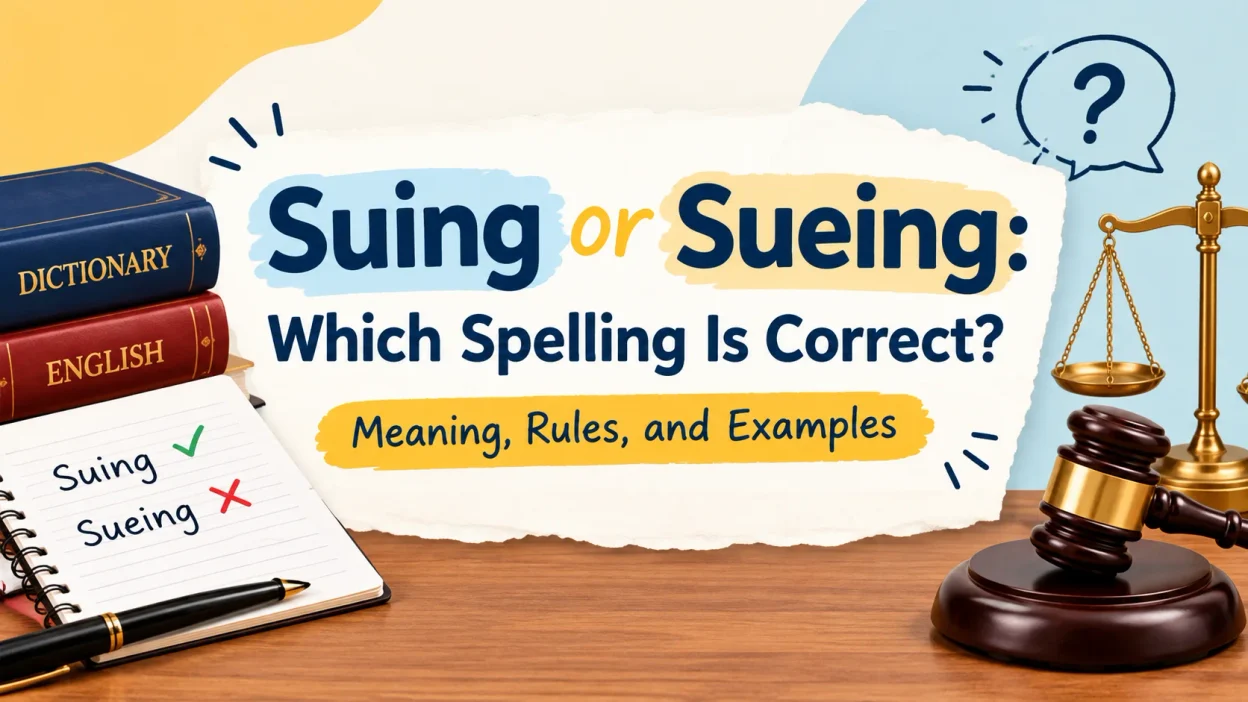
Suing or sueing can look like a tiny spelling question, but the difference comes from an important English spelling rule. If you’ve ever wondered whether the correct form is suing or sueing, the answer is clear: suing is the standard spelling. The word sueing is a misspelling in standard English.
The confusion happens because the base verb is sue. When you add -ing, it may seem natural to keep every letter and write sueing. English spelling doesn’t work that way here. The final silent e drops before the -ing ending, giving us suing.
This article explains the difference between suing or sueing, including the correct spelling, meaning of suing, verb forms, and the silent-e spelling rule. You’ll also see practical examples involving legal action, lawsuits, court cases, and everyday English.
To make the pattern easier to remember, the article compares sue → suing with other verbs such as make → making, write → writing, and use → using. It also explains why some words behave differently, such as see → seeing and agree → agreeing.
Whether you’re checking a legal sentence, editing professional writing, or simply trying to improve your English spelling, understanding this one rule can prevent a surprisingly common mistake.
Suing or Sueing: Which Is Correct?
The correct spelling is suing.
Sueing is not the standard spelling of the -ing form of the verb sue. The spelling changes because the final silent e in sue is removed before -ing is added.
The formation looks like this:
sue + ing → suing
Not:
sue + ing → sueing
Here are a few examples:
- Correct: The customer is suing the company.
- Incorrect: The customer is sueing the company.
- Correct: The family is considering suing for damages.
- Incorrect: The family is considering sueing for damages.
The same general spelling pattern appears in many English verbs ending in a silent e.
| Base verb | + -ing | Correct form |
| make | make + ing | making |
| write | write + ing | writing |
| use | use + ing | using |
| take | take + ing | taking |
| sue | sue + ing | suing |
So, when you’re deciding between suing or sueing, choose suing.
What Does Suing Mean?
The word suing comes from the verb sue. In legal English, to sue generally means to bring a legal action against another person, organization, or entity in court.
Suing is the present participle and gerund form of sue.
For example:
The homeowner is suing the contractor over the disputed work.
Here, suing describes an action that is happening or is in progress.
You can also use suing as a gerund:
Suing a company can involve significant legal costs.
In that sentence, suing functions more like a noun because it names an activity.
Meaning of Sue
The verb sue means to bring a legal claim against someone.
Depending on the context, a person might sue because they believe another party caused financial loss, physical injury, property damage, or another legally recognized harm.
For example:
- She decided to sue the manufacturer.
- The business plans to sue for breach of contract.
- They threatened to sue after the dispute escalated.
The exact legal meaning and available remedies depend on the jurisdiction and circumstances. The word itself, however, simply refers to initiating or pursuing a legal action.
Meaning of Suing
Suing means taking legal action against someone or an organization through a lawsuit or court proceeding.
Consider these examples:
- The tenant is suing the landlord.
- The company is suing its former partner.
- The customer discussed suing after the accident.
- They are suing for compensation.
The word doesn’t tell you whether the person will ultimately win the case. It describes the legal action itself.
Suing in Legal and Everyday English
Although suing is strongly associated with courts and lawyers, it isn’t restricted to formal legal documents.
You’ll encounter it in:
- News reports
- Legal discussions
- Business communication
- Court-related writing
- Interviews
- Everyday conversations
- Books and journalism
For example, a newspaper might report:
The former employee is suing the company over an employment dispute.
A person might casually say:
He’s talking about suing them.
The grammatical form remains suing in both cases.
Why Is It “Suing” Instead of “Sueing”?
The spelling sueing looks logical at first glance. After all, you can see the entire word sue followed by -ing.
English spelling, however, often changes the final letter of a word when a suffix is added. The important idea here is the silent-e rule.
The Silent-E Rule
Many English verbs end with a final e that isn’t pronounced.
When you add -ing, that final e is usually removed.
Examples include:
- bake → baking
- hope → hoping
- dance → dancing
- drive → driving
- write → writing
- make → making
- use → using
- move → moving
The same pattern applies to sue:
sue → suing
The final e disappears before the -ing ending.
How the Rule Applies to Sue
You can understand the spelling in three simple steps:
Step one: Start with the base verb.
sue
Step two: Remove the final silent e.
su
Step three: Add -ing.
suing
That produces:
SUING
The spelling contains the letters s-u-i-n-g.
It doesn’t contain the extra e found in sue.
Why “Sueing” Looks Plausible
The mistake is understandable because the base word contains four letters:
S-U-E
A writer may simply attach -ing and produce:
S-U-E-I-N-G
That results in sueing.
However, standard English spelling removes the final e in this situation.
This is one reason spelling rules are useful. They help you recognize patterns instead of memorizing every word separately.
Suing vs. Sueing: Quick Comparison
| Point | Suing | Sueing |
| Standard spelling | Correct | Incorrect |
| Base verb | sue | sue |
| Formation | sue → suing | Incorrectly keeps final e |
| Meaning | Taking legal action | Intended to mean “suing” |
| Used in standard English | Yes | No |
| Example | They are suing the company. | They are sueing the company. |
The distinction is straightforward.
If you mean the -ing form of sue, write suing.
They are suing their former business partner.
Don’t write:
They are sueing their former business partner.
Read More: Commit vs Comit: Correct Spelling, Meaning, Grammar, and Usage Guide
Examples of Suing in Sentences
Seeing the word in different contexts makes the spelling easier to remember.
Simple Everyday Examples
- She is suing the company.
- They are suing for damages.
- He talked about suing his former employer.
- The customer considered suing the manufacturer.
- The family is suing after the accident.
- The business is suing its former supplier.
Notice that the spelling stays the same even when the surrounding sentence changes.
Legal Context Examples
The word frequently appears when discussing civil litigation.
For example:
The homeowner is suing the contractor over alleged property damage.
Another example:
The customer is suing the manufacturer after claiming that the product caused financial losses.
A business dispute might be described this way:
The company is suing its former partner over an alleged breach of contract.
These examples illustrate the ordinary use of the word without making any claim about whether a particular lawsuit would succeed.
Suing in Different Verb Structures
Suing can appear after different auxiliary verbs and expressions.
| Structure | Example |
| is suing | The company is suing the supplier. |
| are suing | The customers are suing the business. |
| was suing | The plaintiff was suing the contractor. |
| has been suing | The organization has been suing several parties. |
| considering suing | They are considering suing the manufacturer. |
| avoided suing | The parties avoided suing each other. |
The spelling suing doesn’t change in these constructions.
Common Mistakes With Suing
Spelling isn’t the only potential problem. Writers sometimes confuse suing with other forms or words.
Writing “Sueing”
This is the most direct spelling mistake.
Incorrect:
The company is sueing the contractor.
Correct:
The company is suing the contractor.
The correction is simple: remove the final e before adding -ing.
Confusing Suing With Sue
Sue and suing are different grammatical forms.
Compare:
They plan to sue the company.
and:
They are suing the company.
The first sentence uses the base form after plan to. The second uses the -ing form after are.
Other examples include:
- She wants to sue.
- She is suing.
- They decided to sue.
- They considered suing.
The surrounding grammar determines which form you need.
Confusing Suing With Sewing
This is a particularly interesting spelling issue because suing and sewing can sound similar in many varieties of English.
But their meanings are completely different.
Suing relates to legal action.
The customer is suing the company.
Sewing relates to working with fabric and thread.
She is sewing a button onto her jacket.
Think of the difference this way:
| Word | Meaning | Example |
| suing | Taking legal action | They are suing the company. |
| sewing | Joining fabric with thread | She is sewing a dress. |
Context usually makes the intended meaning clear.
Sue Verb Forms: Sue, Sued, Suing, Sues

Understanding the complete verb pattern can eliminate confusion.
| Verb form | Example |
| sue | They may sue the company. |
| sues | She sues the contractor. |
| sued | He sued the manufacturer. |
| suing | They are suing the manufacturer. |
| sued | The company has been sued. |
The base form is sue.
The third-person singular present form is sues:
The customer sues the company.
The past tense is sued:
The customer sued the company.
The present participle is suing:
The customer is suing the company.
The past participle is also sued:
The company has been sued.
Why Suing Is Different From Sued
The spelling changes differently depending on the suffix.
With -ing, the final e disappears:
sue → suing
With -ed, the spelling becomes:
sue → sued
This difference is worth remembering because English doesn’t apply one identical spelling operation to every suffix.
The Silent-E Rule in Other Common Words
The spelling of suing becomes much easier once you understand the larger pattern.
Verbs That Drop the Final E Before -Ing
Many verbs ending in silent e drop that letter before -ing.
| Base verb | -ing form |
| bake | baking |
| hope | hoping |
| dance | dancing |
| drive | driving |
| write | writing |
| make | making |
| use | using |
| move | moving |
| take | taking |
| save | saving |
The same principle gives us:
sue → suing
Verbs That Keep the E
The rule isn’t “remove every final e.”
Some words retain an e because removing it would create a problematic spelling or pronunciation.
For example:
- see → seeing
- agree → agreeing
- flee → fleeing
If you wrote seing instead of seeing, you would lose the established spelling of the word.
Likewise:
agree → agreeing
not:
agreing
These examples show why English spelling rules need to be learned as patterns rather than rigid mathematical formulas.
Why Sue Fits the Drop-E Pattern
The standard spelling of the -ing form is established as:
sue → suing
The final e isn’t retained.
That’s why sueing doesn’t become correct simply because it visually resembles the base word plus suffix.
Suing vs. Sewing: What’s the Difference?
The words suing and sewing deserve special attention because they can cause confusion.
Suing
Suing is the -ing form of sue.
It refers to bringing or pursuing a legal action.
The workers are suing the company.
Sewing
Sewing is the -ing form of sew.
It refers to joining, repairing, or creating fabric with thread.
My grandmother enjoys sewing clothes.
The two words therefore belong to completely different semantic fields.
| Category | Suing | Sewing |
| Base verb | sue | sew |
| Meaning | Take legal action | Work with fabric and thread |
| Example noun | lawsuit | needle |
| Example sentence | They are suing the company. | She is sewing a shirt. |
A useful memory trick is to connect suing with court and sewing with fabric.
How to Remember the Spelling of Suing
A simple spelling trick can save you from repeatedly checking the word.
Remember “Sue Drops the E”
Think:
Sue loses E before -ing.
Then:
sue → suing
This gives you a quick mental shortcut.
Compare It With “Use → Using”
Another useful comparison is:
use → using
and:
sue → suing
Both verbs lose their final e before -ing.
This makes the spelling pattern easier to recognize.
Think About the Core Word and Suffix
Rather than memorizing suing as a random sequence of letters, break it into its grammatical parts.
sue + -ing → suing
The spelling change is the important part.
Watch for the “Sueing” Trap
Whenever you see sueing, pause for a second.
Ask yourself:
Does this verb normally drop its final silent e before -ing?
For sue, the answer is yes.
Therefore:
suing
is the form to use.
When Should You Use Sue, Suing, or Sued?
Choosing the right form depends on grammar.
Use Sue for the Base Form
Use sue after structures such as to, may, might, will, and can.
Examples:
- They plan to sue.
- She may sue the company.
- The customer might sue.
- They will sue if negotiations fail.
Use Suing for the -Ing Form
Use suing after forms of be when describing an ongoing action.
Examples:
- They are suing the company.
- She is suing her former employer.
- The organization was suing over the dispute.
It can also follow certain verbs and prepositions:
- They considered suing.
- He talked about suing.
- She avoided suing immediately.
Use Sued for Past Actions
Use sued as the simple past and past participle.
Examples:
- The customer sued the company.
- The company was sued by a former employee.
- They have sued several defendants.
The core forms are therefore:
sue → sues → sued → suing
A Practical Case Study: Correcting “Sueing” in Professional Writing
Imagine an employee preparing a business report about a legal dispute.
The original sentence reads:
The customer is considering sueing the manufacturer.
The meaning is understandable. However, the spelling doesn’t follow standard English usage.
The corrected sentence is:
The customer is considering suing the manufacturer.
Why?
Because sue becomes suing when the -ing suffix is added.
This small correction matters in professional writing because spelling errors can distract readers from the actual information. In legal, academic, business, or journalistic material, precise language is especially useful.
The lesson isn’t that one misspelled word automatically ruins a document. Instead, it shows why proofreading matters when accuracy and credibility are important.
Common Questions About Suing and Sueing

Is “Sueing” Ever Correct?
In standard English, sueing is not the accepted spelling of the -ing form of sue. The standard form is suing.
If you’re writing an essay, article, email, report, or professional document, use suing.
Why Is It Spelled “Suing”?
The final silent e in sue is removed before the -ing suffix is added.
The pattern is:
sue → suing
The extra e in sueing doesn’t belong in the standard spelling.
What Does Suing Mean?
Suing means bringing or pursuing a legal action against another party.
For example:
The company is suing its former partner.
The word describes the legal action. It doesn’t indicate whether the lawsuit will succeed.
Is Suing a Legal Term?
Suing is commonly used in legal contexts, but it’s also an ordinary English word.
You’ll see it in court-related writing, news articles, business discussions, and everyday conversations.
What Is the Difference Between Sue and Suing?
Sue is the base verb.
They plan to sue.
Suing is its -ing form.
They are suing.
The spelling changes because the final e is removed before -ing.
Is Suing the Present Tense of Sue?
Not exactly.
Suing is the present participle and gerund form of sue. It commonly appears in the present progressive construction:
They are suing the company.
The simple present uses sue or sues:
They sue companies.
She sues companies.
What Is the Past Tense of Sue?
The past tense is sued.
The customer sued the company last year.
The past participle is also sued:
The company has been sued.
Is Suing the Same as Sewing?
No.
Suing relates to legal action, while sewing means joining or working with fabric using thread.
They are suing the company.
She is sewing a dress.
Why Does Sue Lose the E Before -Ing?
English commonly drops a final silent e before -ing.
Examples include:
- hope → hoping
- make → making
- write → writing
- use → using
- sue → suing
However, this pattern has exceptions, so individual word forms still matter.
Quick Practice: Suing or Sueing?
Test your understanding with these examples.
Choose the Correct Spelling
Which sentence is correct?
A. The company is sueing the contractor.
B. The company is suing the contractor.
Answer: B — suing.
Fill in the Blank
The customer is considering ______ the manufacturer.
The correct answer is:
suing
Correct the Sentence
They are sueing their former business partner.
Correct version:
They are suing their former business partner.
Explain the Spelling Rule
Why does sue become suing?
Because the final silent e is dropped before the -ing suffix.
Suing or Sewing?
Which sentence uses the correct word?
Maria is sewing a button onto her coat.
Here, sewing is correct because the sentence refers to fabric and thread.
Now consider:
The customer is suing the manufacturer.
Here, suing is correct because the sentence refers to legal action.
Final Takeaway: Suing or Sueing?
When choosing between suing or sueing, the correct spelling is suing.
The word comes from the verb sue, which means to bring legal action against another party. When -ing is added, the final silent e is dropped:
sue → suing
The form sueing is a common spelling error, even though it may look logical at first.
The easiest way to remember the difference is to compare sue → suing with familiar patterns such as use → using, make → making, and write → writing.
Also remember that suing and sewing have completely different meanings. Suing relates to legal action, while sewing involves fabric and thread.
So, the next time you pause over the spelling, keep the rule simple:
Sue drops the silent E before -ing: SUING.
Once that pattern sticks, suing or sueing becomes an easy choice.
Frequently Asked Questions
Is “Sueing” Ever Correct?
No. Suing is the standard spelling of the -ing form of sue. Sueing is a misspelling in standard English.
Why Is “Suing” Spelled Without the E?
The final silent e in sue is removed before -ing is added. Therefore, sue + ing becomes suing.
What Does “Suing” Mean?
Suing means bringing or pursuing legal action against another person, company, or organization.
What Is the Correct Spelling: Suing or Sueing?
The correct spelling is suing. The spelling sueing is incorrect in standard English.
Is “Suing” a Legal Word?
Suing is frequently used in legal contexts, but it isn’t limited to legal documents. It also appears in everyday conversation, journalism, and general writing.
What Is the Difference Between “Sue” and “Suing”?
Sue is the base verb, while suing is its -ing form.
They plan to sue.
They are suing.
What Is the Past Tense of “Sue”?
The past tense of sue is sued.
The customer sued the company.
Is “Suing” the Same as “Sewing”?
No. Suing means taking legal action. Sewing means joining or working with fabric using thread.
Does “Sue” Drop the E Before “-Ing”?
Yes. The standard spelling is sue → suing. The final silent e is dropped before the -ing ending.