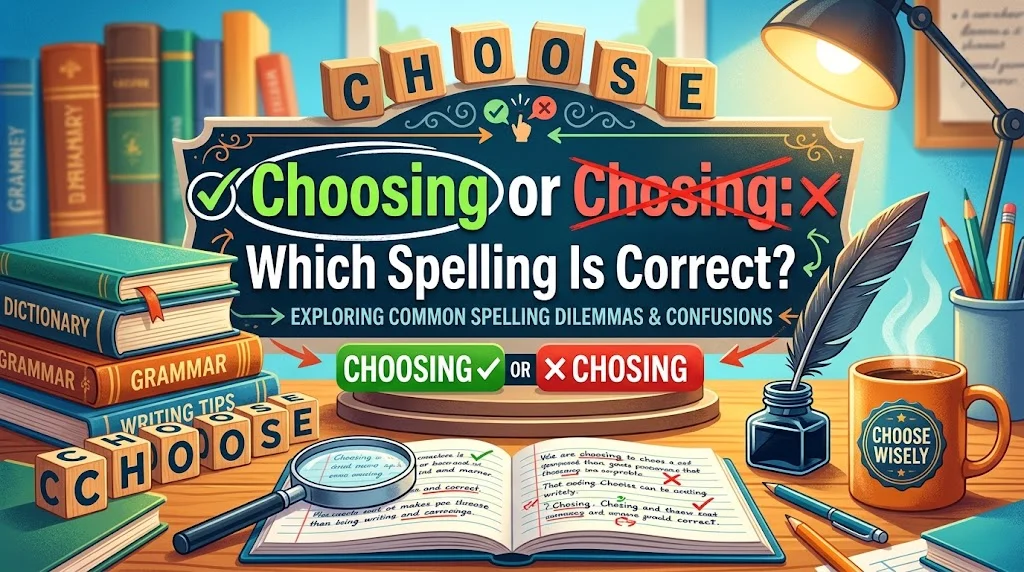
Are you confused about Choosing or Chosing? You’re not alone. These two spellings look nearly identical, but only one is correct in standard English. Choosing is the correct spelling, while chosing is a common spelling mistake. The word choosing comes from the verb choose and works as its present participle and gerund form. You use it when talking about selecting something, making a decision, or picking between different options.
Understanding choosing becomes easier when you know the basic English grammar, verb forms, word formation, and spelling rules behind it. The main rule is simple: when you add -ing to choose, you remove the final silent e but keep both o’s. Therefore, choose becomes choosing, not chosing.
This guide explains the meaning, definition, pronunciation, grammar, correct usage, and sentence examples of choosing. You’ll also learn the difference between choose, chooses, choosing, chose, and chosen. Whether you’re an English learner, student, writer, or simply trying to improve your writing skills, this explanation will help you remember the correct form with confidence.
Choosing: Definition, Meaning, and Correct Usage
Choosing is the correct spelling of the present participle and gerund form of the verb choose.
The verb choose means to select one person, thing, action, or possibility from several options.
For example:
She is choosing a dress for the wedding.
Here, choosing describes the action happening at the moment.
The word can also function as a gerund, which means it acts like a noun:
Choosing the right career takes time.
In this sentence, choosing isn’t simply describing what someone is doing right now. The entire activity of making a career decision functions as the subject.
What Does Choosing Mean?
The meaning depends on context, but the central idea remains selection or decision-making.
You might be choosing:
- A restaurant
- A college
- A career
- A color
- A book
- A vehicle
- A vacation destination
- A candidate
- A solution
- A gift
- An answer
- A course of action
Consider these examples:
- I’m choosing between two apartments.
- They are choosing a new team leader.
- She spent an hour choosing a birthday gift.
- We are choosing the best option for the project.
In each sentence, someone selects one possibility from others.
Chosing: Is It a Correct Word?
Chosing is incorrect in standard English.
It isn’t the accepted spelling of the -ing form of choose.
The correct transformation is:
choose → choosing
Not:
choose → chosing
This mistake happens frequently because the spelling seems logical at first glance. A writer may think that adding -ing simply means removing the final e:
choose → chos + ing → chosing
However, that reasoning removes more than the final silent e. It also loses one of the two o’s that belong to the base word.
The correct process is:
choose → choosing
The oo remains intact.
Read More: Eying or Eyeing? Correct Spelling, Meaning, and Usage Explained
Why Do People Commonly Write Chosing?
Several factors can cause this mistake.
First, English spelling doesn’t always behave predictably. Learners often memorize patterns rather than individual words.
Second, choose has several unusual forms:
- Choose
- Chooses
- Choosing
- Chose
- Chosen
Because the word changes differently across its forms, learners may become uncertain about its spelling.
Third, pronunciation can contribute to confusion. In normal speech, the word choosing doesn’t sound like every letter is clearly separated.
The safest solution is to remember the complete word family rather than trying to rebuild the word from memory each time.
Choosing vs Chosing: Key Differences
The difference is straightforward.
Choosing is correct. Chosing is incorrect.
| Feature | Choosing | Chosing |
| Correct spelling | Yes | No |
| Base verb | Choose | Intended to be choose |
| Ends with -ing | Yes | Intended to |
| Standard English | Yes | No |
| Dictionary-standard form | Yes | No |
| Appropriate in formal writing | Yes | No |
| Example | He is choosing carefully. | He is chosing carefully. |
The most important thing to remember is that chosing isn’t an alternative spelling of choosing.
If you’re writing an email, essay, article, application, report, or professional message, use choosing.
Choose, Chooses, Choosing, Chose, and Chosen: Complete Verb Family
The easiest way to understand choosing is to see how it fits into the complete verb family.
| Verb form | Word | Example |
| Base form | choose | I choose tea. |
| Third-person singular | chooses | She chooses tea. |
| Present participle | choosing | She is choosing tea. |
| Simple past | chose | She chose tea yesterday. |
| Past participle | chosen | She has chosen tea. |
This table reveals an important point: choosing isn’t related to chose simply because they look similar. It comes directly from the base verb choose.
Choose
Use choose for the base form.
I usually choose the cheaper option.
It also appears after modal verbs:
You should choose carefully.
And after to in an infinitive:
I want to choose a different seat.
Chooses
Use chooses with a third-person singular subject in the simple present.
He chooses his words carefully.
Sarah chooses healthy meals.
The -es ending appears because choose ends with the sound represented by z and its spelling pattern requires -es.
Choosing
Choosing is the present participle and gerund form.
They are choosing a new logo.
It can also work as a noun-like gerund:
Choosing a major can feel overwhelming.
Chose
Chose is the simple past form.
I chose the blue jacket yesterday.
Don’t write:
I choose the blue jacket yesterday.
The time expression yesterday requires the past form in this context.
Chosen
Chosen is the past participle.
It usually appears with an auxiliary verb such as have, has, or had.
She has chosen her university.
They had chosen a different route.
It can also appear in passive constructions:
He was chosen as team captain.
Why Is “Choosing” Spelled With Two O’s?

This is the heart of the spelling issue.
The base verb is:
choose
When English adds -ing to a verb ending in a silent e, the final e commonly disappears.
For example:
- make → making
- take → taking
- write → writing
- use → using
- choose → choosing
Notice what happens to choose:
choose + ing → choosing
Only the final e disappears.
The two o’s stay.
That’s why this is correct:
choosing
And this is wrong:
chosing
The Simple Spelling Rule
A useful rule is:
When choose takes -ing, remove the final silent e but keep the rest of the base word.
So:
choose → choosing
Don’t remove an extra letter.
Similar Examples
The same general spelling idea appears in other verbs:
| Base verb | -ing form |
| make | making |
| take | taking |
| give | giving |
| write | writing |
| drive | driving |
| move | moving |
| choose | choosing |
The spelling of choosing follows the same broad pattern.
Grammar: How to Use Choosing Correctly
The word choosing performs several grammatical jobs.
Choosing After Forms of Be
The most familiar use appears in progressive tenses.
I am choosing a new laptop.
She is choosing a restaurant.
They were choosing between two candidates.
Here, a form of be combines with choosing to show an ongoing action.
Choosing as a Gerund
A gerund looks like a verb but functions as a noun.
Choosing takes time.
Here, choosing serves as the subject.
Another example:
I enjoy choosing gifts for my friends.
The word choosing functions as the object of enjoy.
Choosing With Objects
The verb can take a direct object.
She is choosing a dress.
We are choosing a location.
They are choosing a winner.
The thing selected becomes the object.
Choosing Between Options
The phrase choose between is especially common when discussing two or more alternatives.
I’m choosing between two apartments.
She couldn’t decide which course to take because she was choosing between two excellent programs.
You can also use choose from when emphasizing a group of available options.
You can choose from five different plans.
Choosing vs Choose vs Chose vs Chosen
These words belong to the same verb family, but you can’t swap them freely.
| Word | Main use | Example |
| choose | Present/base form | I choose carefully. |
| chooses | Present with he/she/it | She chooses carefully. |
| choosing | Ongoing action/gerund | She is choosing carefully. |
| chose | Simple past | She chose carefully. |
| chosen | Past participle | She has chosen carefully. |
A quick timeline makes the difference clearer:
Present:
I choose.
Ongoing:
I am choosing.
Past:
I chose.
Completed action:
I have chosen.
This distinction can prevent more than just spelling errors. It also helps you select the correct tense.
Pronunciation of Choosing
Choosing is generally pronounced /ˈtʃuːzɪŋ/ in American English.
You can think of it roughly as:
CHOO-zing
It has two syllables:
choos-ing
The first syllable contains the long oo sound found in words such as food and moon.
The second syllable has the common -ing sound.
Common Pronunciation Mistakes
Some learners pronounce choosing too quickly and make it sound closer to another word.
The easiest approach is to break it into two parts:
choose + ing
Then blend them:
choos-ing
Remember that the s in choosing has a z sound.
Common Mistakes With Choosing
Mistake 1: Writing Chosing
Incorrect:
I am chosing a new phone.
Correct:
I am choosing a new phone.
The second o must remain.
Mistake 2: Using Chose for an Ongoing Action
Incorrect:
I am chose a restaurant.
Correct:
I am choosing a restaurant.
After am, use the present participle.
Mistake 3: Using Choose With “Was”
Incorrect:
She was choose a dress.
Correct:
She was choosing a dress.
The structure was + verb-ing expresses an ongoing past action.
Mistake 4: Confusing Chosen With Chose
Incorrect:
She has chose the winner.
Correct:
She has chosen the winner.
After has, use the past participle chosen.
When to Use Choosing
Use choosing when you need the -ing form of choose.
Common situations include:
An Action Happening Now
I’m choosing my lunch.
An Ongoing Past Action
She was choosing clothes when I called.
A General Activity
Choosing the right words matters.
A Decision-Making Process
He’s still choosing between the two offers.
A Repeated or Temporary Activity
They are choosing new suppliers this month.
The context determines the tense and structure, but the spelling remains the same.
When Not to Use Choosing
Don’t use choosing when the grammar requires another form of choose.
For example, use choose after a modal:
You should choose wisely.
Not:
You should choosing wisely.
Use chose for a completed action in the simple past:
She chose the red dress yesterday.
Not:
She choosing the red dress yesterday.
Use chosen after perfect auxiliaries:
They have chosen a winner.
Not:
They have choosing a winner.
The spelling isn’t the only issue. Verb form and sentence structure matter too.
Choosing in Different Contexts

The word appears in countless everyday situations.
Making a Decision
I’m choosing whether to accept the offer.
Selecting a Product
She spent twenty minutes choosing a new laptop.
Selecting a Place
We’re choosing a hotel near the airport.
Making a Career Decision
Many students struggle when choosing a career.
Selecting Words
Be careful when choosing your words.
That last example is especially useful because it shows how choosing can describe a deliberate process.
Real-World Examples of Choosing
Everyday Examples
- I’m choosing what to eat.
- She is choosing a birthday gift.
- We’re choosing a movie tonight.
- He is choosing between two shirts.
- They’re choosing seats near the front.
Workplace Examples
- The committee is choosing a new manager.
- We are choosing a software provider.
- The company is choosing between several proposals.
- She is carefully choosing her presentation topics.
Academic Examples
- Students are choosing their courses.
- He is choosing a research topic.
- Choosing the right sources can improve an assignment.
- She spent weeks choosing her major.
Formal Writing Examples
The organization is choosing a long-term strategy.
Consumers are increasingly careful when choosing financial products.
Choosing an appropriate method can affect the final results.
Synonyms for Choosing
Depending on context, several words can replace choosing.
| Synonym | Meaning | Example |
| Selecting | Picking from options | She is selecting a dress. |
| Picking | Informal selection | He’s picking a movie. |
| Deciding | Reaching a decision | We’re deciding where to go. |
| Opting for | Selecting one option | She is opting for tea. |
| Preferring | Favoring one thing | He’s preferring the simpler option. |
| Determining | Establishing a choice or outcome | They’re determining the best approach. |
| Electing | Choosing formally | Members are electing a chairperson. |
| Settling on | Finally deciding | We settled on the blue design. |
However, these words aren’t always interchangeable.
For example, electing often involves a formal vote. Picking sounds more casual. Choosing remains the broadest and most natural option in many situations.
Easy Rule to Remember Choosing vs Chosing
Here’s the quickest memory trick:
Choose has two O’s. Choosing keeps both O’s.
Think:
CHOOSE → CHOOSING
Only the final e disappears.
A useful visual pattern is:
CH O O S E
↓ remove final E
CH O O S + ING
↓
CHOOSING
So if you write chosing, ask yourself:
“Where did the second O go?”
It shouldn’t have gone anywhere.
Choosing or Chosing: Fill-in-the-Blank Practice
Complete each sentence with the correct form.
- She is ________ a new apartment.
- I am ________ between two options.
- They were ________ a team captain.
- He enjoys ________ gifts for people.
- We are carefully ________ our words.
- Sarah has ________ a different approach.
- Yesterday, I ________ the blue one.
- You should ________ carefully.
- He ________ the restaurant every Friday.
- The students are ________ their courses.
Answers
- choosing
- choosing
- choosing
- choosing
- choosing
- chosen
- chose
- choose
- chooses
- choosing
The first five examples specifically demonstrate why choosing is the correct -ing form.
Final Verdict: Choosing or Chosing?
The answer is clear:
Choosing is correct.
Chosing is incorrect.
The correct spelling comes from the verb choose plus the -ing suffix:
choose → choosing
When the silent e disappears before -ing, the two o’s remain.
So write:
I am choosing a new book.
Not:
I am chosing a new book.
This distinction applies whether you’re writing casually, academically, professionally, or formally.
Conclusion
The spelling difference between choosing and chosing may seem tiny, but it represents an important English spelling rule. Choosing is the only standard spelling for the present participle and gerund form of choose. The incorrect form chosing usually results from removing too much of the base word when adding -ing.
Remember the transformation:
choose → choosing
The final silent e disappears. The two o’s stay.
It’s also worth keeping the entire verb family in mind:
choose → chooses → choosing → chose → chosen
Each form has its own grammatical job. Choose works as the base form. Chooses fits third-person singular present sentences. Choosing describes an ongoing action or functions as a gerund. Chose expresses the simple past. Chosen serves as the past participle.
Once you see that pattern, choosing vs chosing becomes much easier. When in doubt, return to the base word choose, remove only the final e, and add -ing.
The result is always:
CHOOSING
Frequently Asked Questions
Is “choosing” the correct spelling?
Yes. Choosing is the correct standard English spelling. It is the present participle and gerund form of choose.
She is choosing a new dress.
Is “chosing” a real word?
Chosing is not the standard English spelling of the -ing form of choose. It is generally treated as a spelling error.
Use choosing instead.
Why is choosing spelled with two o’s?
The base verb choose contains two o’s. When -ing is added, only the final silent e is removed.
Therefore:
choose → choosing
The two o’s remain.
What is the present continuous form of choose?
The present continuous uses a form of be plus choosing.
Examples include:
- I am choosing.
- She is choosing.
- They are choosing.
What is the difference between choose and chose?
Choose is the present/base form.
I choose tea every morning.
Chose is the simple past form.
I chose tea yesterday.
The two words shouldn’t be used interchangeably.
What is the past participle of choose?
The past participle is chosen.
For example:
She has chosen the winner.
They had chosen another option.
How do you pronounce choosing?
In American English, choosing is generally pronounced /ˈtʃuːzɪŋ/.
A simple pronunciation guide is:
CHOO-zing
It contains two syllables.
Why do people write chosing instead of choosing?
The mistake usually happens because writers remove the final e and accidentally remove one of the two o’s as well.
The correct spelling rule is:
choose + ing = choosing
Only the final e disappears.
Can “chosing” be used in texting or casual writing?
You may see chosing in informal messages, social posts, or online comments. However, its appearance doesn’t make it correct.
If you want standard English, use choosing in both formal and informal writing.
What is an easy way to remember the spelling of choosing?
Remember this simple phrase:
Choose keeps both O’s when choosing.
The spelling is:
CHOOSE → CHOOSING
That single pattern is enough to prevent the most common spelling mistake.


