If you’ve ever hesitated between submission vs submittion, you’re not alone. The two forms look remarkably similar, especially because the verb submit ends in -mit and many English nouns are formed with -tion.
Here’s the key point: submission is the correct standard English spelling. Submittion is a misspelling.
The confusion usually comes from trying to form the noun by simply adding a familiar ending to submit. English word formation doesn’t always work that neatly. In this case, submit changes to submission, with the spelling shifting from -mit to -mission.
You’ll encounter submission in academic assignments, job applications, business documents, online forms, legal writing, contests, and many other settings. Understanding the word means more than memorizing its spelling. You also need to know how it functions in a sentence and why the incorrect form looks so tempting.
This guide explains submission vs submittion in detail. You’ll learn the correct spelling, meaning, word formation, common mistakes, examples, related words, and an easy way to remember the difference.
What Is the Correct Spelling: Submission or Submittion?
The correct spelling is submission.
Submittion is not the standard English noun corresponding to the verb submit. If you’re writing an email, assignment, report, application, essay, or formal document, use submission.
| Word | Correct? | Part of Speech | Meaning |
| Submission | ✅ Yes | Noun | Something submitted or the act of submitting |
| Submittion | ❌ No | — | Common misspelling of submission |
The difference is only a few letters, but those letters matter.
Consider these examples:
Correct: Your assignment submission is due tomorrow.
Incorrect: Your assignment submittion is due tomorrow.
Another example:
Correct: We received your application submission.
Incorrect: We received your application submittion.
The correct noun is always submission in standard English.
Submission Is the Correct Spelling
Submission is a noun related to the verb submit.
Depending on context, it can refer to something that someone submits, the act of submitting something, or a state of yielding or accepting authority.
For example:
- The professor reviewed every submission.
- Your application submission was successful.
- The company received hundreds of submissions.
- Please check your document before submission.
- His submission to the authority was voluntary.
The first four examples involve sending or presenting something for consideration. The final example uses another established meaning of submission: yielding or accepting control.
Submittion Is a Misspelling
Submittion looks plausible because English has many nouns ending in -tion.
A writer might think:
submit + tion = submittion
That reasoning seems logical at first glance. However, English doesn’t form this particular noun by simply attaching -tion to the unchanged verb.
The established noun is:
submit → submission
Not:
submit → submittion
This distinction becomes easier once you understand the word family.
Submission vs Submittion Example Sentences
Seeing the correct spelling repeatedly in natural sentences can make it easier to remember.
- Please complete your submission before the deadline.
- The teacher accepted my essay submission.
- Your submission must include three supporting sources.
- We received your job application submission.
- The website displayed a confirmation after the submission.
- Her article was selected from more than 100 submissions.
- The final submission requires a signed declaration.
- Check the file format before making your submission.
- The competition deadline applies to every submission.
- Late submissions may not receive full consideration.
Notice that submission works naturally in both everyday and formal writing.
Why Do People Confuse Submission and Submittion?
The submission vs submittion confusion isn’t difficult to understand. The incorrect spelling follows a pattern that feels familiar.
English contains thousands of words ending in -tion, including education, information, completion, and application. When writers see submit, they may instinctively add -tion.
That creates submittion, which looks believable even though it isn’t correct.
Double “T” Confusion in English
One major reason for the mistake is the appearance of tt.
The verb is spelled:
submit
When people try to create a noun mechanically, they may retain the final t and add -tion:
submit + tion → submittion
That produces the double t sequence.
The correct word doesn’t preserve that spelling pattern:
submission
The middle of the word changes substantially:
sub-mit → sub-mis-sion
This is one reason simply “adding a suffix” isn’t a reliable method for every English word.
Pronunciation Makes It Harder
Pronunciation can also contribute to the confusion.
In normal speech, submission is commonly pronounced approximately:
/səbˈmɪʃən/
The middle sound is closer to “mish” than a clearly pronounced “mit.”
That pronunciation can make the spelling less obvious if you’re learning English primarily through conversation.
Compare:
- submit → səb-MIT
- submission → səb-MISH-ən
The spelling and pronunciation shift together.
If you know the pronunciation but haven’t seen the written word often, you might reasonably wonder whether the middle should contain -mit-, -mis-, or -mitt-.
That’s why visual familiarity matters.
Typing and Autocorrect Errors
Fast typing creates another source of trouble.
Because submittion resembles the structure of other English words, your fingers can produce it without immediately noticing the error. Spell-checking software may catch it, but automated tools aren’t a substitute for understanding the correct word.
For important writing, look at the actual word rather than simply accepting an autocorrect suggestion.
A useful habit is to remember the pair:
Submit → Submission
Once that connection becomes familiar, submittion starts to look noticeably wrong.
Understanding the Word Submission
The meaning of submission depends on how someone uses it.
The most common modern meaning involves something being formally presented or sent for consideration. However, the noun has several related uses.
Submission as Something You Send or Present
A submission can be something you send to another person or organization for review.
That could include:
- an essay
- an assignment
- an application
- a proposal
- a manuscript
- a competition entry
- a report
- a form
- a legal document
- a creative work
For example:
The editor rejected the submission after reviewing the manuscript.
Here, submission refers to the manuscript or piece of work that was sent to the editor.
Another example:
We received your submission this morning.
In this sentence, the exact item may depend on the surrounding context.
Submission as the Act of Submitting
Submission can also refer to the act or process of submitting something.
For example:
The online submission of the form took less than five minutes.
Here, the word describes the act of sending the form rather than simply naming the form itself.
You can often determine the intended meaning from context.
Compare:
Your submission contains three pages.
Here, submission means the material that was submitted.
Your submission occurred before the deadline.
Here, submission refers more closely to the act or event of submitting.
Submission as Acceptance or Surrender
The word also has a broader meaning involving yielding to authority, control, or another person’s wishes.
For example:
The treaty required the formal submission of the defeated territory.
This meaning is less common in everyday discussions about assignments and applications, but it remains an established sense of the word.
The context makes the distinction clear.
Read More: Striping vs. Stripping: Meaning, Differences, Grammar Rules, and Examples
Submission in Different Contexts
One reason submission appears so frequently is its usefulness across different fields.
Submission in Education
Schools, colleges, universities, and online learning platforms use submission constantly.
Students may submit:
- essays
- homework
- research papers
- projects
- presentations
- lab reports
- discussion responses
- applications
Examples include:
The essay submission deadline is Friday.
Your submission should contain a bibliography.
The instructor reopened the assignment for late submissions.
In academic settings, submission often refers to the work handed in for evaluation.
You may also see phrases such as:
- assignment submission
- paper submission
- project submission
- thesis submission
- late submission
- online submission
- final submission
- submission deadline
These expressions are especially common in academic instructions.
Submission in the Workplace
Businesses use submission when employees, applicants, contractors, or organizations provide materials for review.
For example:
The finance team completed its budget submission.
Please send your proposal submission by Thursday.
We received three vendor submissions.
The word can appear in emails, reports, procurement documents, applications, and project communications.
However, don’t assume that submission always means a single document. It can describe a package of materials or the overall act of presenting information.
Submission on Websites and Online Forms
Digital platforms have made submission even more common.
You’ve probably seen a button labeled:
Submit
After clicking it, the website might display:
Your submission has been received.
Here, submit is the action while submission is the resulting entry or the act of sending it.
You might submit:
- a contact form
- a job application
- a survey
- a contest entry
- a support request
- a document
- a payment form
- an online assignment
For example:
The form won’t accept your submission until all required fields are completed.
This is a natural and standard use of the noun.
Submission in Legal and Formal Contexts
Legal and regulatory writing also uses submission extensively.
A legal submission can refer to material, arguments, representations, or other information formally presented for consideration.
For example:
The court considered the written submissions from both parties.
In formal contexts, submission can therefore have a more specialized meaning than the everyday idea of “sending something.”
This is one reason the word remains important in professional English.
Submission vs Submittion: Key Differences Explained

The simplest distinction is straightforward:
Submission is correct. Submittion is incorrect.
But understanding why helps you avoid repeating the mistake.
| Aspect | Submission | Submittion |
| Standard spelling | Correct | Incorrect |
| Related verb | Submit | Submit |
| Word type | Noun | Misspelling |
| Academic use | Common | Incorrect |
| Workplace use | Common | Incorrect |
| Online forms | Common | Incorrect |
| Formal writing | Appropriate | Avoid |
| Meaning | Something submitted or act of submitting | No standard noun meaning |
Why “Submission” Uses “-ssion”
The spelling of submission reflects the way English developed the word from its Latin source and related word forms.
The verb submit ultimately comes through French from Latin submittere, meaning “to send under” or “place under,” with meanings that developed around yielding or presenting something.
The noun submission developed through the related form that became English submission, rather than through a simple modern spelling formula of submit + -tion.
That history explains why the result isn’t submittion.
You don’t need to memorize the Latin history to spell the word correctly. Still, knowing that the spelling has a historical basis can explain why English doesn’t follow the seemingly obvious construction.
For reference, established dictionaries such as Merriam-Webster and Cambridge Dictionary list submission as the standard English noun.
Submission vs Submit: Understanding the Grammar
Another useful way to understand submission is to compare it with its related verb forms.
Submit Is a Verb
Submit describes an action.
For example:
Please submit your application by Friday.
She will submit the report tomorrow.
Students must submit their assignments online.
The subject performs the action of presenting something for consideration.
Submission Is a Noun
Submission names the thing being submitted or the act of submitting.
Compare these sentences:
Please submit your application.
Your submission has been received.
The first sentence uses submit as a verb. The second uses submission as a noun.
This simple distinction can make the word family much easier to remember.
Submit, Submitted, Submitting, Submission
| Word | Function | Example |
| Submit | Verb | Please submit your form. |
| Submitted | Past tense/past participle | She submitted the report. |
| Submitting | Present participle/gerund | He is submitting the application. |
| Submission | Noun | The submission arrived today. |
A common mistake is to treat these forms as if they follow identical spelling rules. They don’t.
English word families often change spelling when words develop into different grammatical forms.
Common Examples of Submission in Sentences
Understanding submission becomes easier when you see it in realistic contexts.
Everyday Examples
- Your submission is ready for review.
- I sent my submission before lunch.
- The website confirmed my submission.
- We received your submission successfully.
- Please save a copy of your submission.
Academic Examples
- The assignment submission closes at midnight.
- Her research paper was an excellent submission.
- Late submissions may be subject to the instructor’s policy.
- Each student must upload one final submission.
- The professor returned the submission with detailed comments.
Professional Examples
- The proposal submission requires three documents.
- Our team prepared the final submission.
- The client reviewed the project submission.
- Please verify the figures before submission.
- The company rejected the incomplete submission.
Online Examples
- The form displayed a submission confirmation.
- Your submission number appears on the confirmation page.
- The portal accepts submissions in PDF format.
- The competition received thousands of submissions.
- You can’t edit the submission after sending it.
Formal Examples
- The committee reviewed all written submissions.
- The organization invited public submissions on the proposal.
- The parties presented their submissions to the court.
- The deadline applies to all formal submissions.
These examples show why submission is a flexible word rather than a term limited to school assignments.
Common Mistakes With Submission
Even after learning the correct spelling, several related mistakes can cause problems.
Writing Submittion Instead of Submission
This is the main error.
Incorrect:
Please complete your submittion today.
Correct:
Please complete your submission today.
The quickest correction is to memorize the complete noun rather than trying to construct it letter by letter.
Adding “-tion” Directly to Submit
The mistake often comes from a false assumption:
submit + tion = submittion
English doesn’t always allow that kind of mechanical word formation.
Instead, remember:
submit → submission
This is similar to other English word families where the noun changes more than expected.
Confusing Submission With Submittal
Submittal is a real word, so this distinction deserves attention.
Both submission and submittal can refer to something presented for consideration. However, their usage can differ by field and context.
Submission is the much broader and more familiar term. Submittal appears particularly in technical, construction, engineering, and business contexts.
For example:
The contractor sent the equipment submittal for review.
You shouldn’t “correct” every occurrence of submittal to submission. The two are related, but submittal is an established word in its own right.
Confusing Submission With Submitting
These words have different grammatical roles.
Submitting the application took five minutes.
The submission took five minutes.
Submitting functions as an -ing form of the verb. Submission is a noun.
The distinction becomes especially useful when you’re editing formal writing.
Submission vs Submittion: Common Questions About Usage
Is Submission a Noun or a Verb?
Submission is a noun.
The related verb is submit.
For example:
You must submit your application.
Your submission was received.
Can Submission Refer to a Document?
Yes. Submission can refer to a document, application, assignment, proposal, manuscript, or other material presented for consideration.
The exact meaning depends on the context.
Can Submission Refer to an Action?
Yes. Submission can refer to the act or process of submitting something.
For example:
The submission of the application took only a few minutes.
Here, the phrase describes the action of submitting the application.
Is Submittion Ever Correct?
In standard English, submittion is not the correct noun spelling for submit.
If you’re writing formal, academic, professional, or published content, use submission.
Is Submission Appropriate in Formal Writing?
Yes. Submission is widely used in formal English.
You’ll find it in academic instructions, business documents, legal writing, government materials, websites, application systems, and professional correspondence.
What Is the Noun Form of Submit?
The standard noun is submission.
The basic word family is:
submit → submission
What Is the Difference Between Submit and Submission?
Submit is a verb that describes the action of presenting something.
Submission is a noun referring to the thing submitted or the act of submitting.
For example:
Please submit the form.
Your submission has been received.
What Is the Difference Between Submission and Submittal?
Both words can refer to something presented for review or consideration.
Submission is the broader, more common term. Submittal is also an established noun and appears frequently in certain technical and professional contexts.
The correct choice depends on the context and the terminology used within a particular field.
How Do You Remember the Spelling of Submission?
Remember the word pair:
SUBMIT → SUBMISSION
Don’t try to create submission by attaching -tion directly to submit. Learn the complete word family instead.
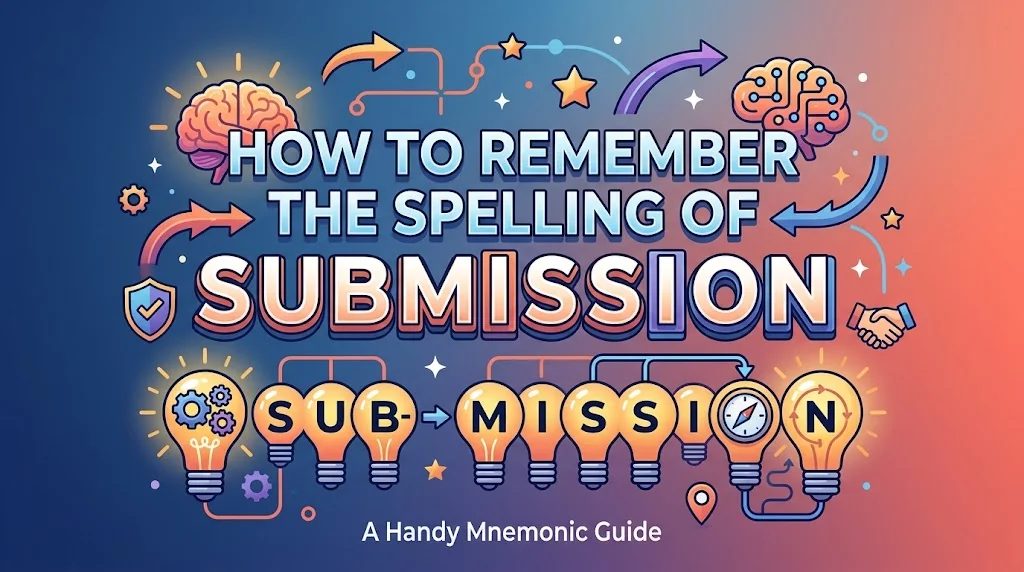
How to Remember the Spelling of Submission
A good spelling trick should be simple enough to use when you’re writing quickly.
Remember the Word Family
The most useful pattern is:
submit → submission
Write it several times if necessary:
- submit
- submitted
- submitting
- submission
Seeing the forms together helps establish the relationship without forcing you to guess the spelling.
Connect Submission With Similar Words
Some related English words follow comparable historical patterns.
| Verb | Noun |
| permit | permission |
| transmit | transmission |
| omit | omission |
| submit | submission |
These examples shouldn’t be treated as a universal rule for every English verb. They simply provide useful reminders that the noun form may change significantly.
Use the Correct Word in Context
Instead of memorizing isolated letters, memorize a phrase.
For example:
- assignment submission
- final submission
- online submission
- job application submission
- submission deadline
When you repeatedly see the correct spelling in meaningful phrases, it becomes easier to recognize.
Check a Reliable Dictionary
If you’re genuinely unsure, consult a reputable dictionary.
Useful references include:
- Merriam-Webster — Submission
- Cambridge Dictionary — Submission
- Oxford Learner’s Dictionaries — Submission
A dictionary gives you more than spelling. It can also show pronunciation, definitions, grammatical information, and example usage.
Submission vs Submittion: Quick Comparison
When you need a fast answer, remember this table:
| Question | Answer |
| Which spelling is correct? | Submission |
| Is submittion standard English? | No |
| What is the verb? | Submit |
| What is the noun? | Submission |
| Can submission mean something sent for review? | Yes |
| Can submission describe an act? | Yes |
| Is submission used in academic writing? | Yes |
| Is submission used in business writing? | Yes |
| Is submission used in legal contexts? | Yes |
| Is submittal a real word? | Yes |
| Should you use submittion in formal writing? | No |
Submission vs Submittion Practice Quiz
Ready to test the difference?
Choose the Correct Spelling
Which sentence is correct?
A. Please complete your submittion today.
B. Please complete your submission today.
Answer: B. Submission is the correct spelling.
Which noun should you use?
A. The committee reviewed every submission.
B. The committee reviewed every submittion.
Answer: A. Submission is correct.
Fill in the Blank
Complete each sentence with submission or submittion.
- Your final ______ is due on Friday.
- The website confirmed receipt of your ______.
- Late ______ may not be accepted.
Answers:
- submission
- submission
- submissions
Spot the Spelling Error
Find the incorrect word:
The professor extended the submittion deadline.
The error is submittion.
Correct version:
The professor extended the submission deadline.
Correct the Sentence
Incorrect:
I uploaded my submittion before midnight.
Correct:
I uploaded my submission before midnight.
Incorrect:
The company received 50 submittion forms.
Correct:
The company received 50 submission forms.
A small detail matters in the second example: if you mean 50 things that were submitted, the natural plural is submissions.
The company received 50 submissions.
Answer Key
The correct form is submission whenever you need the standard noun related to submit.
The plural form is submissions.
The verb remains submit.
How to Avoid Similar Spelling Mistakes
The submission vs submittion problem illustrates a broader lesson about English spelling. You can’t always create a noun by attaching a familiar suffix to a verb.
Learn Word Families
Learning related words together is often more effective than memorizing them separately.
For this word, learn:
submit → submitted → submitting → submission
You can then recognize the forms when they appear in different sentences.
Don’t Assume Every Verb Takes “-tion”
English contains many suffix patterns, but they aren’t completely predictable.
For example, compare:
- educate → education
- inform → information
- decide → decision
- permit → permission
- submit → submission
The endings may look related, but the spelling changes aren’t identical.
That’s why established word forms matter.
Proofread Important Documents
A spelling mistake in a casual message may be harmless. A mistake in an application, report, proposal, or academic paper can make the writing look less polished.
Before sending important documents, check:
- spelling
- grammar
- names
- dates
- numbers
- formatting
- attachments
- submission requirements
A final review takes only a few minutes and can catch surprisingly small errors.
Use Dictionaries and Spell Checkers Together
Spell checkers are useful. They can quickly identify obvious misspellings such as submittion.
However, automated tools don’t replace understanding.
A spell checker might recognize a word without explaining why another form is correct. A dictionary provides definitions and usage information that software alone may not provide.
The strongest approach combines both:
Write → spell-check → proofread → verify unfamiliar words
Why the Correct Spelling Matters
The difference between submission and submittion may seem tiny. In polished writing, however, small details accumulate.
Imagine reading an application containing several unusual spellings. Even if every idea is understandable, the errors can distract you from the message.
Correct spelling helps your writing appear:
- clearer
- more polished
- easier to read
- more consistent
- more professional
This doesn’t mean one spelling error automatically determines how someone judges an entire document. Context matters. Still, proofreading important writing is a sensible habit.
For students, professionals, applicants, and content creators, accuracy supports clear communication.
Submission vs Submittion for SEO and Online Writing
If you’re publishing content online, using the correct spelling is important for readers first.
A page that repeatedly uses submittion instead of submission contains a basic language error. That can reduce reader confidence, particularly when the page is supposed to teach English or provide professional information.
Correct usage also makes your content easier to understand.
Better User Experience
Readers shouldn’t have to stop and wonder whether a word is spelled correctly.
Clear language keeps attention on the information.
Greater Editorial Credibility
Well-edited content generally feels more trustworthy than content filled with avoidable errors.
This is particularly important for:
- educational websites
- grammar resources
- professional blogs
- business websites
- application guides
- technical documentation
Natural Keyword Usage
If your topic is submission vs submittion, you can naturally address both terms.
The article should explain that submission is correct while submittion is the commonly searched incorrect form.
There’s no need to force the misspelling repeatedly into every paragraph. Use it where it helps answer the reader’s question.
Key Takeaway: Submission vs Submittion
The answer is simple:
Submission is the correct spelling. Submittion is a misspelling.
The confusion happens because submittion looks like a logical combination of submit and -tion. English word formation doesn’t work that way here.
The correct word is:
submit → submission
Submission can refer to something presented for consideration, the act of submitting something, or, in another context, yielding to authority or control.
You’ll find the word everywhere from classroom assignments and job applications to websites, business documents, and legal writing.
When in doubt, don’t construct the noun from scratch. Remember the complete word family:
submit, submitted, submitting, submission
That small connection makes the spelling much easier to remember.
Frequently Asked Questions
Is “Submittion” a Real Word?
Submittion is not the standard English noun corresponding to submit. It is generally treated as a misspelling of submission.
Is “Submission” the Correct Spelling?
Yes. Submission is the standard spelling.
For example:
Please send your submission before the deadline.
What Does Submission Mean?
Submission can mean something presented for consideration, the act of submitting something, or yielding to authority or control.
The intended meaning depends on context.
What Is the Noun Form of Submit?
The standard noun form is submission.
The relationship is:
submit → submission
Why Is Submittion Incorrect?
Submittion incorrectly treats submit as though you could simply attach -tion to its unchanged form.
The established English noun is submission, which has a different spelling pattern.
Is Submission Used in Formal English?
Yes. Submission is common in academic, professional, legal, business, and administrative writing.
Examples include assignment submission, formal submission, written submission, and application submission.
What Is the Difference Between Submit and Submission?
Submit is a verb.
Please submit the form.
Submission is a noun.
Your submission has been received.
What Is the Difference Between Submission and Submittal?
Both are established nouns, but they aren’t used in exactly the same way.
Submission is the broader and more common term. Submittal is particularly common in certain technical, construction, engineering, and professional contexts.
How Do You Remember the Spelling of Submission?
Memorize the complete pair:
SUBMIT → SUBMISSION
Don’t spell the noun as submittion. The correct middle sequence is -mission.
Can Submission Be Plural?
Yes. The plural is submissions.
For example:
The contest received more than 500 submissions.
Can Submission Refer to an Assignment?
Yes. In education, submission commonly refers to an assignment, essay, project, or other work handed in for evaluation.
Is Submission a Formal Word?
Yes. Submission works in both everyday and formal English. Its exact tone depends on the context.
Conclusion
When comparing submission vs submittion, there’s one spelling to remember: submission.
Submittion is a misspelling, even though it looks like a reasonable word formed from submit and -tion. The standard noun developed as submission, so that’s the form you should use in academic, professional, online, and formal writing.
The easiest memory trick is straightforward:
Submit → Submission
Use submit when describing the action. Use submission when referring to the thing submitted or the act itself.
Once you recognize that word family, the extra t in submittion becomes much easier to spot. Whether you’re submitting an essay, application, report, proposal, or online form, submission is the spelling that belongs on the page.