Have you ever paused while writing high school and wondered whether highschool might be correct? This spelling question is surprisingly common because English contains countless compound words that appear as one word. However, when discussing secondary education, the standard spelling is high school with a space.
In American English, high school refers to the educational stage students typically attend during their teenage years. You’ll find the phrase throughout academic writing, school assignments, education articles, student records, emails, and everyday conversation. Common expressions include high school student, high school teacher, high school diploma, high school graduation, and high school education.
The form highschool sometimes appears in online writing, usernames, titles, or informal content. Its appearance doesn’t make it the standard spelling. In ordinary writing, joining the words together creates a spelling error.
This distinction also matters when you consider capitalization, grammar, and compound nouns. For example, you write “She attends high school,” but you might write “She attends Lincoln High School” when referring to an institution’s official name.
This guide explores high school vs. highschool, explains why the confusion occurs, and provides practical examples. By the end, choosing the correct form should feel effortless.
Quick Answer: High School or Highschool?
The correct standard spelling is high school.
Write it as two words, not one:
Correct: She is in high school.
Incorrect: She is in highschool.
The same rule applies when high school appears before another noun:
- high school student
- high school teacher
- high school diploma
- high school graduation
- high school sports
- high school education
The form highschool isn’t the standard spelling for the educational institution in American English.
One important distinction deserves attention. A specific title, brand, username, or fictional work might deliberately use Highschool as a stylistic choice. That doesn’t change the ordinary spelling used in standard English.
So if you’re writing an essay, email, resume, application, article, or school assignment, choose high school.
Why Is It “High School” Instead of “Highschool”?
The confusion makes sense when you look at how English builds compound expressions.
English uses several patterns for combining words. Some combinations remain separate, some become hyphenated, and others eventually merge into a single word.
Consider these examples:
| Open form | Hyphenated form | Closed form |
| high school | — | — |
| ice cream | — | — |
| well-being | well-being | — |
| school bus | — | — |
| classroom | — | classroom |
| schoolhouse | — | schoolhouse |
There isn’t a single rule that tells you exactly when every compound must close up.
That’s why guessing can lead you astray.
High school is an established open compound. English speakers recognize the two words as a standard phrase rather than treating them as one closed word.
The pronunciation doesn’t change that spelling. Saying the phrase quickly doesn’t mean the written form should lose its space.
Why “Highschool” Looks Reasonable
The word high modifies school. That relationship resembles many familiar compounds.
For example:
- classroom
- schoolhouse
- schoolwork
- schoolyard
Because English contains these closed compounds, a writer might naturally assume that highschool follows the same pattern.
It doesn’t.
The spelling has developed through conventional usage. Standard English isn’t always perfectly predictable from logic alone. Sometimes the best approach is simply to learn the established form.
What Does “High School” Mean?
High school generally refers to the later stage of secondary education.
In the United States, high school commonly covers grades 9 through 12, although school structures vary by state, district, and institution. Some schools use different grade configurations.
Students typically encounter subjects such as:
- English language arts
- mathematics
- science
- social studies
- foreign or world languages
- physical education
- arts
- technology
- career and technical education
The phrase can describe both the institution and the period of education.
For example:
“My daughter starts high school next year.”
Here, high school functions as the name of an educational stage or institution.
You can also say:
“He had a difficult high school experience.”
Here, the phrase refers to the period of education rather than a particular building.
High School vs. Secondary School
The terms overlap, but they aren’t always identical.
High school is especially common in American English. Secondary school is a broader educational term used widely in international English.
Depending on the country, secondary education may include several stages that Americans would describe differently.
So avoid assuming that every education system uses the term high school in exactly the same way.
Read More: Privilege or Priviledge? Correct Spelling, Meaning, and Usage Explained
High School or Highschool: What’s the Difference?
The main difference is simple: high school is the standard spelling, while highschool is not the normal spelling in standard American English.
High School
High school consists of two words:
high + school = high school
It appears in countless ordinary expressions.
Examples:
- high school student
- high school teacher
- high school principal
- high school diploma
- high school graduation
- high school sports
- high school class
- high school education
Notice something important: the phrase doesn’t suddenly become one word when another noun follows it.
You still write:
“She is a high school student.”
Not:
“She is a highschool student.”
Highschool
Highschool combines the two words without a space.
That form may appear in certain names, titles, usernames, or informal online content. However, it isn’t the standard spelling for ordinary references to secondary education.
For formal or edited writing, use high school.
A useful rule is:
If you mean the educational stage, write “high school.”
That rule will solve the problem in nearly every ordinary writing situation.
High School or Highschool: Comparison Table

| Feature | High School | Highschool |
| Standard spelling | Yes | No |
| Written as two words | Yes | No |
| Used in American English | Yes | Not standard |
| Appropriate for schoolwork | Yes | No |
| Appropriate for formal writing | Yes | No |
| Meaning | Secondary educational stage | Nonstandard spelling |
| Common in phrases | Yes | No |
| Used in official school names | Sometimes | Depends on the actual name |
| Suitable as ordinary spelling | Yes | No |
The table makes the distinction clear. When you mean the school level, high school is the form to choose.
Is “High School” a Noun or an Adjective?
This question gets a little more interesting because high school can appear in different grammatical roles.
In:
“I attend high school.”
the phrase functions as a noun phrase.
In:
“She is a high school student.”
the phrase appears before student and helps identify what kind of student she is.
English grammar often allows nouns or noun phrases to modify other nouns. This doesn’t necessarily turn the first phrase into a single adjective.
That’s why you shouldn’t assume that high school student needs to become highschool student.
The space remains.
Common Examples
| Expression | Correct? |
| high school student | ✅ |
| high school teacher | ✅ |
| high school athlete | ✅ |
| high school principal | ✅ |
| high school diploma | ✅ |
| highschool student | ❌ |
| highschool teacher | ❌ |
| highschool diploma | ❌ |
The pattern is remarkably consistent.
Common “High School” Phrases You Should Know
Learning common phrases can make the spelling easier to remember.
High School Student
“My brother is a high school student.”
High School Teacher
“Her mother works as a high school teacher.”
High School Diploma
“He earned his high school diploma last year.”
High School Graduation
“The family attended her high school graduation.”
High School Sports
“He played several high school sports.”
High School Education
“A strong high school education can provide useful preparation for further study.”
High School Years
“They remained friends throughout their high school years.”
In every example, high school stays open.
High School Capitalization Rules
Spelling isn’t the only issue. Capitalization often causes confusion too.
The general rule is straightforward.
When to Write “high school” in Lowercase
Use lowercase when you refer to high school generally.
Examples:
“I went to high school in California.”
“She teaches at a high school.”
“He met his wife in high school.”
“My son starts high school next fall.”
Here, high school isn’t a specific proper name. It’s a general term.
When to Capitalize “High School”
Capitalize the words when they’re part of an official name.
For example:
“She attends Lincoln High School.”
“The tournament takes place at Roosevelt High School.”
Here, Lincoln High School and Roosevelt High School identify specific institutions.
The capitalization comes from the school’s proper name.
A Simple Comparison
| General reference | Official name |
| She attends high school. | She attends Lincoln High School. |
| He teaches at a high school. | He teaches at Central High School. |
| They toured several high schools. | They toured Westlake High School. |
This distinction prevents unnecessary capitalization.
High School in Titles
Titles follow their own capitalization conventions.
For example, a title might capitalize the phrase:
High School Musical
That doesn’t mean you should capitalize High School every time you use it.
Compare:
“She watched High School Musical.”
with:
“She watched a movie after high school.”
The first is a title. The second is an ordinary phrase.
What About “Highschool of the Dead”?
Highschool of the Dead is the stylized title of a specific Japanese manga and anime series.
Its unusual spelling belongs to the title itself. A title can use a particular spelling for artistic, branding, or stylistic reasons.
That doesn’t establish highschool as the standard spelling in ordinary English.
Think of it this way: a proper title can be unusual without changing the dictionary form of a common phrase.
High School or Highschool in Different Types of Writing
The correct choice doesn’t change simply because the writing platform changes.
School Assignments
Academic writing calls for standard spelling.
Correct:
“My high school offers advanced science courses.”
Avoid:
“My highschool offers advanced science courses.”
This applies to essays, reports, presentations, projects, and applications.
Emails and Messages
Casual writing can be relaxed, but standard spelling still makes your message clearer.
For example:
“I’ll send the high school enrollment form tomorrow.”
There’s no reason to close the phrase into one word.
Resumes and Applications
Education-related documents should use conventional spelling.
Correct examples include:
- High school diploma
- High school education
- High school activities
- High school graduation
If you’re naming a specific institution, use its official name and capitalization.
Articles and Reports
Editors and readers expect standard English in published material.
For example:
“The report examines academic performance among high school students.”
Using highschool repeatedly would make the writing look careless even when the rest of the article is polished.
Social Media
Social media is different because users frequently experiment with spelling.
You may encounter:
- highschool
- high-school
- HIGH SCHOOL
- high school
Some variations come from usernames, hashtags, branding, or personal style.
Still, if you’re writing ordinary prose, high school remains the standard choice.
High School or Highschool: Common Mistakes
Writing “Highschool” as One Word
This is the most common mistake.
Incorrect:
“I graduated from highschool.”
Correct:
“I graduated from high school.”
The fix is tiny. Add the space.
Incorrectly Capitalizing “High School”
Another common issue is unnecessary capitalization.
Incorrect:
“I am currently attending High School.”
Correct:
“I am currently attending high school.”
Unless you’re referring to a proper name, lowercase is normally appropriate.
Adding an Unnecessary Hyphen
Writers sometimes assume that high-school should be hyphenated because the phrase modifies another noun.
In ordinary modern American usage, however, you’ll usually see:
high school student
rather than:
high-school student
The open form is standard and natural in common usage.
Copying Incorrect Spelling Online
The internet creates a strange illusion: if you see something often enough, it can start looking correct.
Search results, usernames, social posts, and informal comments contain plenty of nonstandard spelling.
Frequency alone doesn’t establish correctness.
When spelling matters, rely on established dictionaries and style references rather than copying whatever appears most frequently online.
Treating Every Compound as One Word
This mistake comes from overgeneralizing.
English has:
- schoolhouse
- schoolwork
- schoolyard
- classroom
But it also has:
- school bus
- school year
- school district
- high school
English compound formation has historical patterns, but it isn’t a mathematical equation.
You can’t simply combine two related words and assume the result is correct.
High School vs. Similar Education Terms
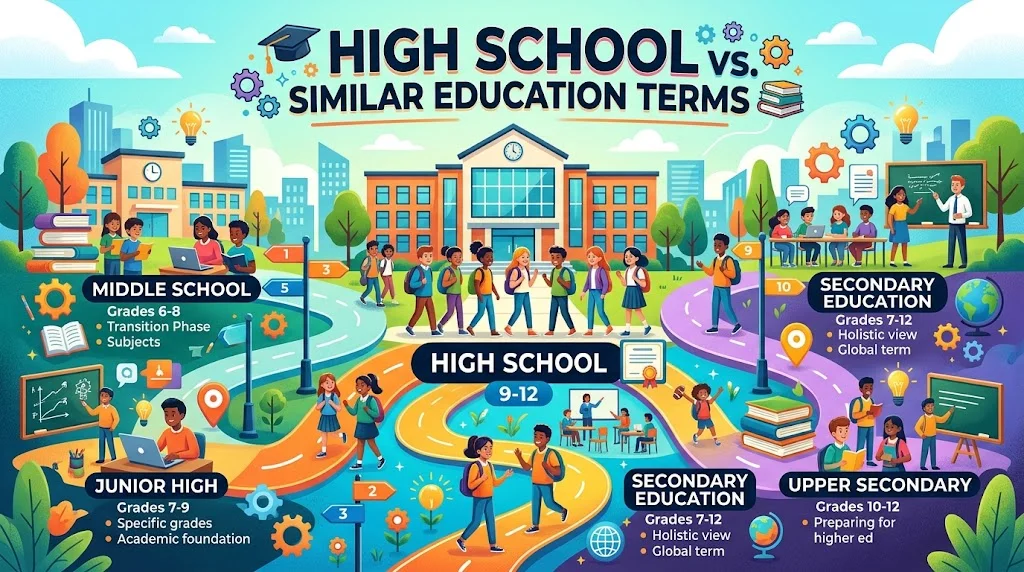
Understanding related terms makes the phrase easier to place in context.
High School vs. Middle School
Middle school generally comes before high school in the American education system.
For example:
“My daughter is finishing middle school this year.”
Then:
“She’ll start high school next year.”
Both phrases are written as two words.
High School vs. Secondary School
Secondary school is a broader term that commonly describes education after primary school.
In American English, people often use high school for a particular portion of secondary education.
Other English-speaking countries organize secondary education differently. As a result, the terms don’t always match perfectly.
High School vs. Junior High School
Junior high school is another term used in some American school systems.
Its grade structure varies. Some districts use middle school instead.
The important spelling point remains the same: high school is written separately.
High School vs. College
In the United States, high school generally comes before college.
For example:
“She graduated from high school before attending college.”
These are distinct stages of education.
“High School Diploma” or “Highschool Diploma”?
The correct expression is:
high school diploma
Not:
highschool diploma
The phrase contains a noun, diploma, modified by high school.
Examples:
- “He earned his high school diploma.”
- “She is completing the requirements for her high school diploma.”
- “The application asks whether you have a high school diploma.”
Should “High School Diploma” Be Capitalized?
Normally, no.
A generic credential is written in lowercase:
“She received her high school diploma.”
However, an institution may use a particular capitalization style in an official document or title.
Always follow the official wording when reproducing an institution’s exact name or document title.
Real-Life Examples of “High School”
Seeing the phrase in realistic sentences is often more useful than memorizing a rule.
Everyday Conversation
“What was your high school like?”
“I haven’t seen him since high school.”
“My cousin starts high school this fall.”
School Writing
“High school students often begin thinking about career options.”
“The project examines student experiences during high school.”
Professional Writing
“The applicant earned a high school diploma in 2024.”
“Please provide the name of your high school.”
News and Informational Writing
“The district announced changes affecting high school students.”
“The new program will begin at three local high schools.”
Personal Stories
“During high school, she developed an interest in journalism.”
“His high school years shaped his interest in engineering.”
Each example uses the same basic spelling.
Quick Test: Can You Spot the Correct Spelling?
Choose the correct form in each sentence.
A. She is a highschool student.
B. She is a high school student.
Answer: B
A. He received his highschool diploma.
B. He received his high school diploma.
Answer: B
A. I met her in high school.
B. I met her in highschool.
Answer: A
A. He teaches at Lincoln High School.
B. He teaches at Lincoln Highschool.
Answer: A, assuming Lincoln High School is the institution’s official name.
This quick test reveals the main rule: keep the space unless you’re reproducing a specific name or title that intentionally uses another form.
Easy Memory Trick for “High School”
Here’s an easy way to remember the spelling:
High school has a space, just like middle school.
Both phrases describe educational stages.
- high school
- middle school
Neither becomes one word in standard American English.
You can also remember the phrase as:
high + space + school
It sounds silly. That’s exactly why it works.
High School or Highschool: Correct Examples at a Glance
| Incorrect | Correct |
| highschool student | high school student |
| highschool teacher | high school teacher |
| highschool diploma | high school diploma |
| highschool graduation | high school graduation |
| highschool education | high school education |
| in highschool | in high school |
| highschool sports | high school sports |
| highschool years | high school years |
The pattern is consistent: high school remains two words.
Frequently Asked Questions
Is “high school” one word or two?
High school is two words. This is the standard spelling in American English when referring to secondary education.
Is “highschool” grammatically correct?
Highschool isn’t the standard spelling for ordinary references to secondary education. Use high school instead.
Why is “high school” written as two words?
English treats high school as an open compound. The two words work together as a standard phrase while retaining their separate forms.
Is high school capitalized?
Usually, no.
Write:
“I attend high school.”
Capitalize it when it’s part of an official name:
“I attend Lincoln High School.”
Should I write “High School” in a sentence?
Only when capitalization is justified by context.
Use lowercase for a general reference. Use capitals when the phrase belongs to an official institution name or follows a title-specific capitalization style.
Is “high school diploma” or “highschool diploma” correct?
High school diploma is correct.
The phrase remains two words.
Should “high school diploma” be capitalized?
Usually, no.
Write:
“She earned her high school diploma.”
Capitalize it only when a particular official title or document requires that treatment.
Is “high school student” correct?
Yes.
High school student is the standard phrase.
Is “high school teacher” correct?
Yes.
Write high school teacher, not highschool teacher.
Is “high school” hyphenated?
Usually, no. Standard American usage normally writes it as high school.
Is “middle school” one word?
No. Middle school is normally written as two words.
What does “high school” mean?
It generally refers to the later stage of secondary education. In the United States, it commonly includes grades 9 through 12, although school structures vary.
Is “high school” the same as “secondary school”?
Not always. The terms overlap, but secondary school can cover a broader range of education depending on the country.
Why does “High School Musical” use capital letters?
High School Musical is a specific title. Titles often capitalize important words according to title-style conventions.
Why does “Highschool of the Dead” use “Highschool” as one word?
Highschool of the Dead is a specific title that uses its own stylized spelling. A title’s spelling doesn’t establish a general English spelling rule.
Can “highschool” ever be correct?
It can occur as part of a specific name, title, username, or deliberate stylistic choice. For ordinary English writing, however, high school is the standard form.
How can I remember the correct spelling of high school?
Pair it with middle school. Both are normally written as two words:
high school
middle school
That simple association makes the spelling easy to remember.
Final Takeaway: High School or Highschool?
The answer is clear: high school is the standard spelling.
When you’re talking about the educational stage, use two words. This applies to phrases such as high school student, high school teacher, high school diploma, and high school graduation.
Remember these three points:
- High school = standard spelling.
- Highschool = generally nonstandard in ordinary English.
- High School = capitalized when used in an official name or appropriate title context.
For example:
Correct: “She is in high school.”
Correct: “She graduated from Lincoln High School.”
Incorrect: “She is in highschool.”
The internet may make highschool look familiar. Familiarity, however, isn’t the same as standard usage. When accuracy matters, keep the space.
High school is the safe, conventional choice for American English.


