
Flier vs Flyer is a common spelling question that can leave even confident writers second-guessing themselves. At first glance, the two words look almost identical. However, their meanings and common uses can change depending on the context, audience, and style guide you follow. Both flier and flyer are recognized forms in standard English, so calling one universally wrong would be misleading.
In everyday American English, flyer is especially common when referring to a promotional advertisement, printed handbill, event advertisement, or marketing material. You might create a business flyer, distribute a sales flyer, or download a digital flyer. Meanwhile, flier appears in expressions such as take a flier, which means taking a risk or chance. It can also refer to a person who flies, although usage varies among major English style guides.
The distinction becomes even more interesting when comparing AP Style, the Chicago Manual of Style, and major dictionaries. These authorities don’t always recommend the same spelling for every meaning.
Understanding flier vs flyer therefore isn’t about memorizing a single rule. It’s about recognizing the meaning, choosing the appropriate spelling, and maintaining consistent usage throughout your writing.
Flier vs Flyer: Quick Answer
Both flier and flyer are accepted English spellings. Neither should automatically be treated as a misspelling.
Here’s the practical distinction:
| Spelling | Common use | Example |
| flier | Someone or something that flies in some editorial styles | “She’s an experienced flier.” |
| flier | A risky or speculative attempt | “He took a flier on the new company.” |
| flyer | Promotional handbill or advertisement | “The store distributed a flyer.” |
| flyer | Person who flies in some styles and common expressions | “She’s a frequent flyer.” |
For everyday American writing, flyer is particularly familiar in marketing and advertising.
You might see a concert flyer, restaurant flyer, event flyer, or sales flyer. At the same time, flier remains perfectly legitimate in other contexts.
The safest rule is simple: look at the meaning first, then follow the style guide if one applies.
What Does “Flier” Mean?
Flier is a noun with several established uses. It can describe a person or thing that flies, although some style guides prefer “flyer” for that meaning.
It also appears in a well-established idiom: take a flier.
Understanding these meanings makes the flier vs flyer distinction much easier.
Flier as a Person Who Flies
A flier can mean a person who flies, particularly in contexts where that spelling is preferred by a dictionary, publication, or style guide.
For example:
“The experienced flier remained calm during the turbulent flight.”
Here, flier refers to someone who travels by air.
However, don’t assume every publication will use this spelling. Frequent flyer is an extremely familiar expression in American English, even though other editorial systems may prefer “frequent flier.”
That’s why context and house style matter.
Flier as Someone or Something That Flies
The word can also describe someone or something capable of flying.
For example:
- “The eagle is an impressive flier.”
- “The young bird is already a strong flier.”
- “She became a confident flier after years of travel.”
This meaning connects naturally with the verb fly.
Yet here’s where English gets messy in a perfectly normal way: flyer can carry the same general meaning in some sources and style systems.
English doesn’t always provide one spelling for every meaning.
Flier in the Expression “Take a Flier”
One of the clearest uses of flier appears in the phrase take a flier.
This expression means to take a chance or make a speculative attempt.
For example:
“The investor decided to take a flier on the small technology company.”
The person isn’t literally flying anywhere.
Instead, the expression describes taking a risk or chance.
Other examples include:
- “She took a flier on the new restaurant.”
- “He took a flier and applied for the unusual job.”
- “The company took a flier on an untested product.”
- “I decided to take a flier on the cheaper option.”
This idiomatic use is one reason you shouldn’t assume that “flyer” can replace “flier” in every sentence.
Examples of “Flier” in Sentences
Here are several natural examples:
- She is a confident flier despite her dislike of turbulence.
- The eagle is an impressive flier.
- He took a flier on the new business.
- The company took a flier on an unconventional marketing idea.
- She became a frequent flier after taking a job that required international travel.
Whether the first, second, or fifth example uses flier depends partly on the style system being followed.
What Does “Flyer” Mean?
Flyer is also a standard English word. In modern American English, one of its most recognizable meanings is a printed or digital advertisement.
Think of the sheet you see on a community bulletin board advertising a concert, restaurant special, garage sale, class, or local event.
That’s a flyer.
Flyer as an Advertisement or Handbill
A flyer is commonly a short promotional or informational document designed to attract attention.
It may be printed on paper or distributed digitally.
Common examples include:
- Event flyer
- Restaurant flyer
- Sales flyer
- Product flyer
- Business flyer
- Real estate flyer
- School event flyer
- Promotional flyer
- Digital flyer
- Workshop flyer
For example:
“The restaurant created a colorful flyer announcing its weekend special.”
Here, flyer is the natural choice for most modern American readers.
Flyer as a Person Who Flies
“Flyer” isn’t limited to advertising.
It can also refer to someone who flies. That’s especially visible in the common expression frequent flyer.
For example:
“She’s a frequent flyer who spends several weeks each year traveling for work.”
This usage is widely recognized in American English.
Some style guides distinguish flier and flyer more sharply. Others use flyer for both aviation and advertising contexts.
Therefore, the presence of “flyer” in an aviation sentence doesn’t make it incorrect.
Flyer in Aviation and Travel
The phrase frequent flyer is particularly common.
Airlines often call their loyalty programs frequent flyer programs, and travelers commonly describe themselves as frequent flyers.
You’ll also encounter phrases such as:
- frequent flyer
- frequent flyer miles
- frequent flyer program
- flyer benefits
- airline flyer
This is a useful reminder that flyer doesn’t only mean an advertisement.
Examples of “Flyer” in Sentences
Consider these examples:
- The business printed 500 flyers for the grand opening.
- The event flyer includes the venue and start time.
- She designed a flyer for the weekend sale.
- He’s a frequent flyer because of his consulting job.
- The airline offers special benefits to frequent flyers.
The intended meaning becomes obvious from the surrounding words.
Flier vs Flyer: What’s the Actual Difference?
The biggest mistake is treating this as a simple right-versus-wrong spelling debate.
It isn’t.
Both words exist in standard English. The distinction becomes clearer when you examine their meanings and editorial conventions.
Flier vs Flyer Meaning Comparison
| Context | Flier | Flyer |
| Promotional advertisement | Less common | Very common |
| Printed handbill | Sometimes used | Common |
| Digital advertisement | Sometimes used | Common |
| Person who flies | Used by some style guides | Common in American usage |
| Thing that flies | Used by some style guides | Also used |
| “Take a ___” meaning take a risk | Flier | Not the usual form |
| Frequent airline traveler | Used in some usage | Flyer is very common |
The table reveals something important.
There isn’t one universal rule that works in every situation.
When the Two Spellings Mean the Same Thing
In some contexts, flier and flyer function as spelling variants.
For example, a writer might describe someone who flies as a flier, while another writer uses flyer.
Both forms can be found in reputable English usage.
The difference may reflect:
- A style guide
- Regional preference
- Industry convention
- Historical usage
- Personal preference
- An organization’s house style
This is common in English. Similar variation appears in many words where multiple accepted forms have developed over time.
When the Spelling Helps Signal the Meaning
Sometimes the spelling can make the intended meaning immediately clearer.
Compare:
“The company distributed a flyer.”
Most readers will understand that the company distributed an advertisement.
Now compare:
“He took a flier on the business.”
The second sentence uses the established idiom meaning that he took a chance.
The spelling helps distinguish the two expressions.
Why Context Matters More Than the Spelling
You don’t usually understand flyer or flier in isolation.
The surrounding words do much of the work.
Compare:
- event flyer
- frequent flyer
- take a flier
- experienced flier
- digital flyer
- young flier
The context makes the intended meaning clear.
That’s why writers shouldn’t obsess over finding one spelling that works everywhere.
Why Do Both “Flier” and “Flyer” Exist?
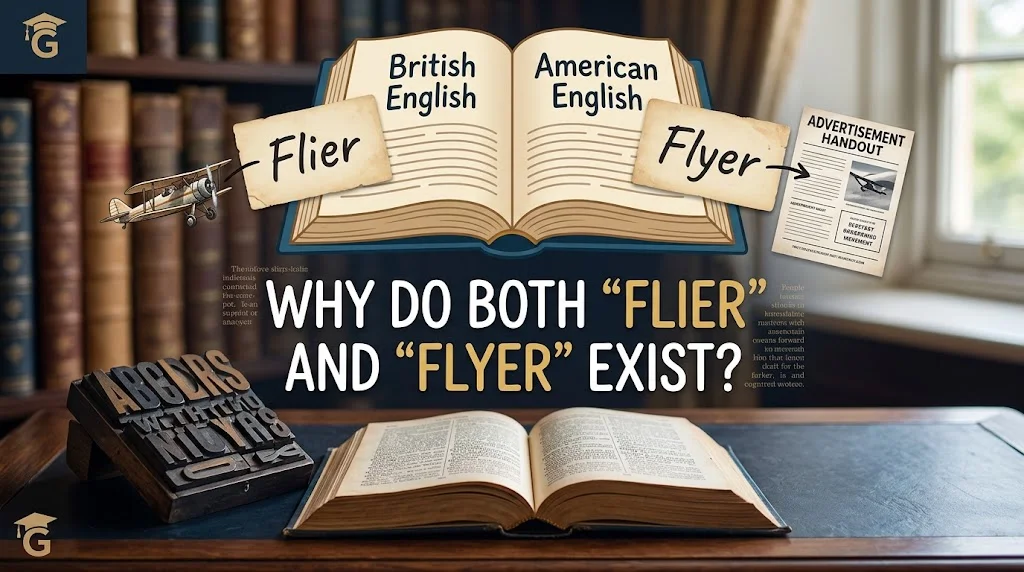
English spelling has never been completely tidy.
Words evolve through pronunciation, writing habits, regional conventions, publishing practices, and analogy with other words. Competing forms can survive for centuries.
The Development of the Two Spellings
Both forms are connected to the verb fly and the noun-forming suffix -er.
At first glance, flier may seem more natural because it follows the spelling pattern of changing fly to fli- before adding the suffix.
Yet flyer also developed and became firmly established.
Once a spelling becomes widespread in books, newspapers, advertising, and everyday speech, it can become difficult to dislodge.
That’s exactly what happened here.
Why “Flyer” Became Common in Advertising
Advertising helped make flyer highly visible.
A flyer is inexpensive to create and distribute. Businesses, schools, event organizers, community groups, and retailers have used flyers for decades.
That created a strong association between flyer and promotional material.
Today, the word covers both traditional paper advertisements and digital versions.
You can create:
- A PDF flyer
- An email flyer
- A social media flyer
- A printable flyer
- A digital event flyer
The medium doesn’t change the basic word.
Why “Flier” Remains in Standard Usage
The continued existence of flier isn’t accidental.
Dictionaries recognize it, and major style authorities continue to discuss it. The spelling also survives in established expressions such as take a flier.
Language doesn’t always eliminate an older or less common spelling simply because another form becomes more widespread.
Sometimes both forms remain useful.
Read More: Appreciate It or Appreciated It? Meaning, Grammar, and Correct Usage
Flier vs Flyer in Major Style Guides and Dictionaries
When a question involves competing spellings, style guides become especially useful.
However, style guides don’t always agree.
That isn’t necessarily a problem. A style guide is an editorial system designed to create consistency.
Associated Press Style
The Associated Press has a particularly useful distinction.
AP’s published guidance says to use flyer for a person who flies and for a handbill. It uses flier in the expression “take a flier.”
That means an AP-style writer might write:
“She is a frequent flyer.”
But:
“The investor took a flier on the company.”
The distinction comes from AP’s editorial preference rather than from a claim that the other spelling is universally wrong.
Source: Associated Press Stylebook
Merriam-Webster
Merriam-Webster recognizes both flier and flyer.
Its dictionary treatment is useful because it demonstrates that neither spelling should automatically be dismissed as an error.
When using a dictionary, pay attention to the definitions and examples rather than looking only for a “preferred” label.
A dictionary tells you how a word is recognized and used. A style guide may go further by telling writers which form to choose in a particular publication.
Those are different jobs.
Source: Merriam-Webster
Oxford English Dictionary
The Oxford English Dictionary provides historical documentation of English words and their development.
Its value here lies partly in showing that competing spellings aren’t necessarily modern mistakes. English has long allowed variation in spelling.
However, historical evidence shouldn’t automatically be treated as evidence about current American usage.
A word can have a long history while its modern frequency and preferred contexts change.
Source: Oxford English Dictionary
Chicago Manual of Style
Chicago makes a useful distinction between the two forms.
Its current guidance recommends flier for someone or something that flies and flyer for an advertising circular.
So under this approach:
- frequent flier
- experienced flier
- bird flier
- event flyer
- advertising flyer
This is different from AP’s approach.
Chicago’s guidance demonstrates an important point: professional style authorities can disagree while still recognizing both words as legitimate English.
Source: Chicago Manual of Style
What the Style Guides Actually Show
Here’s the practical comparison:
| Source | Person/thing that flies | Advertisement/handbill | “Take a risk” |
| AP | Flyer | Flyer | Flier |
| Chicago | Flier | Flyer | Flier |
| General usage | Flier or flyer | Usually flyer | Flier |
| Dictionaries | Both forms are recognized | Flyer is established | Flier is established |
The lesson isn’t that one organization is right and another is wrong.
The lesson is that style choices can vary even when the underlying English is valid.
Flier vs Flyer in American English
American English frequently uses flyer in places where another editorial system might choose flier.
The most obvious example is frequent flyer.
You probably encounter that expression regularly in airline websites, loyalty programs, travel writing, and everyday conversation.
Which Spelling Is Common in Everyday Writing?
The answer depends on the specific meaning.
For promotional material, flyer is the familiar modern choice:
“Download our event flyer.”
For a risky attempt, flier is standard:
“He took a flier on the new business.”
For someone who flies, both forms appear.
That last category is where style guides become particularly useful.
Common American Expressions
Some common expressions include:
- frequent flyer
- frequent flier
- event flyer
- sales flyer
- take a flier
- promotional flyer
- digital flyer
Notice that the two forms don’t behave identically in every phrase.
You shouldn’t mechanically replace every flyer with flier.
Regional and Editorial Variation
Spelling preferences can vary between countries, publications, and organizations.
British English, American English, journalism, academic writing, advertising, and corporate communication may all develop different conventions.
That’s why a writer should first ask:
Who am I writing for?
Then ask:
Does that audience or publication follow a particular style guide?
Those two questions often solve the problem immediately.
Flier vs Flyer in Marketing and Advertising
When you’re talking about promotional material, flyer is usually the clearest choice.
A flyer can advertise almost anything.
Why “Flyer” Is Common for Promotional Material
Businesses use flyers because they’re flexible and inexpensive.
A single page can communicate:
- A product offer
- A discount
- An event date
- A store opening
- A class schedule
- A service
- Contact information
- A call to action
For example:
“The gym distributed flyers advertising its new membership offer.”
Calling that material a flier isn’t necessarily incomprehensible. However, flyer is the more familiar term for many American readers.
Printed Flyer vs Digital Flyer
A flyer doesn’t have to be printed.
Modern usage includes digital promotional materials.
For example:
“The designer created a digital flyer for the online workshop.”
You might receive a flyer as:
- A PDF
- An image
- An email attachment
- A social media graphic
- A web page
- A printable document
The basic concept remains the same.
Choosing the Spelling for Business Content
If you’re writing business content, consistency matters.
Suppose a company’s website calls its promotional material flyers.
Switching randomly between flyers and fliers can make the website look inconsistent.
A practical approach is:
- Check the company’s existing terminology.
- Check the required editorial style.
- Consider the intended audience.
- Choose the appropriate form.
- Use it consistently.
Good editing isn’t about changing every possible variant into one spelling.
It’s about making deliberate choices.
Flier vs Flyer: Common Examples Compared
The following examples show how context changes the choice.
| Sentence | Why it works |
| The store printed 2,000 flyers. | Promotional material |
| She designed a flyer for the concert. | Event advertisement |
| He’s a frequent flyer. | Common aviation expression |
| She’s an experienced flier. | Person who flies under styles preferring “flier” |
| The eagle is a powerful flier. | Thing that flies under a “flier” convention |
| He took a flier on the startup. | Idiom meaning took a chance |
| The company emailed customers a digital flyer. | Digital promotional material |
| She became a frequent flier because of her job. | Aviation usage under a style favoring “flier” |
The important point is that context determines the best spelling.
Common Mistakes With Flier and Flyer
These words cause several predictable mistakes.
Assuming “Flier” Is Incorrect
This is perhaps the most common misconception.
Flier is not simply a misspelling of flyer.
It is a recognized English word with established meanings and uses.
If someone writes:
“He took a flier on the business.”
changing flier to flyer would not improve the sentence under standard usage.
Assuming “Flyer” Only Means an Advertisement
This mistake goes in the opposite direction.
Flyer can refer to someone who flies.
The phrase frequent flyer is a familiar example.
Therefore, defining “flyer” exclusively as a promotional sheet gives readers an incomplete picture.
Treating One Style Guide as Universal
AP isn’t the same thing as Chicago.
A publication following AP may make a different spelling choice from a publication following Chicago.
Neither approach requires declaring the other form an English error.
Instead, writers should follow the style required by their publication.
Switching Between Spellings Without a Reason
Imagine an article that uses:
“event flyer”
in one paragraph, then:
“event flier”
in another, and later:
“promotional flyer.”
That inconsistency can distract readers.
If both forms are technically accepted, consistency becomes even more important.
Changing a Quotation or Official Name
If a quotation, title, product name, organization name, or other official wording uses a particular spelling, don’t casually rewrite it.
For example, if an organization’s official publication is titled Community Flyer, preserve that name.
Proper names have their own conventions.
How to Choose Between Flier and Flyer

You can make the decision quickly once you know the context.
Use “Flyer” When Referring to Promotional Material
Choose flyer for most modern references to advertising handbills.
Examples:
- Event flyer
- Sales flyer
- Restaurant flyer
- Product flyer
- Business flyer
- Promotional flyer
- Digital flyer
For instance:
“Please download the event flyer before Friday.”
That’s clear and natural.
Use “Flier” When Your Style Guide Calls for It
If your publication follows a style guide that distinguishes flier for someone or something that flies, follow that rule.
Chicago is a notable example.
This is especially important in professional editing, journalism, academic publishing, and corporate communications.
Use the Established Form in a Fixed Expression
Some expressions have a conventional spelling.
The clearest example is:
take a flier
For example:
“The entrepreneur took a flier on the new technology.”
Using flier preserves the established expression.
When Either Form May Be Acceptable
If you’re writing ordinary prose without a required style guide, context gives you flexibility.
For a person who flies, flier and flyer can both be encountered.
In such cases, choose the form that best fits your audience and maintain consistency.
Flier vs Flyer for SEO and Online Content
Writers sometimes worry that using flier instead of flyer will automatically damage SEO.
That concern needs some perspective.
Search optimization should start with search intent and useful content, not keyword stuffing.
Does Google Treat “Flier” and “Flyer” as Different Words?
Search engines can encounter spelling variants and understand that related terms may refer to the same concept.
However, it’s not useful to make unsupported claims about a specific ranking preference for one spelling.
Instead, build the page around the user’s actual question.
Someone searching “flier vs flyer” probably wants to know:
- Whether both spellings are correct
- What each word means
- Which spelling is used for advertisements
- Which spelling appears in aviation
- Whether style guides disagree
- Which form they should use
Answer those questions directly.
Should You Use Both Spellings for SEO?
Yes, when both are genuinely relevant.
No, when you’re forcing them into every paragraph.
A natural article might use:
- flier vs flyer
- flyer or flier
- flier or flyer
- event flyer
- frequent flyer
- frequent flier
- take a flier
But each term should appear because it helps explain the topic.
Don’t write awkward sentences simply to insert a keyword variant.
Readers notice that quickly.
Should You Target “Flier vs Flyer” as a Keyword?
The phrase has clear informational intent.
A useful article can naturally cover related searches such as:
- flier vs flyer
- flyer vs flier
- flier or flyer
- flyer or flier
- is flier correct
- is flyer correct
- frequent flier vs frequent flyer
- event flier vs event flyer
- flier meaning
- flyer meaning
The goal isn’t to repeat these phrases mechanically.
Instead, answer the underlying questions.
A Simple Decision Guide for Flier vs Flyer
Still unsure?
Use this quick guide.
Are you talking about an advertisement?
→ Flyer is the natural choice.
Are you using the expression meaning “take a chance”?
→ Flier.
Are you talking about someone or something that flies?
→ Check your style guide. Flier and flyer are both used.
Are you writing for a publication with a house style?
→ Follow that style.
Are you writing ordinary American English without a specific style requirement?
→ Choose the form that best fits your context and audience.
Quick Decision Table
| Your meaning | Practical choice |
| Advertisement | Flyer |
| Event advertisement | Flyer |
| Sales handbill | Flyer |
| Digital promotion | Flyer |
| “Take a chance” | Flier |
| Person who flies | Flier or flyer, depending on style |
| Thing that flies | Flier or flyer, depending on style |
| Frequent airline traveler | Flyer is very common; follow house style |
Flier vs Flyer Examples You Can Copy
Sometimes the easiest way to understand a spelling distinction is to see it in action.
Examples With “Flier”
She is an experienced flier who travels internationally every month.
Here, “flier” refers to a person who flies.
The eagle is an excellent flier.
Here, it describes something capable of flying.
He took a flier on the new restaurant.
Here, “flier” appears in the established expression meaning he took a chance.
The company took a flier on an experimental product.
Again, the word describes a speculative attempt.
Examples With “Flyer”
The business printed 1,000 flyers for its opening weekend.
Here, the flyers are promotional materials.
She created an attractive flyer for the community event.
The word refers to an advertisement.
The restaurant handed out flyers outside the shopping center.
Again, these are printed promotional materials.
He’s a frequent flyer who travels for work.
Here, “flyer” refers to an airline traveler.
Examples Showing Both Spellings
Consider these pairs:
Promotional material:
“The company printed a flyer for the sale.”
Risk-taking expression:
“The investor took a flier on the company.”
Now compare aviation usage:
“She is a frequent flyer.”
versus:
“She is a frequent flier.”
Both can be encountered, but the preferred form depends on the editorial system.
This is precisely why a blanket rule such as “always use flyer” isn’t reliable.
Flier vs Flyer: Frequently Asked Questions
Is “Flier” or “Flyer” Correct in 2026?
Both are correct English spellings. The preferred form depends on meaning, usage, and style.
For promotional material, flyer is the common modern choice. Flier remains standard in expressions such as take a flier and is preferred for some aviation meanings by certain style guides.
Is “Flier” a Correct English Word?
Yes. Flier is a standard English word.
It can refer to someone or something that flies, depending on the usage system. It also appears in the established phrase take a flier, meaning to take a chance.
Is “Flyer” a Correct English Word?
Yes. Flyer is also a standard English word.
It commonly means a promotional handbill or advertisement. It can also refer to someone who flies, as in frequent flyer.
Is “Flyer” More Common for Advertising?
Yes. Flyer is the familiar spelling for advertising material in modern American English.
You commonly see phrases such as:
- event flyer
- sales flyer
- promotional flyer
- business flyer
- digital flyer
Is “Frequent Flyer” or “Frequent Flier” Correct?
Both forms occur.
Frequent flyer is especially common in American English and aviation-related language. Some style guides prefer frequent flier when referring to a person who flies.
The appropriate choice depends on the publication’s style.
Which Spelling Does AP Style Prefer?
AP’s published guidance uses flyer for a person who flies and for a handbill. It uses flier in take a flier.
That makes AP’s treatment somewhat different from Chicago’s.
Source: Associated Press Stylebook
What Does the Chicago Manual of Style Recommend?
Chicago distinguishes the terms by meaning.
Its current guidance uses flier for someone or something that flies and flyer for an advertising circular.
Source: Chicago Manual of Style
Should I Write “Event Flyer” or “Event Flier”?
Event flyer is the practical choice for most American English readers because it clearly identifies a promotional handbill.
If your organization follows a style guide that requires another form, follow that guide.
Is “Take a Flier” Correct?
Yes.
Take a flier is an established expression meaning to take a chance or make a speculative attempt.
For example:
“She decided to take a flier on the new business.”
Can “Flier” and “Flyer” Be Used Interchangeably?
Not always.
They overlap in some meanings, especially when referring to someone or something that flies. However, flyer is strongly associated with advertisements, while flier is established in the expression take a flier.
Context should guide your choice.
Does the Spelling Change in British English?
Usage can vary across varieties of English.
British and American English sometimes differ in spelling preferences, and individual publications can establish their own conventions.
If you’re writing specifically for a British audience, check a British dictionary or the publication’s style guide rather than assuming American usage applies unchanged.
Which Spelling Should I Use in Professional Writing?
Follow the style guide used by your employer, publisher, client, or publication.
If no specific style applies, use flyer for promotional material and choose consistently for other meanings.
The key is not to treat one spelling as universally mandatory.
Does Using “Flier” Instead of “Flyer” Hurt SEO?
There is no good reason to assume that simply using the accepted spelling flier creates an automatic SEO penalty.
For online content, focus on satisfying the reader’s search intent. Use both variants naturally when they’re relevant to the subject.
For example, an article targeting flier vs flyer can naturally explain flyer meaning, flier meaning, frequent flyer, and take a flier.
Flier vs Flyer: Final Takeaway
The flier vs flyer debate doesn’t have a single answer that works for every sentence.
Both spellings are legitimate.
The most useful practical distinction is this:
Use “flyer” for promotional material.
“The company printed a flyer for the event.”
Use “flier” in the established expression “take a flier.”
“The investor took a flier on the startup.”
For someone or something that flies, flier and flyer are both found in standard usage. That’s where style guides can make a difference.
AP uses flyer for a person who flies, while Chicago recommends flier for someone or something that flies. Both approaches recognize flyer as the advertising form and flier in the “take a flier” expression.
So, rather than asking only, “Which spelling is correct?”, ask a better question:
“Which spelling fits this meaning and the style I’m following?”
That approach works in professional writing, websites, marketing materials, academic work, and everyday communication.
When in doubt, remember the simplest rule: a promotional flyer, a risky flier, and a style-dependent flying flier or flyer. Once you see the context, the spelling becomes much easier to choose.