If you’ve ever hesitated over totalling vs totaling, you’re not alone. Both spellings appear in dictionaries, professional writing, and everyday English. The difference isn’t about meaning. It comes down mainly to British English vs. American English spelling conventions.
The short answer is simple:
- Totalling is the standard British English spelling.
- Totaling is the standard American English spelling.
- Both forms mean adding things together to reach a total.
- Neither spelling changes the meaning of the word.
- Your choice should match the English variety you’re using.
For example, a British writer might say, “The expenses are totalling £2,500.” An American writer would normally write, “The expenses are totaling $2,500.”
The distinction becomes more interesting when you look at why the extra l appears. It connects to a broader difference between British and American spelling, which also affects words such as travelling/traveling, labelling/labeling, and cancelled/canceled.
Let’s break down the difference so you can choose the right spelling confidently.
Totalling vs Totaling: What’s the Difference?
Totalling and totaling are two spellings of the same word form. Both come from the verb total, which means to add amounts together or reach a particular sum.
The main distinction is geographical.
| Spelling | Common English variety | Meaning |
| Totalling | British English | Adding amounts together or reaching a total |
| Totaling | American English | Adding amounts together or reaching a total |
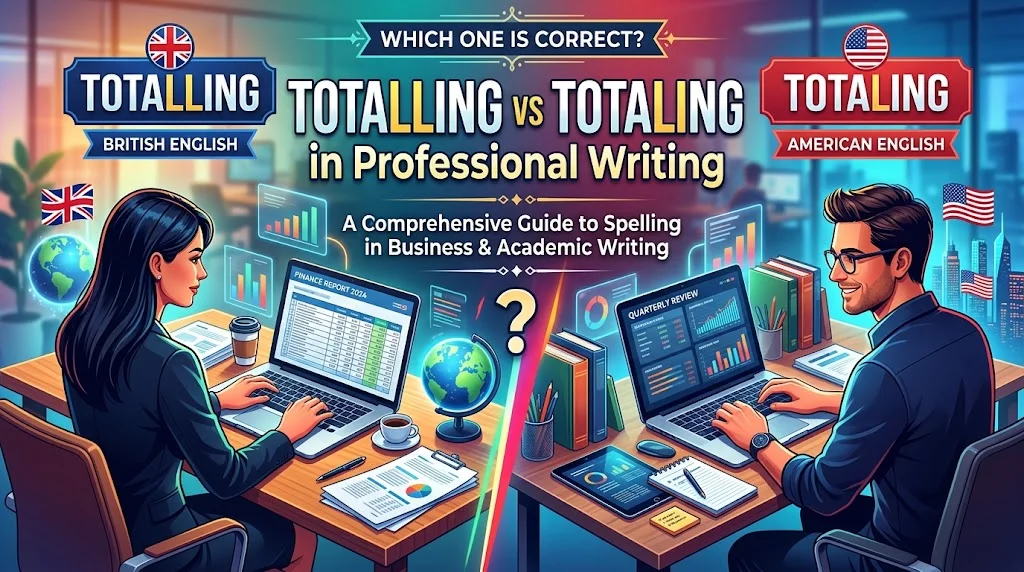
So, if you’re writing for a British audience, totalling is the natural choice. If you’re writing for an American audience, totaling is generally preferred.
Totalling and Totaling Have the Same Meaning
Neither spelling represents a different action.
Consider these two sentences:
The repair costs are totalling £4,000.
The repair costs are totaling $4,000.
The spelling changes, but the underlying meaning remains the same. In both sentences, the costs are reaching a combined amount.
You can think of the two forms like colour and color. The regional spelling differs, but the word itself doesn’t suddenly acquire a new meaning.
Totalling Is Mainly British English
Totalling follows the spelling convention commonly used in British English.
You’ll encounter it in British newspapers, reports, educational materials, business documents, and other forms of writing.
For example:
- The expenses are totalling £1,850.
- The project costs are totalling more than £20,000.
- The damages are totalling several thousand pounds.
- The team’s points are totalling 75.
Totaling Is Standard American English
American English generally uses totaling with one l.
Examples include:
- The expenses are totaling $1,850.
- The repairs are totaling more than $20,000.
- The damages are totaling several thousand dollars.
- The team’s points are totaling 75.
The pronunciation remains essentially the same. The spelling is what changes.
What Does Totalling Mean?
Totalling is the present participle of the verb total in the spelling convention commonly used in British English.
The verb total has several related uses. One common meaning is to calculate the complete amount of something.
For example:
The invoices are totalling £6,400.
Here, totalling describes the combined value of the invoices.
The word can also describe something reaching a particular amount:
The crowd is totalling more than 10,000 people.
In another context, total can mean to damage something severely, especially a vehicle. The related form can therefore appear in sentences such as:
The accident left the car totalled.
That meaning is different from simply adding figures together, even though the spelling comes from the same root word.
Examples of Totalling in a Sentence
Here are several natural examples:
- The bills are totalling nearly £3,000.
- Her expenses are totalling £850 this month.
- The company’s losses are totalling millions of pounds.
- The receipts are totalling more than expected.
- The two invoices are totalling £1,250.
- The team’s scores are totalling 96 points.
- The repairs are totalling £4,500.
- The purchases are totalling £275.
Notice the pattern. In each example, totalling describes a combined or accumulated amount.
Totalling in British English
If the rest of your writing follows British spelling, totalling usually fits naturally with it.
For instance, a British document might contain:
The travelling expenses are totalling £1,200.
That sentence uses travelling and totalling, both of which fit the common British spelling pattern.
By contrast, an American document would typically use:
The traveling expenses are totaling $1,200.
The regional spelling is consistent throughout the sentence.
What Does Totaling Mean?
Totaling is the American English spelling of the same present participle.
It has the same meaning as totalling. The difference is simply the spelling convention.
For example:
The monthly expenses are totaling $2,450.
This means that the combined expenses amount to $2,450.
Examples of Totaling in American English
Here are some common examples:
- The receipts are totaling $450.
- The repairs are totaling $3,200.
- The expenses are totaling more than $5,000.
- The team’s points are totaling 82.
- The invoices are totaling $12,750.
- The damages are totaling thousands of dollars.
- The purchases are totaling nearly $900.
- The costs are totaling more than we expected.
These examples demonstrate that totaling works naturally in financial, academic, business, statistical, and everyday contexts.
Totaling vs. Other Forms of Total
Understanding the word family makes the spelling difference easier to remember.
| Form | Example |
| total | We need to total the expenses. |
| totals | The report totals the costs. |
| totaled | The expenses totaled $5,000. |
| totaling | The expenses are totaling $5,000. |
In British English, you may instead encounter:
| American English | British English |
| totaled | totalled |
| totaling | totalling |
This distinction is important because the spelling pattern affects more than just the -ing form.
Why Does British English Spell It “Totalling”?
The extra l isn’t random. It reflects a broader spelling convention found in British English.
When certain words ending in l take suffixes such as -ed or -ing, British English often doubles the final l.
That gives us forms such as:
- total → totalled → totalling
- travel → travelled → travelling
- label → labelled → labelling
- model → modelled → modelling
American English often uses one l in these forms:
- total → totaled → totaling
- travel → traveled → traveling
- label → labeled → labeling
- model → modeled → modeling
The British English Doubling Pattern
The easiest way to understand totalling is to view it as part of this larger spelling pattern.
The base word is:
total
Add -ing, and British English commonly produces:
totalling
The final l becomes doubled.
This isn’t because British speakers pronounce the word differently. The difference is primarily orthographic, meaning it concerns written spelling.
Total → Totalled → Totalling
Here’s the pattern side by side:
| Base word | British English | American English |
| total | totalled | totaled |
| total | totalling | totaling |
This gives you a useful memory trick:
British English: total + extra L = totalling
American English: total + one L = totaling
Of course, English spelling has plenty of exceptions and complications. Still, this pattern works well for totaling/totalling.
Related British Spellings
The same regional difference appears in several familiar words.
| British English | American English |
| travelling | traveling |
| labelling | labeling |
| modelling | modeling |
| cancelled | canceled |
| totalled | totaled |
| totalling | totaling |
This comparison reveals an important point: totalling vs totaling isn’t an isolated spelling disagreement. It belongs to a larger family of British and American spelling differences.
Why Does American English Spell It “Totaling”?

American English generally follows a different convention for words like total when forming their -ing and -ed versions.
Instead of doubling the final l, American spelling usually keeps one l:
total → totaling
and:
total → totaled
This is why totaling looks different from totalling, even though both forms come from exactly the same verb.
The American Single-L Pattern
Compare these examples:
- traveling
- labeling
- modeling
- totaling
The single l is a familiar feature of American spelling.
For an American reader, totaling looks completely ordinary. In fact, totalling may stand out as a British spelling.
Total → Totaled → Totaling
The American pattern is straightforward:
total + ing = totaling
The final l stays single.
Likewise:
total + ed = totaled
That gives you this simple comparison:
British English
total → totalled → totalling
American English
total → totaled → totaling
The pronunciation doesn’t provide much help because the two forms generally sound alike. When you’re writing, you need to choose the spelling that matches your regional style.
Read More: Persue or Pursue? Learn the Correct Spelling of Pursue
Totalling vs Totaling: Side-by-Side Comparison
A quick comparison can make the distinction crystal clear.
| Question | Totalling | Totaling |
| Is it a word? | Yes | Yes |
| Is it grammatically valid? | Yes | Yes |
| Common regional use | British English | American English |
| Meaning | Adding to a total | Adding to a total |
| Root word | total | total |
| Ending | -ing | -ing |
| Final spelling | ll | l |
| Pronunciation | Essentially the same | Essentially the same |
Which Spelling Should You Use?
The answer depends on your audience and your chosen English variety.
If you’re writing in American English, use:
totaling
If you’re writing in British English, use:
totalling
For example, an American financial report might say:
The outstanding invoices are totaling $18,500.
A British report might say:
The outstanding invoices are totalling £18,500.
Neither sentence needs correction merely because it uses one spelling rather than the other.
Is Either Spelling Wrong?
No.
Calling totalling universally wrong would be inaccurate. Calling totaling universally wrong would be just as misleading.
The forms belong to different spelling conventions.
Think of it this way:
The problem isn’t choosing the “correct” spelling in isolation. The problem is choosing a spelling that doesn’t match the style of the document.
If you’re writing a US-focused article, totaling is the natural choice. If you’re producing UK-focused content, totalling is generally the better fit.
The Grammar and Spelling Rule Behind Totalling and Totaling
It’s helpful to separate grammar from spelling.
Grammatically, both totalling and totaling perform the same job. The difference appears in spelling conventions rather than grammatical function.
Adding -ing to Total
The base verb is:
total
The -ing form is:
totalling or totaling
The form can function as part of a verb phrase:
The expenses are totaling $4,000.
It can also appear as a participle in other constructions:
The company reported expenses totaling $4,000.
The grammatical role stays the same regardless of whether you write totaling or totalling.
British English and Double L
British English commonly doubles the final l in this type of word.
So:
total → totalling
This same pattern appears in words such as travelling and labelling.
American English and Single L
American English generally retains one l:
total → totaling
Again, the same broad distinction appears in words such as traveling and labeling.
Why the Two Spellings Developed
British and American English developed different spelling preferences over time.
American spelling was influenced by efforts to simplify and regularize certain spellings. British English retained many traditional spelling patterns that differ from those commonly used in the United States.
That’s why modern English contains pairs such as:
- colour / color
- favour / favor
- centre / center
- travelling / traveling
- labelled / labeled
- totalling / totaling
These differences don’t mean that one variety is “better.” They reflect different conventions within the same language.
Totalling vs Totaling in Real Sentences
Seeing the words in context makes the distinction much easier to remember.
Business and Finance Examples
British English:
The quarterly expenses are totalling £75,000.
American English:
The quarterly expenses are totaling $75,000.
Another example:
The invoices are totalling £12,450.
or:
The invoices are totaling $12,450.
The structure remains the same. Only the spelling and, in these examples, the currency change.
Education and Mathematics Examples
A teacher might describe a student’s accumulated scores:
Her test scores are totalling 94 points.
In American English:
Her test scores are totaling 94 points.
The word can also describe quantities:
The collected measurements are totalling 150 units.
The key idea is always combining separate amounts into one total.
Statistics and Reports
The word also works well in reports:
The survey responses are totalling 3,500 participants.
Or in American English:
The survey responses are totaling 3,500 participants.
In formal reporting, consistency matters more than trying to include both spellings.
Everyday Examples
You don’t need a financial report to use the word.
Consider these examples:
- The groceries are totaling $175.
- The hotel charges are totaling $900.
- The repairs are totalling £600.
- The household bills are totalling £1,100.
- The purchases are totaling more than $300.
The context can change. The spelling rule doesn’t.
Common Mistakes With Totalling and Totaling
Most mistakes happen because writers mix regional spelling systems.
Using Totalling in American English
If you’re writing standard American English, totaling is normally the expected form.
For example:
The expenses are totaling $2,500.
Using totalling isn’t a different grammatical construction. However, it introduces a British-style spelling into otherwise American writing.
Using Totaling in British English
The reverse can happen in British writing.
If your document consistently uses forms such as:
- travelling
- labelling
- cancelled
then totalling generally fits that style better than totaling.
Consistency creates a smoother reading experience.
Treating the Two Spellings as Different Words
This is one of the easiest mistakes to make.
Totalling and totaling don’t have different meanings.
They are regional spelling variants of the same form.
You shouldn’t define them as two separate vocabulary words simply because one has an extra l.
Mixing British and American Spellings
Imagine an article that says:
The company is travelling across the country and totaling its expenses.
That combination isn’t automatically grammatically wrong. However, if the article is supposed to follow one regional style, the mixture may look inconsistent.
A US-style version would use:
The company is traveling across the country and totaling its expenses.
A British-style version would use:
The company is travelling across the country and totalling its expenses.
The goal isn’t to make every English document look identical. It’s to make each document internally consistent.
Assuming Spell Check Always Knows Best
Spell-checking software can help, but it doesn’t understand your entire editorial context.
A spell checker configured for American English may flag totalling. A British English dictionary may accept it without hesitation.
Before changing a spelling, check the language setting in your writing software.
How to Choose Between Totalling and Totaling
Choosing the right form doesn’t need to become a headache.
Identify Your Target Audience
Start with the simplest question:
Who will read this?
For primarily American readers, choose:
totaling
For primarily British readers, choose:
totalling
If you’re writing for an international audience, choose one consistent variety based on your publication’s preferred style.
Follow Your Organization’s Style Guide
Businesses, universities, publishers, and websites may have their own style preferences.
If a style guide says to use American English, totaling fits that requirement.
If it requires British English, totalling is the appropriate form.
A style guide can also settle related choices such as:
- canceled vs cancelled
- traveled vs travelled
- labeling vs labelling
- color vs colour
Check the Regional Dictionary
When you’re unsure, consult a reputable dictionary that identifies regional usage.
Look for labels such as:
- US
- UK
- American English
- British English
That label can tell you whether a spelling belongs to a particular variety.
Keep Related Spellings Consistent
This is one of the most useful practical rules.
If your American English article uses:
- traveling
- labeling
- canceled
then totaling naturally belongs in the same spelling system.
If your British English article uses:
- travelling
- labelling
- cancelled
then totalling fits the pattern.
Totalling vs Totaling in Professional Writing
Professional writing rewards consistency because readers notice patterns even when they don’t consciously think about them.
Business Reports
Choose the spelling used by your organization’s preferred English variety.
For example, a US company might write:
Operating expenses are totaling $4.2 million.
A British company might write:
Operating expenses are totalling £4.2 million.
The choice should follow the organization’s established style.
Academic Writing
Academic writers should follow the requirements of their institution, journal, publisher, or style guide.
Don’t switch between British and American spelling simply because both forms appear in dictionaries.
If the assignment requires US English, use totaling.
Websites and Blog Content
Website content should match its primary audience.
A US grammar website might naturally use:
Totaling
A UK-focused educational website may prefer:
Totalling
If your website publishes articles in one consistent variety, stick with that variety throughout your content.
Formal Documents
Formal writing benefits from consistency.
Before submitting a report, scan for regional spelling differences. A single British spelling in an otherwise American document may not change the meaning, but repeated inconsistencies can make the document look poorly edited.
Totalling vs Totaling for SEO
Writers sometimes wonder whether they should use both spellings to capture searches.
The practical approach is simple: write naturally for your audience first.
If your article targets American readers, use totaling naturally throughout the content.
If your audience primarily uses British English, use totalling.
You can mention the alternative spelling when explaining the difference. That’s especially useful for a comparison article such as Totalling vs Totaling.
Both Spellings Represent the Same Word
The spelling variation doesn’t mean you need to repeat both forms unnaturally.
For example, this is useful:
Totalling is commonly used in British English, while totaling is the standard American spelling.
That sentence tells readers exactly what they need to know.
There’s no reason to force both forms into every paragraph.
Match the Spelling to Your Audience
Consider your audience’s location, vocabulary, and preferred English variety.
A US-focused article might use:
totaling, canceled, traveling, labeling
A UK-focused article might use:
totalling, cancelled, travelling, labelling
Consistency gives readers a clearer signal about the style you’re following.
Don’t Force Both Spellings Into the Article
Keyword repetition can make otherwise useful writing feel mechanical.
Instead, explain the variation once, then use the appropriate form naturally.
That’s better for readers and produces cleaner writing.
A Quick Case Study: A Business Report With Mixed Spellings
Imagine an American company preparing a quarterly financial report.
The writer uses:
- traveling
- labeled
- canceled
- totaling
The document has a consistent American spelling pattern.
Now imagine the same report contains this sentence:
Travel expenses are totalling $18,500.
The sentence is understandable. The number doesn’t change. The meaning doesn’t change.
However, totalling introduces a British-style spelling into an otherwise American document.
An editor would likely change it to:
Travel expenses are totaling $18,500.
Now the spelling matches the rest of the report.
What This Example Teaches
The important lesson isn’t that totalling is “wrong.”
It isn’t.
The lesson is that regional consistency matters.
The same principle works in reverse. A British document should generally maintain British spelling throughout.
Totalling vs Totaling: Quick Practice
Test yourself with these questions.
Choose the Correct British English Spelling
Which sentence fits standard British English spelling?
A. The expenses are totaling £2,000.
B. The expenses are totalling £2,000.
Answer: B — totalling
Choose the Correct American English Spelling
Which sentence fits standard American English spelling?
A. The expenses are totaling $2,000.
B. The expenses are totalling $2,000.
Answer: A — totaling
Identify the English Variety
The repair costs are totalling £4,500.
This uses the spelling commonly associated with British English.
The repair costs are totaling $4,500.
This uses the spelling commonly associated with American English.
Does the Meaning Change?
No.
Both sentences communicate that the repair costs amount to the stated figure.
Complete the Sentence
For American English:
The invoices are ______ $8,000.
Answer: totaling
For British English:
The invoices are ______ £8,000.
Answer: totalling
Totalling vs Totaling: Quick Answer Guide
Here’s the entire distinction at a glance:
| If you’re writing… | Use… |
| American English | totaling |
| British English | totalling |
| A US business report | totaling |
| A UK business report | totalling |
| US academic writing | totaling |
| UK academic writing | totalling |
| US-focused website content | totaling |
| UK-focused website content | totalling |
The spelling decision becomes much easier once you identify the regional variety.
Frequently Asked Questions
Is “Totalling” a Correct Spelling?
Yes. Totalling is a correct spelling commonly used in British English.
It is the present participle of total and means adding amounts together or reaching a total.
Is “Totaling” Correct in American English?
Yes. Totaling is the standard American English spelling.
It has the same meaning as totalling. The main difference is the spelling convention.
Do Totalling and Totaling Mean the Same Thing?
Yes.
Both forms refer to totaling or adding amounts together to reach a combined figure.
The extra l doesn’t create a new meaning.
Which Is British: Totalling or Totaling?
Totalling is the British English spelling.
British English commonly doubles the final l in this type of form.
Which Is American: Totalling or Totaling?
Totaling is the standard American English spelling.
American English generally keeps one l in this form.
Why Does British English Have Two Ls?
British English commonly doubles the final l in certain words when adding suffixes such as -ing and -ed.
That’s why you see:
- travelling
- labelling
- modelling
- totalling
The spelling reflects a regional convention rather than a difference in pronunciation or meaning.
Why Does American English Use One L?
American English generally follows a single-l pattern in these forms.
That produces:
- traveling
- labeling
- modeling
- totaling
The spelling is shorter, but the pronunciation and meaning remain essentially the same.
Can I Use Both Spellings in the Same Article?
You can mention both spellings when you’re explaining the regional difference. However, it’s generally better to choose one regional spelling for the main writing and use it consistently.
For example, an American article can explain totalling as the British variant while using totaling throughout the rest of the article.
Is “Totalled” Also Different in British and American English?
Yes.
The corresponding past-tense forms are commonly:
- British English: totalled
- American English: totaled
The same regional spelling pattern appears in the -ing forms:
- British: totalling
- American: totaling
Does Totalling Have a Different Meaning From Totaling?
No.
Totalling and totaling have the same basic meaning. They’re regional spelling variants of the same word form.
Conclusion
The difference between totalling vs totaling is straightforward once you know which English variety you’re using.
Totalling is the common British English spelling, while totaling is the standard American English spelling. Both forms come from the verb total, and both mean adding amounts together or reaching a combined total.
The extra l reflects a broader spelling difference. British English commonly uses forms such as travelling, labelling, modelling, and totalling. American English generally uses traveling, labeling, modeling, and totaling.
So, which spelling should you choose?
If you’re writing in American English, use totaling.
If you’re writing in British English, use totalling.
Most importantly, stay consistent. Your readers don’t need you to choose one variety over another. They need the spelling to fit the English style used throughout the document.
Once you recognize the pattern, totalling vs totaling becomes much easier to remember: British English usually doubles the L, while American English generally keeps one L.