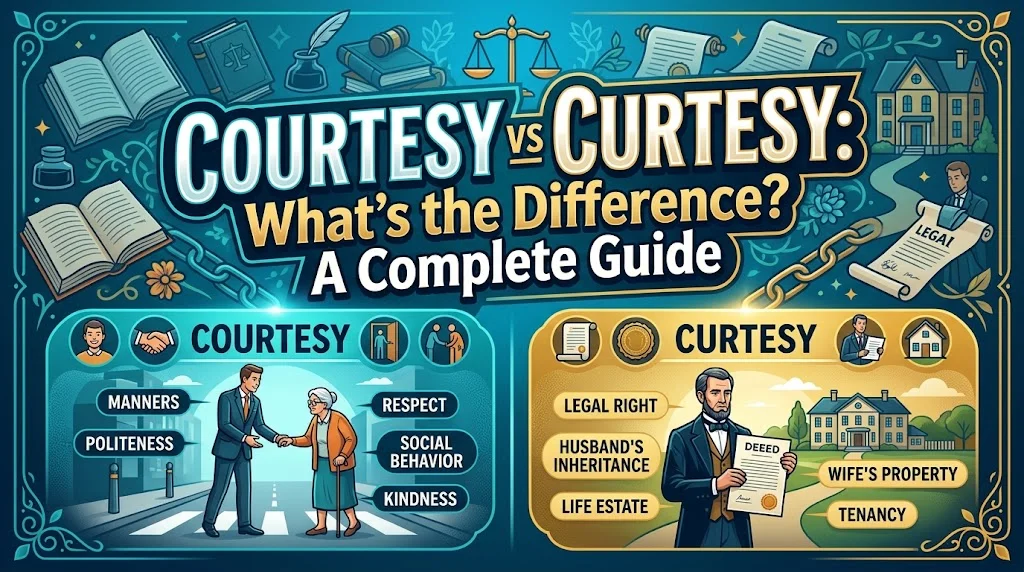
Courtesy vs Curtesy is a common spelling confusion because both words look and sound remarkably similar. However, they don’t have the same meaning or purpose. Courtesy is the standard word used in modern English for politeness, good manners, respect, consideration, and courteous behavior. You’ll see it in everyday conversations, professional emails, customer service, and phrases such as common courtesy, professional courtesy, and courtesy call.
Curtesy, on the other hand, is a genuine but uncommon historical legal term. It refers to a husband’s historical legal interest in certain property associated with his deceased wife. Because this meaning belongs mainly to English common law, historical property law, and legal history, most people rarely need to use the word.
Understanding the difference between these similar words, commonly confused words, and English spelling variations can help you avoid mistakes in both casual and professional writing. If you’re talking about polite behavior, respectful treatment, or a complimentary service, courtesy is almost certainly the word you need. If you’re discussing an old legal doctrine involving property rights, curtesy may be appropriate.
Once you understand the meaning behind each spelling, the courtesy vs curtesy difference becomes much easier to remember.
Courtesy vs Curtesy: Quick Answer
The simplest way to remember the difference is this:
Courtesy means politeness, consideration, respect, or a complimentary service.
Curtesy is a historical legal term concerning a husband’s property rights.
For example:
- Please show courtesy to the other guests. ✅
- The hotel provided a courtesy shuttle. ✅
- Thank you for your courtesy. ✅
- The historical document discusses curtesy rights. ✅
But if you write:
- Please show curtesy to the other guests. ❌
the spelling is incorrect because the intended word is courtesy.
Courtesy vs Curtesy at a Glance
| Word | Meaning | Modern Usage | Example |
| Courtesy | Politeness, respect, consideration, or a complimentary service | Very common | “She treated everyone with courtesy.” |
| Curtesy | Historical legal right or interest of a husband in his deceased wife’s property | Rare | “The text discusses the husband’s curtesy.” |
So, if you’re talking about good manners, choose courtesy.
If you’re reading a historical legal text about property rights, curtesy may be the correct term.
What Does “Courtesy” Mean?
Courtesy is a common modern English noun. Its central meaning involves treating other people with politeness, respect, and consideration.
When you act with courtesy, you recognize that other people deserve respectful treatment. That doesn’t necessarily mean you agree with them. It simply means you behave in a civil and considerate way.
For example:
He showed courtesy by allowing the elderly passenger to board first.
Here, courtesy describes considerate behavior.
The word also has another common meaning. In certain expressions, courtesy describes something offered free of charge as a favor or accommodation.
For instance:
The hotel offers a courtesy shuttle to the airport.
The shuttle isn’t necessarily a permanent public transportation service. The business provides it as a convenience for customers.
Courtesy Definition
According to its modern usage, courtesy can refer to:
- Polite behavior
- Respectful treatment
- Consideration for other people
- A polite gesture
- A favor or accommodation
- Something supplied without charge as a service or convenience
The exact meaning depends on context.
Consider these two sentences:
She thanked him for his courtesy.
Here, courtesy means polite or considerate behavior.
The dealership provided a courtesy car.
Here, courtesy describes a service or item supplied as a convenience.
The same word works in both situations because the underlying idea is consideration or accommodation.
Courtesy as Polite or Respectful Behavior
In everyday English, courtesy often describes good manners.
It can involve small actions that make social interaction smoother:
- Saying “please” and “thank you”
- Listening without interrupting
- Respecting someone’s personal space
- Holding a door open
- Responding to a message politely
- Giving someone an opportunity to speak
- Following agreed social rules
Courtesy doesn’t have to involve a grand gesture. Often, it’s the little things.
For example:
As a courtesy to the other passengers, please keep your phone volume low.
The sentence asks people to consider how their behavior affects others.
Another example:
She called ahead as a courtesy.
The call isn’t necessarily required. She made it because it was considerate.
Courtesy in Professional Communication
Professional environments rely heavily on courtesy.
A workplace can have clear rules and procedures. Yet communication still works better when people treat one another respectfully.
Courtesy can appear in:
- Emails
- Meetings
- Customer support
- Phone calls
- Business letters
- Workplace conversations
- Formal requests
- Follow-up messages
Compare these two messages:
Send the report today.
and:
Could you please send the report by the end of the day? Thank you.
Both communicate a request. The second uses a more courteous tone.
Courtesy doesn’t mean making every message excessively formal. In fact, overly elaborate language can sometimes make a simple request harder to understand.
Good professional courtesy usually means being clear, respectful, timely, and considerate.
Courtesy as a Free Service or Benefit
Courtesy can also describe something a company provides without charging the customer.
Common examples include:
- Courtesy shuttle
- Courtesy car
- Courtesy phone
- Courtesy ticket
- Courtesy service
- Courtesy call
For example:
The repair shop gave me a courtesy car while my vehicle was being serviced.
The vehicle is provided as a temporary convenience.
Another common construction is:
Courtesy of the management team, refreshments were provided.
In this context, courtesy of indicates who provided something or made it available.
Common Examples of Courtesy
Here are some natural examples:
- Thank you for your courtesy.
- Please show courtesy to other passengers.
- He called as a courtesy before arriving.
- The hotel offers a courtesy shuttle.
- Professional courtesy is important in customer service.
- She treated the visitor with courtesy and respect.
- The complimentary meal was provided courtesy of the restaurant.
Notice how naturally courtesy fits modern communication.
Read More: Coach vs Couch: What’s the Difference? Meaning, Pronunciation, Examples, and Easy Tips
What Does “Curtesy” Mean?
Curtesy is a real English word, but its meaning is much narrower.
It is primarily a historical legal term associated with property rights under English common law.
Historically, curtesy referred to a husband’s legal interest in certain property of his deceased wife, subject to particular conditions. The exact rules varied according to the legal system and historical period.
That means curtesy isn’t a misspelled version of courtesy when it appears in a genuine historical legal context.
However, most people don’t need the word in ordinary communication.
Curtesy Definition
In historical legal usage, curtesy refers to a husband’s recognized interest in certain real property belonging to his deceased wife.
The concept was associated with what is commonly called tenancy by the curtesy or tenant by the curtesy.
Historical versions of the doctrine could involve specific requirements. These included matters such as the wife’s ownership of qualifying land and, traditionally, the birth of a child capable of inheriting the property.
Because property law has changed substantially over time, the historical doctrine shouldn’t be treated as a description of ordinary modern marital property rights.
Curtesy in Historical English
You’re most likely to encounter curtesy when reading:
- Historical legal texts
- Old property-law materials
- Common-law discussions
- Historical documents
- Legal dictionaries
- Books about medieval or early modern English law
For example:
The treatise describes the husband’s right of curtesy after his wife’s death.
That sentence uses curtesy correctly because it discusses a historical legal doctrine.
Example Sentences With Curtesy
Here are examples that preserve the historical meaning:
The medieval legal text discusses tenancy by the curtesy.
The husband’s claim was examined under the old doctrine of curtesy.
The historian explains how curtesy operated under English common law.
These sentences are very different from everyday statements about politeness.
You wouldn’t normally write:
Thank you for your curtesy. ❌
If you mean politeness, the correct sentence is:
Thank you for your courtesy. ✅
Why Most People Rarely Need “Curtesy”
Modern readers generally encounter curtesy only in specialized historical or legal contexts.
That explains why many people assume it must simply be a spelling mistake. The word is unfamiliar because its specialized meaning rarely appears in everyday conversation.
Still, unfamiliar doesn’t mean incorrect.
English contains many specialized terms that are perfectly legitimate but rarely used outside their specific fields. Curtesy belongs in that category.
Courtesy vs Curtesy: Side-by-Side Comparison
The spelling difference is only one letter, but the meanings are far apart.
| Category | Courtesy | Curtesy |
| Part of speech | Noun | Noun |
| Main meaning | Politeness, consideration, or a complimentary service | Historical legal property interest |
| Everyday use | Common | Very rare |
| Business use | Common | Generally inappropriate unless discussing historical law |
| Social meaning | Yes | No |
| Complimentary service meaning | Yes | No |
| Historical legal meaning | No | Yes |
| Typical phrase | “common courtesy” | “tenancy by the curtesy” |
The Simple Rule to Remember
Use courtesy when you’re talking about:
- Manners
- Politeness
- Respect
- Consideration
- Complimentary services
- Professional behavior
Use curtesy only when you’re referring to its specific historical legal meaning.
A useful memory trick is:
Courtesy = considerate behavior. Curtesy = historical property law.
That’s enough to prevent most spelling mistakes.
Courtesy vs Curtesy Example Sentences
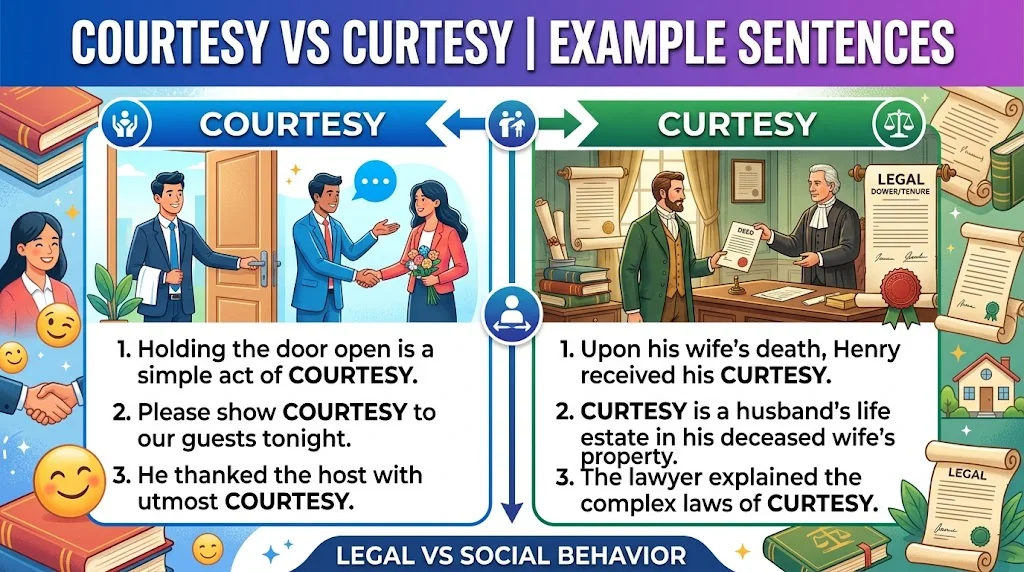
Seeing the words in context makes the difference much easier to remember.
Correct Examples With Courtesy
Common courtesy requires you to respect other people’s time.
She thanked the receptionist for the courtesy.
The airline provided a courtesy hotel room after the cancellation.
He called as a courtesy before visiting the office.
Please extend the same courtesy to your coworkers.
The hotel offers a courtesy shuttle for guests.
Each example uses courtesy in a modern sense.
Correct Examples With Curtesy
The legal historian examined the doctrine of curtesy.
The old statute addressed tenancy by the curtesy.
The property dispute involved a historical claim of curtesy.
Here, curtesy has a specialized legal meaning.
Incorrect Examples and Corrections
| Incorrect | Correct | Why? |
| Thank you for your curtesy. | Thank you for your courtesy. | The sentence means politeness. |
| Please show curtesy to guests. | Please show courtesy to guests. | The sentence concerns respectful behavior. |
| The company offers a curtesy shuttle. | The company offers a courtesy shuttle. | The shuttle is a complimentary service. |
| She acted with curtesy. | She acted with courtesy. | The intended meaning is polite behavior. |
The pattern is straightforward. When the context involves manners or consideration, spell it courtesy.
Why Do People Spell Courtesy as Curtesy?
The confusion isn’t surprising. English spelling often doesn’t perfectly match pronunciation.
When people hear a word rather than see it written, they may construct the spelling from the sounds they recognize.
Pronunciation Can Cause the Confusion
The pronunciation of courtesy doesn’t make every letter obvious.
In many varieties of English, the word is pronounced approximately:
KUR-tuh-see
That pronunciation can make the written sequence cour- less intuitive.
Someone unfamiliar with the spelling may naturally write:
curtesy
instead of:
courtesy
This is a classic example of why English spelling can’t always be predicted from pronunciation alone.
Similar-Looking and Similar-Sounding Words
English contains many words whose pronunciation and spelling don’t line up neatly.
Consider:
- because
- beautiful
- Wednesday
- colonel
- business
- necessary
You learn the conventional spelling through exposure, reading, and practice.
Courtesy works the same way.
The pronunciation doesn’t make curtesy an accepted modern spelling. The standard spelling remains courtesy.
Typing and Autocorrect Mistakes
Typing quickly can also create problems.
If you’re writing an email and type curtesy, a spell checker may flag it depending on the software and dictionary being used. However, specialized dictionaries can recognize rare words, which means context still matters.
Don’t rely entirely on spell check.
If a word looks unfamiliar, ask what you actually mean. Are you talking about politeness, or are you discussing historical property law?
That question usually solves the problem.
Courtesy vs Curtesy: Word Origins
The similarity between the two words has historical roots. Their relationship is more interesting than simply saying one is a typo.
Origin of Courtesy
Courtesy entered English through Anglo-French and Middle English forms connected with court and courtly behavior.
The word developed around ideas associated with behavior expected at court. Over time, its meaning broadened.
What once suggested refined or courtly behavior eventually became associated with politeness, good manners, consideration, and respectful conduct.
That semantic development explains why modern English uses courtesy in ordinary social situations.
The word eventually moved well beyond royal or aristocratic settings. Today, anyone can show courtesy.
Origin of Curtesy
Curtesy developed as a legal term connected with the historical doctrine of tenancy by the curtesy.
The doctrine belonged to the property-law framework of English common law. It concerned a husband’s historical rights in certain land associated with his wife after her death.
The term therefore developed within a very different semantic environment.
Although the words look similar, you shouldn’t treat them as interchangeable modern spellings.
Why Their Origins Matter
Understanding word history can make confusing vocabulary easier to remember.
Think of the distinction this way:
Courtesy developed into a broad word for social consideration.
Curtesy remained tied to a specialized historical legal concept.
Their similar appearance is therefore not enough to make them synonyms.
How to Use Courtesy Correctly
Knowing the definition is useful. Knowing how the word behaves in real sentences is even better.
Courtesy as a Noun
Courtesy is primarily used as a noun.
For example:
Her courtesy made the difficult conversation easier.
The noun refers to the quality or act of being considerate.
Another example:
He offered his courtesy to the visiting delegation.
The word can also appear in established phrases.
Common Phrases With Courtesy
Several expressions occur frequently in modern English.
Common Courtesy
Common courtesy means basic polite behavior that people generally expect from one another.
Holding the door for someone is a simple act of common courtesy.
Professional Courtesy
Professional courtesy refers to respectful conduct within a workplace or professional relationship.
The two doctors extended professional courtesy to each other.
Courtesy Call
A courtesy call is a call made as a polite gesture, often to provide information or maintain good communication.
The representative made a courtesy call before the meeting.
Courtesy Service
A courtesy service is a service provided as a convenience.
The hotel operates a courtesy service for airport transfers.
Courtesy of
Courtesy of can identify the person, organization, or source providing something.
The photographs were provided courtesy of the museum.
It can also introduce a person or organization responsible for making something available.
Out of Courtesy
This phrase means someone does something because it is considerate or polite.
She informed her neighbors out of courtesy.
Courtesy of vs. Courtesy From
These expressions can overlap, but they aren’t always used in exactly the same way.
Courtesy of is a well-established phrase that often identifies a provider or source:
The images are courtesy of the National Archives.
Courtesy from is less idiomatic in many contexts.
For example, instead of:
We received courtesy from the company.
a natural sentence would be:
The company extended us the courtesy of a late checkout.
The structure matters because courtesy commonly appears in fixed constructions.
Common Mistakes With Courtesy and Curtesy
The biggest mistake is simple: treating curtesy as another spelling of courtesy.
It isn’t.
Using Curtesy When You Mean Politeness
This mistake often appears in phrases involving manners.
Incorrect:
Please show curtesy to your guests.
Correct:
Please show courtesy to your guests.
The intended meaning is respectful behavior, so courtesy is required.
Treating Curtesy as an Alternative Spelling
Some people see curtesy in a dictionary and assume they can use it whenever they would use courtesy.
That’s not how specialized vocabulary works.
A dictionary may include a word because it has a legitimate historical meaning. That doesn’t make it a general-purpose synonym.
For example, a historical legal term can remain in dictionaries long after its everyday use has declined.
Choosing a Word Based Only on Pronunciation
Writing curtesy because that’s how courtesy sounds is understandable, but it isn’t standard spelling.
English contains plenty of spelling patterns that require memorization.
The best approach is to connect the spelling with a familiar word:
courtesy → courteous
The adjective courteous can help reinforce the spelling of courtesy.
Using Curtesy in Modern Business Communication
Imagine sending this sentence to a client:
Thank you for your curtesy and patience.
The intended message is clear, but the spelling is wrong.
Write:
Thank you for your courtesy and patience.
In professional writing, small spelling mistakes can distract readers from the message. That’s especially true when the incorrect spelling resembles a real but obscure word.
Courtesy in Everyday English
Courtesy isn’t merely a dictionary definition. It’s a word that appears throughout everyday communication.
Courtesy at Work
Workplace courtesy can include:
- Responding to messages within a reasonable time
- Respecting colleagues’ schedules
- Listening during meetings
- Giving credit for other people’s work
- Avoiding unnecessary interruptions
- Communicating disagreements respectfully
- Keeping shared spaces usable
Consider a meeting where someone disagrees with your proposal.
You can say:
That’s a terrible idea.
Or you can say:
I see the concern you’re addressing. Could we consider another approach?
The second version doesn’t hide disagreement. It expresses disagreement with greater courtesy.
Courtesy in Customer Service
Customer service relies heavily on courteous communication.
A customer may be frustrated because a product arrived late. A representative still needs to communicate clearly and respectfully.
For example:
I’m sorry about the delay. Let me check the order status and see what options are available.
That’s courteous without becoming excessively wordy.
Businesses also use courtesy in a different sense when they provide complimentary services.
Examples include:
- Courtesy transportation
- Courtesy calls
- Courtesy beverages
- Courtesy Wi-Fi
- Courtesy vehicles
Courtesy in Daily Life
Everyday courtesy often consists of small choices.
You might:
- Let someone merge into traffic
- Hold an elevator
- Lower your voice in a quiet place
- Return something you borrowed
- Say thank you
- Apologize after making a mistake
- Respect someone’s queue position
None of these actions requires a grand speech.
Courtesy is often quiet. That’s part of what makes it useful.
Courtesy vs Curtesy in Modern Writing

The context of your writing should determine which word you use.
Which Word Should You Use in Emails?
For ordinary emails, courtesy is almost certainly the correct choice.
Examples:
Thank you for your courtesy during our meeting.
As a courtesy, I’m sending the updated schedule ahead of time.
The company offers a courtesy shuttle for employees.
You wouldn’t normally use curtesy unless your email specifically discusses historical legal terminology.
Which Word Should You Use in Articles and Reports?
For general articles and reports, use courtesy when discussing politeness or complimentary services.
Use curtesy when the subject genuinely involves its historical legal meaning.
For example, a history article might say:
English common law recognized a doctrine known as tenancy by the curtesy.
That’s appropriate because the word has a precise historical meaning.
Which Word Is More Common?
Courtesy is vastly more relevant to modern everyday English.
You encounter it in ordinary conversations, business communication, customer service, signs, advertisements, and formal writing.
Curtesy, by contrast, belongs primarily to specialized historical and legal discussions.
This difference in usage is important. A rare word isn’t necessarily incorrect. It simply has a narrower domain.
Courtesy vs Curtesy: How to Remember the Spelling
A good memory trick should be simple enough to use when you’re typing quickly.
Use “Courtesy” for Modern Politeness
Associate courtesy with courteous.
Both words begin with:
cour-
For example:
- courteous behavior
- courteous response
- courtesy call
- common courtesy
That shared spelling can help reinforce the correct form.
Reserve “Curtesy” for Historical Legal Contexts
If you’re writing about medieval property law or historical common-law rights, stop and consider whether curtesy is the specialized term you need.
In ordinary writing, don’t choose it merely because it looks shorter.
A One-Line Memory Trick
Remember:
Courtesy is for courtesy and manners. Curtesy belongs to old legal terminology.
When the sentence involves politeness, use courtesy.
Courtesy vs Curtesy: Quick Practice
Try these sentences before looking at the answers.
Choose the Correct Word
1. Please show ___ to the other passengers.
2. The hotel offers a ___ shuttle to the airport.
3. The historical text discusses tenancy by the ___.
4. She thanked him for his ___.
5. The company made a ___ call before changing the appointment.
Answers
- courtesy
- courtesy
- curtesy
- courtesy
- courtesy
The pattern becomes obvious once you identify the context.
If the sentence involves politeness or a complimentary service, choose courtesy.
If it discusses the historical legal doctrine, curtesy may be correct.
A Practical Case Study: Correcting a Professional Email
Imagine a customer writes:
Thank you for your curtesy and quick response.
The reader can understand the message. However, the spelling is incorrect for the intended meaning.
The corrected version is:
Thank you for your courtesy and quick response.
Why?
Because the customer is thanking the recipient for polite or considerate treatment.
Now consider a completely different sentence:
The historian examined the doctrine of curtesy in medieval English property law.
Here, curtesy is appropriate because the sentence refers to its specialized legal meaning.
The lesson is simple:
Don’t judge these words by appearance alone. Identify the meaning first.
Frequently Asked Questions
Is It Courtesy or Curtesy?
For modern meanings involving politeness, respect, consideration, or complimentary services, the correct word is courtesy.
Curtesy is a separate historical legal term.
Is Curtesy a Real Word?
Yes. Curtesy is a legitimate English word with a specialized historical legal meaning.
It isn’t simply a common alternative spelling of courtesy.
Is Curtesy an Alternative Spelling of Courtesy?
No. In modern standard English, curtesy isn’t an alternative spelling for courtesy.
The two words have different meanings.
What Does Courtesy Mean?
Courtesy means polite, respectful, or considerate behavior. It can also describe something provided as a complimentary service or accommodation.
Examples include:
- common courtesy
- professional courtesy
- courtesy call
- courtesy shuttle
What Does Curtesy Mean?
Curtesy refers to a historical legal doctrine involving a husband’s interest in certain property associated with his deceased wife.
It is mainly encountered in historical property law and related legal writing.
Why Do People Spell Courtesy as Curtesy?
The pronunciation of courtesy can make its spelling less obvious. Someone who spells the word from sound may omit the ou.
The similarity between the two written forms also contributes to confusion.
Can I Use Curtesy in Business Writing?
Only if you’re discussing the historical legal concept.
If you’re thanking someone for politeness or describing a complimentary business service, use courtesy.
For example:
Thank you for your courtesy.
How Do I Remember the Correct Spelling of Courtesy?
Connect courtesy with courteous.
Both use the cour- beginning.
You can also remember:
Courtesy = manners. Curtesy = historical law.
Is Courtesy Always Related to Politeness?
No. Courtesy can also describe something provided as a favor or convenience.
For example:
The hotel provides a courtesy shuttle.
The word refers to a complimentary service rather than someone’s personal manners.
When Is Curtesy Correct?
Curtesy is appropriate when discussing its specific historical legal meaning, especially the old doctrine of tenancy by the curtesy.
It isn’t appropriate as a general substitute for courtesy.
Key Takeaways
The difference between courtesy vs curtesy becomes easy once you focus on meaning rather than spelling.
- Courtesy is the standard modern English word.
- Courtesy means politeness, respect, consideration, or a complimentary service.
- Curtesy is a legitimate but rare historical legal term.
- Curtesy isn’t simply another spelling of courtesy.
- Use courtesy in everyday, professional, and customer-service writing.
- Use curtesy when discussing its specific historical legal meaning.
- Common courtesy, professional courtesy, and courtesy call all use courtesy.
- Tenancy by the curtesy belongs to historical legal terminology.
The easiest rule is worth remembering: if you’re talking about good manners, write “courtesy.” If you’re discussing an old legal property doctrine, “curtesy” may be the word you need.

[…] Read More: Courtesy vs Curtesy: What’s the Difference? A Complete Guide […]