Choosing between Jobsite or Job Site may seem like a small spelling decision, but it can affect the clarity and consistency of your writing. Both forms appear in construction terminology, workplace communication, safety documentation, project management, and general business writing. So, which one should you use?
In most contexts, jobsite and job site refer to the same thing: a physical location where employees, contractors, or crews perform work. For example, a construction site, worksite, or project location may all describe a place where a specific job takes place. However, the preferred spelling can depend on your style guide, dictionary usage, industry standards, and the audience you want to reach.
Context also plays an important role. A physical job site is very different from an online job site, which may refer to an employment website or job board. That small space between “job” and “site” can sometimes change how readers interpret your sentence.
The good news is that you don’t need to overcomplicate the choice. Once you understand compound words, accepted usage, and the importance of writing consistency, choosing between Jobsite or Job Site becomes much easier. This guide explains the difference, correct usage, common mistakes, and practical examples.
Jobsite vs. Job Site: The Quick Answer
The difference between jobsite and job site usually comes down to spelling rather than meaning.
Both can describe a physical location where people perform work. For example:
- The crew arrived at the jobsite at 6:30 a.m.
- The crew arrived at the job site at 6:30 a.m.
In both sentences, the meaning is essentially the same. The reader understands that the crew went to the physical location where the work was taking place.
The real question isn’t always, “Which one is grammatically possible?”
Instead, ask:
- Which form does your preferred dictionary recognize or prefer?
- Does your employer have an editorial style?
- What spelling does your industry commonly use?
- Could the two-word form confuse readers in your specific context?
- Which spelling are you already using throughout the document?
That last point is easy to overlook. Consistency often separates polished professional writing from writing that feels stitched together.
Is “Jobsite” One Word or Two?
You will encounter both jobsite and job site in real-world writing.
English doesn’t have a universal rule stating that every compound noun must always appear as one word or as two separate words. Some compounds remain open. Others eventually become closed compounds. Still others use hyphens in particular grammatical situations.
Language can be a little messy. That’s part of the deal.
Consider how familiar terms can take different forms:
- workplace
- work site
- website
- job board
- database
- construction site
These examples show why writers can’t always rely on a simple formula.
Does the Spelling Change the Meaning?
Usually, no.
When you use either jobsite or job site to describe the physical location of a project or work activity, readers generally understand the same concept.
For example:
All contractors must complete the safety orientation before entering the jobsite.
The meaning is clear.
Now consider:
All contractors must complete the safety orientation before entering the job site.
Again, the meaning remains clear.
However, context can change how readers interpret “job site.” An online job site can mean a website that advertises employment opportunities. That’s why surrounding words matter.
Which Form Should You Use?
Use this simple hierarchy:
| Situation | Recommended Approach |
| Your organization has a style guide | Follow the organization’s preferred spelling |
| You’re writing for a publication | Follow its editorial style |
| You’re using a specific dictionary | Follow that reference |
| You’re writing technical or industry content | Check common terminology in that field |
| No rule applies | Choose one accepted form and use it consistently |
That’s the short version. The rest of the article explains why this approach works.
What Does “Jobsite” Mean?
Jobsite refers to a physical location where workers perform a particular job or project.
The term often appears in industries where employees work away from a permanent office or facility. Construction provides the most obvious example, but the word can also appear in engineering, utilities, maintenance, manufacturing, field services, and infrastructure projects.
A jobsite might include:
- A building under construction
- A road repair project
- A bridge project
- An industrial installation
- A utility repair location
- A maintenance area
- A temporary field operation
The size of the project doesn’t matter. A jobsite might cover several acres or consist of one small renovation area.
Jobsite Definition
In everyday usage, jobsite generally means:
A physical location where work connected to a specific job, project, contract, or assignment takes place.
The term often implies something temporary or project-specific.
For instance, a construction company may have a permanent headquarters, warehouse, and equipment yard. Each individual construction project, however, may have its own separate jobsite.
That distinction helps explain why the word feels especially natural in project-based industries.
Examples of “Jobsite” in Sentences
Here are several natural examples:
- Workers must wear appropriate protective equipment at the jobsite.
- The project manager visited the jobsite to inspect the completed foundation.
- Heavy rain delayed deliveries to the jobsite.
- The supervisor held the morning safety meeting at the jobsite entrance.
- Unauthorized visitors aren’t allowed on the jobsite.
- The company installed temporary lighting throughout the jobsite.
Notice how the word fits naturally into operational and technical communication.
When “Jobsite” Works Especially Well
The one-word spelling often feels particularly natural when you’re discussing an established project location repeatedly.
For example:
The jobsite opens at 7:00 a.m. All jobsite personnel must attend the morning briefing. Visitors must check in at the jobsite office.
That repeated terminology creates a compact, industry-focused style.
However, repetition still matters. If every sentence begins with jobsite, the writing can become clunky. You can vary the wording when the meaning remains clear:
- the project location
- the work area
- the site
- the construction area
Just don’t replace a technical term with a vague synonym when precision matters.
What Does “Job Site” Mean?
Job site is the two-word form of the same general concept.
It can refer to the physical location where employees, contractors, or other workers perform their duties.
For example:
The materials arrived at the job site before the installation crew.
In this context, job site clearly refers to a physical location.
Job Site Definition
When used to describe a physical workplace, job site means:
A place where a specific job, assignment, or project is being carried out.
The phrase appears in general business writing as well as technical documents.
You might see it in:
- Project reports
- Employee handbooks
- Contractor agreements
- Safety procedures
- Business emails
- Training materials
- Government documents
Examples of “Job Site” in Sentences
Here are several examples:
- Please report directly to the job site tomorrow morning.
- The inspector arrived at the job site shortly after lunch.
- Equipment must be secured before leaving the job site.
- The company posted updated safety notices around the job site.
- No employee may remove materials from the job site without authorization.
The meaning remains straightforward because the surrounding language provides context.
Why Writers Still Use the Two-Word Form
Compound words don’t all follow the same path.
Some English compounds eventually become closed:
- web site → website
- work place → workplace
Others continue to appear as separate words in many contexts.
Usage changes over time. Dictionaries update. Industries develop their own habits. Publishers choose house styles.
As a result, you shouldn’t assume that a one-word spelling automatically makes a term more modern or that a two-word spelling automatically makes it more formal.
Neither assumption holds true across English as a whole.
Why Are Both Spellings Used? Understanding Compound Words
The jobsite or job site debate exists because English compound words evolve.
A compound expression combines two or more words to create a concept. Sometimes the words remain separate. Sometimes writers add a hyphen. Sometimes the words merge into a single unit.
How Compound Words Evolve
Many compounds can appear in one of three forms:
| Form | Example | Description |
| Open compound | job site | Two separate words |
| Hyphenated compound | decision-making | Words connected by a hyphen |
| Closed compound | jobsite | Words written as one unit |
These categories don’t mean that every compound automatically moves from open to hyphenated to closed. English isn’t that tidy.
Instead, usage develops through dictionaries, publishers, industries, and everyday communication.
Why There Isn’t Always One Permanent Spelling
Several forces influence compound-word spelling.
Common usage plays a major role. As more people repeatedly use a form, dictionaries and publications may eventually recognize it.
Editorial standards matter too. A newspaper, university, company, or trade publication may establish its own preferred spelling.
Industry language can also influence terminology. Workers in construction may favor compact technical terms that appear frequently in reports, signage, safety procedures, and project documents.
Finally, regional and institutional variation can affect spelling preferences.
The result is straightforward: two forms can coexist.
Why “Jobsite” Feels Natural to Many Readers
The closed form jobsite follows a familiar pattern in English. Readers already recognize many workplace-related compounds written as single words.
That familiarity can make jobsite feel concise and efficient, especially in technical writing.
Still, familiarity isn’t the same as a universal grammar rule.
The best spelling depends on the authority governing your document.
Is “Jobsite” or “Job Site” More Correct?
Here’s where many articles oversimplify the answer.
Neither spelling automatically wins in every situation.
The better question is:
Which form best matches the standard, audience, and context of your writing?
The Grammar Answer
Grammar alone doesn’t provide a universal rule requiring one spelling.
Both forms can function as nouns describing a physical location where work occurs.
For example:
- The supervisor inspected the jobsite.
- The supervisor inspected the job site.
Both sentences follow normal English grammar.
The spelling choice is primarily a matter of accepted usage and style.
Dictionary and Reference Sources Matter
When accuracy matters, consult a reliable reference rather than relying on memory.
Useful authorities include major dictionaries and established editorial guides, such as:
- Merriam-Webster
- Cambridge Dictionary
- Oxford English Dictionary
- AP Stylebook
- The Chicago Manual of Style
Not every source treats every compound word in exactly the same way. That’s precisely why checking your required authority matters.
Consistency Matters More Than Random Switching
Imagine reading a safety document that says:
All workers must check in at the jobsite.
Then, two paragraphs later:
Smoking is prohibited throughout the job site.
Then, on the next page:
Visitors must remain inside the designated jobsite areas.
Nothing may be technically impossible about those spellings. Still, the switching can make readers wonder whether the writer intended different meanings.
Usually, that isn’t helpful.
Choose a preferred form. Then stick with it.
Jobsite vs. Job Site in Different Writing Contexts
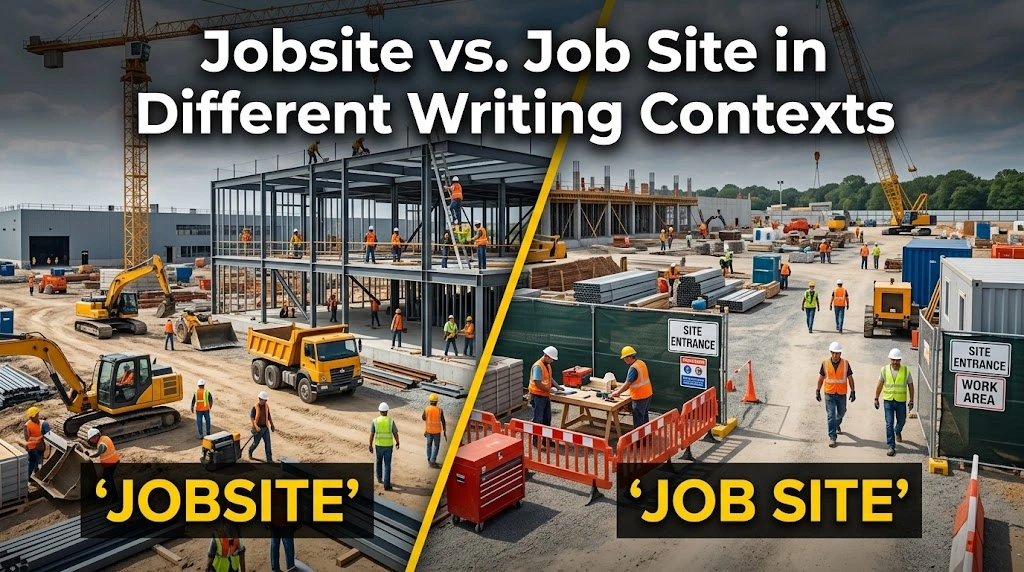
Context can influence which spelling feels most natural.
Jobsite in Construction and Trade Industries
Construction and field-based industries frequently use compact terminology.
In these environments, you may encounter jobsite in:
- Safety programs
- Project management software
- Equipment documentation
- Daily reports
- Training materials
- Contractor communications
For example:
All jobsite personnel must complete the required orientation before beginning work.
The term sounds direct and operational.
Job Site in General Professional Writing
The two-word form can fit naturally into ordinary business communication.
For example:
The manager will meet the contractor at the job site on Monday.
Nothing sounds awkward here.
If your audience doesn’t regularly use technical construction language, job site may feel more immediately familiar.
Jobsite or Job Site in Formal Documents
Formal doesn’t automatically mean one form is better.
Instead, formal documents should prioritize:
- Consistency
- Precision
- Compliance with required standards
- Clear definitions
- Audience expectations
A contract, safety policy, or technical manual should establish terminology and maintain it.
If necessary, define the term once:
For purposes of this policy, “Jobsite” means any location where employees perform work on behalf of the company.
After that, use the defined term consistently.
Jobsite vs. Job Site in Digital Content
Online content creates another consideration: search intent.
People search for both jobsite and job site. However, that doesn’t mean you should force both versions into every sentence.
That approach can make an article sound robotic.
Instead, use natural variations:
- jobsite
- job site
- worksite
- construction site
- project location
Use each term where it genuinely fits.
Good SEO starts with useful language. Keyword stuffing is a dead end.
Read More: Ight Meaning in Text: What Does “Ight” Mean?
When “Job Site” Can Mean Something Different
The phrase job site can occasionally create ambiguity.
Why?
Because job site may also describe a website related to employment.
Physical Job Site vs. Job-Search Website
Compare these examples:
Workers must report to the job site by 7:00 a.m.
This clearly refers to a physical location.
Now consider:
She found several openings through an online job site.
This refers to a website where people search for employment opportunities.
Context does the heavy lifting.
| Phrase | Likely Meaning |
| Construction job site | Physical work location |
| Job site safety rules | Physical workplace |
| Visit the job site for inspection | Physical location |
| Online job site | Employment website |
| Popular job-search site | Employment platform |
| Post the position on a job board | Employment platform |
How Context Prevents Confusion
Readers interpret words based on nearby language.
Words such as these usually signal a physical location:
- workers
- equipment
- safety
- inspection
- construction
- contractor
- materials
On the other hand, these words suggest an employment website:
- online
- listings
- applications
- vacancies
- careers
- job search
- employers
Better Alternatives When Ambiguity Exists
If readers could misunderstand your meaning, use a more precise term.
Instead of:
We found the information on a job site.
Try:
We found the information on an employment website.
Or instead of:
The accident occurred at the job site.
Try:
The accident occurred at the construction site.
Precision beats cleverness every time.
Jobsite vs. Worksite vs. Workplace vs. Construction Site
These terms overlap, but they don’t always mean exactly the same thing.
Choosing the right word can make your writing sharper.
Jobsite
A jobsite usually refers to a specific location connected to a particular job, assignment, or project.
Example:
The electrical crew returned to the jobsite after the inspection.
Worksite
A worksite generally refers to a place where work takes place.
The term can be broader than jobsite.
For example:
The company conducted a safety assessment at each worksite.
A company with multiple facilities may describe all of them as worksites.
Workplace
A workplace can refer to the physical environment where people work. It can also describe the broader professional environment or culture.
For example:
The company promotes a respectful workplace.
That sentence doesn’t refer to one specific project location.
Construction Site
A construction site specifically refers to a location where construction work occurs.
If the project involves building, demolition, renovation, excavation, or similar activity, this term may provide the greatest precision.
How to Choose the Right Term
| If You Mean… | Consider Using… |
| A specific project location | Jobsite or job site |
| A general place where work happens | Worksite |
| A broader professional environment | Workplace |
| An area where construction occurs | Construction site |
| A website for employment opportunities | Job board or employment website |
The best word is the one that gives readers the clearest picture.
How to Choose Between “Jobsite” and “Job Site”
You don’t need to flip a coin.
Use a practical decision process.
Check the Meaning First
Ask yourself what you’re describing.
Is it:
- A construction project?
- A temporary work location?
- A general workplace?
- An employment website?
Once you know the exact meaning, the right vocabulary becomes easier to choose.
Check Your Style Guide
If you’re writing for an employer, client, publication, or school, check its style requirements.
This matters particularly in:
- Legal documents
- Government materials
- Safety manuals
- Academic work
- Corporate communications
- Published content
Don’t override an established editorial standard just because another spelling looks better to you.
Consider Your Audience
A construction professional may immediately recognize jobsite.
A general audience may find job site equally clear.
Think about who will read the content.
The goal isn’t to impress readers with terminology. The goal is to communicate without friction.
Choose One Primary Form
If no style guide applies, choose the spelling that best fits your content.
Then use it consistently.
For example, if you select jobsite, keep that spelling throughout:
- jobsite safety
- jobsite inspection
- jobsite access
- jobsite procedures
You don’t need to repeat the word excessively. Just avoid unnecessary switching.
Avoid Random Changes
Search-and-replace errors can create inconsistencies quickly.
Before publishing, use your editor’s search function to review both forms:
- Search jobsite
- Search job site
Then decide whether each occurrence follows your chosen style.
A two-minute review can save a surprisingly embarrassing cleanup later.
Common Mistakes When Using Jobsite or Job Site
Several mistakes appear frequently in professional and online writing.
Assuming the Two Forms Have Completely Different Meanings
In most physical workplace contexts, they don’t.
The spelling usually represents variation in compound-word treatment.
Don’t invent a distinction that readers and authoritative references don’t support.
Mixing Both Spellings Randomly
This is probably the most common problem.
For example:
The jobsite manager conducted an inspection. Later, the job site was closed due to weather.
Unless you intentionally mean two different things, choose one style.
Confusing a Physical Location With a Job-Search Website
This sentence creates ambiguity:
I found the information on a job site.
Does that mean a physical workplace or an employment platform?
Rewrite it.
Capitalizing the Term Unnecessarily
In normal sentences, jobsite and job site are common nouns.
Write:
The workers arrived at the jobsite early.
Don’t write:
The workers arrived at the Jobsite early.
Capitalization makes sense in titles, headings, or official names when required.
Using a Hyphen Automatically
Don’t assume job-site is necessary simply because two words work together.
Hyphenation has specific style and grammatical uses. When in doubt, consult the style guide you’re following.
Jobsite and Job Site Examples in Real-World Writing
Examples make the distinction easier to understand.
Construction Examples
- The crane operator inspected the jobsite before beginning work.
- The project manager scheduled a safety meeting at the jobsite.
- Deliveries must enter through the designated jobsite gate.
- Workers cleared the job site before the concrete pour began.
- The inspector documented several hazards at the job site.
Each version can communicate the same basic meaning.
Business Communication Examples
Email example:
Please meet the installation team at the jobsite at 8:00 a.m.
Project update:
Work at the jobsite continued despite the morning rain.
Internal memo:
Employees must follow all posted safety procedures while on the job site.
Technical and Safety Documentation
Consistency becomes especially important in technical writing.
Consider this short example:
All jobsite personnel must wear required protective equipment. Before entering the jobsite, workers must complete the daily check-in procedure. Supervisors must report any jobsite hazards immediately.
The terminology remains consistent and easy to scan.
When Another Term Works Better
Sometimes neither jobsite nor job site offers the best level of precision.
For example:
The company improved its jobsite culture.
That phrase could work, but workplace culture may better express the intended meaning.
Likewise:
The accident occurred at the jobsite.
If the location specifically involves building activity, construction site may provide more detail.
Choose accuracy over habit.
A Simple Style Guide for Using “Jobsite” or “Job Site”
Use this checklist whenever you’re unsure.
Choose “Jobsite” When:
- Your industry commonly uses the closed compound.
- Your company or publication prefers jobsite.
- You’re writing repeatedly about a specific project location.
- The one-word form matches the terminology used elsewhere in the document.
Choose “Job Site” When:
- Your required style guide prefers the open form.
- Your organization already uses job site.
- The two-word version better matches the surrounding terminology.
- Your audience is more familiar with the open compound.
Use Another Term When:
- You mean a general workplace.
- You specifically mean a construction site.
- You mean an employment website.
- Job site could create confusion.
Best practice: Follow an authoritative style when one applies. If no standard controls your writing, choose a clear form and stay consistent.
Quick Comparison: Jobsite or Job Site?
The table below provides the fast version.
| Question | Answer |
| Is jobsite used as one word? | Yes |
| Is job site also used as two words? | Yes |
| Do they usually refer to the same physical location? | Yes |
| Does grammar universally require one form? | No |
| Should a style guide control the choice when available? | Yes |
| Should you randomly switch between forms? | No |
| Can “job site” refer to an employment website? | Yes, depending on context |
| Should the term usually be capitalized? | No |
| Is “construction site” sometimes more precise? | Yes |
| Is consistency important? | Absolutely |
Case Study: Why Consistency Matters in Construction Writing
Imagine a contractor preparing a 30-page safety manual.
On page three, the document says:
All employees must wear approved footwear at the jobsite.
On page twelve:
Smoking is prohibited anywhere on the job site.
Then, near the end:
Supervisors must inspect the Jobsite before each shift.
The reader can still understand every sentence. However, the document now contains three different treatments:
- jobsite
- job site
- Jobsite
That inconsistency can create unnecessary questions.
Did the company intentionally distinguish between them?
Does capitalization signal a defined term?
Was the document assembled from multiple sources?
A consistent style avoids those distractions.
A Better Approach
Before writing the manual, the company establishes:
Preferred term: jobsite
The document then uses that form consistently.
| Inconsistent Version | Consistent Version |
| jobsite safety | jobsite safety |
| job site inspection | jobsite inspection |
| Jobsite access | jobsite access |
| jobsite hazards | jobsite hazards |
This doesn’t just improve appearance. It makes terminology easier to search, standardize, and maintain across documents.
That’s especially useful for organizations that manage policies, training materials, forms, reports, and digital records.
Quick Checklist: Jobsite or Job Site?
Before you publish, ask yourself:
- What does the term mean in this sentence?
- Am I describing a physical work location?
- Could readers mistake “job site” for an employment website?
- Does my employer or client have a style guide?
- Does the publication require a specific editorial standard?
- Have I checked a reliable dictionary or reference source?
- Am I using the same spelling consistently?
- Would “worksite,” “workplace,” or “construction site” be more precise?
If you can answer those questions clearly, you’re unlikely to make a serious usage mistake.
Frequently Asked Questions About Jobsite vs. Job Site
Is Jobsite One Word or Two Words?
Both jobsite and job site appear in English usage. The preferred form can depend on the dictionary, style guide, industry, or organization you’re writing for.
Is “Jobsite” a Real Word?
Yes. Jobsite is used as a compound term for a physical location where work takes place, particularly in construction and other field-based industries.
However, because reference works and editorial standards can differ in their treatment of compound words, you should follow the authority that governs your specific document.
Is “Job Site” More Formal Than “Jobsite”?
Not necessarily.
A two-word spelling isn’t automatically more formal, and a one-word spelling isn’t automatically less professional. The correct choice depends on the editorial and industry context.
Which Spelling Is More Common in Construction?
Jobsite frequently appears in construction and project-based writing. Still, usage varies between companies, publications, regions, and style systems.
The safest professional choice is to follow the terminology used by the relevant organization or industry authority.
Should You Use “Jobsite” in Professional Writing?
You can use jobsite when it matches your organization’s style, your industry’s terminology, or your chosen reference standard.
For formal documents, consistency matters as much as the initial spelling choice.
What Is the Difference Between a Jobsite and a Worksite?
A jobsite often refers to a location associated with a particular project or job.
A worksite generally describes any location where work takes place and may have a broader meaning.
The exact distinction can vary by industry and organization.
What Is the Difference Between a Jobsite and a Workplace?
A jobsite usually refers to a specific physical project location.
A workplace can refer to a broader physical work environment or even the organizational environment itself.
For example, workplace culture describes relationships and conditions within an organization. You generally wouldn’t call that jobsite culture unless you’re discussing a specific project environment.
Can “Job Site” Mean a Website Where People Search for Jobs?
Yes.
Context determines the meaning.
An online job site usually refers to an employment website. A construction job site, on the other hand, refers to a physical place where construction work happens.
Should “Jobsite” Be Capitalized?
Usually, no.
Use lowercase in ordinary sentences:
The workers arrived at the jobsite before sunrise.
Capitalize the term when normal title capitalization rules apply or when it forms part of an official name or formally defined term.
Can You Use Both Spellings in the Same Article?
You can, but you generally shouldn’t switch between them randomly.
An article discussing the spelling difference can naturally use both forms because the comparison requires it. Once you choose a preferred spelling for ordinary usage, however, maintain that choice throughout the rest of the document.
Final Verdict: Jobsite or Job Site?
So, should you write jobsite or job site?
For a physical place where a particular job or project takes place, both forms can be used. The difference usually involves spelling preference and editorial convention rather than a dramatic difference in meaning.
The smartest approach is simple:
- Check the meaning first.
- Follow your required style guide.
- Consult a reliable dictionary or language authority when necessary.
- Consider your industry and audience.
- Use a more specific term when context demands it.
- Choose one spelling and remain consistent.
If you’re writing construction, engineering, field-service, or project documentation, jobsite may fit naturally within the terminology your readers already use. If your organization or publication prefers job site, follow that standard instead.
The goal isn’t to win a spelling argument.
It’s to write clearly enough that your reader never has to stop and wonder what you mean.
And in professional writing, that’s usually the job worth doing.